Ghana Agribusiness PlaybookCashew
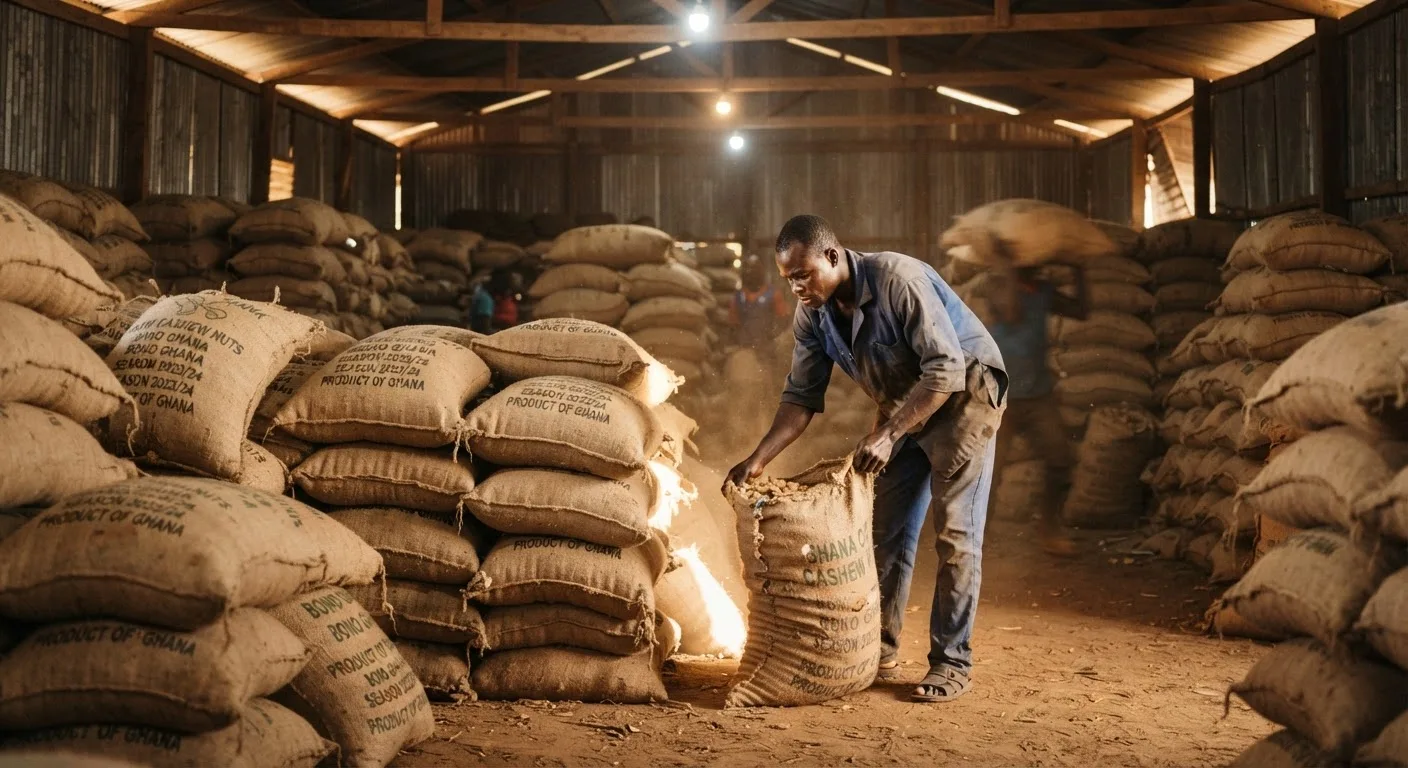
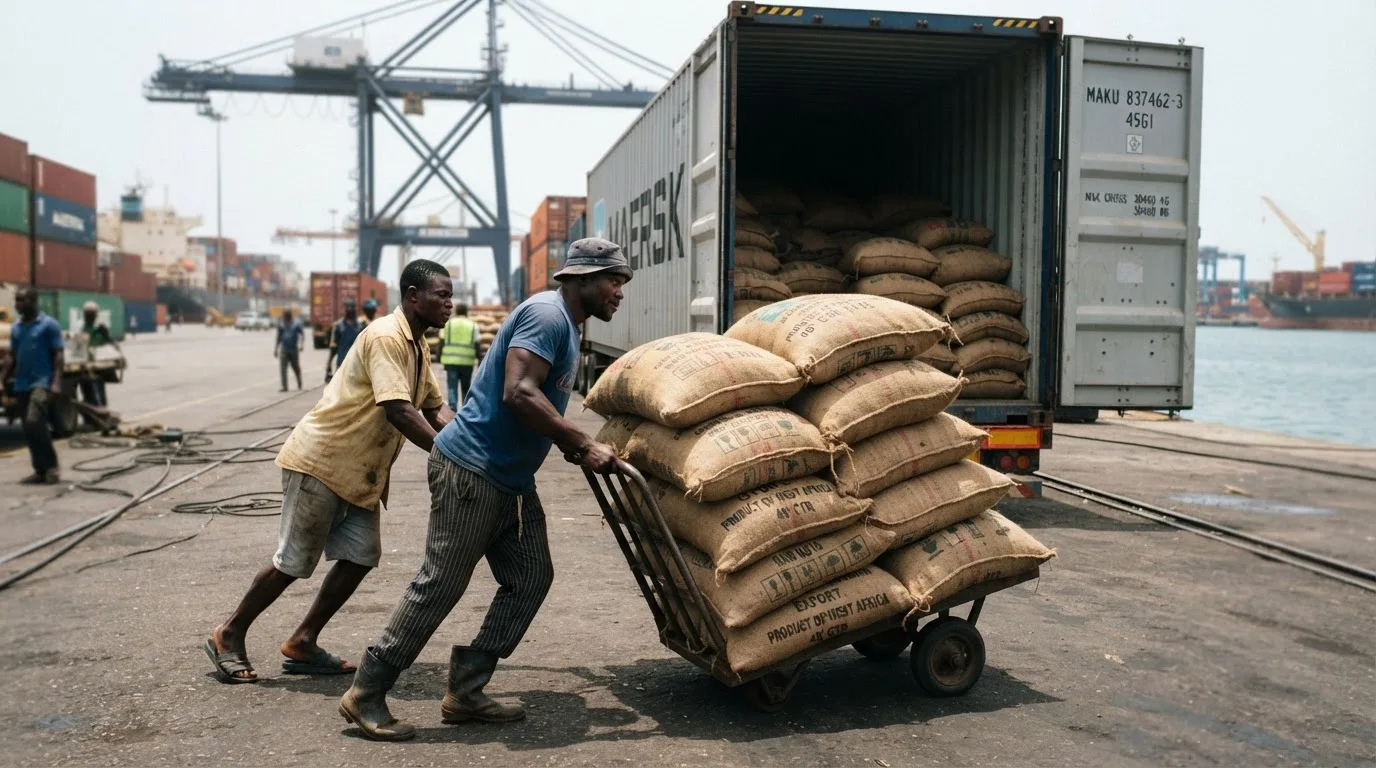
Jute sacks of raw cashew nuts stacked at a Ghanaian aggregation shed, graded and bagged for export
Cashew · Pillar 02

Demand, Markets, Trade and Prices

Ghana is one of the world's biggest sellers of raw cashew and one of its smallest sellers of finished cashew. It grows the crop and ships it east, and the value is added somewhere else.
Demand, Markets, Trade and Prices · Pillar 02

Ghana is one of the world's biggest sellers of raw cashew and one of its smallest sellers of finished cashew. It grows the crop and ships it east, and the value is added somewhere else.

This pillar reads the market as it is: who buys Ghana's cashew, what sets the price, and where the demand and the premiums that Ghana does not yet capture actually sit. Cashew earned Ghana about US$297.6 million in 2025, up about 10.15 percent on the year, making it Ghana's largest agricultural non-traditional export earner (Ghana Export Promotion Authority, 2026), yet almost all of it leaves the country as a raw nut.

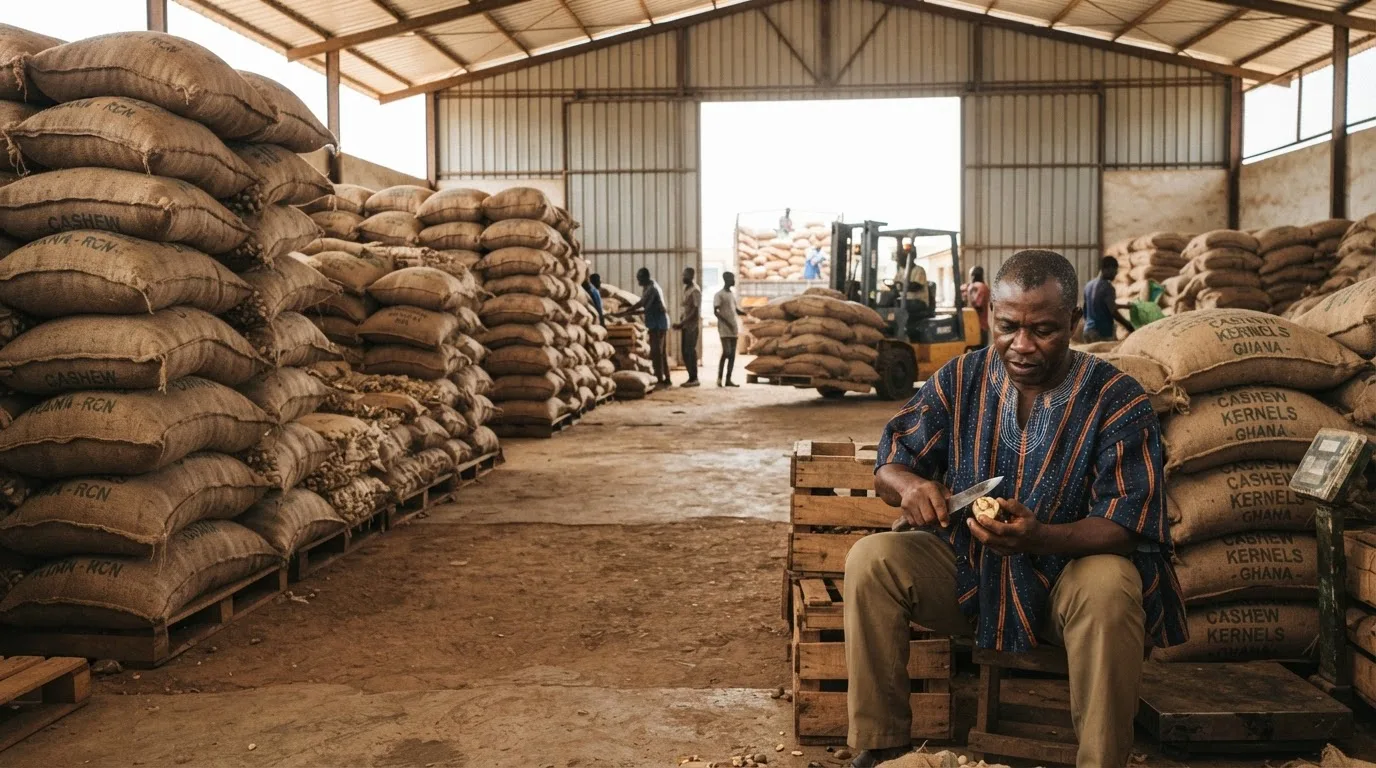
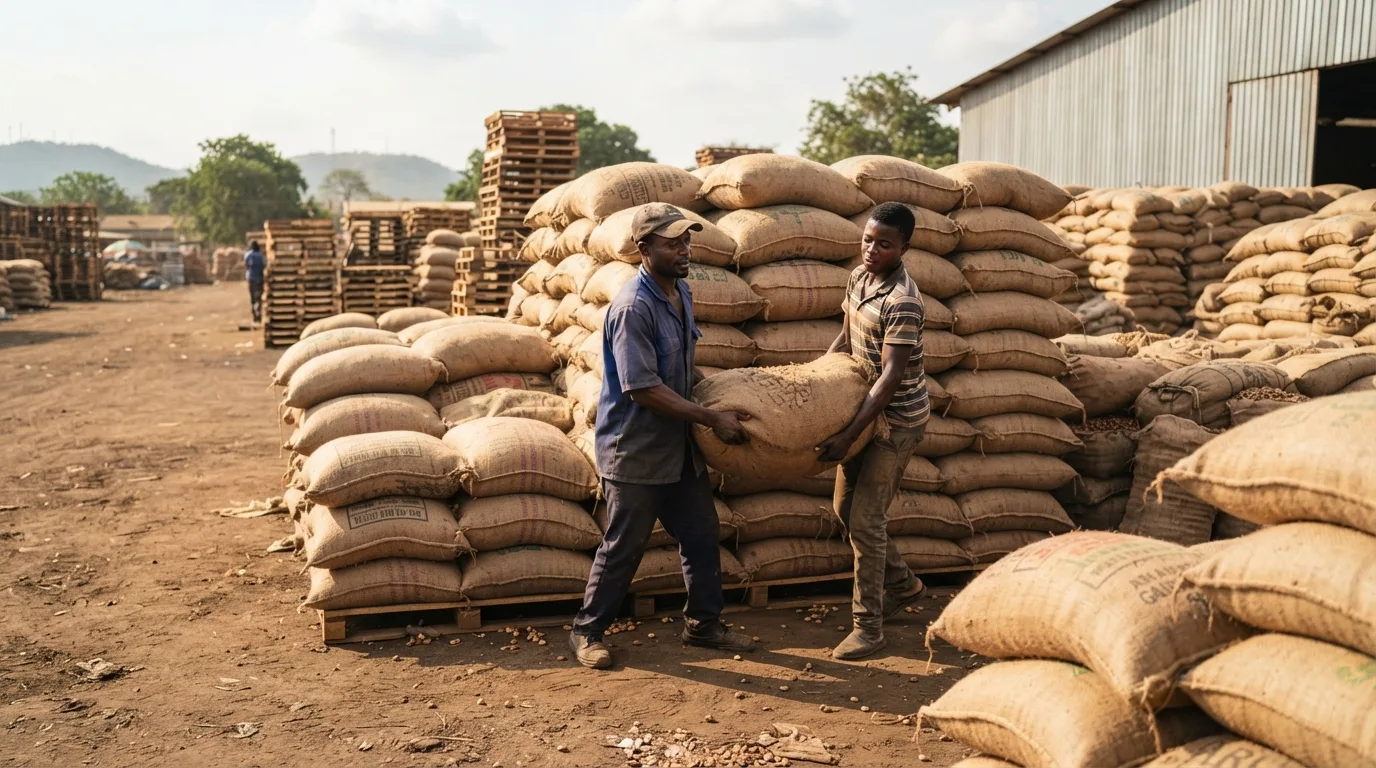
Raw cashew nuts dried and bagged for export, the form in which Ghana sells most of its crop
Ghana sells the crop raw and ships it east
The form Ghana sells: raw cashew nuts, dried and bagged for export.
US$297.6 m
cashew exports in 2025, Ghana's largest non-traditional agricultural earner
~90%
of the raw cashew nuts are shipped unshelled
~95%
of the raw nuts go to India, Vietnam and the UAE

🌰 Ghana sells the cheap form, others sell the dear one 🌰

On volume, Ghana is the third-largest raw cashew nut exporter in the world (International Trade Centre, 2024). Yet almost all of that is raw nuts: about 90 percent of the raw cashew nuts are exported unshelled (IMANI Africa; trade reporting, 2025 to 2026), mainly to India, Vietnam and the United Arab Emirates, which together take about 95 percent of the raw nuts (trade data (IndexBox), 2026). The country sells the cheapest form of the product and lets others sell the expensive form.

That flow is not an accident of geography. India and Vietnam together buy about 98 percent of the world's raw cashew nuts and re-sell the kernels to Europe and the United States (UNCTAD, 2020). Western Africa grows most of the crop but processes very little of it, so the value that leaves Ghana as a raw nut comes back to the region as an expensive branded kernel. Every tonne shelled and graded at home keeps that margin in Ghana.

3rd
largest raw cashew nut exporter in the world, by volume
~90%
of the raw nuts leave Ghana unshelled
~98%
of the world's raw crop is bought by India and Vietnam
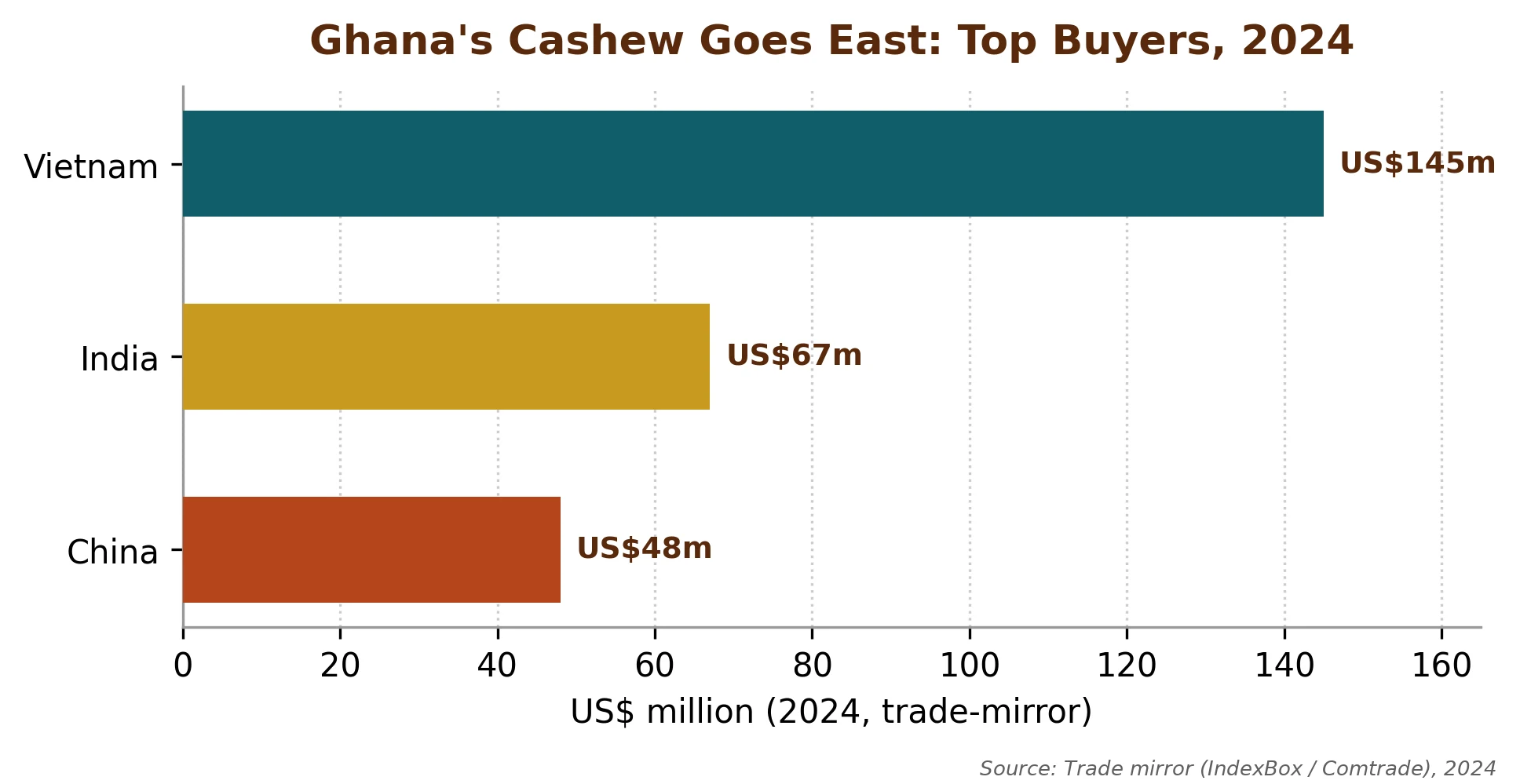
Ghana's cashew flows east to be processed: India, Vietnam and the UAE take about 95 percent of the raw nuts
Figure 2.1 Ghana's cashew flows east to be processed: India, Vietnam and the UAE take about 95 percent of the raw nuts

International Trade Centre (2024); IMANI Africa and trade reporting (2025 to 2026); trade data, IndexBox (2026); UNCTAD (2020).

What this shows

Being the third-largest raw exporter but a tiny processed exporter is the whole opportunity in one sentence. India, Vietnam and the UAE take about 95 percent of Ghana's raw nuts, and the kernels are then re-sold to Europe and the United States at several times the price.

4 to 5x
more per tonne for a kernel than for the raw nut Ghana sells
~85%
of Ghana's smallholder supply is chemical-free, ideal for the organic niche

What this means. The value that leaves Ghana as a raw nut comes back to the region as an expensive branded kernel. Western Africa grows most of the world's cashew but captures little of its profit, because the shelling, grading and branding happen in Asia. The opening is not to grow more nuts; it is to keep the next step of the chain, shelling and grading, at home, where the margin is.

🌰 Where the demand is: a growing, quality-led market

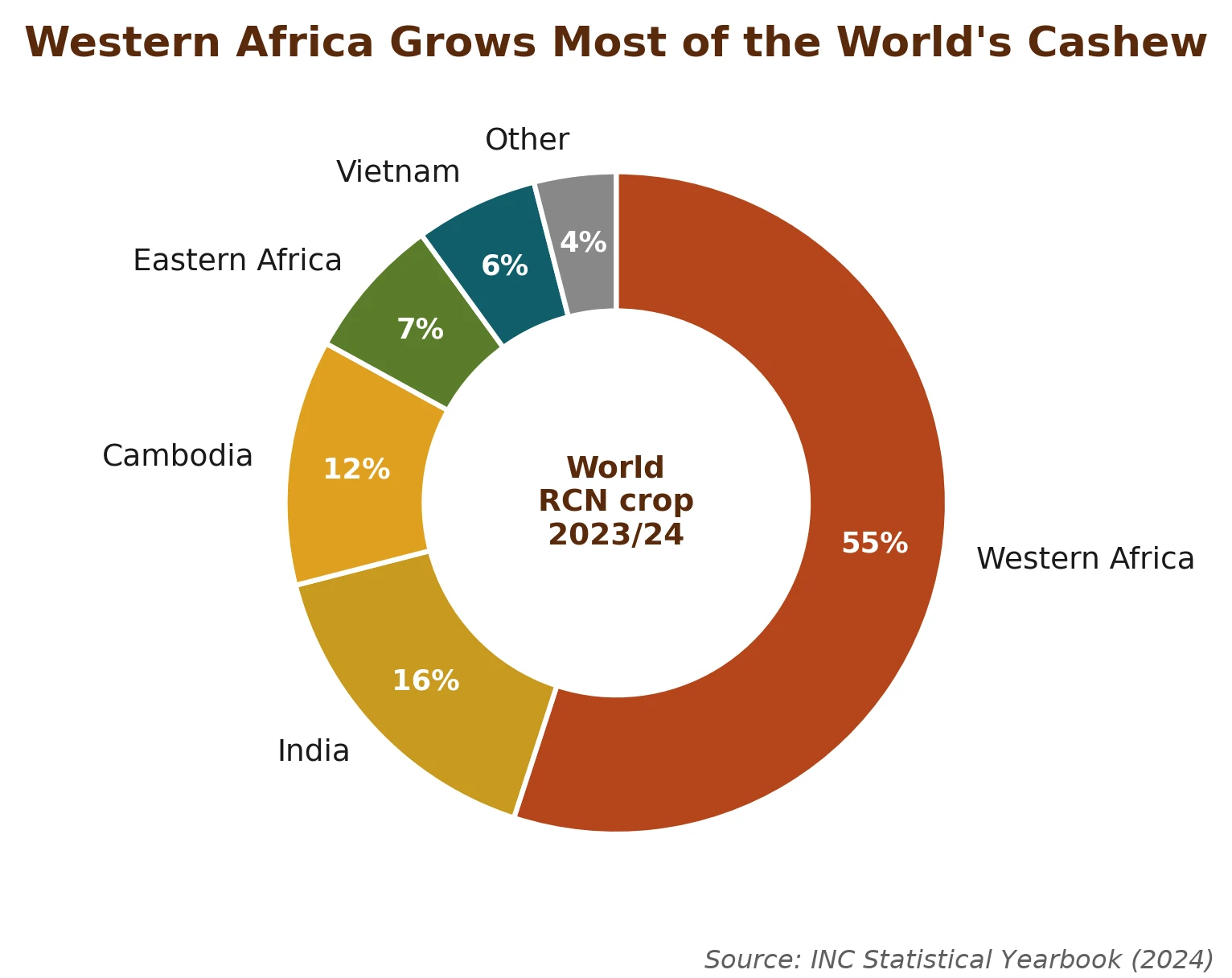
Western Africa grows most of the world's cashew, but the processing and the profit sit in Asia
Figure 2.2 Western Africa grows most of the world's cashew, but the processing and the profit sit in Asia

International Nut and Dried Fruit Council (2024); CBI (2026); African Cashew Alliance (2025).

What this shows

Western Africa grows most of the world's cashew, but the processing and the profit sit in Asia. The demand is growing at about 5 percent a year and it is shifting toward certified, traceable, African-origin kernels.

Cashews on sale in a Ghanaian market, the growing local and regional demand a domestic processor can reach
A growing consumer-food market
Not a shrinking commodity: demand up about 5 percent a year, and quality-led.

Cashew has become one of the world's largest tree-nut crops, second only to almonds by production share in 2023/24, with output rising at about 5 percent a year (International Nut and Dried Fruit Council, 2024). The biggest buyers are India, the largest consumer, then the United States and, in Europe, Germany. European demand is dynamic, driven by healthy-snacking and plant-based eating, and African origins are gaining European share (CBI, 2026).

This is not a shrinking commodity market; it is a growing consumer-food market that pays for quality, safety and story. Two demand shifts favour a Ghanaian processor. First, buyers increasingly want certified, traceable and sustainable kernels, and African origins are gaining European share fast: Cote d'Ivoire went from under 3 percent to about 13 percent of EU kernels between 2020 and 2024. Second, trade tensions over Asian supply, including proposed United States tariffs on Vietnamese and Indian cashew, could hand African kernels a cost advantage in the large United States market where Africa is barely present (African Cashew Alliance, 2025; CBI, 2026).

~5%
a year: the rate global cashew output and demand are rising
under 3% to 13%
Cote d'Ivoire's share of EU kernels, 2020 to 2024
2nd
only to almonds by tree-nut production share in 2023/24

MARKET SIGNAL: THE FASTEST-GROWING DEMAND WANTS EXACTLY WHAT GHANA CAN SUPPLY. Two demand shifts favour a Ghanaian processor. Buyers increasingly want certified, traceable and sustainable kernels, and African origins are winning European share fast, while trade tensions over Asian supply could open the large United States market where Africa is barely present. A processor who can certify and grade at home is selling into a market that is growing and actively looking for exactly what Ghana can supply.

🌰 What sets the price: the farm-gate formula and the world market 🌰

The Tree Crops Development Authority set a minimum farm-gate price of GH¢12.00 a kilogram for the 2025/26 season (Tree Crops Development Authority, December 2025), down from GH¢15 a kilogram the previous season (Tree Crops Development Authority, 2024/25). The price is not arbitrary. It is worked back from a reference free-on-board price of about US$1,400 a tonne (Tree Crops Development Authority, 2025/26), at a kernel outturn of 48 and a nut count of 180, converted at a six-month average of about GH¢11.02 to the dollar, which gave an indicative GH¢11.16 that stakeholders rounded up to GH¢12. Trade press called the move from GH¢15 a 20 percent cut; the Authority disputes that framing, pointing out that GH¢12 sits above the formula value (Business and Financial Times, 2026; Ecofin Agency, 2026).

The bigger price problem is enforcement and quality. Some aggregators paid as little as GH¢8 to 10 a kilogram in parts of the 2024/25 season, below the price floor (Business and Financial Times, 2024 to 2025), and a wet December harvest pulled quality down to a realised kernel outturn ratio of about 42 (Business and Financial Times, 2025 to 2026), below the 46 target, which drags the price the crop can command. On the world market, raw nuts trade at about US$1,000 to 1,700 a tonne (African Cashew Alliance; market reports, 2025) while premium kernels fetch about US$7,500 to 8,400 a tonne (APEDA, 2025).

GH¢12/kg
minimum farm-gate price set for the 2025/26 season, down from GH¢15
US$1,400/t
reference free-on-board price the floor is worked back from
GH¢8 to 10
a kilogram some aggregators paid, below the 2024/25 floor
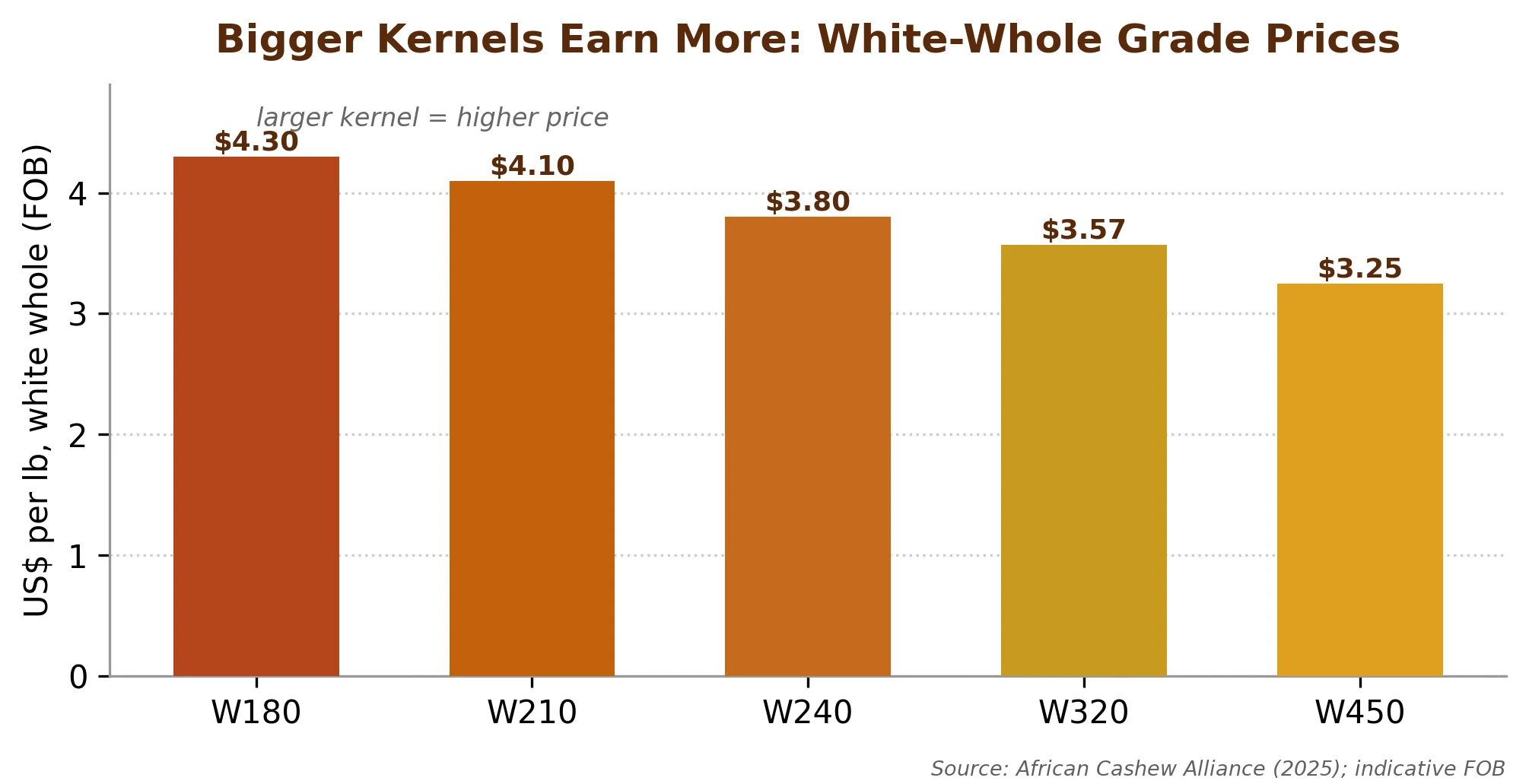
Bigger, whiter, whole kernels earn more: the grade ladder from W180 down to splits and pieces
Figure 2.3 Bigger, whiter, whole kernels earn more: the grade ladder that rewards careful processing

UNCTAD (2020); CBI (2026); APEDA (2025).

What this shows

Bigger, whiter, whole kernels earn more: the grade ladder that rewards careful processing. White wholes, from W180 the largest down to W450, sit at the top, then scorched grades, then splits, butts and pieces.

Graded white whole cashew kernels, the form that earns four to five times the raw-nut price
Four to five times the raw price
The dear form: graded white whole kernels, W240 to W320.
US$1,000 to 1,700/t
what raw nuts trade at on the world market
US$7,500 to 8,400/t
what premium kernels fetch: the spread Ghana gives away

MARKET SIGNAL: A PRICE-TAKER ON RAW, BUT A PREMIUM PAYER ON PROCESSED. The price data carry one clear message: Ghana is a price-taker on a raw commodity, but the market pays a large, reliable premium for processed, certified, well-graded kernels. Ghana's roughly 85 percent chemical-free, smallholder supply is ideal raw material for exactly the organic and sustainable segment that is growing fastest and paying most. The gap is not demand; it is processing, certification and market access.

🌰 The quality gate: grades, outturn and food safety 🌰

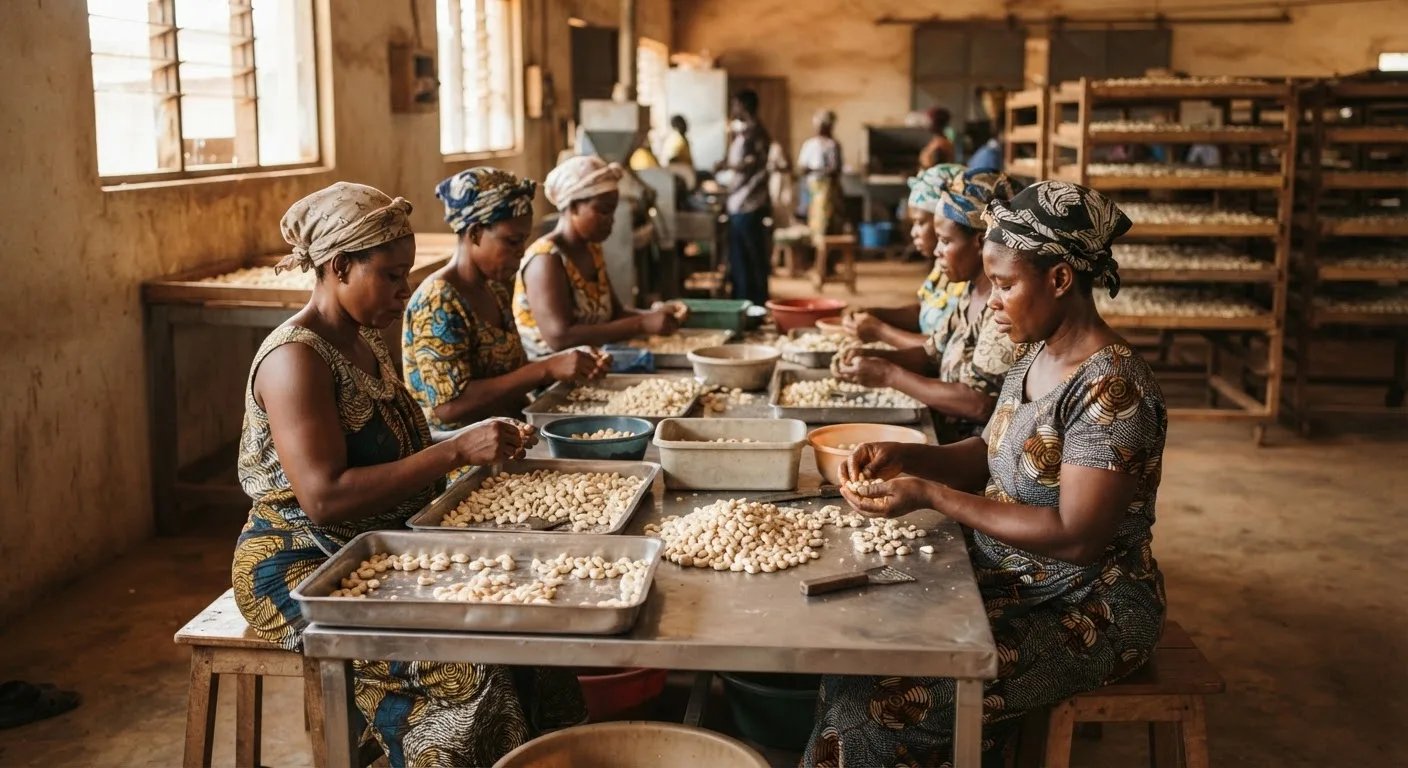
Inside a Ghanaian cashew processing unit, women at a long steel bench shelling and hand-grading white cashew kernels into trays by size and colour, drying racks of pale kernels behind them, dust motes in shafts of daylight from high windows, warm earthy tones, documentary photograph, natural light, no text overlay, no watermark
Where the margin is captured
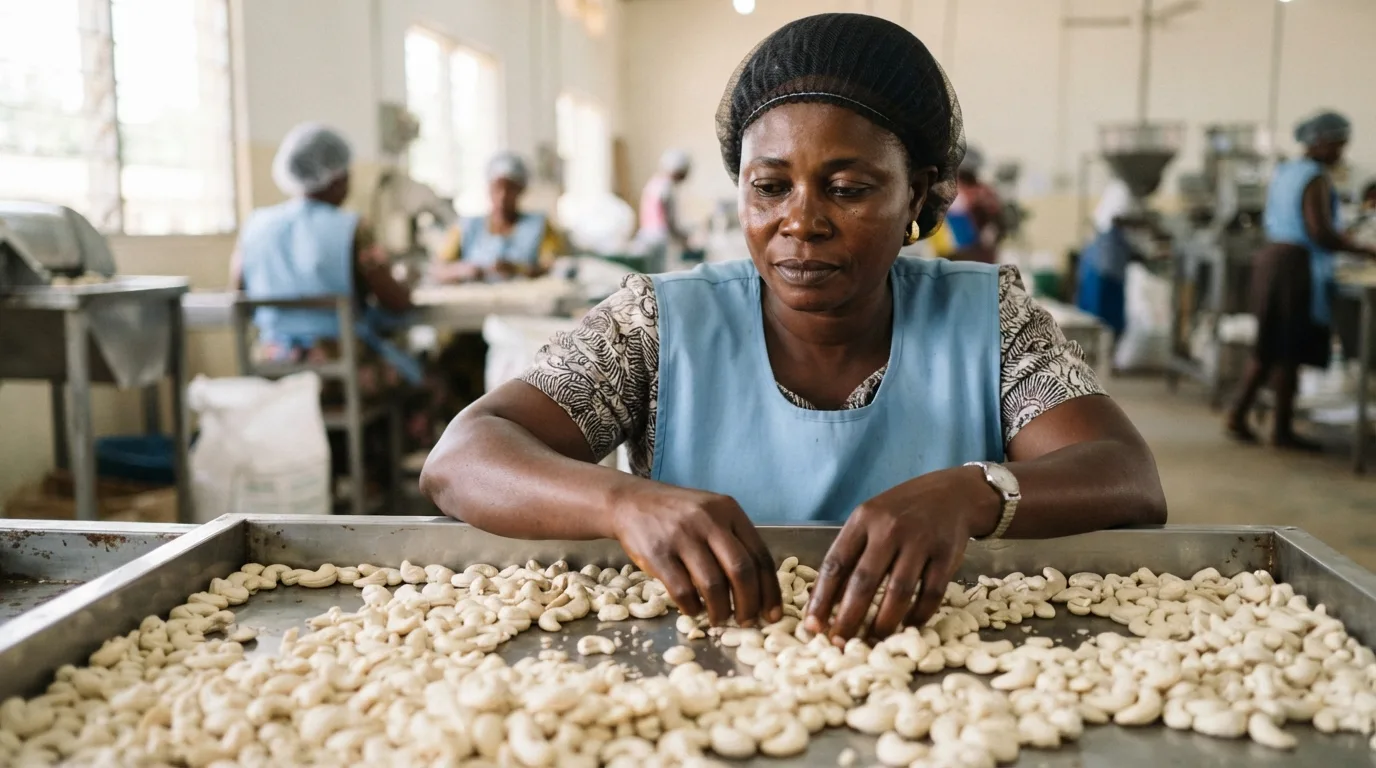
Shelling and grading at home is where the raw-to-kernel margin is captured, and where the food-safety gate is either passed or failed.

Cashew is priced on measurable quality. Raw nuts are judged on kernel outturn, the kernel weight per 80 kilogram bag, nut count, the nuts per kilogram where fewer means bigger, and moisture, no more than about 9 to 10 percent. Kernels are then graded by size and colour: white wholes, from W180 the largest down to W450, then scorched grades, then splits, butts and pieces. The larger and whiter the whole kernel, the higher the price (UNCTAD, 2020; CBI, 2026).

For the European and United States markets there is a hard safety gate on top of grade. Buyers require food-safety certification such as BRCGS or FSSC 22000, and strict aflatoxin limits, with aflatoxin B1 no more than 5 micrograms a kilogram in the EU. A single failure can mean rejection: European buyers rejected a West African organic cashew consignment for aflatoxin as recently as December 2021 (CBI, 2026). Meeting this gate is not optional; it is the entry ticket to the high-price shelf.

5 µg/kg
EU aflatoxin B1 limit: a single failure can mean rejection
9 to 10%
the moisture ceiling a raw nut is judged against
48 vs 42
target outturn against the wet-harvest realised ratio in 2024/25

What this means. Grade and safety are not paperwork; they are the price. A well-graded, aflatoxin-clean, certified kernel reaches the EUR 12 to 28 a kilogram retail shelf, while an ungraded, uncertified nut is stuck at the raw-commodity floor. The same crop earns a very different price depending only on whether Ghana passes the quality gate, so the gate is the business, not an afterthought to it.

🌰 Timing the market: the lean-season price peak 🌰

Ghana's harvest runs from about February to June, and there are no dedicated year-round raw-nut traders, so the market is intensely seasonal. Prices across the world tend to peak in the July to October lean season, when supply is low and festive demand in India and China is high (APEDA, 2025).

This seasonality is a business problem and a business opportunity. A farmer or aggregator who can store dried nuts safely, or a processor who can buy and hold a year's raw material, can sell into the higher-price window instead of dumping at harvest. The buyer who times the sale captures the lean-season premium the harvest scramble gives away.

Feb to Jun
Ghana's cashew harvest window, when the market floods
Jul to Oct
the lean season, when world prices tend to peak
A warehouse of jute-sacked, dried raw cashew nuts held in store to sell into the lean-season price peak
Store now, sell into the peak
Safely dried and stored raw nuts let a seller wait for the July to October lean-season price peak.
🌰 Opportunity: four demand-side openings 🌰
01

A branded domestic roasted-kernel line. Local demand already outstrips local kernel supply, and packaged kernels sell into Ghanaian supermarkets, hotels and the regional AfCFTA market, a nearby buyer that needs no aflatoxin certificate to reach.

02

Certified smallholder groups. Certify farmer groups for EU organic and Fairtrade to earn the 15 to 25 percent premium on an under-supplied niche that Ghana's roughly 85 percent chemical-free supply is already built for.

03

Fill the food-safety and grading gap. Aflatoxin control and W-grading are the entry ticket to EU and United States buyers, so a testing and grading service sells the one thing that unlocks the high-price shelf.

04

Sell direct to roasters. Supply European and United States roasters directly to cut out the raw-nut middleman entirely and hold the kernel margin at home.

🌰 The value staircase, from raw nut to retail shelf 🌰

Put the price data end to end and the value staircase is stark. Ghana sells at the bottom step, the raw nut, and the market pays four to five times more for a graded kernel and more again for a certified organic one. The table below reads the staircase from what Ghana sells to what the market pays.

The cashew price staircase
Table 2.1: The cashew price staircase, from what Ghana sells to what the market pays
SegmentTypical price (2025)What it means for Ghana
Raw cashew nut (RCN)US$1,000 to 1,700 / tWhat Ghana sells today, at the world commodity floor
Kernel, premium whole (W240 to W320)US$7,500 to 8,400 / tFour to five times more per tonne than the raw nut
EU retail, roasted and packagedEUR 12 to 28 / kgThe branded end Ghana never reaches
Organic / Fairtrade kernel+15 to 25% premiumAn open, under-supplied niche on top of the kernel price

Sources: African Cashew Alliance and market reports (2025); APEDA (2025); CBI (2026); UNCTAD (2020).

🌰 Opportunity: the open field 🌰
01

Capture the raw-to-kernel spread. The staircase is the opening: the businesses that win will shell, grade, certify and brand at home rather than ship the raw nut, and they will time their sales into the July to October lean-season peak rather than the harvest glut.

🌰 The risks that sit inside the market 🌰

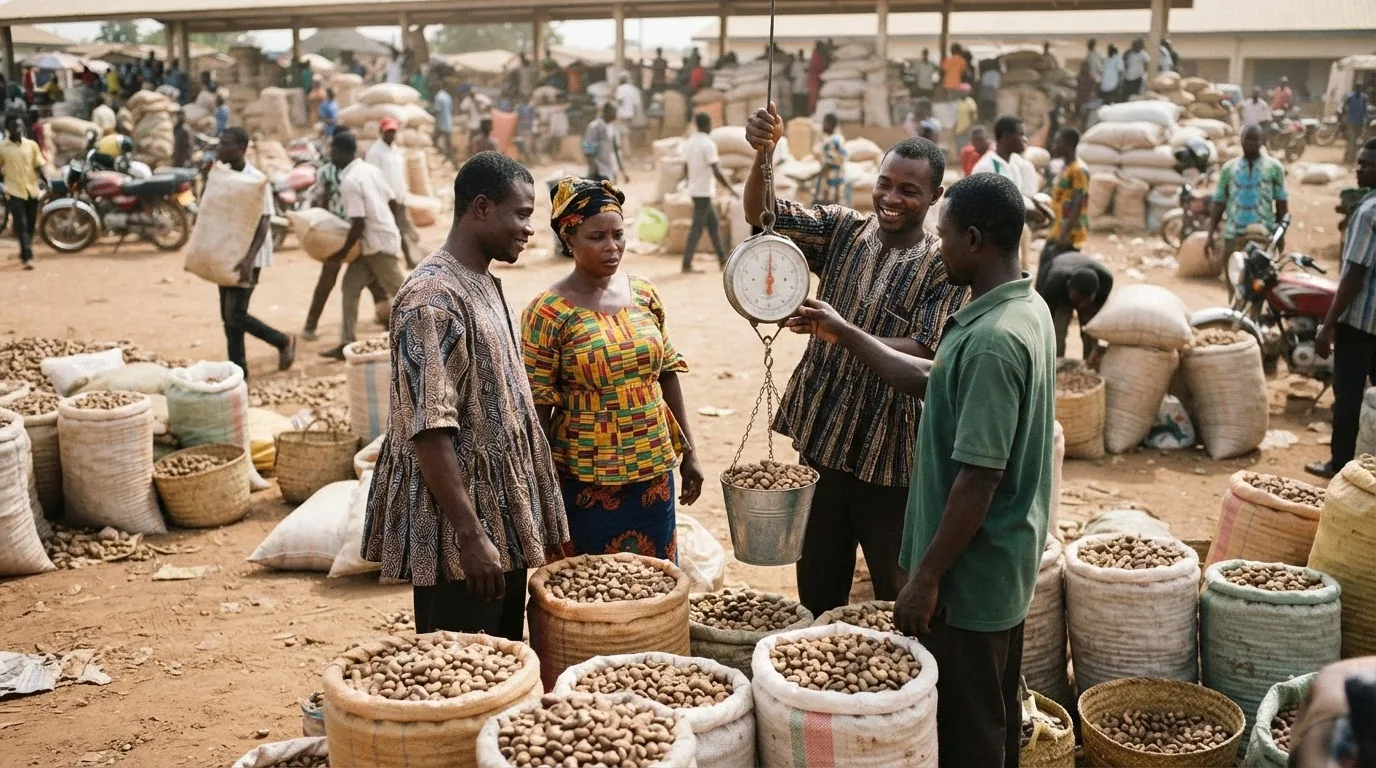
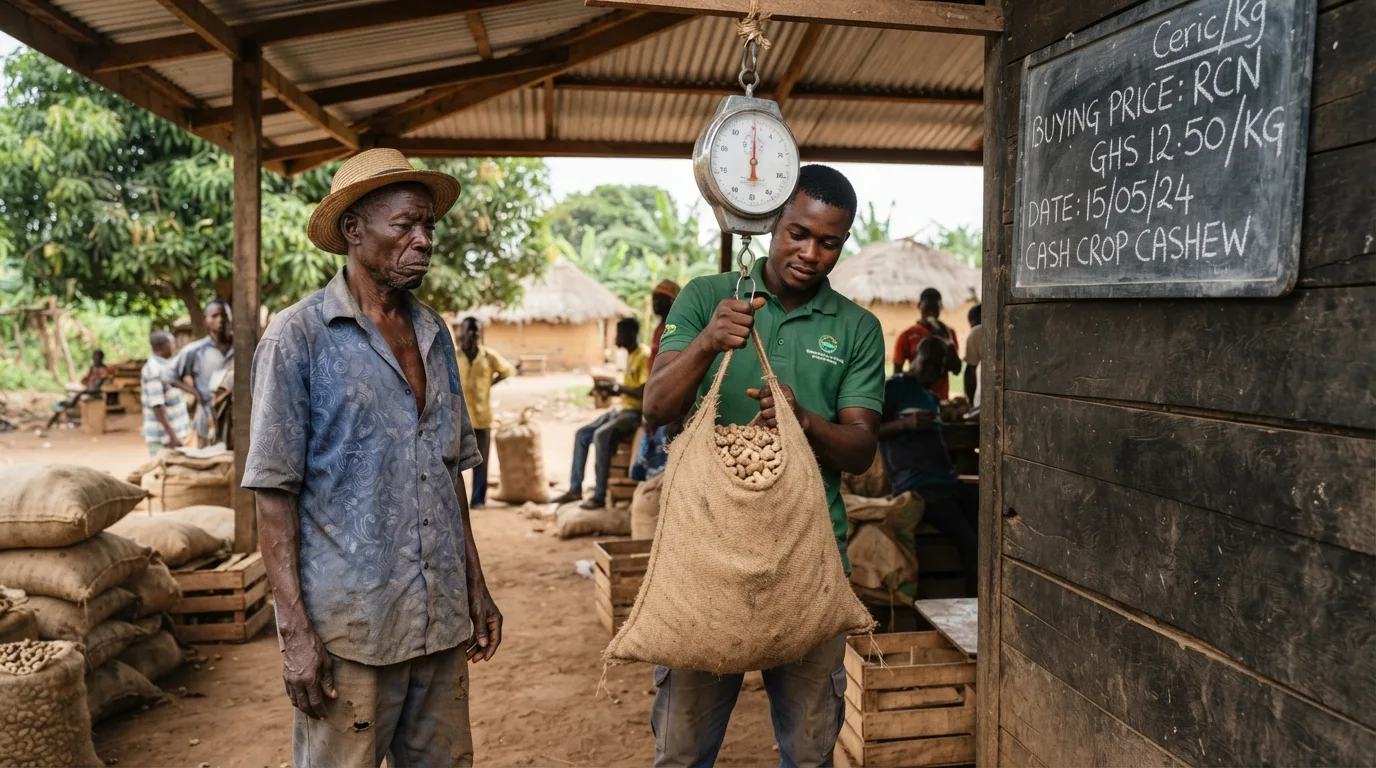
A trader weighing sacks of raw cashew nuts at a buying point, taking a world price set far away in Asia
Selling raw is taking the world's price

Competing on the raw price as a price-taker

HIGH
What it is

Selling raw nuts means taking a world price you cannot influence, set by Asian buyers and swung by weather and tariffs. The raw nut sits at the bottom of the value staircase, so the farmer or trader carries all the volatility and captures none of the premium above it.

Evidence

Raw nuts trade at about US$1,000 to 1,700 a tonne while kernels fetch four to five times more, about US$7,500 to 8,400 a tonne (African Cashew Alliance; APEDA, 2025).

Who it hits

Farmers and traders with no processing or differentiation, whose whole income is the raw commodity price.

How to manage it, and the opening

Move up the ladder: shell, grade, certify and brand, or lock a premium contract with a named buyer. The asymmetry that hurts the raw seller is itself the opening, because the four-to-five-fold spread is captured margin for whoever takes the next step.

Almost all of Ghana's raw cashew loaded for two destinations, India and Vietnam, a single point of failure
Two buyers, one point of failure

Depending on two buyers

MEDIUM-HIGH
What it is

Almost all of Ghana's cashew goes raw to India and Vietnam, so a slowdown, a tariff shift or a bad season in either market hits the whole sector at once. A crop concentrated on two destinations has no fallback when either one buys less.

Evidence

India, Vietnam and the United Arab Emirates take about 95 percent of the raw nuts (IndexBox, 2026), and India and Vietnam alone buy about 98 percent of the world's raw crop (UNCTAD, 2020).

Who it hits

Exporters and aggregators exposed to a single destination, and the farmers who supply them.

How to manage it, and the opening

Diversify into direct kernel sales to EU and United States roasters, and into the domestic and regional AfCFTA market. The opening is buyer diversification, which also moves Ghana up the value ladder at the same time.

🌰 Key takeaways 🌰
01

Ghana earns about US$297.6 million from cashew, almost all of it raw, and is the third-largest raw cashew nut exporter in the world while remaining a tiny processed exporter.

02

India, Vietnam and the United Arab Emirates take about 95 percent of the raw nuts, so a slowdown or tariff shift in Asia hits the whole sector at once.

03

Kernels are worth four to five times more a tonne than raw nuts, and certified organic kernels more again, so the value Ghana gives away sits in shelling, grading and certification, not in weak demand.

04

The demand is growing at about 5 percent a year and it is quality-led, shifting toward certified, traceable, African-origin kernels that Ghana's chemical-free smallholder supply is built for.

05

The businesses that win will shell, grade, certify and brand at home, and time their sales into the July to October lean-season peak rather than the harvest glut.

Where this connects

The kernel premium this pillar identifies is only winnable if the processing and value-addition economics make shelling and grading at home profitable, and if the post-harvest handling and quality work can hold moisture, outturn and aflatoxin inside the limits that open the EU and United States shelf. The certification, finance and policy environment, where the farm-gate floor is set and where group organic and Fairtrade certification is funded, shapes whether the premiums read here are captured at home or given away as a raw nut.

Written for each reader

🌰 Practitioner intelligence 🌰

Hover any card to pause and lift it.

For students

If you are thinking of entering, do not trade raw nuts against well-funded exporters; start as a quality-grading and market-information service. Learn to run a moisture meter and a kernel-outturn cut-test, and sell farmers and small buyers the grade knowledge that lets them claim the right price. The trap is assuming the farm-gate price is fixed; it moves with outturn, moisture and season, and the person who can prove quality captures that gap, which is your skill and your entry.

For entrepreneurs

First move: pick one buyer channel and build to its exact specification, a branded domestic roasted-kernel line for Ghanaian supermarkets, or certified kernels for a named European importer. Secure that buyer's grade, packaging and food-safety requirement in writing before you invest in a roaster or a pack line. The trap is producing an ungraded, uncertified product and finding no premium buyer will touch it; the EU aflatoxin limit and GFSI certification are pass-or-fail gates, not nice-to-haves.

For investors

Diligence asks: which specific buyer and grade is the venture selling to, and is there a signed offtake; does it hold the food-safety certification the target market requires; and how exposed is it to a single destination and to price swings. The thesis is capturing the four-to-five-fold raw-to-kernel spread and the organic premium, not selling raw. Tie disbursement to secured certification and a signed offtake, and size the deal against price volatility rather than a headline margin.

For faculty

Assignment: give students the price staircase, raw nut, kernel, roasted, retail, and the W-grade price table, and ask them to calculate the value captured at each stage per kilogram of raw nut and identify where Ghana loses most. Deliverable: a value-capture waterfall chart with a short note recommending which stage to enter. It teaches value distribution and why raw export is a strategic choice, not a necessity.

For ecosystem actors

The lever is to build the quality and certification infrastructure that unlocks premium markets: fund aflatoxin-testing labs, group organic and Fairtrade certification for smallholders, and a national grading standard enforced at buying points. Measure success by the share of exports that are graded and certified and by the volume qualifying for the EU premium. The failure to avoid is spending on production volume while the quality gate stays shut, so the extra nuts still leave raw and cheap.
Download full PDF
UpcomingThis document isn't available yet.