Ghana Agribusiness PlaybookCashew
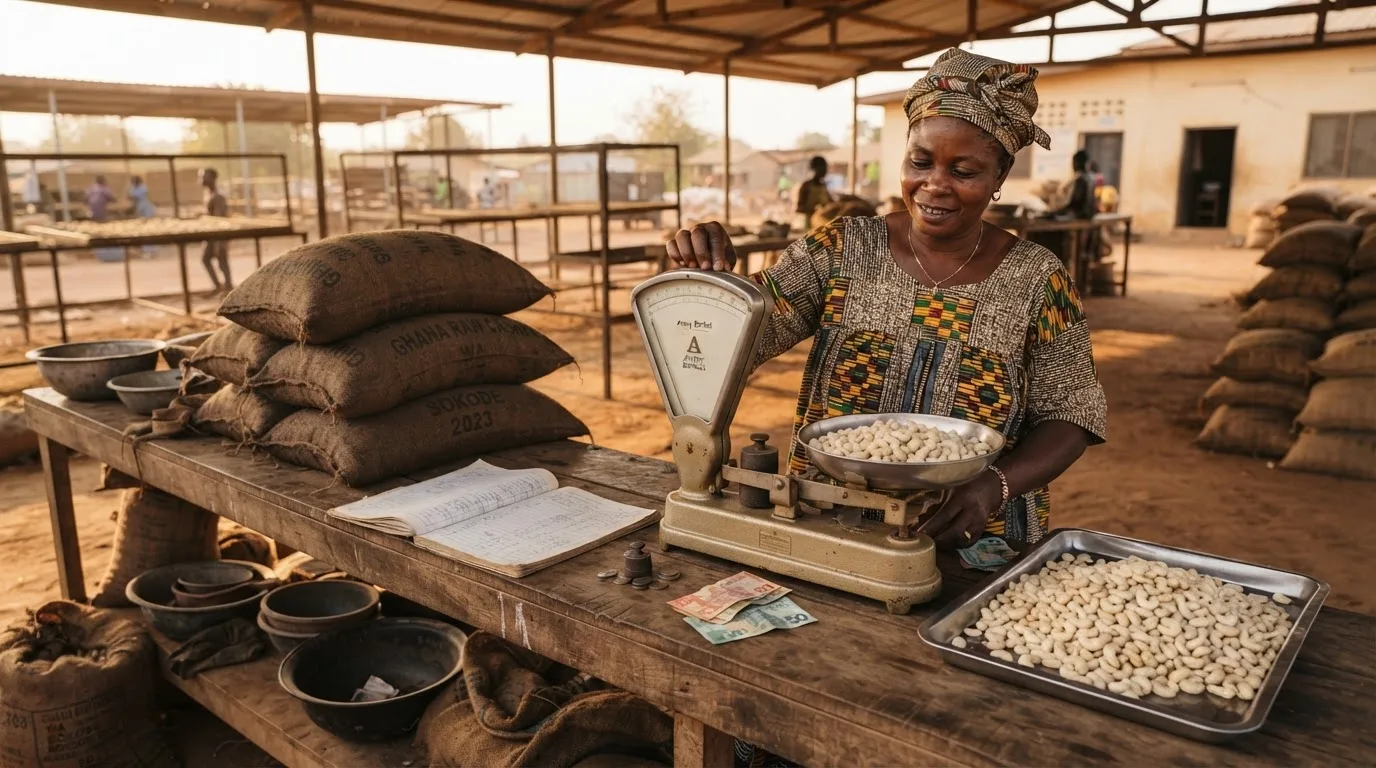
A cashew processor weighing a tray of graded white kernels against the raw-nut sacks they came from
Cashew · Pillar 05

Cost, Returns and Financial Analysis

The money pillar. Does a cashew orchard pay, does processing pay more, and how is either financed. Ghana has no current published per-acre budget, so the figures here are indicative and must be checked with field data.
Cost, Returns and Financial Analysis · Pillar 05

This is the money pillar, and it answers three questions: does a cashew orchard pay, does processing pay more, and how is either financed. The honest starting point is that Ghana has no current, published, per-acre cashew budget, so the cost and returns figures here are indicative and shown in red, and must be checked with primary field data before any decision.

What is solid is the shape of the opportunity: the value added by processing, the cost gap that holds it back, and the finance now lining up behind it. The central financial fact is the gap between what Ghana sells and what the market pays, and closing that gap by processing at home is the whole strategic push of this pillar.

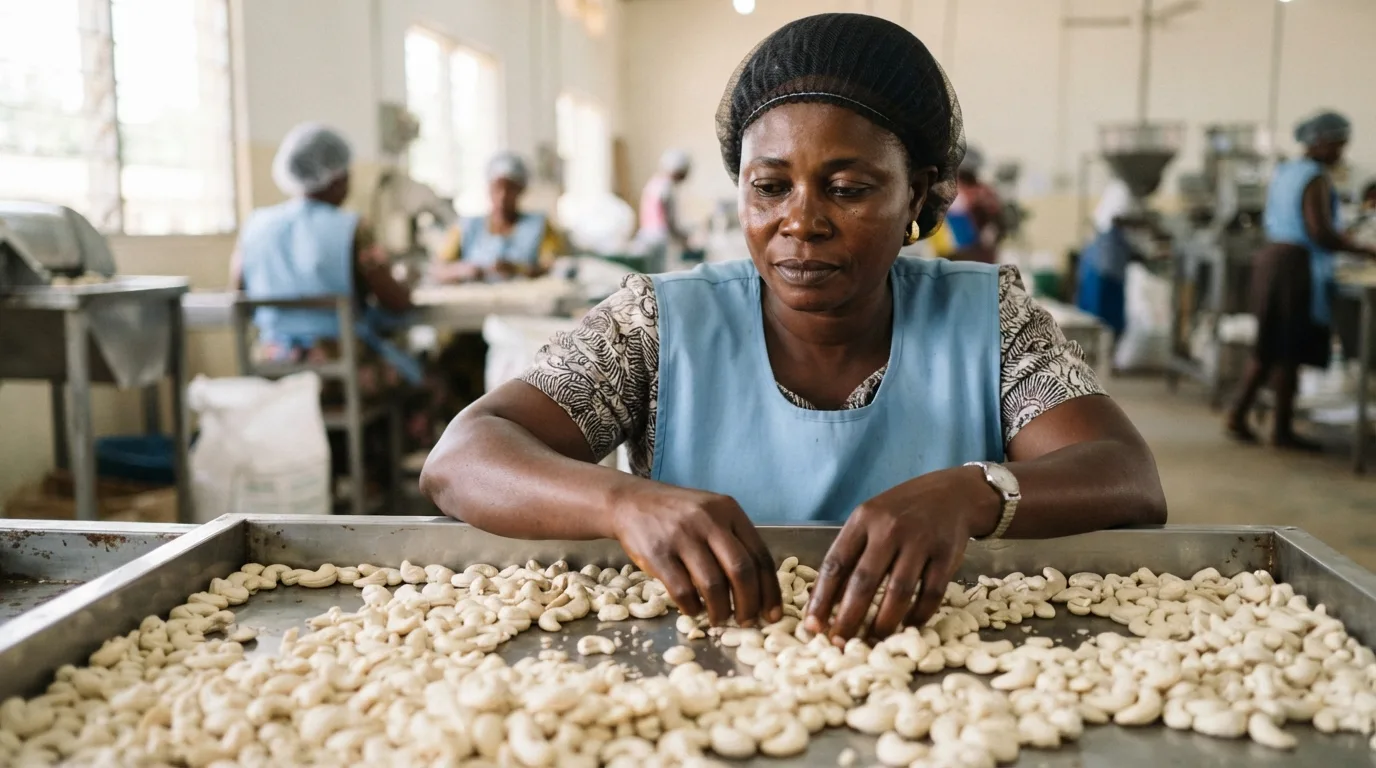
Processed white cashew kernels, whole W-grade, spread in a grading tray at a Ghanaian plant, the form that earns four to five times the raw price, documentary photograph
The value is in processing
Four to five times the raw price: the white kernel is the form that keeps the value at home.
4 to 5x
kernel versus raw-nut price a kilogram (derived from market prices, 2025 to 2026)
US$350/t
Ghana processing cost, against about US$210 in Vietnam (Wittern et al., 2023)
US$660m
a year the sector could earn with full value addition (TCDA, 2026)

🌰 Where the value is: the processing premium

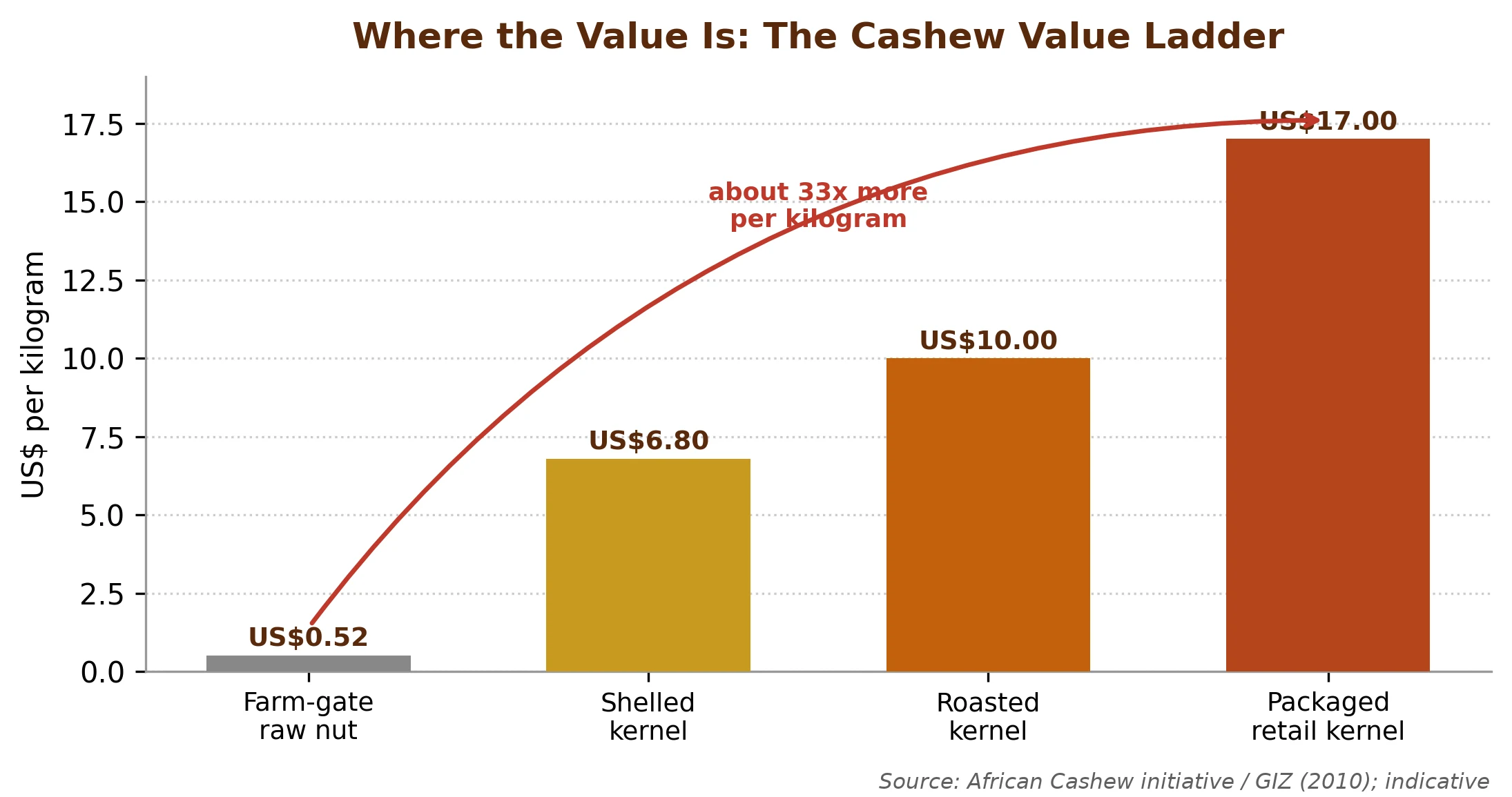
The value ladder: each step of processing multiplies the price per kilogram, from raw nut to branded kernel and by-products, and most of it happens outside Ghana
Figure 5.1 The value ladder: each step of processing multiplies the price per kilogram, and most of it happens outside Ghana

Source: derived from market prices (2025 to 2026); APEDA (2025); African Cashew Alliance (2025).

What this shows

Each step of processing multiplies the price per kilogram, and most of it happens outside Ghana. The country exports the raw nut and imports the finished premium back at four to five times the price.

Begin with the premium, because it is the reason everything else in this pillar matters. Raw nuts trade at about US$1,000 to 1,700 a tonne (African Cashew Alliance; market reports, 2025), while premium kernels fetch about US$7,500 to 8,400 a tonne (APEDA, 2025), so kernels are worth roughly four to five times raw nuts a kilogram (derived from market prices, 2025 to 2026). Add roasting, branding and retail and the gap widens further.

This is why the whole strategic push is towards processing. The about US$660 million a year with full value addition that the sector could earn (Tree Crops Development Authority, 2026) is mostly the value it currently gives away by exporting raw. Every tonne that leaves Ghana as a raw nut is a tonne of that premium captured somewhere else, in India, Vietnam or the UAE, rather than at home.

US$1,000 to 1,700
a tonne for raw nuts (African Cashew Alliance; market reports, 2025)
US$7,500 to 8,400
a tonne for premium kernels (APEDA, 2025)

What this means. The premium tells you where the business is. A raw-nut trader captures a thin margin on a low-value commodity; a processor captures the four-to-five-fold spread between the nut and the kernel, and the by-products pay again on top. The strategic question for the whole sector, and for any serious entrant, is not how to grow more raw nuts but how to keep more of them at home to be processed, because that is where the value the country gives away is sitting.

🌰 Does an orchard pay? An indicative cost and returns picture

Before processing comes the orchard, and here the honesty problem is sharpest. A cashew orchard is a long-term asset with a slow start: it earns nothing for the first two years, gives first nuts in years three to four, and reaches full bearing around year seven, after which it can produce for decades. The immature-year cash-flow gap, covered in Pillar 4, is bridged with intercrops.

The only complete Ghana project-level return on record is historical: the African Development Bank Cashew Development Project reported a financial internal rate of return of about 35 percent for cashew production and processing together, but that is a 2000 figure and cannot be read across to today's prices (African Development Bank, 2000). The indicative table below shows the shape of a mature orchard's economics at current prices. It is a framework to be completed with field data, not a quote, and its incomplete cells are flagged in red because they must be field-collected first.

~400 kg/ha
indicative mid-range mature yield; 200 old to 550 achieved (MoFA)
GH¢12 / kg
TCDA 2025/26 minimum farm-gate price, a solid figure
Indicative red-flagged figures that must be field-validated before any investment decision, because no current published Ghana cashew budget exists
Field-validate before deciding
Table 5.1: Indicative mature-orchard economics per hectare. Red-flagged cells need primary field data.
Line, per hectare, matureIndicative valueBasis, or to validate
Yield~400 kg/hamid-range; 200 old to 550 achieved (MoFA); 800 was the AfDB target
Farm-gate priceGH¢12 / kgTCDA 2025/26 minimum, solid
Gross revenue~GH¢4,800 / hayield times price, indicative
Production costfield-validatelabour, inputs, harvest; no current Ghana figure
Net marginfield-validategross minus cost, indicative pending data

Sources: TCDA (2025/26); MoFA; African Development Bank (2000).

🌰 Opportunity: the data gap and the idle capacity 🌰
01

Build the cost data the sector lacks. The gap is itself the opening: a farm-economics data service that collects real per-acre costs and yields, the very figures shown in red here, owns information every farmer, aggregator and lender needs and none currently has (Pillar 7).

02

Buy into unused capacity, do not build it. Because about 70 percent of Ghana's installed processing capacity sits idle for want of feedstock and finance, an entrant who can secure nuts and working capital is buying into a stranded asset rather than pouring concrete for a new one (World Bank, 2023).

🌰 Does processing pay more? Yes, but four things hold it back

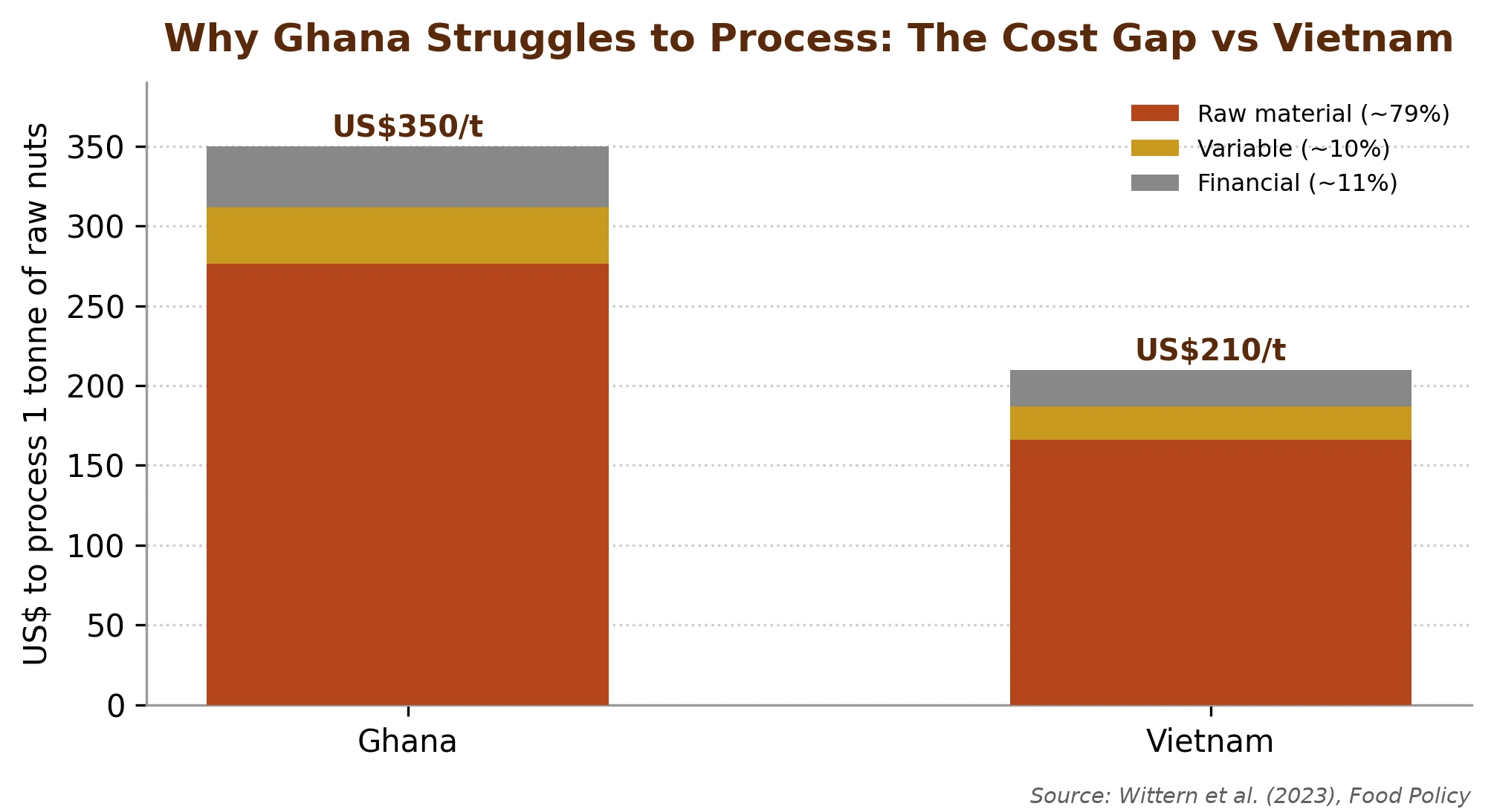
Why Ghana struggles to process: it costs about US$140 a tonne more than Vietnam, and raw material dominates the cost
Figure 5.2 Why Ghana struggles to process: it costs about US$140 a tonne more than Vietnam, and raw material dominates the cost

Source: Wittern et al. (Food Policy, 2023); CBI (2018); World Bank (2023).

What this shows

Ghana processes only a fraction of its crop because it costs about US$140 a tonne more than Vietnam, and raw material dominates the cost. Cheaper finance and larger scale are what close that gap.

So does processing pay more than selling raw? Yes: processing captures the four-to-five-fold premium, and gross margins in African cashew processing are reported at roughly 30 to 40 percent with a return on investment in three to five years (ComCashew, 2019). But Ghana processes only a fraction of its crop, and the reasons are well documented, so an entrant should treat them as the four things to solve rather than reasons to stay out.

First, cost: it costs about US$350 a tonne of raw nuts to process in Ghana against about US$210 in Vietnam (Wittern et al. (Food Policy), 2023), because raw material is about four-fifths of the cost and finance is dear. Second, finance: Ghanaian processors have historically borrowed at around 30 to 35 percent, against 1 to 2 percent for large Asian buyers (CBI, 2018), and financial costs in Ghana run about 83 percent higher than in Vietnam (Wittern et al., 2023). Third, working capital: a processor must buy a whole year's nuts in the three-to-four-month harvest window. Fourth, scale: only large plants above 10,000 tonnes approach competitiveness (World Bank, 2023).

30 to 40%
gross margins reported in African cashew processing, ROI in three to five years (ComCashew, 2019)
30 to 35%
the rate Ghanaian processors borrowed at, against 1 to 2 percent for large Asian buyers (CBI, 2018)

Market signal: the four barriers are the diligence questions. The four barriers are also the diligence questions. Before backing any processor, ask what it costs to process a tonne against the Vietnam benchmark, what rate it borrows at and whether the loan is guaranteed, how it funds the harvest-window buy, and whether it runs at a scale that can compete. A plant with good answers to those four is a business; one that has a machine but no answer to finance and feedstock is the stranded capacity this pillar is about to describe.

🌰 The result: capacity built, but sitting idle 🌰

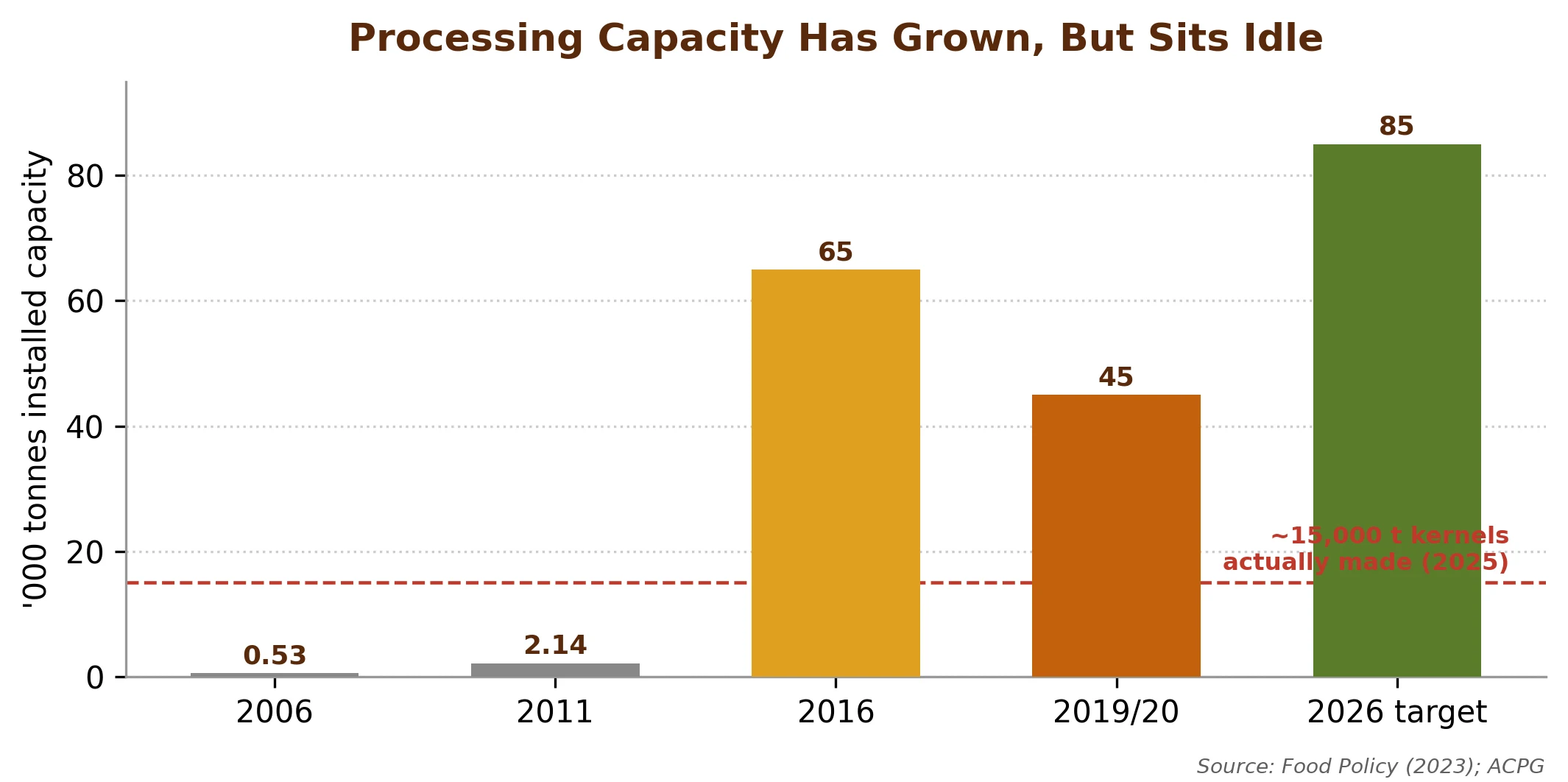
The result of those barriers is idle capacity, and it is stark. Ghana has about 65,000 tonnes of installed processing capacity, with an industry target of 85,000 tonnes by 2026 (ComCashew; Association of Cashew Processors Ghana, 2024 to 2026), but only about 30 percent is used.

Even Ghana's largest processor secured only about 7,000 tonnes of its 35,000-tonne capacity in 2025 (African Cashew Alliance; IMANI Africa, 2025), and has signalled a move to Cote d'Ivoire. The machines exist; the feedstock and the finance do not reach them. That is the exact problem the raw-export ban and the new finance facilities are meant to fix, and it is why an entrant who can secure feedstock and working capital is buying into unused capacity rather than building it.

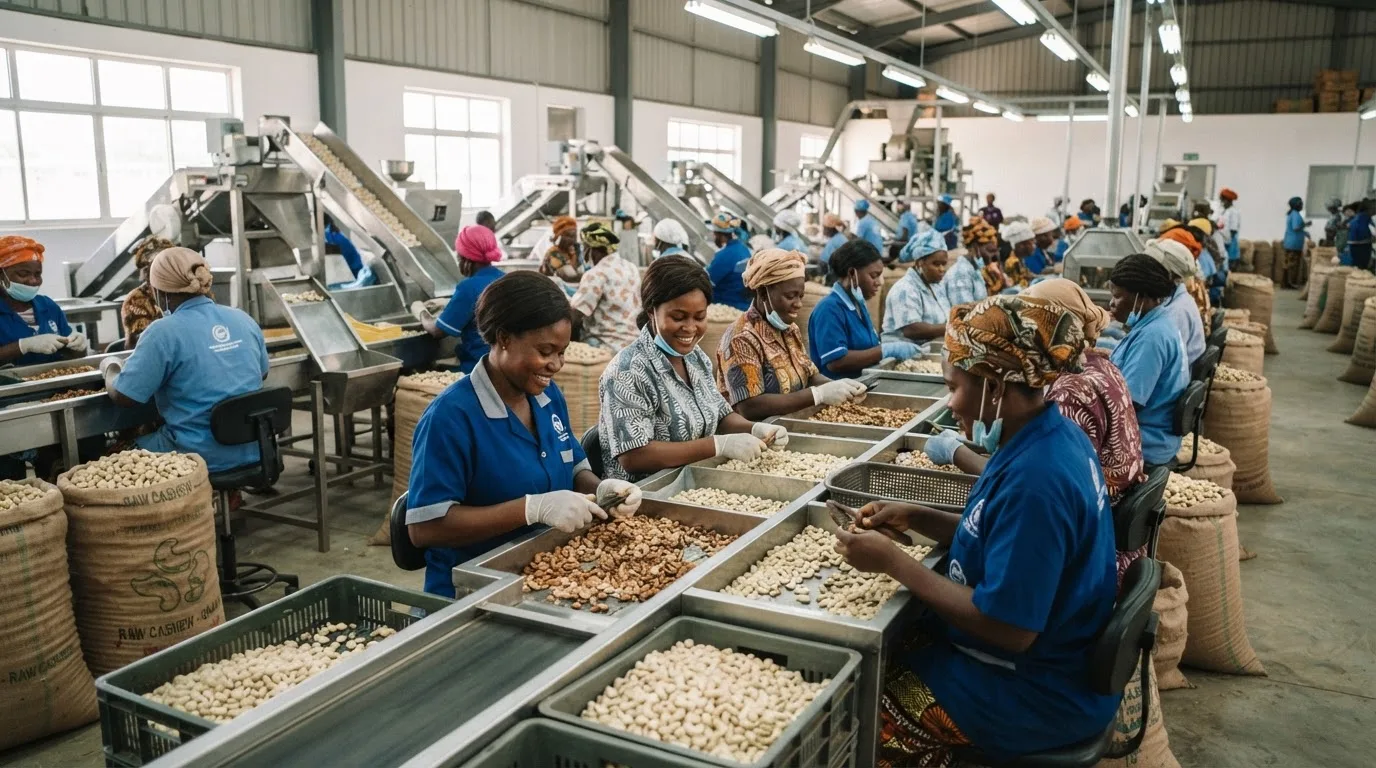
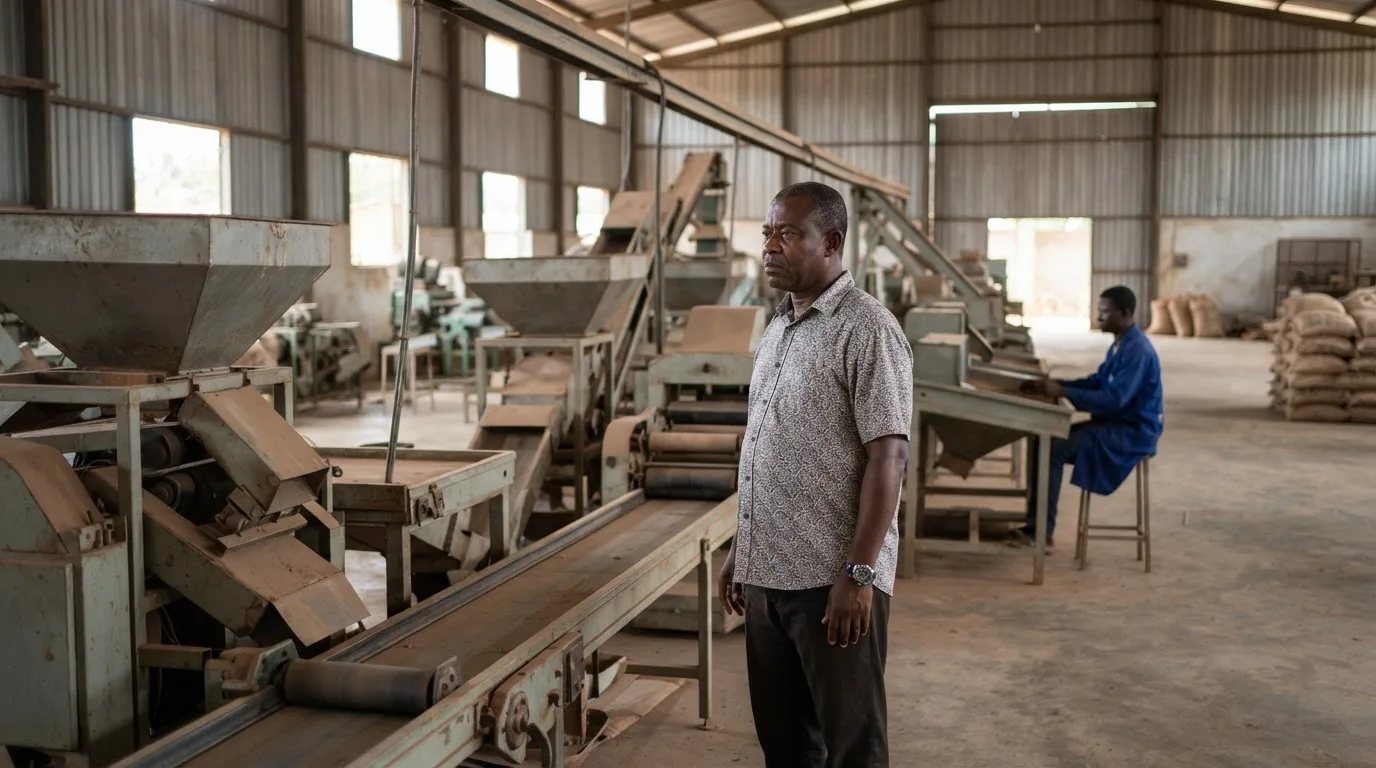
Inside a Ghanaian cashew processing plant, shelling and grading lines running below capacity, workers at cutting tables, stacked jute sacks of raw nuts, documentary photograph
The machines exist
Starved of feedstock and finance: only about 30 percent of installed capacity is used.
Processing capacity has been built but sits largely idle, starved of raw material and affordable finance
Figure 5.3 Processing capacity has been built but sits largely idle, starved of raw material and affordable finance

Source: ComCashew; Association of Cashew Processors Ghana (2024 to 2026); African Cashew Alliance; IMANI Africa (2025).

What this shows

Processing capacity has been built but sits largely idle, starved of raw material and affordable finance. The constraint is not machines; it is the nuts and the money that reach them.

~65,000 t
installed processing capacity, with an 85,000-tonne industry target by 2026
~30%
of that capacity actually used; the largest plant secured 7,000 t of its 35,000 (IMANI Africa, 2025)

🌰 The by-products: two revenue lines Ghana throws away

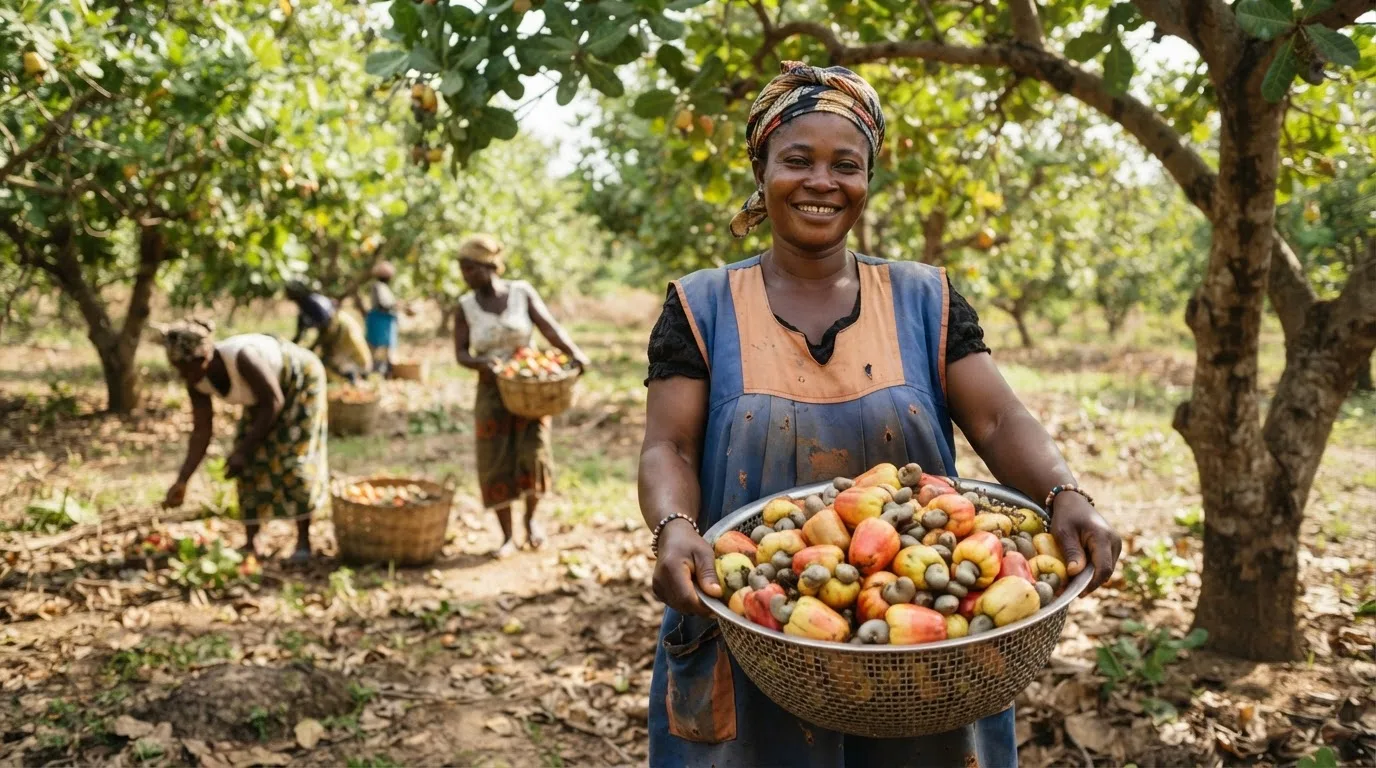
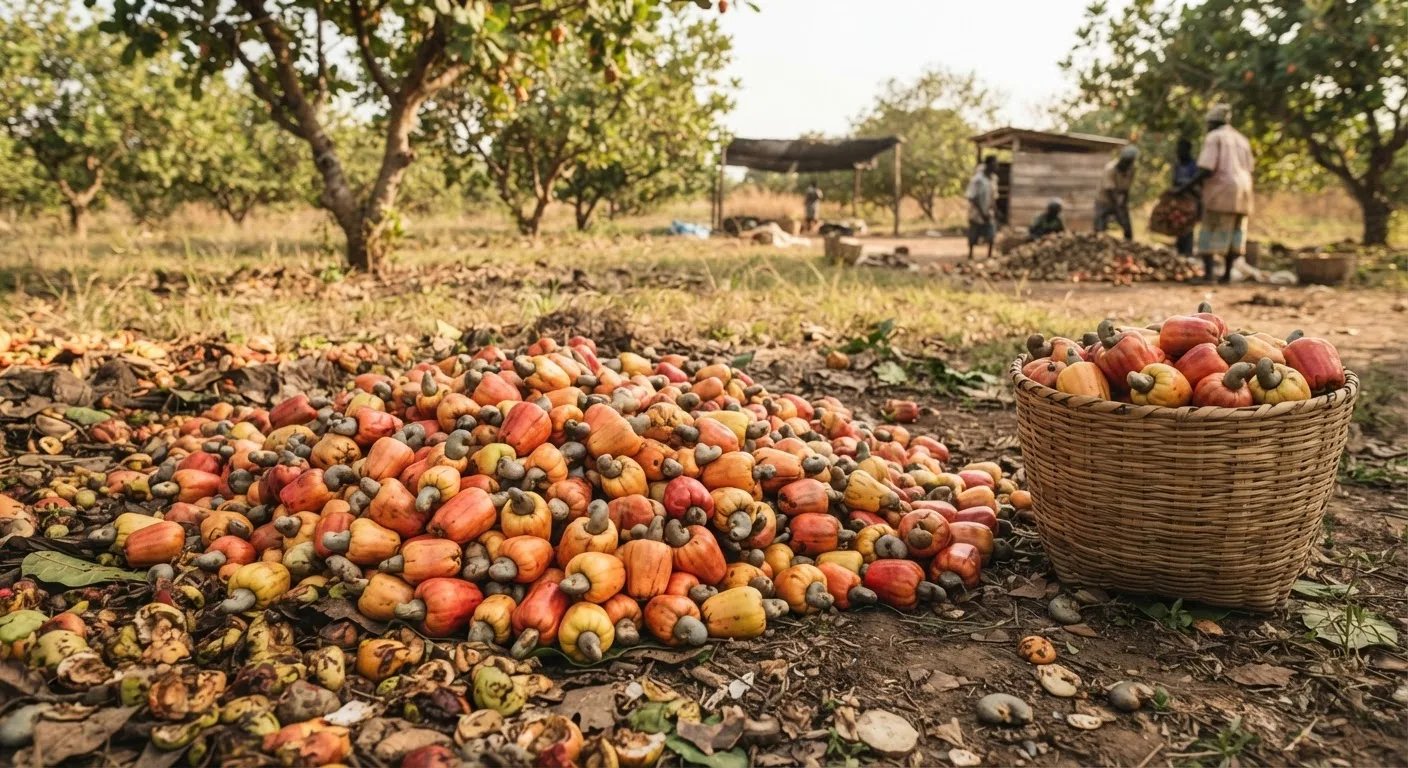
Bright red and yellow cashew apples with the grey nut still attached, heaped fresh at harvest in a Bono-region orchard, most of them left to rot on the ground while the nut is kept, one basket set aside for juice, documentary Ghana photograph
More than 90% wasted
A near-zero-cost feedstock: the cashew apple makes juice, gin, jam and feed, yet under a tenth is used.
20 to 25%
of the shell is cashew-nut-shell liquid, used in brake linings, resins and paints (ComCashew / GIZ, 2019)
>90%
of the cashew apple is wasted, with under 10 percent used (Akyereko et al., 2022)

A cashew nut is more than its kernel, and Ghana throws away two revenue lines that a well-planned plant would keep. The shell, about half the nut, contains cashew nut shell liquid: cashew nut shell liquid is about 20 to 25 percent of the shell (ComCashew / GIZ, 2019), used in brake linings, resins, paints and bio-based chemicals. By-product sales can cut a processor's costs by up to 20 percent, and the shell itself can fuel the roasting (ComCashew, 2019; Nyirenda et al., 2021). Ghana already has a commercial cashew-nut-shell-liquid extractor in the Bono region.

The cashew apple, the fleshy fruit the nut hangs from, is the larger waste: more than 90 percent of the cashew apple is wasted, with under 10 percent used (Akyereko et al., 2022), even though it makes juice, gin, jam and animal feed. One Ghanaian company, Mim Cashew, already makes cashew-apple spirits (Akyereko et al., 2022), and recent government initiatives are promoting cashew-apple beverages in the Bono and Bono East regions.

🌰 Opportunity: turn the waste into revenue 🌰
01

By-products turn a cost into two revenue lines. Cashew-nut-shell-liquid and cardanol extraction, following the Bono-region model, both cuts processing cost and adds a chemical-industry revenue stream, though it only pays at volume. Cashew-apple juice, gin and dried-fruit products attack a near-zero-cost feedstock that is more than 90 percent wasted; the barriers are perishability, solved with cold storage at about minus 17 degrees, and skills, not raw material. Integrating shell and apple use at the plant-planning stage is the difference between a thin margin and a healthy one.

🌰 What swings the profit most: a sensitivity read 🌰

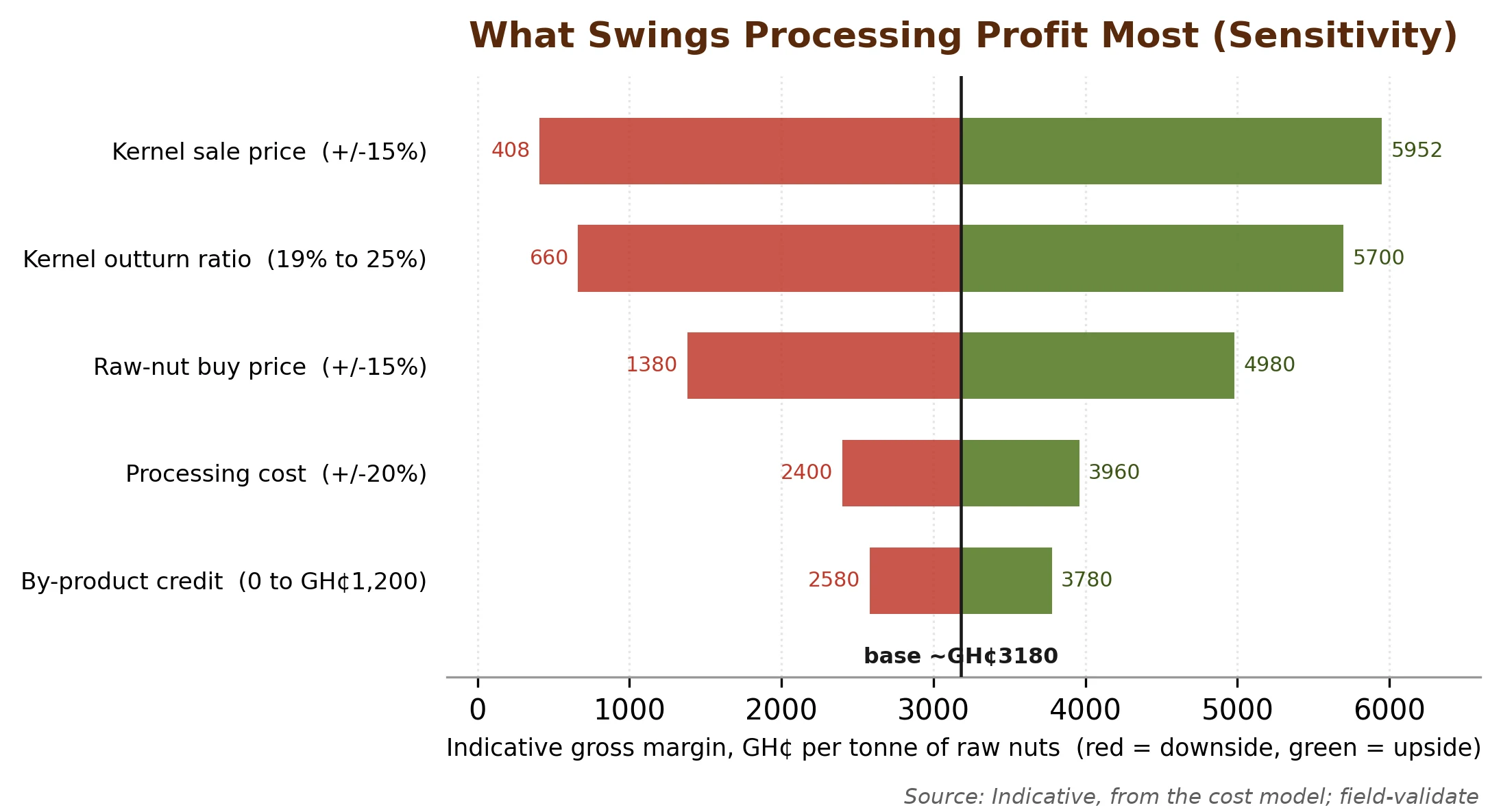
Sensitivity of the indicative processing margin: kernel price and outturn swing profit most, ahead of the raw-nut price and the running cost
Figure 5.4 Sensitivity of the indicative processing margin: kernel price and outturn swing profit most, ahead of the raw-nut price and the running cost

Source: author sensitivity model on indicative processing figures; parameters from Wittern et al. (2023); APEDA (2025).

What this shows

Kernel price and outturn swing profit most, ahead of the raw-nut price and the running cost. A processor who chases whole high-grade kernels is watching the right numbers; one who obsesses over the running cost is not.

Before asking how to cut cost, an operator should know which numbers actually move the result, and the ranking is clear and unusual. The chart takes the indicative processing margin and swings each major driver across a realistic range, holding the others at their base. Two levers dominate, and neither is the running-cost line most people worry about.

The kernel sale price and the kernel outturn ratio move the margin far more than the processing cost does, with the raw-nut buy price next. The reading for a processor is that grade and price discipline, selling whole high-grade kernels and holding outturn, matter more than shaving the running cost, though the buy price still has to be controlled because raw material is the largest single outlay.

~46%
indicative kernel outturn, about 3.3 kg of raw nuts a kg of kernel, a top-two driver
~80%
of a processor's cost is raw material, so the buy price still has to be controlled

What this means. The sensitivity read rewrites the operator's to-do list. Because kernel price and outturn dominate, the plant that wins invests in correct steaming, humidification and trained cutting to lift the whole-kernel share, and in grade discipline to sell into the premium W-grades, before it worries about trimming the running cost. Get the grade and the outturn right and the margin follows; run a spotless cost sheet but break the kernels and sell them low, and it does not.

🌰 Model it yourself 🌰

Numbers on a page are one thing. Move the levers yourself. Set the kernel price, the outturn, the raw-nut buy price, the processing cost and the finance rate to your own field numbers, then swing them one at a time. Push the processing-cost slider from the Vietnam benchmark to the top of its range and watch how little the answer moves, then nudge the kernel price or the outturn and watch it jump. That is the argument of this pillar in one gesture, and every figure in it is indicative until the field confirms it.

Tool 1

Does processing pay?

Slide the drivers that decide a tonne of raw nuts turned into kernel: the price the kernel sells at, how much usable kernel comes out of the nut, what the raw nuts cost, what it costs to process, and the finance rate on the harvest-window buy. Overwrite every number with your own field prices. No field-validated Ghana cost model exists yet, so these are indicative.

US$1,916
Cost per tonne of raw nuts, including US$216 of finance
US$2,363
Revenue per tonne, from 303 kg of kernel
+US$44723% return
Net margin a tonne · US$2,237,000 across 5,000 t
Processing pays at these numbers, and the way it pays says where to be careful. Kernel price and outturn move the margin most, so grade and price discipline, selling whole high-grade kernels and holding outturn, matter more than shaving the running cost. But note the working capital: buying a year of nuts in the harvest window ties up about US$6,750,000 at 32 percent, which is why de-risking the loan, not cutting the running cost, is what lets the plant scale.

Base case: the Pillar 5 indicative processing frame, per tonne of raw nuts. Premium kernel at US$7,800 a tonne (APEDA, 2025), about 46 percent outturn (roughly 3.3 kg of raw nuts a kg of kernel), raw nuts at US$1,350 a tonne (African Cashew Alliance; market reports, 2025), Ghana processing cost at US$350 a tonne against about US$210 in Vietnam (Wittern et al., Food Policy, 2023), finance at about 32 percent against 1 to 2 percent for large Asian buyers (CBI, 2018). Working capital is the year's raw-nut buy, held about half a year across the three-to-four-month harvest window.

Tool 2

What swings the profit most

The same model, re-run as a sensitivity read. Each bar is how much a 10 percent move in that one driver shifts the net margin, holding the others where you left them. Two levers dominate, and neither is the running cost most people worry about.

1. Kernel sale priceUS$473/t

The premium kernel price the plant sells at. Selling whole high-grade kernels and holding grade discipline is the single strongest lever on the margin, ahead of everything a processor spends.

2. Kernel outturn ratioUS$473/t

How much usable kernel comes out of a tonne of raw nuts. Correct steaming, humidification and trained cutting lift the whole-kernel share, and it moves the margin as hard as the sale price does.

3. Raw-nut buy priceUS$313/t

The largest single outlay, because raw material is about four-fifths of a processor's cost. It has to be controlled, but it swings the result less than kernel price and outturn.

4. Processing costUS$70/t

The running cost of steaming, shelling, drying, roasting and grading. Ghana runs about US$350 a tonne against about US$210 in Vietnam (Wittern et al., 2023), but shaving it moves the margin little.

5. Finance and working-capital rateUS$43/t

The interest on the harvest-window buy. It decides whether a plant lives or dies, but as a swing on the per-tonne margin it moves the answer least of the five.

US$473/t
What a 10 percent move in the top driver, kernel price or outturn, does to the margin
US$43/t
What the same move in the finance rate does, the smallest swing of the five
Kernel price and the kernel outturn ratio swing the margin most, ahead of the raw-nut buy price, and the finance rate and the running cost move it least. The reading for a processor is that grade and price discipline, selling whole high-grade kernels and holding outturn, matter more than shaving the running cost, though the buy price still has to be controlled because raw material is the largest single outlay. Slam the processing-cost slider from one end to the other in Tool 1 and watch how little the answer moves; that is the argument of this pillar in one gesture.

Sensitivity is computed by moving each driver 10 percent up and down around its current level and holding the others fixed, mirroring Figure 5.4. Kernel price and outturn both act straight on revenue, so they lead; raw material and finance act on cost, where raw material is about four-fifths of the total (Wittern et al., 2023).

🌰 Where a processor can cut cost, and by how much

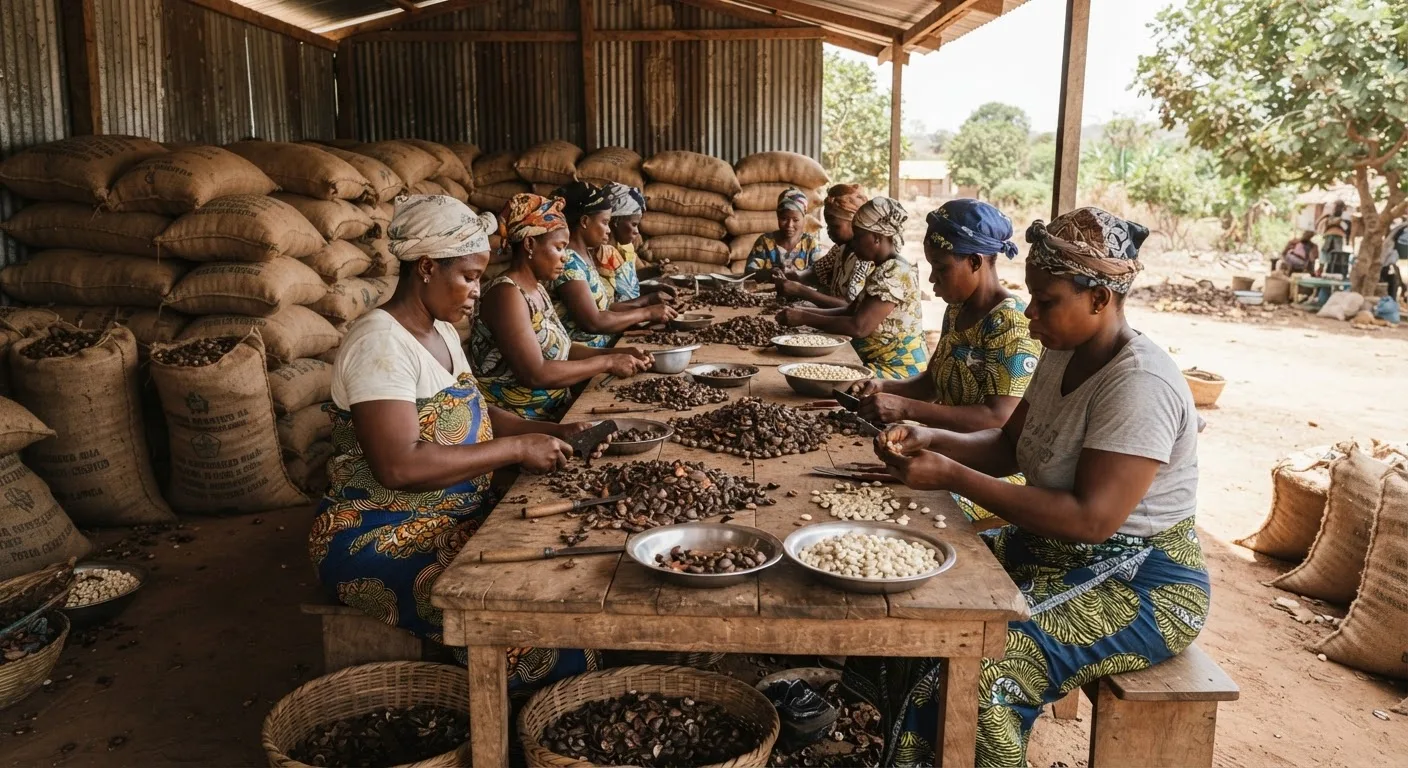
A satellite village cashew-shelling and grading station near the Bono supply, women at long cutting tables hand-shelling nuts and sorting whole white kernels by grade, sacks of raw nuts stacked behind, bright natural light, documentary Ghana photograph
The Mim model
Village stations near the supply: lower unit labour and inbound freight, and higher whole-kernel yield.

If the sensitivity read says what moves profit most, this section asks the operator's question: which of Ghana's high costs can actually be cut, with what lever, and by roughly how much. The savings below are indicative and shown in red because no field-validated Ghana cost model exists yet, but the levers are real and each comes with a way to check it against your own numbers.

They are ordered by where the money sits, raw material and finance first, because they dominate the cost. The two that move the needle most are finance, a guarantee that cuts the borrowing rate, and by-product energy, shells and cashew-nut-shell liquid displacing bought fuel, because finance and raw material together are about four-fifths of a processor's cost.

Table 5.3: Indicative cost-cutting levers for a cashew processor and its suppliers. Red cells are indicative and must be field-validated.
Cost lineIndicative baseThe leverIndicative savingHow to validate
Working-capital finance~30 to 36% interest on the harvest-window buy, raw material is ~80% of coststack a GIRSAL guarantee, up to 70% of the loan, and time the buy against warehouse receiptsrate cut toward ~20 to 24%get a GIRSAL-backed loan quote against an unguaranteed one
Process energygrid or diesel heat for steaming, drying and roastingburn the cashew shells and use cashew-nut-shell liquid as process heat instead of buying fuelup to ~20% of processing cost, with by-productscompare a shell-fuel trial against the current energy bill
Whole-kernel yieldbreakage downgrades kernels well below whole W-gradescorrect steaming and humidification plus trained cutting to lift the whole-kernel sharehigher revenue per tonne of raw nutsrun a cut-test breakage rate before and after
Labour and sitingmanual shelling and grading labour at a single plantsatellite village stations near the Bono and Ahafo supply, the Mim modellower unit labour and inbound freighta time-and-motion check at a pilot station
Raw-nut purchasethe GH¢12/kg floor plus the aggregator's marginbuy direct through a cooperative and the commodity exchange on an outturn-based gradethe aggregation-layer margintrack a direct price against an agent price over a season
Farm post-harvest loss3 to 4 day drying and no storage for about 76% of farmersdry on raised mats to 10 to 12% moisture and store in clean jute on palletshigher outturn and price, fewer rejectionsmeasure moisture and kernel outturn before and after

Sources: GIRSAL; ComCashew (2019); Wittern et al. (2023); Akyereko et al. (2022).

🌰 How it is financed: the instruments now on the table

The finance gap that has starved processing is being addressed by a stack of instruments a serious entrant should learn and combine. The single most important move for a would-be processor is to stack these: use a GIRSAL guarantee, covering up to 70 percent of the loan, to make a bank comfortable, add a Free Zone or GIPC tax holiday to protect the margin, then draw on the US$220 million World Bank facility or GCB Bank's up to GH¢2.5 billion framework for scale.

Because historic Ghana processing survived only at around 30 to 36 percent interest, de-risking the loan is what decides whether a plant lives or dies. The economics carry a clear policy lesson too: a peer-reviewed model of Ghanaian cashew found that a processor subsidy is the most efficient way to grow processing, while a blunt raw-export tax hurts farmers most, an average welfare loss of about US$93 a year per smallholder (Wittern et al., 2023).

up to 70%
of a loan's principal covered by a GIRSAL credit guarantee, accepted as collateral
US$220m
World Bank tree-crop facility, US$100m TCDA and US$120m COCOBOD, for scale-up
A processor's working capital locked in a whole year of raw nuts bought in a three-to-four-month harvest window at 30 to 36 percent interest
Buy a year of nuts in one window
Table 5.2: The cashew finance and incentive stack, 2025 to 2026.
InstrumentWhat it offersBest used for
GIRSAL credit guaranteecovers up to 70% of a loan's principal; favourable risk-weight; accepted as collateralde-risking harvest-window working capital
World Bank tree-crop facilityUS$220m (US$100m TCDA + US$120m COCOBOD)production, processing and trade scale-up
GCB Bank frameworkup to GH¢2.5bn for agribusinessprocessor and aggregator lending
Free Zones10-yr corporate-tax holiday and 0% equipment duty if >70% exportedexport-focused processing plants
GIPC agro-processing0% corporate tax up to 10 yrs; 0% equipment dutydomestic-and-export processors

Sources: GIRSAL; World Bank (2023); GCB Bank; Ghana Free Zones Authority; GIPC (2025 to 2026).

What this means. For an investor this means the smart bet is not to wait for a perfect ban, but to build processing capacity now while the finance stack and incentives are being rolled out, and to press for a processor subsidy and guaranteed off-take alongside any export restriction. The money pillar is also where digital tools close the two gaps that sink cashew ventures, records and finance: a farm-and-plant record app to build the cost data the sector lacks, mobile money for transparent farmer payments and harvest-window float, and digital credit scoring that lets a GIRSAL-backed lender price a loan on real cash flow rather than collateral alone.

🌰 The risks that sit inside the money pillar

Treating indicative figures as decision-ready

MEDIUM-HIGH
What it is

No current published per-acre Ghana cashew budget exists, so any cost or returns number used unvalidated can mislead an investment. An entrant who mistakes an indicative model like the one in this pillar for a proven return can commit capital against figures that real farms and plants may not deliver.

Evidence

The cost lines in this pillar are shown in red precisely because they must be field-collected first; the only complete Ghana project-level return on record is an AfDB figure from 2000 that cannot be read across to today's prices (African Development Bank, 2000).

Who it hits

Anyone who commits capital on the red figures without primary data, and lenders pricing a facility off an unvalidated model.

How to manage it, and the opening

Run the field questionnaire and re-price the model before deciding. Treat every red cell as a hypothesis to test, not a return to bank. The opening is a farm-economics data service that both collects the field figures and feeds them into finance, which is itself a business the sector needs.

The working-capital trap in processing

HIGH
What it is

A processor must buy a whole year of nuts in a three-to-four-month window, historically at 30 to 36 percent interest, then hold overheads until kernels sell. An under-capitalised plant then runs below capacity or folds, exactly what has stranded Ghana's largest processor at about a fifth of its capacity.

Evidence

Raw material is about four-fifths of processing cost, and Ghana's finance costs run far above Asia's, about 83 percent higher than Vietnam (Wittern et al., 2023; CBI, 2018); only about 30 percent of installed capacity is used (ComCashew; IMANI Africa, 2024 to 2025).

Who it hits

Under-capitalised processors, who then run below capacity or fold, and the farmers whose nuts have no buyer.

How to manage it, and the opening

Solve working capital before buying a machine. Stack a GIRSAL guarantee, a Free Zone or GIPC tax status and the World Bank facility to secure harvest-window capital, and start at a scale you can actually fund. The opening is structured trade finance built around the harvest window.

🌰 Key takeaways 🌰
01

An orchard can pay, but the numbers must be field-validated: Ghana has no current published per-acre cashew budget, so every cost and returns figure here is indicative and shown in red.

02

Processing pays more, four to five times the raw price, and the by-products, cashew-nut-shell liquid and the cashew apple, pay again, but only with scale, affordable finance and year-round feedstock.

03

Ghana processes only a fraction of its crop because it costs about US$350 a tonne against US$210 in Vietnam, borrows at 30 to 35 percent against 1 to 2, and about 70 percent of installed capacity sits idle.

04

Profit moves most on the kernel sale price and the kernel outturn ratio, ahead of the raw-nut buy price, while the running cost most people worry about moves it least.

05

The finance stack, GIRSAL guarantees, the World Bank facility, GCB and Free Zone or GIPC tax holidays, is the tool that closes the gap; the winning move is to build processing now and de-risk the working capital, not to wait.

Where this connects. The processing premium here is the value the raw-export trade of Pillar 2 gives away, and the orchard economics rest on the slow-bearing tree and the intercrops of Pillar 4. The finance stack that de-risks the harvest-window buy is the working-capital problem of Pillar 7, and the by-products, grading and branding that lift the margin are where a processor reaches up the value chain of Pillar 6. The winning move, build processing now and de-risk the working capital, is the thread that ties the money pillar to all of them.

Written for each reader

🌰 Practitioner intelligence 🌰

Hover any card to pause and lift it.

For students

If you are thinking of entering, start where the cost model is thinnest: a farm-economics data service that collects real per-acre costs and yields for farmers, aggregators and lenders who currently have none. You will learn how the money actually works across the chain and build relationships with everyone who needs the numbers. The trap is acting on the indicative figures in this pillar as if they were real; they are shown in red because they must be field-collected first, and collecting them is your opening.

For entrepreneurs

First move: if you are processing, solve working capital before you buy a machine, because raw material is about four-fifths of your cost and must be bought in a three-to-four-month window. Line up a GIRSAL-backed facility and a Free Zone or GIPC tax status before the harvest, and start at a scale you can actually fund. The trap is buying a plant and then running it at a fifth of capacity for want of nuts and cash, exactly what has stranded Ghana's largest processor.

For investors

Diligence asks: is the cost model field-validated or still indicative, how is the harvest-window working capital secured and at what interest, and what is the plant's realistic capacity utilisation and kernel breakage rate. The thesis is that processing captures the four-to-five-fold spread but only with scale, cheap finance and year-round feedstock. Do not accept a headline margin; require field-priced numbers, tie disbursement to secured working capital and offtake, and underwrite the feedstock and finance risk, not the machinery.

For faculty

Assignment: have students take the indicative orchard budget and the processing model, field-validate or research one line each, and rerun the returns to show how sensitive the outcome is to the buy price of nuts and the cost of finance. Deliverable: a revised model with a sensitivity chart on those two drivers. It teaches evidence-based finance and why an unvalidated figure is a liability, not an asset.

For ecosystem actors

The lever is to de-risk processing finance and cut the input cost that makes Ghana uncompetitive: a processor-focused working-capital guarantee, an interest-rate buy-down, and reliable industrial power. Measure success by processors' capacity utilisation and by the cost per tonne of processing against Vietnam. The failure to avoid is a blunt raw-export tax that hits farmers, about US$93 a year each in the model, instead of a processor subsidy, which the evidence shows is the more efficient instrument.

Download full PDF
UpcomingThis document isn't available yet.