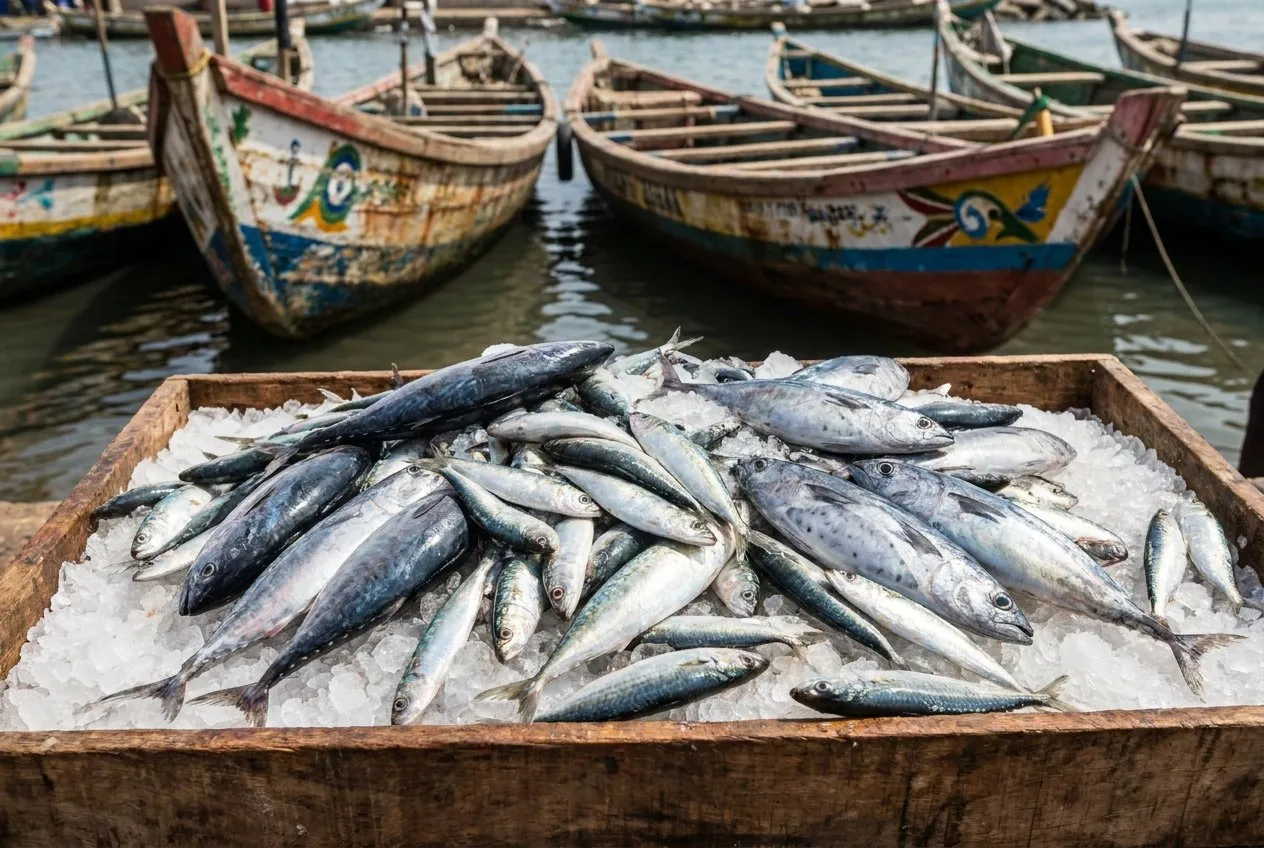
The market. Fish supplies between 50 and 80 per cent of the animal protein Ghanaians eat, with pelagic fish 71 per cent of total fish intake1, most of it small pelagic and mostly smoked. Ghana’s own fleet cannot meet demand: self-sufficiency fell from 52.0 per cent in 2022 to 44.4 per cent in 2023, and imports and cross-border trade fill part of the gap. Tuna, the part of the sector in good health, earns its money from export markets, and its pole-and-line fleet depends on a bait stock that is itself collapsing. The opening is the value that both halves of the chain currently leave on the table: graded, traceable, well-handled fish for buyers who will pay for it, and a data layer that lets a lender or investor plan with confidence.
Is this a business for you?
The briefThe opportunity, what it takes to start, and the market signal, in plain terms.
The opportunity
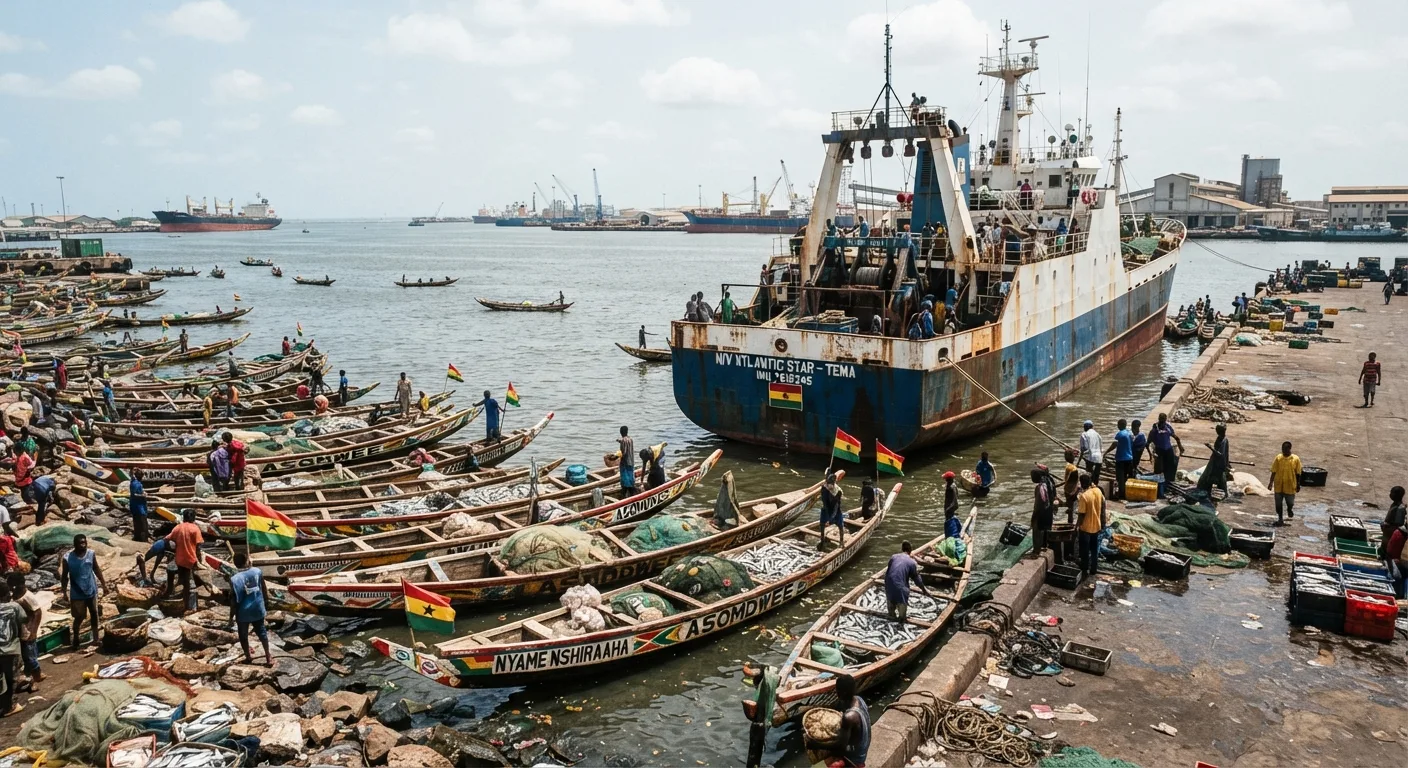
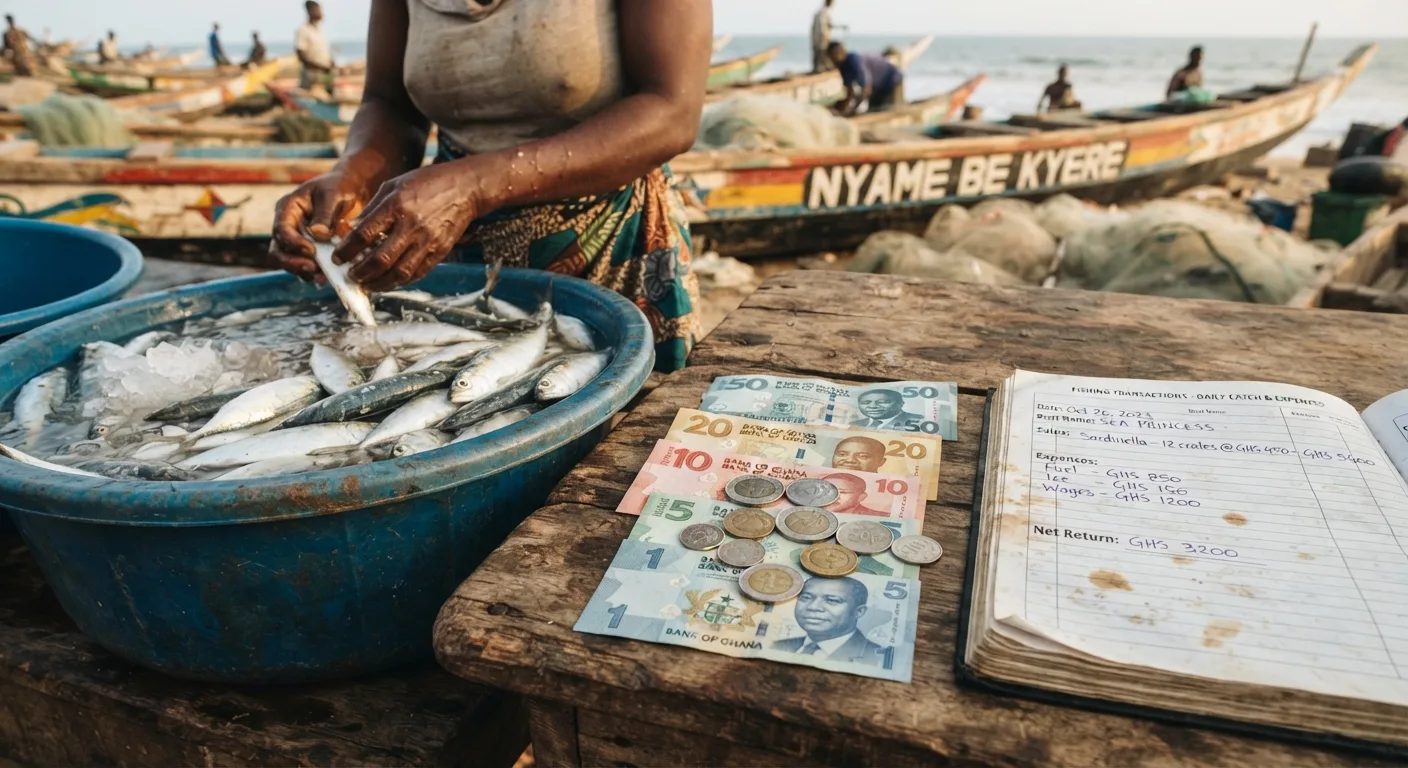
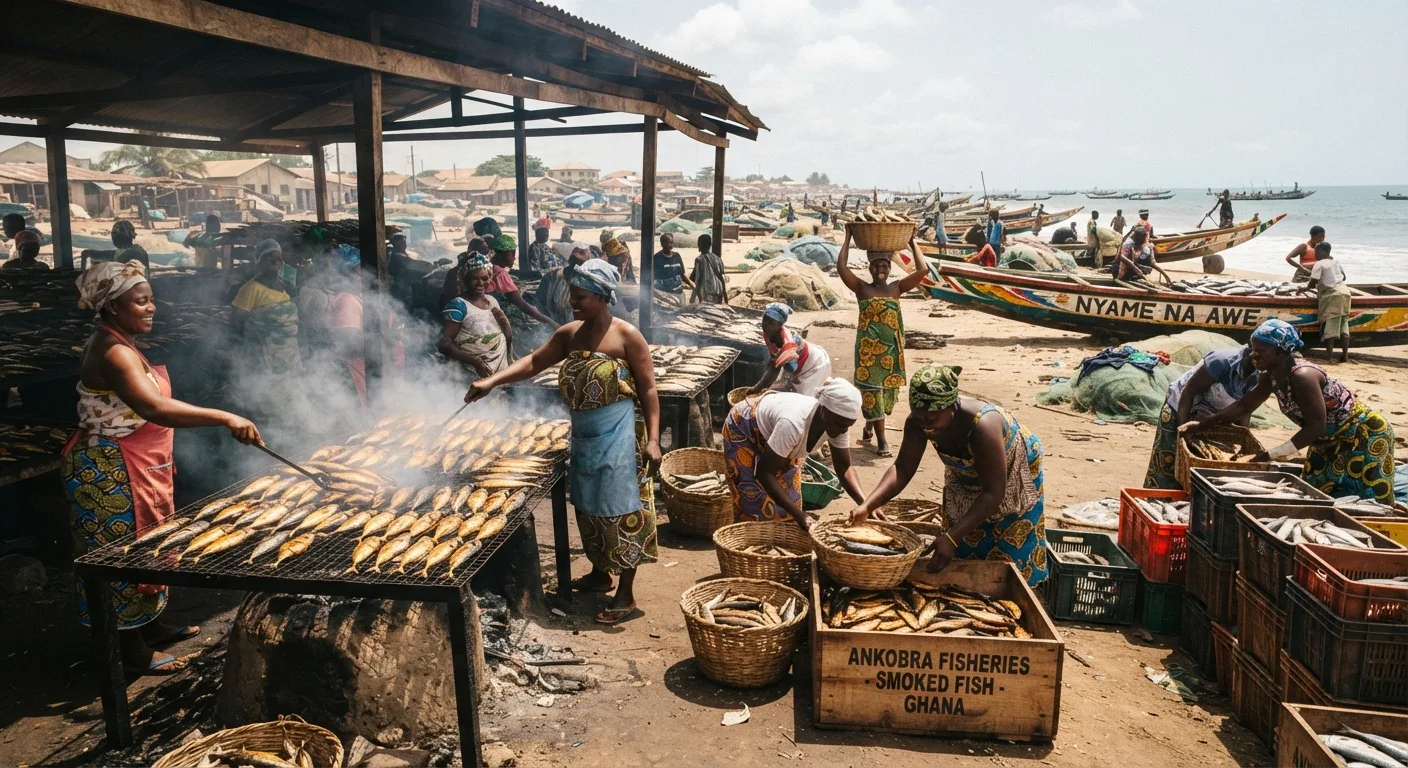
Ghana's marine landings were worth GH¢9.82 billion at first sale in 2023, but the small pelagic stocks are overfished and much of the value is lost after landing. Grading, ice, clean smoking, price data and certified tuna supply are where an operator turns catch into margin.
What it takes
GHS 0 to 222,000
An indicative range at 2026 prices: an improved smoking oven at the low end, a purse seine canoe with a 40 hp motor and net at the top. First revenue in about 1 to 3 days (a trip or a smoking cycle).
Market signal
GHS 0.00 bn landed value (2023)
Disease, price and policy risks are set out section by section below.
🔑 The thesis
Ghana’s marine fishery is a shared wild stock being taken faster than it grows, so the constraint on any business moves off the water and onto the shore: into grading, cold chain, clean processing, finance and data.
Marine fisheries at a glance
The numbersThe numbers a student, entrepreneur or investor should carry into the pillars, each unpacked with its source inside.
0 t
Marine fish landed in 2024, up from 425,424 tonnes worth GH¢9.82 billion in 2023
Ministry of Fisheries and Aquaculture, 2025; Fisheries Commission, 2024
0%
Of the biomass for maximum sustainable yield: the combined small pelagic stock in 2019
Lazar et al., 2020
0.0%
Tuna's share of landings by weight, but 34.6% of value
Fisheries Commission, 2024
0.0%
Of production lost after landing, 95% of it from the marine sector
Fisheries Commission, 2024
2016
The year of the last full canoe census
Dovlo, Amador and Nkrumah, 2016
2021
The newest data behind a stock assessment: the 2022 regional small pelagic assessment
CECAF, 2023
Jan 2026
MSC certification of Ghana's purse seine and pole-and-line tuna fleets, valid to January 2031
Marine Stewardship Council, 2026
Apr 2026
Ghana's first marine protected area, declared at Busua
Ministry of Fisheries and Aquaculture, 2026
Figures are as reported between July and September 2026 and may have changed since.
🎯 The five openings
01
Loss reduction and cold chain. Recover the roughly one fifth of catch lost after landing, in a resource that cannot be made to grow (Pillars 1, 5, 6).
02
Grading and traceability. Build the price-for-quality signal the chain currently lacks, and the paper trail export buyers already require (Pillars 2, 6, 7).
03
Alternative bait supply. Serve the tuna fleet's live-bait need without drawing further on a collapsing sardinella stock (Pillars 1, 4).
04
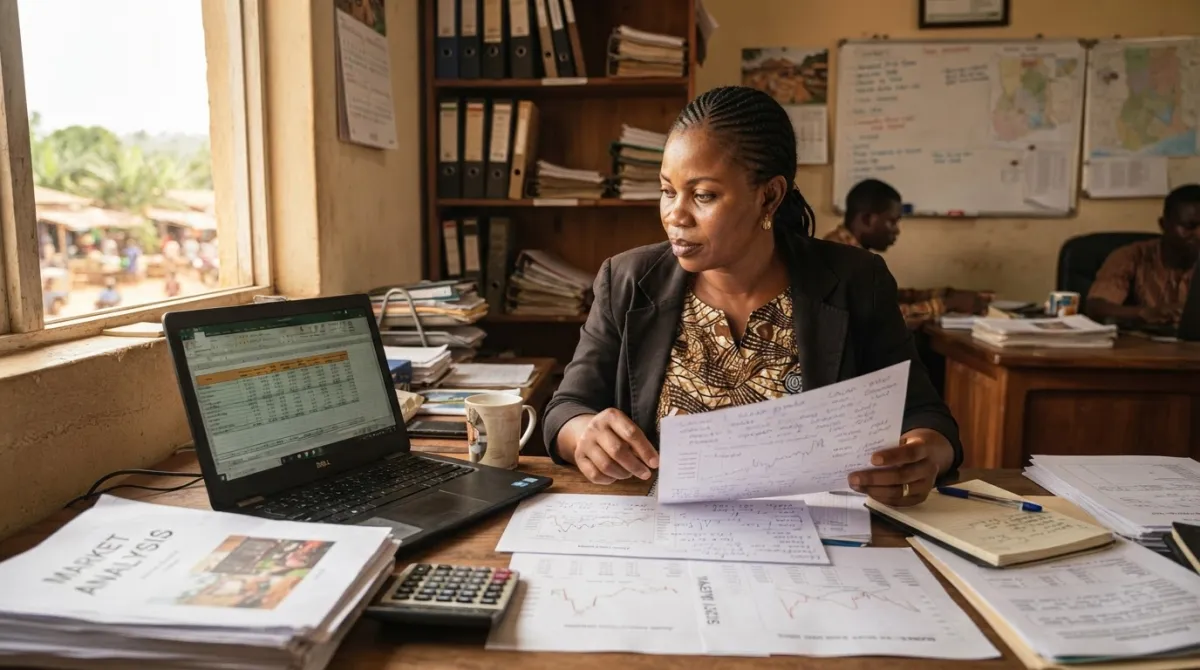
Data and price services. Sell current landing, price and licensing information in a usable form, a gap several buyers in this chain would pay to close (Pillars 1, 7).
05
Working-capital finance. Replace buyer credit that locks in an underpriced catch with a financing product built for the chain's real cash-flow pattern (Pillars 5, 6, 8).
Footnotes
- Wabnitz, Colette C. C., and Vanessa F. Jaiteh. Gender and Fisheries: Ghana. Country Fact Sheet. Ocean Risk and Resilience Action Alliance (ORRAA), 2025. https://oceanrisk.earth/wp-content/uploads/2025/11/Ghana-fact-sheet.pdf.↑

Every stage is a business of its own. Find the one that is yours.
The biggest returns rarely sit in production. Read the playbook section by section to see where the real value is.
The playbook, section by section
8 sectionsSix content pillars plus market intelligence and a strategic outlook. Open any section.
Take a playbook with you.
DownloadsEvery entry ships as a full playbook, a value chain analysis, an investor snapshot and a set of risk cards.
Full Playbook
All eight content pillars, data tables, diagrams and market summaries.
PDFDownload Marine Fisheries playbook↓Value Chain Analysis
A mapped breakdown of the value chain, from farmgate to export, and who captures what along the way.
PDFDownload Marine Fisheries value chain analysis↓Market Opportunity Snapshot
A market opportunity brief covering demand, pricing and entry points.
PDFDownload Marine Fisheries snapshot↓Disease & Risk Cards
Quick-reference disease and risk profiles for the whole entry.
PDFDownload Marine Fisheries disease & risk cards↓Read across the whole series.
Series guidesFour companion guides that sit above the eleven playbooks. Start with the overview, then use the other three to find your place in the chain and take your first step. Figures are as reported between June and September 2026 and may have changed since.
Series Overview
The capstone of the series. All eleven commodities read side by side on market size, value leakage, returns, risk and ease of entry.
PDFDownload series overview↓The Entry Playbook
How to actually start an agribusiness in Ghana: registration, licences, land, money and your first 180 days.
PDFDownload entry playbook↓The Career Compass
A student's guide to where you fit across the eight stages of the chain, with the jobs, ventures, skills and starting budgets at each.
PDFDownload career compass↓The Opportunity Atlas
Every business opening across the eleven commodities, regrouped by chain stage so you can see where the money actually sits.
PDFDownload opportunity atlas↓