Ghana Agribusiness PlaybookMarine Fisheries
Three fleets, one coastline, three different entry prices.
Marine Fisheries · Pillar 04

Production Systems

Ninety-eight of every hundred boats here are canoes, yet the state raised just GH¢189,767 licensing the entire 258-vessel middle fleet in 2023, against GH¢57.65m from 74 industrial vessels. Three fleets, three businesses, three very different entry prices.
Production Systems · Pillar 04

Three fleets on this coastline are three separate businesses. Ninety-eight of every hundred boats are canoes, and a canoe is not one asset but three, often owned by three different people who split the catch by an unwritten rule. The middle fleet is the only motorised one a Ghanaian can buy outright, and the state charges it almost nothing. The top fleet is not entered but partnered into. Almost every commercial opening here sits beside a fleet, not inside one.

Three Ghanaian fishing fleets together at a harbour at dawn, painted canoes drawn up on the beach, a semi-industrial vessel moored mid-water and an industrial trawler at the quay behind, documentary photograph
Three fleets, one coastline
The second decision: which fleet a proposal actually sits beside.
98%
of hulls are canoes, landing just over half the fish by value
GH¢189,767
raised licensing the whole 258-vessel semi-industrial fleet in 2023
GH¢57.65m
raised from 74 industrial vessels the same year

🐟 Three fleets, three businesses, one ministry 🐟

The three fleets differ in fish, gear and law, and only one has an entry price a Ghanaian saver could meet. Landings split artisanal canoes 54.3 per cent, tuna 28.5, industrial trawl 12.5 and semi-industrial 4.7, recomputed against the Commission’s own stated total1, so about 98 per cent of the hulls land about half the fish, fewer than a hundred industrial and tuna vessels landing nearly as much.

Two boundaries moved this year, both in Pillar 3. The line that kept trawlers off the canoe grounds has lapsed: the repeal of the 2002 Act extinguished the zone that statute had declared outright, which reached to the 30 metre isobath or six nautical miles offshore, whichever was farther, and no replacement zone had been designated and gazetted in its place2. The 2026 closed season then bound every fleet but the canoes, which now fish all year with no statutory boundary.

What this means. Fix which fleet a proposal touches first: the answer sets the law, customer, financier and entry price. Every industrial company but one was entered through a foreign partner, so anything sold to that fleet is a service, not a stake.

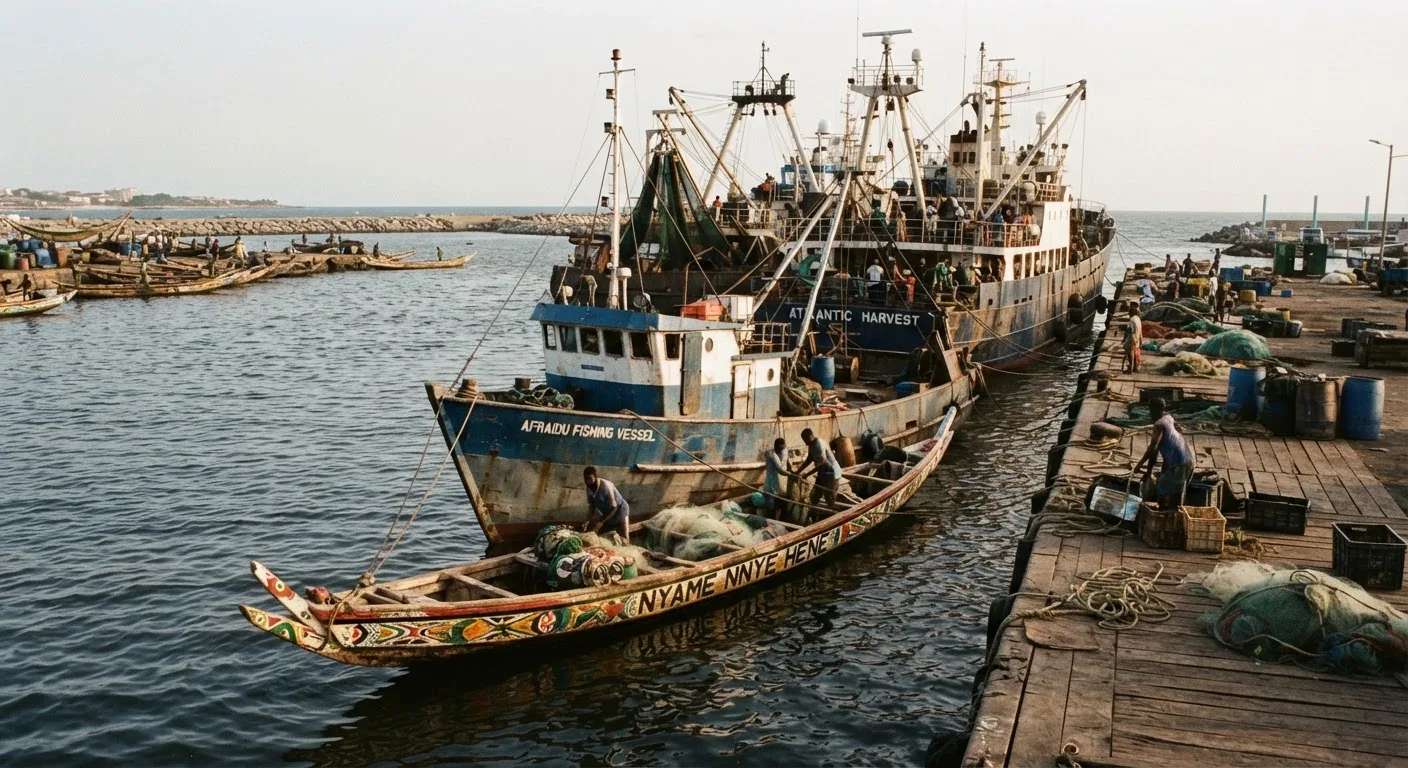
Three Ghanaian fishing vessels of different scale moored side by side, a canoe, a semi-industrial boat and an industrial trawler, showing the size contrast, documentary photograph
One ministry, three worlds
Three fleets: different fish, gear, law and entry price.
Table 8: Ghana's three marine fleets, on the measures that decide entry
Artisanal canoeSemi-industrial (inshore)Industrial
How many, and on what basis11,583 counted on the beach in 2016; 12,175 preliminary in 2022; 13,700 registered; 14,031 in a 2026 administrative count268 in 2009 of which 226 operational; 258 licensed in 2023; 224 in 202674 licensed in 2023, down from 106; 68 in 2026
What the boat isWooden dugout, 4.5 m to 20.5 m depending on gearLocally built wooden or small steel vessel, 9 m to 12 m, 30 to 90 hp dieselSteel trawlers, tuna purse seiners and pole-and-line bait boats
Gear it carriesPurse seine, set net, line, beach seine, ali net, drift gill netTrawl and purse seine, worked seasonallyBottom trawl; tuna purse seine; pole and line with a live bait fishery
Where it worksInshore, historically inside the 30 m depth zone and well beyond it in practiceInshore at 30 m to 50 m, in direct competition with canoesOffshore, and across the eastern Atlantic tuna grounds
Who owns itFamilies, with hull, net and engine often in separate handsGhanaian owned, because the licence cannot issue otherwiseMostly joint ventures with a foreign counterpart
What the state requires, and what it givesRegistration and embossment, and in return a premix allocationA licence fee set by vessel lengthA licence fee of US$135 per gross tonne
What a newcomer can buyA share of a hull, a net or an engineA whole vessel, and this is the only fleet where that is realisticNothing directly; entry is a partner, a supply contract or the shore

Sources: Fisheries Commission, Dovlo et al. (2016); Fisheries Commission (2023); Osei-Bonsu, Fisheries Commission (2026); Drury O'Neill et al. (2018); Samey (2015) for the semi-industrial vessel specification and the 2009 vessel counts; Fisheries and Aquaculture Act 2025, section 58(4). Counts on four different bases are shown separately and are not averaged.

🐟 The canoe fleet: what it is, and what it is as an asset 🐟

The census classifies canoes by gear, so a buyer sourcing small pelagic fish deals with the 3,346 purse seine and 1,052 ali canoes, four thousand hulls, not fourteen thousand. Over 50 service canoes carry no gear and bring fish ashore from industrial vessels3.

Two table movements are signals: ali net canoes fell 43.8 per cent in three years, tied to the round sardinella collapse, while line canoes, the only class icing catch at sea, rose nearly a fifth. Landings run Western 38.6 per cent, Greater Accra 27.9, Central 23.3 and Volta 10.24, canoes at 4,044 in Western against 1,051 in Volta, motorisation 85 per cent in Greater Accra against 56 in Volta. A landing-side business trades volume in the west against proximity to the largest market in the east.

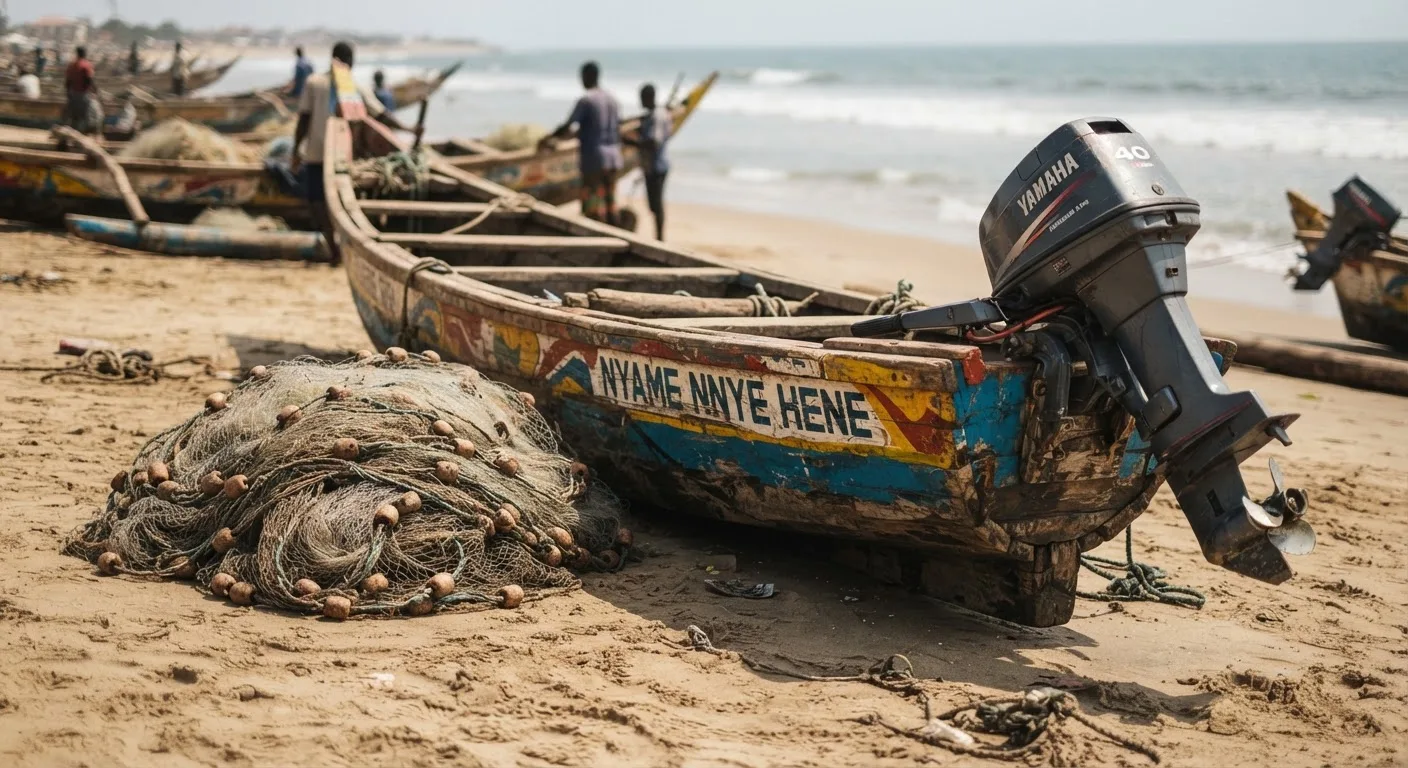
The thing to understand before buying anything. A canoe is three assets. Hull, net and motor are bought and owned separately, often by three people, so a newcomer can hold one component, not a boat. Each return is set by custom, not contract.

Close view of a Ghanaian fishing canoe on a beach with its hull, net and outboard motor visible as separate pieces of equipment, documentary photograph
Three assets, one hull
Hull, net and motor: bought, owned and paid separately.
Table 9: The canoe fleet by gear, and what moved between the last two censuses
Canoe class by gearNumber, 2016 censusChange on 2013Typical lengthWhat it lands
Set net3,729down 9.0 per cent7.1 to 9.2 mMixed demersals and lobster
Purse seine (poli and watsa)3,346up 8.5 per cent13.0 to 20.5 mSardinella, anchovy, chub mackerel
Hook and line (lagas)1,344up 17.7 per cent15.0 mHigh-value demersals, iced at sea on 2 to 4 day trips
Beach seine1,084up 0.9 per cent8.6 to 11.5 mMixed inshore catch including juveniles
Ali net1,052down 43.8 per cent13.0 to 20.5 mSardinella, off the main season
Drift gill net836down 14.3 per cent12.0 to 19.0 mSkipjack, swordfish, sailfish
One man192down 60.1 per cent4.5 to 4.8 mSet net or handline
All canoes11,583down 9.0 per cent9,122 outboard motors, 79 per cent motorised

Source: Fisheries Commission, Dovlo et al. (2016), Tables 4.3, 4.5 and 4.7. Both counts are beach censuses. Lengths are Table 4.7.

🐟 Who takes the fish: the share system, and the half nobody wrote down 🐟

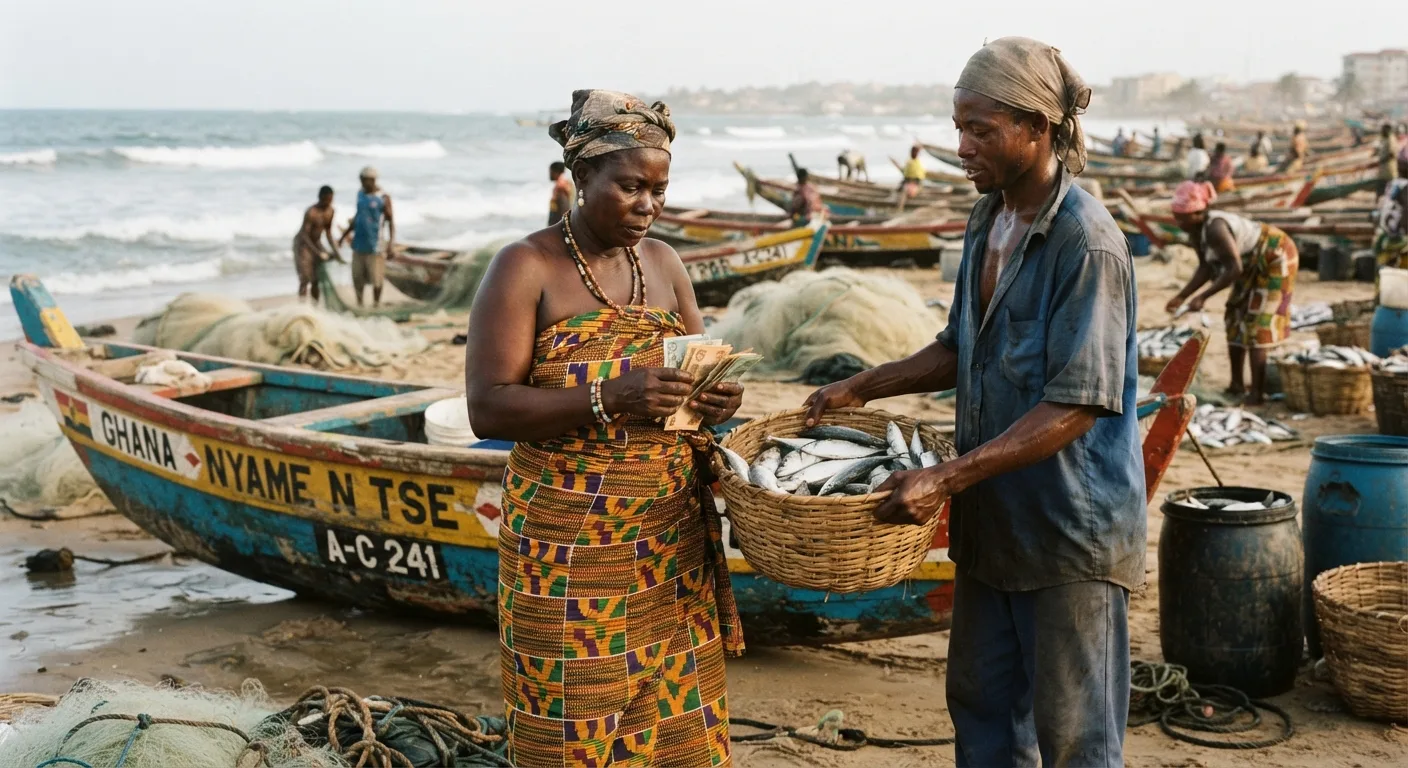
A Ghanaian woman fish trader beside a canoe at a landing beach, counting cedi banknotes while a fisherman hands her a basket of fish, documentary photograph
Who finances the fleet
Credit against the next catch: resource risk without holding the asset.
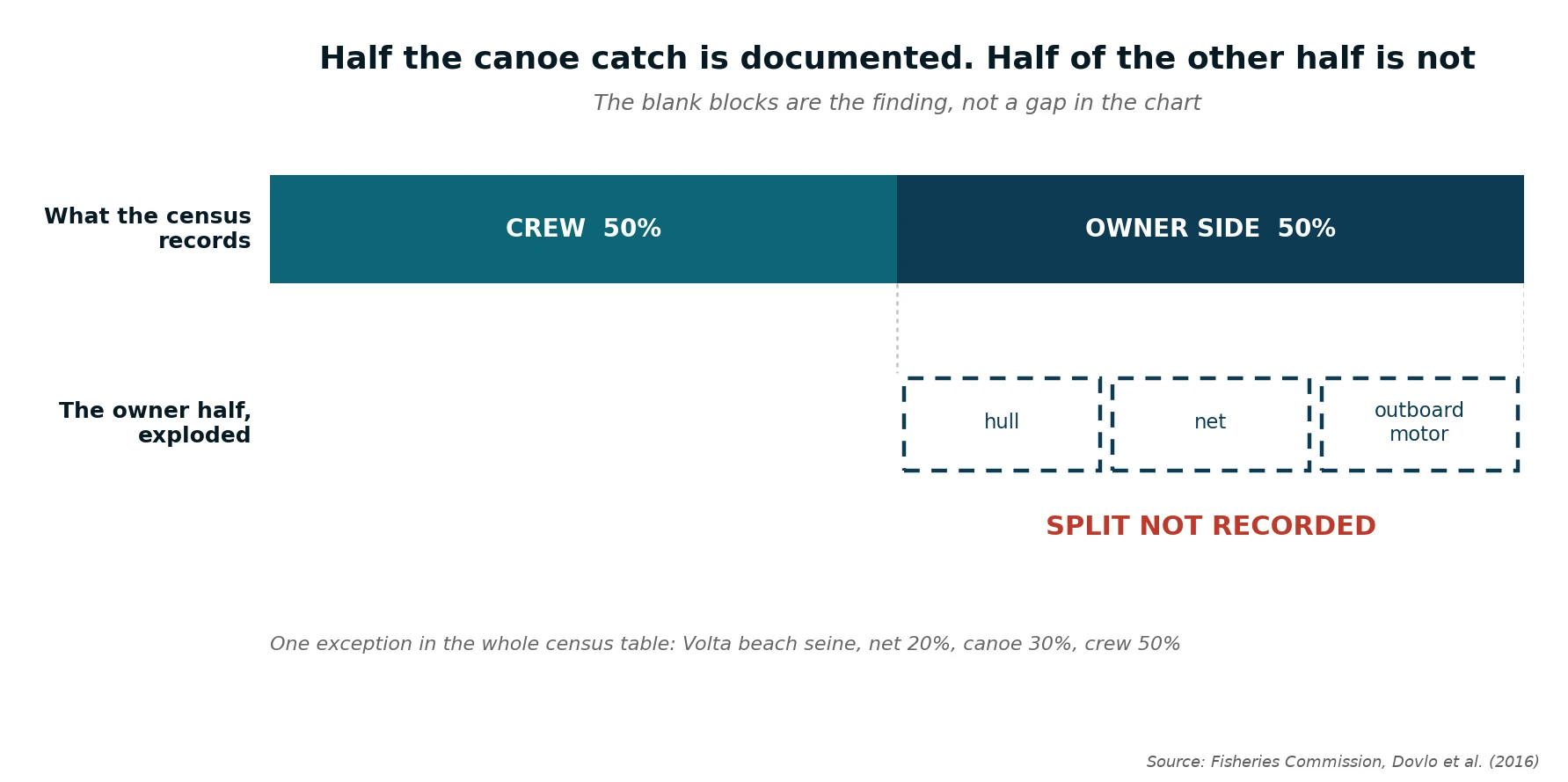
The documented half of the canoe share system, crew 50 per cent and owner side 50 per cent, and the undocumented split of the owner half between hull, net and outboard motor
Figure 9 The documented half of the canoe share system, and the half that is not

Nobody in this fleet is paid a wage. Across all four coastal regions and every gear type the 2016 census recorded one split, 50 per cent to the crew and 50 to the owners of craft, net and motor, the single exception the Volta beach seine at 20 to the net, 30 to the canoe5.

Two readings of that share sit on different bases. The census gives the owner side 50 per cent of the catch; a survey of 70 canoe owners gives labour 50 per cent of revenue after operational costs6. This pillar uses the census; Pillar 5’s cost model runs the higher reading, a difference of about GH¢55,000 a year to the owner.

The record gap matters more than the disagreement: no source says how the owner’s 50 per cent divides between hull, net and engine when three people own them, the number an outside financier most needs. That is where the women financing the fleet sit. There are an estimated 99,642 women active across Ghana’s fisheries value chains in 2016, a national count spanning the inland and marine chains alike7, a national figure, not a marine canoe one. Ghanaian women own canoes and gear and fund trips outright, and in parts of Central the Konkohemaa has owned boats and taken a share8, most of it as credit against the next catch, carrying resource risk without holding the asset.

The missing document that unlocks the asset.Write the share agreement down and the component becomes financeable. A one-page contract between engine, net and canoe owners stating each party’s percentage of the owner half, signed before the chief fisherman, is what a lender, leasing company or outboard dealer needs before offering better than cash against fish. No such instrument appears here.

🐟 The semi-industrial fleet: the only one you can buy, and it is not growing 🐟

A semi-industrial fleet works the upwelling seasons at 30 m to 50 m for the same sardinella and chub mackerel as the canoes. The rule that matters is licensing: the Commission may not license a Ghanaian semi-industrial or artisanal vessel unless owned by a citizen, or a company whose shares are all beneficially held by one (Fisheries and Aquaculture Act 2025, section 58(4)). That provision, not the boat, makes this the only motorised fleet a Ghanaian buyer can hold outright. Pillar 8 carries the regime.

The segment has been flat for two decades and is close to free to hold. Licensing the entire fleet raised GH¢189,766.50 in 2023 while 74 industrial vessels raised GH¢57,653,238.14, so three and a half times as many vessels pay about a three-hundredth as much, about GH¢736 a vessel against about GH¢779,098, on landings barely moved at 20,193.58 tonnes against 19,950.70 the year before9.

The segment nobody is looking at.A fleet flat in numbers, small in landings and almost free to license is either dead or underpriced. The vessels are locally built, repairable, and work the canoes’ seasonal runs without the beach-landing constraint. The first question is why 42 of 268 vessels sat non-operational at the last count reporting both, since the answer is capital, crew or fish and only one is fixable with money.

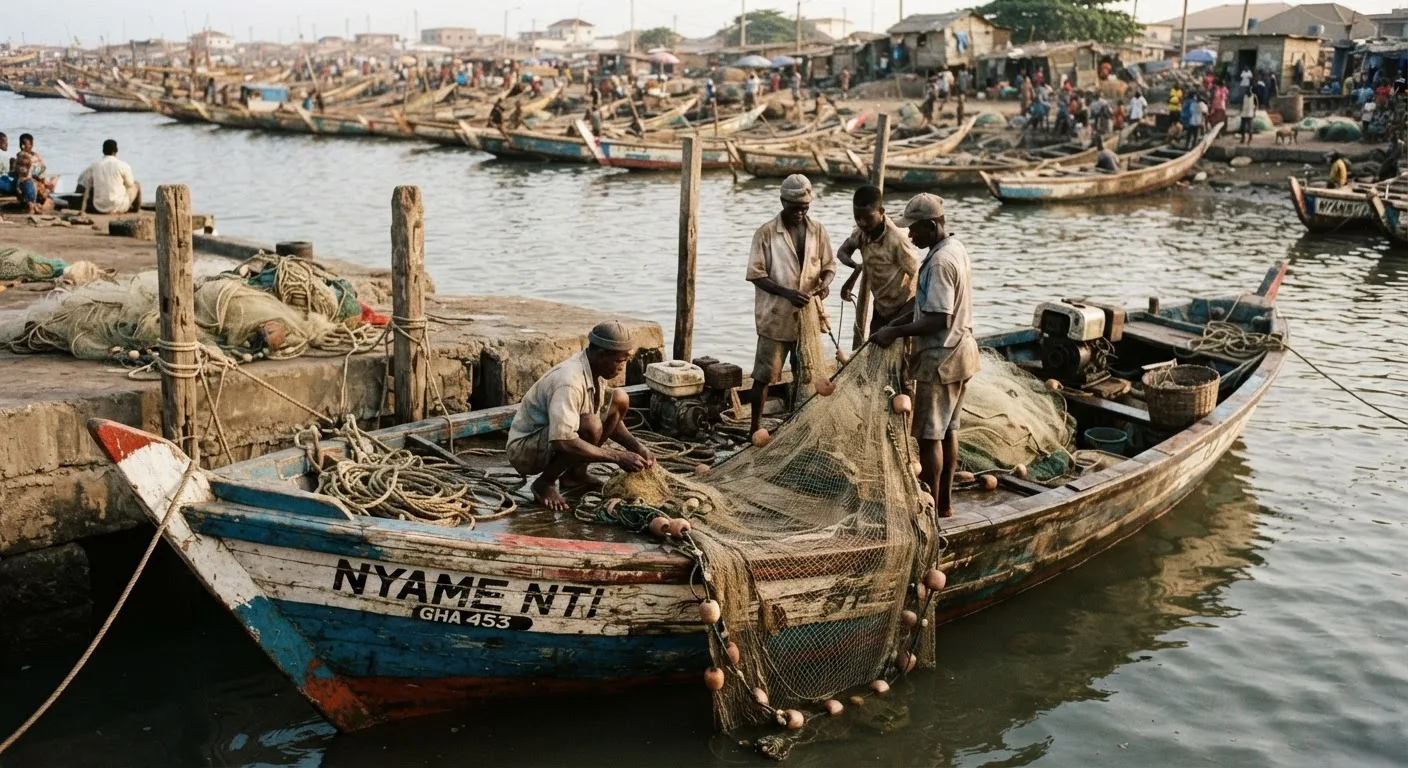
A small Ghanaian semi-industrial fishing vessel, locally built, moored at a modest inshore harbour, crew preparing trawl net on deck, documentary photograph
GH¢736
licence fee per semi-industrial vessel, about
GH¢779,098
licence fee per industrial vessel, about

🐟 The industrial fleet: a licence, a partner and a flag 🐟

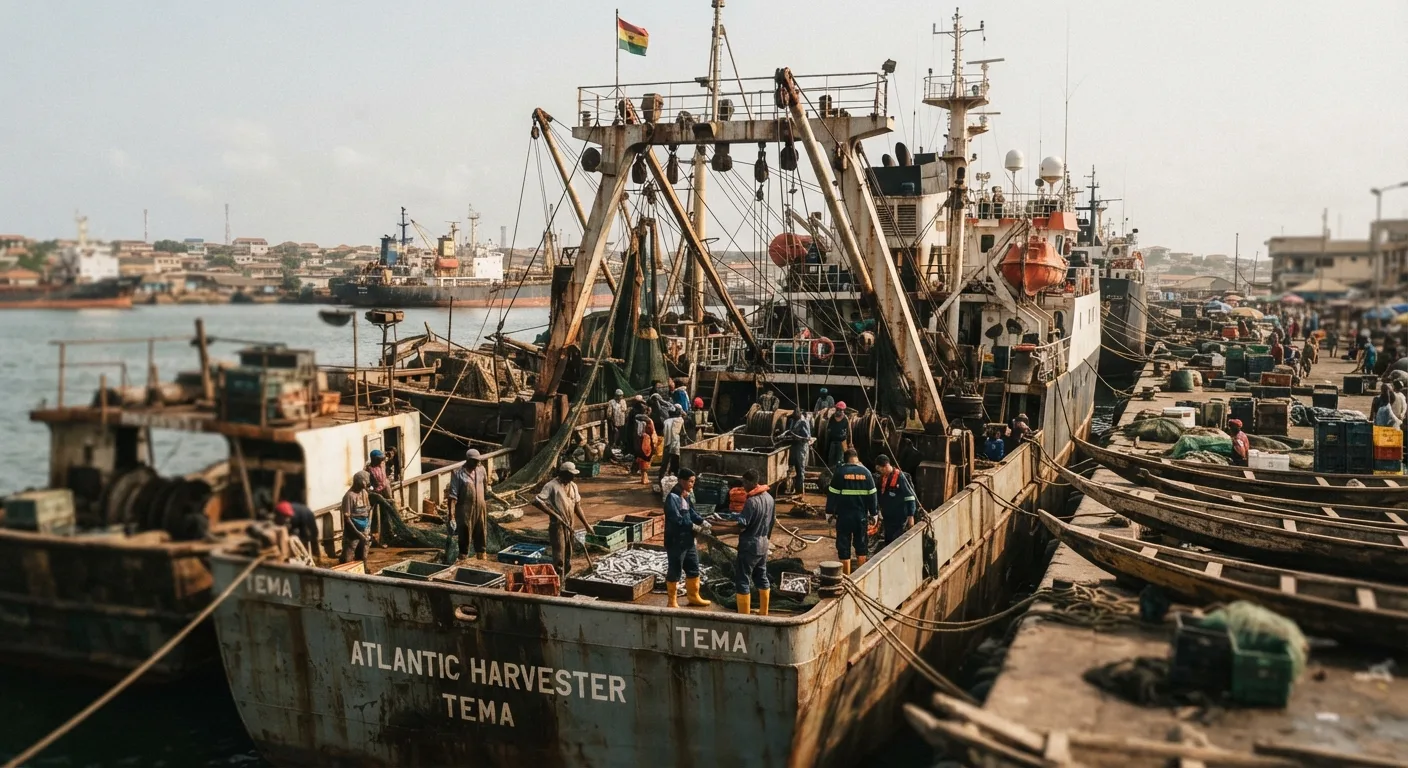
A large industrial fishing trawler flagged in Ghana docked at Tema harbour, a mixed Ghanaian and foreign crew working on deck, documentary photograph
Ghanaian flag, foreign bridge
Entered by negotiation: the licence and flag are Ghanaian, the command is not.
74
licensed industrial vessels in 2023, down from 106
68
in the 2026 count

The top fleet is small, foreign in capital and entered by negotiation. The 2023 register carried 74 licensed industrial vessels, down from 106 the year before10, 41 trawlers and 32 tuna vessels, and the 2026 count 68. Licences cost US$135 per gross tonne, so tuna vessels of 298 to 2,500 gross tonnes pay 77.4 per cent of industrial licence revenue from fewer than half the hulls. A licensed count is not an operating count, four vessels suspended for twelve months from 1 April 2025 for reasons Pillar 3 takes up, so model trawl supply from the quarterly licence tables.

The wage ladder has a rung missing: Ghanaians served almost entirely as fishers while captains, chief officers and first engineers were foreign, baseline pay per trip US$2,000 to US$5,000 for a captain against US$100 to US$200 for a fisherman11. The fieldwork is early-2010s and nothing suggests change.

One trend decides how many Ghanaians the fleet employs. The same study counted 19 pole-and-line bait boats against 16 purse seiners and a shift towards purse seining, bait boats older, slower, about 37 per cent more costly a tonne and 35 to 45 per cent thinner in margin. The counts disagree: the 2024 pole-and-line fishery improvement project listed three vessels, all Ghana flagged12, while trade press alongside the January 2026 certification puts the Ghana Tuna Association at 20 pole-and-line vessels and 17 purse seiners, no retirement. What is evidenced is a cost disadvantage, not a fleet decline. That certification records certification of Ghana’s Atlantic skipjack and yellowfin tuna fisheries to the Marine Stewardship Council standard, covering both the purse seine and the pole-and-line fleets13, so purse seining costs Ghana neither certificate nor buyer, only jobs.

Table 10: Who is licensed, and who pays for it
Vessel typeLicensed 2022Licensed 2023Licence revenue 2023 (GH¢)Share of revenue
Trawler704110,649,05518.5 per cent
Tuna, Ghanaian flagged232230,329,94652.6 per cent
Tuna, foreign flagged121014,264,77824.7 per cent
Support carrier or supplier112,409,4594.2 per cent
All industrial vessels1067457,653,238100 per cent
All semi-industrial vessels218258189,767for comparison

Source: Fisheries Commission (2023), Tables 2.11, 2.13 and 2.14. The fee was US$135 per gross tonne in both years, so the 43 per cent rise in cedi revenue on a smaller fleet is an exchange rate movement, not a fee increase. The report's summary page states the fall in licensed vessels as 62.4 per cent where its own table gives 30.2 per cent; the table figure is used here.

The crew-intensive half of the tuna fleet.The crew-intensive, more selective half of Ghana’s tuna fleet is the half operators have cost reasons to leave, and with both halves certified nothing in the market stops them. Ghana keeps the tonnage and certificate and loses the jobs and selectivity a European buyer thinks it is paying for. Ask how many pole-and-line hulls will still be fishing at the first surveillance audit; the public counts disagree.

🐟 Premix fuel: a distribution system before it is a subsidy 🐟

Premix is petrol blended with two-stroke oil, sold to canoe fishers below pump price, the largest transfer the state makes to this fleet and the reason boats accept registration, embossment and the identification card by which the Commission counts them.

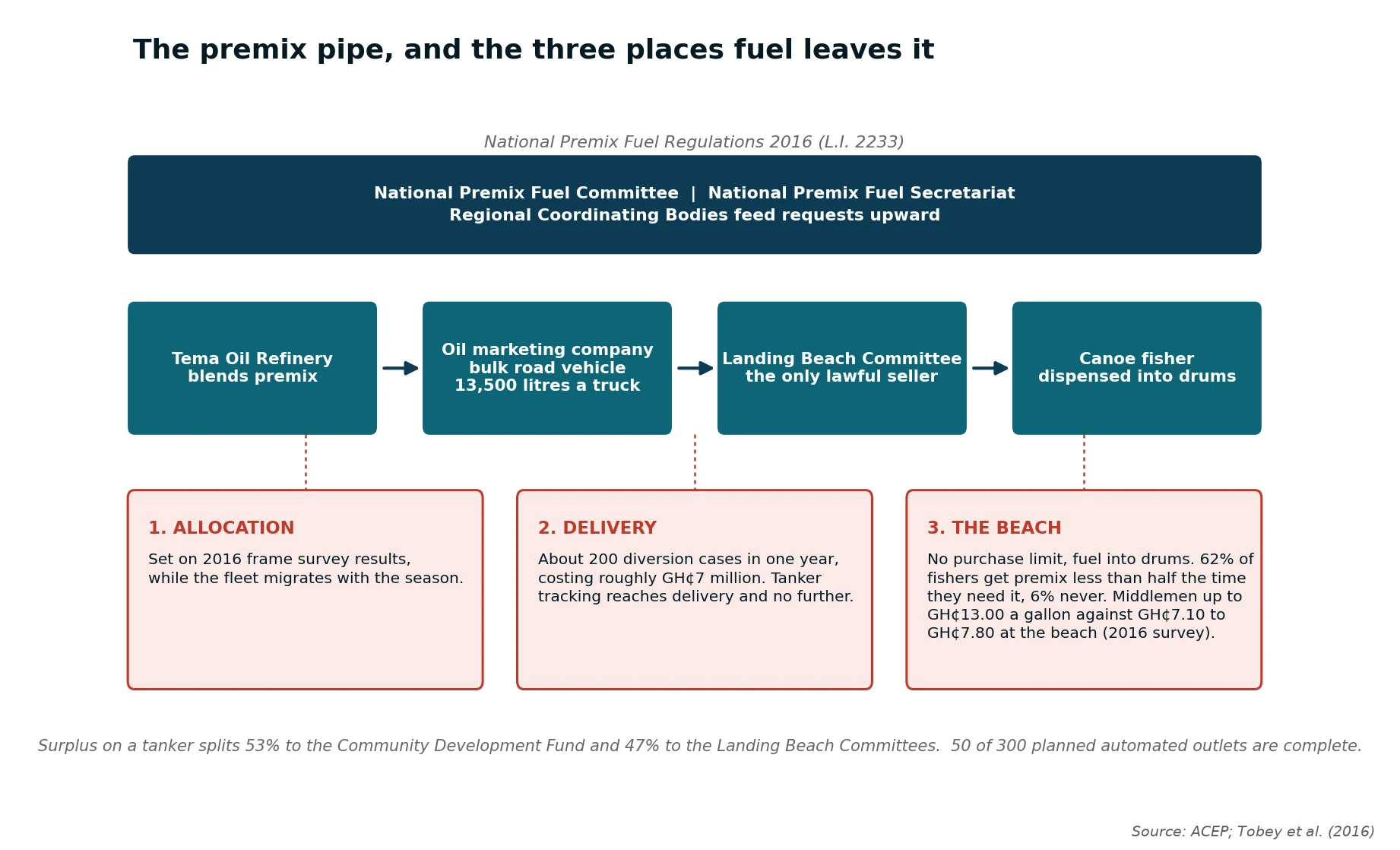
Under the National Premix Fuel Regulations, 2016, a Landing Beach Committee is the only lawful seller at each site, allocation follows frame survey results, and each committee adds a margin of which 53 per cent must fund community development. A shortage when fishers follow a season is structural, the allocation count dating from 2016, and the committee is at once fuel monopolist and development fund.

The premix pipeline from Tema Oil Refinery through the oil marketing company and Landing Beach Committee to the canoe fisher, and where the fuel leaves the pipe at allocation, delivery and the beach
Figure 10 The premix pipe from refinery to canoe, and where the fuel leaves it

The 2026 directive attaches that margin to a tanker load and names the other half for the first time, specifying 53 per cent of the surplus on a 13,500 litre tanker to the Community Development Fund and 47 per cent to the Landing Beach Committees14. Nearly half the surplus on every tanker is discretionary local revenue, so any project proposed at that beach competes with the committee’s own uses for the same money.

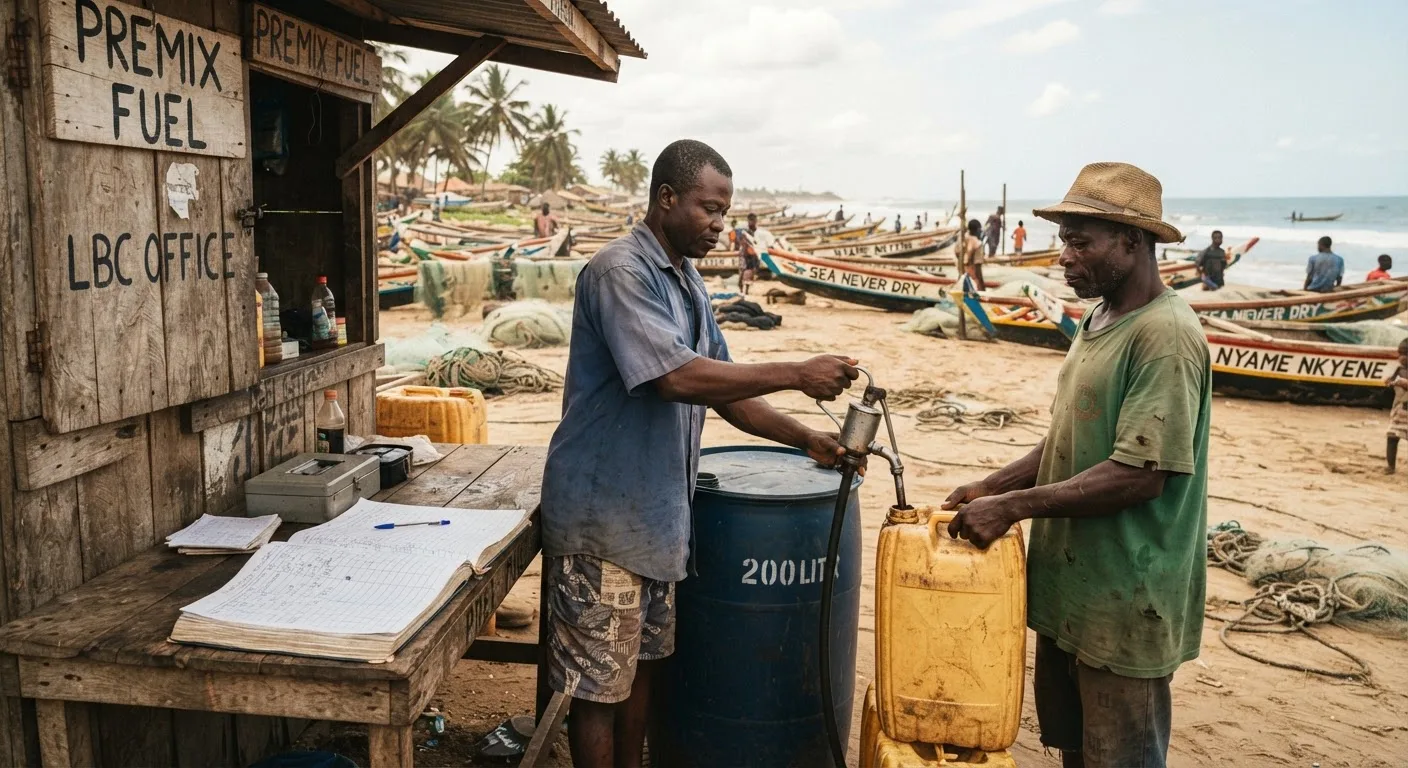
A Landing Beach Committee attendant dispensing premix fuel from a drum into a jerrycan at a wooden kiosk on a Ghanaian beach, a ledger on a table beside them, documentary photograph
Fuel monopolist and development fund
One lawful seller a beach, and no limit on how much one buyer may take.

The system fails in the last hundred metres, where fuel goes into drums with no limit on how much one buyer may take. Field survey work found 41.2 per cent of fishers always getting premix when needed, 62 per cent less than half the time and 6 per cent never15. A nationwide accountability exercise with district chief executives has run since March 2026 and published no outcome.

The entitlement is now priced, and Pillar 5 carries that price. Two movements are not in doubt: subsidy was cut from 85 per cent to 50 between 2022 and 2023, and the metering meant to replace discretion has civil works finished at 50 of 300 planned outlets, 17 per cent complete16. Stalled there, it splits beaches in two, fuel moving from the unmetered to the metered.

Action points. Before committing to a landing site, check three fuel facts: whether it has a working automated outlet, how many days a month it has premix, and the beach price the last day it did. None is published; all can be had in an afternoon from the committee and three canoe owners. A site dry a third of the year cannot supply a line on schedule.

🐟 Where the fleets come ashore, and what that costs them 🐟

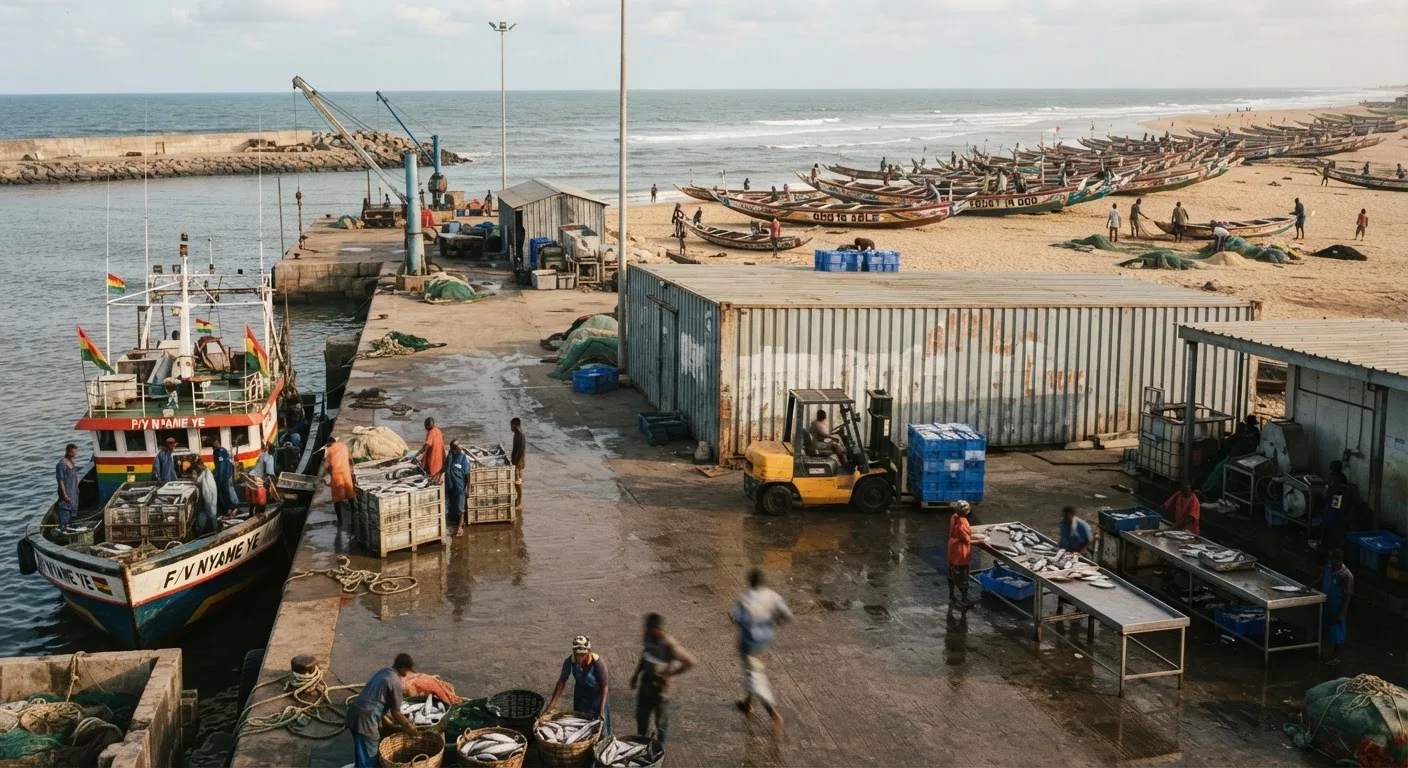
Where a fleet lands decides its fate, and the canoe fleet’s disadvantage is physical. Ghana has four fishing harbours: Tema at about 40 hectares, serving all three fleets with berths, cold storage and processing; Albert Bosomtwi-Sam at Sekondi at about 16; Elmina at about 13; and Jamestown in Accra at 4 to 5 hectares with a 200-capacity fish market, a 60 tonne ice plant and a 200 tonne cold store. The rest, most of 263 landing beaches, is open beach without jetties, sanitation or waste management, some with no electricity or preservation.

Nor is a landing site permanent: the census blames beaches lost between 2013 and 2016 on coastal erosion, sites in Central and Western going inactive as canoes migrated. The canoe fleet landed 230,892.55 tonnes, worth GH¢4.61 billion17 across roughly 263 to 292 points on an open coast, almost none with ice. Fish is not short; what is short is anywhere to hold it long enough to sell to someone other than whoever stands on the beach.

A modern concrete fish harbour quay with cold storage sheds in the foreground and an open sandy beach with canoes and no shelter in the distance, showing the contrast in landing infrastructure, documentary photograph
4
fishing harbours against 263 open landing beaches
230,893 t
canoe landings worth GH¢4.61 billion, almost none with ice
Table 11: Ghana's landing infrastructure, sorted by what a business can do
TierSitesCold chainWhat a buyer can do there
Industrial harbourTema; Albert Bosomtwi-Sam, SekondiStrongest capacityHold volume to a schedule
Modern harbour and processing hubElminaModerate cold storage and refrigerated processing, insufficient for artisanal landingsRun a mid-size line, once capacity is verified
Beach with government refrigerationShama, New Takoradi, Half Assini, Kormantse, Nyanyano, PrampramExists but limited in scaleHold a day's catch, not a week's throughput
Beach with small private cold storesNungua, Axim, Cape CoastSmall private units, constrainedPartner with an operator already there
Beach with little or noneWinneba, Apam, Mumford, Keta, Ada and much of the Volta coastNone functionalSmoke, salt or sell at once, so the price is taken and not made

Source: Osei-Bonsu, Fisheries Commission (2026), presented to the ATLAFCO Blue Ports workshop, Tangier, 4 to 6 March 2026. Ports or landing sites are under construction or upgrade at Axim, Dixcove, Winneba, Senya Beraku, Gomoa Fetteh, Moree, Mumford, Teshie and Keta.

🐟 The risks that sit inside the fleets 🐟

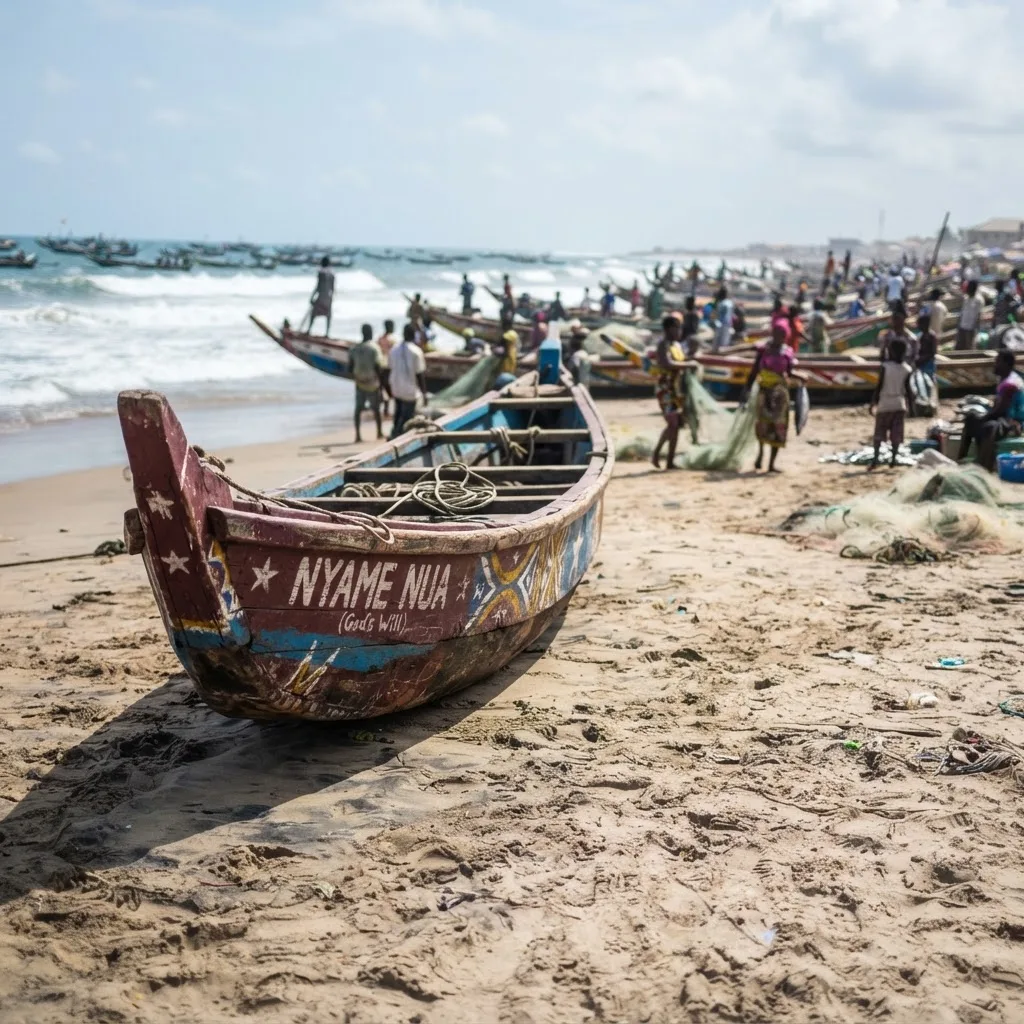
A painted wooden fishing canoe named Nyame Nua hauled up on a crowded Ghanaian beach, crew and nets in the background

Buying the boat instead of the position

HIGH
What it is

A canoe is a depreciating wooden hull working a declining stock, and the asset first-time entrants buy because it is the one they see. Owning the hull carries neither net, engine nor crew relationship, and the customary share pays the owner side as a bundle without saying how it divides.

Evidence

The 2016 census records the owner side at 50 per cent and the crew 50 across all four coastal regions and all gear types, the internal split shown in exactly one row18. A second source puts labour at 50 per cent of revenue after operational costs, a different basis19.

Who it hits

First-time entrants, diaspora investors buying a boat for a relative to operate, and any lender asked to finance a canoe, net or outboard motor.

How to manage it, and the opening

Do not buy a hull as a first position. If you buy a component, take the one with the shortest life and clearest replacement demand, and put the split in writing before money moves. Ask what percentage of the owner half it earns; if nobody can answer, hold off. The opening is the written agreement: whoever standardises it creates the fleet's first financeable cash flow.

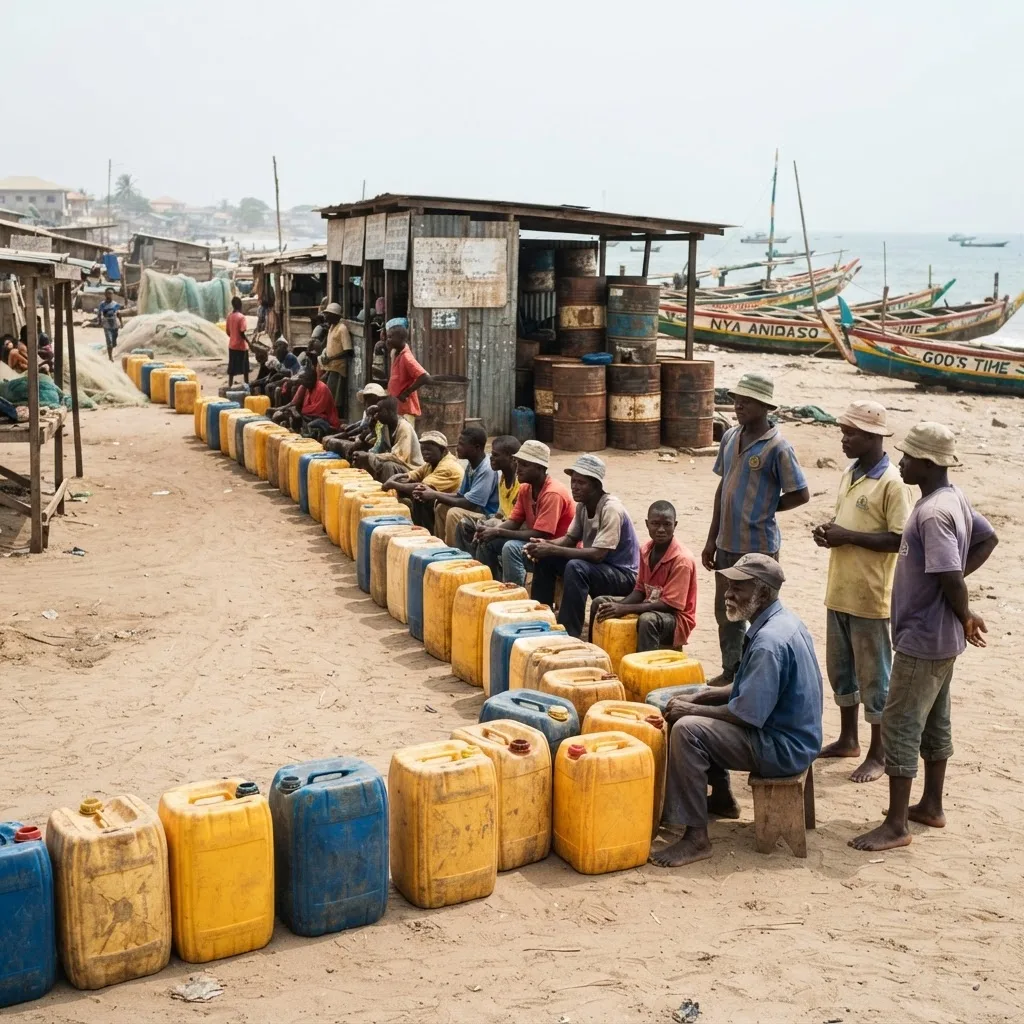
A row of fishermen seated beside a long line of yellow and blue fuel jerrycans queuing at a premix kiosk on a Ghanaian beach

A fuel line that is a queue rather than a price

HIGH
What it is

Canoe operations depend on subsidised premix from a single lawful seller per beach, allocated on a 2016 fleet count, with no limit on how much one buyer may take. Interruption is normal and stops boats regardless of how much fish is in the water or how good the buyer's contract is.

Evidence

Field survey work found 62 per cent of fishers getting premix less than half the time they needed and 6 per cent never, with beach prices of GH¢7.10 to GH¢7.80 a gallon against up to GH¢13.00 from middlemen20. Supply fell 18.28 per cent between 2022 and 202321.

Who it hits

Processors and aggregators contracting canoe supply, cold store operators sizing throughput, and anyone whose revenue depends on a landing schedule.

How to manage it, and the opening

Contract across landing sites with different fuel positions, not the largest, and record availability at each for a season before signing. Prefer sites with a completed automated outlet. The opening is in the failure: metered last-mile dispensing is being bought by the state at 300 sites, civil works finished at 50, the project 17 per cent complete.

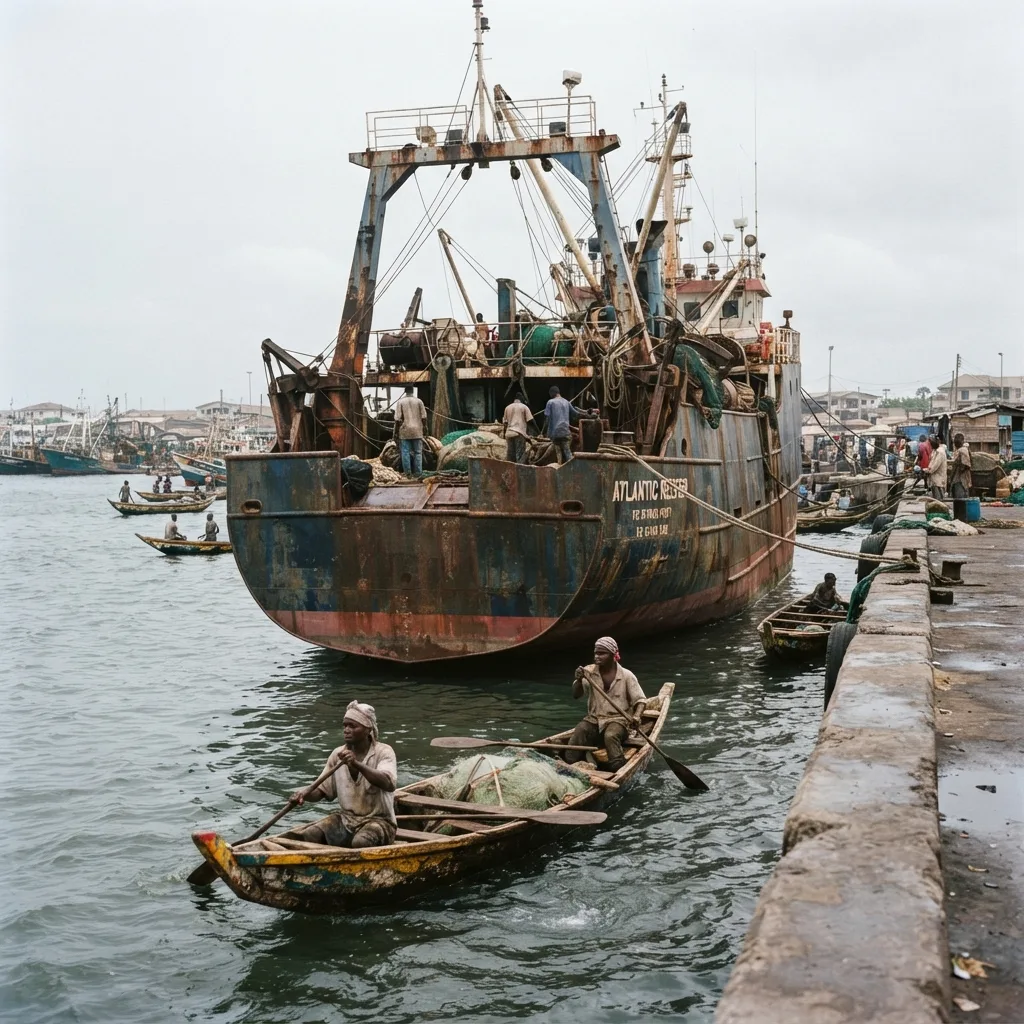
A rusted industrial trawler named Atlantic Reefer docked at a Ghanaian harbour with two men paddling a canoe past its stern

An industrial position that belongs to the partner

MEDIUM-HIGH
What it is

Entry into the industrial fleet runs through joint ventures with foreign counterparts who supply the vessel, master and technical crew. The Ghanaian side holds the flag and licence while the operating knowledge sits across the table, the exposure a partner withdrawal or market-access shock turns into a stopped vessel.

Evidence

Ten tuna companies operated 35 active vessels, most joint ventures and only one wholly Ghanaian owned; captains, chief officers and first engineers were foreign nationals while Ghanaians served almost entirely as fishers, and falling landings led foreign crew to terminate contracts and investors to withdraw22. Licensed industrial vessels fell from 106 to 74 in a single year23.

Who it hits

Ghanaian partners in tuna and trawl ventures, lenders financing vessel operations, and processors whose raw material comes from a joint-venture fleet.

How to manage it, and the opening

Underwrite the partner and officer roster, not only the vessel and licence, and require a dated succession plan for the master and chief engineer. Treat a fleet whose Ghanaian nationals hold no command position as a single point of failure. The opening is training: certificated Ghanaian deck officers and marine engineers are an input this fleet has historically imported at scale.

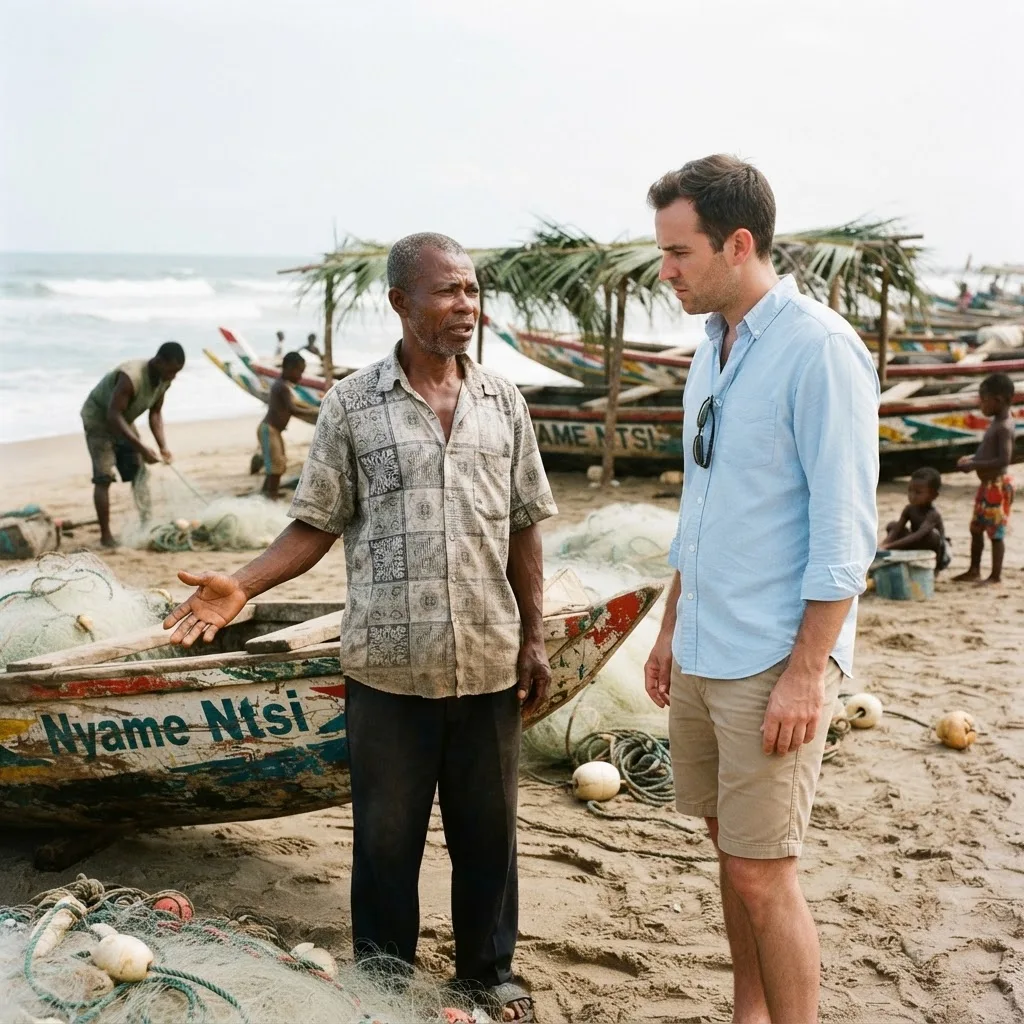
A visitor in casual clothes talking with a Ghanaian fisherman beside his beached canoe named Nyame Ntsi, nets and floats piled in the foreground
The first financeable cash flow
Put the crew and owner split in writing and the fleet gets its first cash flow a lender can actually price.
🐟 The Opening: what actually pays 🐟
01

The written share-and-ownership agreement. A standard, one-page contract naming who owns hull, net and engine and each party's percentage of the owner half, witnessed by the chief fisherman, converts a customary arrangement into a documented cash flow: no source here puts the share of owners able to show a lender such a claim above zero.

02

Component supply and repair, not vessel ownership. The investable position is service and component supply to a fleet nobody can buy cleanly: about 9,122 outboard engines work this coast, two thirds one brand at one horsepower, and a mobile repair and spares round needs a toolkit and a parts float, not a boat.

03

Certificated Ghanaian deck officers and marine engineers. Captains, chief officers and first engineers on the industrial fleet are foreign nationals while Ghanaians serve almost entirely as fishers; training the command roles this fleet has historically imported is an unserved input with a captive customer (Pillar 8).

🐟 Key takeaways 🐟
01

Three fleets, three businesses. Canoes are about 98 per cent of the hulls and just over half the catch, semi-industrial vessels under 5 per cent of landings, and the industrial fleet fewer than a hundred vessels.

02

A canoe is three assets. Hull, net and motor are bought, owned and paid separately, so a newcomer can take a position without buying a boat, and the boat is usually the worst of the three.

03

The 2016 census records a 50 to 50 owner-crew split in every coastal region but not how the owner half divides between the three components. That missing split is where outside finance would sit, and why almost none is there.

04

Licensing the whole 258-vessel semi-industrial fleet raised GH¢189,767 in 2023 while 74 industrial vessels raised GH¢57.65 million. Yet the middle fleet is the only motorised segment a Ghanaian buyer can hold outright, by section 58(4) of Act 1146.

05

Premix is a distribution system: one lawful seller per beach, allocation on a 2016 canoe count, no purchase limit, and 62 per cent of fishers getting fuel less than half the time they need. Fuel reliability predicts supply better than fleet size.

Written for each reader

🐟 Practitioner intelligence 🐟

Hover any card to pause and lift it.

For students

The first move: do not buy a canoe or a share in one. Go to the shortest-life, highest-replacement component, the outboard motor and the net, and service it: about 9,122 outboard engines were counted along this coast, two thirds one brand at one horsepower, so a mobile repair and spares round across three beaches needs a toolkit, a parts float and a phone. First-timers wrongly assume the catch belongs to whoever owns the hull; custom splits it between the crew and up to three separate owners, and if you cannot recite that beach's rule from memory you are not ready to invest. You leave with a customer list, working knowledge of the share system, and the standing to be trusted with the next thing.

For entrepreneurs

First move: pick the landing site before the product, on fuel and ice, not landings. At three candidate sites, spend a season recording how many days premix was available, the beach price, whether an automated outlet is installed, and what cold storage sits within an hour. Only then commit to a product and capacity. Contract across several sites with different fuel positions, not the biggest, and write every supply arrangement against the component owner who controls the trip, usually the engine owner, not the hull. The trap here is a facility sized on regional landings at a site whose canoes migrate seasonally, so shortages arrive the same months every year.

For investors

The investable position: service and component supply to a fleet nobody can buy cleanly, not vessel ownership. Require any canoe-linked investment to produce a written share split, naming who owns hull, net and engine and each party's percentage of the owner half, and treat its absence as unpriced counterparty risk. Require any semi-industrial purchase to explain the non-operational rate, since 226 of 268 vessels were operational at the last count reporting both. Require any tuna position to produce the officer roster and partner agreement with the licence, since the licence is Ghanaian and the command capability is not. Release the cheque against verified landings and a signed component-ownership agreement, not installed capacity. The dominant risk is asset control, sized by who can stop the boat sailing.

For ecosystem actors

The lever: a standard written share-and-ownership agreement for a fishing unit, issued by the Fisheries Commission alongside canoe registration and witnessed by the chief fisherman. It costs a printing budget and a form, converts a customary arrangement into a documented cash flow, and moves a countable number: the share of canoe, net and engine owners able to show a lender a written claim on catch income, which no source here puts above zero. The second lever is finishing the premix automation: civil works at 50 of 300 outlets, a project 17 per cent complete, leaves two classes of beach and moves the diversion, not stops it. The failure to avoid is capital on landing infrastructure at sites chosen from a 2016 canoe count. Public money should buy the documentation and metering that let private lenders see a cash flow.

Where this connects. The stock these fleets compete for, and the bait fishery inside the pole-and-line tuna fleet, are in Pillar 1, with the canoe counts and their vintage. What is illegal about how some vessels fish, and the enforcement record against the trawl fleet, is in Pillar 3. What premix, gear and crew cost a fishing unit, and the 2026 administered fuel price, are in Pillar 5. Post-landing handling is in Pillar 6, and the licensing regime that reprices these fleets once the section 169 Regulations land is in Pillar 8.

Footnotes
  1. Fisheries Commission (2023).
  2. Fisheries and Aquaculture Act 2025, section 171, read with CEMLAWS Africa (2025).
  3. Fisheries Commission, Dovlo et al. (2016).
  4. Fisheries Commission (2023).
  5. Fisheries Commission, Dovlo et al. (2016), Table 4.8.
  6. Tobey et al. (2016).
  7. Illuminating Hidden Harvests, reported in Ocean Risk and Resilience Action Alliance (2025).
  8. Ocean Risk and Resilience Action Alliance (2025).
  9. Fisheries Commission (2023).
  10. Fisheries Commission (2023).
  11. Drury O'Neill et al. (2018).
  12. Key Traceability (2024).
  13. Marine Stewardship Council (2026).
  14. Ministry of Fisheries and Aquaculture Development, reported by the Business and Financial Times (2026).
  15. Tobey et al. (2016).
  16. Fisheries Commission (2023).
  17. Fisheries Commission (2023).
  18. Fisheries Commission, Dovlo et al. (2016).
  19. Tobey et al. (2016).
  20. Tobey et al. (2016).
  21. Fisheries Commission (2023).
  22. Drury O'Neill et al. (2018).
  23. Fisheries Commission (2023).
Download full PDF
UpcomingThis document isn't available yet.