Tool 1
Does the canoe pay?
Slide the four levers that decide a motorised purse-seine canoe owner’s year: the catch a trip, the first-sale price a kilogram, the owner’s share of the net catch, and the premix fuel bill a trip. Watch the first-sale revenue, the costs the owner carries, and the owner’s annual net move. Every figure is indicative, so overwrite each one with your own landing-site numbers.
GH¢360,000
First-sale revenue a year, 150 kg a trip at GH¢20/kg across 120 trips
GH¢291,330
Costs the owner carries: the running cost, the crew’s share and the GH¢38,250 fixed line
GH¢106,920
Owner’s 33% share of the net catch, before gear, motor and depreciation
+GH¢68,670
Owner annual net · crew take home GH¢18,090 each, of 12
At these numbers the owner clears GH¢68,670 for the year, and look at what carried it there. The catch a trip and the premix bill move the net fast; the price moves it less; and a cheaper boat would barely help. The trouble is that the two levers doing the most work, the 150 kg the catch slider shows and the gallons the fuel slider burns, are the two numbers Ghana does not measure. Break-even here sits at about 63 kg a trip at this price, or GH¢8.44 a kilogram at this catch, so a plan built on a spreadsheet fuel line of 40 litres a trip is precise about the wrong things.
Base case: the Pillar 5 Table 13 frame, one motorised purse-seine canoe a year. Catch 150 kg a trip over 120 trips at GH¢20 a kilogram gives a first-sale value of GH¢360,000; premix at 40 litres and GH¢4.50 a litre is GH¢180 a trip and other running cost GH¢120, so the net catch value is GH¢324,000; the owner’s 33 per cent share is GH¢106,920, and after GH¢38,250 of gear, motor and depreciation the owner annual net is GH¢68,670. Parameters from the Marine Fisheries Cost and Returns Model, grounded in Tobey et al.1, Tetra Tech for USAID5 and the Fisheries Commission7. Every figure is indicative: no published Ghanaian canoe budget exists (gap PD-9), so field-verify by species and gear before you rely on it.
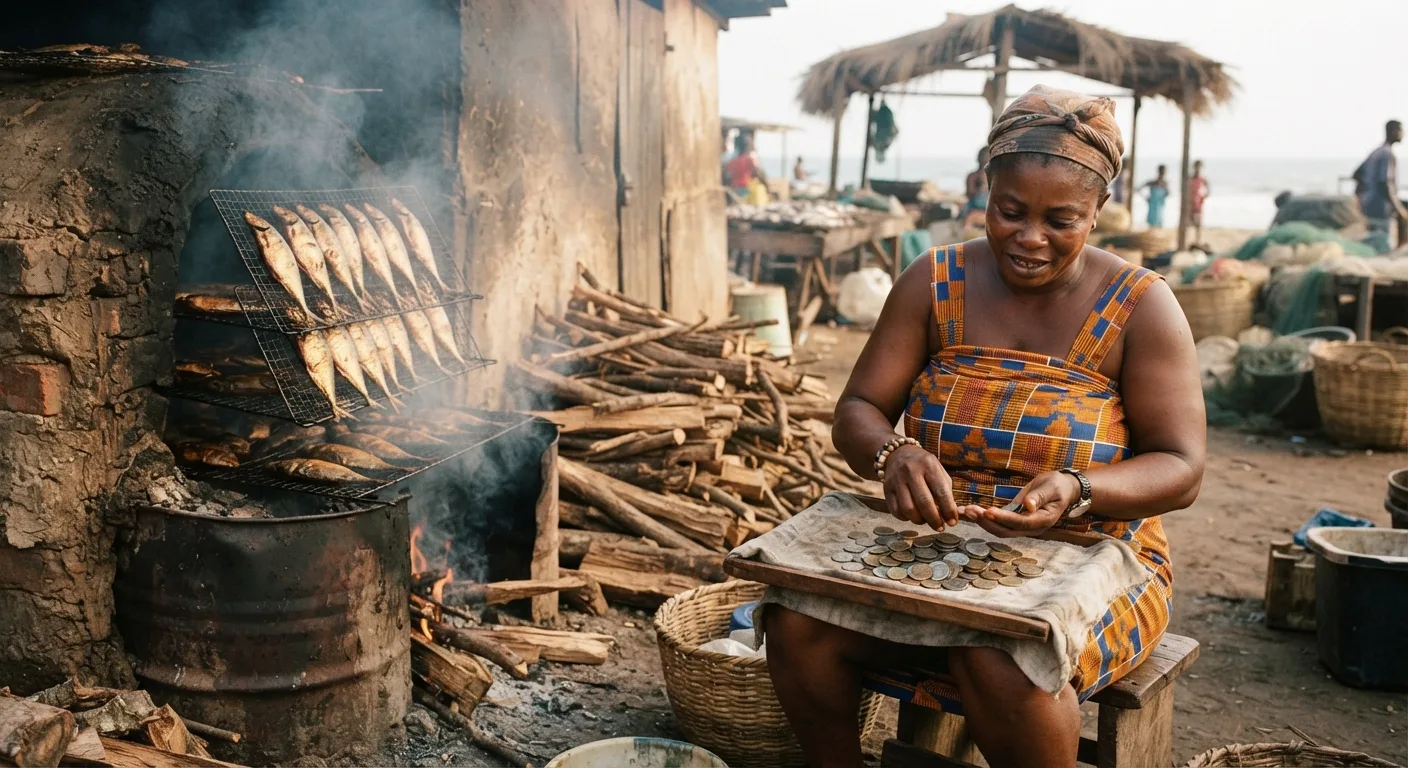
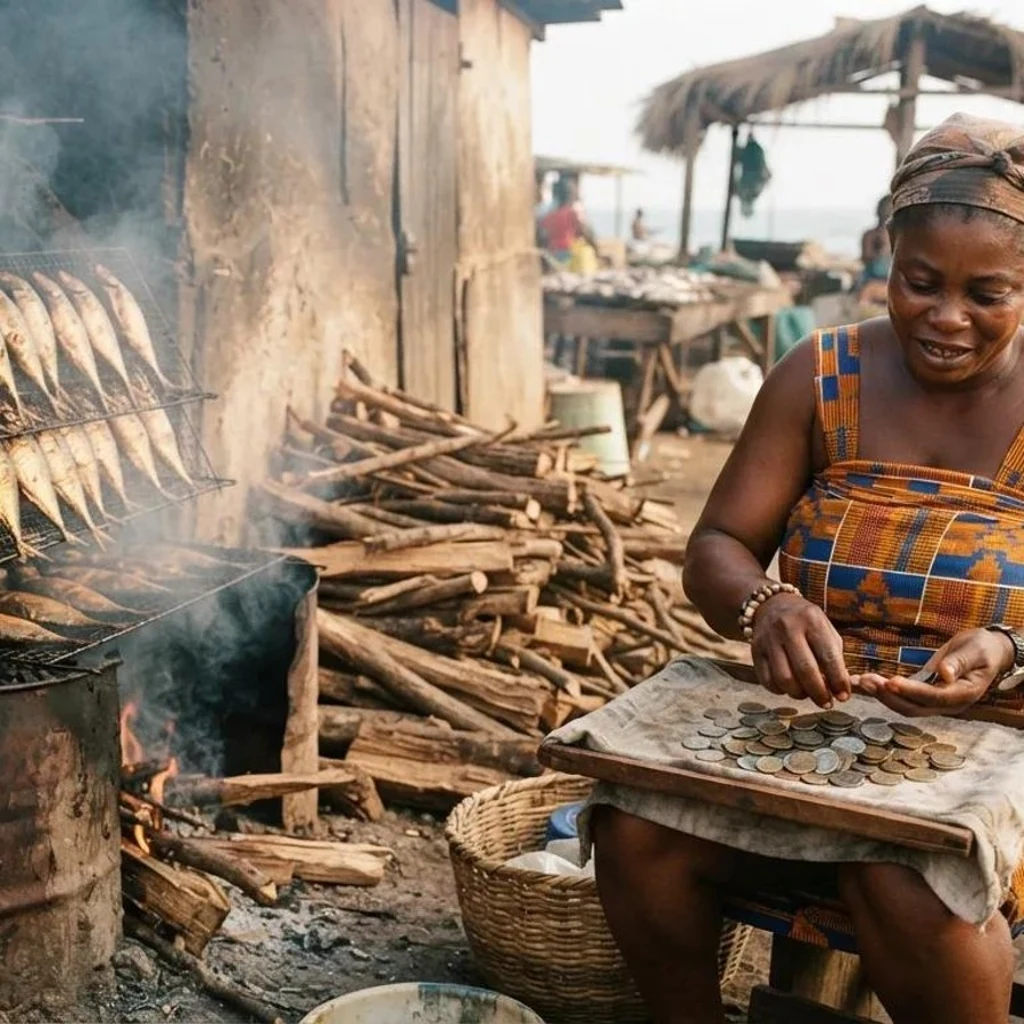
The low-capital alternative is on land, not water: a fish-smoking micro-enterprise on an improved Ahotor oven costs about GH¢6,000 and returns about GH¢39,800 a year, against the canoe’s GH¢68,670 on GH¢90,000 of capital. It is the better business per cedi of capital, though it still loses money on the sale because the oven shrinks a fish the buyer pays for by size. The interactive model here is the canoe.
Tool 2
What swings the net most
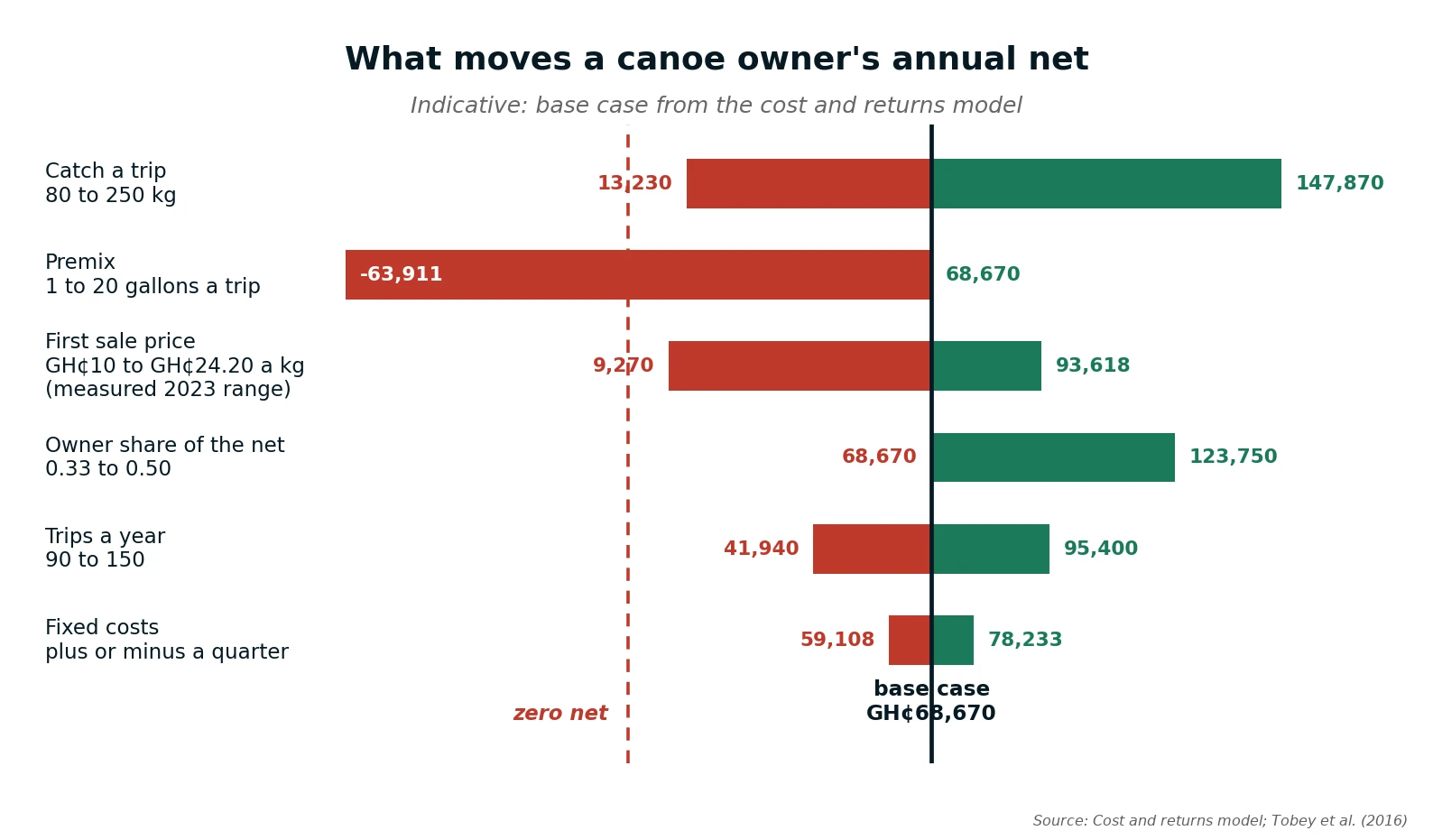
The same model, re-run as the sensitivity tornado. Each bar is how far the owner’s annual net moves across that one driver’s plausible range, holding the others where you left them. Two drivers lead and tie, and both are numbers Ghana does not measure.
1. Catch a trip, in kilograms±GH¢134,640
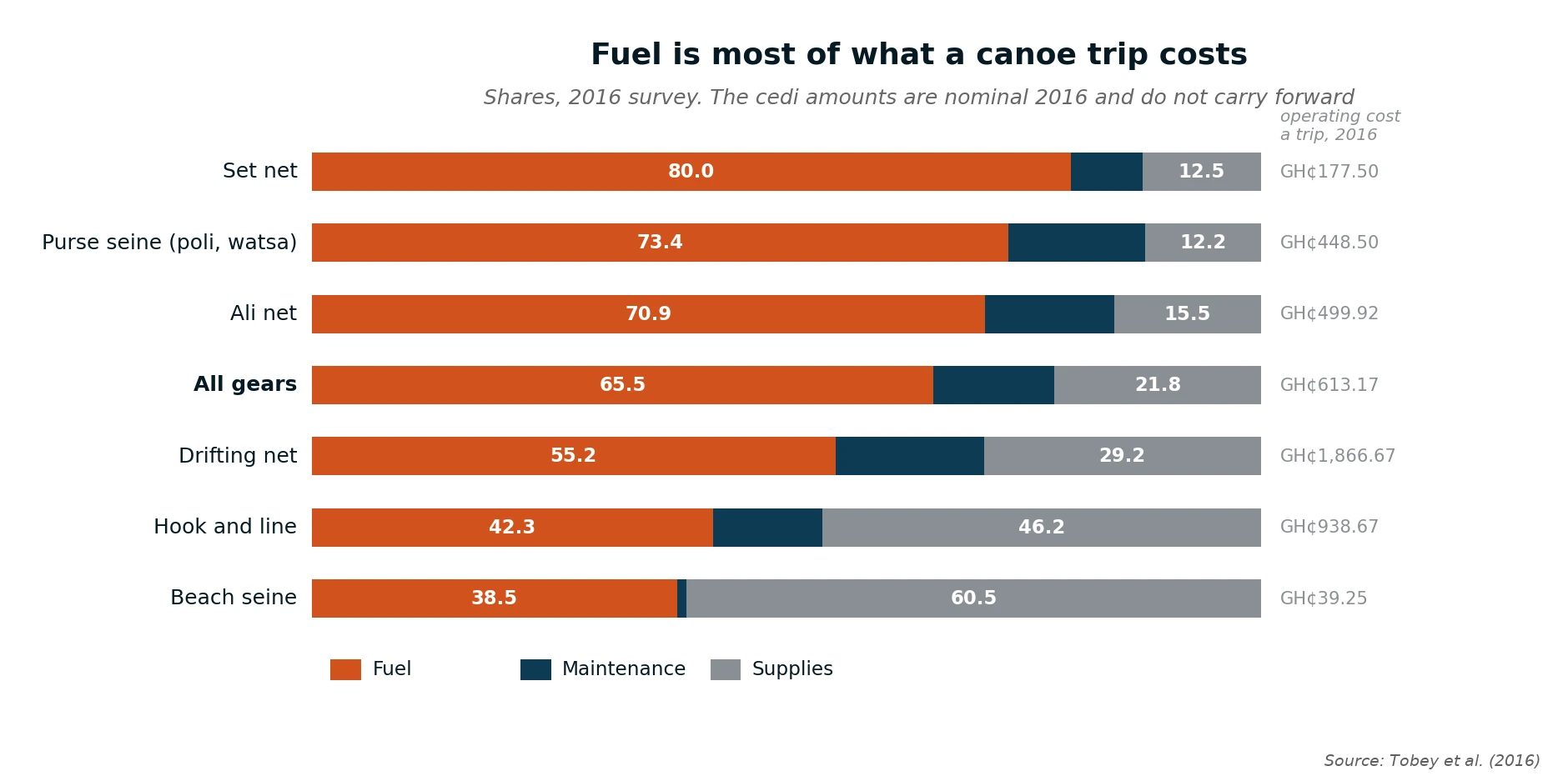
How many kilograms the trip actually lands, from 80 kg in the lean season to 250 kg in a glut. It is a joint-widest lever and one nobody measures in Ghana: no national catch-a-trip series exists. This is the first number an operator should spend a season recording on their own boats.
2. Premix fuel, the gallons a trip±GH¢132,581
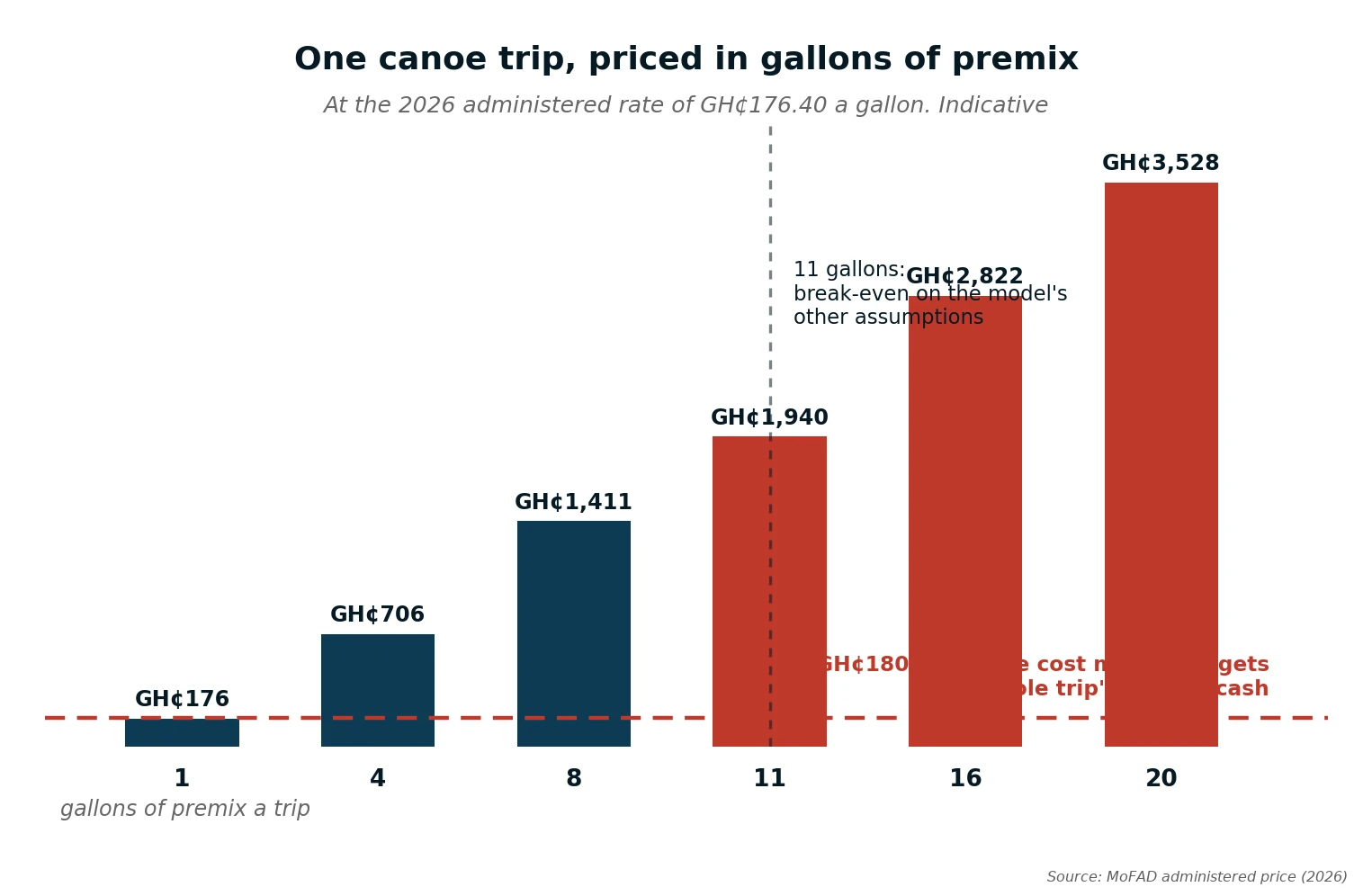
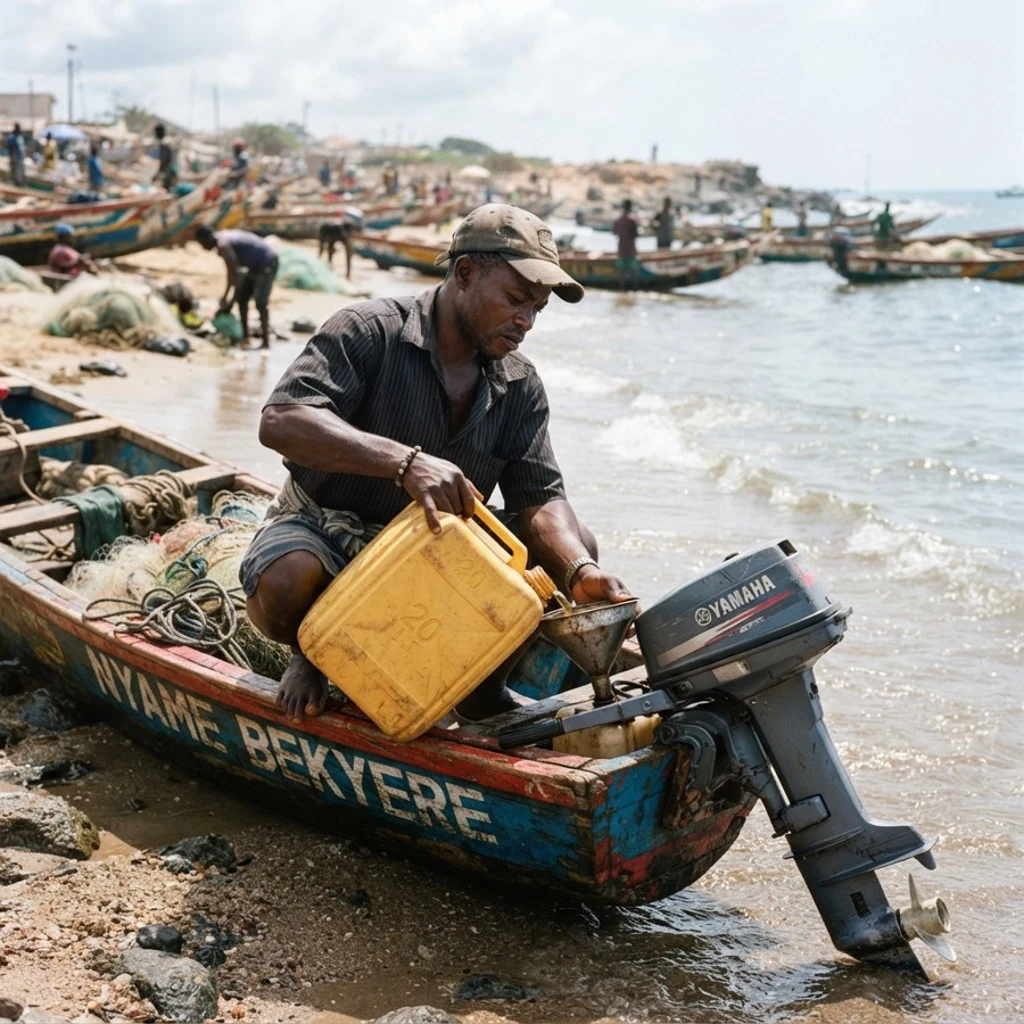
Fuel is the largest cost line, and its quantity is the other unmeasured number. The bar runs from the model's GH¢180 cash line to twenty yellow gallons at the administered rate, and break-even arrives at roughly eleven gallons a trip. It ties with the catch for the widest swing.
3. First-sale price a kilogram±GH¢84,348
The beach price, third in rank whether it runs across the workbook's GH¢15 to GH¢30 band or the measured 2023 range of GH¢10 to GH¢24.20. Ghana's newest measured fish price is three years old and covers three small pelagic species, so this is a guess dressed as a figure.
4. Owner share of the net catch±GH¢55,080
The split between owner and crew, a modelling choice with no Ghanaian source. It runs from the model's 0.33 to the 0.50 the one measured study (Tobey, 2016) implies, at which the base case becomes about GH¢123,750. Fourth in rank, below the price.
5. Fixed costs: gear, motor and depreciation±GH¢25,500
Net and gear replacement, motor upkeep and the depreciation of the canoe and motor. It moves the net least, so a canoe business cannot be rescued by buying a cheaper boat: the financing question here is a working-capital question, not a capital-cost one.
±GH¢134,640
What the catch a trip does, from 80 to 250 kg, one of the two widest levers
±GH¢25,500
What the whole fixed-cost line does, gear, motor and depreciation, the smallest swing
The catch a trip and the premix quantity dominate, each moving the owner’s annual net by roughly GH¢130,000 to GH¢135,000 on a base of GH¢68,670, and both are unmeasured in Ghana. The first-sale price is third, narrowing to about GH¢84,348 across the measured 2023 range without changing rank. The owner share is fourth, worth about GH¢55,000 as it runs from the model’s 0.33 to Tobey’s measured 0.50. The fixed costs move the net least. This ranking matches the Sensitivity sheet of the Marine Fisheries Cost and Returns Model and the Pillar 5 tornado, and it is also a fieldwork plan: the two variables that decide whether a canoe pays are the two an operator can measure in one season and the national evidence base cannot.
Each bar holds three levers where you left them and moves the fourth across its range: catch a trip 80 to 250 kg, premix a trip GH¢180 to twenty yellow gallons at GH¢176.40, first-sale price GH¢10 to GH¢24.20 (the measured 2023 range), owner share 0.33 to 0.50, and fixed costs across a plausible gear, motor and depreciation band. Ranks match the Sensitivity sheet and the Pillar 5 tornado. Indicative figures, to validate against your own trip records.