Ghana Agribusiness PlaybookMarine Fisheries
The direction of travel: a law in force, a set of hedged bets, and the trader who still banks the fish.
Marine Fisheries · Series intelligence

Strategic Outlook

The Fisheries Act was rewritten in 2025 and binds an operator today, but almost nothing it governs is priced, its section 169 fee regulations still in draft. So the working capital that moves the fish is still the trader's advance, not the bank's 3 per cent a month.
Strategic outlook · Pillar 08

The direction of travel: three structural bets, each with its own hedge; a policy reset now in force but not yet priced; and the enabling environment of money, institutions and finance a business must navigate. The law was rewritten in 2025 and binds an operator today, but almost nothing it governs is costed, so the working capital that moves the fish is still the trader’s advance, and the institution to court is the trader, not the bank.

Wide banner at dusk of a Fisheries Commission officer briefing a fisherman, a young crewman and a trader from a binder on a Ghanaian landing beach, boats and town lights behind them, documentary photograph
Reading the reset together
The direction of travel: a law in force, a set of hedged bets, and the trader who still banks the fish.
3
structural bets this pillar sizes, each with its own hedge
14 Aug 2025
the Act's assent date; its section 169 fee Regulations are still in draft
3% a month
the best documented bank rate for working capital, after 20% cash collateral first

🐟 Where this is heading: the three structural bets 🐟

Three slow movements set the direction: a shared stock that will not recover on any business timetable, an export leg newly certified but still market-access conditional, and a regulatory reset, real in principle and unmade in detail. None resolves within a normal investment horizon, so the honest strategy is a set of hedged directional bets.

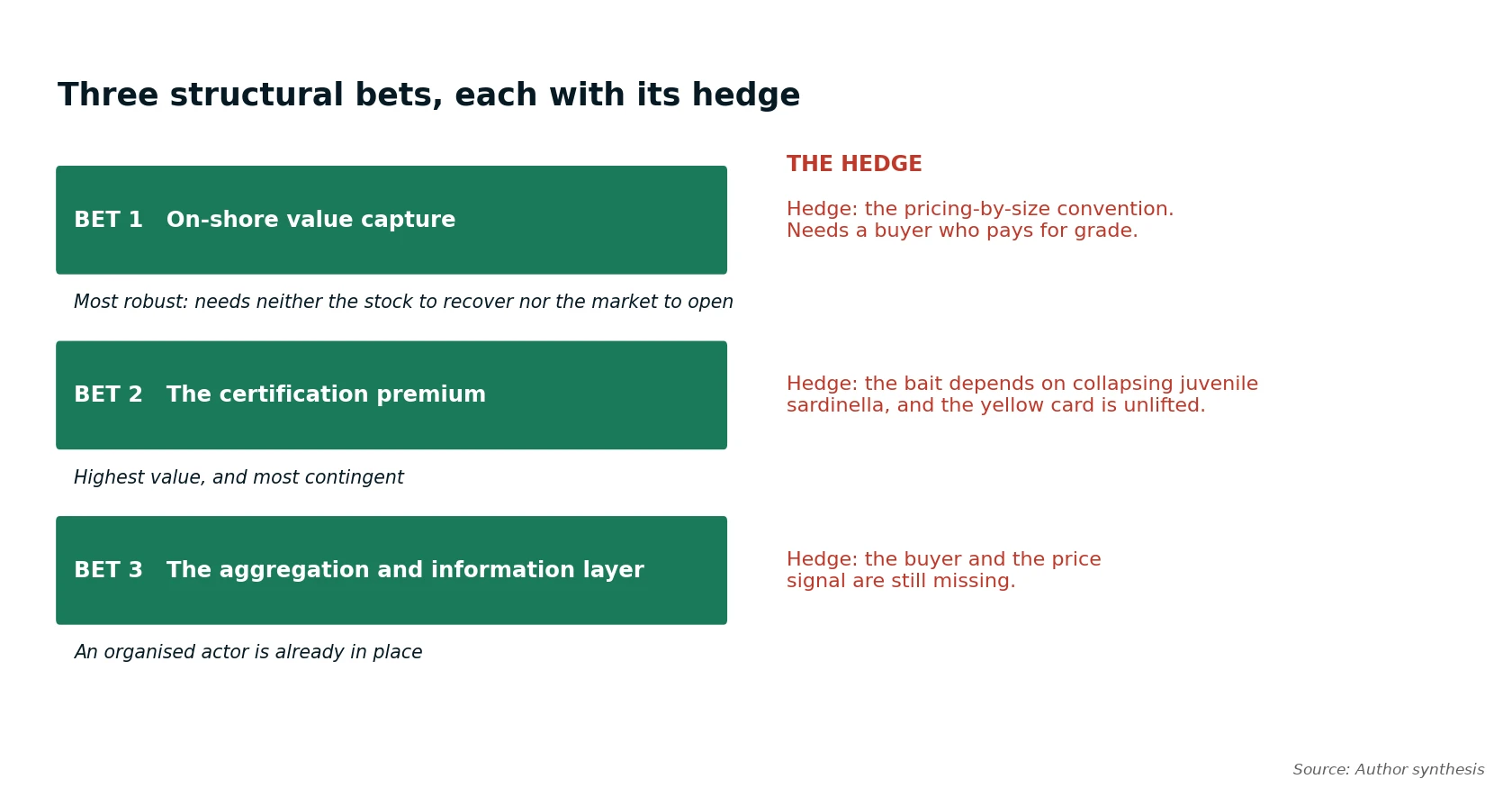
The three structural bets, and the hedge that sits against each
Figure 19 The three structural bets, and the hedge that sits against each

Each bet is directional, not a forecast: the on-shore bet is safest, since it does not depend on the stock recovering or the market opening; the certification bet is highest value and most contingent, because the method it rewards ties to collapsing bait; and the aggregation bet already has an organised actor in place but still lacks a buyer.

The first and safest bet is on-shore value capture: the loss pool does not depend on the stock recovering or the European market opening, but is fixed in a chain with no grading and almost no cold chain, and every point recovered is worth more as supply shrinks. Lifting fish out of the downgraded grade, through ice, grading and a clean process sold to a premium buyer, bets on an already-measured, persistent problem. The hedge is the pricing convention: it pays only if a buyer who values grade can be found or created, the work of Pillar 6.

The second bet, highest value and most contingent, is the certification premium: certification of Ghana’s Atlantic skipjack and yellowfin tuna fisheries to the Marine Stewardship Council standard, covering both the purse seine and the pole-and-line fleets1 makes a real premium available to the tuna leg for the first time. The hedge is written into the fishery: the pole-and-line method the certificate names runs on live anchovy, juvenile round sardinella and round scad2, and the middle species there is a juvenile of the collapsing sardinella stock, so the premium and the bait sit on opposite sides of the same ledger. A tuna or cannery bet is a bet on that bait holding.

The third bet is the aggregation and information layer: the chain carries an organised actor positioned to anchor it, an estimated 99,642 women active across Ghana’s fisheries value chains in 2016, a national count spanning the inland and marine chains alike3, many already prefinancing landings, so what’s missing is a buyer who pays for grade and a lender who will finance against that offtake. Build the buyer and the price signal, and several of the lower rungs of the entry ladder in Pillar 7 become bankable at once; financing routes follow later in this pillar.

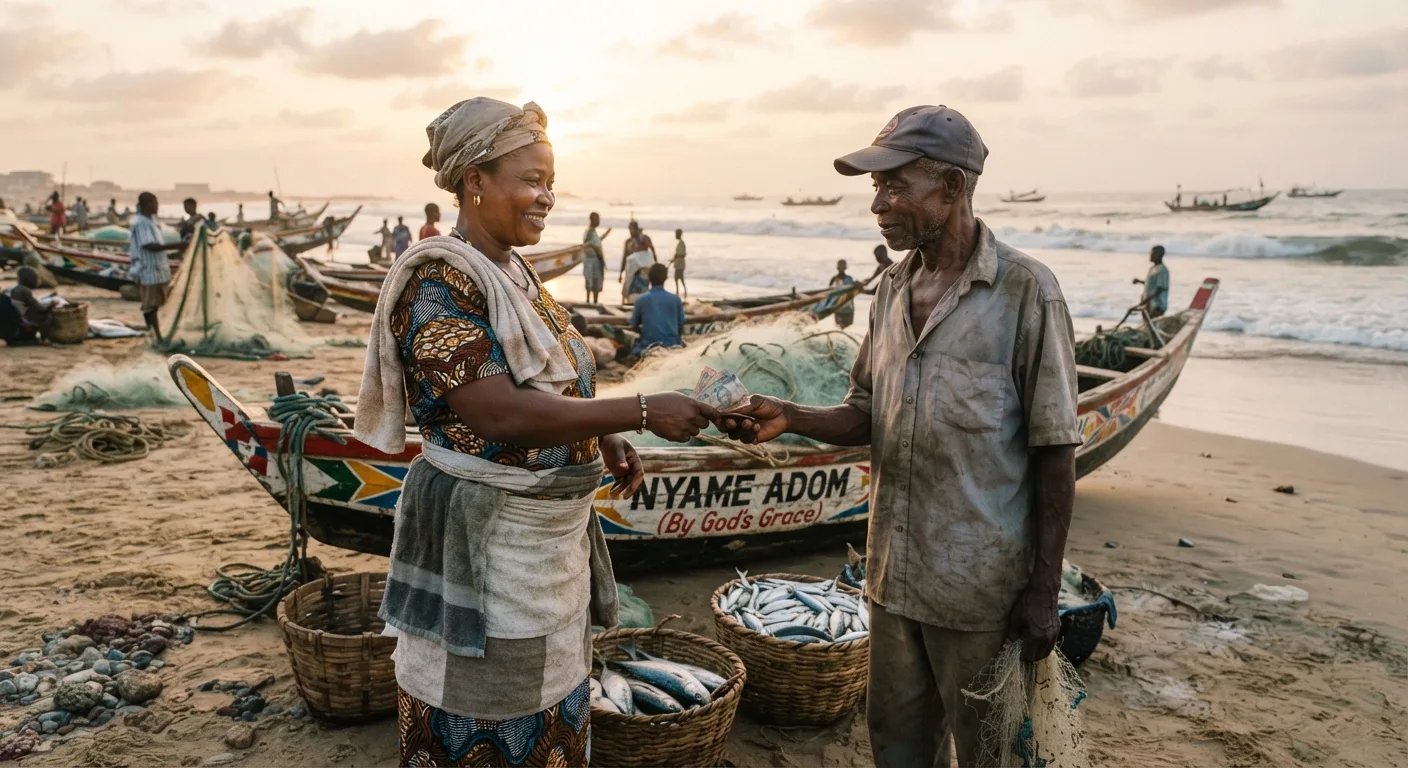
A Ghanaian fishmonger woman handing cash to a fisherman for a basket of small pelagic fish beside a beached canoe named Nyame Adom, sunset over other canoes and crews behind them, documentary photograph
Already prefinancing landings
The actor already in place: cash for the catch, before the aggregation layer exists to serve her.
3
structural bets this section sizes, each hedged against its own downside
99,642
women already anchoring the aggregation bet, a 2016 count

The downside sits against each bet and should be underwritten, not assumed away: on-shore fails if no buyer will pay for grade, the same convention that sank the Ahotor oven; certification fails if the bait thins or the yellow card escalates to a red card and closes the European market the premium leans on; and aggregation fails if the licensing Regulations, once made, price small operators out, or if capital reaches the equipment before the buyer. None is remote, and a plan that cannot say what it does in each case is a hope, not a strategy.

The bets are a sequence, not a choice. The three bets are a sequence, not a choice: on-shore loss-recovery businesses generate the price data and buyer relationships that make the aggregation layer possible, and a working aggregation layer finally lets the certification premium reach back down to the canoe. An entrant need not place all three, but should know which one their rung stands on.

🐟 The policy reset: a law in force, its prices unset 🐟

The standing sector policy is the National Fisheries and Aquaculture Policy 2022, which set the direction the Act later hardened into law: modernise the sector, rebuild the small pelagic stocks, grow aquaculture4. But everything a fish business does now runs through the statute, now live. The Act carries no commencement provision of its own, so on the reading of its August 2025 Gazette notification it took effect on assent while its Regulations remained in draft5. It repealed the 2002 law and rebuilt the Fisheries Commission as an independent body corporate that can hold property and contract in its own name (Fisheries and Aquaculture Act 2025, section 2), and its Board reserves seats for the Ghana Tuna Association, the National Fisheries Association, the aquaculture associations and one woman with knowledge of gender, trade and fish processing (section 5). Those seats are where the industry argues the Regulations still being written.

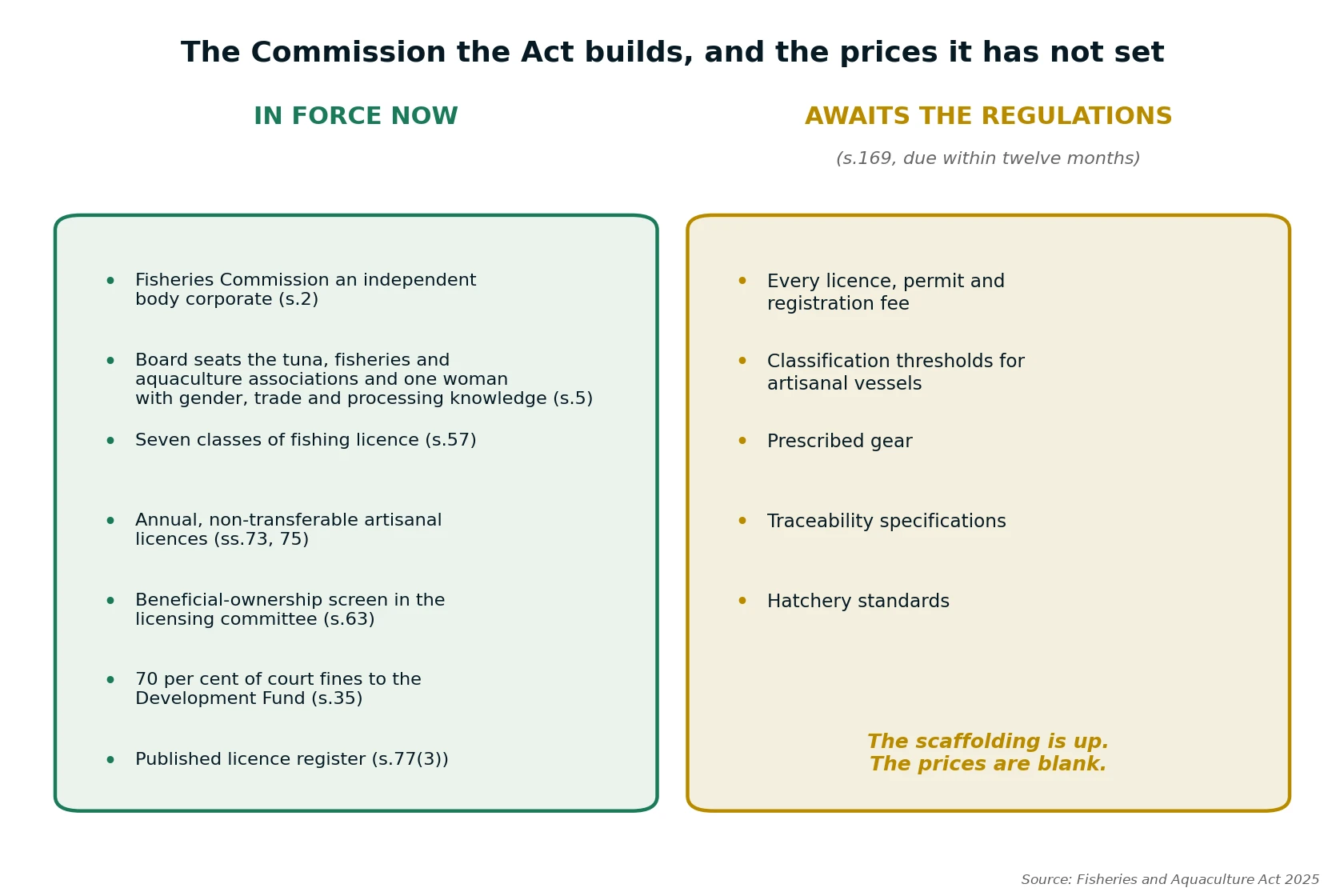
The Fisheries and Aquaculture Act 2025, which received assent on 14 August 20256, hands eighteen subjects to subsidiary Regulations the Minister must make within twelve months of commencement, and those Regulations carry every fee, the thresholds that decide which licence an artisanal vessel needs, the prescribed gear and the traceability specifications (Fisheries and Aquaculture Act 2025, section 169). Last publicly sighted, the Act was still awaiting its licensing Regulations, which were in draft when the first of a series of regional stakeholder workshops was held at Takoradi on 14 and 15 July 20267. The obligations and penalties are enforceable now; the prices are blank.

What Act 1146 puts in force, and what it leaves for the Regulations to price
Figure 20 What Act 1146 puts in force, and what it leaves for the Regulations to price
What this shows

The whole commercial position sits in the gap between the two columns: the law has been in force for nearly a year, so its obligations and penalties are live, yet no licence cost can be quoted because the section 169 Regulations that carry every fee are still in draft. Budget for the enforcement risk, which is real now, and treat the fee as an open figure until the Gazette closes it.

The licence is an annual, single-vessel instrument in one of seven classes, and the artisanal licence is now non-transferable and re-inspected every year (Fisheries and Aquaculture Act 2025, sections 57, 66 and 75). What separates the classes is the paperwork, not the fee nobody can quote: an industrial application runs to twenty-nine documents including a beneficial-ownership declaration, against six items and a safety inspection for a marine artisanal one (sections 59 and 73). The trading permits are harder on cash flow: an import or export permit covers a single transaction for three months, so every consignment needs its own (section 109). Two quieter features stand out: co-management committees now have a statutory basis (sections 13 to 15), and the smallest processors get two years from commencement to register their micro units cheaply, ahead of enforcement (section 172).

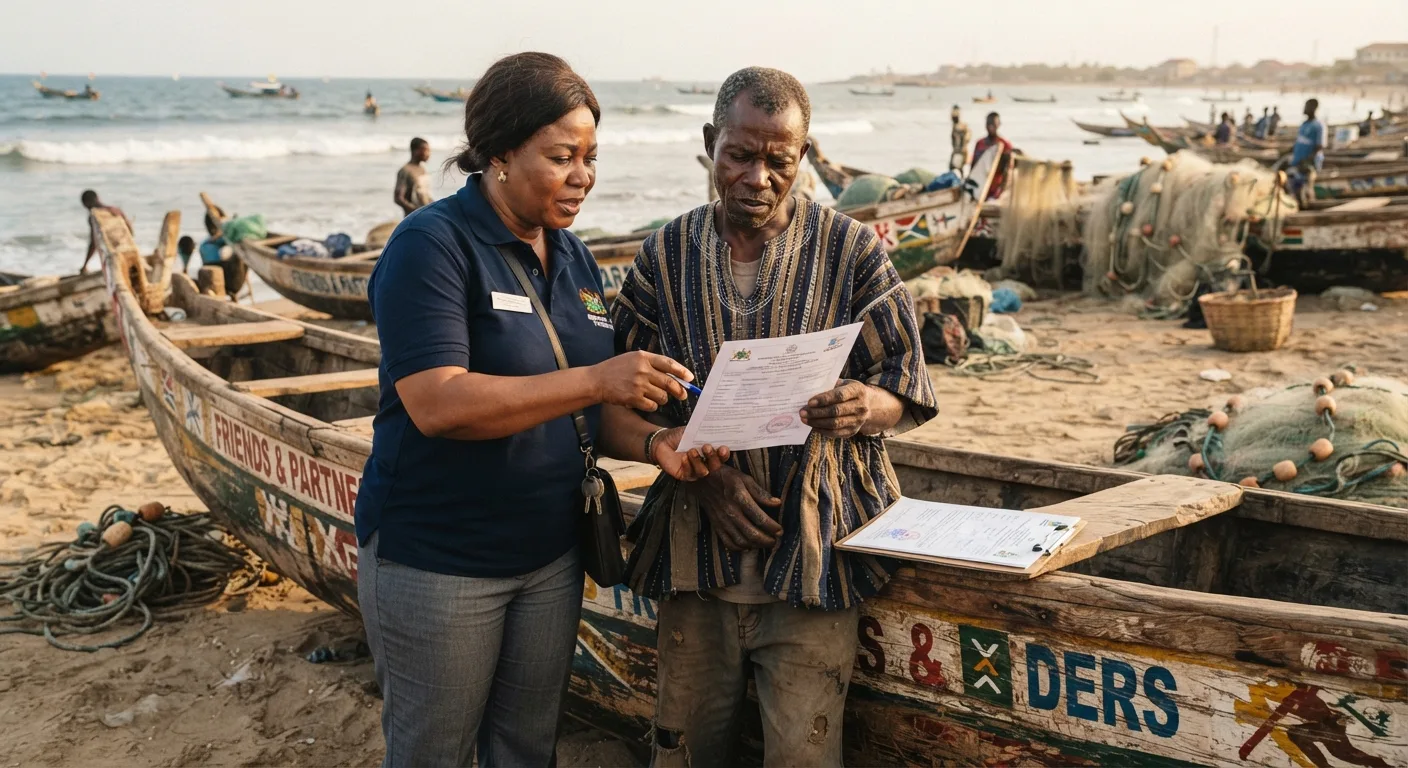
A Fisheries Commission officer showing a licence document to a fisherman beside a beached canoe painted Friends & Partners, other boats and crews on the beach behind them, documentary photograph
The paperwork, not the fee
What separates the classes: documents and inspections; the fee itself is still blank.
29 vs 6
documents required: an industrial application against a marine artisanal licence
3 months
validity of a single import or export permit, renewed for every consignment
Table 20: The Act 1146 licensing regime by operator type, and the figures still in draft
If you areWhat the Act requires to operateWhat is not yet knowable
A canoe operatorA marine artisanal licence, annual, non-transferable, with a fit-for-purpose inspection and six documents; exempt from the new traceability labellingThe licence fee, and the length and engine thresholds that classify the vessel
A fish processorRegistration of even a micro processing or storage unit, certified with the Food and Drugs Authority; a two-year grace runs from the Act's commencementThe registration fee, and the standards the certificate is issued against
An importer or exporterIncorporation under the Companies Act 2019, an annual Commission registration certificate, and a separate permit for every consignment valid three monthsThe permit fee, the import levy rate, and the traceability specification
An industrial or tuna operatorA licence application of twenty-nine documents including a beneficial-ownership declaration, a fitted monitoring device, and 75 per cent Ghanaian crewThe licence fee, and the day and gear conditions the Regulations will attach

Source: Fisheries and Aquaculture Act 2025, sections 57, 59, 66, 73, 78, 97, 100, 105, 109, 111 and 169, read directly from the statute. Fees throughout are left to Regulations not yet made.

🐟 The enabling environment: money, institutions and finance 🐟

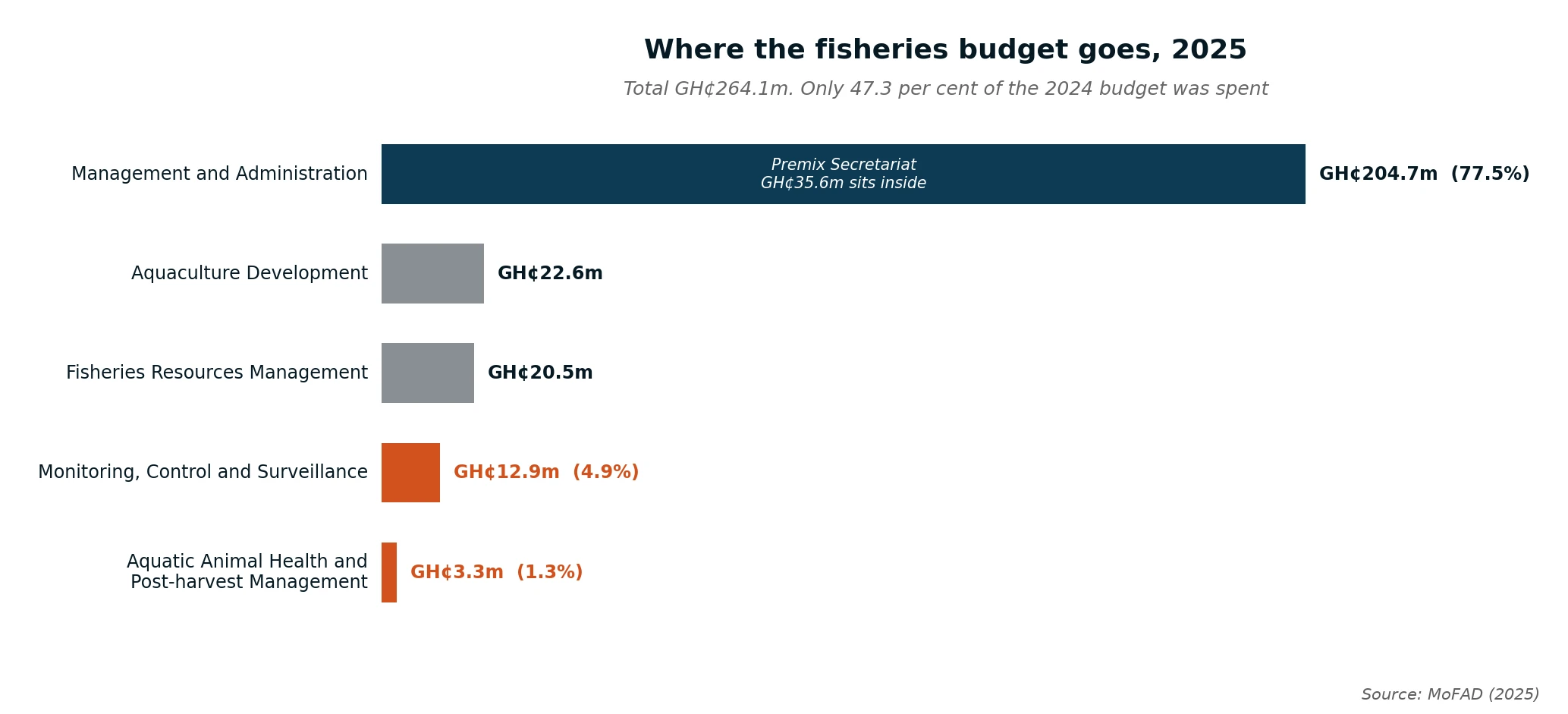
The Act builds a Fisheries and Aquaculture Development Fund and points real revenue at it: seventy per cent of every court fine, plus a share of licence fees and levies, with the Commission drawing not less than thirty per cent of the Fund’s approved moneys (Fisheries and Aquaculture Act 2025, sections 27, 33 to 35). But the enforcement that would feed it barely happens, as Pillar 3 sets out, so the Fund is a mechanism waiting for a flow. The direct budget is small and tilted the wrong way.

GH¢264m
the whole 2025 fisheries ministry budget
77.5%
goes to running the ministry, not the fishery
47%
of the 2024 budget was actually spent

Of the GH¢264.1 million allocated for 2025, GH¢204.7 million goes to management and administration, while monitoring, control and surveillance receives GH¢12.95 million and post-harvest management and aquatic animal health together GH¢3.34 million8. The two lines a private operator most needs the state to fund, enforcement and the cold chain, are the smallest on the sheet, and in 2024 only 47 per cent of the approved budget was spent. Inside the administration block the National Premix Fuel Secretariat alone carries about GH¢35.6 million, more than monitoring, surveillance, post-harvest and animal health put together: the subsidy machinery, whose distribution Pillar 4 covers, absorbs more than every function a business needs from the state. Donor money has a poor record too: the World Bank’s West Africa Regional Fisheries Programme in Ghana, a US$53.8 million project that disbursed US$35.3 million, closed in 2018 rated unsatisfactory, having built one of nine planned landing sites9.

The 2025 fisheries budget by programme, and the two lines an operator depends on
Figure 21 The 2025 fisheries budget by programme, and the two lines an operator depends on
What this shows

More than three quarters of a budget smaller than the sector loses to post-harvest spoilage in a single year goes to running the ministry, while monitoring and post-harvest management, the two public goods a processor or exporter depends on, share less than one part in five, and less than half of that was spent in 2024. A business plan should assume the state co-invests in nothing and price the enforcement and cold-chain gaps as its own to close.

Action points.Build the model as if the state co-invests in nothing: no grant, no public landing site, no donor cold chain. Cost every piece of shared infrastructure as your own to build or share privately, and treat any programme that does materialise as unplanned upside. Track the Development Fund: if fine revenue ever flows at the rate the Act directs, the sector’s enforcement and post-harvest budget changes shape, so revisit the plan when it does.

🐟 Who holds the gates, and where the working capital actually comes from 🐟

The Act concentrates authority in the Fisheries Commission, then spreads the practical gates across a dozen bodies: a processor answers to the Food and Drugs Authority and the Ghana Standards Authority, an aquaculture operator to the Environmental Protection Agency and the Water Resources Commission, and a foreign shareholder to the Ghana Investment Promotion Authority and, inside the licensing committee, the Registrar of Companies (Fisheries and Aquaculture Act 2025, sections 63, 84 and 98). The most useful change here is transparency: the licence register must now be published and the beneficial-ownership screen has moved inside the licensing committee, so ownership becomes a matter of record instead of rumour. Ask to see the published register before taking any counterparty’s word on who owns the vessel or plant.

Set the law aside: the working capital question has a thin formal answer. The best bank terms a donor programme could arrange, through three rural banks, were 3 per cent interest a month once the borrower had first saved 20 per cent of the loan as cash collateral10; a quasi-government microcredit line was taken up by almost nobody, and village savings and loan associations proved the most resilient formal option and the least scalable.

Table 21: Four ways to finance working capital in Ghanaian fisheries
RouteThe termsWhat it needsWhat it costs you
Rural bank loan3 per cent a month, save 20 per cent as cash collateral first, 6 to 12 monthsCash saved up front and conventional collateral such as landThe highest money cost, and an asset most processors cannot pledge
MASLOC microcreditA quasi-government line of about GH¢1,000Application and eligibility; uptake was near zero in the documented programmeLittle, but it reaches almost no one and is too small to matter
Village savings and loan groupMember savings lent out in small sums, seasonalMembership and a savings habitNothing, but it does not scale beyond a working-capital float
The trader's advance50 to 100 per cent of a landing prefinanced, at the beachThe catch, pledged to the traderThe buyer is fixed in advance, so the price and the customer are hers, not yours

Source: Coastal Resources Center (2021), on the Sustainable Fisheries Management Project's oven-financing experience.

The formal routes fail on collateral, not price: a lender recognises land, and the women who dominate processing and trading are in most communities not permitted to own it, so fish-movement credit is informal and organised by those same women. There are an estimated 99,642 women active across Ghana’s fisheries value chains in 2016, a national count spanning the inland and marine chains alike11, and the traders among them prefinance between half and all of some tuna companies’ landings12, advancing cash against a catch not yet on the beach and clearing without a land title because it is secured on the fish (Pillar 6 covers that relationship). That actor is already partly formalised: the National Fish Processors and Traders Association counted 14,700 members across 41 local associations, ninety-nine per cent of them women13, a network a formal lender or serious buyer should work through, not around.

A group of women fish processors and traders at a beach association meeting under a thatched shelter, one holding open a handwritten ledger book, a sign reading Ahoto Ye Bo F/P Assn Jamestown behind them, documentary photograph
Already partly formalised
The network to work through: associations that already keep the ledger nobody else does.
14,700
members counted by the National Fish Processors and Traders Association
41
local associations that network spans, ninety-nine per cent women

The finance product this chain is missing.The gap is a lending product, not a grant. A bank cannot underwrite here: it prices the wrong security, land, where the asset is a signed offtake and a season of landing records. A lender who finances against a purchase agreement and verified throughput, as trade finance does elsewhere in this series, would be selling into a market the informal system already proves and prices, at a rate it could beat. Scored on logged catch and a signed offtake, this is the credit product in Pillar 7’s digital openings; the field questionnaire with this playbook collects the throughput record nobody keeps now.

🐟 What an investor can price in 2026, and what remains blank 🐟

The enabling environment changed at the top in 2026, with the Ghana Investment Promotion Centre Act 2013 replaced by the Ghana Investment Promotion Authority Bill, passed 2 April 2026, which removes the minimum foreign capital requirement except for trading, cut there from US$1 million to US$500,000 in cash only14. The headline is a lighter door for foreign capital, but the Act already keeps fisheries largely closed to it: a Ghanaian fishing vessel must be beneficially owned wholly by a citizen, the state or a Ghanaian public body, with a single carve-out letting a tuna vessel be held at 50 per cent by qualifying Ghanaians (Fisheries and Aquaculture Act 2025, section 58). Foreign money can own a cannery, a cold store or a processing plant on shore; it cannot lawfully own the canoe or trawler that catches the fish. The tax position is unsettled: no tax holiday is set for fisheries under Act 1146, and the Ghana Revenue Authority’s agro-processing concession list does not name fishing, fish farming or aquaculture, so any model leaning on a tax break needs current advice first.

Table 22: What an investor can and cannot price about Ghanaian fisheries in 2026
The investment questionWhat the corpus can sayStatus
What does a fishing or processing licence cost?Nothing. Every fee is left to Regulations not yet madeNot yet knowable
What tax holiday applies to a fish business?None is set under Act 1146, and fishing is absent from the Ghana Revenue Authority concession listNot yet knowable
What foreign capital minimum applies?The 2026 investment Bill removes the general minimum except for trading; the fishing vessel itself must stay wholly Ghanaian, tuna excepted at halfPartly settled
What import levy applies to fish?The Act requires proof of payment of an import levy, but no rate appears anywhere in the corpusNot yet knowable

Sources: Fisheries and Aquaculture Act 2025, sections 58, 101 and 169; Ghana Investment Promotion Centre (2026). Three of the four answers depend on instruments not yet issued.

The enabling environment as a pricing problem.The returns case is strong and independently made: the best-evidenced management intervention returns many times its cost (Pillar 3). What’s unresolved is the cost side, because the fees, the tax treatment and the levies sit in draft Regulations. Diligence here means measuring how much of your return depends on a number the state has not set.

🐟 The strategist’s toolkit: PESTLE and SWOT 🐟

Two standard scans place the sector for an entrant. PESTLE reads the external forces; SWOT reads the sector’s own hand against them. Both point the same way: the openings are on shore and in services, and the largest risks sit in instruments the state has not finished.

PESTLE: the external forces shaping the sector

Table 23: PESTLE, the forces an entrant is operating inside
ForceWhat it means for Ghanaian marine fisheriesSo what for an entrant
PoliticalA government direction to rebuild stocks and substitute imports; a politically protected premix subsidy; EU yellow-card diplomacy driving reformA policy tailwind built on subsidy and diplomacy that can shift; bank on neither
EconomicImports supply about a quarter of fish; tuna earns roughly 90 per cent of fish export value; post-harvest loss is worth about GH¢2.6 billion a yearThe money is in loss recovery and value-add on shore, not in catching or importing more
SocialFish is about 60 per cent of animal protein; roughly 99,642 women run processing and trade; food-security politics keep enforcement off the canoesWork through the women's trade and credit network, not around it
TechnologicalNo fisher-facing app, cold chain, price service or AI monitoring runs at scale; a 2022 selective-gear directive measurably workedThe first digital, cold-chain or data product is an open field, not a crowded one
LegalAct 1146 (2025) is in force but its fee and licensing Regulations are unmade; traceability and an MPA exist on paper; the inshore zone is undesignatedObligations bind now, costs are unknowable until the Gazette; carry every fee as a range
EnvironmentalSmall pelagic stocks are collapsed and still overfished; tuna is healthy but its bait is juvenile sardinella; upwelling is variableNo production-growth story; underwrite the bait risk on tuna and the ceiling on pelagics

Source: Synthesis of Pillars 1 to 8; the underlying sources are cited in those pillars.

SWOT: the sector on one page

Table 24: SWOT, strengths and weaknesses inside the sector, opportunities and threats outside it
Helpful to a ventureHarmful to a venture
Internal (the sector's own hand)Strengths: a healthy, MSC-certified tuna fishery with European approval and cannery capacity; strong, price-inelastic domestic demand; an organised women's trade and credit networkWeaknesses: collapsed small pelagic stocks; no grading and almost no cold chain; fish sold by size not weight; no current price series; formal credit that fails on collateral
External (the environment)Opportunities: on-shore loss recovery, grading and clean processing; price and aggregation services; the certification premium; a trade-finance product priced on the catch; alternative baitThreats: a yellow card that could escalate to a red card and close the EU market; the tuna bait dependency; unmade fee Regulations; trawl and IUU pressure; premix and climate volatility

Source: Synthesis of Pillars 1 to 8.

What the two scans agree on. Read PESTLE and SWOT together and the same instruction falls out: build on shore, sell a service or a graded product, and treat the two biggest external threats, the yellow card and the unmade Regulations, as things to monitor and price rather than control.

🐟 Risks inside the policy and finance picture 🐟

An empty coastal meeting room with a blank flip chart, stacked plastic chairs and a water bottle on a bare wooden table, fishing canoes visible through the open window and door

Costing a business on fees and incentives the state has not set

HIGH
What it is

Act 1146 is in force, but every licence fee, permit fee, registration fee and import levy is left to draft Regulations, and no tax holiday is set for fisheries. A model built on any of these numbers rests on a figure that does not yet exist.

Evidence

Every fee reads as the prescribed fee, and the section 169 Regulations that carry them were still in draft at the Takoradi workshops of 14 and 15 July 2026. The Ghana Revenue Authority concession list omits fishing, fish farming and aquaculture.

Who it hits

Anyone preparing a feasibility study, licence-cost line or tax assumption, and any funder relying on one.

How to manage it, and the opening

Carry every fee and tax line as a range triggered by the Gazette, and take current Ghanaian tax advice before resting any return on a holiday. Watch the section 169 Regulations and the GIPA schedule rather than the news coverage; operators who read the statute are positioned before the numbers land.

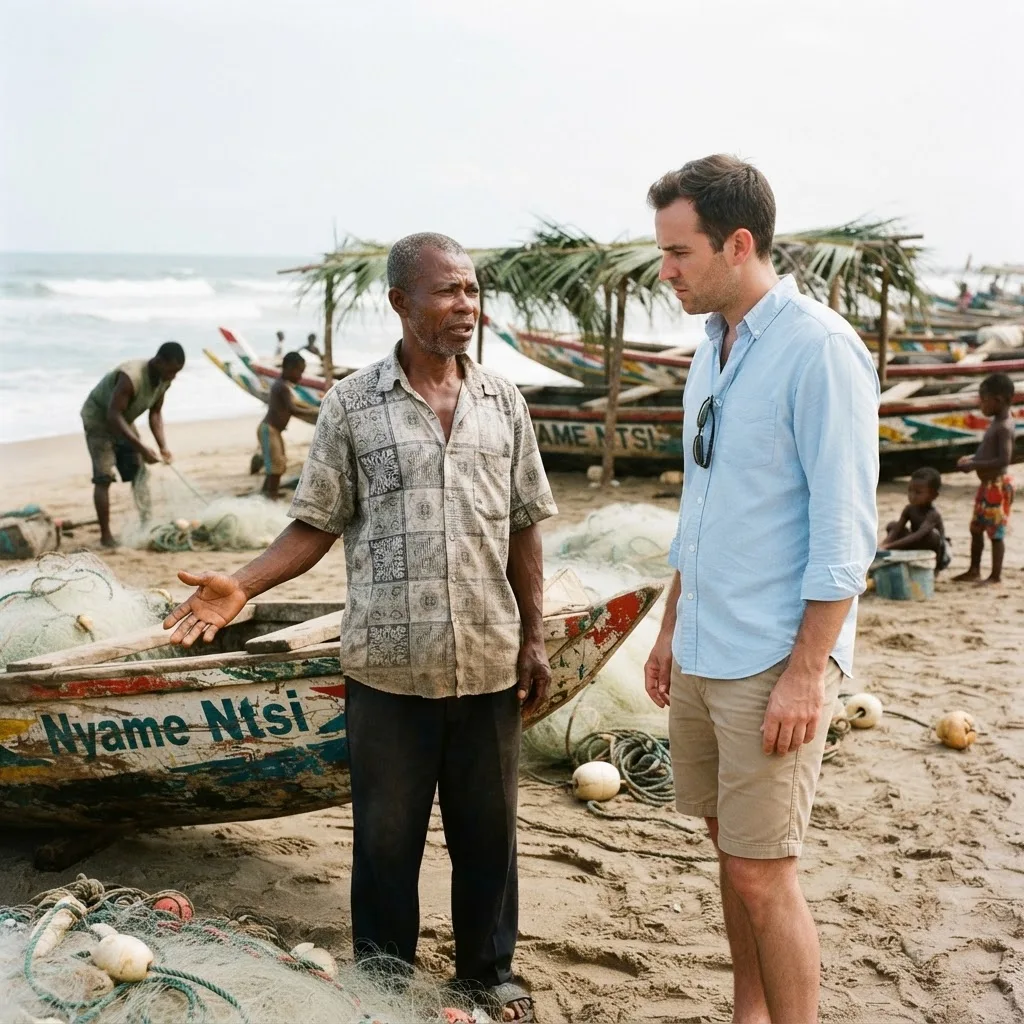
A visitor in casual clothes talking with a Ghanaian fisherman beside his beached canoe named Nyame Ntsi, nets and floats piled in the foreground

Financing against collateral the operator cannot give

HIGH
What it is

Formal credit asks for cash saved in advance and conventional collateral, chiefly land, which the women who dominate this trade are in most communities not permitted to own, so formal finance reaches almost no one. The real working capital is the trader's advance, which fixes the buyer and price in exchange for cash.

Evidence

The best documented bank terms were 3 per cent a month after saving 20 per cent as cash collateral, and the government microcredit line was taken up by almost nobody15. An estimated 99,642 women worked the fisheries value chains in a 2016 count, and traders prefinance up to all of some tuna landings.

Who it hits

Processors, traders and aggregators needing working capital, and any lender entering post-harvest fisheries finance.

How to manage it, and the opening

Underwrite the offtake and throughput record, not the land, since a signed purchase agreement and a season of landing data are the security that exists here. Start keeping that record now: a formal lender needs it and nobody collects it yet. The opening is a trade-finance product priced against the fish, undercutting the informal advance.

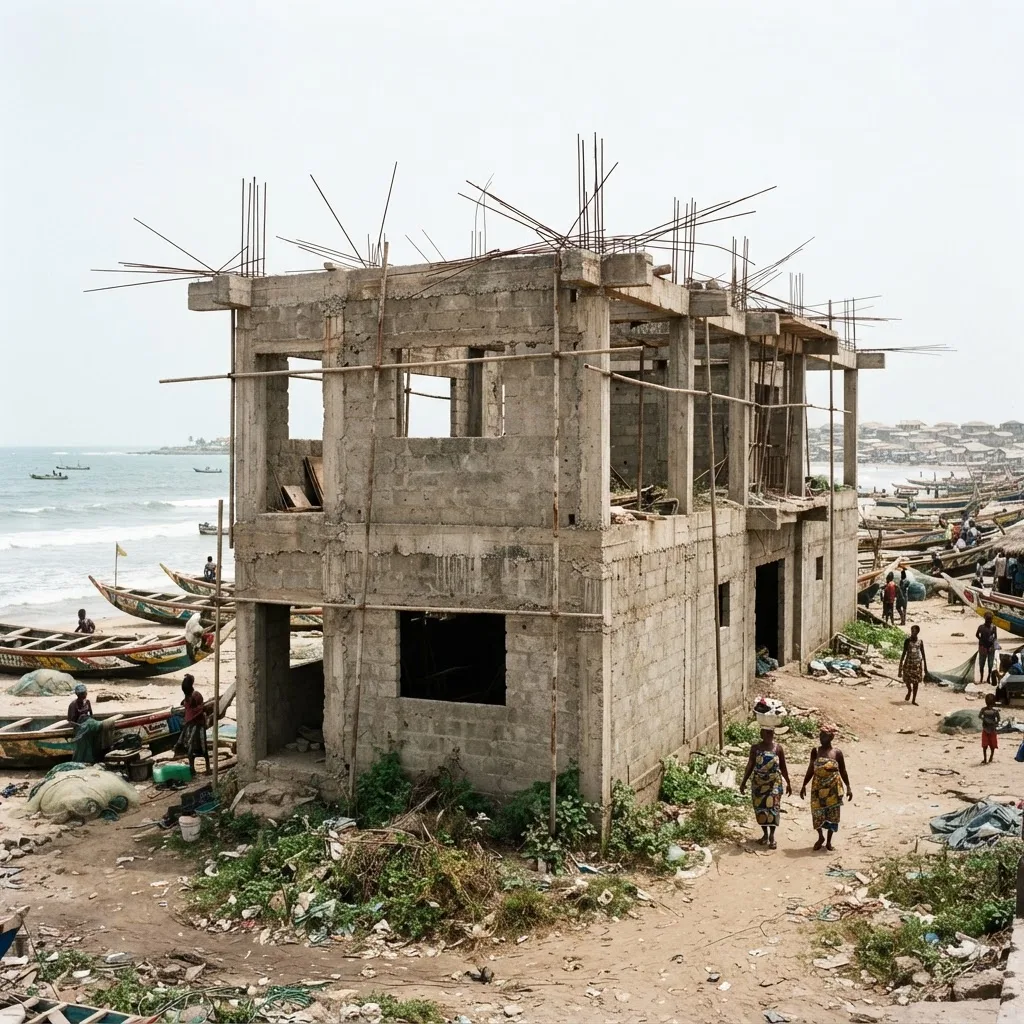
An unfinished, overgrown concrete building shell with exposed rebar on a Ghanaian beach, fishing canoes and traders working the sand around it

Planning on public or donor money to build the shared infrastructure

MEDIUM-HIGH
What it is

The state's direct budget is small and spends more than three quarters on administration, and the largest donor programme of the last decade closed unsatisfactory having built one of nine planned landing sites. A plan assuming a public landing site, cold chain or monitoring system will arrive leans on the weakest part of the record.

Evidence

The 2025 fisheries budget was GH¢264.1 million, 77.5 per cent administration, monitoring at GH¢12.95 million, and only 47 per cent of the 2024 budget spent16. The World Bank programme disbursed US$35.3 million and closed unsatisfactory17.

Who it hits

Any operator whose model depends on shared public infrastructure, and any investor underwriting a plan that does.

How to manage it, and the opening

Cost every piece of shared infrastructure as your own to build or share privately. Track whether Development Fund revenue starts flowing at the rate the Act directs, because that would change what the sector's budget can do.

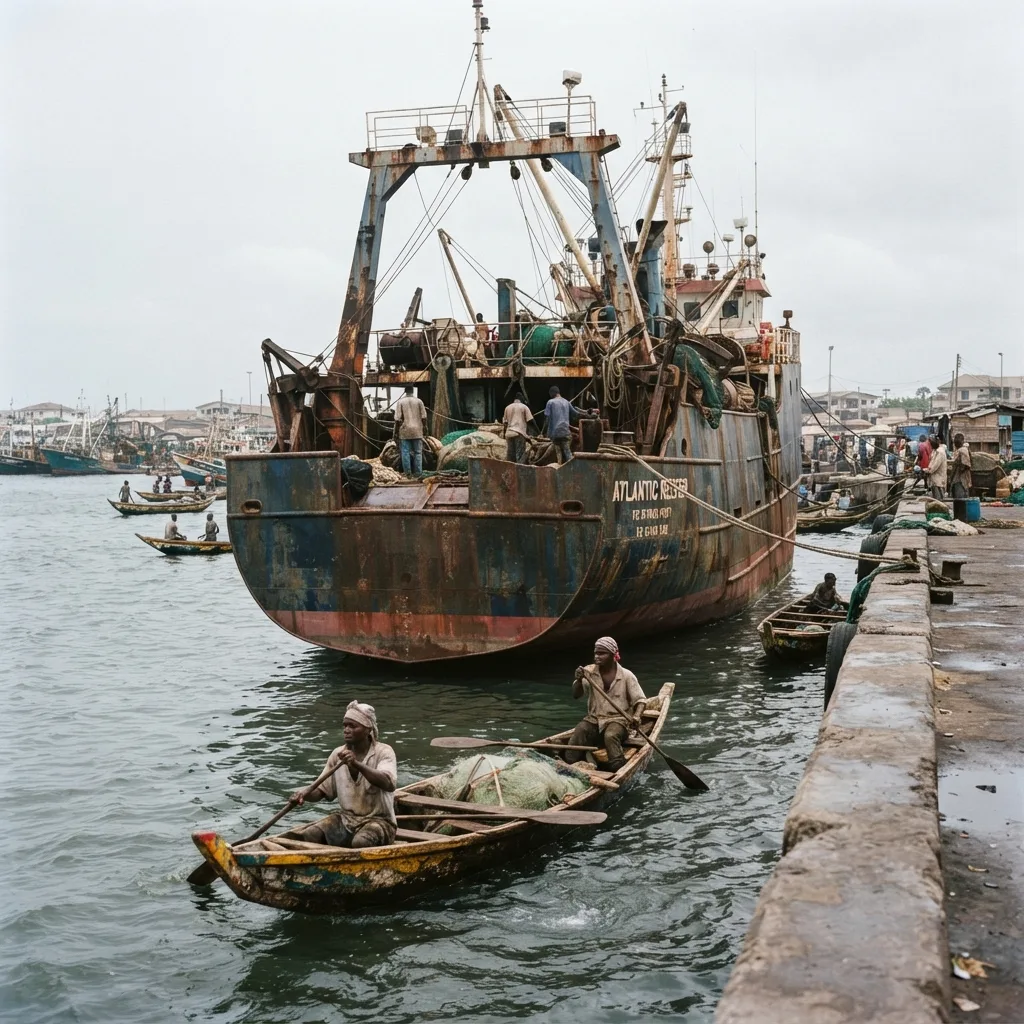
A rusted industrial trawler named Atlantic Reefer docked at a Ghanaian harbour with two men paddling a canoe past its stern
What an investor can price
The licence and flag stay in Ghana while the command and the capital sit across the table, and that is the position an investor is really buying.
🐟 The Opening: what actually pays 🐟
01

A trade-finance product priced on the catch. A bank cannot underwrite here because it prices the wrong security, land; a lender who finances against a signed purchase agreement and verified throughput would be selling into a market the informal advance already proves and prices, at a rate it could beat.

02

Reading the statute before the numbers land. Every fee, permit and levy is still in draft Regulations; watching the section 169 Regulations and the GIPA schedule, rather than the news coverage, positions an operator ahead of whoever waits for the Gazette.

03

The aggregation layer an organised actor already anchors. An estimated 99,642 women already prefinance landings across the chain; building the buyer and the price signal behind them makes several of the lower rungs of the entry ladder in Pillar 7 bankable at once.

🐟 Key takeaways 🐟
01

Act 1146 is in force, so its obligations and penalties bind an operator now, but the section 169 Regulations that carry every fee are still in draft. The compliance risk is live; the compliance cost is not yet a number.

02

The public money is small and tilted away from you: the 2025 fisheries budget was GH¢264 million, over three quarters administration, and less than half of the 2024 budget was spent. Assume the state co-invests in nothing.

03

Formal credit fails on collateral, not price. Banks want land the women who run this trade cannot own, so working capital is the trader's advance, prefinancing up to all of some landings against the catch.

04

The finance gap is a product, not a grant. A lender who underwrites a signed offtake and throughput record instead of land would be selling into a market the informal advance already proves and prices.

05

The outlook is a set of hedged bets and a pricing problem. On-shore value capture is the safest bet, certification the highest-value but bait-contingent one, and aggregation the one with the actor in place; and how much of any return depends on a fee, tax or levy the state has not set is the diligence question.

Written for each reader

🐟 Practitioner intelligence 🐟

Hover any card to pause and lift it.

For students

Do not chase a licence or a tax holiday; neither is priced yet, and both will need a lawyer later. Start where the money moves: the credit relationship that finances the trade. Spend a season with a trader or processor recording who advanced cash to whom, against what catch, at what implied cost, and you will understand the one financial system here that actually works. First-timers assume formal finance is merely expensive; for most of this chain it is out of reach for want of land to pledge. You leave with a map of how working capital flows, raw material for any lending or aggregation business you build later.

For entrepreneurs

Settle two things before spending a cedi, in order: legal structure, then working capital. Incorporate under the Companies Act and, if foreign money is involved, register with the investment authority; the beneficial-ownership screen now sits inside the licence committee, and a hidden shareholder is the fastest way to lose a licence. Then secure working capital before supply, not assuming a bank will provide it: line up your own float or a buyer's advance, knowing the trader who prefinances a landing also takes the fish and sets the price. The trap: treating the licence fee as the cost of entry, then being ambushed by the real one, a working-capital gap the formal system will not fill, closed only by an informal lender taking your margin.

For investors

The thesis: Ghanaian fisheries is underpriced by the state and mispriced by its lenders, and value accrues to whoever fixes the second. Three diligence asks. Quantify how much of the target's projected return depends on a fee, tax or levy the Regulations have not set, and discount it. On any vessel-owning target, require beneficial ownership in writing, checked against the Commission's published register. Examine how the business is financed; if it runs on trader advances, price the cost of replacing them. Release the cheque against a signed offtake and verified throughput, not a licence or installed capacity, and size the dominant risk as regulatory: how much of the model survives numbers the state has not yet published.

For ecosystem actors

The lever: a collateral registry, not another grant line. Formal credit fails because lenders recognise land while operators hold fish and offtake, so letting a signed purchase agreement or a warehoused, graded stock serve as security would move a measurable number: the share of processors and traders able to borrow formally, currently near zero. Pair it with the Commission's new duty to publish the licence register, which makes offtake counterparties checkable. Avoid repeating the last decade's approach, which bought ovens, landing sites and cold stores ahead of the finance and record-keeping to run them, most now idle or unbuilt. Public effort should build the plumbing that lets private capital price a risk already priced informally, and price it lower.

Where this connects.The enforcement record that decides whether the Development Fund ever fills, and the yellow card and instruments this pillar’s policy risk sits behind, are in Pillar 3. The fish-mammy advance whose finance terms are set out here runs the value chain in Pillar 6, and the firm-level economics that a licence fee and a tax rate would feed into, once they exist, are in Pillar 5. The entry ladder, the market signals and the digital opening that these bets and this finance are meant to serve are in Pillar 7.

Footnotes
  1. Marine Stewardship Council (2026).
  2. Key Traceability (2024).
  3. Illuminating Hidden Harvests, reported in Ocean Risk and Resilience Action Alliance (2025).
  4. Ministry of Fisheries and Aquaculture Development (2022).
  5. Fisheries and Aquaculture Act 2025, read with CEMLAWS Africa (2025).
  6. Republic of Ghana (2025).
  7. Fisheries Commission, reported by Modern Ghana (2026).
  8. Ministry of Fisheries and Aquaculture Development (2025).
  9. World Bank (2019).
  10. Coastal Resources Center (2021).
  11. Illuminating Hidden Harvests, reported in Ocean Risk and Resilience Action Alliance (2025).
  12. Drury O'Neill et al. (2018).
  13. World Bank (2019).
  14. Ghana Investment Promotion Centre (2026).
  15. Coastal Resources Center (2021).
  16. Ministry of Fisheries and Aquaculture Development (2025).
  17. World Bank (2019).
Download full PDF
UpcomingThis document isn't available yet.