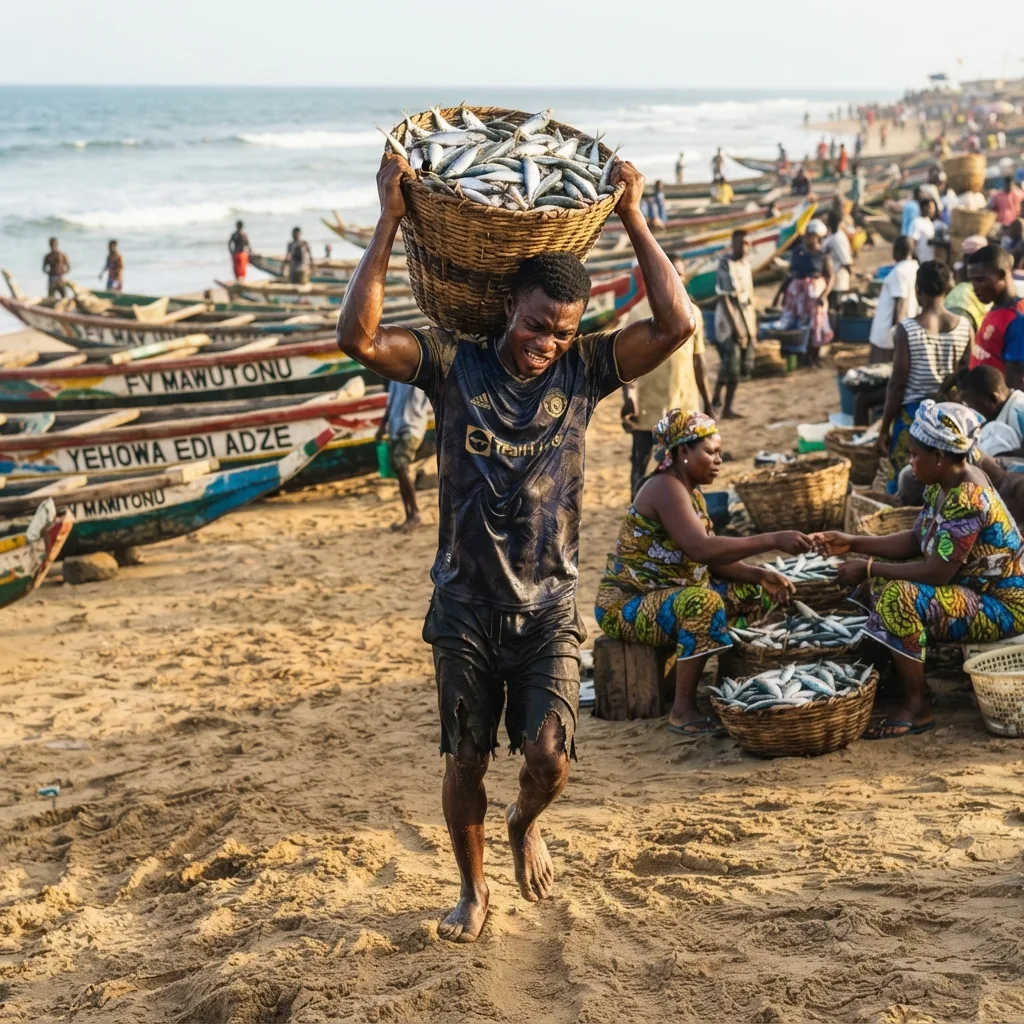
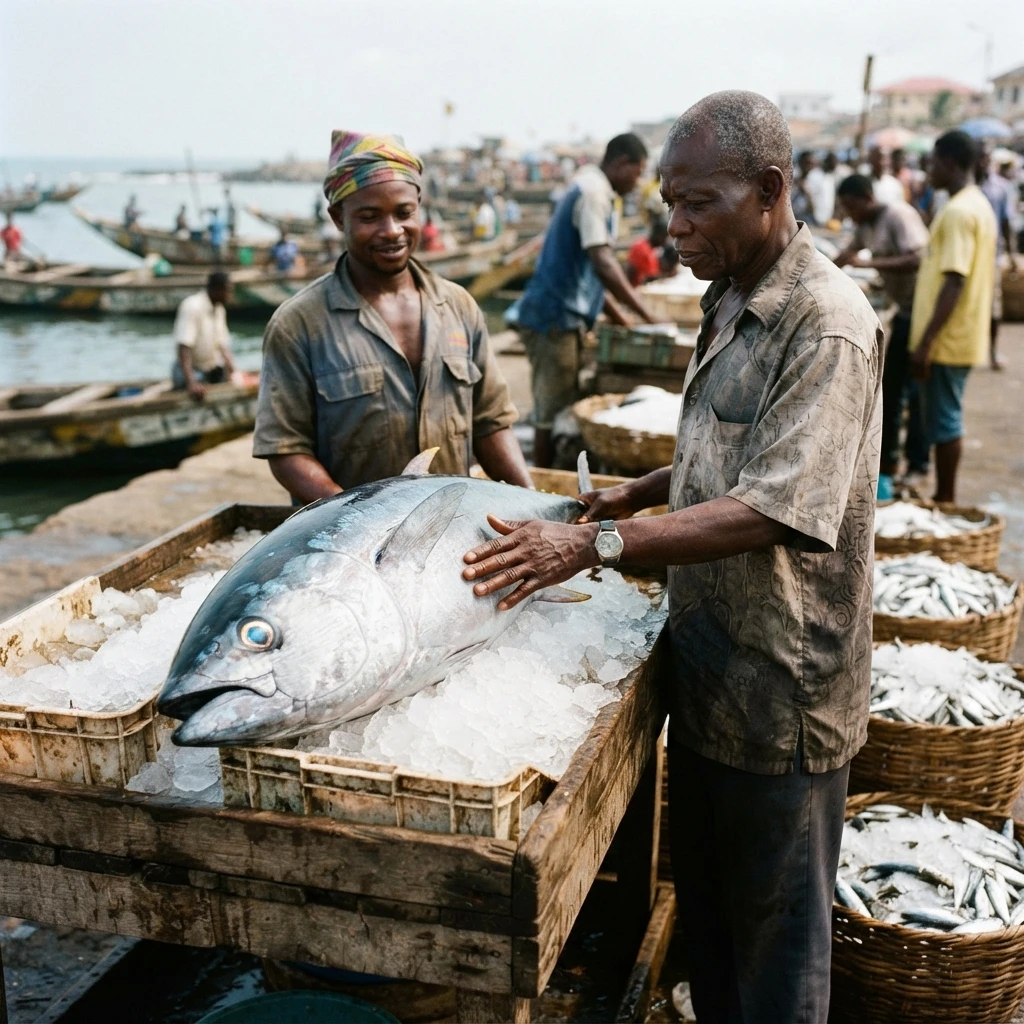
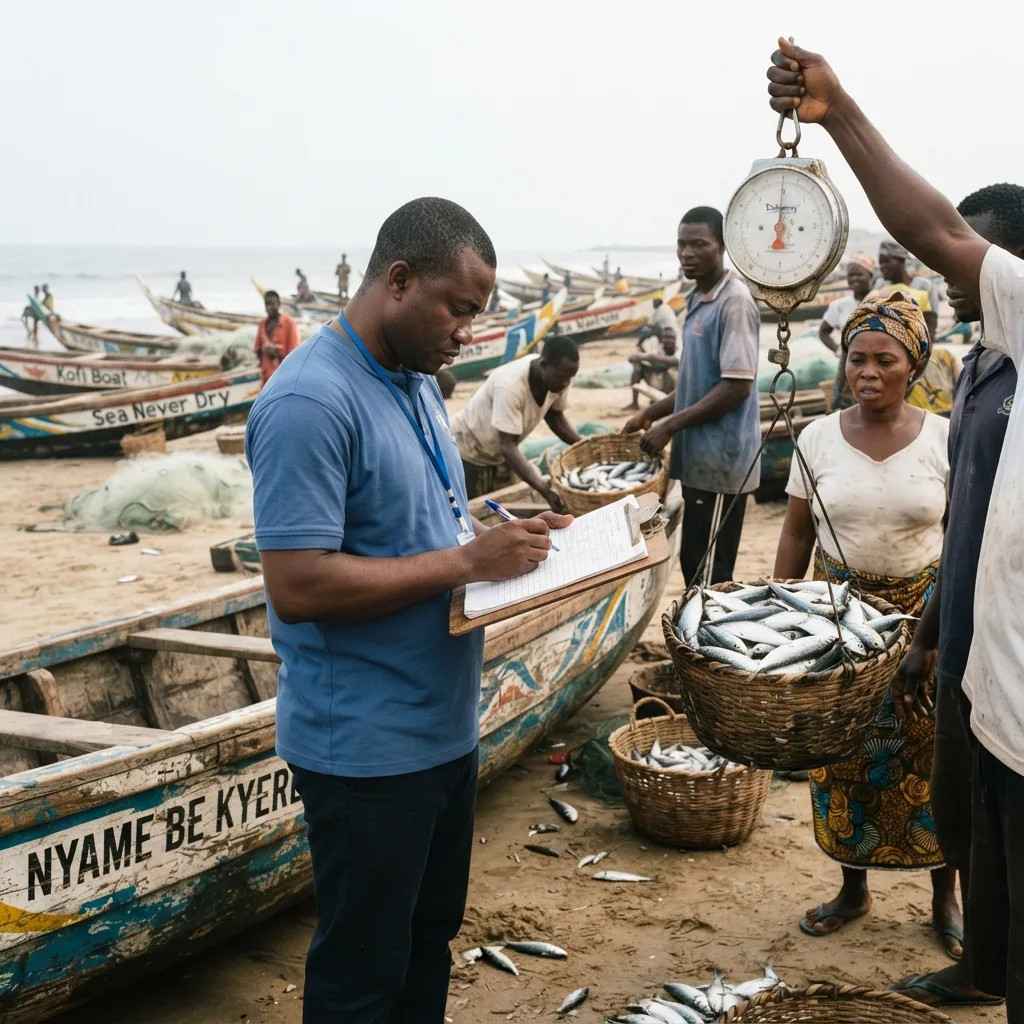
A fish trader recording a catch and price in a ledger beside a hanging scale at a busy Ghanaian landing beach at dawn.Upload photo · /images/marine-pillar-hero-6.webp
Marine Fisheries · Series intelligence
Market Intelligence
The biggest openings are services the artisanal chain lacks at scale, and the largest is loss itself: 22.5 per cent of fish production was lost after landing in 2023, worth GH¢2.6 billion. Grading, ice, clean processing and price data all have buyers and few sellers.
Market Intelligence · Pillar 07
The openings, who is not yet serving them and the capital each needs are set out below. The biggest openings are services the artisanal chain lacks at scale: grading, ice and cold storage at the landing beaches, clean processing, traceability, current price data and alternative bait. Six signals a founder must watch are also set out, two of which decide whether a lender can price a plan at all.
A fish trader recording a catch and price in a ledger beside a hanging scale at a busy Ghanaian landing beach at dawn, canoes and baskets of small pelagic fish around her, documentary photographUpload photo · /images/marine-pillar-hero-6.webp
A price recorded at the landing
The first product: a landing-beach price series.
22.5%
of total fish production is lost after landing, worth GH¢2.6 billion
6 rungs
on the entry ladder, from a notebook to a cannery stake
2 of 6
signals decide whether a lender can price a plan at all
🐟 Where the openings are 🐟
The resource has a ceiling, and its value leaks out after landing. Growth has to come after landing: every assessed stock, small pelagic and demersal, is fished beyond its limit and round sardinella landings fell from 119,515 tonnes in 1992 to 11,834 tonnes in 2019, 9.9 per cent of the historical maximum1. National post-harvest loss is 22.5 per cent of total fish production, worth GH¢2.6 billion, with the marine sector carrying 95 per cent of the loss2, its marine share alone close to the size of the fish export account. Fish is bought by size, not weight, so a cleaner, cheaper smoking oven may not repay the processor; the missing link is a buyer paying a premium for graded, certified fish. Pillar 6 sets out these openings link by link; Pillar 8, the finance to fund that buyer.
The first decision is which of the two fisheries you are standing in. The small pelagic fishery feeds the country; its problem is loss on shore. The tuna fishery earns the foreign exchange, at 28.5 per cent of landings by weight but 34.6 per cent by value2, and its problem is a conditional export market. The two are linked: the pole-and-line tuna fleet’s live bait is anchovy, juvenile round sardinella and round scad, drawn from the collapsing small pelagic stocks, so a portfolio spreading its risk across both has doubled down on the same sardinella.
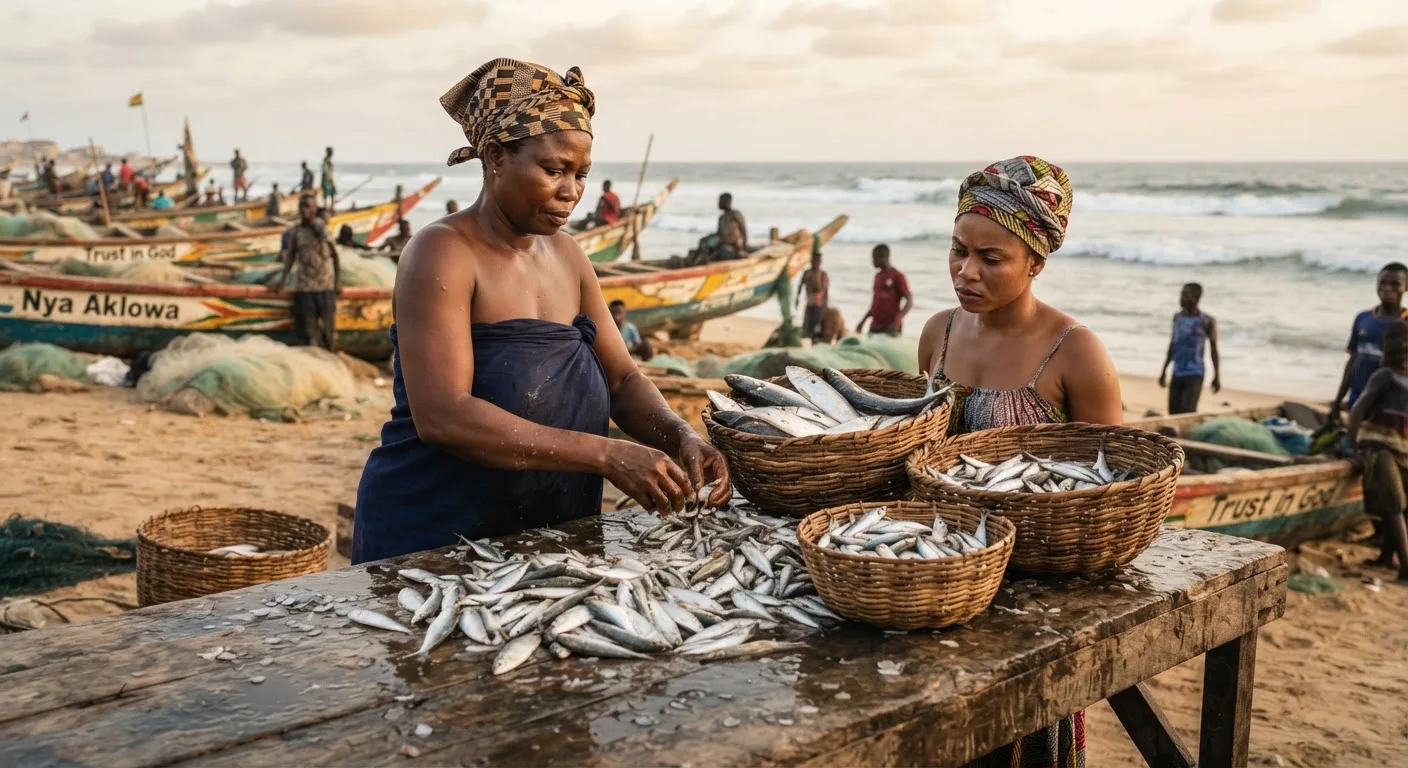
Two Ghanaian women sorting a mixed catch of small pelagic fish by hand at a beach-side table, baskets and canoes behind them, documentary photographUpload photo · /images/marine-mi-grading.webp
Priced by size
The missing product: a written grade with a buyer who pays for it.
95%
of national post-harvest loss sits in the marine sector alone
9.9%
round sardinella's 2019 landing against its historical maximum
What this means.The obvious way in, owning a canoe or a cannery stake, is the riskiest first move: the headline asset carries the resource or market-access risk and the chain’s worst control. The openings sit closer to shore, in the handling, grading and information the fish passes through after landing.
🐟 The entry ladder, by capital 🐟
The rungs sort by capital, and by risk: asset-light rungs sit on shore, where value leaks and no operator competes for a shared stock; capital-heavy rungs sit at sea or behind an export licence, where the resource ceiling and market access bite. Most return signals are indicative: the newest official landed values are the Fisheries Commission’s for 2023, 2026 market prices come from retail and trade listings rather than a landing-beach series, no cannery margin has been published since 2019, and no licence fee exists until the Act’s Regulations are made.2
Table 18How to enter Ghanaian marine fisheries, ordered by the capital each rung needs
Table 18: How to enter Ghanaian marine fisheries, ordered by the capital each rung needs
Rung, lowest capital first
Capital to start
Secure before you spend
The first-timer trap
Return signal
A landing price and data service
Near nothing: a notebook, a hanging scale, a measuring board
A landing site and the trust of a few canoe owners
Treating the beach as an open market when the catch is pledged to the trader who financed the trip
No published revenue benchmark for a beach price service
A cold-box aggregation round
Low: an insulated box, ice and transport
An offtake buyer and a reliable ice source
Buying the box before the buyer; ice recovers value if someone pays for the grade it protects
Indicative; sized against the loss pool, not from any measured per-round margin
A clean-smoking or grading enterprise
The oven cost in Pillar 5's 2026 cost model
A buyer who pays a premium for graded, cleaner fish
The pricing-by-size convention that left the Ahotor oven unrewarded for its operator
The smoking net in Pillar 5's 2026 cost model, on cited 2026 fish prices
A canoe, or a share in one
The canoe and motor cost in Pillar 5's 2026 cost model
A crew, a catch-sharing agreement and a buyer; the stock is shared and falling
Owning the hull while the catch splits between crew and up to three owners
The owner's net in Pillar 5's 2026 cost model
A semi-industrial vessel
High; the one fleet segment an entrant can buy
A licence, a berth and a crew
Buying into a segment that is not growing, squeezed from both sides
No current Ghana margin is published for the segment
A cannery stake or an industrial vessel
Very high
A European sanitary approval, bait-supply data and a signed offtake
The bait dependency and unlifted yellow card behind the export licence
No Ghana cannery margin has been published since 2019
The capital and return figures are the 2026 cost model's indicative estimates, with their basis set out in Pillar 5. The semi-industrial and cannery rungs carry no current Ghanaian return figure.
The two bottom rungs, both on shore, suit a first-timer with little capital. A price and data service needs a notebook and a season of early mornings at one landing site, producing a continuous landing-beach price series, which the Fisheries Commission’s annual landed values do not provide; the newest measured beach prices cover three small pelagic species on two gear types around the 2023 closed season.3 A cold-box aggregation round is the next step: buying ice to move fish out of the downgraded grade before its value is lost. Few operators offer either, so each is an open niche. The middle rung, a clean-smoking or grading enterprise, carries the central lesson: the Ahotor oven burns less wood and cuts the carcinogens in smoked fish, yet processors reported that its prices did not repay the investment, because it shrinks the fish and the buyer pays by size, and adoption has been low. Sell the buyer on grade before selling the processor on equipment.
The top three rungs are the visible ones, each carrying a risk the lower rungs do not. A canoe ties an entrant to Pillar 1’s falling stock and to a catch that customary rule splits between crew and up to three owners, so the hull buys less control than it seems. The semi-industrial boat is the one vessel segment a Ghanaian entrant can buy outright, and Pillar 4 shows it squeezed and not growing. The cannery inherits both the bait dependency and European market conditions. Each works better as a later step, once a buyer is signed and a season is measured.
How to read the ladder. The ladder has one shape: cash cost rises as you climb, resource and market risk rise with it, and control over your margin falls. The disciplined entry is the lowest rung your capital and ambition can accept, held until you have a signed buyer and a measured number, then a deliberate climb. Start where you can afford to be wrong.
Lowest rung first
A signed buyer before you climb
A measured number before a bigger asset
🐟 The signals to watch 🐟
A business on any rung is exposed to a small set of moving signals, most regulatory and outside an operator’s control; two of six decide whether a lender can price a plan at all. The Act’s licensing Regulations were due within twelve months of its Gazette notification of 14 August 2025 and were still in draft after regional reviews began at Takoradi on 14 and 15 July 2026,4 so no licence cost can yet be quoted4; no continuous landing-beach price series exists beyond Pillar 2’s 2023 figures, so a 2026 price needs its source, species, point in the chain and basis stated. The other four move value without deciding it: the export leg turns on a second European Union yellow card, issued 2 June 2021 and still in force in September 2026, when the Fisheries Minister met European Commission officials to press for its lifting5;6the tuna leg gained access to certified-seafood buyers with certification of Ghana’s Atlantic skipjack and yellowfin tuna fisheries to the Marine Stewardship Council standard, covering both the purse seine and the pole-and-line fleets7; the canoe’s largest running cost, premix, has been set at GH¢24.80 a gallon and GH¢174 a yellow gallon since 1 September 2026;89 and the calendar has industrial trawlers closed for two months and semi-industrial vessels for one, from 1 July 2026, with marine artisanal canoes exempt for the second year running, as in 2025.101112 Check each against its own authority: the European Commission for the card, the Marine Stewardship Council for the certificate, the Fisheries Commission and the Gazette for the Regulations, and the Ministry for premix price and closed season.
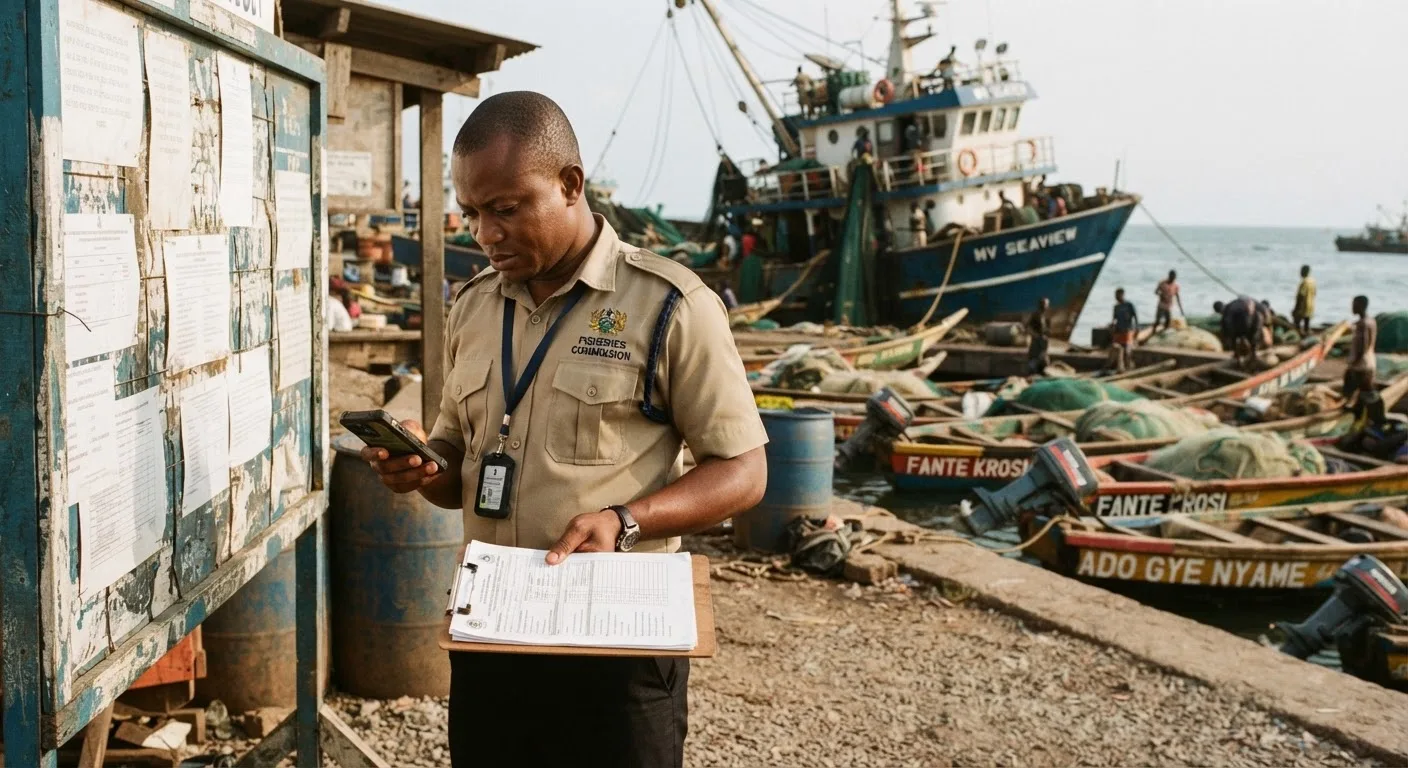
A fisheries officer in uniform checking a notice board and a clipboard beside a trawler and moored canoes at a Ghanaian port, documentary photographUpload photo · /images/marine-mi-signals.webp
Checked against its own authority
The watch list: each signal has its own authority to check against.
14-15 Jul 2026
regional reviews of the draft licensing Regulations began at Takoradi
GH¢24.80
a gallon of premix from 1 September 2026, the canoe's largest running cost
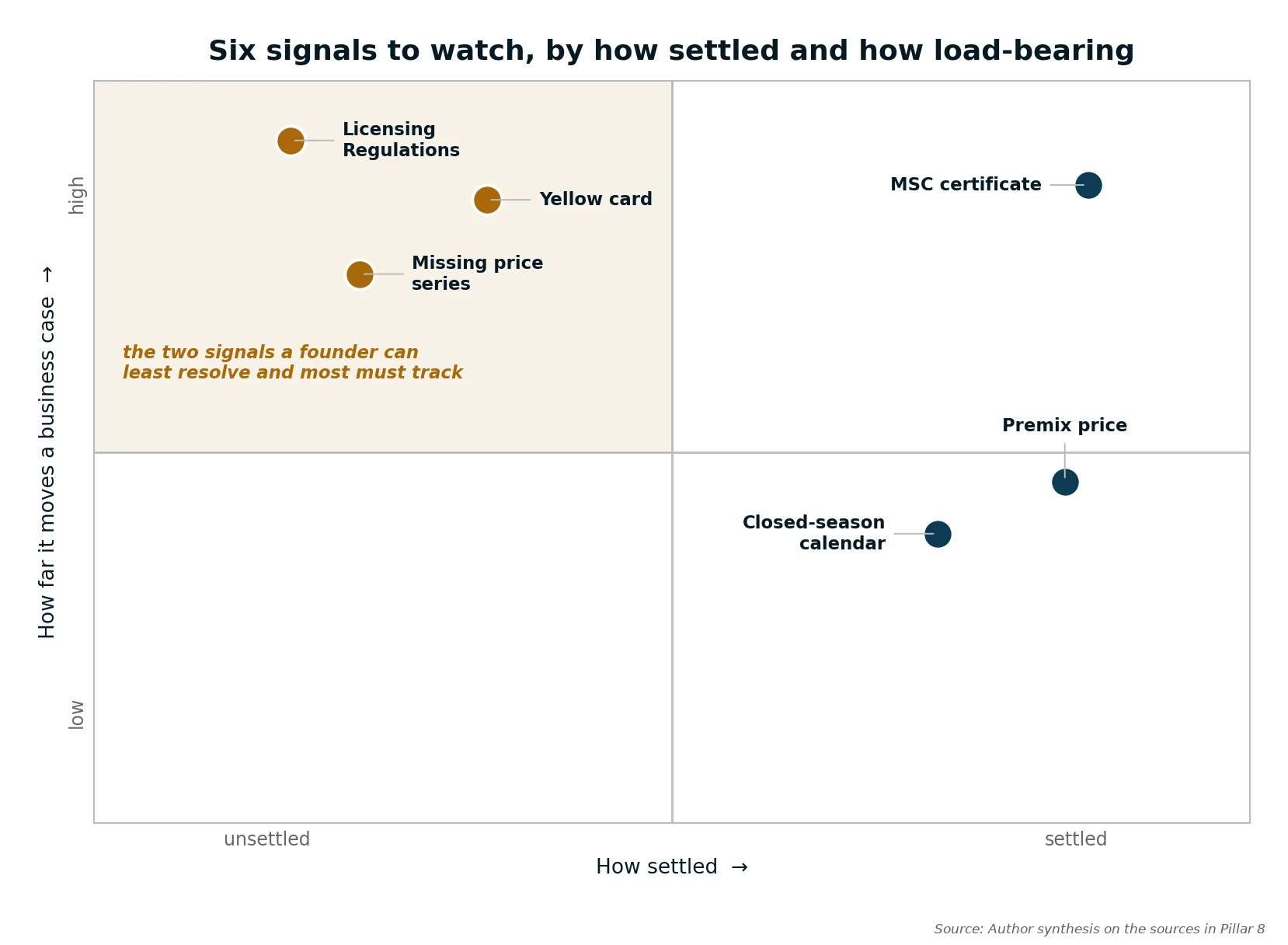
Figure 18 The six signals, by how settled each is and how far it moves a business case
What this shows
The two signals in the unsettled, high-impact corner are what a founder can do least about and most needs to track: the licensing Regulations, deciding whether a licence line can be budgeted at all, and the absent price series, leaving every revenue line an estimate. The certificate and yellow card move the export leg; the premix price and closed season move the canoe.
The six move on different clocks. The licensing Regulations and the yellow card are event-driven and can turn on one announcement, needing a standing alert and named source; the premix price and closed-season calendar reset annually and can be diarised; the certificate and any first price series are slow, structural, checked once or twice a year. A business that learns of an escalated card, or made Regulations, from a customer rather than its own watch has given up the lead time the signal was worth.
Ghana’s digital fisheries tools so far serve enforcement and the premix subsidy: canoe fishers can report illegal trawling on the DASE app launched by the Environmental Justice Foundation and Hen Mpoano in 2020,13port officers screen every foreign-flagged vessel with Global Fishing Watch’s Vessel Viewer,14 industrial tuna vessels are under electronic monitoring, which had not been extended to trawlers by June 2026,1516 and premix is sold through automated outlets tracked by web and mobile applications.2None of them publishes beach prices, so the first commercial digital product is a price and aggregation service, the ladder’s bottom rung and the watch-list’s first line. Two further changes bear on a plan. Ghana declared its first marine protected area on 14 April 2026 at Busua in the Western Region, covering about 703 square kilometres of the Greater Cape Three Points area and 21 communities, with a no-fishing core zone and multiple-use zones whose rules were still being finalised;1712 and the Ghana Investment Promotion Authority Act, 2026 (Act 1173), assented on 15 July 2026, replaced the 2013 investment law, removing the general minimum foreign capital requirement except for trading enterprises, which need US$500,000 in cash equity and a workforce at least 75 per cent skilled Ghanaians.18The reserve’s zoning will set where canoes may fish around Cape Three Points, and the industry-specific tax incentives that Act 1173 leaves to a legislative instrument will set what an on-shore processor pays.19
What to do with the two signals you cannot resolve. Do not wait on the licence fee, and use a 2026 fish price only with its source, species and basis stated. Model the licence line as a flagged range until the Regulations land, and carry the revenue side as an estimate with its 2023 basis attached. A lender here reads a confident number with no source as risk.
Two event-driven signals, watch for the announcement
Two annual-clock signals, diarise them
Two structural signals, check once or twice a year
🐟 AI and digital openings: what is feasible now 🐟
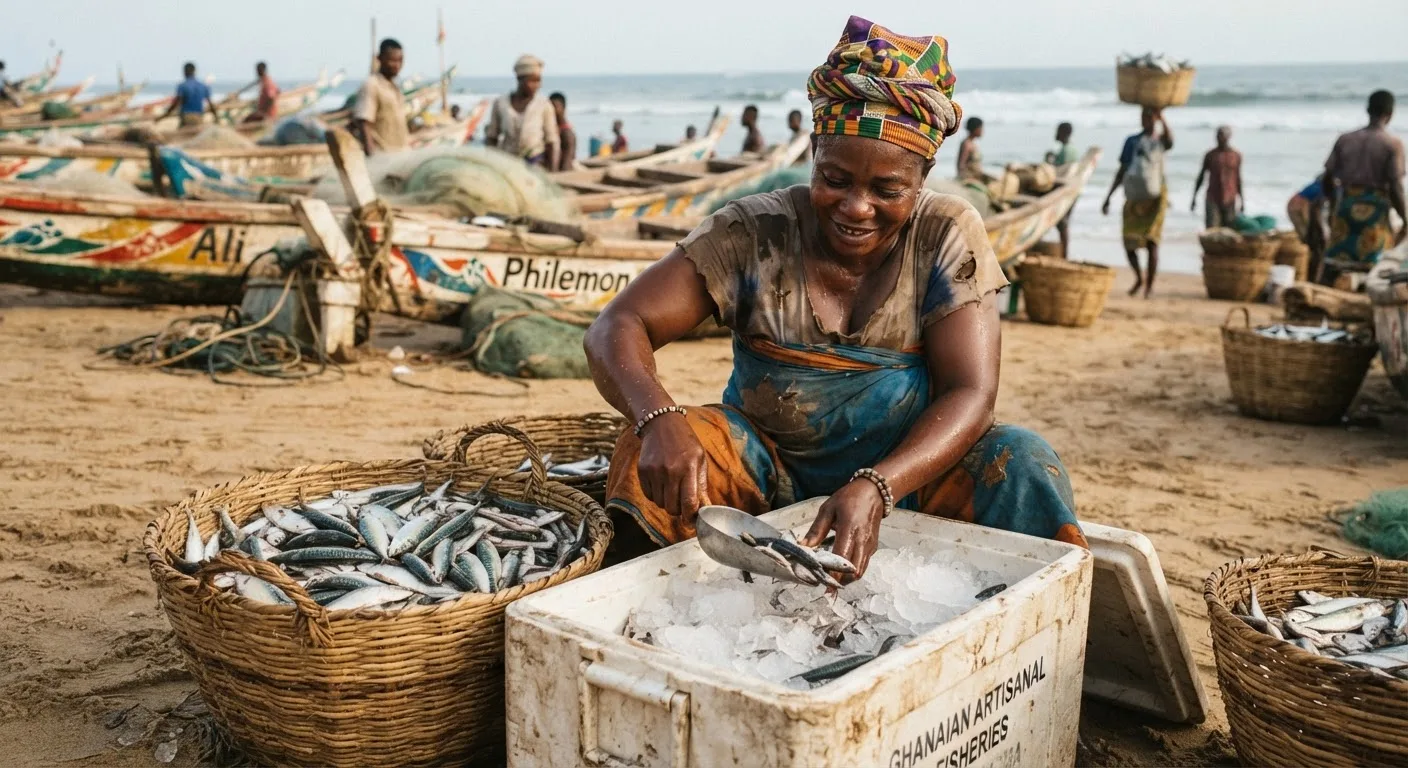
A woman packing small pelagic fish into a portable ice-filled cold box on a Ghanaian landing beach, baskets and canoes around her, documentary photographUpload photo · /images/marine-mi-coldbox.webp
The logic already works elsewhere
Aggregation and cold chain: the same routing logic a delivery app already runs.
The digital tools in use serve the state: vessel tracking and electronic monitoring for enforcement, and automated premix dispensing. Commercial services for the chain, a beach price series, cold-chain logistics and credit scored on the catch, have few or no providers. Four are feasible now, each with a tool that already works elsewhere.
7,322
small-scale fishers on Abalobi in South Africa and Kenya, the model for a price series
4
digital openings feasible now, each with a tool already working elsewhere
Table 19The AI and digital openings, and the tool proving each works elsewhere
Table 19: The AI and digital openings, and the tool proving each works elsewhere
The digital opening
What it does, and the tool that proves it
Who pays
A landing price and data service
A phone app logs catch, size and beach price at each landing and builds a landing-beach price series; South Africa’s Abalobi platform does this for 7,322 small-scale fishers in 27 collectives in South Africa and Kenya20
Processors, lenders and ministries that need a verified revenue line
Catch monitoring and traceability
Satellite and vessel-tracking analytics flag illegal and undersized activity and document a clean chain of custody; Global Fishing Watch’s Vessel Viewer already screens every foreign-flagged vessel calling at Ghana’s ports, and Skylight supported a 2020 Ghana Navy operation that arrested four vessels1421
Tuna exporters needing catch documentation to hold Europe and to help lift the yellow card
Aggregation and cold-chain logistics
A routing and inventory app moves fish out of the downgraded grade before its value is lost, the same logic last-mile delivery apps run
Aggregators, and any buyer paying for graded, consistent supply
Credit scored on the catch
A lender scores a canoe owner or processor on logged catch and a signed offtake instead of land they cannot pledge, the same security a trader's advance prices informally
Processors and traders shut out of formal credit for want of collateral
The comparators are Abalobi (South Africa), Global Fishing Watch and Skylight (Allen Institute for AI). The last two already serve Ghana’s regulators free of charge; the commercial opening is a service built on their open data for exporters, buyers and lenders.
How to read the digital openings. The rule for an AI or digital play here is the rule for a physical one: sell a service against a shared problem, priced on data the chain generates and rarely records. The price series is the keystone: credit scoring, demand forecasting and grading all need a price to work against, and building it starts with a notebook and a phone.
Abalobi, South Africa
Global Fishing Watch and Skylight
The price series, the keystone
🐟 The risks that sit inside the entry decision 🐟
Entering at the wrong rung
VERY HIGH
What it is
The asset that looks like the business, a canoe or a cannery, tops the capital ladder, carries the resource or market-access risk, and holds the least control over its margin. First-timers enter there because it is visible; the openings sit one or two rungs lower, on shore.
Evidence
Pillar 1 puts round sardinella at about a tenth of its historical maximum, capping the canoe; Pillar 5 puts the on-shore loss at 22.5 per cent of production, worth GH¢2.6 billion, the pool lower rungs draw on. No current Ghana return is published for the cannery or semi-industrial rungs.
Who it hits
Students and first-time founders committing scarce capital to the headline asset, and any lender backing them.
How to manage it, and the opening
Match the rung to the capital and enter below where the ambition points, holding the asset decision until a buyer is signed and a season measured. The two asset-light rungs, data and aggregation, have buyers and few sellers, so the cheapest entry is also the least contested.
Pricing a business against a rule that does not yet exist
HIGH
What it is
Two numbers a plan here needs cannot be sourced: the licence fee, since the Regulations are unmade, and a current fish price, since no continuous series is published.
Evidence
The licensing Regulations were still in draft after the section 169 deadline of August 2026 passed (Pillars 3 and 8). The newest measured landing prices by species cover three small pelagic species around the 2023 closed season, with no continuous series (Pillar 2).
Who it hits
Anyone financing a fisheries plan here, and every lender, grant or investment committee relying on one.
How to manage it, and the opening
Carry the licence line as a flagged range, the revenue line as an estimate with its 2023 basis attached, and refuse any 2026 Ghana fish price that cannot name its species, point in the chain and method. The opening is a landing-beach price series, which processors, lenders and exporters need.
Banking the certification premium before the bait is secured
MEDIUM-HIGH
What it is
The MSC certificate is the sector's strongest new value signal, but the pole-and-line method depends on live bait including a juvenile of the collapsing sardinella stock, and the European market it sells into remains gated by an unlifted yellow card: both real, both conditional.
Evidence
The skipjack and yellowfin fisheries were certified in January 2026; the bait is anchovy, juvenile round sardinella and round scad (Pillar 1); the 2021 yellow card was still in force in September 2026 (Pillar 3).
Who it hits
Cannery investors, tuna processing ventures, and anyone relying on the sustainability premium or export licence for market position.
How to manage it, and the opening
Require the bait composition and cost trend before investing, read against the 2022 regional assessment, which rates both anchovy and round sardinella as overexploited, and write the yellow card into the loan covenants. The opening is the alternative: hatchery or imported bait, or gear that reduces the live-bait draw, an unserved need with a captive customer.
A landing-beach price series
A current landing-beach price series is a product processors, lenders and exporters need.
🐟 Key takeaways 🐟
01
The money is on shore. The stock has a ceiling, so the openings sit after landing, in losing less, grading, and selling to a buyer who pays for quality.
02
The binding constraint is a pricing convention and a missing buyer. Because fish is sold by size, processors found that a cleaner, cheaper oven did not repay its cost.
03
Enter by capital, lowest rung first. The headline assets, a canoe or a cannery, top the ladder and carry the resource and market risk; the data and aggregation rungs are asset-light with buyers here and few sellers.
04
Watch six signals: the yellow card, the MSC certification, the licensing Regulations, the premix price, the closed-season calendar and the first published fish price series. The Regulations and a price series decide whether a plan can be financed at all.
05
Ghana's digital fisheries tools serve enforcement and premix dispensing, and commercial services for the chain have few providers. The first product to build is a landing-beach price series.
Written for each reader
🐟 Practitioner intelligence 🐟
Hover any card to pause and lift it.
For students
Choose your rung by the capital you have, and start below where your ambition points. The bottom two rungs, a price and data service and a cold-box aggregation round, need almost no cash and put you next to the buyers and canoe owners the chain runs on. The canoe and cannery that look like the business top the ladder and carry the resource and market risk the earlier pillars documented. Start where you can afford to be wrong, and climb once you hold a buyer and a number.
For entrepreneurs
Work the sequence: buyer before grade before asset. Secure an offtake that pays a premium for graded or certified fish, specify the product to it, then commit capacity, since the constraint is a pricing convention and a missing buyer. The Ahotor oven's trap is buying better technology first: the buyer pays by size, so the improvement went unrewarded. Fix the buyer and the business is fixed.
For investors
The thesis: the money is on shore, the constraint is fish sold by size with no buyer paying for grade, and the country's healthiest fishery runs on its sickest one's bait. Three diligence asks. Establish which rung the plan sits on and price the capital at risk against a return signal that stays indicative almost everywhere. Require any plan quoting a 2026 licence cost or fish price to name its source; an inability to name one is the answer. On any tuna or cannery exposure, require the bait composition and cost trend read against the sardinella assessment. Release the cheque against a signed offtake and a measured season.
For ecosystem actors
The biggest lever for private entry is the buyer. A publicly backed aggregation and grading layer, paired with a monthly landing-beach price series and the overdue licensing Regulations, would give lenders a revenue line, founders a rung to climb, and processors a reason to grade, each cheap against one harbour rehabilitation. Measure it by the share of fisheries plans a lender can assess against a verified price and a stated licence cost, now close to none. Avoid subsidising equipment ahead of the market that would pay for its output: of 520 Ahotor ovens built by January 2019, only 76 carried a subsidy below 88 per cent, and those still had discounts of 30 or 50 per cent.22
For students
Choose your rung by the capital you have, and start below where your ambition points. The bottom two rungs, a price and data service and a cold-box aggregation round, need almost no cash and put you next to the buyers and canoe owners the chain runs on. The canoe and cannery that look like the business top the ladder and carry the resource and market risk the earlier pillars documented. Start where you can afford to be wrong, and climb once you hold a buyer and a number.
For entrepreneurs
Work the sequence: buyer before grade before asset. Secure an offtake that pays a premium for graded or certified fish, specify the product to it, then commit capacity, since the constraint is a pricing convention and a missing buyer. The Ahotor oven's trap is buying better technology first: the buyer pays by size, so the improvement went unrewarded. Fix the buyer and the business is fixed.
For investors
The thesis: the money is on shore, the constraint is fish sold by size with no buyer paying for grade, and the country's healthiest fishery runs on its sickest one's bait. Three diligence asks. Establish which rung the plan sits on and price the capital at risk against a return signal that stays indicative almost everywhere. Require any plan quoting a 2026 licence cost or fish price to name its source; an inability to name one is the answer. On any tuna or cannery exposure, require the bait composition and cost trend read against the sardinella assessment. Release the cheque against a signed offtake and a measured season.
For ecosystem actors
The biggest lever for private entry is the buyer. A publicly backed aggregation and grading layer, paired with a monthly landing-beach price series and the overdue licensing Regulations, would give lenders a revenue line, founders a rung to climb, and processors a reason to grade, each cheap against one harbour rehabilitation. Measure it by the share of fisheries plans a lender can assess against a verified price and a stated licence cost, now close to none. Avoid subsidising equipment ahead of the market that would pay for its output: of 520 Ahotor ovens built by January 2019, only 76 carried a subsidy below 88 per cent, and those still had discounts of 30 or 50 per cent.22
Where this connects. The two fisheries and their bait link are Pillar 1; demand, trade concentration and the missing price series are Pillar 2; enforcement record, the yellow card and the certification behind market access are Pillar 3; fleets and the premix line are Pillar 4; the cost model and on-shore loss the ladder is built on are Pillar 5; the value-capture openings each rung chases are set out link by link in Pillar 6; and the finance instruments, statutory fee regime and strategic bets turning the licence line from unknowable to budgetable are in Pillar 8.
Footnotes
Lazar, N., K. Yankson, J. Blay, P. Ofori-Danson, P. Markwei, K. Agbogah, P. Bannerman, M. Sotor, K. K. Yamoah, and W. B. Bilisini. Status of the Small Pelagic Stocks in Ghana in 2019. GH2014_SCI083_CRC. Narragansett, RI: Coastal Resources Center, Graduate School of Oceanography, University of Rhode Island, 2020. https://www.crc.uri.edu/download/GH2014_SCI083_CRC_FIN508.pdf.↑
Coastal Resources Center. Lessons Learned: 2014-2021, Volume 2. GH2014_PGM355_CRC. Narragansett, RI: Coastal Resources Center, Graduate School of Oceanography, University of Rhode Island, 2021. https://www.crc.uri.edu/download/GH2014_PGM355_CRC_FIN508.pdf.↑