Ghana Agribusiness PlaybookCassava
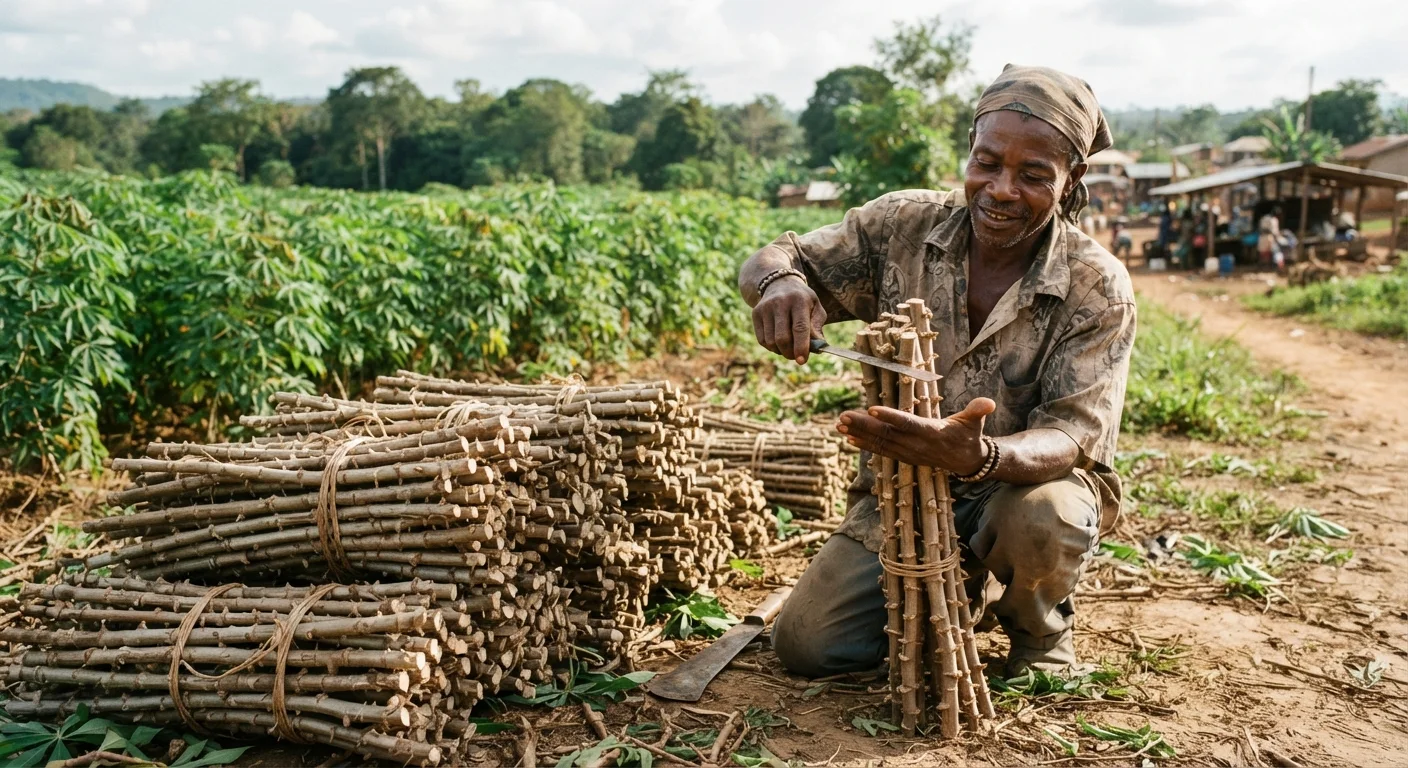
A Ghanaian cassava farmer pushing stem cuttings into a ridged field, bundles of freshly cut cassava stems stacked beside the rows, documentary photograph
Cassava · Pillar 01

Varieties and Planting Material

Ghana grows more cassava than any other crop, yet the national yield runs at barely half its ceiling, and the gap is not climate or genetics but clean planting material and the variety a farmer plants.
Varieties and Planting Material · Pillar 01

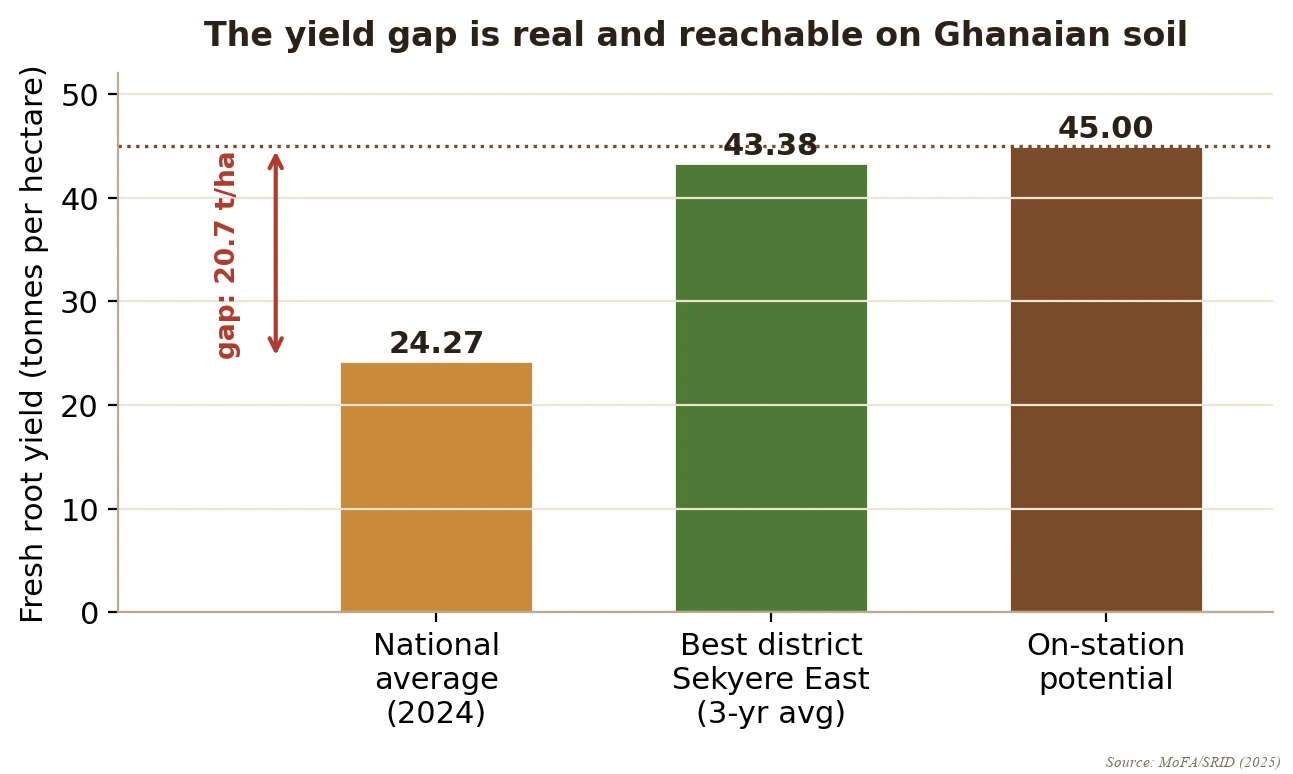
Ghana grows more cassava than any other crop, and the harvest keeps climbing. That rise has come from both more land and higher yield, yet yield still runs far below its ceiling: the national average is 24.27 tonnes a hectare against the 45 the same varieties reach on station, and one district already clears 43. The gap is not a mystery of climate or genetics. It is clean planting material and the variety a farmer plants, and each of those is a business someone can build; the field agronomy that backs them is Pillar 4.

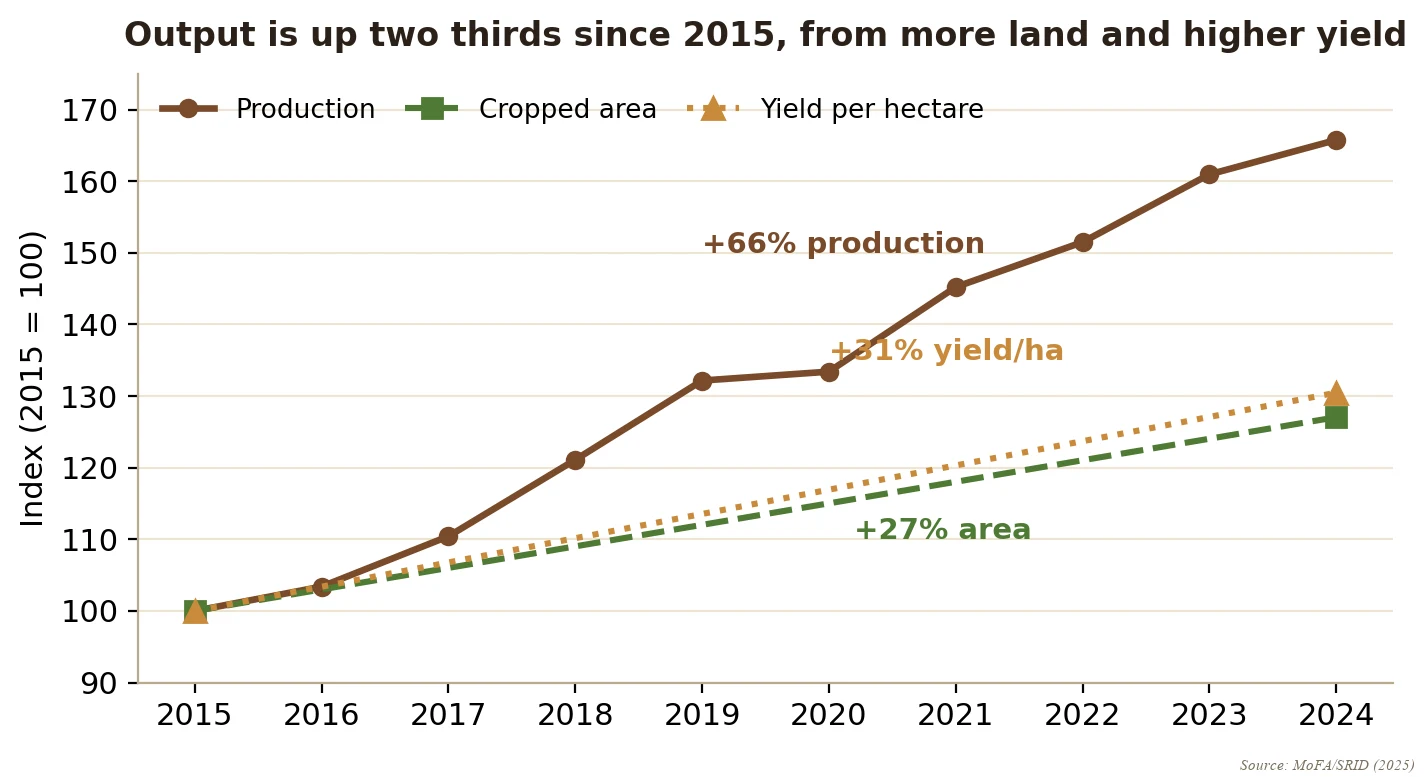
Cassava is Ghana’s largest food crop by weight, and the crop most households name as their fallback when money or rain runs short. National output climbed from 17.2 million tonnes in 2015 to 28.5 million in 2024, a rise of about two thirds in a decade. That growth came from two things at once: farmers planted more land, from roughly 917,000 to 1,165,000 hectares, and they also lifted yield per hectare by about a third, from 18.8 to 24.27 tonnes. Both matter, but the second is where the durable money is, because land eventually runs out and yield does not.1

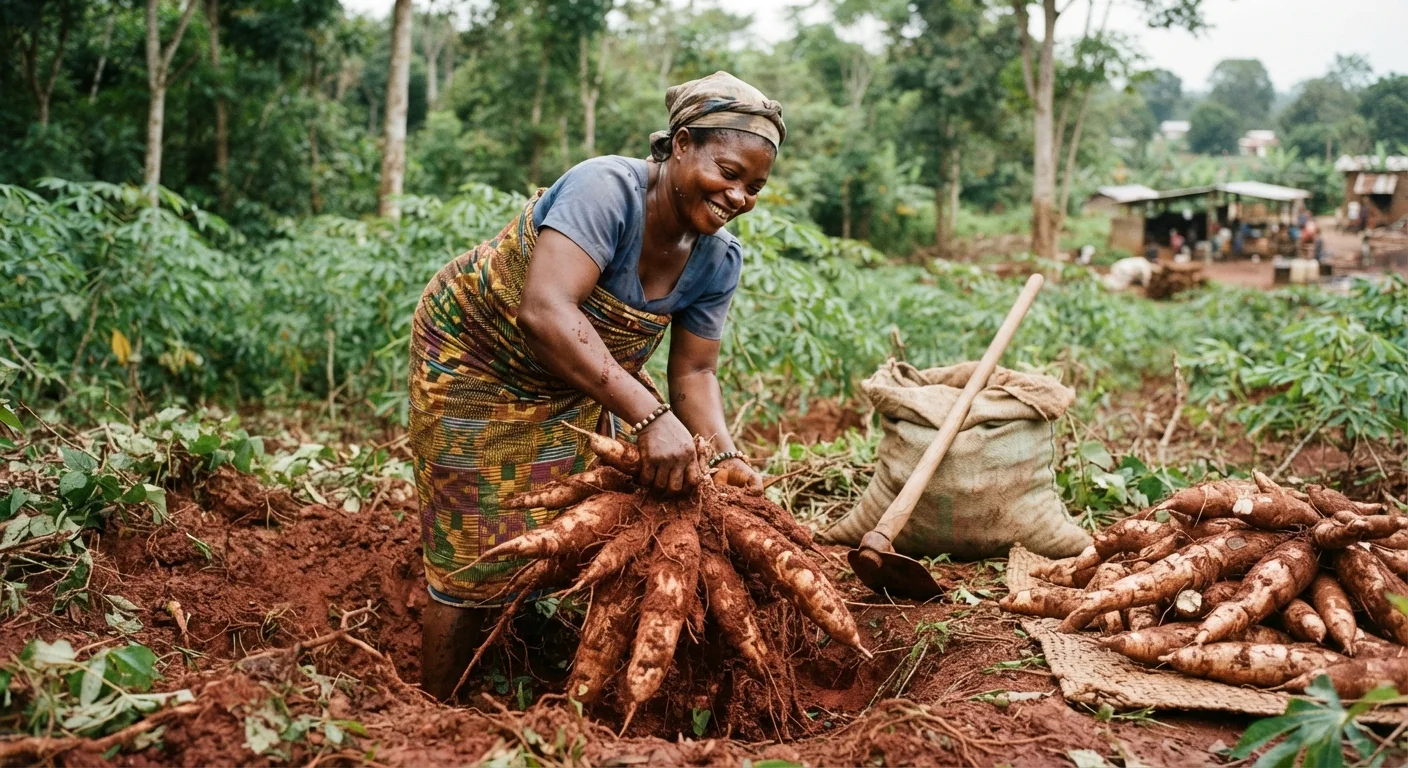
A Ghanaian cassava farmer lifting a cluster of freshly dug cassava roots from red forest soil, a hoe and a heap of harvested tubers beside her, documentary photograph
The gap is the opportunity
Ghana grows more cassava than any other crop, yet yields sit at barely half of what the same varieties reach on station.
24.27 t/ha
Ghana's national average yield, only 54% of the 45 t/ha the same varieties reach on station
28.5M t
national output in 2024, up about two thirds from 17.2 million tonnes in 2015
~40%
the share of farmers growing improved varieties at all

The production base: big, still short of its own ceiling

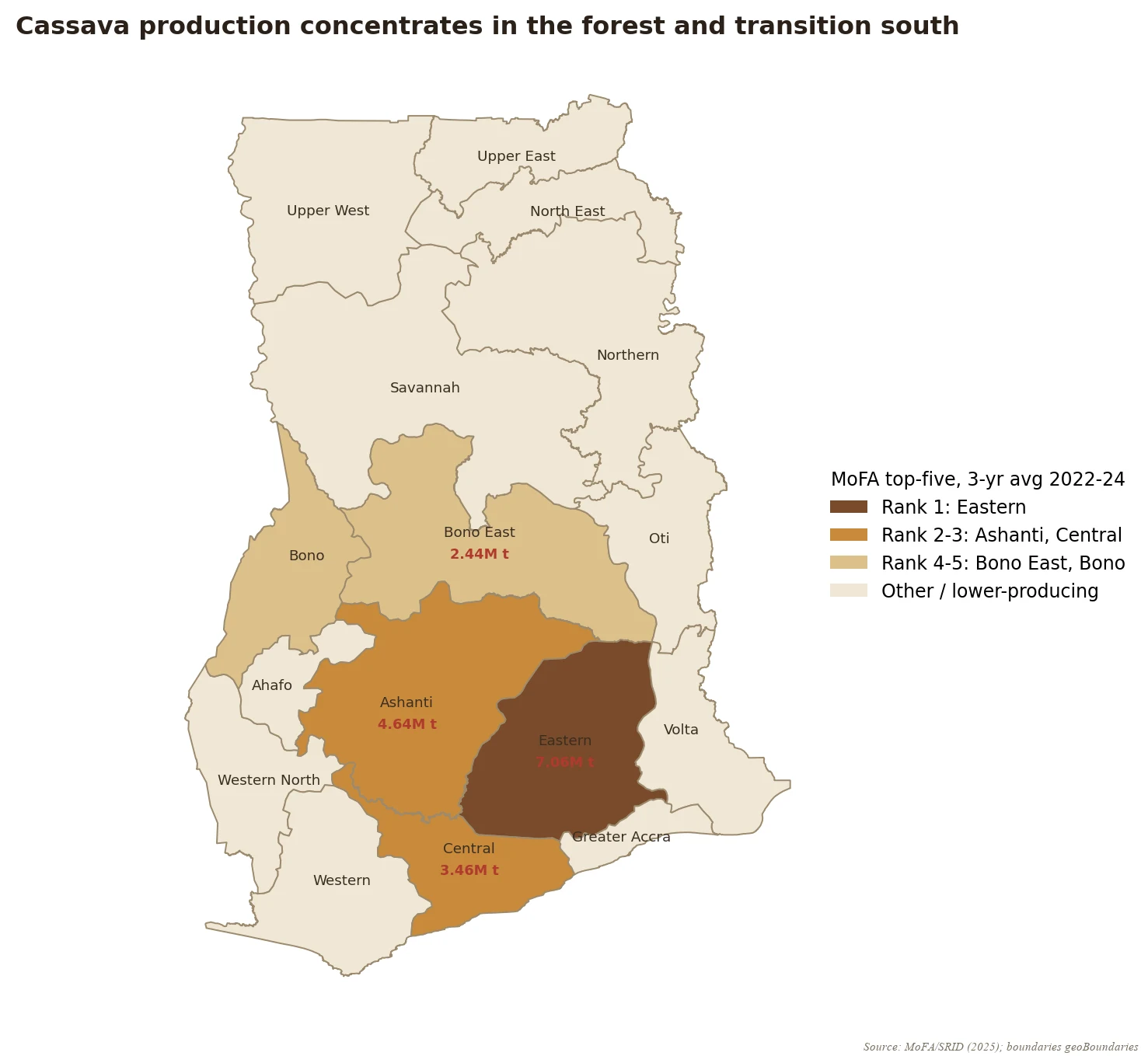
Even after that rise, the national average is only 54 percent of what the crop can give. The best district, Sekyere East in Ashanti, already averages 43.38 tonnes a hectare, which proves the ceiling is reachable on Ghanaian soil, not just on a research plot. Production also sits in a clear belt, with Eastern, Ashanti and Central regions leading and Bono East and Bono behind them, all in the forest and transition south. For anyone entering, the yield gap is the opportunity: closing part of it on a given farm needs no new land, no new variety science and no imported machine, only better planting material, timely weeding and soil that is fed rather than mined.2

54%
of the crop's own on-station ceiling reached by the national average
43.38 t/ha
Sekyere East's three-year average, proof the ceiling is reachable on Ghanaian soil
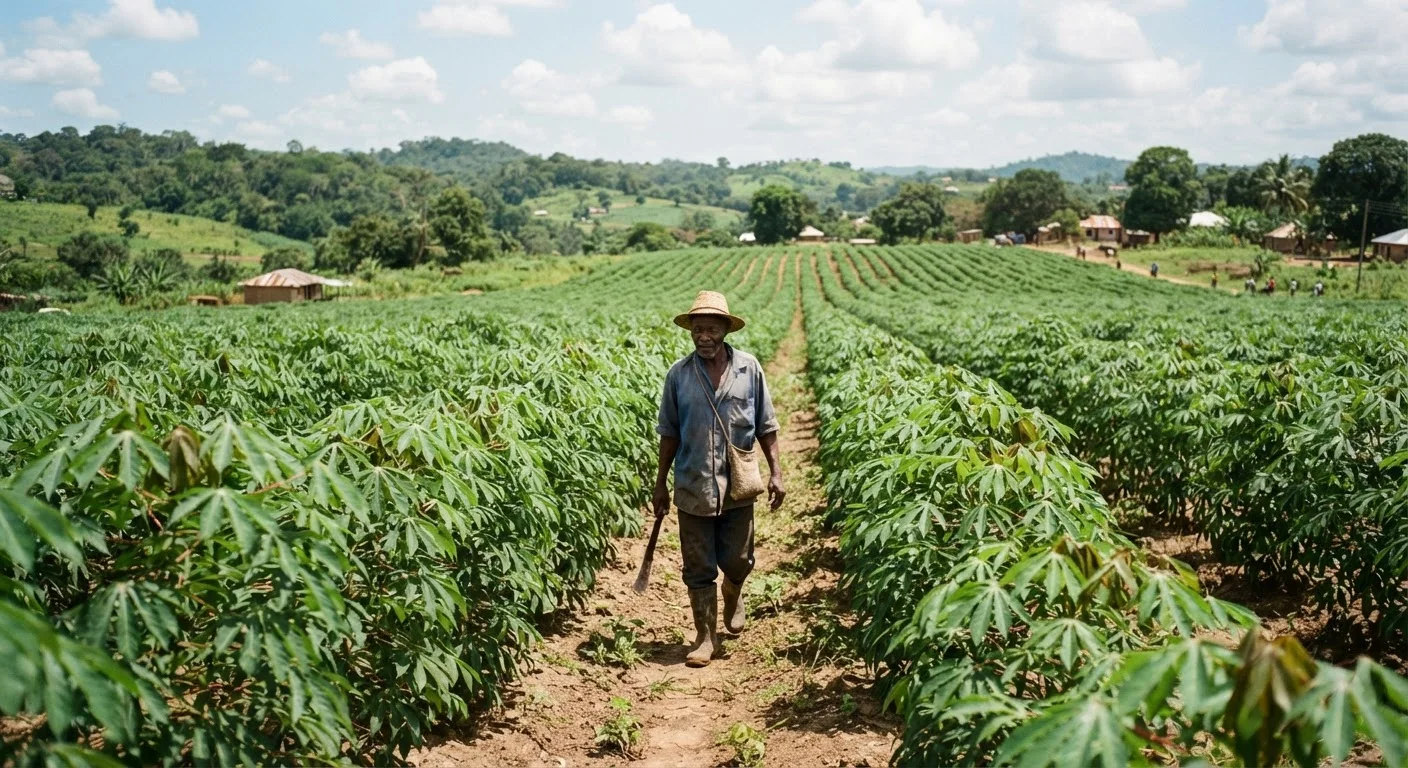
A wide cassava field in Ghana's forest transition zone, tall green cassava plants in neat rows under a bright sky, a farmer walking between them, documentary photograph
The forest and transition south
Eastern, Ashanti and Central lead the belt; the yield gap, not the land, is the opening.
Cassava production, area and yield in Ghana, indexed to 2015: output rising faster than either area or yield alone
Figure 1 Cassava production, area and yield in Ghana, indexed to 2015.
What this shows

Output rose faster than either input alone, so both more land and better farming are at work.

The national cassava yield gap: 24.27 t/ha on-farm average against a 45 t/ha potential, with Sekyere East at 43.38 as proof it is reachable
Figure 2 The national yield gap, and proof it is reachable.
The gap is the opportunity

The national average sits at just 54 per cent of the ceiling the same varieties already reach. One district, Sekyere East, proves it is reachable on Ghanaian soil, not only on a research plot.

Map of where cassava grows in Ghana: the forest and transition south, led by Eastern, Ashanti and Central regions
Figure 3 Where cassava grows: the forest and transition south.

Varieties: choose for the market, not the yield line

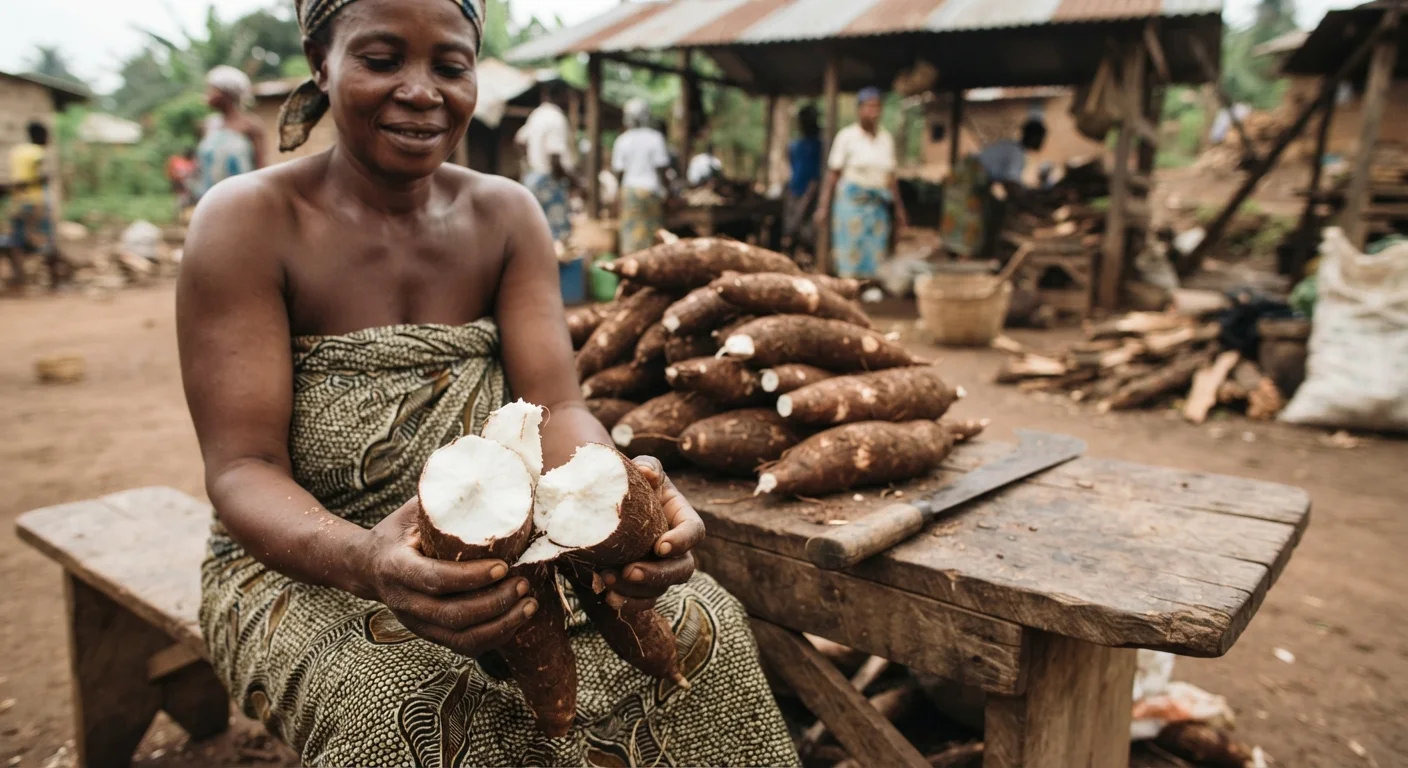
A split cassava root held open to show its white flesh, a stack of freshly harvested roots and a machete on a wooden bench behind it, documentary photograph
Choose for the buyer
A starch buyer pays for dry matter; a flour buyer wants Bankye Hemaa; a nutrition buyer wants yellow flesh.
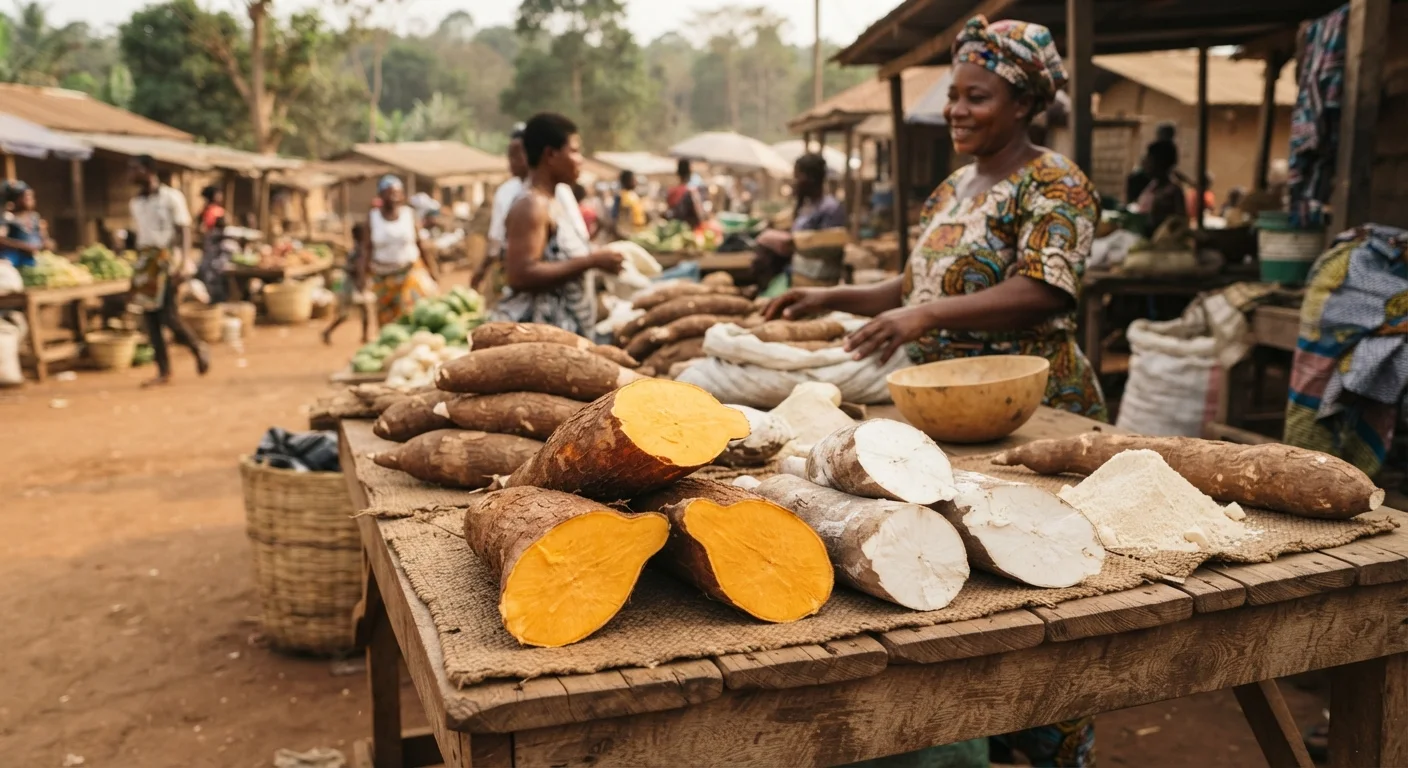
Yellow-fleshed, high-beta-carotene cassava roots sliced open on a market table, their deep orange-yellow flesh contrasting with ordinary white cassava beside them, documentary photograph
The newer, nutrition wave
Yellow-fleshed lines put pro-vitamin A into a staple that usually carries none.

Ghana has a deep bench of released varieties. Research and development since 1993 has released dozens of them, and on average they yield about three times the local landraces they replace.3 The workhorse is Afisiafi: 28 to 35 tonnes a hectare, 32 percent dry matter, tolerant to cassava mosaic virus, and useful for starch, gari and flour. The high-yield names go further, with CRI-Agbelifia rated at a potential 50.8 tonnes and CRI-Bankye Hemaa at 48, the latter with the baking quality a flour buyer wants.4

Yield is not the only axis, and choosing on yield alone is the classic first-timer mistake. Tek-Bankye yields a strong 30 to 40 tonnes but is susceptible to cassava mosaic virus, so it is the wrong plant anywhere the disease is present, whereas Afisiafi and Nkabom trade a little yield for the mosaic tolerance that keeps a crop standing.5 The nutrition angle sits in the newer wave: yellow-fleshed, high-beta-carotene, mosaic-resistant lines released by CSIR-Crops Research Institute in 2022 and by the University of Cape Coast in December 2024, bred to put pro-vitamin A into a staple that usually carries none.6

Table 1: Released Ghanaian cassava varieties, and the trade-off behind each
VarietyYield (t/ha)Dry matterCMD statusBest market useThe trade-off to weigh
Afisiafi28 to 3532%TolerantStarch, gari, flourThe dependable all-rounder; not the top yielder, but forgiving to grow
CRI-Agbelifiaup to 50.8*24% starchNot statedStarch, gariHighest yield on the list, but needs good management to reach it
CRI-Bankye Hemaaup to 48*21% starchNot statedFufu, bakeryHigh yield and bakery quality, but lower dry matter than starch buyers want
Tek-Bankye30 to 4030%SusceptibleFufu, gari, ampesiStrong yield, but a poor choice anywhere mosaic disease is present
Nkabom28 to 3232%TolerantStarch, fufuA reliable, disease-tolerant all-rounder; mid-range yield with dependable quality

Sources: * Potential (on-station) yield. Sources: CSIR-CRI (2017); MoFA/NVRRC (2019). CMD status shown only where the registry states it.

Insight · variety choice is really a market choice

A starch or ethanol buyer pays for dry matter, so Afisiafi and the high dry-matter lines win. A flour or bakery buyer wants Bankye Hemaa. A nutrition or institutional-feeding buyer wants a yellow-fleshed line. Match the variety to the offtake before the first cutting goes into the ground. Deciding once the harvest is already on the ground looking for a buyer is too late.

Put the choice the other way round and it gets simpler. A variety is not chosen for its own qualities; it is chosen for a buyer, and the question is which cassava the person paying wants, and how long you have to get it to them. Table 2 reads the decision from the buyer down.

Table 2: Choose the buyer first, then the variety
If your buyer isWhat they are buyingWhat that demands of the varietyWhere it points
The household pot, through the marketFufu, ampesi, boiled rootPoundability and taste; dry matter matters less than texture, and the root must be eaten within daysThe default market, the lowest unit price, and the sale that punishes a slow seller hardest
A gari processorBulk roots, converted at roughly a quarter of their fresh weightVolume and a steady supply more than any single quality trait; bitter types are welcome because processing is part of the productThe mass engine of the chain, and the tier with real Ghanaian profit data (Pillar 5)
A starch or flour plantDry matter, which is what they actually pay forThe highest dry matter available and a harvest window matched to the plant rather than the farm; fertiliser shape matters here most (Pillar 4)The industrial cohort, bred for exactly this and adopted by almost nobody
An ethanol producerFermentable starch, at scale, close to the plantDistance to the plant matters more than the varietyOne buyer, one plant, and a large import bill behind it (Pillar 2)
Your own field, next seasonPlanting materialDisease-free stems of a known age; a different product from a root, and it should be priced as oneThe business almost nobody is in, and the reason the yield gap persists

Sources: CSIR released-varieties catalogue (2017); Acheampong et al. (2021); International Atomic Energy Agency (2018). Buyer-side economics are developed in Pillars 2 and 5.

The variety also decides how many days a farmer has to sell, which cassava treats as biology and a business should treat as logistics. A root begins to spoil within 24 to 72 hours of harvest, but how fast is set by the genotype, and deterioration-tolerant lines hold far longer than susceptible ones; Pillar 3 carries that clock in full. The catch is a genuine trade-off: post-harvest deterioration rises with root dry matter and falls with carotenoid content, so the high dry-matter roots a starch or flour plant pays most for are the very ones that rot fastest, while the longest-keeping roots tend to be worth less to the industrial buyer (Dankwa et al., 2025).

Opportunity · nobody is selling shelf life

The published variety information covers yield, dry matter and disease resistance, but not how many days a root will hold, so a farmer choosing a stem cannot price the window. For an aggregator or a processor, matching a long-keeping variety to a long haul, and a high dry-matter, fast-spoiling variety to a plant within an hour’s drive, is free margin, available now and needing no new technology and no new variety.

The science is settled; the catch is reach. Only about 40 percent of farmers grow improved varieties at all; more than half the national crop is still lower-yielding local or farmer-saved material. That single fact explains much of the yield gap, and it points straight at the planting-material business.7

Planting material: the real choke point

Cassava is grown from stem cuttings rather than seed. Healthy planting material means 15 to 20 centimetre cuttings taken from vigorous mother plants 8 to 12 months old.8 The trouble is that the same cutting which multiplies a variety also multiplies its diseases. Cassava mosaic disease travels inside infected stems, so a farmer who saves cuttings from a sick field plants the virus straight into the next one. Mosaic is already widespread in Ghana and cuts yields by more than 20 percent, depending on when infection strikes and which viral strains combine.9

Ghana has the institutions for clean seed. The Seed Inspection and Certification Division, under the Plant Protection and Regulatory Services Directorate, certifies foundation and certified seed and primary and secondary planting materials, cassava included.10 What is not yet on the public record is a dedicated clean-cassava-seed scheme at scale, or current figures on how much certified planting material actually reaches farmers. That gap is the opening.

Bundles of freshly cut cassava stem cuttings tied together and stacked on the ground beside a field, a farmer measuring one against his hand, documentary photograph
The choke point
A stem multiplies its variety and its diseases at the same time.
8x
the roughly eightfold multiplication of a clean cassava field in a single year
>20%
the yield cut mosaic disease carries through saved cuttings
Opportunity · the clean-cutting nursery

A registered nursery that multiplies clean, disease-tested cuttings of a named variety and sells them to farmers on an offtake contract sits exactly where the yield gap and the disease risk meet. It is asset-light, it is repeatable season after season, and it is the single highest-leverage entry point in this pillar. Whoever builds the clean-seed layer captures value from every hectare planted downstream of it.

What a stem business actually sells is not the stem; it is the disease status and the age of the mother plant, and a cassava stick multiplies roughly eightfold in a year, so one clean field becomes eight fields’ worth of clean material in twelve months (International Atomic Energy Agency, 2018). That is why the missing seed market is a business that can pay: the biology is easy, but nobody is yet paid for the clean stem. Table 3 sets out three ways in.

Table 3: Three entries into the planting-material gap, and what kills each one
The entryWhat you actually sellWhat it costs to startThe trap
Clean stem multiplicationDisease status and a known mother-plant age rather than the stem itselfLand, clean starter material and a year; the material compounds roughly eightfold a yearA market with free dirty stems at every field edge; you need a buyer who loses money on disease, which usually means a processor rather than a farmer
Variety-to-buyer advisoryThe match between a variety, a buyer's specification and a distanceAlmost nothing; the information gap is the assetNobody pays for advice they can ask a neighbour for free; bundle it with the stem or the offtake, never sell it alone
Aggregating clean-planted farmsA predictable root supply with a known window and known dry matterWorking capital and a relationship rather than equipmentContracting on price alone; the evidence says price does not hold growers (Pillar 6)

Sources: Poku, Birner and Gupta (2018) on the missing seed market; Ministry of Food and Agriculture (2025) on certification; International Atomic Energy Agency (2018) on multiplication. Start-up costs are indicative and require field validation.

One threat is worth watching. Cassava brown streak disease, the more destructive cousin of mosaic, is not yet present in Ghana as of September 2025, but it is spreading westward across Africa and its main entry route is infected stems.11 Anyone moving planting material across borders is the risk. Anyone building a tested clean-seed system is the defence.

Risks that sit inside production

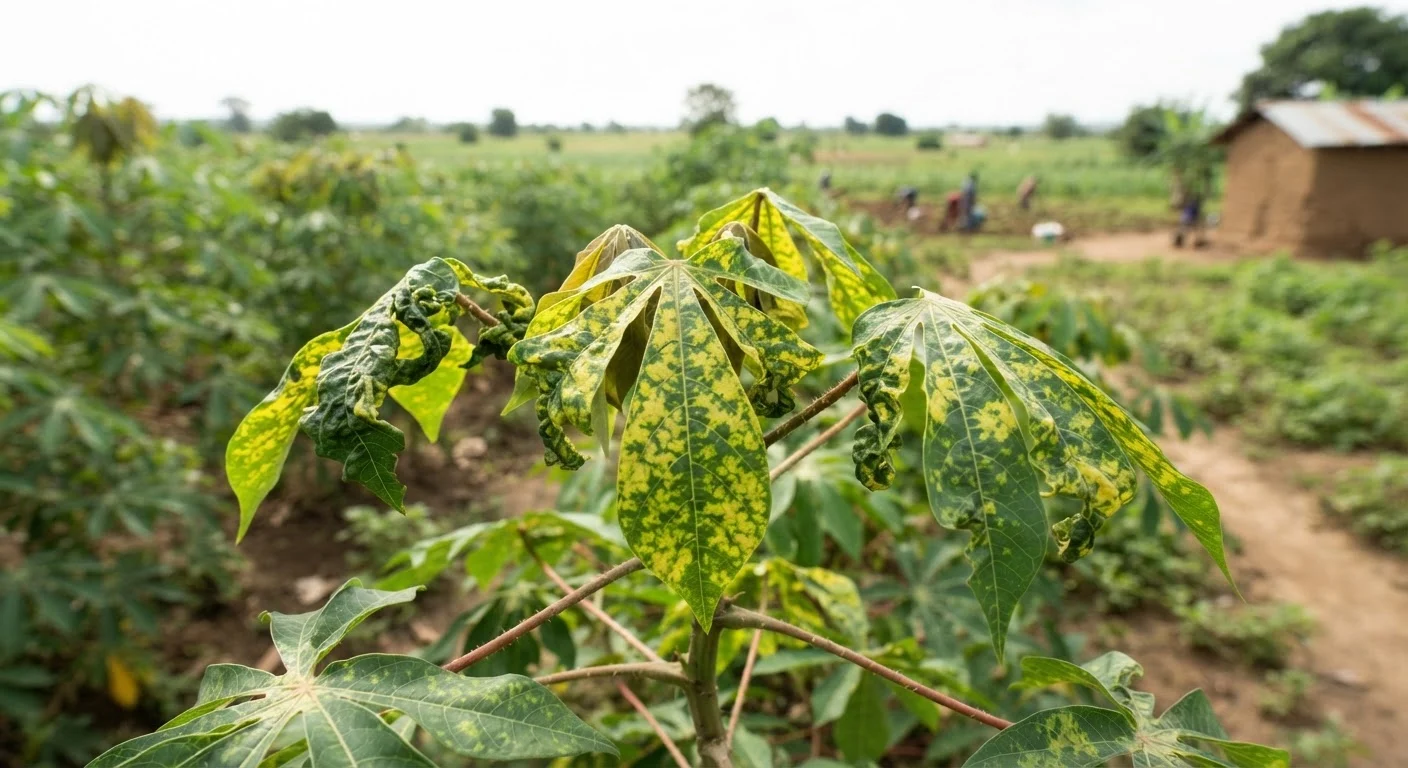
A Ghanaian cassava farmer holding a leaf showing the yellow mottling and distortion of cassava mosaic disease in a young cassava field, documentary photograph

Cassava mosaic disease (CMD)

HIGH
What it is

Carried inside planting material and already widespread, mosaic cuts yields by over 20 percent and travels with every saved cutting from an infected field.

Evidence

Mosaic is already widespread in Ghana and cuts yields by more than 20 percent, depending on when infection strikes and which viral strains combine. Cassava brown streak disease, its more destructive cousin, is not yet present as of September 2025 but is spreading westward.

Who it hits

Every smallholder who replants from last season's own field, and every programme paying for a yield gain it will not get if the material carries disease.

How to manage it

Plant certified or tested cuttings of tolerant varieties such as Afisiafi; rogue out and destroy diseased plants; never take stems from a sick field.

Bundles of freshly cut cassava stem cuttings tied together and stacked beside a field, a farmer measuring one against his hand, documentary photograph
The defence is clean cuttings
Mosaic travels inside saved cuttings, so it plants the virus straight into next season’s field. Clean, disease-tested stems of a tolerant variety are the whole defence.
Openings: where the planting-material gap pays
01

Build the clean-cutting nursery. A registered nursery that multiplies clean, disease-tested cuttings of a named variety and sells them to farmers on an offtake contract sits exactly where the yield gap and the disease risk meet. It is asset-light, it is repeatable season after season, and it is the single highest-leverage entry point in this pillar. Whoever builds the clean-seed layer captures value from every hectare planted downstream of it.

02

Sell shelf life nobody else prices. The published variety information covers yield, dry matter and disease resistance, but not how many days a root will hold, so a farmer choosing a stem cannot price the window. Matching a long-keeping variety to a long haul, and a high dry-matter, fast-spoiling variety to a plant within an hour's drive, is free margin, available now and needing no new technology and no new variety.

03

Match the variety to the buyer, not the yield line. The match between a variety, a buyer's specification and a distance is an asset in itself, and almost nothing to start. Nobody pays for advice they can ask a neighbour for free, so bundle it with the stem or the offtake, and never sell it alone.

Key takeaways
01

Output is rising, but at 24.27 t/ha the national average is only 54 percent of the 45 t/ha the same varieties reach on station. The gap is the opportunity.

02

Only about 40 percent of farmers grow improved varieties; the rest of the crop is lower-yielding local or saved material.

03

Choose variety by the market you are selling into: high dry-matter lines for starch, Bankye Hemaa for flour and bakery, yellow-fleshed lines for nutrition contracts.

04

Clean planting material is the highest-leverage entry point, because it closes the yield gap and blocks disease in the same move.

05

The variety also decides how many days you have to sell: some lines spoil within a day of harvest while others hold for a week or more, and that window is set at planting.

Written for each reader

Practitioner intelligence

Hover any card to pause and lift it.

For students

If you are thinking of entering, the lowest-capital way in is a clean-cutting nursery rather than a farm: multiply disease-tested stems of one named variety and sell them to farmers who cannot source clean material. The first-timer mistake specific to cassava is planting saved cuttings of unknown health, which seeds the virus into your own field before it ever yields.

For entrepreneurs

Secure the offtake first, then match the variety to it, then source or multiply clean planting material of that variety, in that order. Do not cut or buy stems of unknown health before you have confirmed the mother field is free of mosaic disease.

For investors

The thesis: the yield gap closes with clean planting material and the right variety, so returns come from productivity per hectare rather than from adding land. Diligence asks are the variety and its disease status, the source and certification of the planting material, and three seasons of yield on the actual plots, measured in the field rather than on-station. Structure the cheque against clean-seed multiplication and offtake-linked supply, releasing tranches on verified yield.

For ecosystem actors

The lever is a certified clean-cassava-seed scheme with published multiplication volumes, run through PPRSD and its seed certification division. The measurable outcome is hectares planted with certified material and the yield gain over saved seed. The public-money failure to avoid is funding stem giveaways that are never disease-tested, which spreads mosaic faster than it spreads yield.

Where this connects. Variety and dry matter decide which demand channel a crop can serve and which product it becomes (Pillars 2 and 6). The yield gap and farm-gate economics set the cost base and the returns model (Pillar 5). And planting-material supply is the first weak link in the value chain and the clearest missing-middle opening (Pillar 6).

Footnotes
  1. Ministry of Food and Agriculture (MoFA), Statistics, Research and Information Directorate (SRID), Agriculture in Ghana: Facts and Figures (2024) (Accra: Ministry of Food and Agriculture, 2025), Tables 4.4 and 4.6.
  2. MoFA/SRID, Facts and Figures (2024), Table 4.6, Table 4.11 and Appendix 21. On-farm average 24.27 t/ha against a potential of 45 t/ha; Sekyere East district three-year average 43.38 t/ha.
  3. Patricia Pinamang Acheampong et al., "Research and Development for Improved Cassava Varieties in Ghana: Farmers' Adoption and Effects on Livelihoods," in Cassava - Biology, Production, and Use (London: IntechOpen, 2021), https://doi.org/10.5772/intechopen.97588.
  4. CSIR-Crops Research Institute, CSIR Crop Varieties Released and Registered in Ghana (Kumasi: CSIR-CRI, 2017).
  5. CSIR-CRI, Crop Varieties Released and Registered in Ghana (2017).
  6. CSIR-Crops Research Institute, "Four High-Yielding Yellow-Fleshed Cassava Varieties Released by CSIR-Crops Research Institute," cropsresearch.org, May 26, 2022; and University of Cape Coast, "UCC Releases Four New Yellow-Fleshed Cassava Varieties," GhanaWeb, December 20, 2024 [release wording to be confirmed against the University of Cape Coast's own record].
  7. Acheampong et al., "Research and Development for Improved Cassava Varieties."
  8. International Atomic Energy Agency, Cassava Production Guidelines for Food Security and Adaptation to Climate Change in Asia and Africa, IAEA-TECDOC-1840 (Vienna: IAEA, 2018), 25.
  9. Prince Acquah, "Ghana Urged to Step Up Surveillance against Cassava Brown Streak Disease," Ghana News Agency, September 13, 2025; and "Ghana Steps Up Cassava Virus Surveillance," Ghana Business News, September 14, 2025.
  10. Ministry of Food and Agriculture, Plant Protection and Regulatory Services Directorate (PPRSD), accessed July 29, 2026, https://mofa.gov.gh/site/directorates/technical-directorates/plant-protection-regulatory-services.
  11. Acquah, "Ghana Urged to Step Up Surveillance."
Download full PDF
UpcomingThis document isn't available yet.