For students
Trace one government programme from its stated cassava target to what actually happened on the ground. The most useful thing to learn here is the distance between a plan and a plant, and why that gap is the real problem.

Ghana’s strategy machinery has finally turned toward cassava. Over roughly fifteen years the crop has gone from having no dedicated policy to being named an Anchor Industry, with starch targets, an agro-processing factory push and a place in the flagship 24-Hour Economy. Yet the same period shows the catch: when the biggest money is committed, cassava keeps being left off the list, and where factories have been built the record is uneven.
The outlook, then, is about closing the gap between what the plans say and what actually reaches the ground, and about the private, demand-led moves the earlier pillars have already mapped. This pillar reads the policy, the gaps, the risks and the openings, and sets the sequence.
Fifteen years ago there was almost no dedicated policy. The flagship government cassava intervention before the 2020s was a Presidential Special Initiative to make starch, and it had largely failed, although donor-backed programmes such as RTIMP (2007 to 2014) and WAAPP (2008 to 2019) supported cassava production; a review of the sector found no specific cassava policy in place.1 What has changed since is real. In 2021 the government, through the EU-backed WACOMP programme, commissioned a cassava sector export marketing plan for 2022 to 2024 that aims to raise cassava flour and starch export value by at least 25 percent, alongside a Ministry of Trade and Industry target of 200,000 tonnes a year of cassava starch.2
The 2026 to 2029 industrial plan goes further: it confirms industrial starch, made from cassava, as one of ten Anchor Industries under an initiative running since 2019, reports sixteen companies already supported in cassava starch and ethanol, and records a 150 million dollar African Development Bank push, with 30 million more from the national infrastructure fund, that stood up twenty agro-processing factories by 2024 and lifted cassava and palm-oil output;3 the same plan carries a 3.6 billion dollar agro-processing export target that names cassava explicitly.4
The flagship 24-Hour Economy programme, now run by a statutory authority created in February 2026, plans agro-industrial enclaves that process cassava, among other crops, into higher-value products such as gari and starch, and the President has proposed duty-free import of machinery for factories registered under it.5The finance rails have been laid too: cassava, as a root and tuber crop, is eligible for GIRSAL’s credit guarantees, and the GIRSAL-DBG partnership names it among its target chains.6 Figure 22 traces the shift.
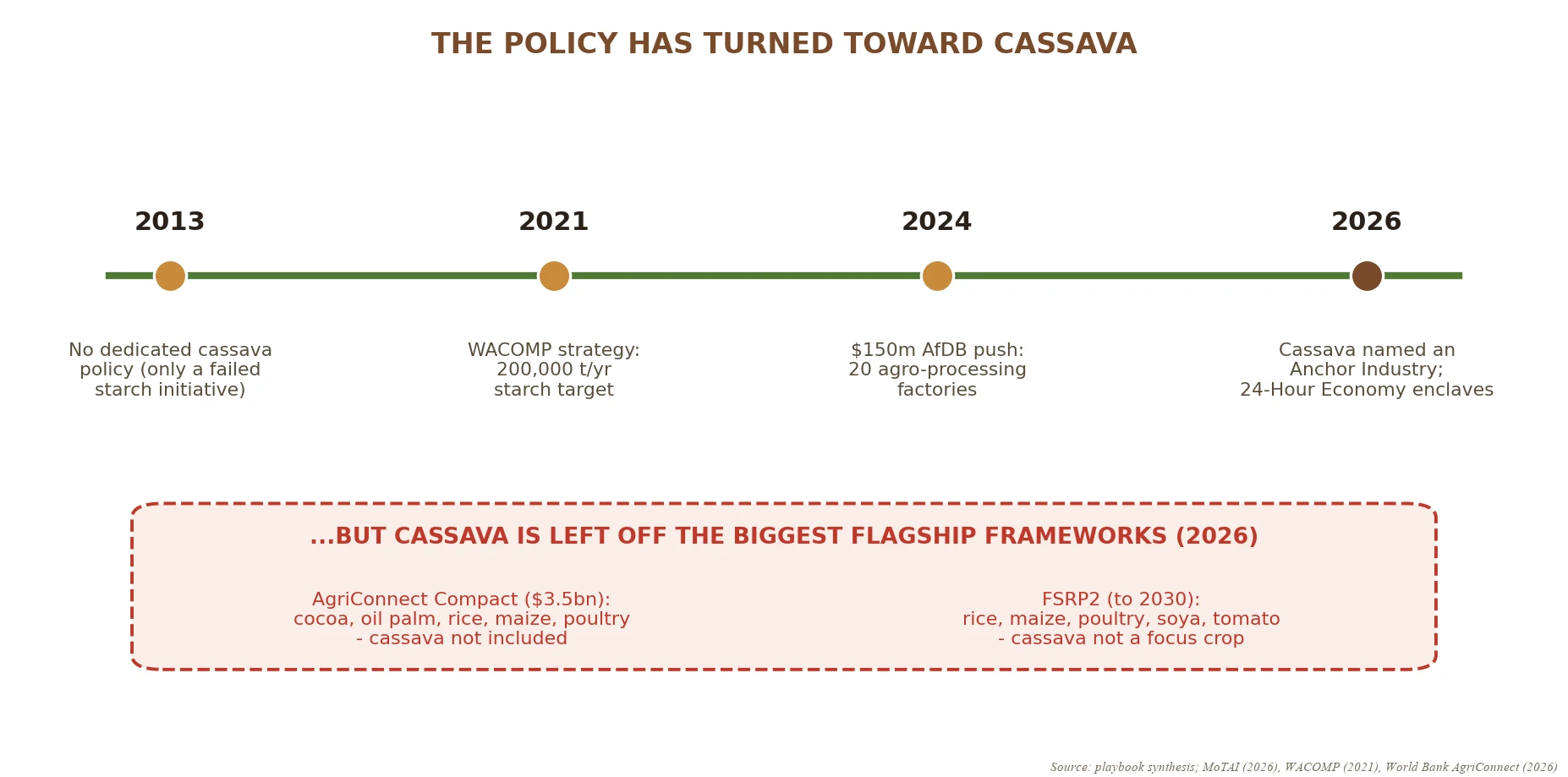
In the late 2000s there was almost no dedicated cassava policy (FAO/MAFAP, 2013). Since 2021 the crop has gone from a WACOMP export strategy to an Anchor-Industry designation, an agro-processing factory push and a place in the 24-Hour Economy, even as the biggest funded frameworks, AgriConnect and the resilience programme, still leave it off.
The intent is real, but the biggest cheques tell a different story. Ghana’s single largest current agri-investment framework, the AgriConnect Compact launched in June 2026, whose first-phase financing needs are estimated at 3.5 billion dollars, is built around five primary chains, cocoa, oil palm, rice, maize and poultry, and a named set of secondary chains; cassava is in none of them.7 The other major donor programme, the World Bank-financed Food System Resilience Programme, is built around rice, maize, poultry, soya and tomato; cassava is not a focus crop there either.8
This is not how it always was. A decade ago cassava was one of the core value chains in IFAD’s national investment programme, which funded collective processing centres, including for women’s groups.9 The pattern now is that cassava is treated as a potential crop, named warmly in the strategy documents, but not a priority one when the flagship money is allocated. Table 19 lays out where it sits.
| Programme | Scale / date | Cassava in? | What it means |
|---|---|---|---|
| Feed Ghana Programme | 2025-2028 | Yes | Raises cassava output to feed agro-industry and exports, with industrial-grade varieties |
| MoTAI Anchor Industries | 2026-2029 | Yes | Names industrial starch from cassava; the clearest pro-industry signal |
| 24-Hour Economy | 2025-2026 | Yes | Enclaves to process cassava into gari and starch; duty-free machinery proposed |
| GIRSAL / DBG finance | Ongoing | Yes | Cassava eligible for credit guarantees and on-lending |
| AgriConnect Compact | 2026-2030, ~$3.5bn need | No | The biggest current framework leaves cassava out |
| Food System Resilience | Ghana phase to Dec 2026, US$100m | No | The other major donor programme leaves cassava out |
Source: playbook synthesis from MoTAI (2026), MoFA/Feed Ghana (2025), World Bank AgriConnect (2026), FSRP and GIRSAL.
The practical consequence is that capital and donor attention flow to the prioritised crops, and cassava’s industrialisation is left to smaller, more scattered instruments. The single highest-value strategic move for the sector is getting cassava onto the frameworks that are raising the money.
Even where cassava has been funded, building a factory has not been the same as running one. The implementer of the AGRA-funded Ghana Cassava Industrialisation and Partnership Project lists, among its project objectives, leveraging about 200 million dollars of government investment under the One District One Factory programme and 85 million dollars of private investment in cassava processing, and new plants do come on stream: the 1D1F Global Almas plant at Bimbilla began mass production of cassava and yam products in April 2026, and a small district-assembly gari factory at Nteso, built with the UN Capital Development Fund, was commissioned in February 2026.10
But the same period tells a harder story: a multi-million-cedi starch factory at Assin South was reported standing idle and overgrown in 2026, and a 1D1F cassava plant at Namasua in the Bono Region, completed in 2022, has never operated because it cannot source roots.11The lesson, which runs straight back to Pillar 6’s missing middle, is that a factory without a reliable supply of roots and a buyer for its output does not become a business. Execution is now the binding constraint.
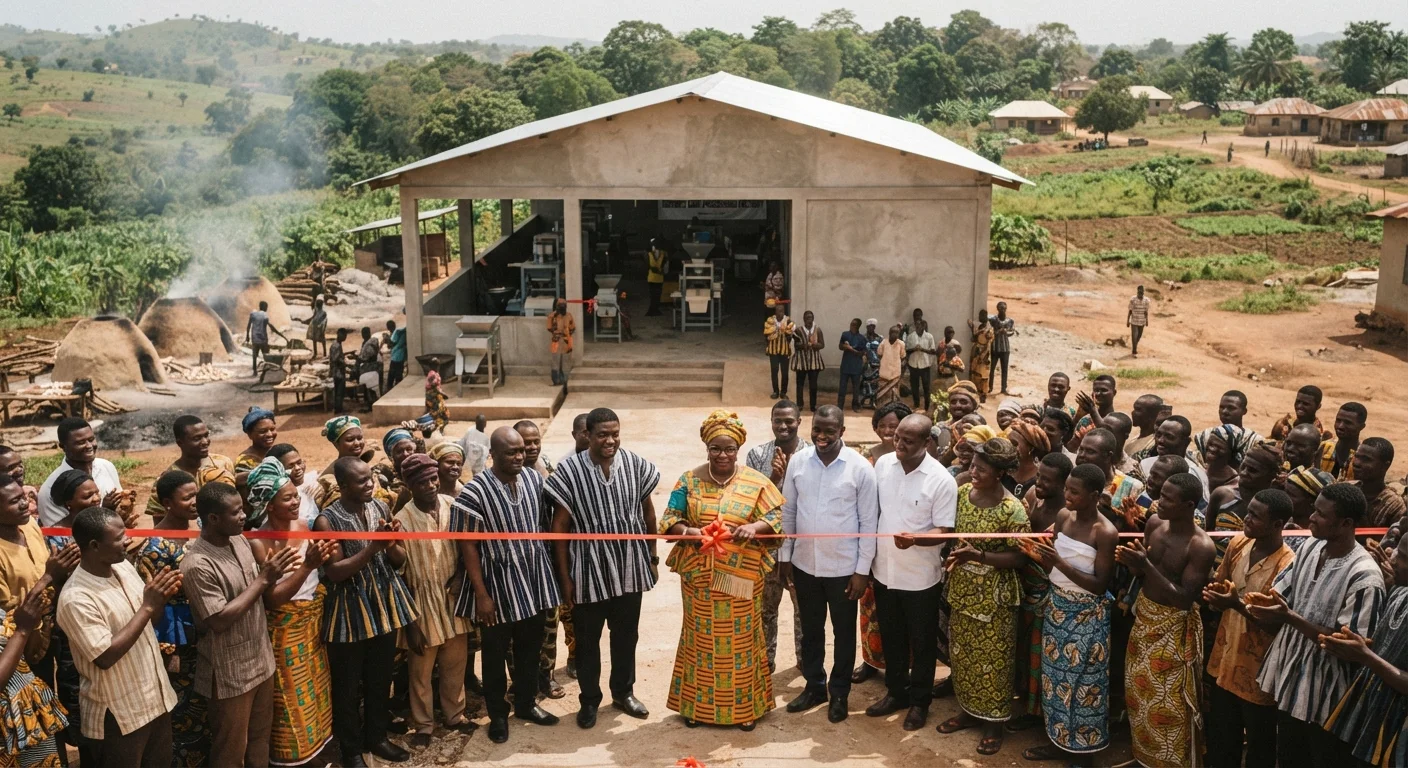
Table 20 reads the wider environment the crop sits in, the political, economic, social, technological, legal and environmental forces that will shape the next few years.
| Factor | What it means for cassava |
|---|---|
| Political | Named an Anchor Industry and written into the 24-Hour Economy, but left off the flagship AgriConnect and resilience frameworks; strong words, uneven backing. |
| Economic | A farm margin that swings with the root price (Pillar 5), a large import bill it could substitute (Pillars 6 and 7), and finance rails that exist but rarely reach the smallholder. |
| Social | Grown by some seven in ten farmers and a food-security staple; industrialising it touches jobs, women's processing groups and rural incomes directly. |
| Technological | Released high-yielding, disease-tolerant varieties (Pillar 1) and processing technology exist; the gap is aggregation, storage and digital price and market tools. |
| Legal | Product standards for gari, flour and starch exist (Pillar 6); no raw-cassava export ban has been announced, unlike the moves President Mahama announced in February 2026 to end raw shea, cashew and rubber exports;12 food-grade and traceability rules gate the export markets. |
| Environmental | A hardy, drought-tolerant crop, but rainfall variability and the perishability clock (Pillar 3) shape where and how fast it must be processed. |
Source: playbook synthesis across Pillars 1 to 8.
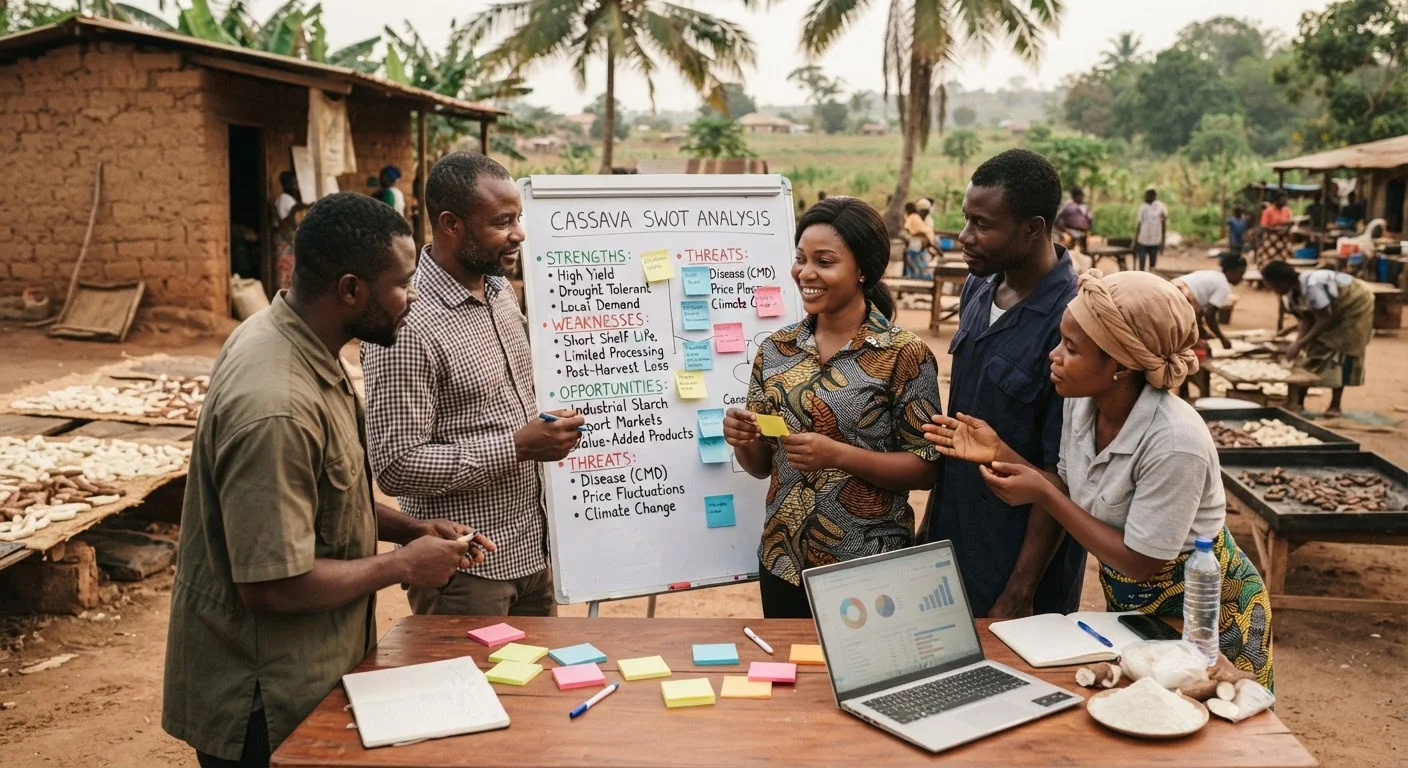
Pull the seven pillars and this policy read together and the picture is one of real strengths held back by weak execution. Figure 23 sets out the SWOT.
The strengths and opportunities are large: world-scale production, released varieties, a standing Anchor-Industry designation, finance rails, and a cluster of demand-led openings in import substitution, food-grade starch and branded regional products. The weaknesses and threats are just as real: the missing middle, uneven execution, no reliable price data, and a habit of being left off the frameworks that carry the money. The investment door is at least open, with the investment-promotion agency (the Ghana Investment Promotion Centre, since July 2026 the Ghana Investment Promotion Authority) actively marketing cassava-processing opportunities and profiling live processors exporting high-quality flour and starch.13 From this, the priorities rank themselves, and they are much the same for the entrepreneur, the investor and the state.
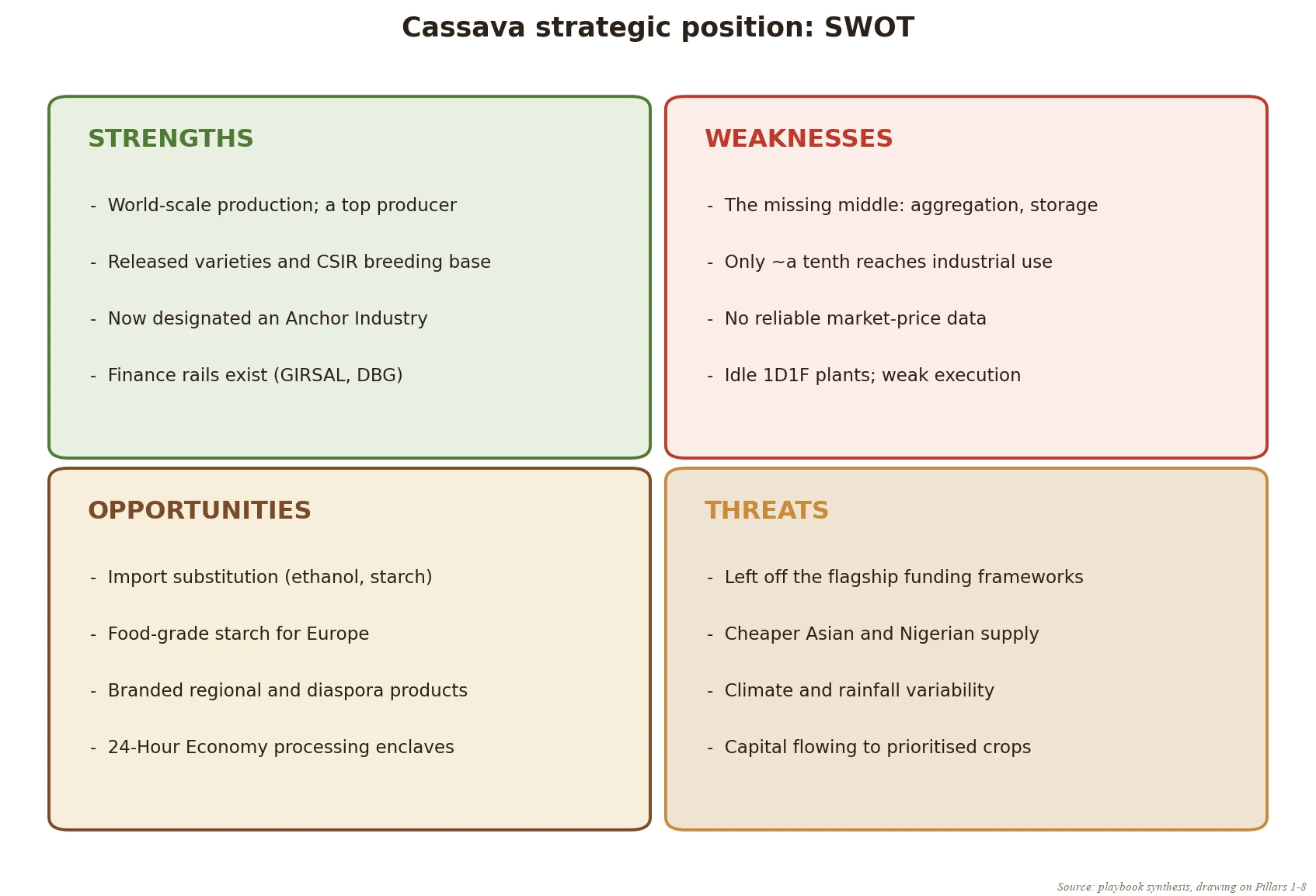
World-scale production, released varieties, a standing Anchor-Industry designation and finance rails on one side; the missing middle, uneven execution, no reliable price data and a habit of being left off the funded frameworks on the other. The reading is real strengths held back by weak execution.
Build the middle first. Aggregation, storage and reliable mid-scale processing, because nothing else in the chain works without it (Pillar 6).
Aim at reachable markets. Import substitution and branded regional and diaspora demand, ahead of any price war in commodity exports (Pillar 7).
Contract before you build. Tie every processing investment to a secured supply of roots and a named buyer, so the next factory is not the next idle plant (Pillars 5 and 6).
Close the policy gaps. Get cassava onto the flagship frameworks and official price series it is missing from, the one job only the public actors can do.
Do those four, in that order, and the crop that already feeds the country starts to pay it too.
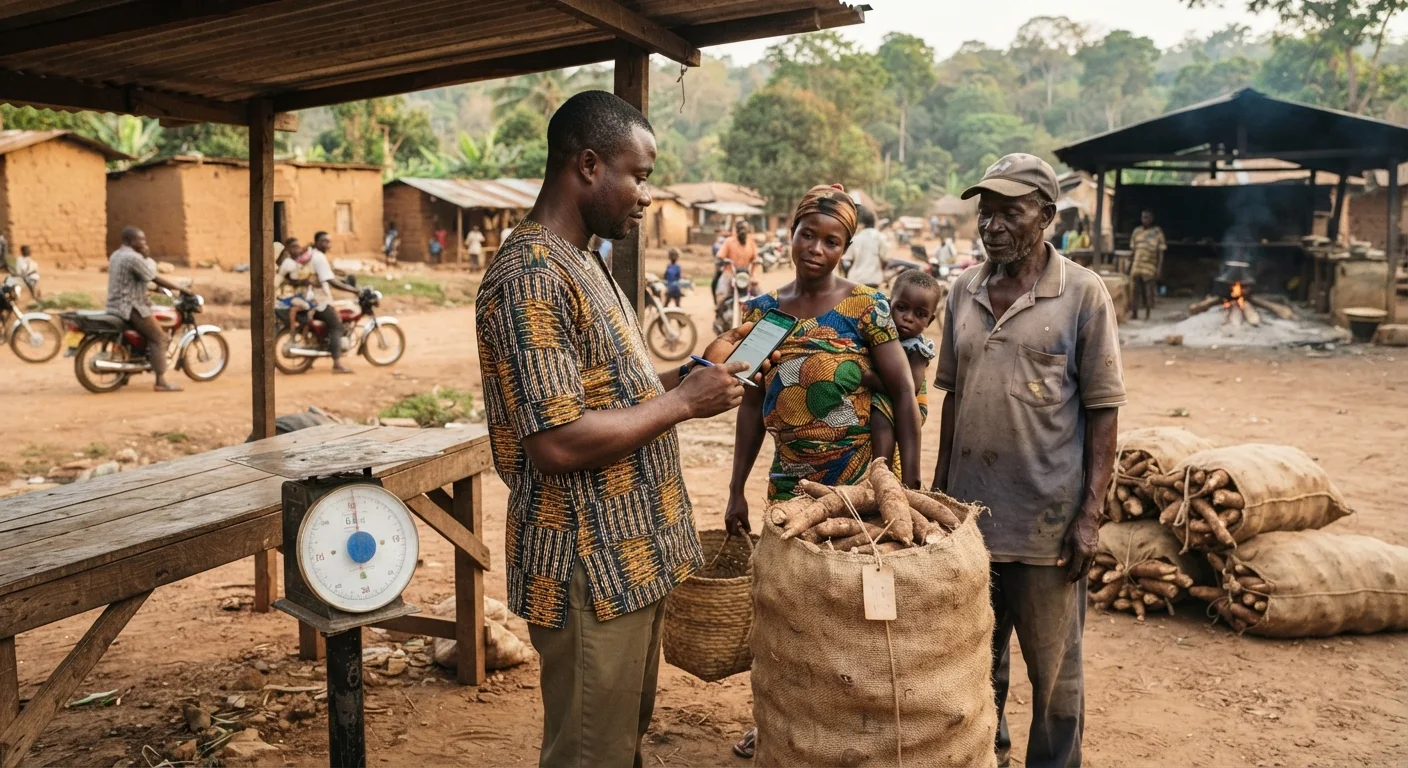
The forward edge, thin today but real, is digital. The chain’s two deepest problems, no reliable price signal and no organised middle, are exactly the kind that digital tools address: aggregation and market-linkage platforms are spreading in Ghana, and traceability vendors are now marketing systems for Ghana's cassava chain to meet export buyers' requirements.14 None of this is a substitute for the physical middle, and the tools that exist are not yet shown to work at scale on cassava specifically, so treat them as an accelerator rather than a fix.
The practical near-term uses are unglamorous and valuable: a price service that lets a farmer and a processor agree a fair number, a simple aggregation app that bulks scattered supply to a factory’s schedule, and traceability that opens the food-grade and export doors. The operator who digitises the middle, rather than the field, will be ahead of the policy.
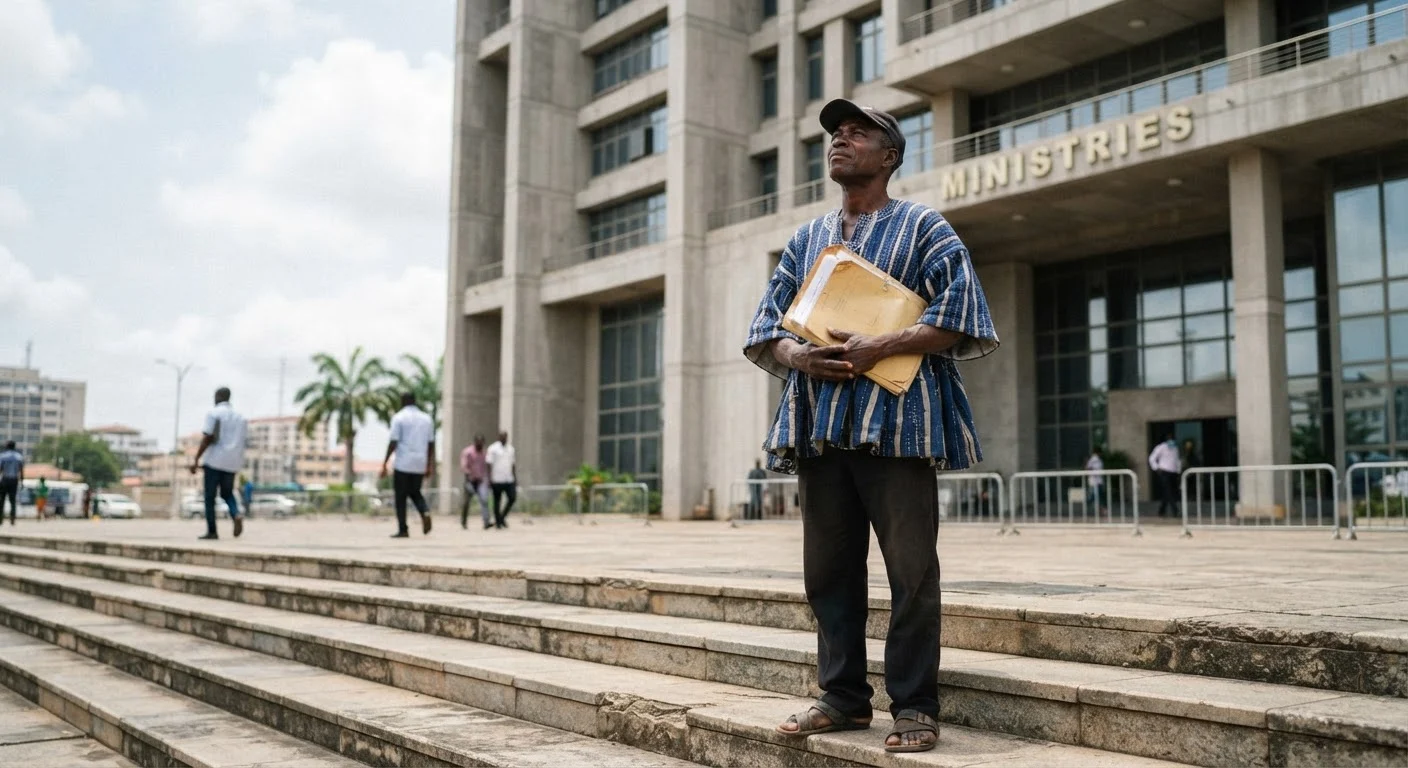
Cassava is named warmly in strategy but excluded from the biggest funded programmes, so capital and donor attention flow to prioritised crops instead.
Any entrepreneur or investor whose plan assumes flagship-programme support, as capital and donor attention flow to the crops those frameworks name.
Make the case for cassava's inclusion on the frameworks that hold the money, and in the meantime build on the instruments that do list it, GIRSAL, DBG and the 24-Hour Economy enclaves.
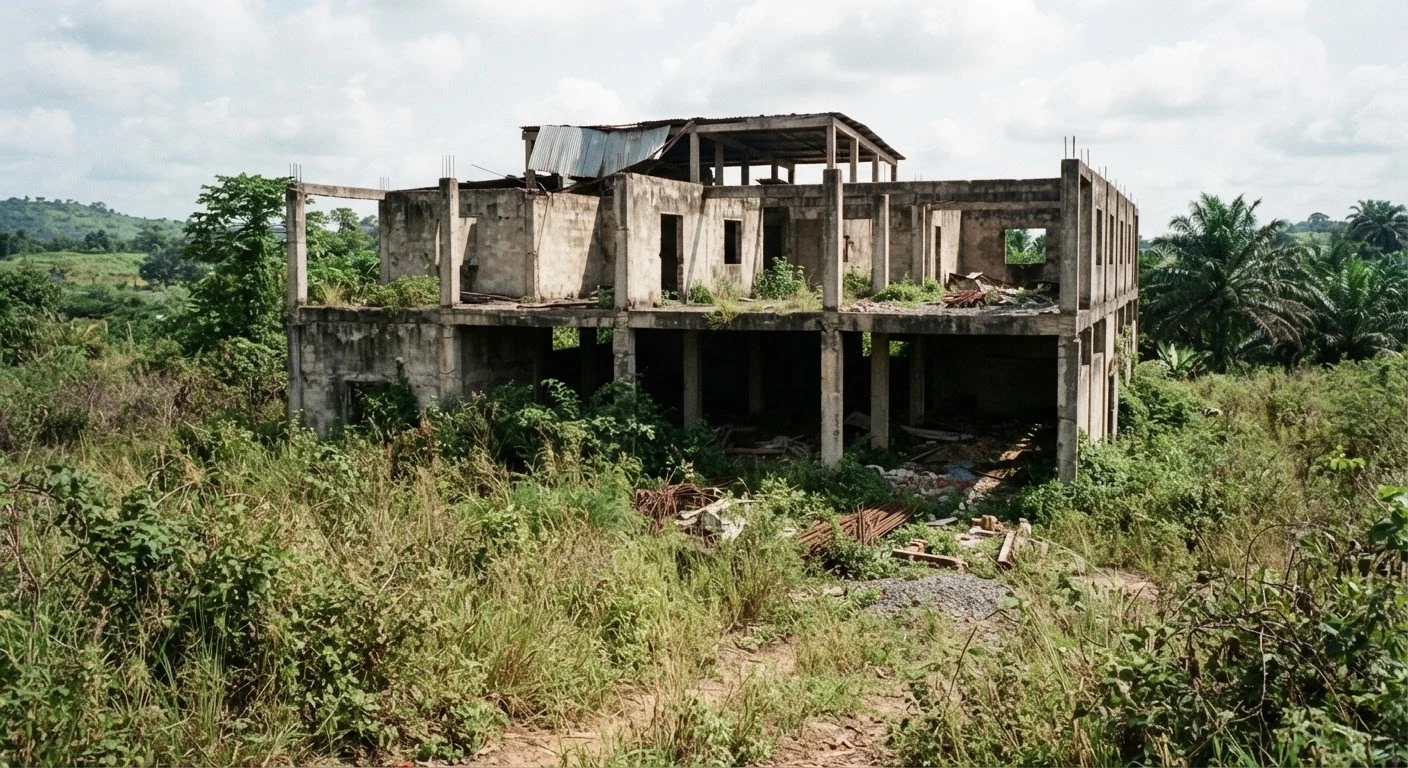
Processing plants are built without a secured supply of roots or a buyer for the output, then stand idle, as several cassava factories already have.
Every processing investment made before a secured supply of roots and a signed buyer, and the public money that builds a plant that then stands idle.
Fund the supply contract and the offtake before the building, and size the plant to the roots it can actually reach within the perishability window.
The policy has genuinely turned toward cassava: from no dedicated policy in the late 2000s to an Anchor Industry, starch targets and a place in the 24-Hour Economy.
But cassava keeps being left off the biggest funded frameworks (AgriConnect, the resilience programme); the highest-value public move is to get it onto them.
The binding constraint is now execution: money has built factories that stand idle, one for want of roots and another never commissioned after funding and procurement delays.
The strategic priorities are one list for everyone: build the middle, aim at reachable markets, tie processing to contracted supply and a buyer, and close the policy gaps.
Digital tools for price, aggregation and traceability are a real accelerator for the chain's two deepest problems, but not yet a substitute for the physical middle.
Where this connects. This is where the eight pillars meet. The yield and clean planting material of Pillar 1 feed the demand of Pillar 2; the diseases and the perishability clock of Pillar 3 are what the processing of Pillar 6 exists to beat; the economics of Pillar 5 decide whether any of it pays; the value chain of Pillar 6 is where the money leaks or is captured; the market intelligence of Pillar 7 says who will actually buy; and the strategy here decides whether the country builds the middle or keeps importing what it could make. The through-line of the whole playbook is one sentence: Ghana already grows the cassava, and the opportunity is to finish it, aggregate it, process it, brand it and sell it, at home first, before anywhere else.