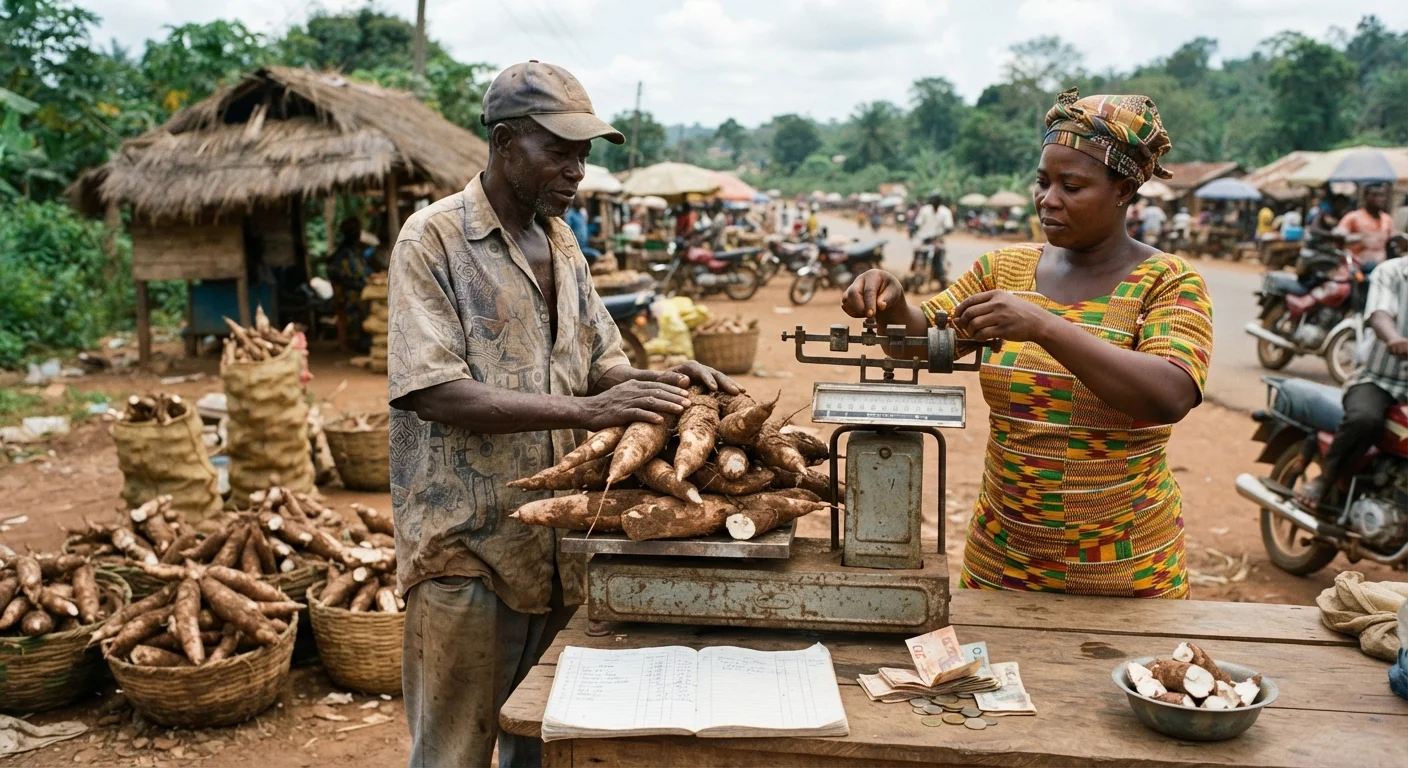
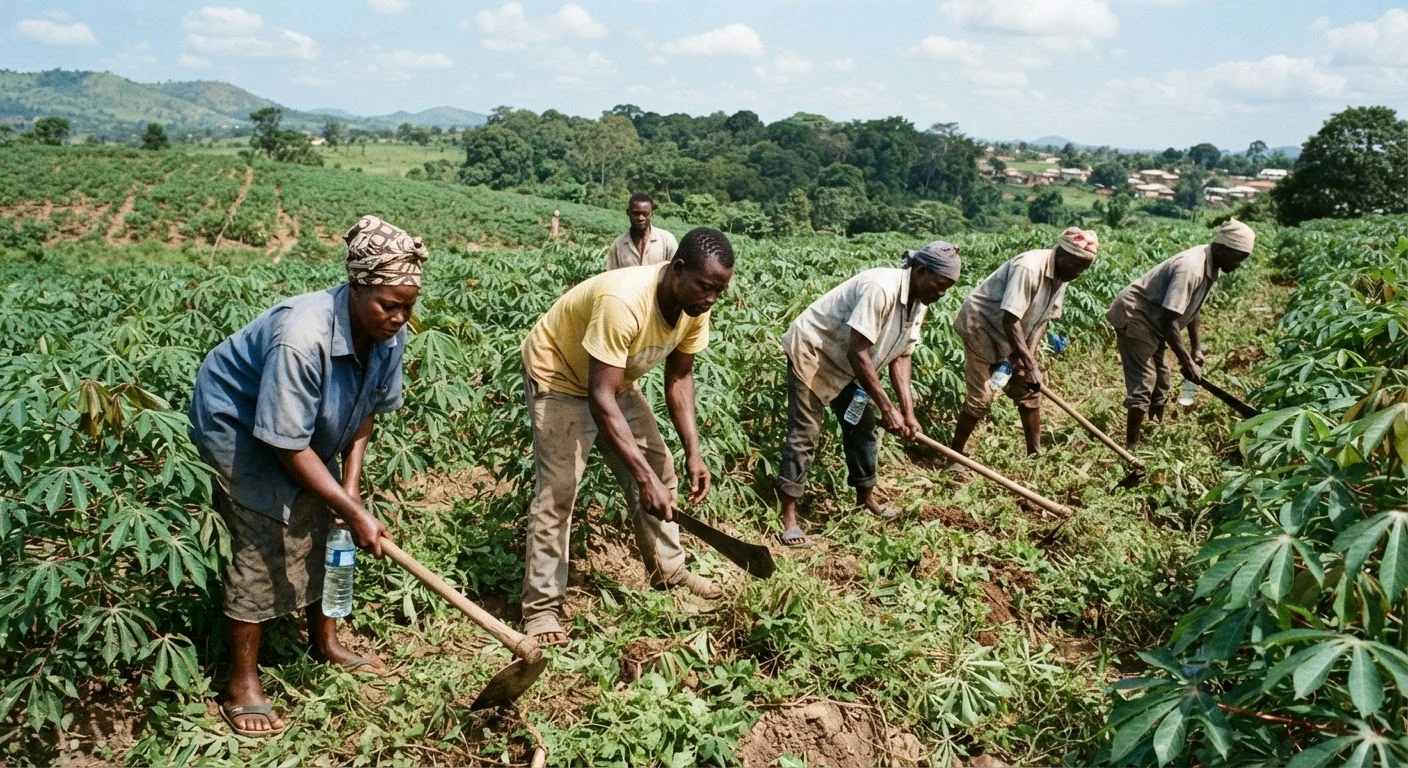
A Ghanaian farmer and a buyer counting cedi notes over a weighed heap of cassava roots at a roadside collection point, documentary photographUpload photo · /images/cassava-pillar-hero-4.webp
Cassava · Pillar 05
Cost, Returns and Economics
An acre of cassava can pay well when prices are high, as in 2024, but the margin swings with the root price and labour is the largest cost. Yield and the price you sell into move the margin far more than any cost line.
Cost, Returns and Economics · Pillar 05
The economics of cassava are easy to state and hard to win. An acre of cassava can pay well when prices are high, as in 2024, but margins swing widely with the root price, costs are dominated by labour, and the published farm budgets are few and dated, so the figures here are indicative and each names its basis.
The two levers that move the margin are yield and the price you sell into, which is why processing matters more than penny-pinching. Finance is both the enabler and the bottleneck. Treat the farm as a high-variability business that rides on the root price, or move up the value ladder (Pillar 6), where the margin is steadier.
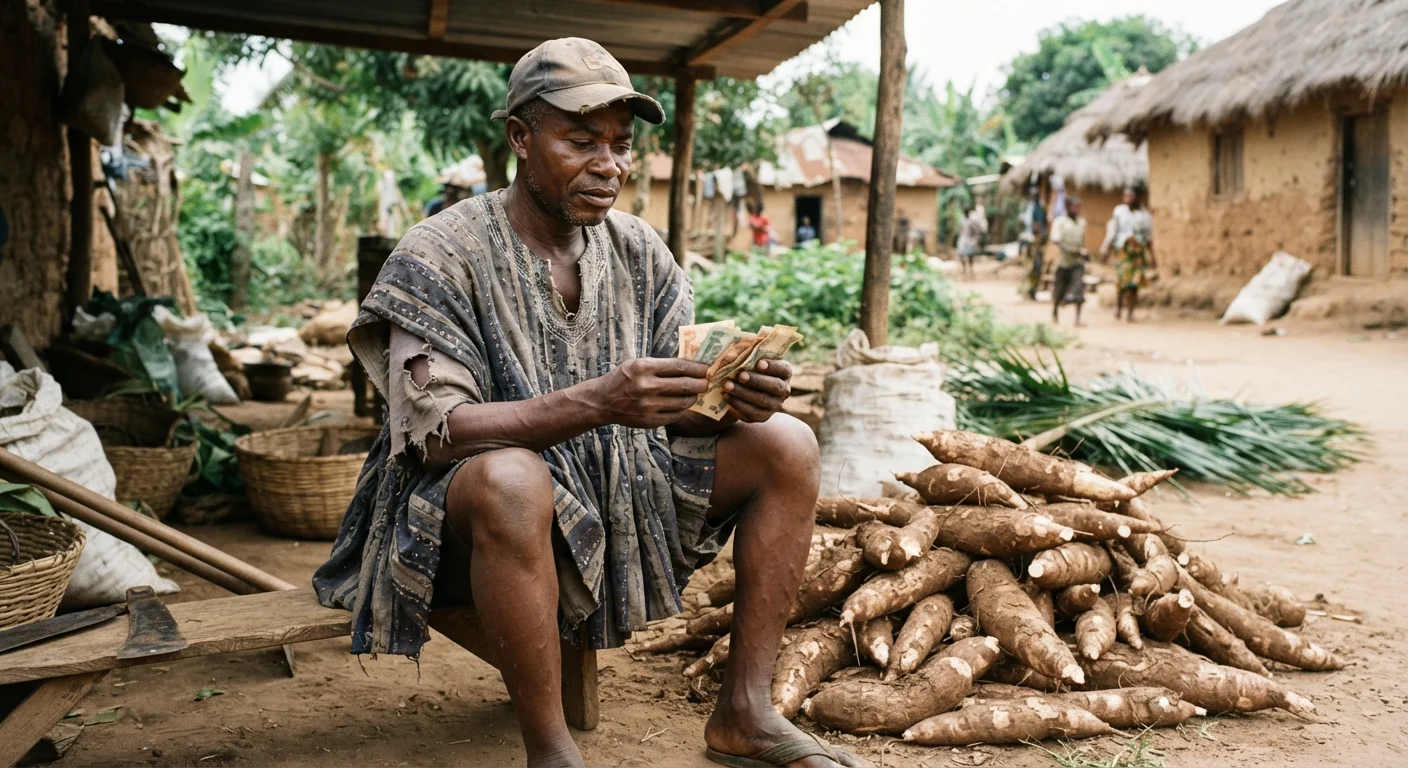
A Ghanaian cassava farmer and a trader weighing a heap of freshly harvested cassava roots on a platform scale at a roadside buying point, a ledger and cedi notes on a table, documentary photographUpload photo · /images/cassava-cr-weighing-roots.webp
A margin that rides on the root price
Yield and the price you sell into move the margin far more than any cost line.
GH¢1,850/acre
the farmer-reported variable cost of an acre, Ashanti 2024
GH¢1,050
labour and weeding, over half the cost of an acre
GH¢16,000
an acre sold standing in 2024, a margin of about GH¢14,150
What a cassava farm actually earns
It depends, and the range is wide. A 50-farmer study in Sekyere East, Ashanti's highest-yielding cassava district, found a gross margin of only about USD 23 an acre, a razor-thin return, though the paper also states the figure in cedis, so its currency is uncertain.1A larger study across the Eastern and Brong Ahafo regions put net farm income at about GH¢4,457 per hectare on a 75 percent profit margin, with net income about twelve times the capital invested, with farmers running at 86.4 percent profit efficiency, so the crop is profitable but farmers lose about 13.6 percent of attainable profit to inefficiency, linked in the study to education, experience and membership of a farmer group.2
The sharpest finding is about labour. A value-chain study in Brong Ahafo found that smallholders who pay the market wage for all labour lose money, about GH¢490 an acre on the study's headline measure (GH¢172 on the like-for-like measure used for commercial farms), while commercial farms make about GH¢1,505 an acre, mainly because they harvest far more per acre.3 Those are 2016 figures, so the cedi values are dated; the pattern, not the number, is the point. What this means is that at low root prices whether cassava makes money at all can turn on whether the grower uses family or hired labour and how well the plot yields, while at the high prices of 2024 the same acre paid well.
Revenue: yield times price
Cost: labour dominates
The margin sits off the farm
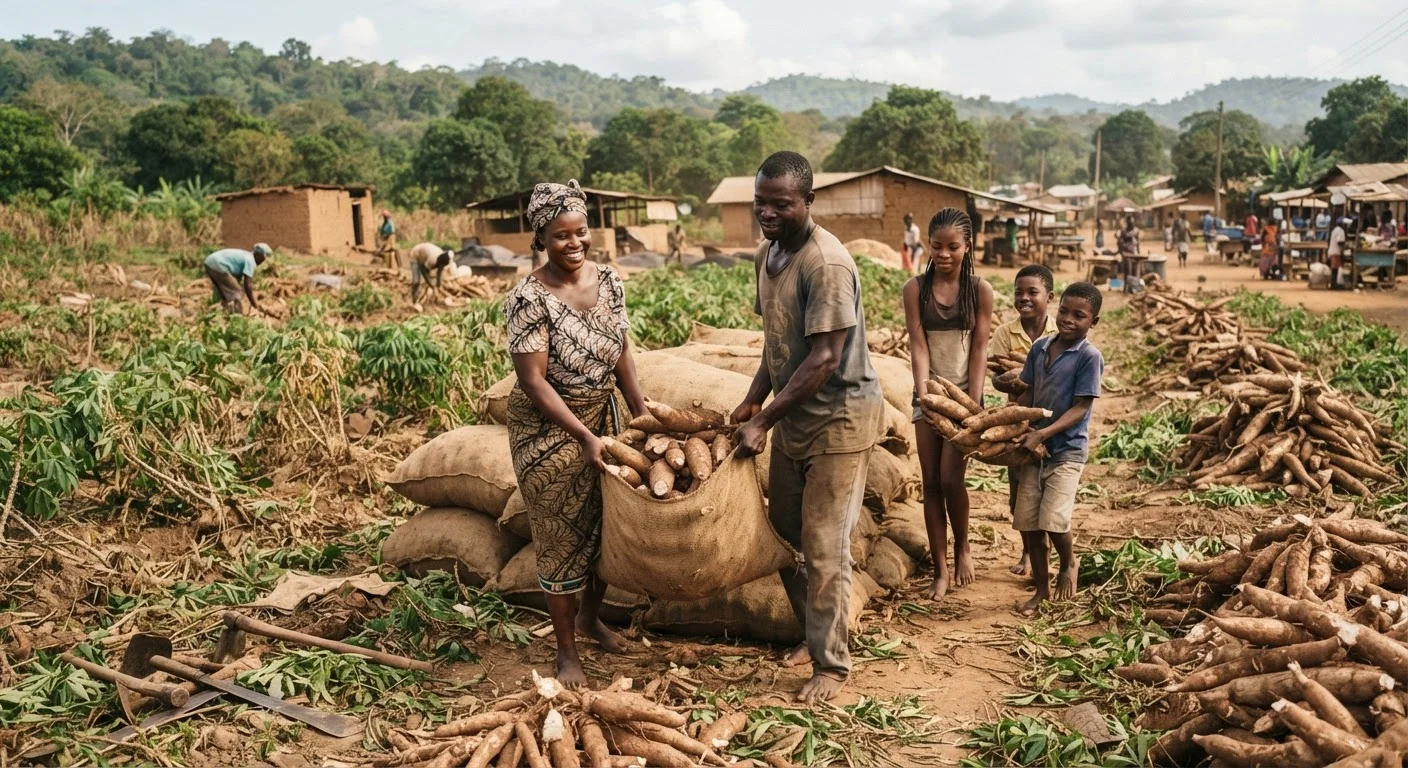
A Ghanaian farming family working together to lift and stack cassava roots in a field at harvest, no hired crew, documentary photographUpload photo · /images/cassava-cr-family-labour.webp
Family or hired labour decides it
At low root prices, whether the acre makes money at all can turn on family versus hired labour.
~USD 23/acre
gross margin in a 50-farmer Sekyere East study (currency uncertain)
86.4%
profit efficiency: about 13.6 percent of attainable profit lost to inefficiency
Table 9Indicative cost and returns for one acre of cassava (2024 costs and a crop sold standing, farmer-reported) and published net margins (2016).
Table 9: Indicative cost and returns for one acre of cassava (2024 costs and a crop sold standing, farmer-reported) and published net margins (2016).
Item (per acre)
Indicative GH¢
Note
Land rent
300
southern-belt, indicative
Land preparation (clearing, ploughing)
300
Planting material (cuttings)
200
Labour and weeding
1,050
the dominant cost, over half the total
Total variable cost
1,850
farmer-reported, Ashanti 2024
Yield (tonnes an acre)
8
Kleih / GASIP (2016) basis, about 20 t/ha
Farm-gate price (GH¢ a tonne)
about 2,000
implied by the acre sold standing (2024)
Revenue, crop sold standing
16,000
farmer-reported, Ashanti 2024
Gross margin
14,150
2024 prices, before valuing family labour
Gross margin at the 2016 root price (GH¢260 a tonne)
230
stress test: the same costs after a price collapse
Break-even farm-gate price (GH¢ a tonne)
about 231
at 8 tonnes an acre and the 2024 cost
Net margin, hired-labour smallholder
(490)
can go negative at market wages (2016 basis)
Net margin, commercial farm
1,505
scale and lower unit costs (2016 basis)
Sources: Amos, Agrighanaonline (2024, farmer-reported); Kleih / GASIP (2016); playbook calculation for the margins.
Where the money goes, and why Ghana is high-cost
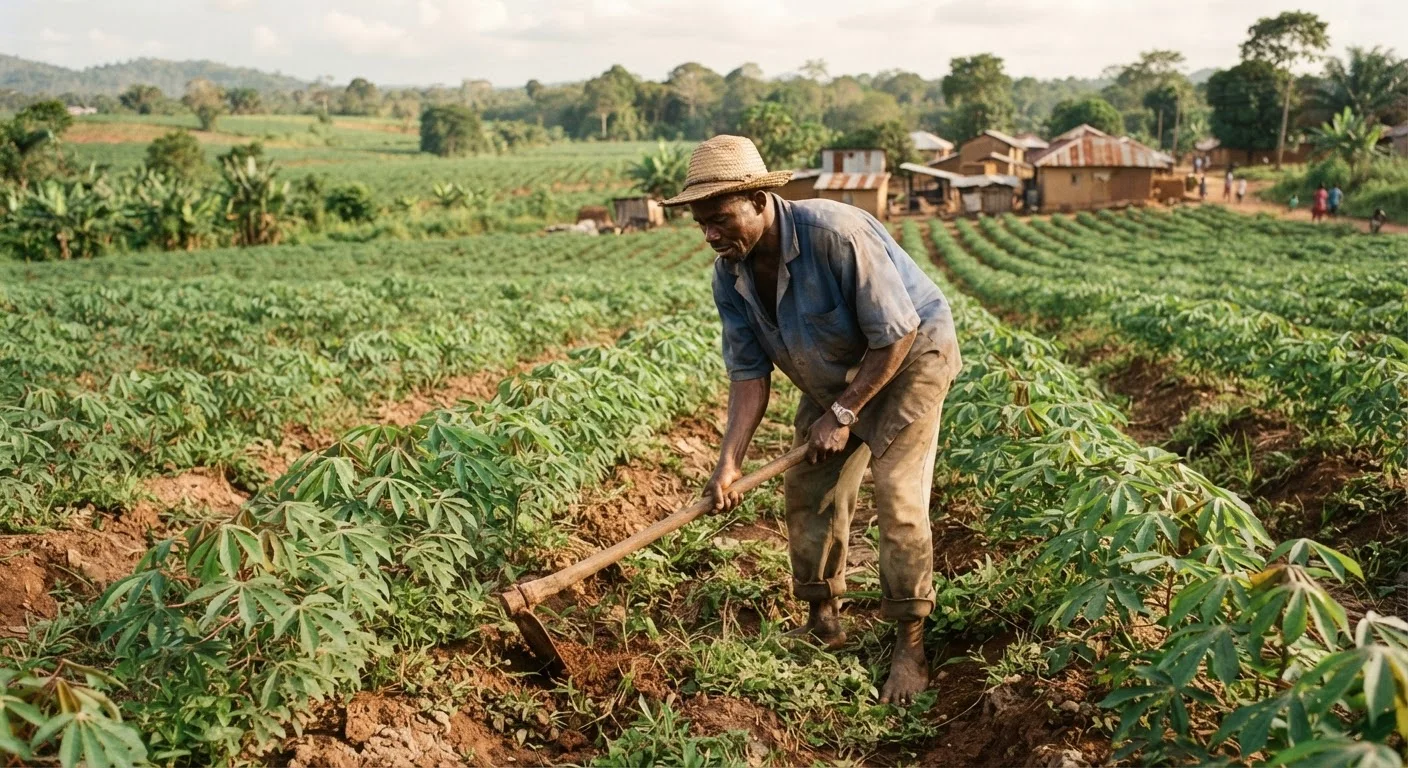
A Ghanaian farm labourer weeding between rows of young cassava plants by hand with a hoe, the field stretching behind, documentary photographUpload photo · /images/cassava-cr-hand-weeding.webp
Hand-powered, and so high-cost
Most operations are still done by hand, which is why labour is over half the bill.
3.0%
food inflation in August 2026 (headline 5.0%), after 26.5 percent in March 2025
GH¢527 → 5,045
nominal rural wholesale price, 2015 to 2024 (MoFA-SRID)
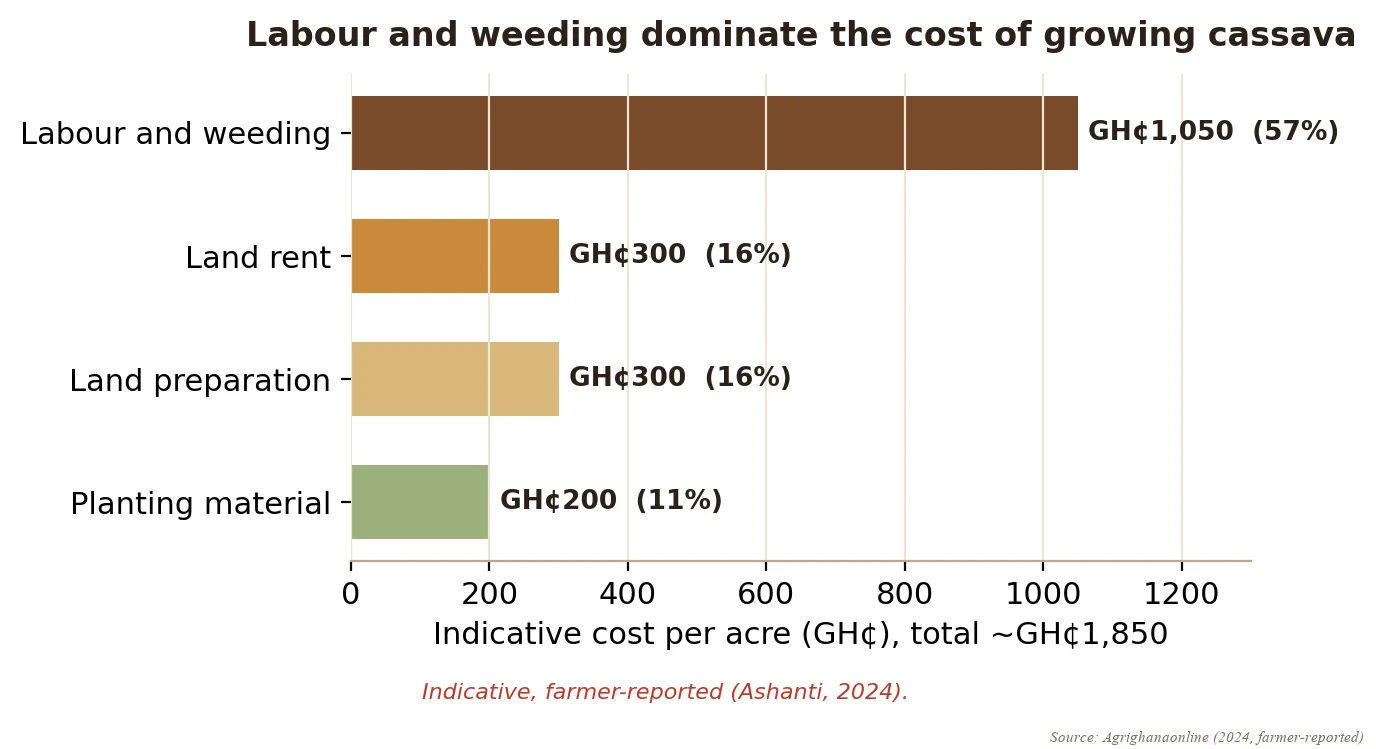
The cost of an acre is dominated by one thing: labour. A 2024 farmer-reported budget in Ashanti put the cost of an acre at about GH¢1,850, of which labour and weeding alone were GH¢1,050, more than half, with land rent, land preparation and planting material making up the rest.4 Figure 12 shows the split.
Ghana is a high-cost place to grow cassava for structural reasons: most operations are still done by hand (Pillar 4), the perishability clock forces a quick and often distress sale (Pillar 3), and inputs were expensive through the 2022 to 2025 inflation surge, with food inflation still 26.5 percent in early 2025.5 The nominal rural wholesale price looks like it is racing up, from about GH¢527 a tonne in 2015 to GH¢5,045 in 2024, but in real, inflation-adjusted terms the 2024 price was essentially flat on 2023, so the 2024 jump was inflation rather than a real gain, although over the decade as a whole the real price still rose about six-fold.6
Costs and prices also move with the wider economy, in both directions. Inflation eased from 23.5 percent in January 2025 to 3.2 percent in March 2026, the lowest reading since the consumer price index was rebased in 2021, then edged back up to 5.0 percent by August 2026, with food inflation at 3.0 percent.7 Cassava needs few bought inputs, but the fertiliser and agrochemicals it does use are imported, so their cost follows the exchange rate: the cedi lost about 9.5 percent against the US dollar in the first nine months of 2026, and the World Bank expects fertiliser prices to rise about 31 percent in 2026, with urea ending the year about 60 percent above 2025.8 Borrowing is still costly, with the Bank of Ghana policy rate held at 14 percent in July 2026.9 On the price side, the planned surplus (Pillar 2) can pull the farm-gate price down in the same season that input costs rise, and a cost build that holds one season can be wrong the next. Re-cost inputs every season, hold a buffer against both a price fall and a cost rise, and prefer offtake contracts that fix the price or tie it to costs.
Figure 12 The indicative cost of growing an acre of cassava.
What this shows
Labour and weeding is GH¢1,050 of a GH¢1,850 acre, more than half, with land rent, land preparation and planting material making up the rest, from a 2024 farmer-reported budget in Ashanti.
Sensitivity: what actually moves the profit
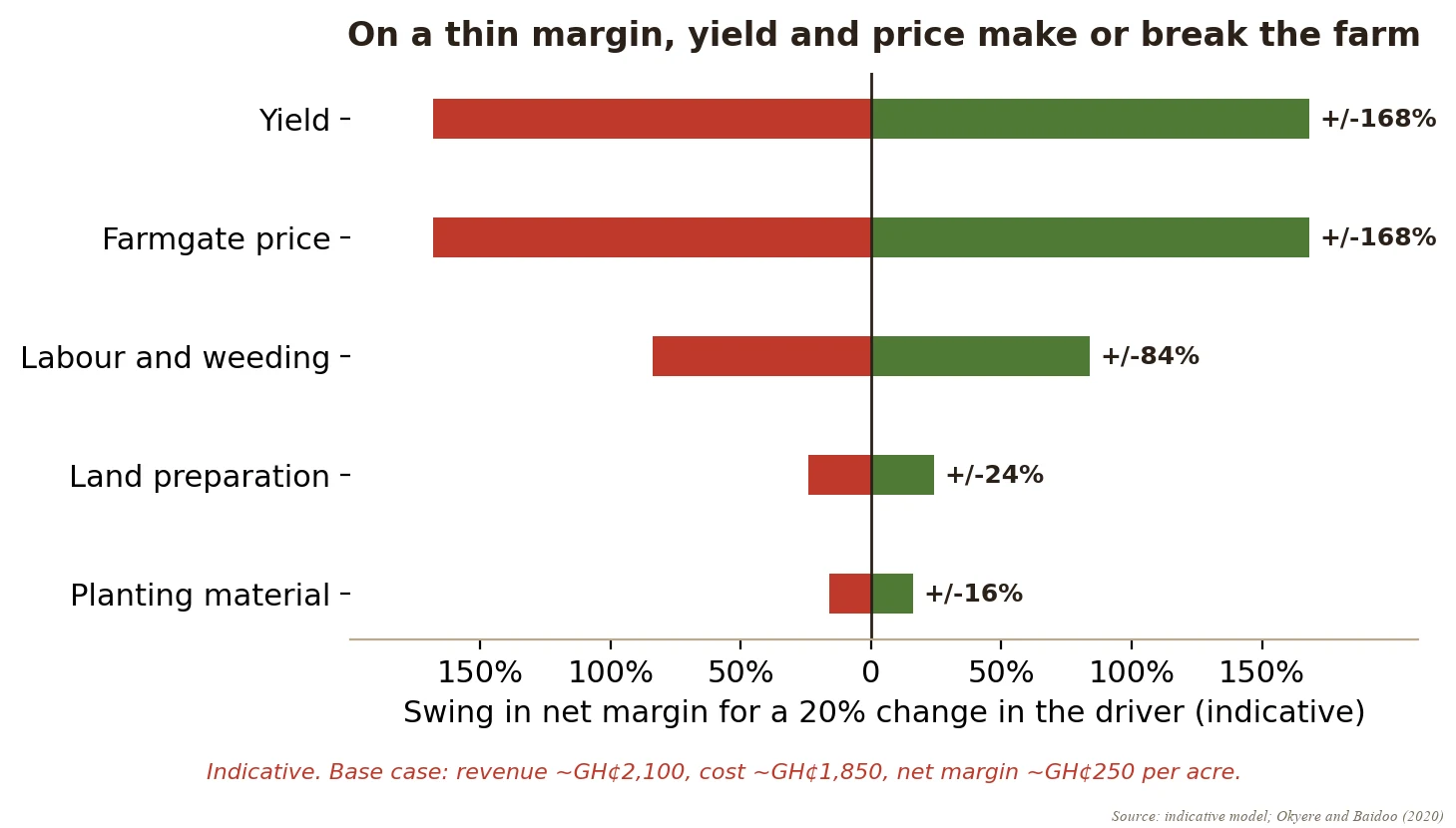
The margin rides on the two revenue drivers. On an indicative model, yield and farmgate price move the margin far more than any cost line. At the 2024 farmer-reported basis (an acre sold standing for about GH¢16,000 against about GH¢1,850 of cost), a 20 percent fall in price or yield cuts the margin by about a quarter, while a 20 percent rise in labour cost moves it by under 2 percent (Figure 13). At the much lower root prices of 2016, the same 20 percent swing in price could erase the margin entirely, which is why price risk is the farmer’s main exposure, well ahead of cost.
±23%
the margin swing from a 20% change in price or yield (2024 basis)
±1.5%
the swing from the same change in labour, the largest cost
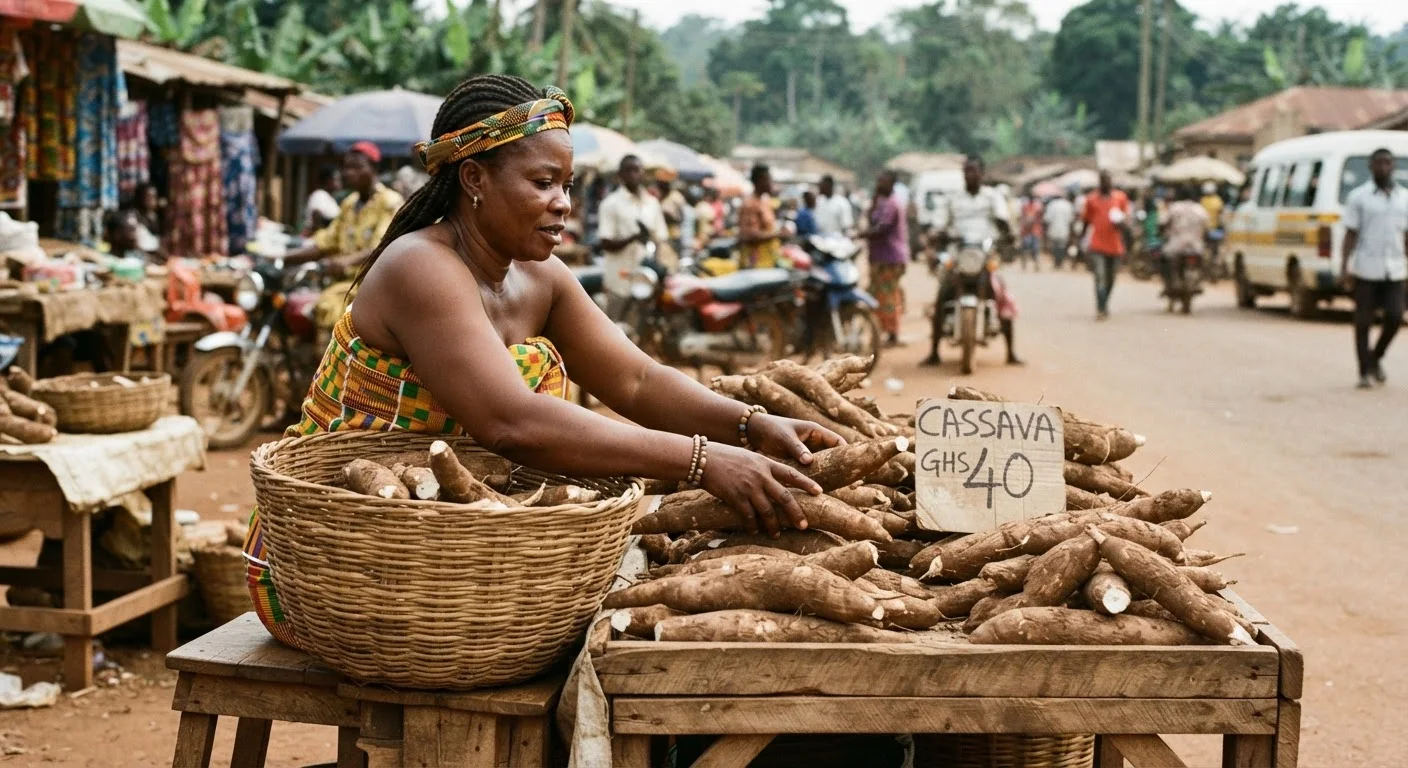
A Ghanaian market trader arranging fresh cassava roots for sale at a bustling roadside market, price written on a card, documentary photographUpload photo · /images/cassava-cr-market-roots.webp
Yield and price move it most
The two revenue drivers swing the net far more than any cost line.
Figure 13 What a 20 percent change in each driver does to the net margin.
What this shows
Yield and farmgate price rank equal first, swinging the margin by about 23 percent for a 20 percent move at the 2024 basis; labour and weeding is third at about 1.5 percent, land preparation fourth at about 0.4 percent, and planting material fifth at about 0.3 percent.
Insight · the margin is made off the farm
Effort and money are best spent on the things that move the margin most: raising yield through clean planting material (Pillar 1) and agronomy (Pillar 4), and lifting the price realised through processing and branding (Pillars 2 and 6). Shaving the smaller cost lines barely moves the result. It also means the farmer is dangerously exposed to a price fall, which is exactly the glut risk the planned surplus creates (Pillar 2).
Model it yourself
Numbers on a page are one thing. Move the levers yourself. Set the yield, the farmgate price and the labour bill to your own plot’s figures, then swing them one at a time. Push the yield or the price slider and watch the margin move fast, then push the labour slider and watch it barely stir. Then drag the price down toward the 2016 level of GH¢260 a tonne and see how quickly the margin disappears: price risk is the grower’s main exposure.
Tool 1
Does the acre clear a margin?
Slide the three levers a grower can hold: the yield in tonnes an acre, the farmgate price you sell into, and the labour and weeding bill, the largest cost. The model starts at the 2024 farmer-reported basis, an acre sold standing for about GH¢16,000 against about GH¢1,850 of cost. Drag the price down toward the 2016 level and watch how fast the margin goes.
GH¢16,000
Revenue, 8.0 t at GH¢2,000/t
GH¢1,850
Total variable cost, of which GH¢1,050 is labour
+GH¢14,150break-even at GH¢231/t
gross margin an acre, before valuing family labour
At the 2016 root price (GH¢260 a tonne) the same costs leave about GH¢230; break-even is about GH¢231 a tonne at 8 t/acre.
At these numbers the acre clears a margin of GH¢14,150, and the price that carried it there is doing most of the work: at the 2016 root price of GH¢260 a tonne the same yield and costs would leave about GH¢230. Push the price or yield slider and the margin moves fast; push the labour slider and it barely stirs. Price risk is the grower's main exposure, so the durable work is a contracted price or offtake, yield from clean material and agronomy (Pillars 1 and 4), and processing that lifts and steadies the price (Pillars 2 and 6).
Base case, per acre: yield about 8 t/acre (Kleih / GASIP 2016) at about GH¢2,000 a tonne gives revenue of about GH¢16,000, the farmer-reported 2024 standing-crop sale; taking off the variable cost of about GH¢1,850 (land rent 300, land preparation 300, cuttings 200, labour and weeding 1,050) leaves a gross margin of about GH¢14,150 an acre. Sources: Amos, Agrighanaonline (2024, farmer-reported); Kleih / GASIP (2016); playbook calculation for the margins.
Tool 2
What swings the margin most
The same model, re-run as a sensitivity read. Each bar is how far the margin moves when that one driver changes by 20 percent, holding the others where you left them. Two drivers lead, and neither of them is a cost line.
1. Yield, in tonnes an acre±GH¢3,200 (±23%)
How many tonnes the acre actually brings in, driven by clean planting material (Pillar 1) and agronomy (Pillar 4). It is the joint-widest lever and the one the grower can build, so it moves the margin far more than shaving any cost line.
2. The farmgate price you sell into±GH¢3,200 (±23%)
The market sets this price and it is volatile: about GH¢2,000 a tonne is implied by the 2024 standing-crop sale, against GH¢260 in 2016. It moves the margin as much as yield does, and lifting it runs through processing and branding (Pillars 2 and 6) rather than through selling a raw root at the gate. It is also the exposure the glut risk of Pillar 2 creates.
3. Labour and weeding±GH¢210 (±1.5%)
The largest cost line, over half the bill, and the one the operator can actually cut through mechanised weeding, canopy-closing spacing and shared equipment (Pillar 4). At the 2024 basis a 20 percent change moves the margin by under 2 percent, so it is worth cutting but it is not where the margin is won.
4. Land preparation±GH¢60 (±0.4%)
Clearing and ploughing. A shared tractor or ploughing service can trim it, but it is a small line and it barely moves the margin.
5. Planting material±GH¢40 (±0.3%)
The cuttings. Clean, certified material earns its keep by avoiding replant and disease loss rather than by being cheap; as a cost line it is the smallest swing of all.
±GH¢3,200
What a 20 percent change in yield or in price does to the margin, about 23% of it
±GH¢210
What a 20 percent change in labour and weeding does, the largest cost line, about 1.5% of the margin
Yield and the farmgate price swing the margin most and by the same amount; labour and weeding, although the largest cost, moves it far less, and land preparation and planting material barely register. At the 2024 basis a 20 percent change in price or yield moves the margin about 23 percent, labour about 1.5 percent. At the 2016 root price the same 20 percent price fall would erase the margin entirely. That is the argument of this pillar: the margin swings with the root price, so price risk is the grower’s main exposure, and the answer runs through yield, a contracted price and processing, well ahead of penny-pinching the cost lines. It is exactly the glut risk of Pillar 2.
Sensitivity holds two levers where you left them and moves the third by 20 percent: yield and price both act on revenue, so they lead and tie; labour and weeding is the largest but controllable cost and swings the margin far less; land preparation and planting material are small lines that barely move it. Ranks and swings match the Sensitivity sheet of the Cassava Cost and Returns Model v2 (2024 basis).
Cost-cutting: what the operator can actually do
Sensitivity says what moves the margin; cost-cutting says what the operator can actually control. Table 10 sets out the controllable cost lines, the lever on each, an indicative saving, and how to check it on your own plot.
Table 10Where a cassava grower can cut cost (indicative playbook estimates, not measured savings).
Table 10: Where a cassava grower can cut cost (indicative playbook estimates, not measured savings).
Cost line
Indicative base
The lever
Indicative saving
How to check on your plot
Labour and weeding
GH¢1,050/acre
Mechanised weeding and herbicide, plus spacing that closes canopy sooner (Pillar 4); shared equipment as a service (Pillar 4)
~30%
Time the labour before and after
Land preparation
GH¢300/acre
A shared tractor or ploughing service in place of hired clearing gangs
~20%
Compare a hire quote against manual
Planting material
GH¢200/acre
Clean, certified cuttings that establish better and resist disease (Pillar 1)
avoids replant and disease loss
Track establishment and survival rate
Harvest and haulage loss
value lost
Process near the farm to beat the perishability clock (Pillar 3)
~15% of value
Weigh what spoils or is discounted
Working-capital cost
12 to 30% interest (2019)
A GIRSAL-guaranteed or group loan in place of an informal lender
a lower rate
Compare your borrowing terms
Source: playbook synthesis, anchored to the cost breakdown in Table 9 and the levers in Pillars 1, 3 and 4.
Finance: the enabler and the bottleneck
Finance is where cassava economics is won or lost, and it is the hardest piece. In 2019 commercial agricultural lending in Ghana ran at 12 to 30 percent interest, and borrowing costs have swung widely since, with the Bank of Ghana policy rate at 14 percent in July 2026.10 Agriculture takes only a small share of bank credit, 3.5 to 4.7 percent on the Feed Ghana Programme's own two baselines, which the government plans to lift to 10 percent by 2028, with loans disbursed under GIRSAL guarantees targeted to rise from about GH¢289 million a year in 2024 to GH¢824 million a year by 2028.11
The main instrument to close the gap is GIRSAL, the state risk-sharing scheme, which guarantees up to 70 percent of a loan's principal and by mid-2026 had guaranteed loans worth about GH¢1.85 billion over six years, supporting 6,695 agribusinesses through 40 partner financial institutions in 88 districts.12 It lists roots and tubers, cassava included, among its eligible sectors.13 The structure exists and is growing, but GIRSAL publishes no breakdown by crop or farm size, so how much of it reaches cassava smallholders is unknown. Digital-credit trials in southern Ghana raised farm investment but did not automatically lift yields or incomes, a reminder that credit alone is not the answer.14 The opening is to package supply: an aggregator or processor that bundles smallholders under an offtake contract and a GIRSAL guarantee turns a scatter of unbankable farmers into a lendable business, the same clean-supply-plus-buyer model that runs through Pillars 2 and 6.
GIRSAL: up to 70% of loan principal
Roots and tubers are eligible
Aggregate to become bankable
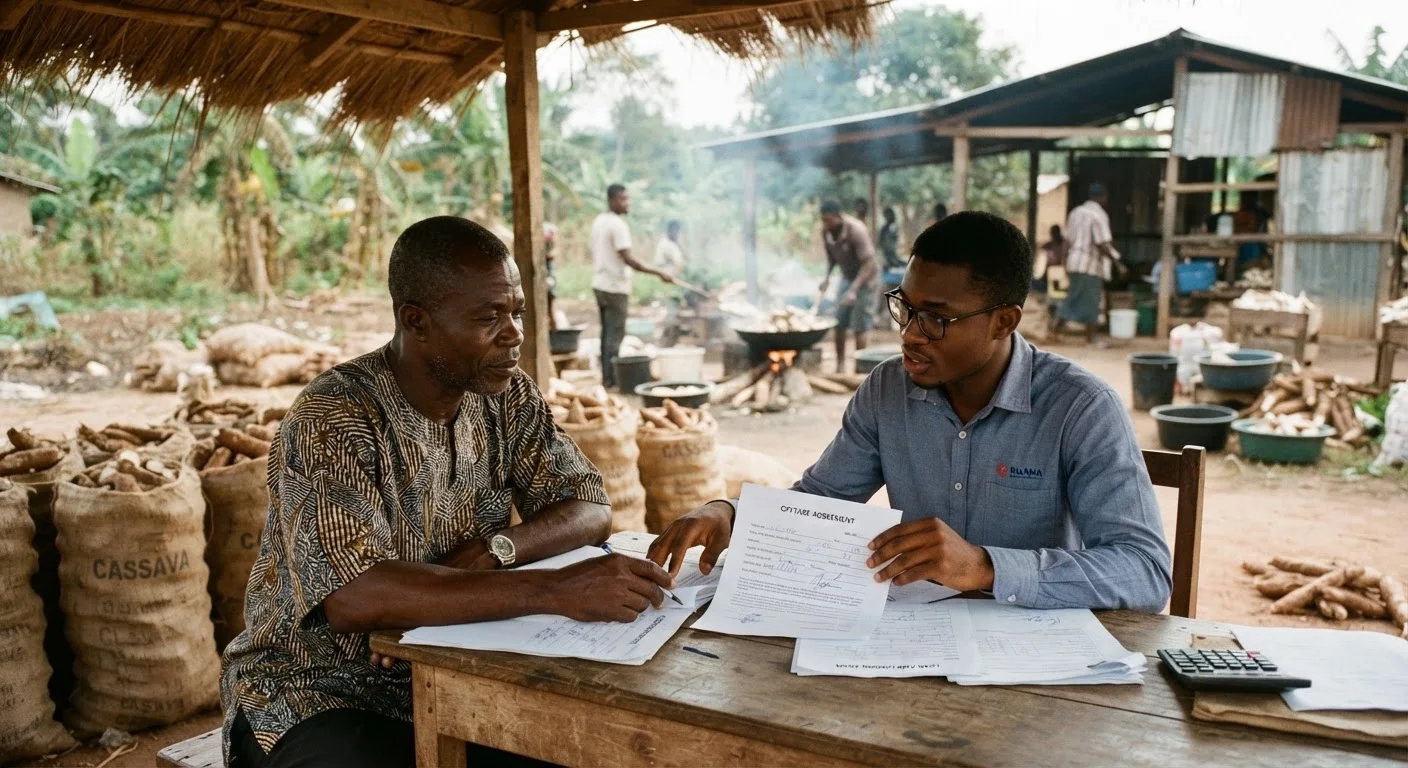
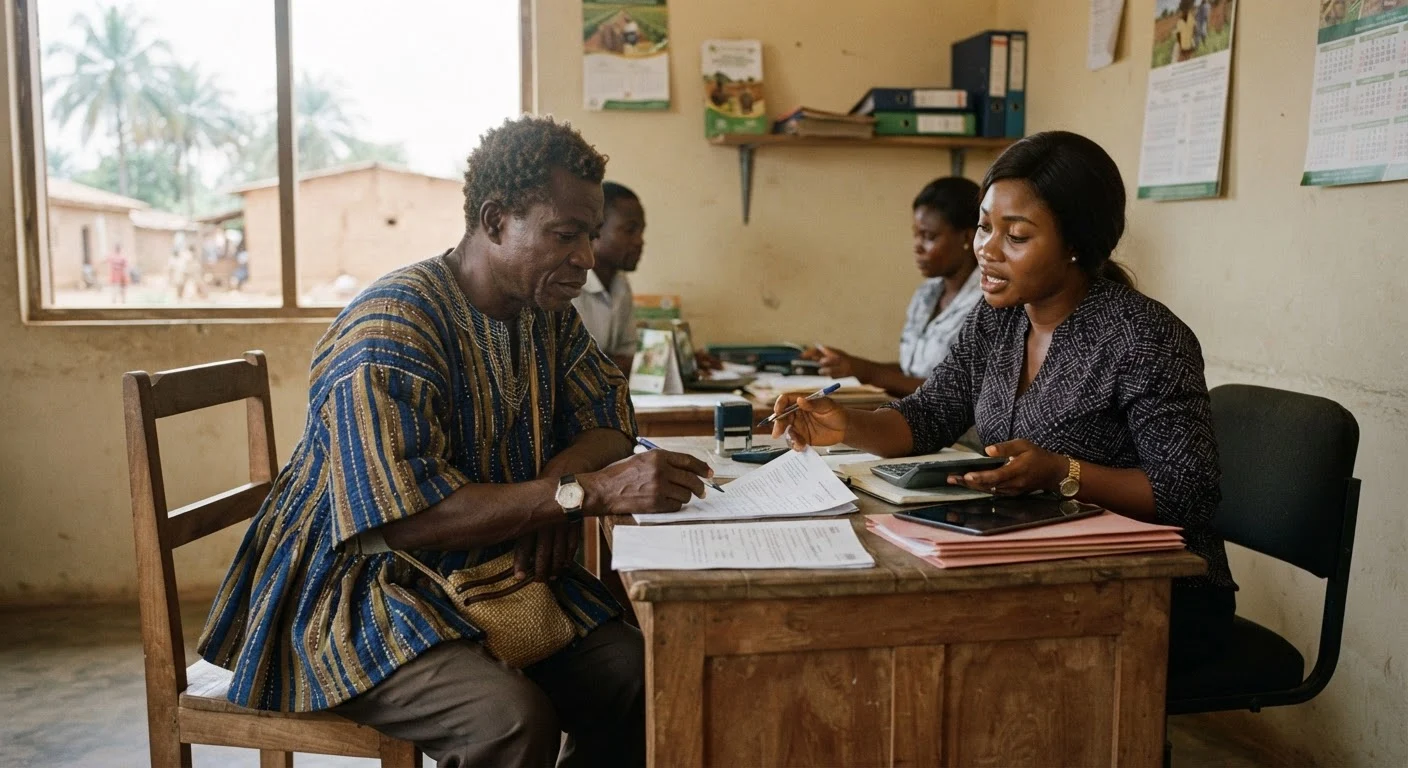
A Ghanaian cassava aggregator and a bank officer reviewing an offtake contract and loan documents at a desk, sacks of cassava and a processing shed visible behind, documentary photographUpload photo · /images/cassava-cr-aggregator-loan.webp
Package supply to be bankable
An offtake contract plus a GIRSAL guarantee turns unbankable farmers into a lendable business.
GH¢1.85bn
loans guaranteed by GIRSAL over six years to mid-2026, cover up to 70% of principal
3.5% → 10%
agriculture's share of bank credit, 2024 to the 2028 target
Risks that sit inside the economics
Margin wiped by a price fall
HIGH
What it is
The margin rides on revenue, so a fall in yield or farmgate price, the glut risk of Pillar 2, shrinks it fast, and at the low root prices of 2016 it could erase it entirely.
Who it hits
Every grower selling at the spot price, and every lender or investor whose case does not stress-test a 20 percent fall in yield or price.
How to manage it
contract a price or offtake before planting; lift yield; move volume up the value ladder into a processed product.
The hired-labour trap
ELEVATED
What it is
Paying the market wage for weeding can turn a subsistence plot’s margin negative, about GH¢490 an acre in one study.
Who it hits
Smallholders who pay the market wage for weeding, whose plot can run at a loss, and anyone scaling hired labour without a yield and price to carry it.
How to manage it
use family or exchange labour, or mechanise; do not scale hired labour without a yield and price to carry it.
Credit that does not reach the farm
MEDIUM
What it is
Agriculture gets a small share of bank credit at high interest (12 to 30 percent in 2019), and guarantee schemes publish no data on how far they reach the individual smallholder.
Who it hits
Individual smallholders borrowing alone at high rates, and every plan that assumes a guarantee scheme will reach a lone farmer.
How to manage it
borrow as an aggregated, offtake-backed group under a GIRSAL guarantee rather than as a lone farmer.
A Ghanaian cassava farmer and a trader weighing a heap of freshly harvested cassava roots on a platform scale at a roadside buying point, a ledger and cedi notes on a table, documentary photographUpload photo · /images/cassava-cr-weighing-roots.webp
The margin rides on the root price
An acre can pay well at high prices, but yield and the price you sell into move the margin far more than any cost line.
Key takeaways
01
Cassava is a high-variability crop at the farm: from a loss for hired-labour smallholders to about GH¢1,500 an acre for commercial farms at 2016 prices, and far more when prices spiked in 2024.
02
Labour and weeding are more than half the cost of an acre (about GH¢1,050 of GH¢1,850); Ghana is high-cost because it is hand-powered.
03
The margin is made off the farm: yield and price swing it far more than any cost line, so raise yield (Pillar 1) and lift price through processing (Pillars 2 and 6).
04
The cost model here is indicative and each figure names its basis and year; the returns depend above all on the root price and yield in the season you sell.
05
Finance exists in structure (GIRSAL, roots and tubers eligible), but its reach to smallholders is unmeasured; the route to bankability is an offtake-and-guarantee package around aggregated smallholders.
Written for each reader
Practitioner intelligence
Hover any card to pause and lift it.
For students
If you are thinking of entering, run the numbers on one acre before you plant one, using the indicative model here with your own local labour and price quotes. The first-timer mistake is assuming the crop pays because it grows easily; on hired labour and a weak price it can lose money.
For entrepreneurs
Do not try to grow cassava cheaper than the next farmer; compete on yield and on the price you sell into. Lock a price or offtake before you plant, hold labour cost down with mechanised or exchange labour, and move volume into a processed product (Pillar 6) where the margin actually sits.
For investors
The thesis: farm-gate cassava is a volatile margin that rides on the root price, and the return is in aggregation, processing and finance rather than in owning acres. Diligence asks are the actual per-acre budget and yield on the target plots, the labour arrangement, the offtake price, and the financing terms. Structure the cheque against an offtake-and-guarantee package and stress-test it for a 20 percent price fall.
For ecosystem actors
The lever is finance that reaches the smallholder. Resource GIRSAL’s guarantee and interest-rate subsidy for aggregated, offtake-backed cassava groups, and fund a regularly updated cassava cost-of-production budget, building on the 2019 national crop budget, so farmers and lenders price on current data. The measurable outcome is agriculture’s share of bank credit rising toward the 10 percent target with cassava included. The public-money failure to avoid is subsidising inputs without the offtake that makes the resulting crop sellable.
For students
If you are thinking of entering, run the numbers on one acre before you plant one, using the indicative model here with your own local labour and price quotes. The first-timer mistake is assuming the crop pays because it grows easily; on hired labour and a weak price it can lose money.
For entrepreneurs
Do not try to grow cassava cheaper than the next farmer; compete on yield and on the price you sell into. Lock a price or offtake before you plant, hold labour cost down with mechanised or exchange labour, and move volume into a processed product (Pillar 6) where the margin actually sits.
For investors
The thesis: farm-gate cassava is a volatile margin that rides on the root price, and the return is in aggregation, processing and finance rather than in owning acres. Diligence asks are the actual per-acre budget and yield on the target plots, the labour arrangement, the offtake price, and the financing terms. Structure the cheque against an offtake-and-guarantee package and stress-test it for a 20 percent price fall.
For ecosystem actors
The lever is finance that reaches the smallholder. Resource GIRSAL’s guarantee and interest-rate subsidy for aggregated, offtake-backed cassava groups, and fund a regularly updated cassava cost-of-production budget, building on the 2019 national crop budget, so farmers and lenders price on current data. The measurable outcome is agriculture’s share of bank credit rising toward the 10 percent target with cassava included. The public-money failure to avoid is subsidising inputs without the offtake that makes the resulting crop sellable.
Where this connects.The yield that drives the margin is Pillar 1’s; the price that drives it is Pillars 2 and 6’s, since processing is where the real margin sits; and the market intelligence and the policy that could unlock the sector at scale are the subject of Pillars 7 and 8.
Footnotes
Paul Okyere and Jacqueline Baidoo, “Profitability of Cassava Production in the Ashanti Region of Ghana,” Applied Studies in Agribusiness and Commerce (APSTRACT) 14, no. 1-2 (2020): 66-69, https://doi.org/10.19041/apstract/2020/1-2/8. Gross margin about USD 22.75 per acre; benefit-cost ratio 1.06; Sekyere East district, 50 farmers.↑
Bilson Kofi Kudivo, “Profit Efficiency of Cassava Production in Eastern and Brong Ahafo Regions of Ghana” (MPhil thesis, University of Ghana, 2021). Net farm income about GH¢4,457 per hectare; profit margin 75 percent; return on capital about 12 percent; profit efficiency 86.4 percent; 300 farmers, 2017-2018.↑
Ulrich Kleih et al., Cassava Value Chain Analysis in Brong Ahafo, Ghana (draft; Chatham: Natural Resources Institute / GASIP-MoFA, 2016). Hired-labour smallholders about GH¢-490 per acre at market wages; commercial farms about GH¢1,505 per acre. 2016 cedi values.↑
Abugri Amos, "2024 High Pricing of Cassava Sways Farmers into Large-Scale Farming at Ashanti Akim Agogo," Agrighanaonline, June 19, 2024, https://agrighanaonline.com/2024-high-pricing-of-cassava-sways-farmers-into-large-scale-scale-farming-at-ashanti-akim-agogo/. Farmer-reported cost of about GH¢1,850 per acre (land rent 300, land preparation 300, planting sticks 200, labour and weeding 1,050), and an acre sold standing for about GH¢16,000; informal news figures, treated as indicative.↑
Bank of Ghana, Quarterly Economic Bulletin, First Quarter 2025 (Accra: Bank of Ghana, 2025). Food inflation 26.5 percent in March 2025.↑
Ministry of Food and Agriculture (MoFA), SRID, Agriculture in Ghana: Facts and Figures (2024) (Accra: MoFA, 2025), Tables 7.1 and 7.2. Nominal rural wholesale cassava price GH¢526.86/MT (2015) to GH¢5,044.56/MT (2024); the real (CPI-deflated) 2024 price was essentially flat on 2023.↑
Citi Newsroom, "From 23% to 6%: Ghana's 2025 Inflation Slowdown, the Context and Economic Signals," December 4, 2025, https://www.citinewsroom.com/2025/12/from-23-to-6-ghanas-2025-inflation-slowdown-the-context-and-economic-signals/; F. Ntow, "Ghana's Inflation Falls to 3.2 Per Cent in March 2026," Ghana News Agency, April 1, 2026, https://gna.org.gh/2026/04/ghanas-inflation-falls-to-3-2-per-cent-in-march-2026/; "Inflation Rises to 5.0% in August 2026," MyJoyOnline, September 2, 2026, https://www.myjoyonline.com/ghanas-inflation-rises-to-5-0-in-august-2026/. Ghana Statistical Service figures.↑
Stéphanas Assocle, "Ghana Drops Fertilizer Subsidies for Free Distribution Amid Price Spike," Ecofin Agency, March 24, 2026, https://www.ecofinagency.com/news-agriculture/2403-54025-ghana-drops-fertilizer-subsidies-for-free-distribution-amid-price-spike; "Cedi Depreciates by 9.5% in Nine Months of 2026: BoG," MyJoyOnline, September 23, 2026, https://www.myjoyonline.com/cedi-depreciates-by-9-5-in-nine-months-of-2026-bog/; "World Bank Projects Sharp Rise in Fertiliser Prices for 2026, Warns of Food Inflation Risks," GBC Ghana Online, 2026, https://www.gbcghanaonline.com/news/business/world-bank-fertiliser/2026/, reporting the World Bank Commodity Markets Outlook, April 2026.↑
F. Ntow, "Bank of Ghana Holds Policy Rate at 14 Per Cent," Ghana News Agency, July 22, 2026, https://gna.org.gh/2026/07/bank-of-ghana-holds-policy-rate-at-14-per-cent/.↑
Ministry of Trade and Industry, A Value-Chain Analysis of the Cassava Sector in Ghana (Accra: MOTI/EU-WACOMP, 2019). Commercial agricultural lending rates of 12 to 30 percent; IFAD/RTIMP matching credit on a 10:30:60 basis.↑
Ministry of Food and Agriculture (MoFA), Feed Ghana Programme (2025), Table 22 (Agricultural Lending Targets Matrix): bank credit to agriculture 3.5 percent (2024) rising to a 10 percent target (2028); loans under GIRSAL guarantees GH¢288.5 million (2024) to GH¢824.3 million (2028).↑
Bank of Ghana, Governor's Remarks: GIRSAL's 5th Anniversary Launch (Accra: Bank of Ghana, September 17, 2024). Over five years, credit guarantees exceeding GH¢604.53 million covering up to 70 percent of default risk, and about GH¢1.18 billion in loans channelled to some 137 agribusinesses. See also GIRSAL, "GIRSAL Holds 2026 Annual General Meeting (AGM)," July 23, 2026, https://www.girsal.com/2026/07/23/girsal-holds-2026-annual-general-meeting-agm/. Loans guaranteed worth GH¢1.85 billion over six years; 6,695 agribusinesses supported through 40 participating financial institutions in 88 districts.↑
GIRSAL Ltd, “Agricultural Credit Guarantee Scheme,” accessed July 29, 2026, https://www.girsal.com/agricultural-credit-guarantee-scheme/. Roots and tubers (including cassava) is an eligible sector.↑
Dean Karlan, Monica P. Lambon-Quayefio, Utsav Manjeer and Christopher R. Udry, “Access to Digital Credit for Smallholder Farmers: Experimental Evidence from Ghana,” Working Paper No. 33271 (Cambridge, MA: National Bureau of Economic Research, 2024), https://doi.org/10.3386/w33271.↑