Ghana Agribusiness PlaybookCassava
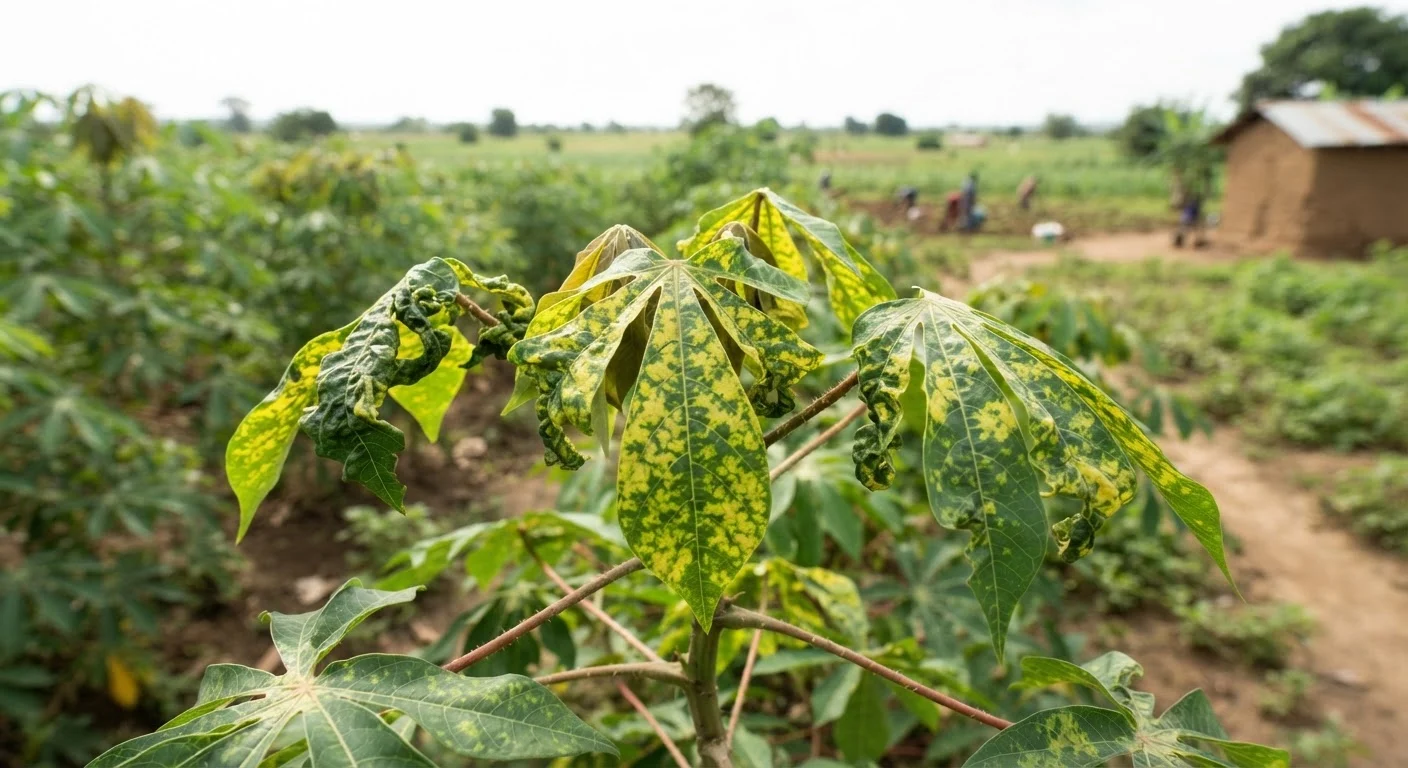
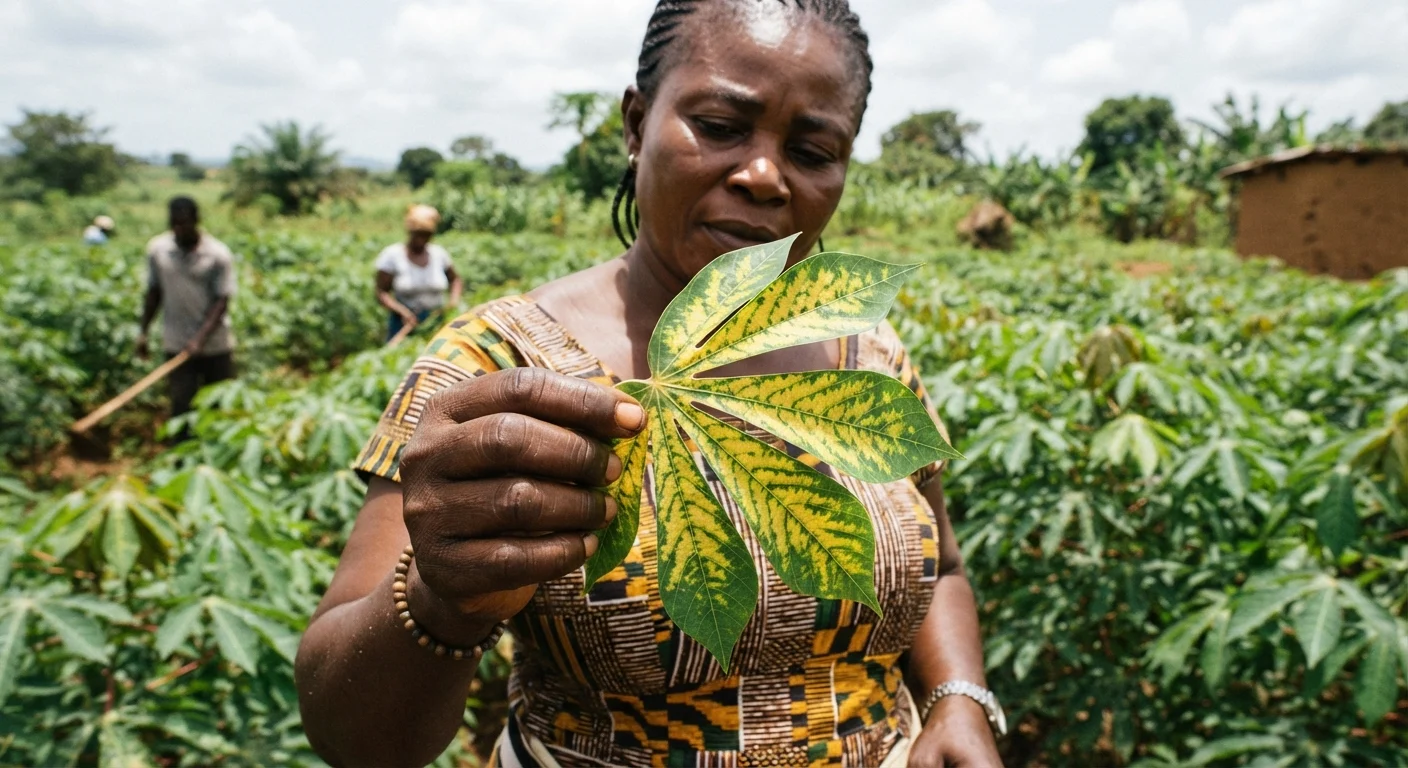
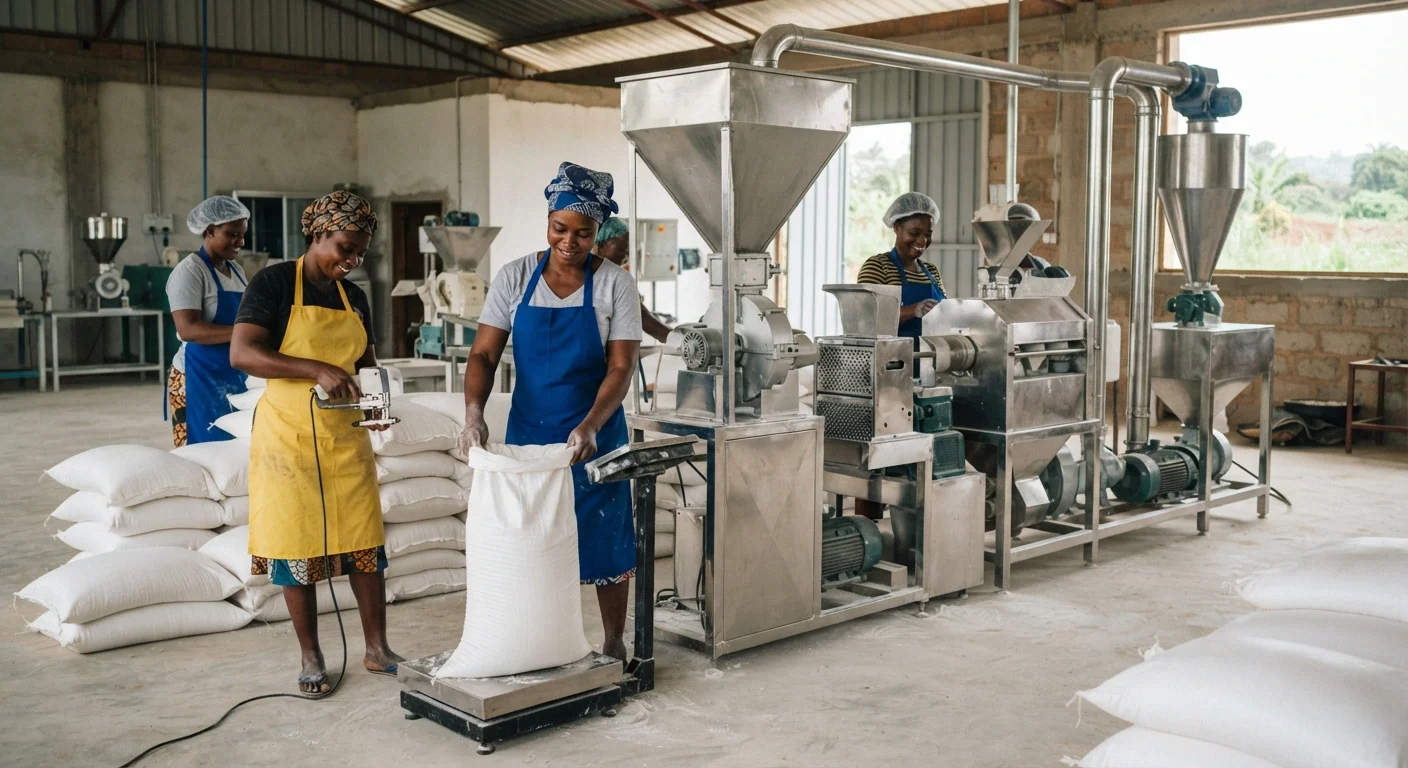
A Ghanaian plant-health officer examining cassava leaves for mosaic symptoms in a green cassava field, documentary photograph
Cassava · Pillar 03

Disease, Pests, Post-Harvest and Toxicity Risk

What decides whether a cassava crop survives and sells is not the weather but four things you can name: the mosaic virus already here, the brown streak virus not yet, the clock that starts the moment a root leaves the ground, and the natural poison inside every root.
Disease, Pests, Post-Harvest and Toxicity Risk · Pillar 03

What decides whether a cassava crop survives and sells is not the weather. It is four things you can name: the mosaic virus that is already here, the brown streak virus that is not yet, the clock that starts the moment a root leaves the ground, and the natural poison inside every root. Each is manageable. Each mismanaged is a business destroyed.

The useful part is that the same processing that adds the most value also removes the poison. The pages that follow set out each of the four in turn, price the loss, and point to the service a practitioner can sell against it. None of the four is a farming problem you solve with a better season. Each is a business decision, and each is currently made by default.

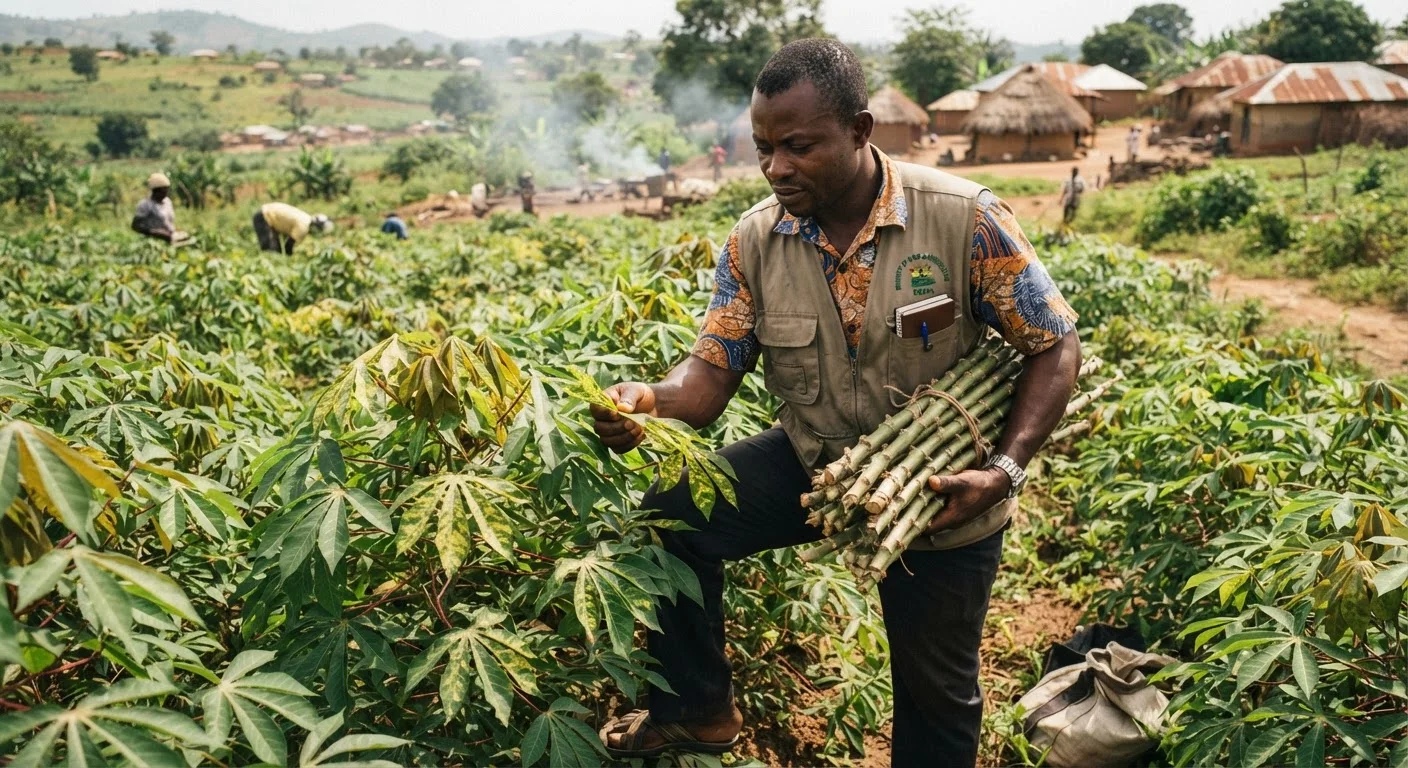
A Ghanaian field scout inspecting cassava leaves for the mottling of mosaic disease, a bundle of stem cuttings under one arm, documentary photograph
One you manage, one you keep out
Two viruses, a clock and a poison decide the crop. Each is manageable, and each is a service to sell.
66.5%
mean cassava mosaic incidence by the 2022 national survey, down from the 94 to 98 per cent of earlier cycles
24 to 72 hrs
from harvest to the first internal spoiling of the root
5.7 mg/kg
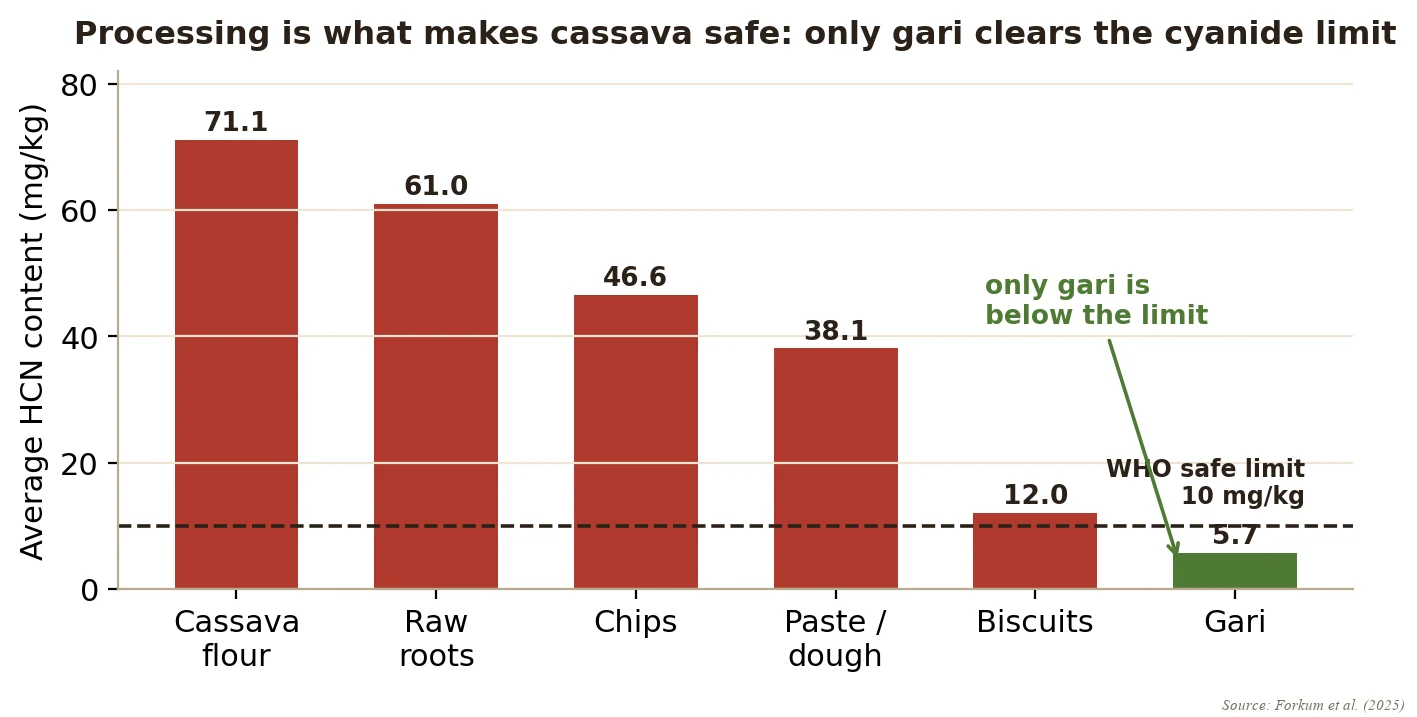
cyanide in gari, the only common cassava product under the 10 mg/kg safe limit

The two viruses that decide the crop

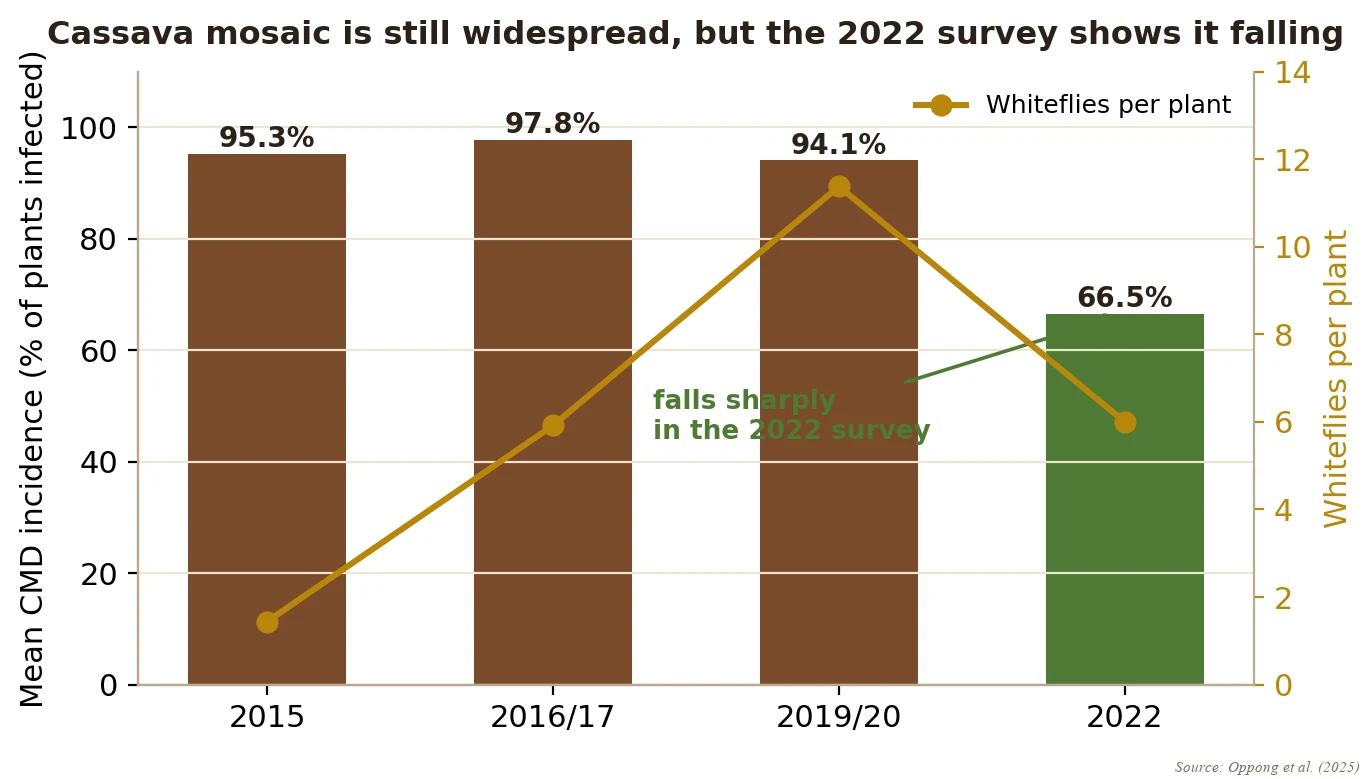
Two virus diseases set the ceiling on cassava yield in Ghana. Cassava mosaic disease is already here and everywhere. It is carried in infected cuttings and spread field to field by the whitefly, and across Africa it still claims 30 to 40 per cent of the harvest.1 Four national surveys between 2015 and 2022 found it in the great majority of fields, though the last brought better news: mean incidence fell from the 94 to 98 per cent range of the earlier cycles to 66.5 per cent in 2022, which the surveyors read as a sign that awareness and cleaner planting material are starting to work.2

The second virus is the one to fear. Cassava brown streak disease rots the root itself and can take up to 70 per cent of a harvest, and unlike mosaic it is not yet present in Ghana as of late 2025.3 It is spreading westward across Africa, its main route of entry is infected planting material carried across borders, and Ghana validated a national response plan against it in 2026.4The defence against both is the same, and it is Pillar 1’s defence: clean, tested planting material of resistant varieties, plus vigilance on imported stems. Managing the whitefly that carries them is the other half.

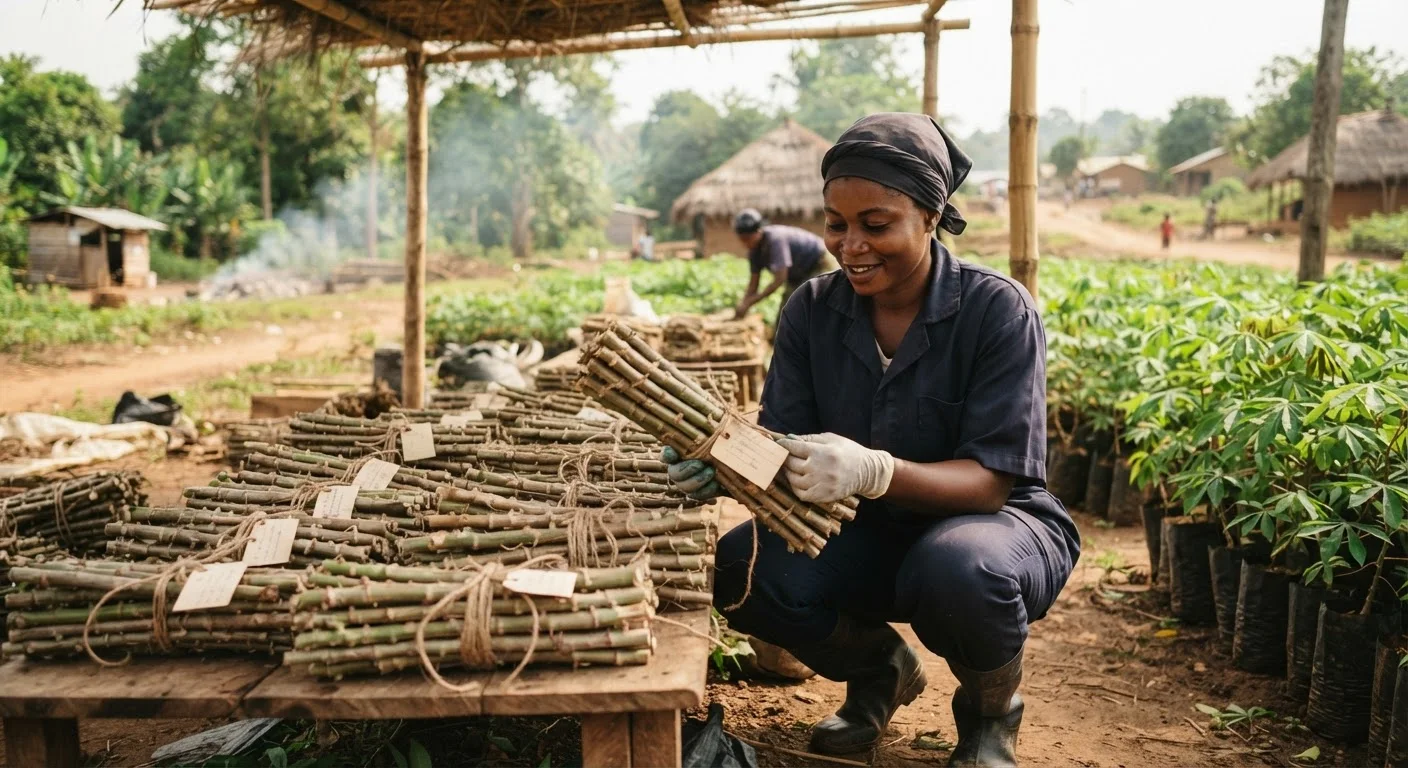
Bundles of certified clean cassava stem cuttings tied and tagged at a seed-multiplication nursery, a technician checking them, documentary photograph
The defence is clean seed
The defence against both viruses is the same: clean, tested planting material and vigilance on imported stems.
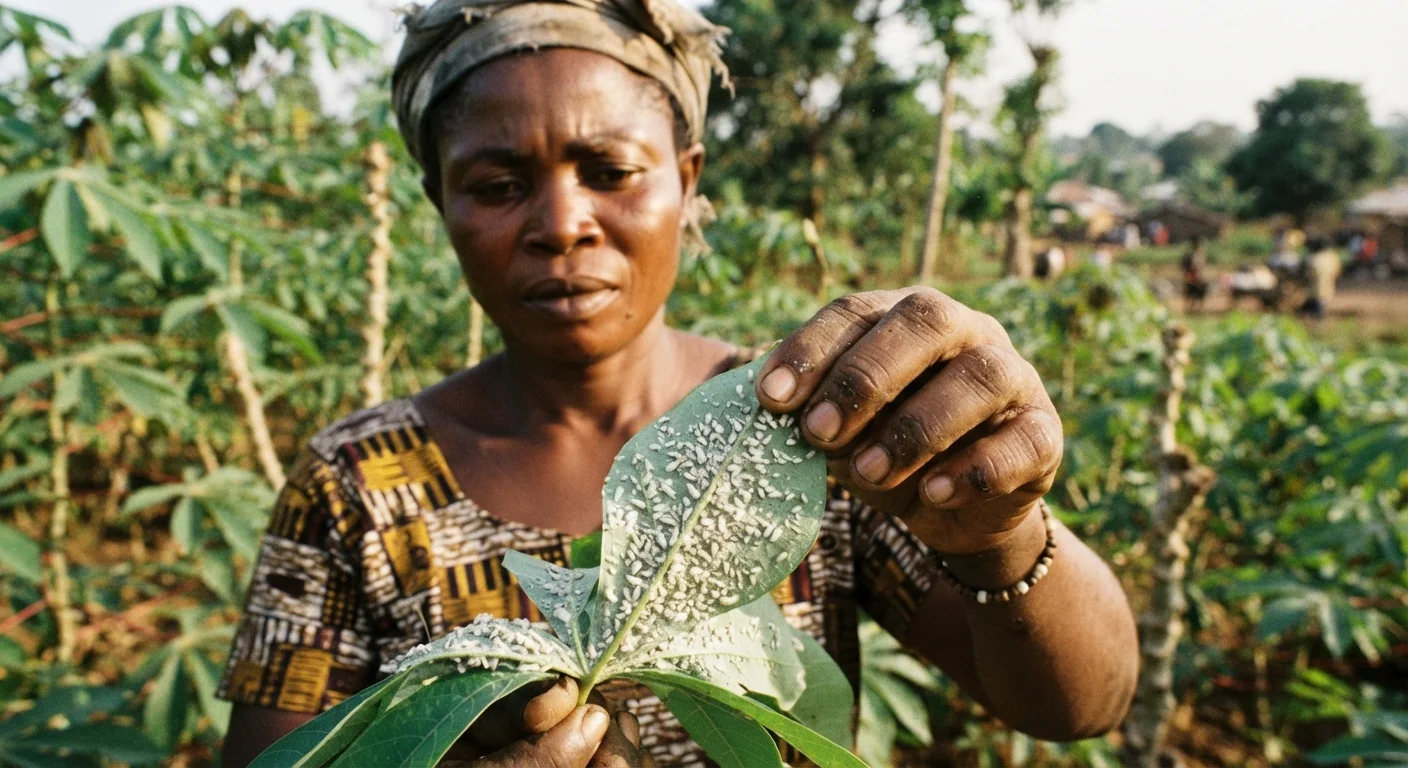
A close-up of the underside of a cassava leaf covered with tiny whiteflies, a farmer's hand turning the leaf to inspect it, documentary photograph
The vector of both
The whitefly carries mosaic and brown streak alike, so managing it is the other half of the defence.
30 to 40%
of Africa's cassava harvest still lost to mosaic disease
up to 70%
of a harvest brown streak can take where it is present, and it is not yet in Ghana
Cassava mosaic incidence and whitefly counts over four national surveys: mean incidence falls from the 94 to 98 per cent of the earlier cycles to 66.5 per cent in 2022
Figure 8 Cassava mosaic incidence and whitefly counts over four national surveys.
What this shows

Mean cassava mosaic incidence across four national surveys: 95.3 per cent in 2015, 97.8 in 2016/17, 94.1 in 2019/20 and 66.5 in 2022, with mean whiteflies per plant ranging from about 1.4 to 11.4. The surveys found no direct relationship between whitefly counts and disease level, a reminder that the infected cutting carries mosaic as surely as the insect does.

Insight: one disease you manage, one you keep out

Mosaic is a management problem: resistant varieties and clean seed hold it down, and the 2022 survey shows that working. Brown streak is a biosecurity problem: it is not here, it must not arrive, and the only thing that brings it is an infected cutting crossing a border. Anyone trading planting material regionally is the risk, and anyone building a tested clean-seed system is the country’s first line of defence.

The pests, and why most of the war is already won

Cassava carries a familiar set of pests: the cassava mealybug, the green mite, the variegated grasshopper and the whitefly. Most of them are, quietly, a solved problem. Classical biological control introduced natural enemies that brought the mealybug and green mite under control decades ago, and they remain managed today rather than devastating, with resistant varieties doing much of the rest.5

The exception that still matters is the whitefly, because it is more than a pest: it is the vector that carries both mosaic and brown streak from plant to plant. Whitefly numbers per plant in the national surveys ran from about one to eleven, and the surveys found no direct relationship between whitefly numbers and disease levels, a reminder that infected cuttings carry mosaic as surely as the whitefly does.6 Ghana now runs a national early-warning and rapid-response system for pests and diseases, backed by the Plants and Fertilizer Act, that gives cassava surveillance an institutional home.7 So pests as such are mostly handled by resistant varieties and established biocontrol; the one worth spending money and attention on is the whitefly, because controlling the vector is how you control the viruses.

A close-up of the underside of a cassava leaf covered with whiteflies, a farmer's hand turning the leaf to inspect it, documentary photograph
More vector than pest
Controlling the whitefly is how you control the viruses, not just the pest.
1 to 11
whiteflies per plant across the four national surveys, with no direct link to disease level
2 viruses
mosaic and brown streak, both carried by the same whitefly vector

The clock: why cassava cannot wait

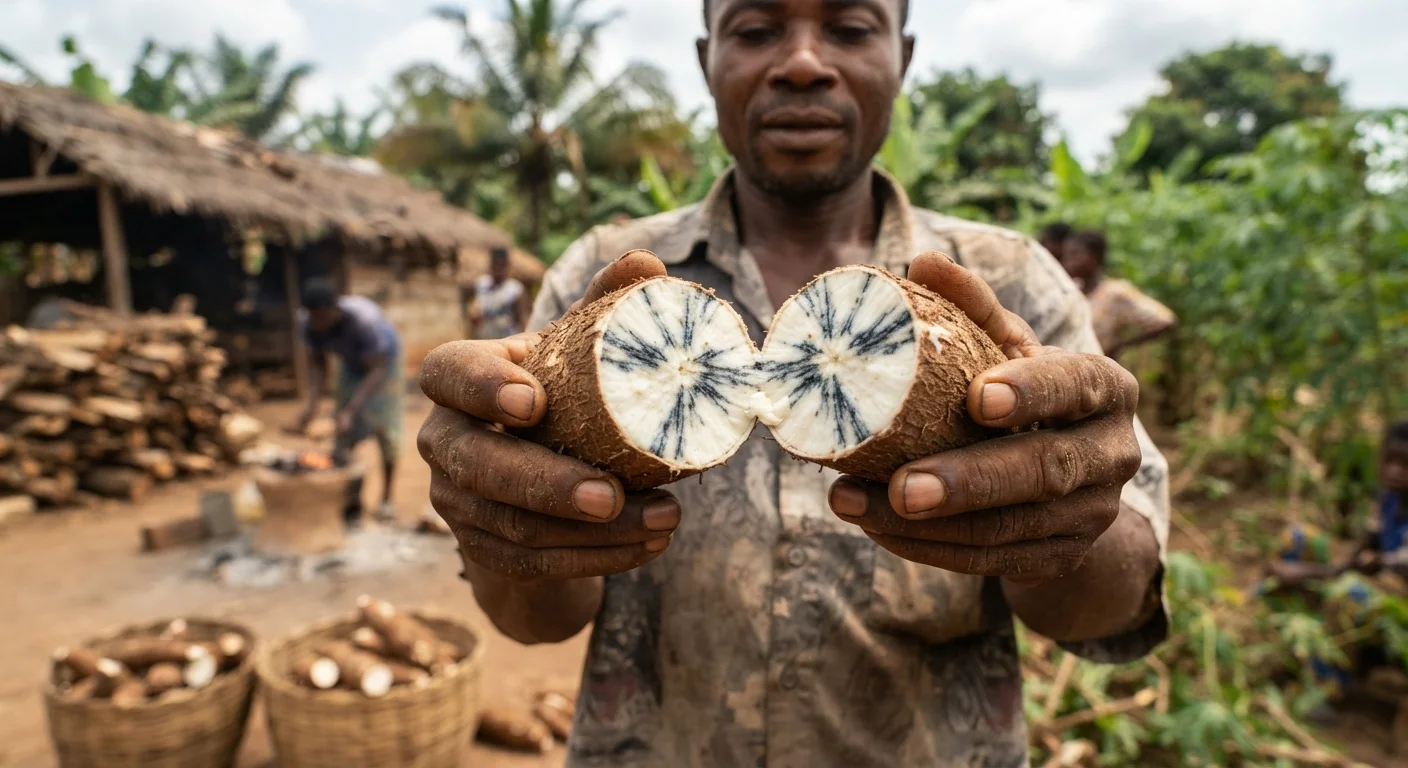
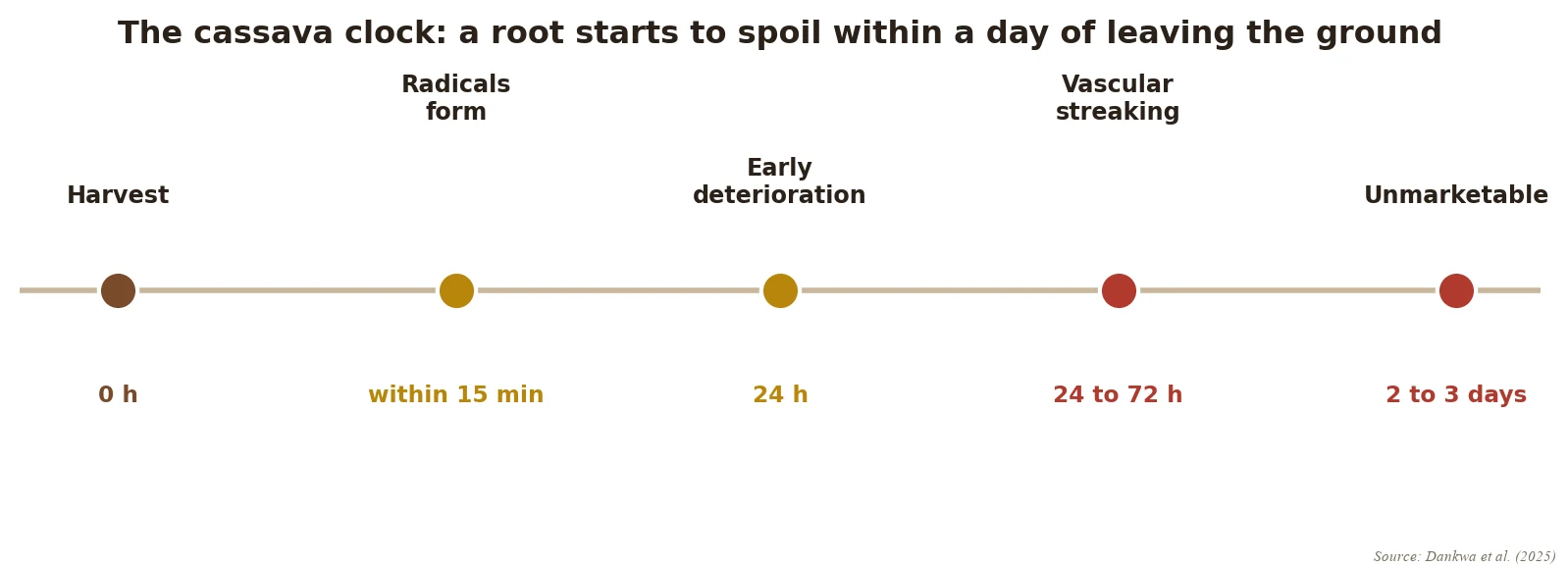
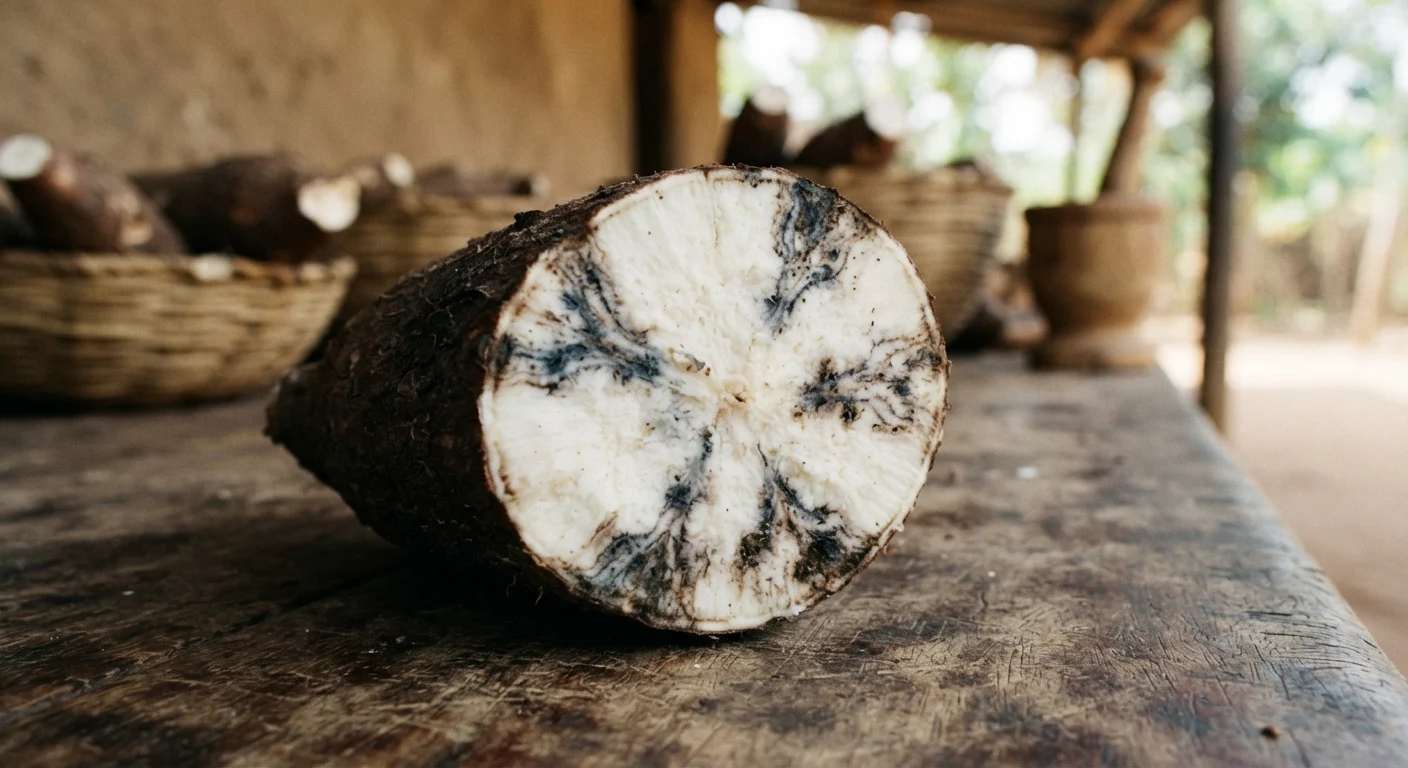
Cassava has a problem no cereal has. Within 24 to 72 hours of harvest the root begins to spoil from the inside, a blue-black streaking of the flesh called post-harvest physiological deterioration, and the chemistry that drives it starts within 15 minutes of the root being cut or bruised.8A root that is not eaten or processed within two to three days is unmarketable.

This single fact shapes the entire cassava economy. It is why cassava is grown, harvested and eaten close to home, why the value chain is short and local, and why a farmer cannot store the crop or ship it raw to a distant buyer the way a maize farmer can. The clock is a constraint and an opening at once. The constraint forces processing within days and near the farm. The opening is everything that beats the clock: rapid on-farm processing, simple storage that buys a few more days, and the PPD-tolerant varieties now in breeding. Whoever shortens the distance between harvest and processing captures value that currently rots.

A freshly cut cassava root held open to show the blue-black internal streaking of post-harvest physiological deterioration, documentary photograph
Months in the ground, days out of it
The root spoils from the inside within days. The chain bends around the clock.
24 to 72 hrs
from harvest before the root begins to spoil from the inside
15 min
from a cut or bruise before the deterioration chemistry starts
2 to 3 days
and an unsold root is unmarketable
The post-harvest clock: from harvest to unmarketable in days, the internal spoiling that starts within hours of lifting the root
Figure 9 The post-harvest clock: from harvest to unmarketable in days.
What this shows

Post-harvest physiological deterioration begins within 24 to 72 hours of harvest, and the biochemistry that drives it starts within 15 minutes of a root being cut or bruised. A root not eaten or processed within two to three days is unmarketable, which is why the cassava chain is short, local and built around beating the clock.

What the losses cost, and where they sit

The clock turns into money lost. Post-harvest losses along Ghana’s cassava chain are large, with commonly cited estimates of measured physical loss running from around 10 to 26 per cent of the crop, rising toward half once roots left unsold for want of a market are counted (Pillar 6), and an economic cost put near US$500 million a year, though these figures are dated and secondary and should be treated as directional until confirmed against primary data.9Ghana’s loss profile is distinctive: because a high share of roots reach the consumer fresh, most of the loss lands at the last, fresh-market stage, and much of it is quality and price discounting rather than outright weight loss.

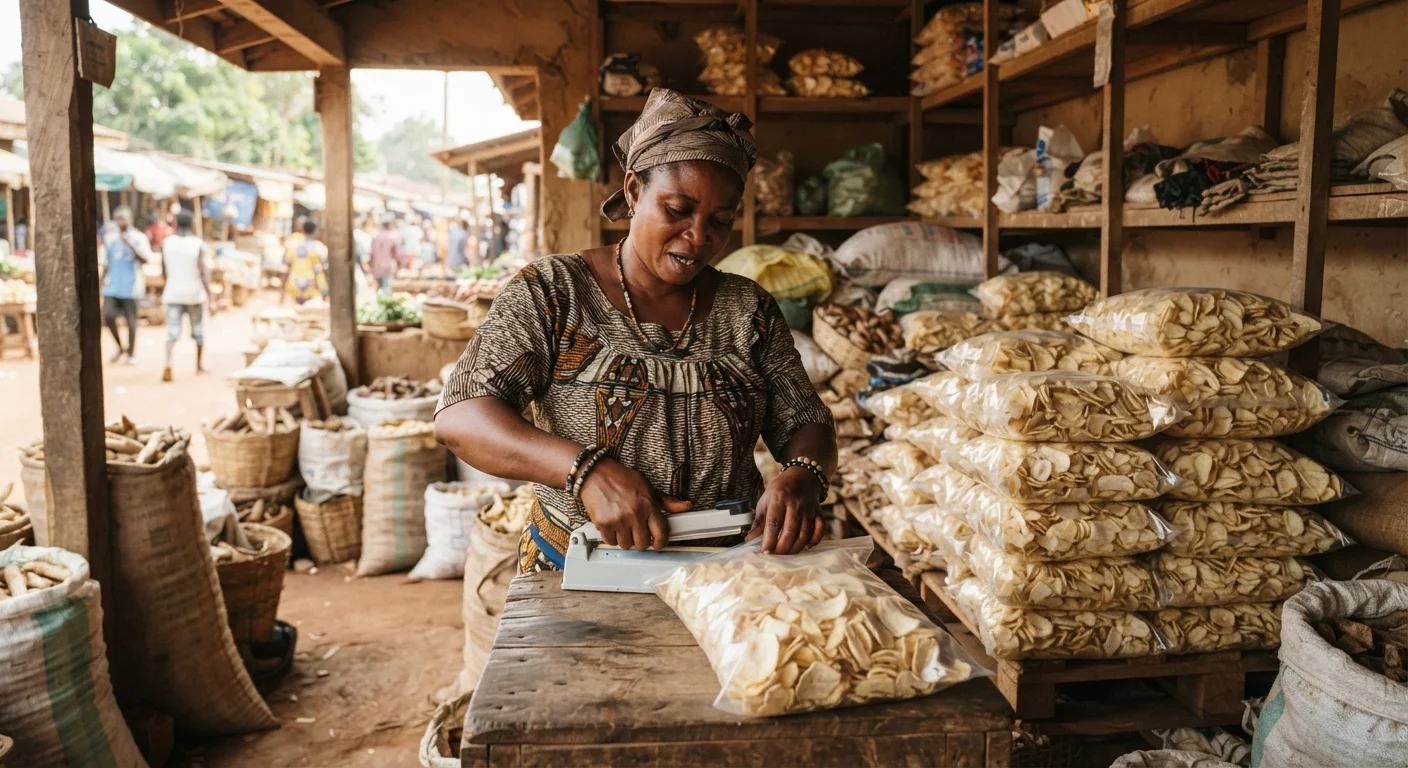
Storage helps at the dried-product end, where hermetic bags of the kind used for grain have been shown to cut losses in stored dried cassava chips in Ghana at a cost of a few cedis a bag.10 The losses are real, concentrated at the fresh end, and fixable by moving the crop into a stable processed form fast. Loss reduction is not charity; it is a service business, and the operator who offers rapid processing or reliable dried storage is selling time.

Stacked hermetic storage bags of dried cassava chips in a Ghanaian store, a trader sealing one shut, documentary photograph
A few cedis a bag
Storage helps only the dried form; the fresh root still runs on the clock.
US$500M/yr
a widely cited, dated estimate of Ghana's cassava post-harvest loss, treated as directional
10 to 26%
commonly cited measured physical loss, rising toward half once unsold roots are counted
Table 6: Ways to beat the post-harvest clock, and who should sell each
The interventionWhat it doesWhat it costsThe catch, and who should sell it
Convert near the farmTurns a root that rots in days into a storable product (chips, gari, flour); the one durable answer to the clockA shed and simple processing kitIt works, but it shifts labour from women to men unless ownership is designed first; sell it as a service, not as advice
Hermetic bags for the dried formCuts storage losses in dried cassava chips over a two-month store, against ordinary sacksAbout GH¢9 a bagHelps the dried form only, leaving the fresh root untouched; the gain is in the protocol more than the kit
Deterioration-tolerant varietiesSome genotypes stay symptom-free far longer than susceptible ones, buying days at the farmChosen at planting, at no extra costA breeding pipeline rather than an off-the-shelf fix, and it trades against dry matter (Pillar 1)
Cold and simple storageCold storage below four degrees, and low-tech ground storage, slow the clock at the marginA cold room, or straw and soilCold storage is almost nowhere in the chain; the low-tech methods are cheap but buy only a little time

Sources: Baral and Hoffmann / IFPRI (2018) on hermetic bags for dried chips; Dankwa et al. (2025) on the deterioration clock and tolerant varieties. Loss-reduction percentages are not quoted here: the held sources carry no cassava-specific field figures for these interventions in Ghana, and this playbook does not invent them.

The poison, and why processing is the answer

Every cassava root contains cyanogenic compounds that release hydrogen cyanide when the flesh is damaged. Eaten raw or poorly processed, cassava causes acute poisoning and, over time, chronic neurological disease, including konzo, a paralytic condition, and tropical ataxic neuropathy.11 The internationally used safe level is 10 milligrams of cyanide per kilogram. A review of cyanide across cassava products found raw roots at about 61 milligrams per kilogram, cassava flour at 71 and chips at 47, all well above the safe line, while gari, which is grated, fermented, pressed and roasted, came in at 5.7, the only common product below the limit.12

The point is worth stating plainly: the traditional processing that makes gari also detoxifies it, which is exactly why gari is the cassava product ready for a formal or export market, where raw roots and simple flour are not. Food safety here is a market-access question as much as a health one. The catch is that Ghana has no confirmed national cyanide standard of its own for cassava products yet, so a processor targeting export should work to the international 10 mg/kg limit and document it.

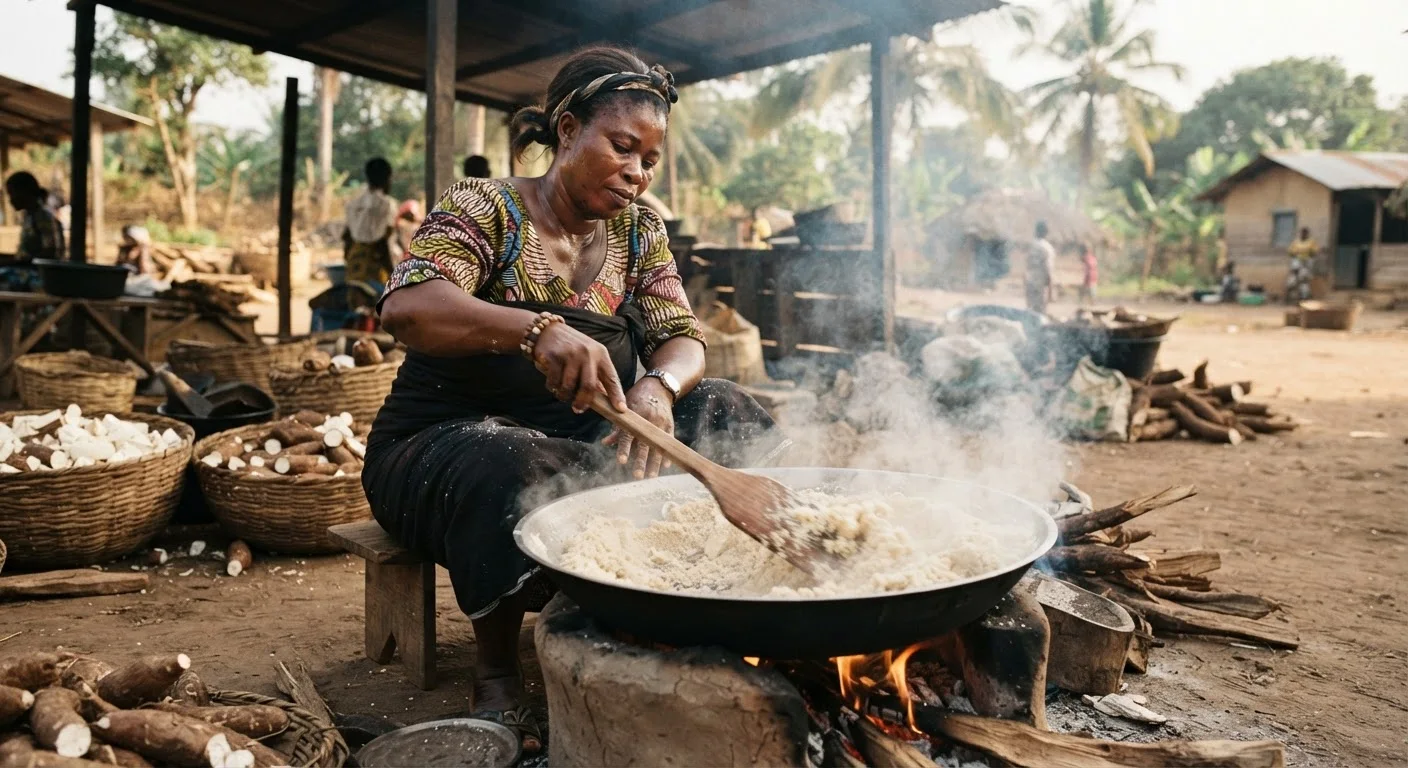
A Ghanaian woman roasting fermented, pressed cassava mash into gari over a wide open pan, steam rising, documentary photograph
Processing removes the poison
Gari is grated, fermented, pressed and roasted. The same steps that add value take out the cyanide.
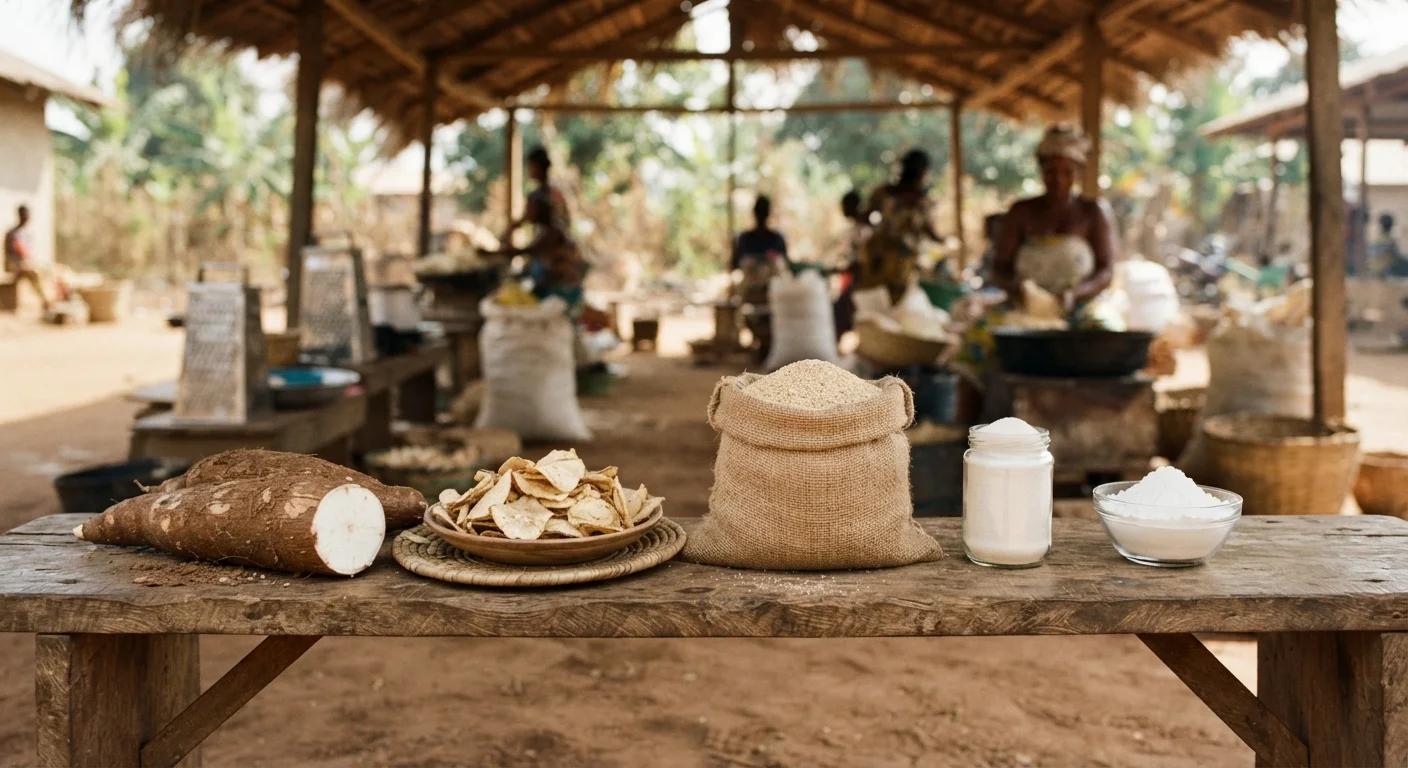
A staged arrangement of cassava products climbing in value, from a raw root to dried chips to a bag of gari to fine flour to refined white starch, on a wooden bench, documentary photograph
Safe only once it is processed
Raw roots, flour and chips all sit above the 10 mg/kg line; only the fully processed gari falls safely below it.
61 mg/kg
cyanide in raw roots, against a 10 mg/kg safe limit
71 mg/kg
cyanide in simple cassava flour, the highest of the common products
5.7 mg/kg
cyanide in gari, grated, fermented, pressed and roasted
Hydrogen cyanide in cassava products against the 10 mg/kg safe limit: cassava flour 71, raw roots 61, chips 47, and gari 5.7, the only common product below the line
Figure 10 Hydrogen cyanide in cassava products against the 10 mg/kg safe limit.
What this shows

Average hydrogen cyanide by product against the WHO/FAO safe level of 10 mg/kg: cassava flour 71.1, raw roots 61.0, chips 46.6, paste or dough 38.1, biscuits 12.0 and gari 5.7. Only gari, the fully fermented and roasted product, falls below the line, which is what makes the processing method, more than the crop, the thing that decides safety.

Table 7: The cassava risk map, ranked by evidence of business impact rather than by menace
ThreatSeverityThe lossThe mechanismThe fix to sell
Post-harvest deteriorationCriticalUp to half the fresh crop; roots turn unmarketable within two to three daysHarvest wounds trigger rapid internal spoilage the root cannot seal; months in the ground become days out of itNear-farm conversion to a storable form; dried storage; PPD-tolerant varieties
No buyer, and a clockCriticalNot separately counted; it shows up as the price the farmer takes every morningHarvest is irreversible and roots waste fast, so a grower with no buyer accepts the day's priceA lifting calendar and a forward offtake; the scarce thing is a credible date rather than a machine
Cassava mosaic diseaseHigh, and fallingOver 20 per cent yield loss; up to 30 to 40 per cent of Africa's harvestCarried in infected cuttings and by whitefly; severity is set by the cutting more than the insect countClean, tested planting material and resistant varieties; national surveys show prevalence already falling
Cassava brown streak diseaseWatch-list, not yet hereUp to 70 per cent where present; it disqualifies flour outright when severeInvisible in the plant, a dry rot in the root; moves in stems over long distancesSurveillance, diagnostics, stem quarantine and pre-emptive breeding; the lead time is the asset
Cyanide and the certification gapHigh for any formal saleMarket access; a poorly processed product fails the 10 mg/kg limit even though standard gari passes at 5.7The toxin hydrolyses to hydrogen cyanide; the processing method, more than the crop, decides the residueControlled fermentation and drying, a defined starter culture, and testing at intake

Sources: Dankwa et al. (2025) and Ghana News Agency (2025) on loss and the clock; Chikoti and Tembo (2022) and Oppong et al. (2025) on mosaic and brown streak; Forkum et al. (2025) on cyanide by method. Ranked by evidence of business impact, not by menace; severity ratings are this playbook's judgement.

The risks that sit inside disease, loss and safety

Cassava leaves showing the yellow-green mottling and distortion of cassava mosaic disease, a field scout inspecting the crop, documentary photograph

Cassava mosaic disease (CMD)

HIGH
What it is

Already widespread and carried in cuttings and by whitefly, mosaic claims 30 to 40 per cent of Africa's harvest and sets the yield ceiling in Ghana.

Who it hits

Anyone budgeting for insecticide against the whitefly instead of clean cuttings, and every yield forecast that assumes clean material without checking the source.

How to manage it

Plant resistant varieties from certified clean seed; rogue diseased plants; manage the whitefly vector.

A cassava root cut open to show the brown, corky necrosis of cassava brown streak disease, documentary photograph

Cassava brown streak disease (CBSD)

SEVERE
What it is

Not yet in Ghana but spreading westward, brown streak rots the root and can take up to 70 per cent of a harvest; it enters on infected stems.

Who it hits

Every processor whose model depends on flour, which the disease disqualifies where it is severe, and every breeding or surveillance programme that has not yet started.

How to manage it

Border vigilance on imported planting material; report suspect plants; back the national response plan.

Freshly harvested cassava roots cut to reveal the blue-black vascular streaking of post-harvest physiological deterioration, documentary photograph

Post-harvest deterioration (the clock)

HIGH
What it is

Roots spoil within 24 to 72 hours of harvest, so the whole value chain bends around the clock and any delay is a direct loss.

Who it hits

Every farmer without a contracted buyer and every aggregator far from a processor; the harvest is irreversible and the root wastes within days.

How to manage it

Process within days and near the farm; use simple storage for dried forms; plant PPD-tolerant varieties as they come.

A cassava processor testing gari at a small quality-control bench with a handheld meter, bags of processed cassava beside her, documentary photograph

Cyanide toxicity

ELEVATED
What it is

Raw and poorly processed cassava carries unsafe cyanide and can cause acute and chronic illness; proper processing removes it and gari is safe.

Who it hits

Any processor moving from the informal stall to a formal buyer, exporter or institutional caterer, where the product is tested against the 10 mg/kg limit.

How to manage it

Ferment, dry and roast properly; work to the 10 mg/kg limit; document safety for buyers.

Key takeaways
01

Two viruses set the ceiling: mosaic is here and being managed (incidence fell to 66.5 per cent by 2022), while brown streak is not yet here and would take up to 70 per cent of a harvest if it arrived.

02

The defence against both viruses is Pillar 1's: clean, tested planting material of resistant varieties, plus whitefly control and border vigilance.

03

Most pests are already handled by resistant varieties and long-standing biocontrol; the whitefly matters because it carries the viruses.

04

Cassava spoils within 24 to 72 hours of harvest, which is why the chain is short and local and why beating the clock is the core post-harvest opportunity.

05

Every root is mildly poisonous raw; proper processing removes it, and gari at 5.7 mg/kg is the only common product under the 10 mg/kg safe limit, which is what makes it export-ready.

Written for each reader

Practitioner intelligence

Hover any card to pause and lift it.

For students

If you are thinking of entering, the most useful skill to sell is beating the clock rather than growing cassava: a small, fast processing service that turns roots into safe, storable gari or flour within a day of harvest. The first-timer mistake is buying roots you cannot process within two or three days; the clock, more than the market, decides your loss.

For entrepreneurs

Lock down disease-free planting material and a processing point close to the field, in that order, before you plant an acre. Never move cuttings across a border without knowing their health, because that is exactly how brown streak arrives, and never buy roots you cannot process before they spoil.

For investors

The thesis: disease and the post-harvest clock, more than yield, are the binding constraints, and the businesses that beat them, clean-seed multiplication and rapid near-farm processing, are where cassava value is protected. Diligence asks are the variety's disease status, the source and certification of planting material, and the time and distance between harvest and processing. Structure the cheque against a working clean-seed-to-processing loop rather than against hectares.

For ecosystem actors

Two levers matter most: enforce border biosecurity on imported cassava planting material to keep brown streak out, and back a confirmed national cyanide standard for cassava products through the standards authority. The measurable outcomes are zero cross-border introductions of brown streak and a published product-safety limit. The public-money failure to avoid is funding surveillance without funding the clean-seed supply that actually prevents spread.

Where this connects.The clean planting material and resistant varieties that hold the viruses down are Pillar 1’s business. The processing that beats the clock and removes the poison is Pillar 6’s. And the value that currently rots between harvest and market is the gap the value chain has to close (Pillar 6).

Footnotes
  1. Patrick Chiza Chikoti and Mathias Tembo, "Expansion and Impact of Cassava Brown Streak and Cassava Mosaic Diseases in Africa: A Review," Frontiers in Sustainable Food Systems 6 (2022): 1076364, https://doi.org/10.3389/fsufs.2022.1076364.
  2. Allen Oppong et al., "Trend Analysis of Four Cycles of National Cassava Mosaic Disease Surveys in Ghana," Journal of Agricultural Science 17, no. 7 (2025): 41-50, https://doi.org/10.5539/jas.v17n7p41. Mean CMD incidence: 95.3 percent (2015), 97.8 percent (2016/17), 94.1 percent (2019/20), 66.5 percent (2022).
  3. On the up-to-70-percent loss, Chikoti and Tembo, "Expansion and Impact of Cassava Brown Streak and Cassava Mosaic Diseases." On CBSD's absence from Ghana as of late 2025, Acquah, "Ghana Urged to Step Up Surveillance against Cassava Brown Streak Disease," Ghana News Agency, September 13, 2025.
  4. CSIR-Crops Research Institute, "Ghana Validates National Response Plan Against Cassava Viral Diseases," cropsresearch.org, May 2026.
  5. Braima James et al., Pest Control in Cassava Farms: IPM Field Guide for Extension Agents (Cotonou: International Institute of Tropical Agriculture, 2000).
  6. Whitefly counts from Oppong et al., "Trend Analysis of Four Cycles of National Cassava Mosaic Disease Surveys" (mean whiteflies per plant ranged from about 1.4 to 11.4 across the four surveys); the whitefly Bemisia tabaci is the vector of both mosaic and brown streak, per Chikoti and Tembo, "Expansion and Impact of Cassava Brown Streak and Cassava Mosaic Diseases."
  7. Joseph Honger et al., Early Warning and Rapid Response System for Pests and Diseases in Ghana, AICCRA Technical Report (Accelerating Impacts of CGIAR Climate Research for Africa, 2023).
  8. Kwame Obeng Dankwa, Winnie Gimode and Bunmi Olasanmi, "A Review of Global Cassava Production Trends, Post-Harvest Physiological Deterioration (PPD) Challenge, and Control Strategies," Discover Food 5, no. 1 (2025): 307, https://doi.org/10.1007/s44187-025-00629-7.
  9. Widely cited secondary estimates synthesised from the Ghana post-harvest-loss literature (for example the analytical review attributed to Vowotor and Mensah-Bonsu). The primary source could not be retrieved directly during preparation, so the 10 to 26 percent range and the US$500 million figure are treated here as directional and flagged for primary-source confirmation.
  10. Siddhartha Baral and Vivian Hoffmann, Tackling Post-Harvest Loss in Ghana: Cost-Effectiveness of Technologies, IFPRI Working Paper (Washington, DC: International Food Policy Research Institute, 2018). The cassava-chip storage result is a secondary observation in a study focused mainly on cereals; treat as directional.
  11. Gareth Osman et al., "Cyanide in Cassava: Unveiling Health Risks in the Lens of Unsustainable Food Systems in Sub-Saharan Africa - A Systematic Review," Frontiers in Sustainable Food Systems 9 (2025): 1636177, https://doi.org/10.3389/fsufs.2025.1636177.
  12. Ambang Tatianne Forkum et al., "Safety of Cassava and Cassava-Based Products: A Systematic Review," Frontiers in Sustainable Food Systems 9 (2025): 1497609, https://doi.org/10.3389/fsufs.2025.1497609. Average HCN (mg/kg): cassava flour 71.1, raw roots 61.0, chips 46.6, paste/dough 38.1, biscuits 12.0, gari 5.7; WHO/FAO safe level 10 mg/kg.
Download full PDF
UpcomingThis document isn't available yet.