Ghana Agribusiness PlaybookCassava
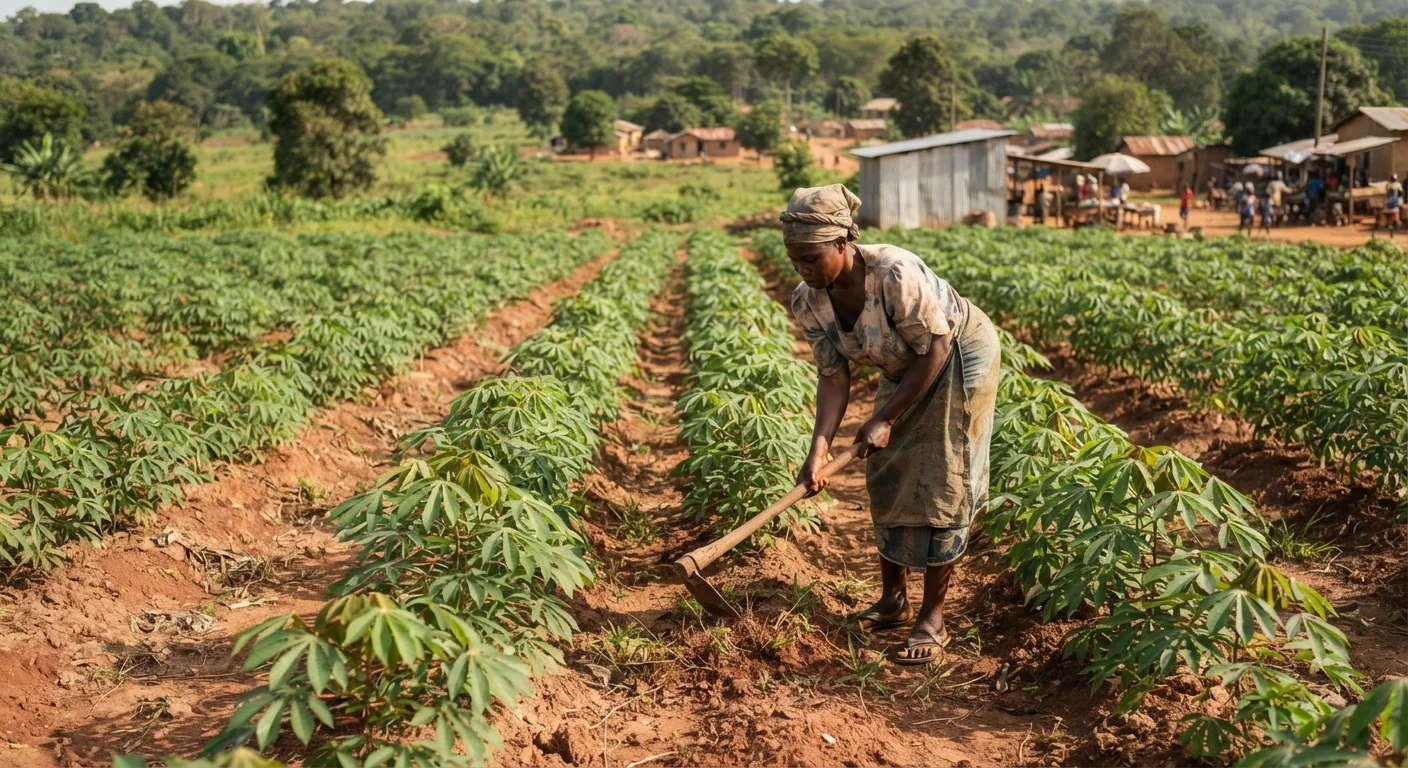
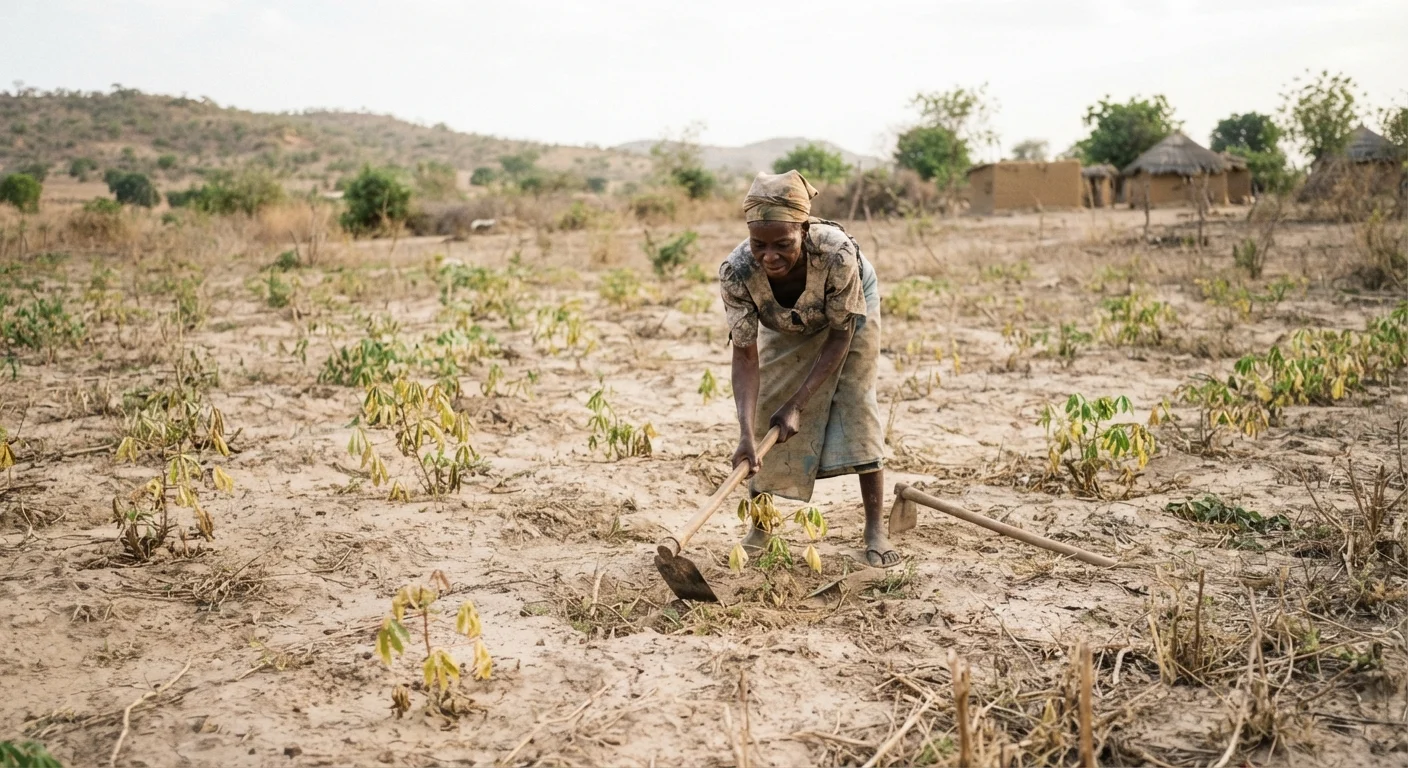
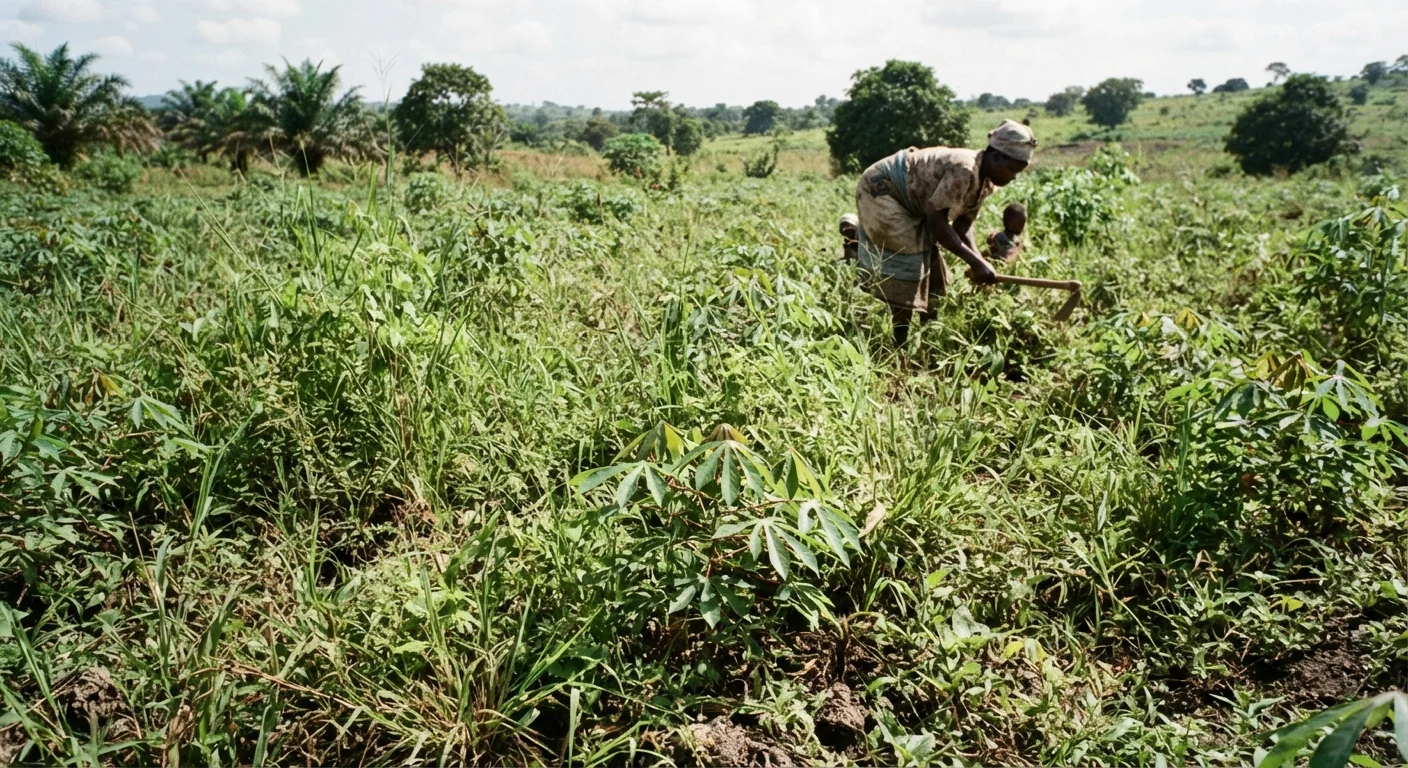
A cassava farmer weeding between young cassava plants on a ridged plot under bright sun, a hoe in hand, documentary photograph
Cassava · Pillar 04

Planting Regime and Agronomy

Cassava is the crop Ghanaian agronomy treats as needing none: planted where the maize was, fed what the maize left over, and lifted when the seller needs cash rather than when the buyer needs starch. Each is a decision, and each is made backwards.
Planting Regime and Agronomy · Pillar 04

Cassava is the crop Ghanaian agronomy treats as needing none. It is planted where the maize was, fed what the maize left over, and lifted when the seller needs cash rather than when the buyer needs starch. Each of those is a decision, and each is being made by default. This pillar is not a growing guide; it is the four field decisions that are worth real money and are currently made backwards.

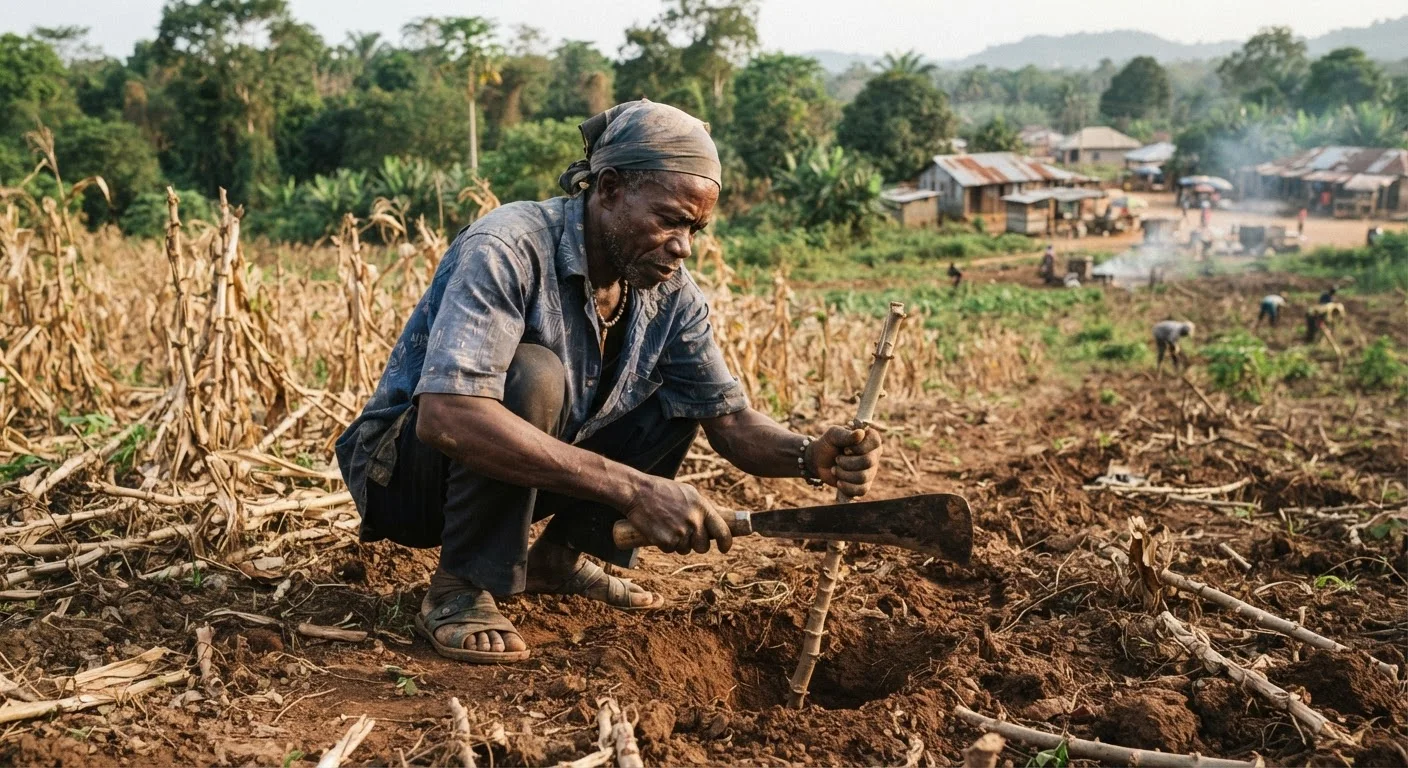
A Ghanaian farmer planting cassava stem cuttings by hand on a cleared plot behind dry maize stubble, a cutlass in one hand, documentary photograph
Planted last, fed least
Four field decisions, each worth real money, are currently made by default.
15:15:15
the equal-share NPK bag on the shelf, when cassava wants potash first
50 to 80%
of the cassava labour budget weeding alone consumes
month 10
where starch plateaus while root tonnage keeps rising

Fertiliser: the shape matters more than the amount

Cassava does not want its nutrients in equal parts. It wants potash first, nitrogen second and phosphate a distant third, because potassium is the nutrient that most limits its yield and, critically, the one that builds the starch an industrial buyer pays for (International Atomic Energy Agency, 2018). The compound fertiliser most available to a Ghanaian farmer is NPK 15:15:15, which is equal-share by construction, fifteen parts of each in every bag. So the bag over-delivers the nutrient cassava wants least and under-delivers the one that raises starch. Fixing the shape, potash-led, lifts both the tonnage and the dry matter, and the gain a wrongly-shaped bag leaves on the table lands in someone else’s factory as a lower starch yield.

The second half of the fertiliser problem is the rotation. Cassava is routinely planted behind a fertilised cereal on the hope of a residual effect, receives nothing of its own, and quietly mines the field’s potassium and organic matter, a decline invisible on any single season but real over five (Adjei et al., 2023). Fertilise the cassava in its own right against its expected yield, and write a soil test into any offtake contract so the buyer and the lender can see the land is not being run down.

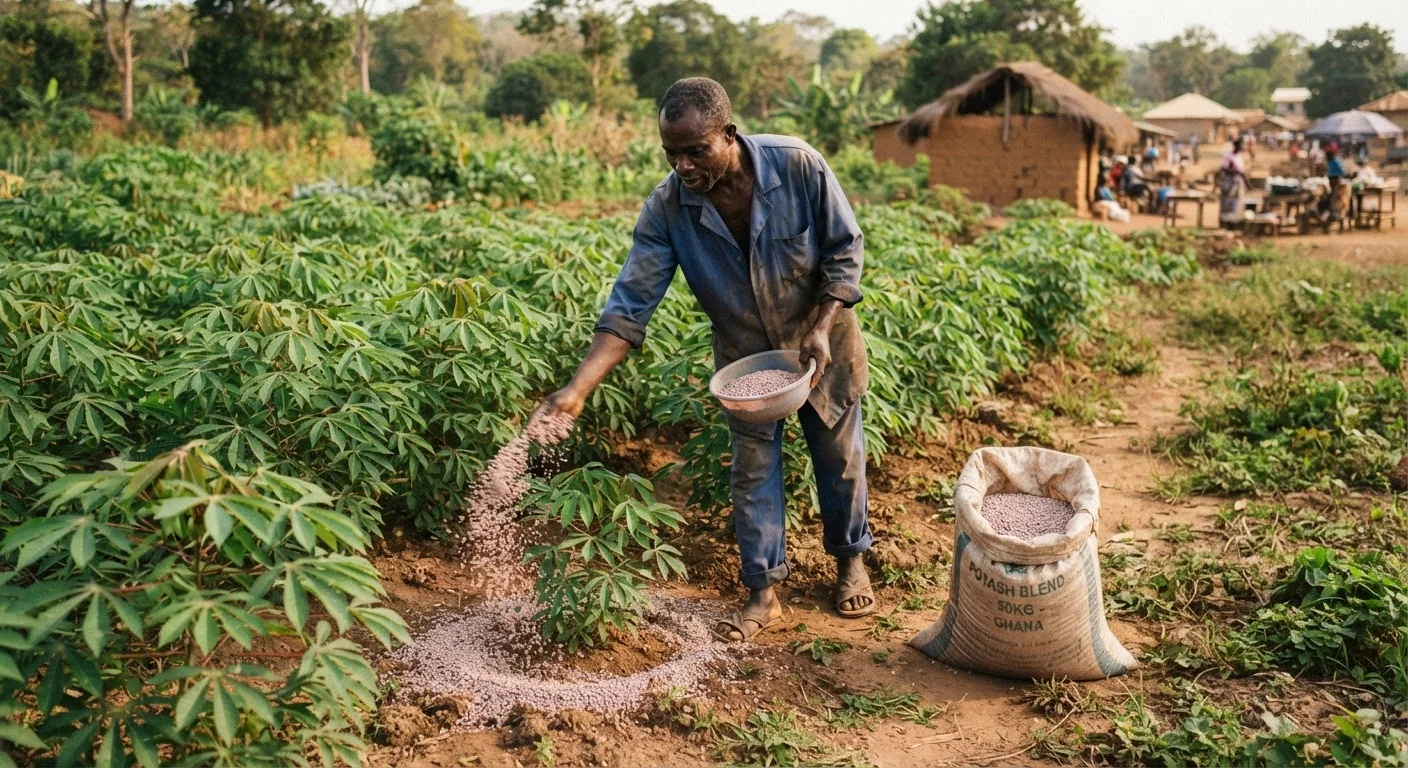
A Ghanaian farmer broadcasting a potash-led granular fertiliser blend by hand around young cassava plants, an open sack beside him, documentary photograph
Fix the shape, not the amount
The equal-share bag over-delivers phosphate and shorts the potash that builds starch.
K first
the nutrient order cassava wants: potash first, nitrogen second, phosphate a distant third
15:15:15
what the common NPK bag delivers, an equal third of each
Table 8: What cassava asks for against what the common bag delivers
NutrientWhat cassava wantsNPK 15:15:15 deliversThe mismatch
Potassium (potash)The most, and it builds starchAn equal thirdUnder-delivered; the yield and dry-matter loss
NitrogenThe middle shareAn equal thirdRoughly matched
PhosphateThe least, by a long wayAn equal thirdOver-delivered; money spent on the least-wanted nutrient

Sources: International Atomic Energy Agency (2018) on the potash-first nutrient order; Adjei et al. (2023) on rotation-driven depletion.

Planting and the weeding window

A Ghanaian cassava field in its first three months, plants not yet closed over, a worker hoeing weeds between the rows, documentary photograph
The first three months decide it
Cassava competes poorly with weeds until it closes canopy; the early window protects the yield.

Weeds come first. Cassava is a poor competitor in its first three months because it grows slowly and closes canopy late, so weed control in that window is what protects the yield. Weeding already eats 50 to 80 per cent of the labour budget on a cassava farm, most of it done by hand and most of it by women.1 The lever is better-timed weeding, backed by spacing and herbicide that close the canopy sooner and starve the weeds of light.

50 to 80%
of the cassava farm's labour budget that weeding alone takes, most of it by hand and by women
3 months
the window cassava competes poorly with weeds and where the yield is protected

Harvest: time it to the buyer’s calendar

The harvest date is a business decision disguised as a farming one. Starch content rises fast and then plateaus at around the tenth month, while the tonnage of root keeps climbing for months more. A farmer paid by weight has every reason to wait; a processor paying for dry matter gains almost nothing after the plateau and may lose quality. No spot contract mentions a harvest month, and it should: contract the month as well as the tonnage, and pay for dry matter, because the same lifting date that sets the weight also starts the two-to-three-day perishability clock that governs everything downstream (Pillar 3).

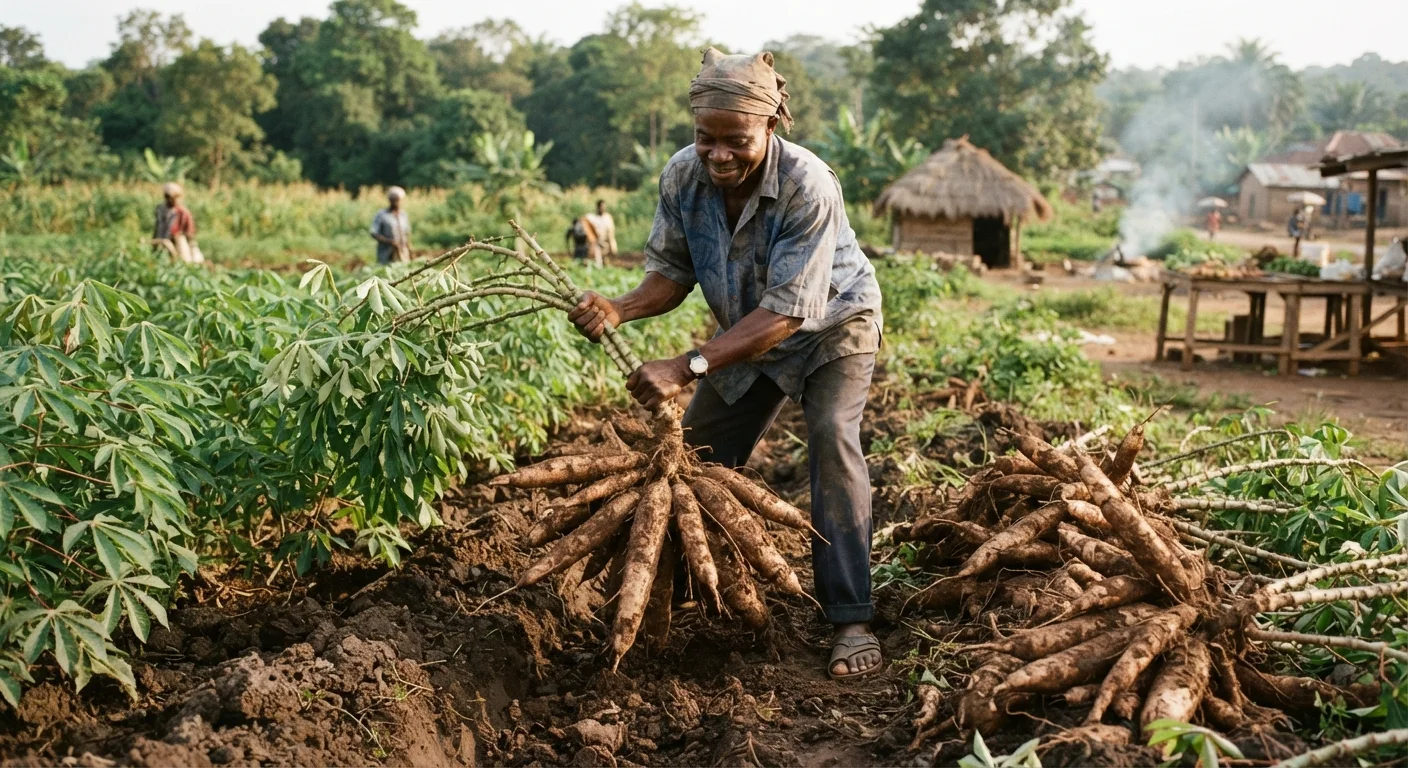
A Ghanaian farmer lifting a bundle of freshly harvested cassava roots from the soil by the stem, a heap of lifted roots beside the row, documentary photograph
A business decision, disguised
The lifting date sets the weight, the dry matter and the clock all at once.
month 10
where starch content plateaus while tonnage keeps climbing
2 to 3 days
the perishability clock the lifting date starts, governing everything downstream
dry matter
what the buyer should pay for, not tonnage alone
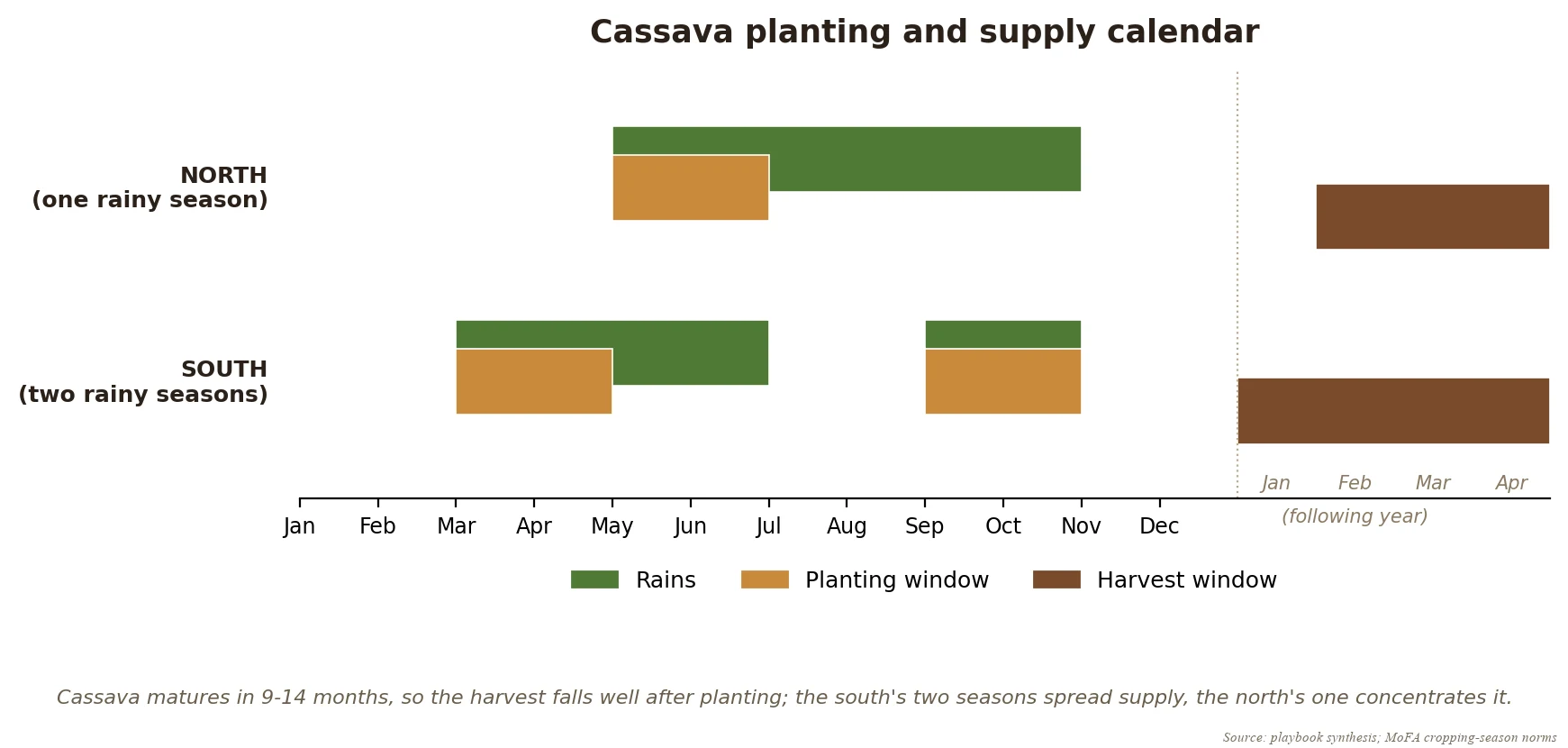
The cassava planting and supply calendar: one rainy season in the north with a concentrated harvest, two in the south that spread supply across the year
Figure 11 The cassava planting and supply calendar: one rainy season in the north, two in the south.
What this shows

Cassava matures in 9 to 14 months, so the harvest window falls well after planting. The north has one rainy season and a concentrated planting and harvest; the south has two, which spread supply across the year. Timing the harvest to the buyer’s calendar, rather than to the seller’s need for cash, is what turns this pattern into a reliable supply.

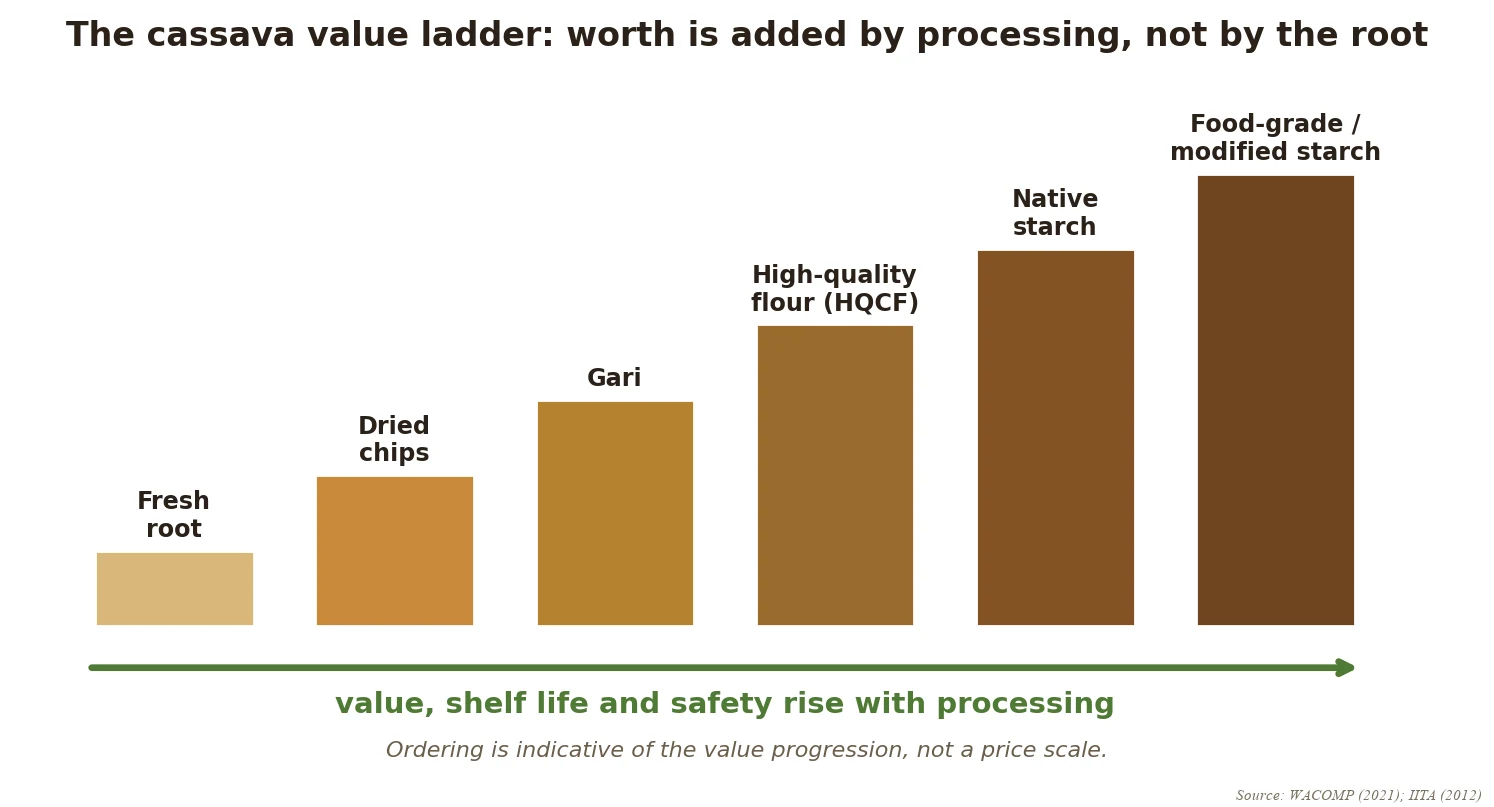
The cassava value ladder: fresh root, dried chips, gari, high-quality flour, native starch and food-grade or modified starch, with value rising at each processing step
Figure 12 The cassava value ladder: worth is added by processing, not by the root.
What this shows

The value ladder runs from fresh root through dried chips, gari and high-quality flour to native and food-grade or modified starch. Value, shelf life and safety all rise with processing, which is why the dry matter this pillar grows is only realised downstream (Pillar 6), and why a harvest paid by dry matter, not weight, is the field’s first claim on that value. The ordering is indicative of the progression, not a price scale.

The soil, over the seasons

Soil comes second. Cassava will crop on tired land where other crops fail, which is why farmers plant it last in the rotation and rarely feed it. It is still a heavy feeder, and potassium is often the nutrient that most limits its yield. A continuous cassava-maize rotation significantly depletes soil organic matter, nitrogen, phosphorus and exchangeable cations including potassium, so yields fall over successive cycles unless the soil is fed back.2 The lever is simple to say and hard to fund: replace potassium and organic matter, and stop treating the cassava plot as the place where soil goes to be mined.

Practice and cost come third. Smallholders already use climate-smart methods, with mulching, mixed farming, crop diversification and rotation all above 80 per cent uptake in surveyed cassava communities. The barriers are money and know-how: weak technical assistance, pests and diseases, and thin knowledge of the practices, each named by about 90 per cent of farmers, on top of the high cost of fertiliser.3 Mechanization stays thin, with most farm operations still done by hand and land preparation both the most-mechanized task and the one in shortest supply.4 The 2026 plan to deploy several thousand machines through shared-access Farmer Service Centres could ease that bottleneck for growers who cannot own a tractor.5

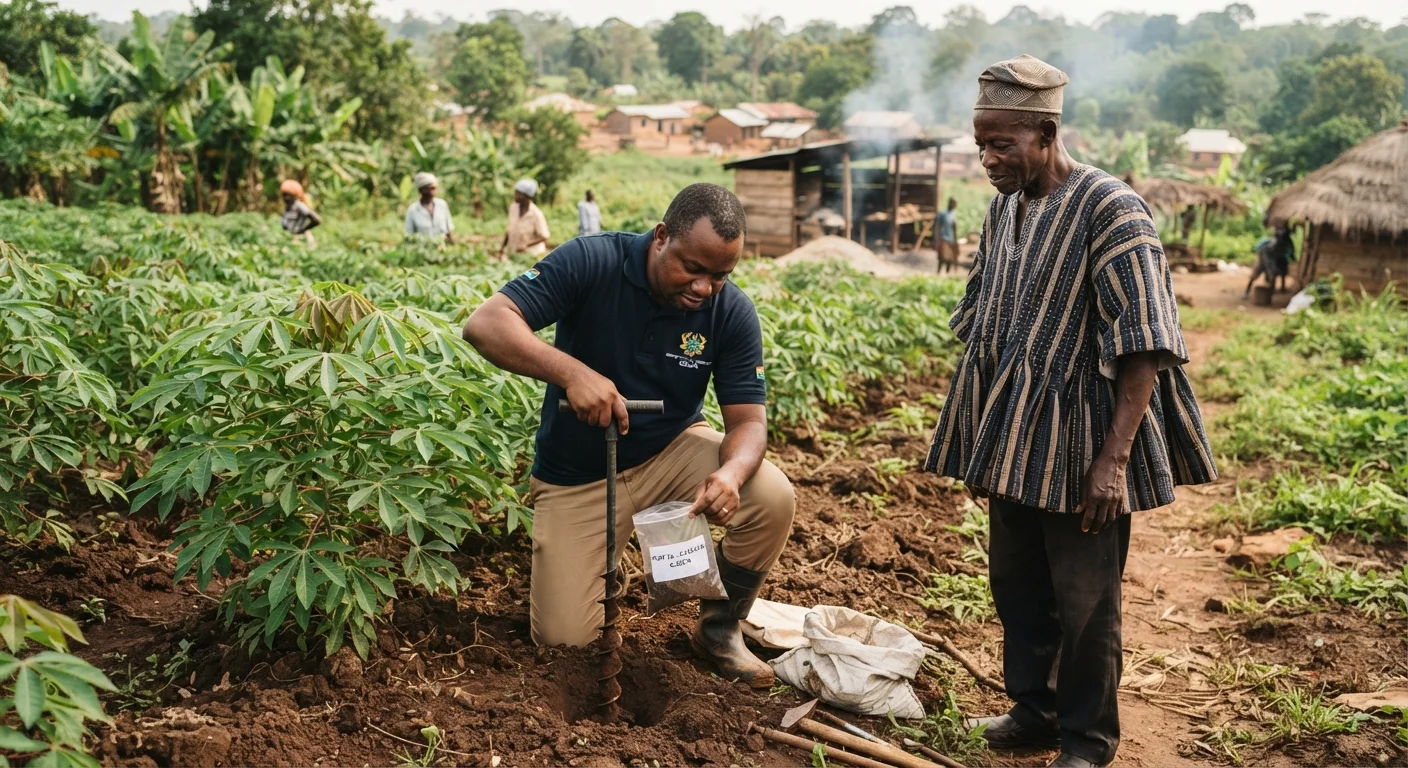
A Ghanaian extension officer taking a soil sample from a cassava plot with an auger and bagging it for testing, a farmer looking on, documentary photograph
Write the soil test into the contract
The cassava plot is treated as the place where soil goes to be mined. It need not be.
80%+
uptake of mulching, mixed farming, diversification and rotation in surveyed cassava communities
~90%
of farmers naming weak technical assistance, pests and diseases, and thin know-how as barriers
4,000
machines the 2026 plan would deploy through shared-access Farmer Service Centres
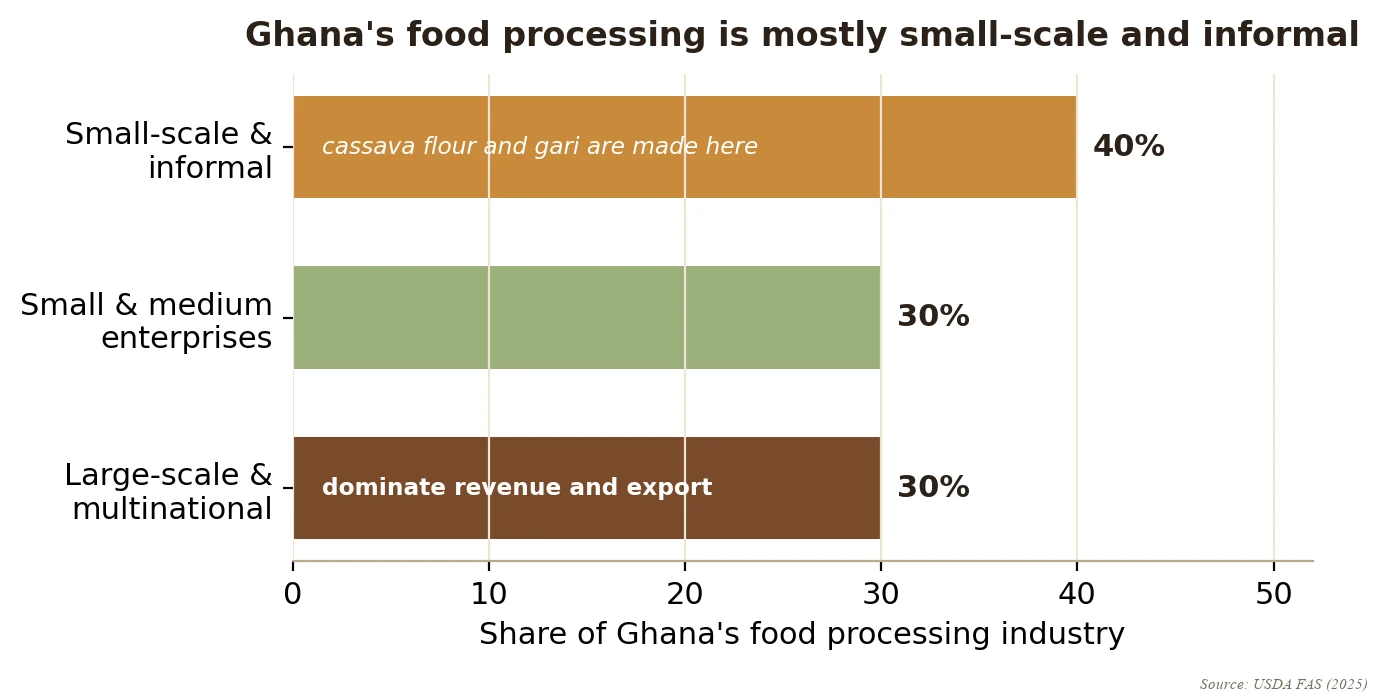
Ghana's food-processing industry by scale: about 40 per cent small-scale and informal, 30 per cent small and medium enterprises, and 30 per cent large-scale and multinational
Figure 13 Ghana’s food processing is mostly small-scale and informal.
What this shows

Ghana’s food-processing industry by scale: about 40 per cent small-scale and informal, where most cassava flour and gari are made, 30 per cent small and medium enterprises, and 30 per cent large-scale and multinational operators that dominate revenue and export. The field decisions this pillar sets, fertiliser shape, weeding and harvest timing, feed a chain whose value still sits mostly in small, informal hands.

The risks that sit inside the field

Sacks of NPK 15:15:15 granular fertiliser stacked at a Ghanaian farm-input shop, a farmer lifting one onto his shoulder, documentary photograph

Buying the bag that is on the shelf

HIGH
What it is

NPK 15:15:15 is equal-share, but cassava wants potash first; the farmer overpays for the nutrient the crop wants least and shorts the one that raises starch, and the loss lands in the buyer's factory as low dry matter.

Who it hits

Every farmer aiming at an industrial buyer, and every processor whose throughput depends on the dry matter the field delivers.

How to manage it

Fix it at the buyer rather than the farmer: specify and finance a potash-led blend in the offtake and recover it against measured dry matter at the gate; soil-test first.

A Ghanaian woman hand-weeding between young cassava plants with a hoe under strong sun, documentary photograph

Late weeding and the labour squeeze

MEDIUM
What it is

Cassava loses most to weeds in its first three months, and weeding is the biggest labour cost on the farm, so a late first weeding quietly caps the harvest.

Who it hits

Smallholders relying on hired labour, whose margin can turn negative when the early weed-control window is missed.

How to manage it

Weed early in the critical window; use recommended spacing and herbicide to close canopy faster and cut repeat weedings.

Key takeaways
01

The fertiliser mistake is one of shape rather than amount: cassava wants potash first, but the common NPK 15:15:15 bag is equal-share, so it shorts the nutrient that builds starch.

02

Fix fertiliser at the buyer: specify a potash-led blend in the offtake and recover it against measured dry matter at the gate.

03

The first three months decide the crop: the early weeding window is where yield is won or lost, and it is the dominant labour cost.

04

Harvest to the buyer's calendar rather than the seller's: starch plateaus around month ten while tonnage keeps climbing, so contract the month and pay for dry matter.

05

Cassava crops tired land, but continuous cropping mines potassium and organic matter; feed the soil back or the yield drifts down.

Written for each reader

Practitioner intelligence

Hover any card to pause and lift it.

For students

Run one plot two ways: the equal-share bag against a potash-led blend, and weigh the difference in root and in dry matter. The lesson is that the cheapest yield gain on a cassava farm comes from the shape of the fertiliser rather than the quantity.

For entrepreneurs

If you are buying roots, do not leave agronomy to the farmer. Specify and finance a potash-led blend and a harvest month in the offtake, and pay for dry matter, because the field decisions you do not control decide the throughput of your plant.

For investors

Diligence the agronomy behind the acreage: what fertiliser is used and in what shape, how the weeding window is managed, and whether harvest is timed to dry matter or to cash. A supply base run on default agronomy is a low-dry-matter supply base.

For ecosystem actors

The lever is a potash-led cassava fertiliser recommendation and a harvest-timing message that reaches the farm, and a soil-test norm written into contracts. The outcome to measure is dry matter delivered per hectare, beyond tonnage alone.

Where this connects.The variety and clean planting material that set the ceiling are Pillar 1’s; the perishability clock that the harvest date starts is Pillar 3’s; the cost of the labour and inputs this pillar decides is Pillar 5’s; and the processing that finally pays for the dry matter grown here is developed in the value chain, Pillar 6.

Footnotes
  1. IAEA, Cassava Production Guidelines, 33-34.
  2. On potassium as the frequent yield-limiting nutrient, IAEA, Cassava Production Guidelines. On rotation-driven depletion, Eric Owusu Adjei et al., "Soil Quality and Fertility Dynamics under a Continuous Cassava-Maize Rotation in the Semi-Deciduous Forest Agro-Ecological Zone of Ghana," Frontiers in Sustainable Food Systems 7 (2023): 1095207, https://doi.org/10.3389/fsufs.2023.1095207.
  3. Frank Baffour-Ata et al., "Barriers Confronting Smallholder Cassava Farmers in the Adoption and Utilization of Climate-Smart Agriculture in the Afigya Kwabre South District, Ghana," Climate Resilience and Sustainability 3, no. 3 (2024): e77, https://doi.org/10.1002/cli2.77.
  4. Gilbert Ayine Akolgo et al., "Status of Agricultural Mechanization in Ghana: Insight from Farmers' Perception, Population, and Nonagricultural Sector Growth," Advances in Agriculture 2022 (2022): 2094276, https://doi.org/10.1155/2022/2094276.
  5. "Ghana to Deploy 4,000 Machines in 2026 to Expand Agricultural Mechanization," Ecofin Agency, November 18, 2025.
Download full PDF
UpcomingThis document isn't available yet.