Ghana Agribusiness PlaybookCassava
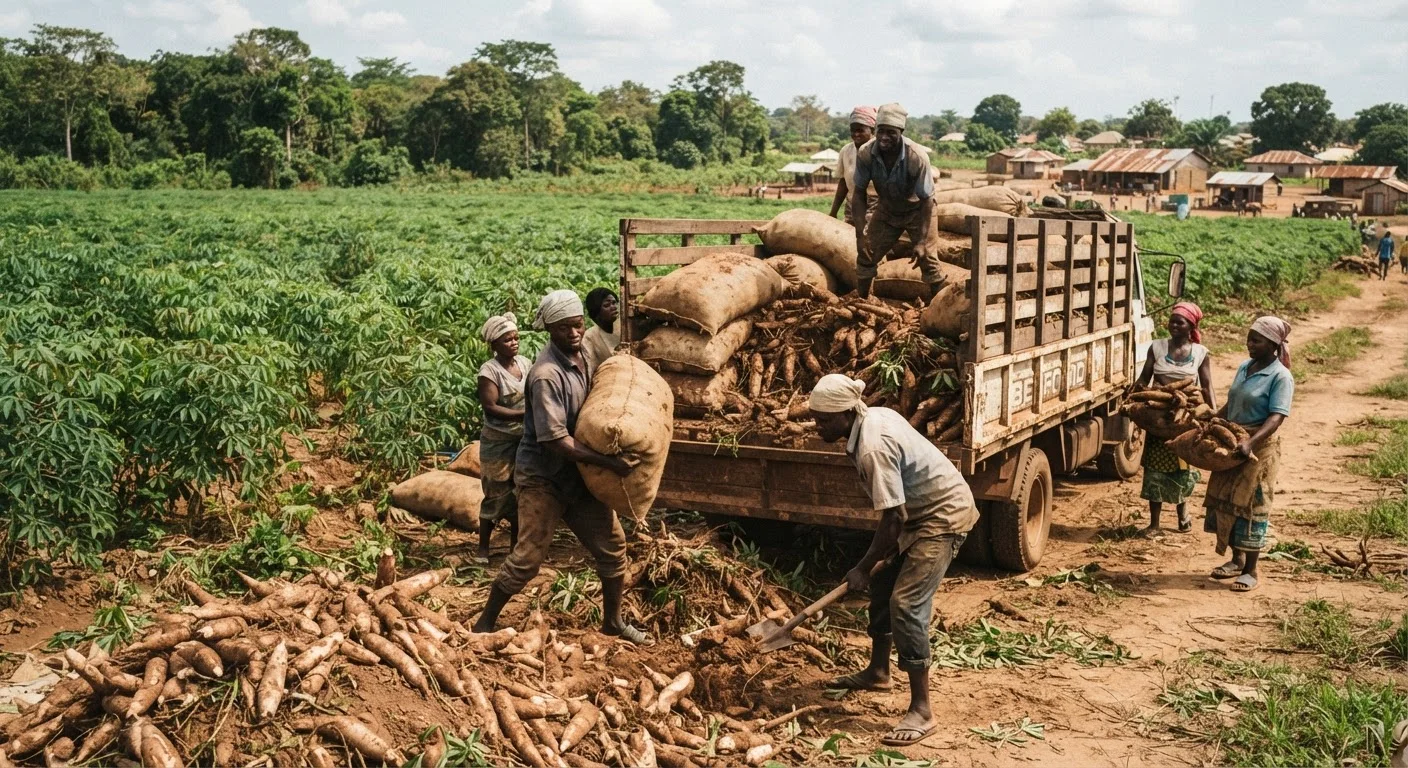
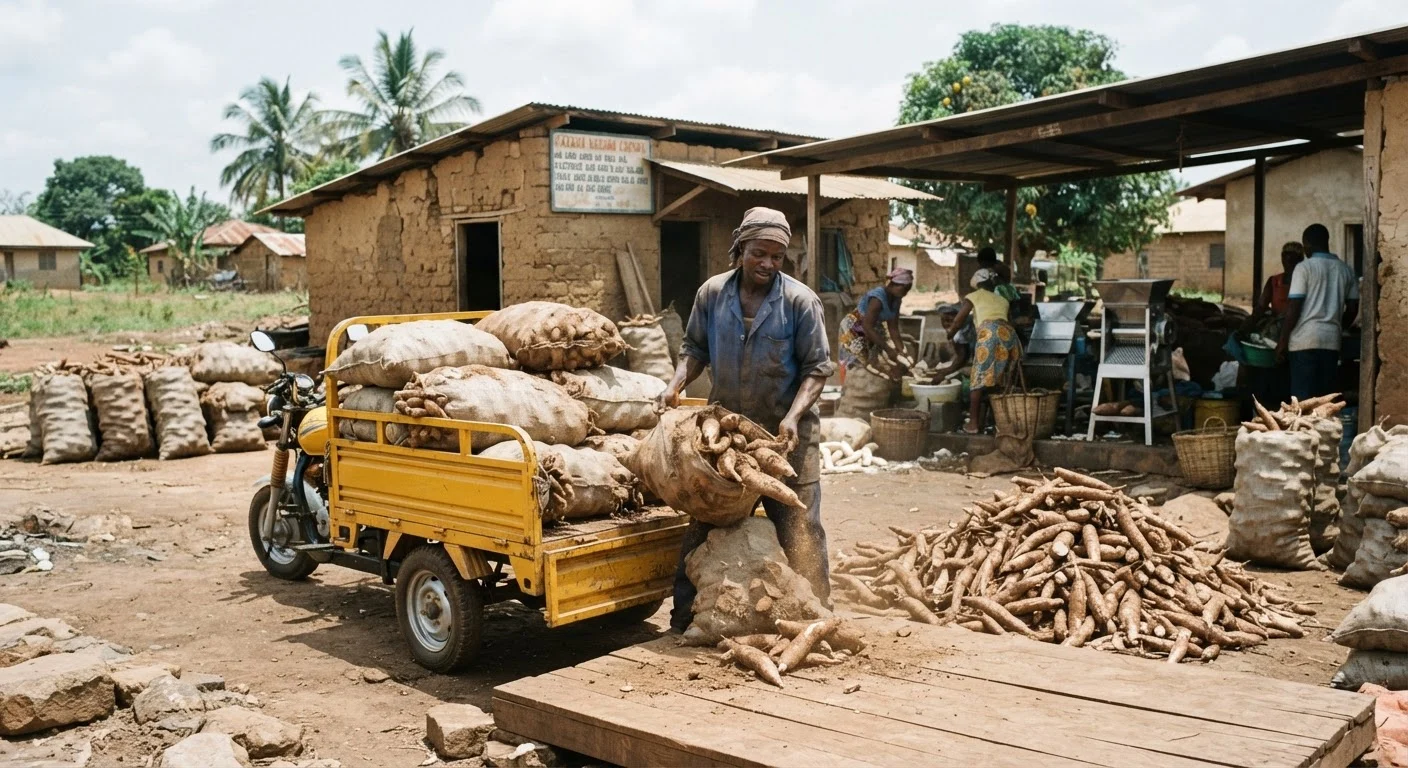
Workers loading sacks of cassava roots and gari onto a truck at a rural aggregation yard, a processing shed in the background, documentary photograph
Cassava · Pillar 06

Value Chain Analysis

Ghana's cassava chain is real and huge, but it is short and shallow: value climbs steeply from farm to processor to exporter, yet almost the entire harvest stops at the first and thinnest link, so the country grows more cassava than almost anyone and still imports far more cassava products than it sells.
Value Chain Analysis · Pillar 06

Ghana’s cassava chain is real and huge, but it is short and it is shallow. The value in cassava climbs steeply as the crop moves from farm to processor to exporter, yet almost the entire harvest stops at the first and thinnest link, because the middle of the chain, the aggregation, storage and reliable processing that would carry roots to a paying market, barely exists.

The result is a country that grows more cassava than almost anyone and still imports far more cassava products than it sells. This pillar maps the chain link by link, follows the margin up it, names who holds the power, and sets out where the value can be captured. It doubles as the standalone value chain analysis for the crop.

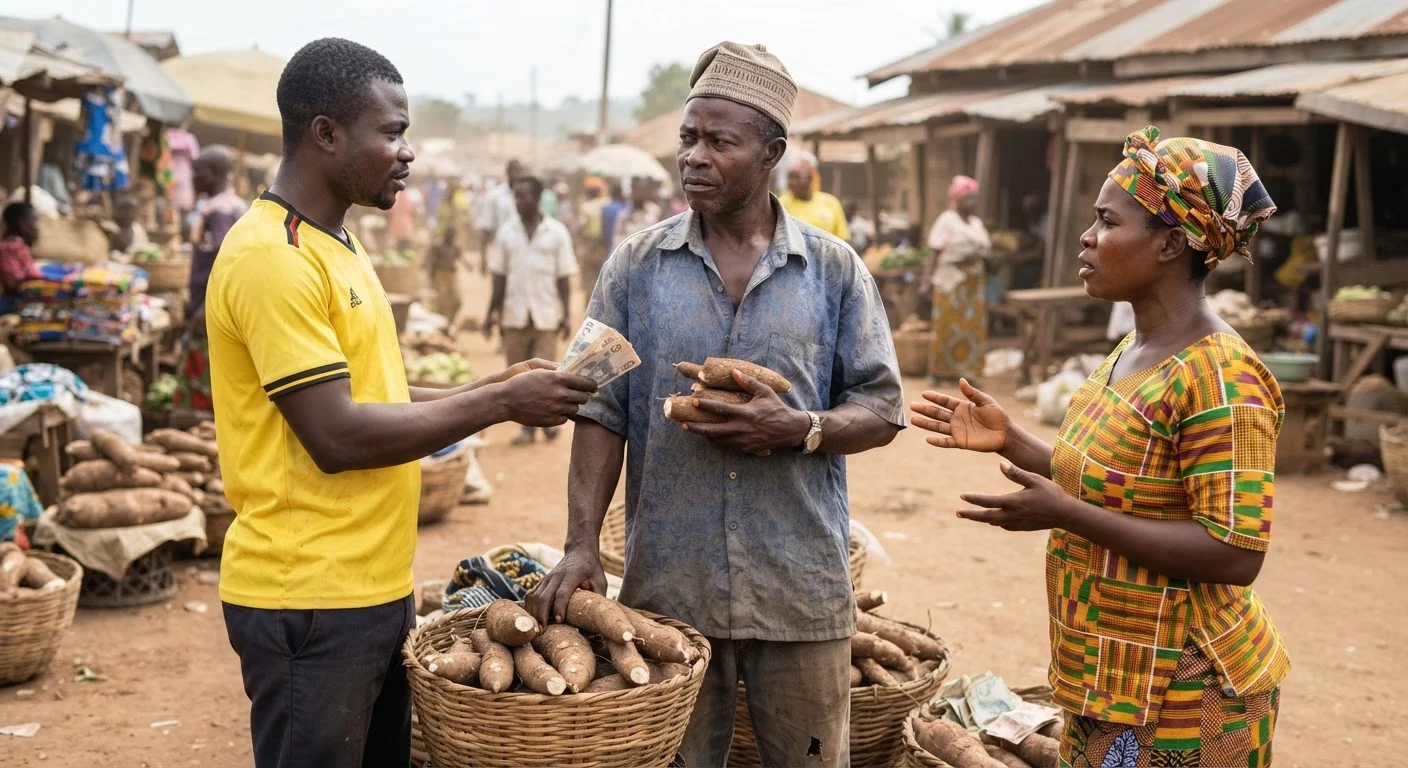
Ghanaian farm workers loading sacks and a loose heap of freshly harvested cassava roots onto a truck at the edge of a field, the roots destined for a quick sale before they rot, documentary photograph
Short chain, shallow value
Roots leave the farm within a day or two of harvest, and most of the crop stops at this first, thinnest link.
~8%
the producer's share of the profit the gari chain generates
~73%
the exporter's share of that same chain profit
~10%
the share of the crop that reaches industrial processing

The chain, farm to fork

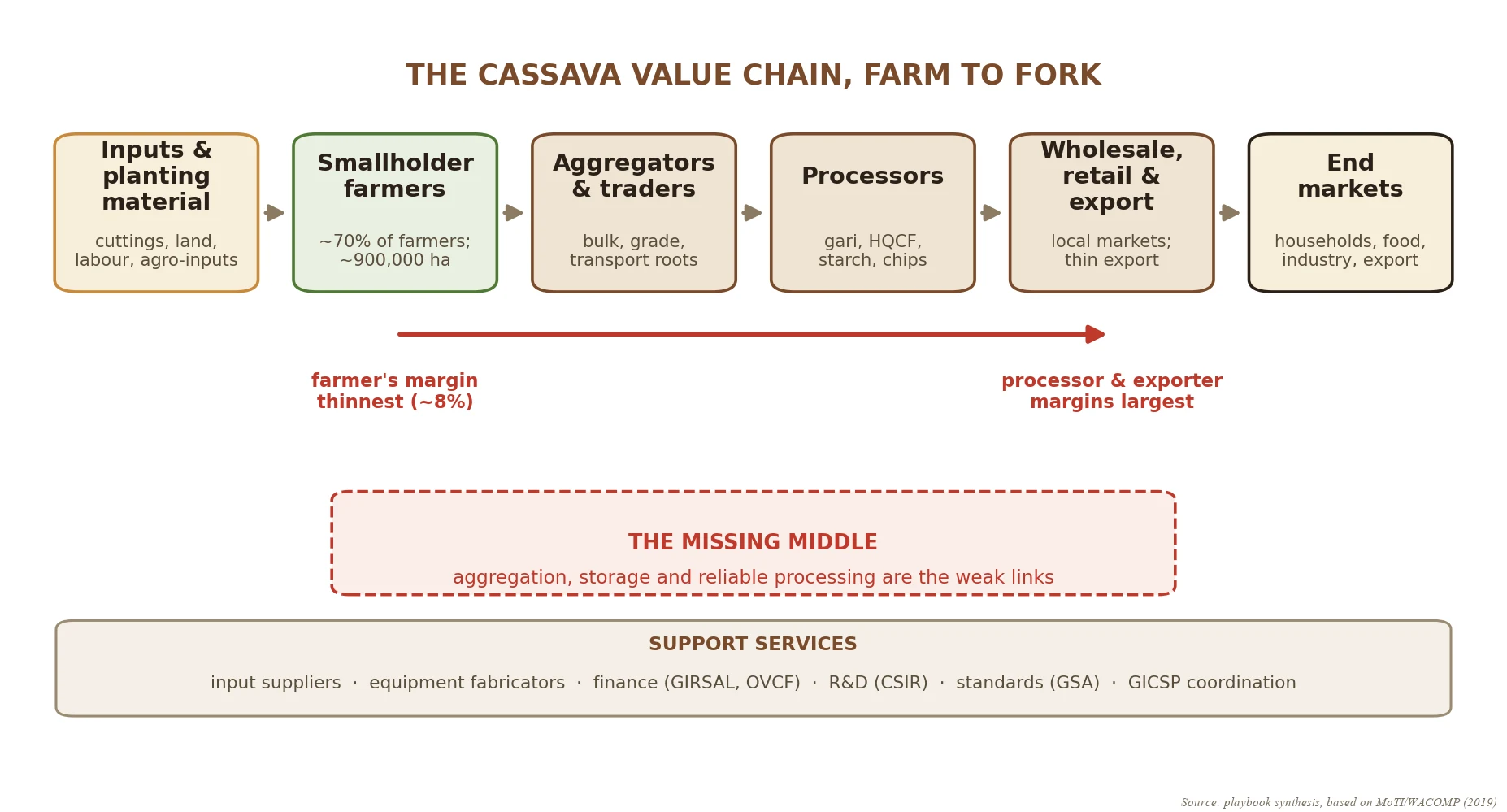
The cassava value chain in Ghana runs through a familiar set of actors: input and planting-material suppliers, the smallholder farmers who make up about seven in ten of the country’s farmers, the aggregators and traders who bulk and move the roots, the processors who turn them into gari, high-quality cassava flour, starch and chips, and the wholesalers, retailers and thin band of exporters who carry the product to its end market.1 Around all of them sits a layer of support services: the equipment fabricators, the finance schemes, the research institutes and the standards body. Figure 14 lays out the whole chain.

The important part of this map is the arrows between the boxes, more than the boxes themselves. Roots leave the farm on a truck, a tricycle or a hand trolley within a day or two of harvest, because the crop starts to rot almost at once, and that single fact shapes everything downstream. The chain is pulled along by scattered, mostly household demand for fresh roots and traditional foods, rather than organised around a large industrial buyer that plans its supply. So it runs the wrong way: it is driven from the bottom by what the farmer can sell today, when it should be pulled from the top by what a factory has contracted to buy. Turn that around, and the rest of this pillar becomes an opportunity list.

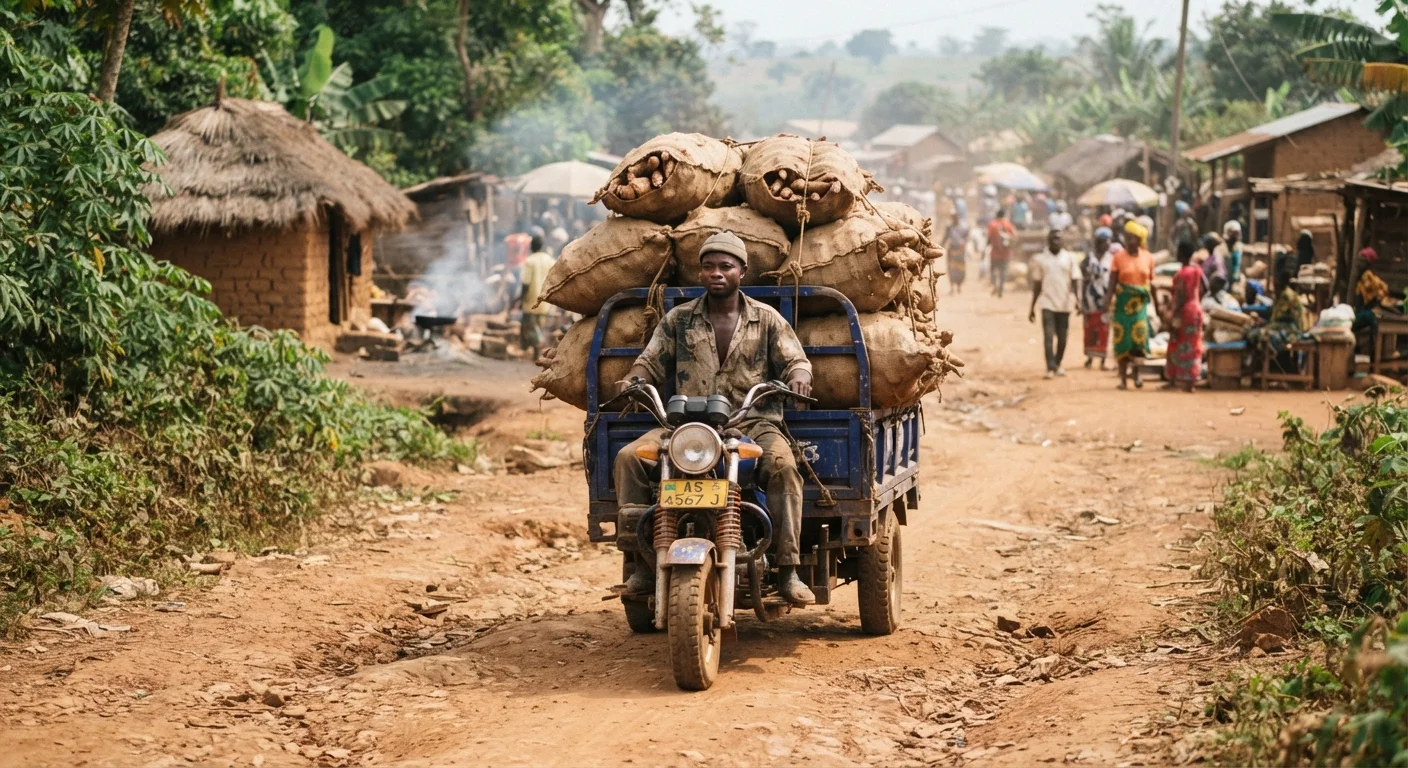
A loaded three-wheeled tricycle truck carrying sacks of cassava roots along a rural Ghanaian road toward a market, driver at the handlebars, documentary photograph
Driven from the bottom
The chain runs the wrong way: pushed by what the farmer can sell today, not pulled by a factory's plan.
A map of the cassava value chain in Ghana from input suppliers and smallholder farmers through aggregators, processors and exporters to households and industry, with support services of finance, equipment fabrication, research and standards around it
Figure 14 The cassava value chain in Ghana, farm to fork.

The chain, link by link

The shape of the chain is not the news; the news is which link has a real number attached to it, who already stands there, and where the value leaks. Table 11 walks the eight links, from the stem in the ground to the consumer, and it is meant to be read as a diagnostic rather than a description. The column that matters is the last one, the opening inside each break, and the column that should give an entrant pause is the money signal, because where it is blank, nobody has measured it and this playbook will not invent it.

Table 11: The eight links of the cassava chain, who stands in each, and the opening inside each break.
The linkWho operates itThe money signalWhere it leaks, and the opening
1. Input supplyExtension agents, agro-dealers, equipment fabricators, the outgrower firmNone measured: no stem price exists in the evidenceThe seed market is missing; sell into a written buyer specification and deduct the stem from the delivered root price
2. ProductionSmallholders (nine in ten under two hectares), nucleus farms, hired and family labourThin and contested (see Pillar 5)Value leaves as wages more than it stays as profit; the lever is yield, not price
3. Post-harvestFarmers, on-farm chippers and driers, bulkers, transportersA penalty more than a spread: roots rejected at the gate are lostThe two-to-three-day clock; convert to a storable form at the farm
4. ProcessingCottage gari groups (women-led), flour and starch SMEs, two starch plants, one ethanol makerThe only fully measured link: per-tonne cost, price and profit for four productsRuns below capacity for want of roots or a buyer; certification is the door
5. Storage & logisticsTransporters, bulkers, tractor-trailer fleets, district assembliesThe largest single cost in moving fresh rootsRoots rarely travel far, so the catchment is small; move the dry weight rather than the wet
6. Marketing & tradeBulkers and aggregators (the chain's leaders), wholesalers, traders, exportersThin, self-reported marginsWeak grading and weighing on the spot market; grading is the opening
7. Retail & distributionMarket retailers, supermarkets, institutional buyersThin; dried products earn more because they keepPoor storage caps volumes; institutional buyers are the softest target
8. The consumerHouseholds, schools, hospitals and prisons, industry, breweries, exportNot a margin link; cassava beer sells below conventional beerCassava is a substitute for maize; rising middle incomes are the growing segment

Source: playbook synthesis, anchored to MoTI/WACOMP (2019), Kleih/GASIP (2016) and FAO/MAFAP (2013). Where a money cell reads 'none measured', it is blank in the evidence, not in the research.

What this shows

There are two different problems in this chain, and an entrant who confuses them buys the wrong fix. For starch and ethanol the binding constraint is roots; for high-quality flour and chips it is the market. The national value-chain analysis (MoTI, 2019) found a lack of a stable market for high-quality cassava flour in three of its six proposed processing clusters, against a shortage of raw material in only one, with a certification gap in all six. The one cluster short of roots, in Volta, is the one that holds the country’s only cassava-ethanol plant. Contracting more farmers for a flour factory whose problem was never the farmers is the most expensive mistake in this pillar.

Where the profit goes

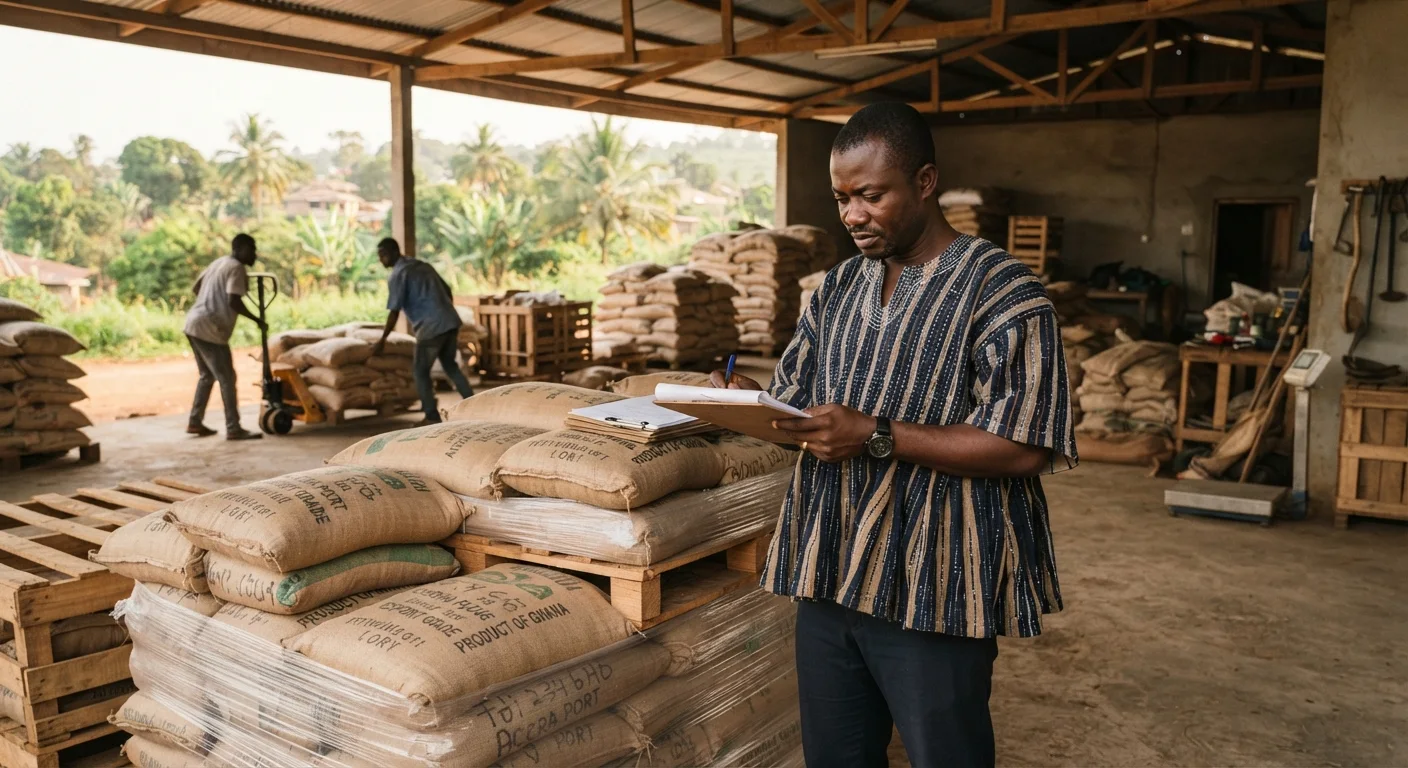
A Ghanaian exporter's warehouse with pallets of bagged, branded cassava products ready for shipping, a manager checking a manifest, documentary photograph
The profit pools at the top
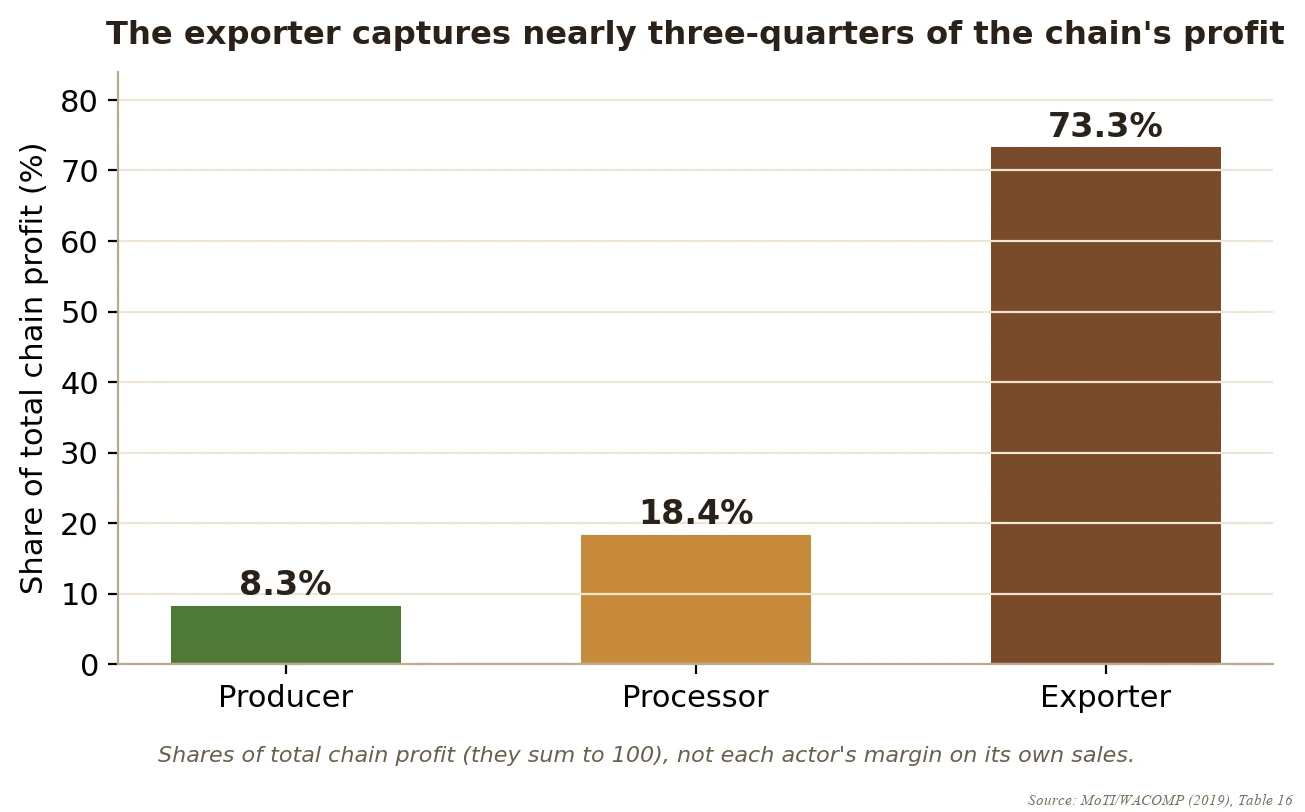
Of every cedi of profit the gari chain makes, the exporter keeps nearly three-quarters and the farmer the least.
8 / 18 / 73
the producer, processor and exporter shares of chain profit (%)
~36% / ~58%
high-quality flour's value-added and profit share, the highest studied

Follow the profit the gari chain generates and it pools at the top. On the government’s own value-chain analysis, of every cedi of profit the chain makes, the producer keeps about 8 per cent, the processor about 18, and the exporter about 73. The exporter captures nearly three-quarters of the profit the whole chain generates, while the farmer who grows the crop keeps the smallest slice. Figure 15 and Table 12 show the split.2One point of care matters here, because it is widely misquoted. The source labels this row ‘profit margin’, but the three figures are shares of the chain’s total profit; they sum to a hundred, and they are not each actor’s margin on its own sales. The exporter’s true margin on its own selling price is about 38 per cent, not 73. Either way the reading is the same: value is captured moving up the chain, and the farmer keeps the least.

The product mix tells the same story from another angle: high-quality cassava flour carried the highest value-added share, about 36 per cent, and the highest profit share, about 58 per cent, of any cassava product studied in southern Ghana, far above the raw root.3 The wider chain is not small in absolute terms, one regional analysis put total value addition across it at roughly two billion cedis at 2016 prices, but that value is unevenly split and thinnest at the farm.4 The lesson for anyone entering the sector is to position as far up this chain as they can fund, and for anyone already farming, to find a way to share in the processing profit rather than selling roots at the bottom of it.

Table 12: Distribution of profit along the gari value chain (per metric ton).
Stage in the chain
Producer (fresh roots)1,4082,0246168.3
Processor (gari)3,1284,5001,37218.4
Exporter9,01514,4665,45173.3

The final column is each actor's share of the chain's total profit (the three sum to 100), not its margin; the exporter's margin on its own selling price is 37.7 percent.

Source: Ministry of Trade and Industry / WACOMP (2019), Table 16, titled 'Distribution of profit along the gari value chain'; 2019 nominal cedi values.

A ladder chart of how the gari chain's profit is split between the producer at about 8 per cent, the processor at about 18 per cent and the exporter at about 73 per cent
Figure 15 How the gari chain’s profit is split between the three actors.

The missing middle

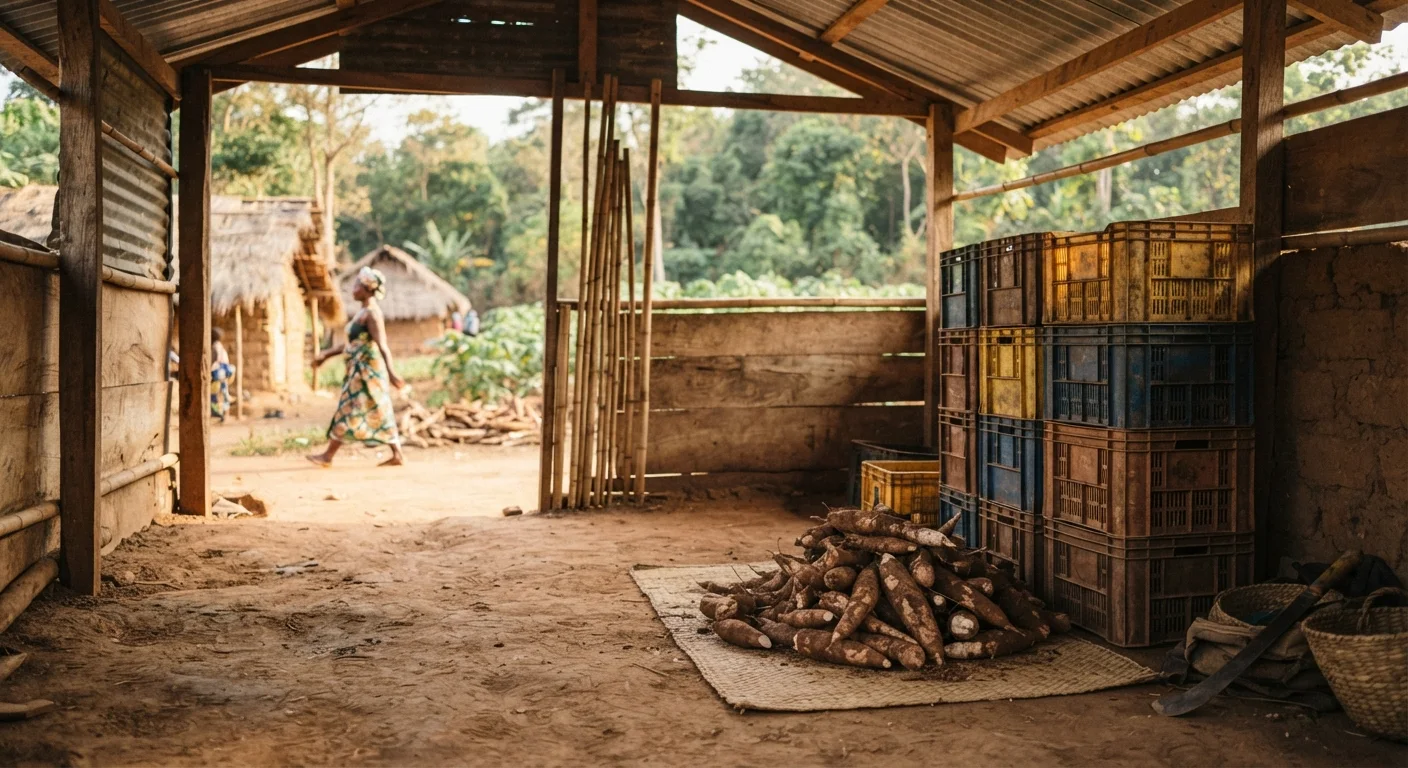
The reason the farmer stays at the bottom of the ladder is that the middle of the chain is missing. Only about a tenth of Ghana’s cassava reaches industrial-scale processing, and as much as half the crop can be lost after harvest, because there is no organised layer to bulk, store and grade a perishable root that spoils within two to three days of leaving the ground.5 Cold storage below four degrees slows that clock, but it is almost nowhere in the chain.6 The gap is not demand. The crop is worth several times more downstream than the farmer is paid at the gate, even by commercial retail estimates of uncertain basis that put roots at around twenty to twenty-five cedis a kilo in 2026; that value simply is not reaching the farmer, who sells under pressure to move a crop that rots within days.7

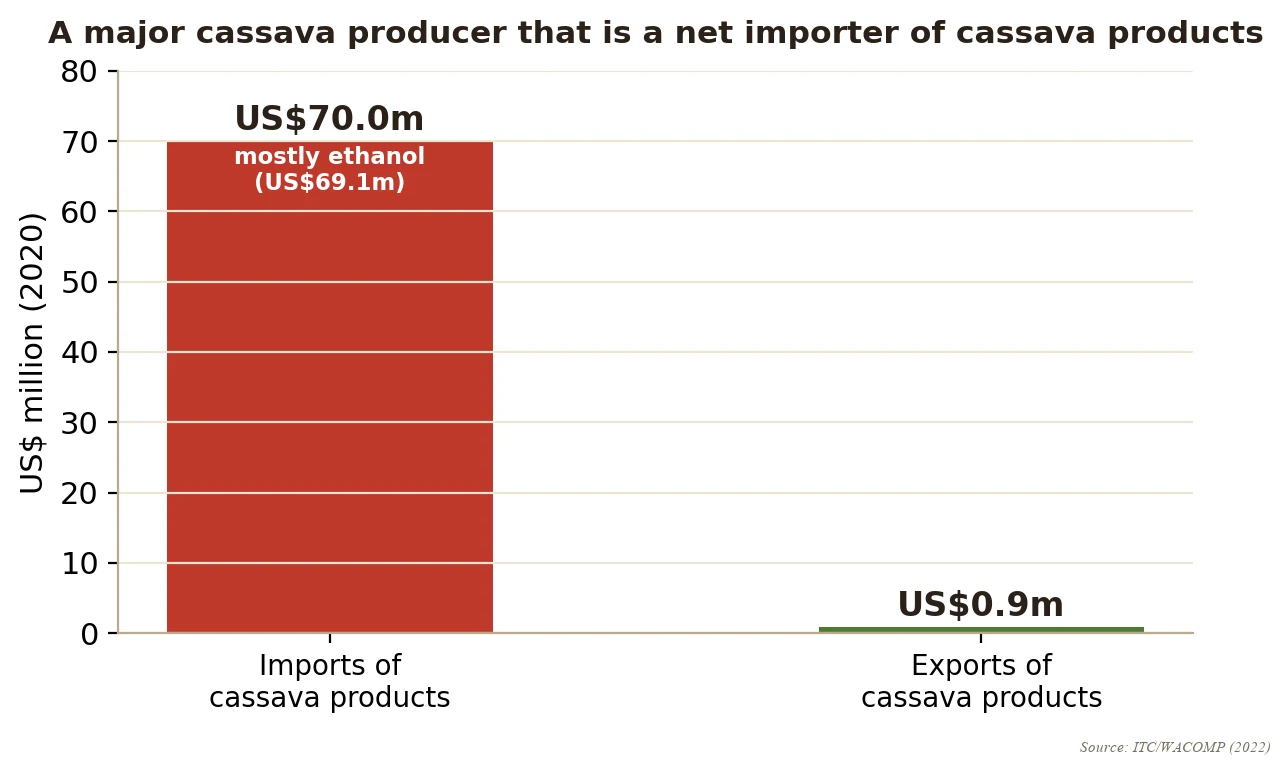
The clearest proof that the middle is missing is the trade balance. Ghana is one of the world’s largest cassava producers, ranked fourth globally in one recent profile, yet in 2020 it imported almost seventy million dollars of cassava products, nearly all of it ethanol, while exporting under one million dollars’ worth. Figure 16 shows the mirror.

Behind that mirror is a set of quantified, unmet openings. The same regional profile put Ghana’s internal demand deficit at more than ninety-six thousand tonnes a year for high-quality cassava flour, more than eighty-five thousand tonnes for starch, and more than two hundred million litres for ethanol on this 2022 profile, well above the roughly eighty million litres a 2019 national cassava stakeholder forum recorded for the same crop (Pillar 2), the range itself a sign of how thinly this demand is measured.8 A single buyer makes the point concrete: Guinness Ghana Breweries needs about a hundred thousand tonnes of cassava flour a year and domestic processors supply less than a third of it. Every one of those numbers is a factory that could be built, a supply contract that could be signed, and a margin that is currently leaving the country.

A near-empty rural storage shed with a small heap of cassava roots and stacked but unused crates, no cold store, documentary photograph
No organised middle
No bulking, grading or cold storage layer stands between the farm and the factory.
US$70m vs US$1m
cassava-product imports against exports, 2020
~100,000 t/yr
cassava flour one brewer needs; domestic supply is under a third
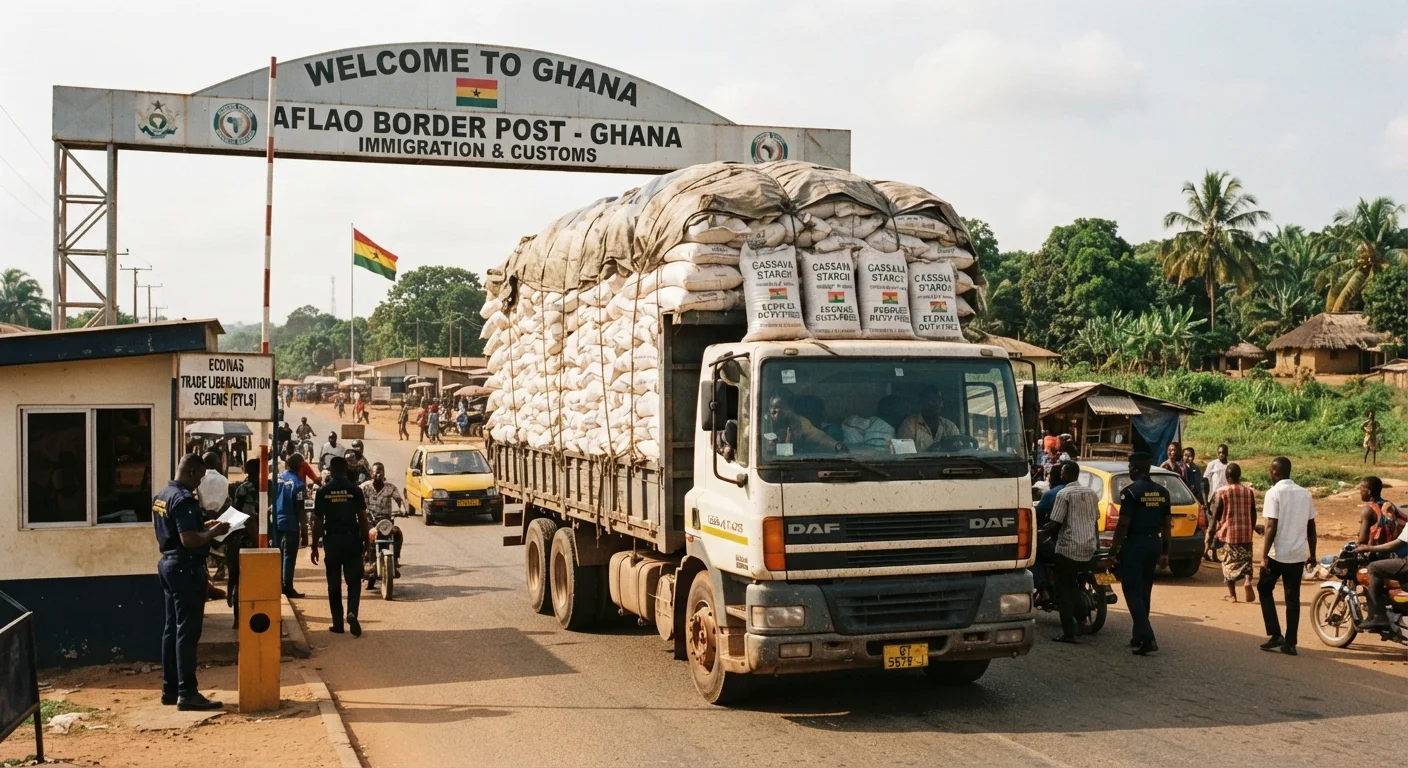
A cargo truck loaded with sacks of cassava starch crossing a West African land border into Ghana, informal and formal import trade, documentary photograph
Imports dwarf exports
In 2020 Ghana imported almost seventy million dollars of cassava products, nearly all ethanol, and exported under one million.
A mirror bar chart of Ghana's cassava-product trade in 2020, showing almost seventy million dollars of imports, nearly all ethanol, against under one million dollars of exports
Figure 16 Ghana’s cassava-product trade: imports against exports, 2020.
What this shows

One of the world’s largest cassava producers imported almost seventy million dollars of cassava products in 2020, nearly all of it ethanol, while exporting under one million dollars’ worth. The gap is the missing middle stated as a trade balance, and every dollar of it is a margin leaving the country.

Who holds the power

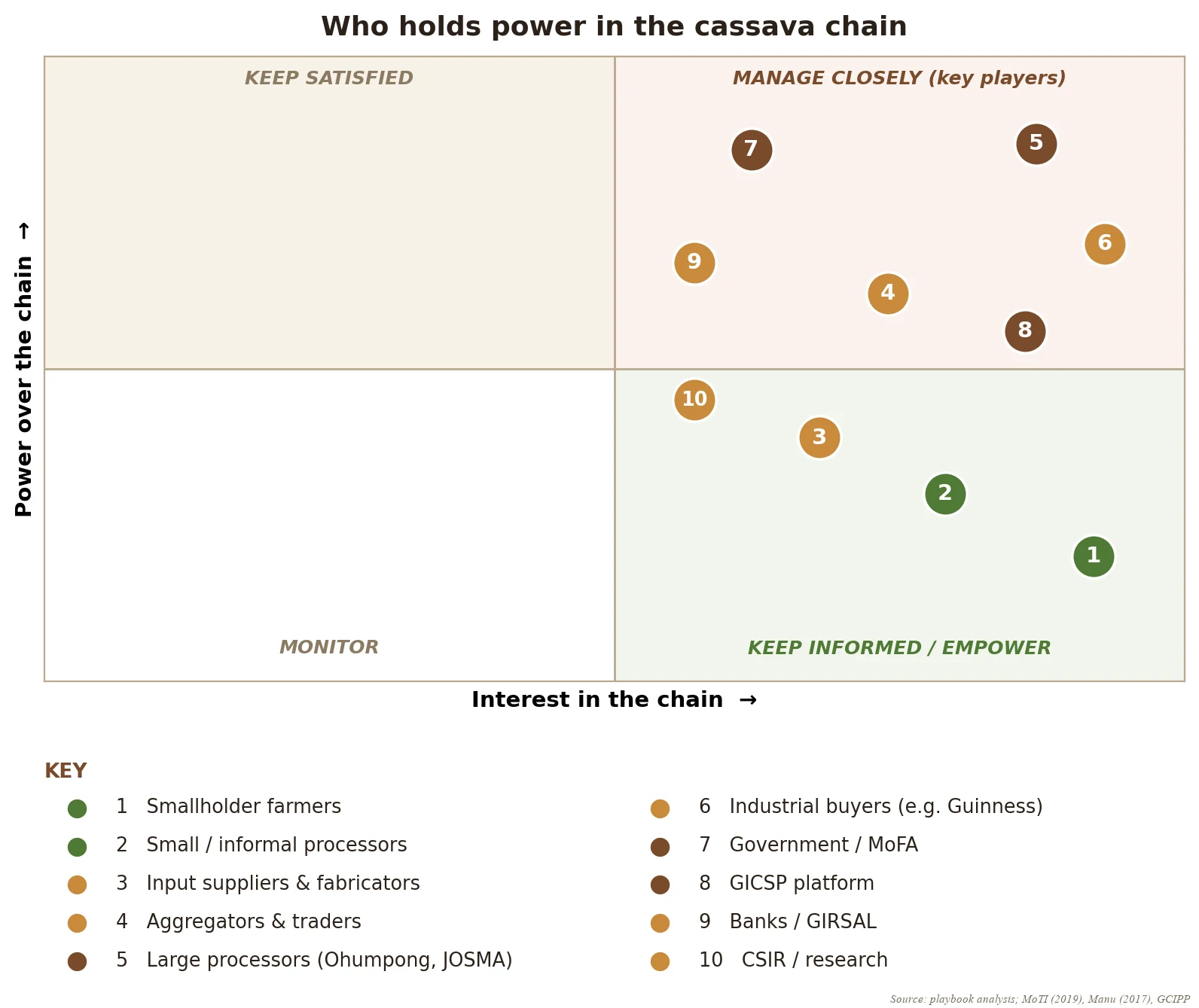
A value chain is also a map of power, and in cassava the power is lopsided. Fieldwork across the southern chain found a captive-market structure: farmers and small processors have little bargaining power and take the price on offer, while a handful of large processors and buyers hold concentrated market power and set the terms.9 Figure 17 places the main actors by how much power they hold over the chain against how much interest they have in it, and Table 13 turns that into an action list.

A power-interest grid placing smallholder farmers, aggregators and traders, processors, industrial buyers, government and the GICSP platform, and banks and GIRSAL by how much power they hold over the cassava chain against how much interest they have in it
Figure 17 Stakeholder power and interest in the cassava chain.
Table 13: The main actors, their power, and the opening each represents.
ActorRole in the chainPowerThe opening
Smallholder farmersGrow the roots; about 70% of farmersLow, captiveAggregate into offtake-backed groups to win a price
Aggregators & tradersBulk, grade and move roots to processorsRisingFormalise the scarce middle; the clearest under-built business
ProcessorsTurn roots into gari, flour, starch, chipsHigh, in few handsMid-scale entry tied to a named buyer
Industrial buyersPull demand (breweries, mills, feed)HighSecure supply through contracts rather than spot markets
Government & GICSP platformPolicy and standards (state); multi-actor coordination (GICSP)HighStructured markets and finance that reach the farm
Banks / GIRSALFinance the chainMediumGuarantee aggregated, contracted supply

Source: playbook analysis, drawing on MoTI (2019), Manu (2017) and the GCIPP programme record.

The concentration is not abstract. Under the AGRA-funded cassava industrialisation programme, a small number of named processors held the supply contracts that tie farmers into the chain, with Amantin Agro Processing, Ohumpong Investments and JOSMA Agro-Industries each holding dozens, and in one case more than a hundred and fifty, smallholder agreements.10 On the other side, the Ghana Industrial Cassava Stakeholders Platform is the one standing body that convenes farmers, processors, government, fabricators and buyers together, which makes it the natural place to push for the structured markets that would rebalance the chain.11 The strategic point is simple: a lone farmer has no power, but an aggregated, contracted group of farmers with a guaranteed buyer does, and building that group is the single most powerful move in the chain.

The grid is worth reading for what is missing as much as for what is there. The top-left corner, the actors with power over the chain but little interest in it, is empty: nobody with real market power is sitting this chain out and blocking it. That is the encouraging part of the map. The cassava chain is not held shut by a powerful gatekeeper the way some commodities are; it is simply unorganised, and an unorganised chain is a far easier one to enter than a captured one.

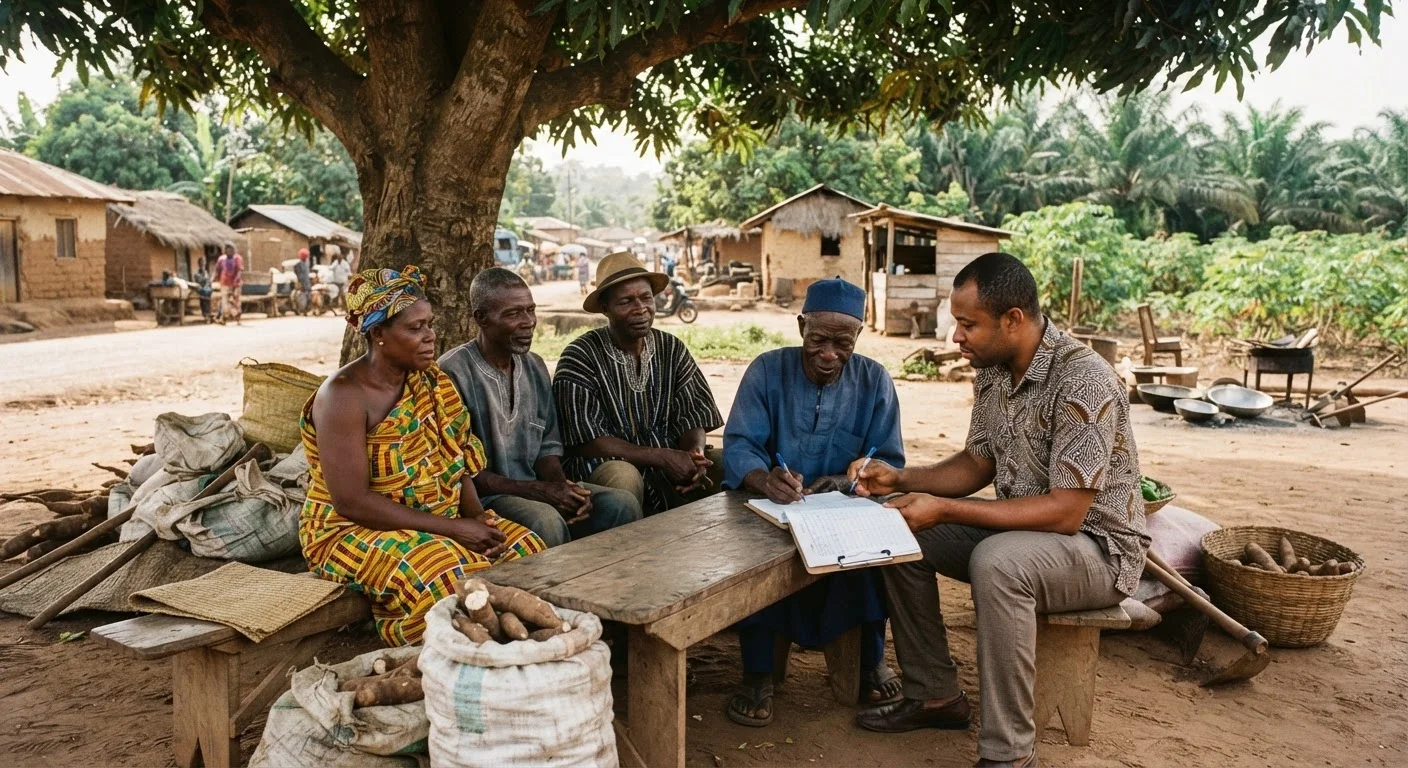
A group of Ghanaian cassava farmers meeting under a tree with an aggregator, agreeing terms and signing an offtake sheet, documentary photograph
Aggregate to win a price
A lone farmer has no power; an aggregated, contracted group with a guaranteed buyer does.

Table 13 names the six actors whose decisions move the chain; the fuller register behind them, every distinct actor from the stem supplier to the exporter and the institutions around them, is set out in Table 14. It is the map an entrant uses to find where they fit and whom they must work with.

Table 14: The full actor register of the cassava chain, and each actor's leverage or constraint.
ActorWhat they do in the chainTheir leverage or constraint
Input suppliers and agro-dealersSell fertiliser, agrochemicals and tools; fabricate equipmentThin reach to smallholders; the potash-shape gap sits here (Pillar 4)
Nursery and planting-material operatorsMultiply and sell clean cuttingsBarely exists as a market; the highest-leverage missing business (Pillar 1)
Smallholder farmersGrow about seven in ten of the crop, mostly under two hectaresPrice-takers with no aggregation; low power, high number
Nucleus and commercial farmsLarger, sometimes processor-linked growersCan anchor supply for a plant, but still few
Aggregators and tradersBulk, grade and move roots to processorsThe scarce, under-built middle; rising power and the clearest opening
TransportersHaul a perishable root against the clockThe largest single cost in moving fresh roots
Cottage gari processors (women-led)Make the country's proven cassava productInformal and unbranded; they leave the branded premium to imports (Pillar 2)
Flour and starch SMEsMid-scale processing into flour and starchThe missing middle; gated by certification and a steady root supply
Industrial plants (starch, ethanol)Large-scale conversionRun below capacity for want of roots or a buyer; the stranded-asset risk
Wholesalers and retailersCarry product to the consumerThin margins; dried products keep and earn more
Industrial and institutional buyersPull demand: breweries, mills, schools, prisonsHigh power; contracts, rather than spot markets, are the way in
Research, standards and coordinationCSIR breeding, GSA standards, extension, the GICSP platformSets the varieties, specs and convening table; the lever for structured markets
FinanceBanks, GIRSAL guarantees and the OVCFRarely reaches the individual smallholder; guarantees need aggregated, contracted supply

Source: actors compiled from Ministry of Trade and Industry / WACOMP (2019) and the chain map; each actor's role and leverage are this playbook's reading. Where market power concentrates is set out in Figure 17 and Table 13.

Where the value can be captured

Put the chain, the profit split, the missing middle and the power map together and the openings line up in a clear order. Table 15 sets them out.

Table 15: Ranked value-capture openings in the cassava chain.
OpeningThe gap it fillsWhat kills itBest suited to
Aggregation & storageUp to half the crop is lost after harvest and roots spoil in 2-3 days; no organised middle existsPaying a price premium instead of selling reliability, inputs and transportTraders, cooperatives, SMEs
Mid-scale processingUnmet demand of 96,000 t/yr for flour and 85,000 t/yr for starch; one brewer short by roughly 70,000 t/yr of flourBuilding the plant before signing the buyer; for flour and chips the constraint is the market, not the rootsEntrepreneurs, investors
Certification as the productEvery quality buyer (supermarkets, institutions, exporters, industry) requires it; a gap flagged in all six clustersChoosing a product whose standard does not exist; gari has one, high-quality flour does notProcessors, SMEs
Convert at the farmBeats the 2-3 day clock and cuts the weight that must be hauled; a starch plant that buys chips has bought itself out of the clockDrying before a buyer for the dried form is contractedFarmer groups, aggregators
Contract farmingFarmers are unbankable and side-sell; industrial buyers cannot rely on supplyBuying loyalty with a high price instead of embedded services, inputs, transport and cash on deliveryProcessors, OVCF, GIRSAL
Ethanol import substitutionAbout US$69m of ethanol imported a year against a 213m-litre annual deficitUnderestimating the roots constraint; for ethanol, roots really are the bottleneckLarge investors

Source: playbook synthesis from ITC/WACOMP (2022), MoTI/WACOMP (2019) and the live-search findings.

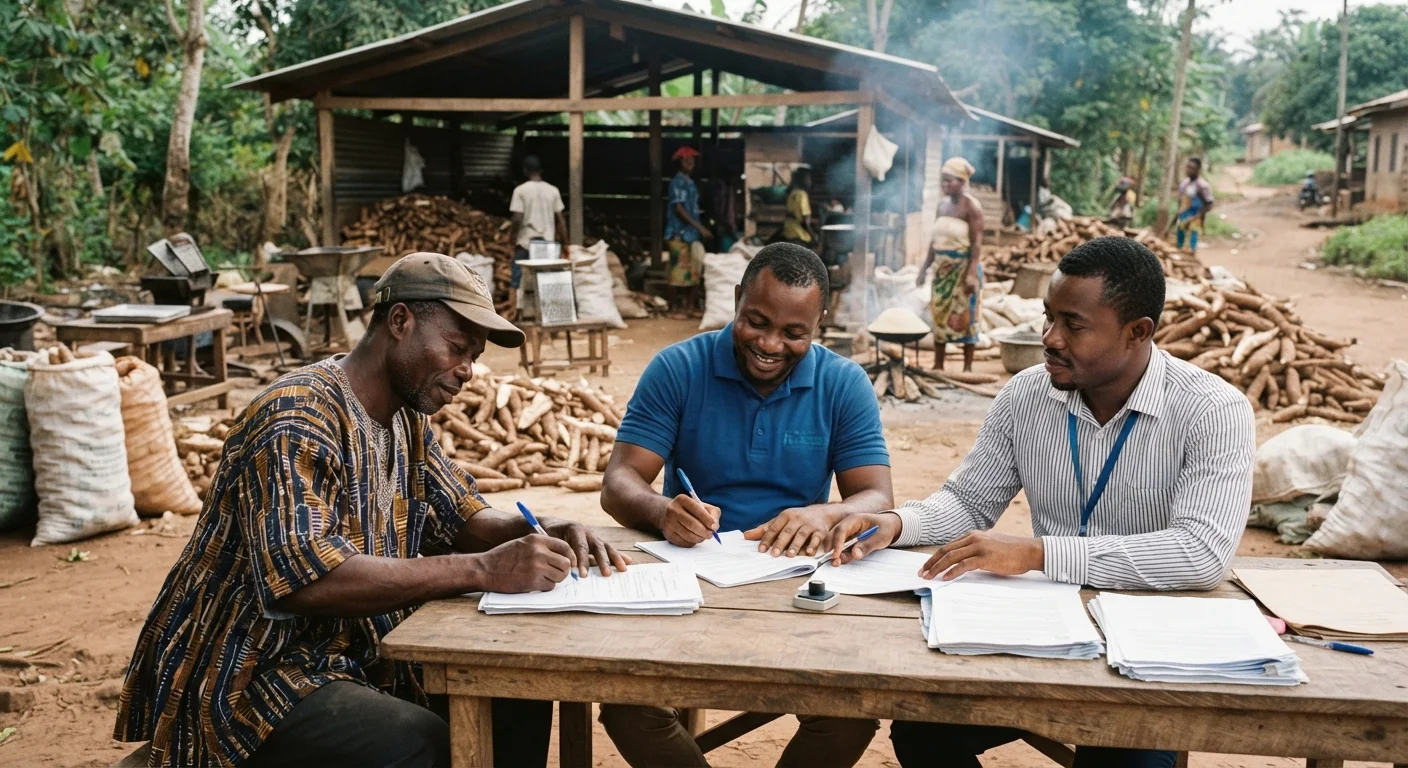
A Ghanaian cassava outgrower and a technical operator signing a tri-partite contract with a bank officer present, a processing shed in the background, documentary photograph
A ready template
The Outgrower and Value Chain Fund already finances cassava-gari on a tri-partite model.
GH¢10/kg
the 2025 minimum guaranteed farmgate price for gari
8.40 vs 5.62 t/acre
contract against non-contract yield in the private scheme

Two structures already exist to build around. The Outgrower and Value Chain Fund runs a tri-partite model, an outgrower association, a technical operator and a participating bank, and cassava-gari is one of the value chains it finances, which is a ready template for anyone assembling contracted supply.12 And the state has put a floor under the price: a minimum guaranteed farmgate price for gari of about ten cedis a kilo, announced in 2025, gives a processor and a farmer group a number to plan around.13 None of this is theoretical. Independent fieldwork in the Ashanti and Volta regions reads the growth of off-farm cassava processing and trading as an early, local agricultural transformation already under way, which is exactly the middle of the chain beginning to fill in.14 The opportunity is to accelerate it deliberately rather than wait for it.

There is unusually clear Ghanaian evidence on what actually makes contracted supply hold, and it is not the price. Poku, Birner and Gupta compared a private and a public cassava outgrower scheme: the private firm paid below the spot price yet kept its growers and lifted their yields, while the state scheme matched the market price and still lost its farmers to side-selling. Table 16 shows why, and it is the single most useful lesson for anyone designing an outgrower model.

Table 16: Two cassava outgrower schemes, and why the low-price one held its growers.
The schemeThe price it paidContract vs non-contract yieldHeld its growers?Why it worked, or did not
Private firmGH¢120, below the GH¢150 spot price8.40 against 5.62 tonnes an acre, significant at the 1% levelYesIt embedded inputs, technical assistance and transport and enforced the contract, so the below-market price was outweighed by the services and the reliability
State schemeGH¢220, level with the GH¢222 spot price5.20 against 5.72 tonnes an acre, not a significant differenceNoIt matched the market but embedded nothing, and set a 15 percent starch specification its growers could not reliably meet, so they had no reason to stay and side-sold

Source: Poku, Birner and Gupta (2018), a comparative study of one private and one public cassava outgrower scheme in Ghana. Yields per acre; prices as reported. The lesson: embedded services and enforcement, not a high price, are what make contract farming hold.

Processing and value addition: where the value is added

Every step of processing does three things at once: it adds value, it adds shelf life, and it makes the crop safer. A fresh root is cheap, spoils in days and carries unsafe cyanide; the same root dried into chips, grated and roasted into gari, milled into high-quality flour or extracted into starch becomes steadily more valuable, more storable and safer to eat. The highest rung, food-grade and modified starch, is also where global demand is largest and where Ghana has built the least (Figure 18).15

US$1.7bn
global cassava starch imports, still growing
~10%
the share of Ghana's cassava that reaches industrial processing
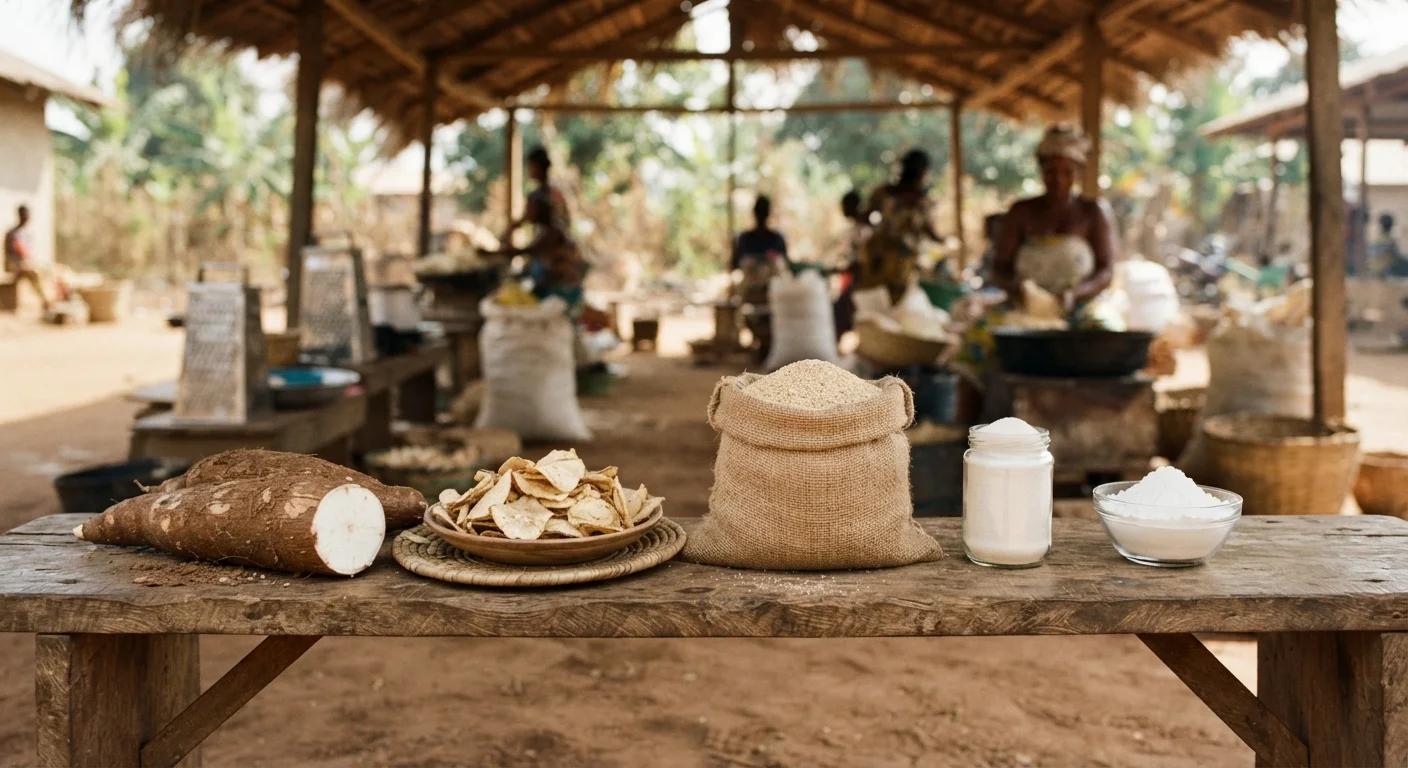
A staged arrangement of cassava products climbing in value, from a raw root to dried chips to a bag of gari to fine high-quality flour to refined white starch, on a wooden bench, documentary photograph
Each rung adds value and shelf life
From a perishable root to modified starch, value, storability and safety all climb the ladder.
Table 17: The cassava product ladder, and where the opening is on each rung.
ProductWhat it is and who buysWhat it needsThe opening
Fresh rootHome and local food; cheapest and most perishableNothing beyond harvestNone; the crowded floor of the ladder
Dried chipsRaw material for feed, starch and ethanol; storableDrying, low cyanideDried intermediates that buy time against the clock
GariMass-market staple, urban convenience, regional exportGrating, fermentation, roasting; moisture at or below 12%Consistent, branded, graded gari
High-quality flour (HQCF)Bakery and food-manufacturing wheat substituteFast processing, fine milling, low moistureReliable HQCF supply to a named bakery
Native starchFood, paper, textile and pharmaceutical industryExtraction plant and clean, steady supplyStarch built against secured offtake
Food-grade / modified starchThe highest-value, fastest-growing global segmentAdvanced processing, standards and scaleThe prize Ghana has barely touched

Sources: van Duijvenbode / WACOMP (2021); IITA (2012); Ghana Export Promotion Authority.

Gari: the product that already works

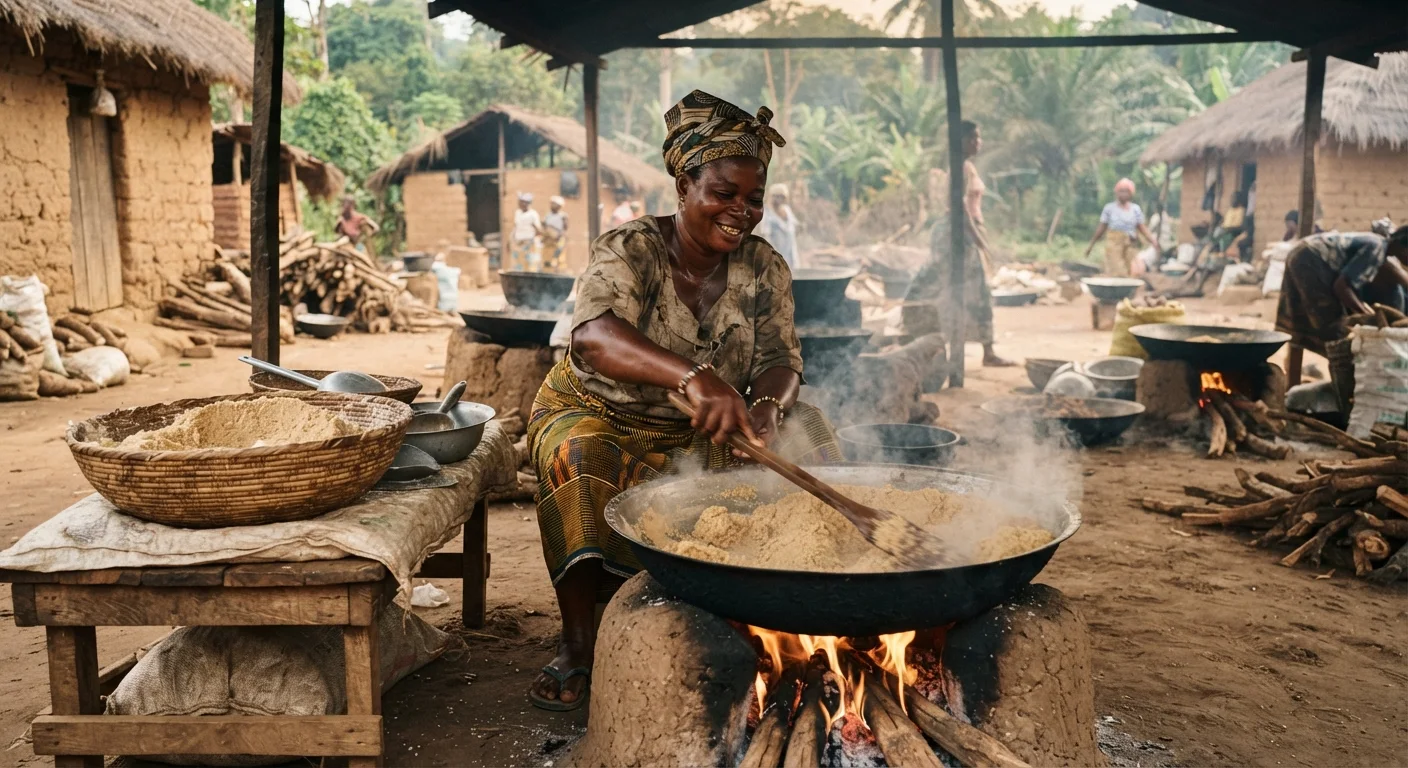
A Ghanaian woman roasting gari over a wood fire in a wide pan at a cottage processing yard, sifted cassava mash beside her, documentary photograph
The proof value addition sells
Gari is made almost entirely by small-scale, informal processors, the tier where cassava flour and gari are produced.
~40%
the small-scale, informal share of the food-processing industry
45 min vs 4-5 hrs
mechanized against hand processing of one tricycle-load

Gari is the most commercialized cassava product in Ghana and the proof that value addition sells. It is made almost entirely by small-scale and informal processors, who make up about 40 per cent of the country’s food processing industry, the tier where cassava flour and gari are produced (Figure 19).16

What turns cassava into gari is a fixed sequence, peeling, washing, grating, fermenting, pressing, sifting, roasting and grading, and it is that sequence, above all the fermentation and roasting, that also drives the cyanide out (Pillar 3). Quality is measurable: good-quality gari holds moisture at or below 12 per cent and total acidity between 0.6 and 1.0 per cent, the accepted processing specifications,17 and Ghana maintains its own gari standard alongside them.18

The gap is not demand or safety but consistency and scale. One Ashanti processor was still hand-processing a single tricycle-load of cassava over four to five hours with firewood, work that mechanized equipment could do in about forty-five minutes.19 That is the whole opportunity in miniature: the product sells, the standard is known, and the constraint is simply better, faster, more consistent processing, which is also what unlocks the branded-gari premium that imports currently capture (Pillar 2).

Starch and flour: the value Ghana leaves on the table

Above gari sit the industrial products, and this is where the money and the neglect both concentrate. Global demand for cassava starch runs to over US$1.7 billion in imports and is still growing, yet Ghana does not rank as a significant supplier to any of the leading starch markets, and the sector’s own export plan identifies the clearest opening as food-grade rather than industrial-grade starch, which carries far more volume of demand and which Ghana has barely entered.20By converging industry estimates, only around a tenth of Ghana’s cassava reaches industrial-scale processing at all.21

Flour is the nearer-term play. High-quality cassava flour already goes into bakery products at 10 to 35 per cent inclusion, and a cross-sector effort has worked for years on a composite-flour policy, but Ghana still has no mandatory blending rule, unlike Nigeria, which has moved toward a 20 per cent inclusion mandate.22 So the demand for high-quality flour is real but policy-optional, which means it has to be won bakery by bakery on price and reliability, since regulation will not hand it over. Ethanol is the third industrial route: Ghana imports tens of millions of litres a year and already has its first cassava ethanol distillery running, so the substitution logic is sound but the capacity is thin.23

Technology, and the mid-scale opportunity

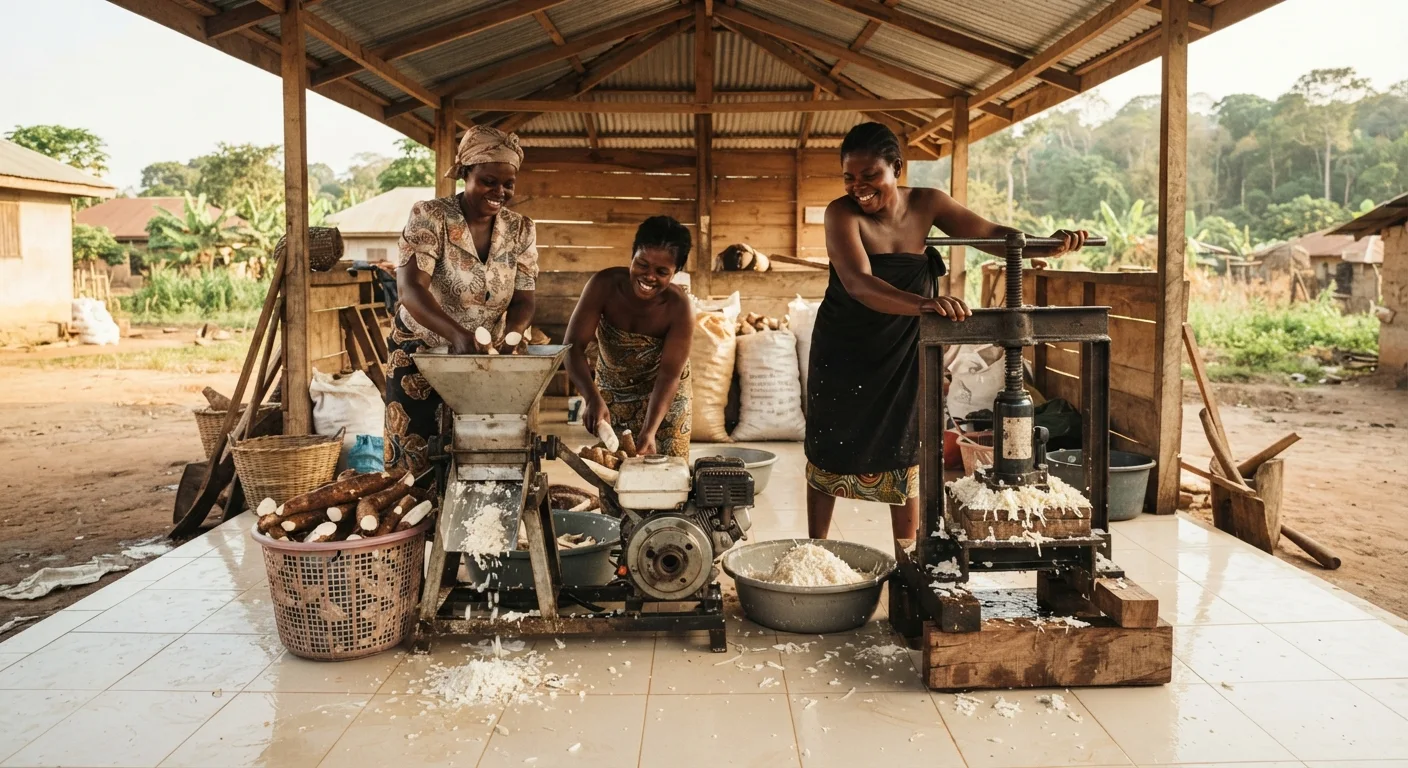
Between the informal gari yard and the handful of big factories sits very little, and that missing middle is the sector’s structural weakness. The equipment to fill it exists and is largely made locally, from graters and presses to mechanical dryers, but processors consistently favour small, affordable machines, and there is strong latent demand for mechanized services such as peeling rather than outright equipment purchase, which points to an equipment-as-a-service model as much as a factory one.24

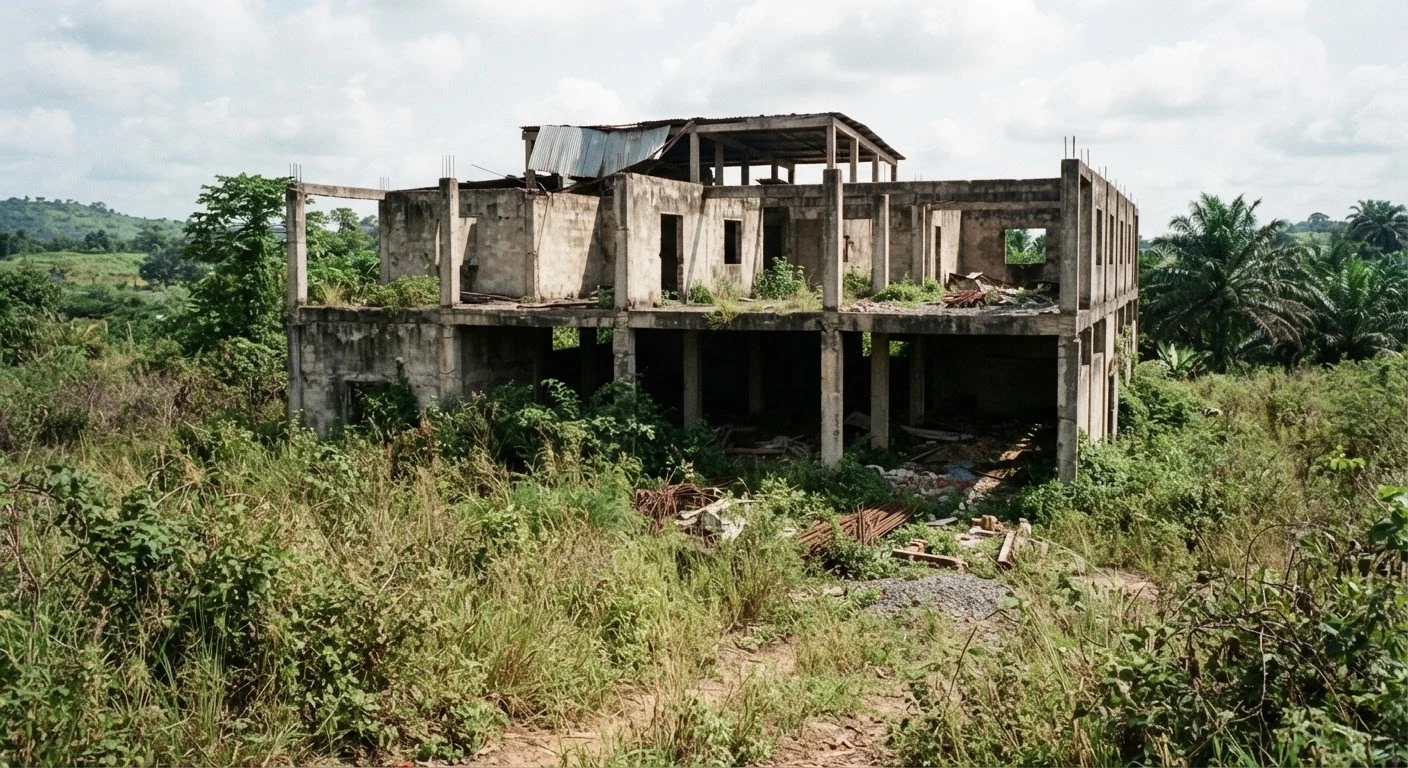
New capacity is being built, with cassava flour, gari and starch factories commissioned across Bono East, the Eastern Region, the Volta Region and the north between 2024 and 2026.25 But scale is not safety. A multi-million-cedi one-district-one-factory starch plant at Assin South, begun around 2019, never reached production and now stands overgrown, a direct warning that a plant sized ahead of its supply and offtake is a stranded asset rather than an achievement.26

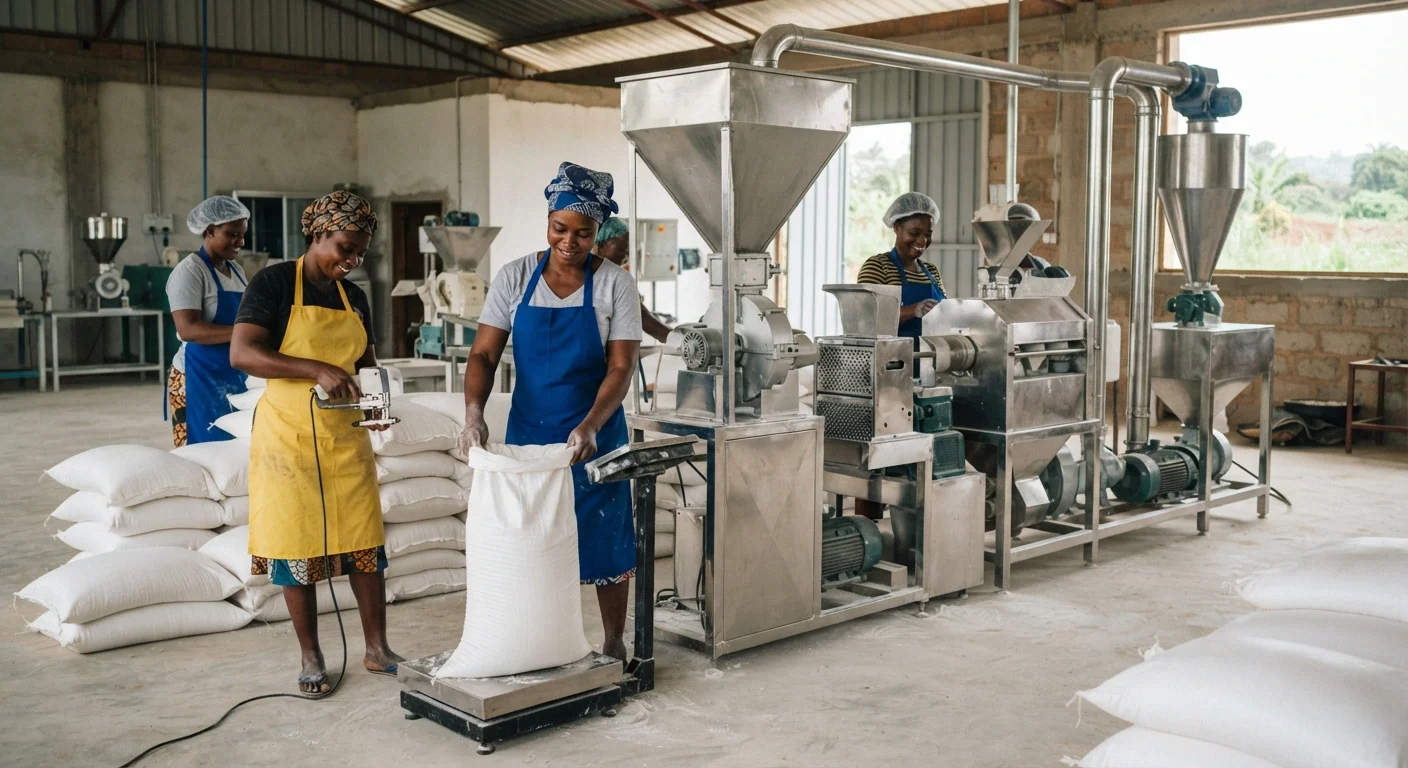
A mid-scale Ghanaian cassava processing unit with a mechanized grater and press running, a few workers feeding peeled roots, a clean tiled floor, documentary photograph
Right-sized, not flagship
The safest entry is a mid-scale, mechanized, quality-controlled processor built against a real supply base and a named buyer.
Opportunity · the right-sized processor, not the flagship factory

The safest entry is not a mega-factory but a mid-scale, mechanized, quality-controlled processor built against a real supply base and a named buyer, plus the shared equipment services (peeling, grating, drying) the informal sector will pay for. It matches the missing middle exactly, it phases capital to demand, and it avoids the stranded-asset trap that has claimed the flagship plants.

Quality, standards and the export gate

For anything beyond the local market, quality is the gate. Ghana has a full suite of cassava-product standards, for gari, edible flour, industrial and food-grade starch, and composite flour, and formal and export buyers increasingly require verified traceability alongside a safe, consistent product.27 Meeting the standard is not red tape; it is the difference between selling gari by the cup at the roadside and selling branded, certified gari into a supermarket or an export contract, and it is how a processor captures the value the informal sector cannot. Programmes that pair smallholder supply with quality control, such as the cassava industrialisation partnership linking tens of thousands of farmers to named processors under a national quality regime, show the model: clean supply, documented quality and a committed buyer.28 A recent removal of import duties on processing equipment and tax incentives for agro-processors add a policy tailwind, though the detailed measures are worth confirming before they are banked.29

Risks in the value chain

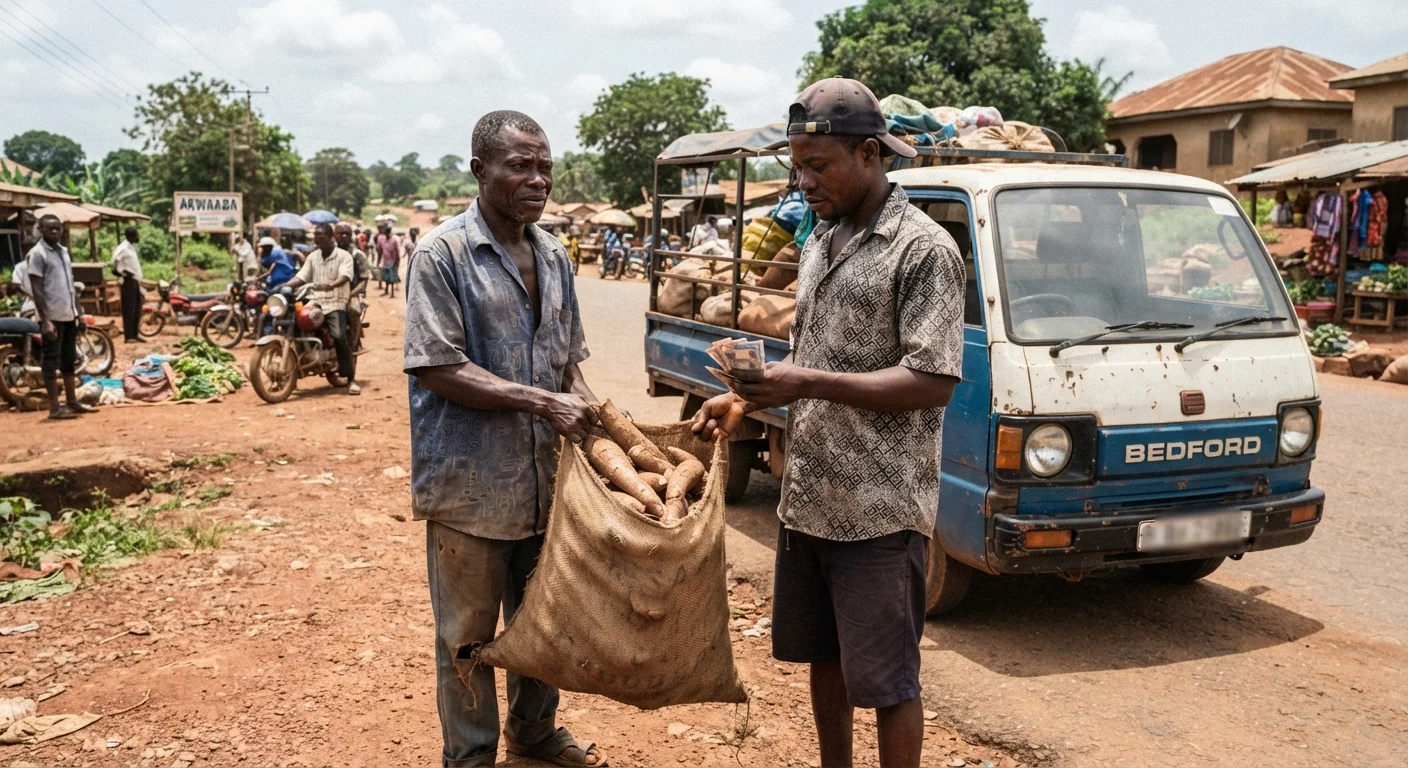
A Ghanaian cassava farmer accepting a low price from a single buyer at a roadside, sacks of roots on a truck behind, documentary photograph

The captive market

HIGH
What it is

Farmers and small processors sell into a market with few buyers and little price information, so they take the price offered rather than one they negotiate.

Who it hits

Smallholders and small processors selling into a market with few buyers and no price information, who take the price offered rather than negotiate it.

How to manage it

sell as an aggregated group under a forward contract, use market-price information, and process to widen the pool of buyers.

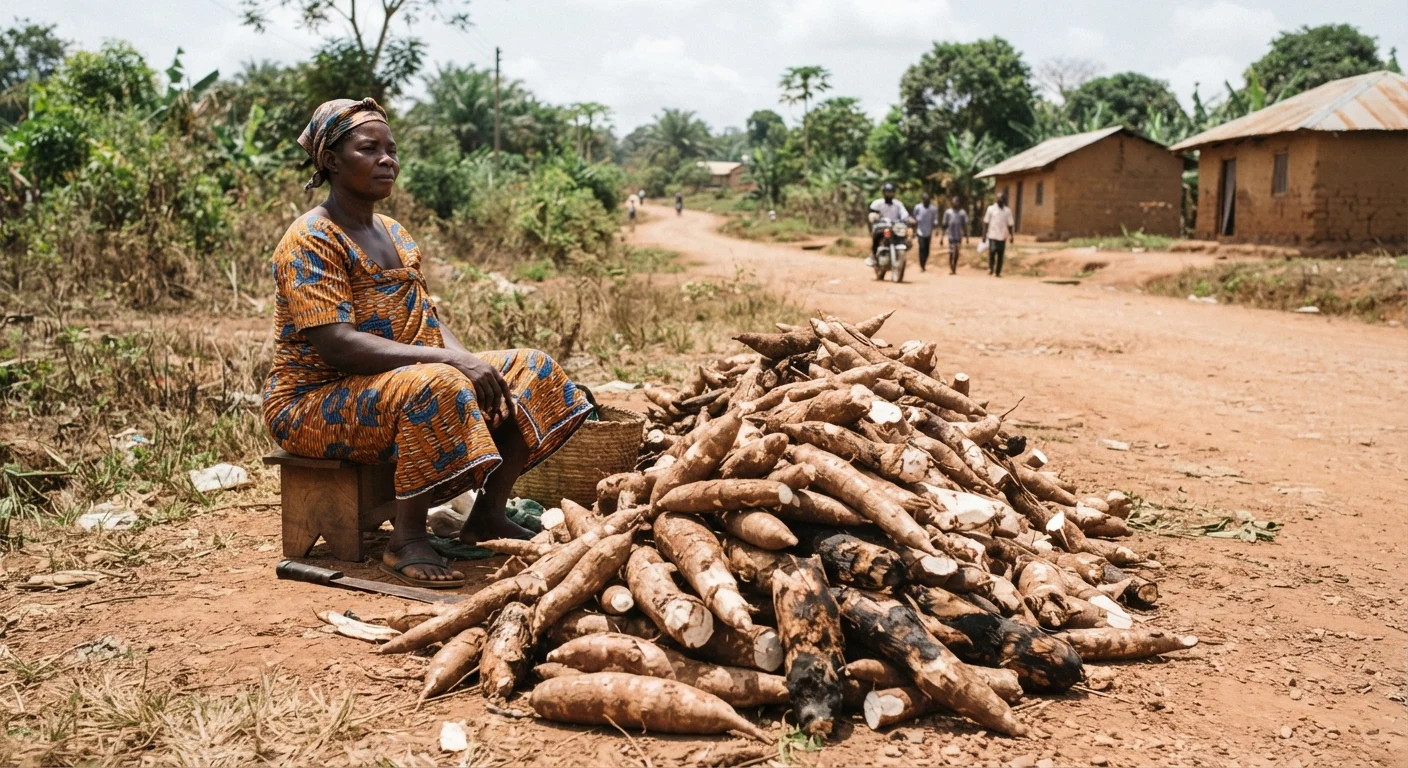
A pile of freshly harvested cassava roots left at the edge of a field with no organised bulking or storage, some already spoiling, documentary photograph

The aggregation gap

HIGH
What it is

There is no organised layer to bulk, store and grade roots, so a perishable crop is dumped into a thin local market within days of harvest and much of it is lost.

Who it hits

Every farmer far from a processor and every plant whose roots arrive spoiled or late because no organised bulking and storage layer exists.

How to manage it

build or contract bulking and short-cycle storage close to farms, and schedule harvest to a processor’s demand rather than the calendar.

A Ghanaian cassava farmer quietly selling roots to an alternative buyer away from the contracting processor's collection point, documentary photograph

Side-selling and default

ELEVATED
What it is

Contract-farming schemes fail when farmers sell elsewhere for quick cash or buyers renege, so supply stays unreliable and finance stays away.

Who it hits

Every processor or fund designing an outgrower scheme, and every investor underwriting one on a projected purchase price rather than a working service package.

How to manage it

price contracts fairly and pay on time, and bundle inputs, extension and a guaranteed offtake so the contract is worth keeping on both sides.

An abandoned Ghanaian cassava starch factory building overgrown with weeds, machinery idle behind shuttered doors, documentary photograph

The stranded factory

HIGH
What it is

Plants built ahead of secured supply and offtake never reach production; the Assin South starch factory is the cautionary case, overgrown and idle.

Who it hits

Investors and district programmes that fund a plant before the roots and the buyer are secured, and the community left with an idle building.

How to manage it

right-size to contracted supply and a named buyer; start mid-scale and phase capacity; do not build for a surplus that has no market yet.

Cassava roots arriving late and unevenly at a processing plant intake bay, a worker checking a mostly empty hopper, documentary photograph

Erratic raw supply against the clock

ELEVATED
What it is

Processing depends on getting roots in within days of harvest (Pillar 3); broken supply idles the plant and burns working capital.

Who it hits

Any processor running to a schedule against a perishable crop with no forward supply, whose line then runs below the capacity it was built for.

How to manage it

site near the farm; contract supply; buffer throughput with dried intermediates such as chips.

A Ghanaian quality-control technician testing gari for moisture and acidity in a small processing lab, documentary photograph

Quality and standards failure

MEDIUM
What it is

Inconsistent moisture, acidity or cyanide fails buyers and closes the export gate, stranding product at the low-value informal end.

Who it hits

Every processor with ambition above the village market, since supermarkets, institutions, exporters and industry all gate entry on a standard.

How to manage it

adopt the gari and flour standards and HACCP; test and document every batch; work to the published specification.

Key takeaways
01

The chain is short and shallow: value climbs steeply from farm to processor to exporter, but almost the whole crop stops at the farm, the thinnest link.

02

Value pools at the top of the chain: of every cedi of profit it generates, the producer keeps about 8 per cent and the exporter nearly three-quarters, so position as high up the chain as you can fund.

03

The binding constraint is the missing middle, aggregation, storage and reliable processing, rather than the growing of the crop.

04

Power sits with a few processors, large buyers and the state; farmers and small processors are price-takers in a captive market, and the fix is to aggregate and contract.

05

The openings are concrete and quantified: unmet flour and starch demand, ethanol imports, and a brewer short some 70,000 tonnes of flour a year, all waiting on someone to build the middle.

Written for each reader

Practitioner intelligence

Hover any card to pause and lift it.

For students

Map a real chain for one product, gari or flour, from a named farm to a named buyer, and price each link. The exercise that teaches most is to find where a tonne of roots gains and loses value, and to ask why the farmer keeps so little of it.

For entrepreneurs

The money is in the middle, not the field. The least contested, most needed business is aggregation and storage that gets roots to a processor before they rot; the next is mid-scale processing tied to a buyer you have already signed. Do not start by planting acres.

For investors

Back the middle of the chain and the offtake that de-risks it. The thesis is that Ghana grows the crop and imports the product, so value added at home is import substitution into a captive domestic market. Diligence asks: is there a signed buyer, a working aggregation model, and a storage plan that beats the two-day clock?

For ecosystem actors

The public job is to build the middle the market has not. Resource aggregation and storage infrastructure, make contract-farming vehicles such as OVCF and GIRSAL actually reach cassava groups, and enforce standards so a processor can sell into the industrial and export markets that pay. The outcome to measure is the share of the crop that reaches processing, today about a tenth, rising.

Where this connects.The clean, reliable supply this chain needs starts with planting material and yield (Pillar 1); the surplus it must absorb is Pillar 2’s; the products that carry the margin are made by the processing set out above; the field decisions behind their dry matter are Pillar 4’s; and the finance that lets an aggregator or processor build the missing middle is Pillar 5’s. The market intelligence to size these openings and the policy to unlock them are Pillars 7 and 8.

Footnotes
  1. Ministry of Trade and Industry, A Value-Chain Analysis of the Cassava Sector in Ghana (Accra: MOTI/EU-WACOMP, 2019), section 2.4 and Figure 3. The chain comprises farmers, aggregators, processors, exporters and transporters, supported by input suppliers, equipment fabricators, finance and certification providers; over 70 percent of Ghanaian farmers grow cassava.
  2. MOTI, Value-Chain Analysis of the Cassava Sector (2019), Table 16, titled “Distribution of profit along the gari value chain.” Per metric ton, 2019 nominal cedi values. The figures 8.3, 18.4 and 73.3 are each actor's share of the chain's total profit (they sum to 100), although the source's own row is mislabelled “profit margin”; the exporter's margin on its own selling price is 37.7 percent (5,450.5 / 14,465.5).
  3. I. Manu, “Analysis of the Cassava Value Chains and Economic Implications on Actors in Southern Ghana” (PhD diss., University of Ghana, 2017). Field survey (2016) across the Volta, Eastern and Central regions found high-quality cassava flour carried the highest value-added share (about 36 percent) and profit share (about 58 percent) of the products studied. The repository download endpoint was unreachable at the time of writing; figures are as reported in the abstract and secondary summaries.
  4. Ulrich Kleih et al., Cassava Value Chain Analysis in Brong Ahafo, Ghana (draft; Chatham: Natural Resources Institute / GASIP-MoFA, 2016). Total value addition across the chain estimated at about two billion cedis at May 2016 prices, with commercial farms far more profitable than hired-labour smallholders. 2016 cedi values.
  5. “Ghana Produces 8 Percent of World Cassava but Exports Little,” News Ghana, March 16, 2026, citing FAO, GEPA, CSIR and WACOMP. Reports that only about 10 percent of output reaches industrial-scale processing, post-harvest losses of up to 50 percent, and that Guinness Ghana Breweries requires about 100,000 MT/yr of cassava flour with domestic processors supplying under 30 percent. Trade press; treat the processing-share and loss figures as directional pending primary confirmation.
  6. Food and Agriculture Organization, Post-Harvest Compendium: Cassava (Rome: FAO, n.d.). Fresh cassava roots typically deteriorate within two to three days of harvest; cold storage below 4 degrees Celsius slows internal discoloration. Global technical reference, not Ghana-specific.
  7. Selina Wamucii, “Cassava Price in Ghana,” accessed July 29, 2026; corroborated by Tridge market data. Retail cassava quoted at roughly GH¢20 to GH¢25 per kilogram in 2026. Commercial-aggregator estimates with undisclosed methodology; treated as indicative.
  8. International Trade Centre, West Africa Competitiveness Programme: Cassava Value Chain - Regional Investment Profile Summary (Geneva: ITC/EU/ECOWAS, 2022), Ghana country profile. 2020 cassava-product imports US$69.99 million (mostly ethanol, US$69.14 million) against exports of US$0.947 million; internal demand deficits exceeding 96,000 t/yr for high-quality cassava flour, 85,000 t/yr for starch and 213 million litres/yr for ethanol; Ghana ranked fourth globally in production (2019).
  9. Manu, “Analysis of the Cassava Value Chains” (2017). The study characterises a captive-market governance structure in which farmers and small-scale processors have low bargaining power while large-scale processors hold concentrated market power.
  10. Agri-Impact Group, “Ghana Cassava Industrialisation and Partnership Project (GCIPP)” (completed), accessed July 29, 2026. An AGRA-funded consortium reporting supply/contract-farming agreements held by named processors, including Amantin Agro Processing (153), Ohumpong Investments (79) and JOSMA Agro-Industries (46); figures as reported by the implementer.
  11. “Stakeholders Empowered to Boost Cassava Value Chain,” News Ghana, August 4, 2020. The Ghana Industrial Cassava Stakeholders Platform (GICSP) convenes farmers, processors, government institutions, fabricators, input suppliers, buyers, researchers and transporters.
  12. Ministry of Food and Agriculture, “The Outgrower and Value Chain Fund (OVCF),” accessed July 29, 2026. A KfW-financed tri-partite model (outgrower associations, a technical operator and a participating bank); cassava-gari is one of eight value chains financed.
  13. “Government Announces New Farmgate Prices for Maize, Rice and Gari,” Graphic Online, September 29, 2025. A minimum guaranteed farmgate price for gari of GH¢340 per 34kg bag (about GH¢10 per kilogram); a policy floor, not an average market price.
  14. Martin Andersson et al., “A Local-Level Agricultural Transformation in the Making? The Case of the Cassava Industry in the Ashanti and Volta Regions of Ghana,” Oxford Development Studies 52, no. 3 (2024): 310-24, https://doi.org/10.1080/13600818.2024.2418002. Based on 109 interviews; cassava is grown as an income crop and its growing off-farm processing and trading activity is read as an early sign of local agricultural transformation.
  15. Alfons van Duijvenbode, Cassava Sector Export Marketing Plan - Ghana, West Africa Competitiveness Programme (Accra: UNIDO/WACOMP, 2021). The plan identifies food-grade over industrial-grade starch as Ghana's clearest opening and notes Ghana's limited penetration of the highest-value processed segments.
  16. United States Department of Agriculture, Foreign Agricultural Service, Ghana: Food Processing Ingredients Annual 2025, GAIN Report GH2025-0007 (Accra: USDA FAS, April 2, 2025). Three-tier structure: small-scale and informal 40 percent, SMEs 30 percent, large-scale 30 percent; food-processing-ingredient imports US$1.24 billion in 2024, up 44 percent.
  17. A. B. Abass, N. T. Dziedzoave, B. E. Alenkhe and B. D. James, Quality Management Manual for the Production of Gari (Ibadan: International Institute of Tropical Agriculture, 2012).
  18. Ghana Standards Authority cassava-product standards, as listed in the GSA Catalogue of Ghana Standards (2019): GS 237:2017 (gari), GS 762:2008 (edible cassava flour), GS 676:2004 and GS 584:2003 (cassava starch), GS 1057:2013 (composite flour); full texts are sold by the Authority. On buyer traceability requirements, TraceX Technologies, “Traceability in the Cassava Value Chain in Ghana,” 2026.
  19. “Building Africa's Next Billion-Dollar Food Chain: How Progal Agro Processing Ltd Is Empowering Farmers,” CediRates, 2025.
  20. van Duijvenbode, Cassava Sector Export Marketing Plan - Ghana (2021). Global cassava starch imports exceed US$1.7 billion (about US$1,763 million); Ghana does not rank as a significant supplier to the leading cassava starch markets.
  21. Ghana Export Promotion Authority, “Cassava Starch,” Buyer Portal, accessed July 29, 2026; with converging industry and trade-press estimates that only about 10 percent of Ghana's cassava reaches industrial-scale processing. The most recent confirmed GEPA cassava-starch export value dates to 2018 (about US$1 million, mostly to the USA); no 2024-2026 figure was located. Treat the processing-share figure as directional pending primary confirmation.
  22. On high-quality cassava flour at 10 to 35 percent bakery inclusion and the Cassava: Adding Value for Africa (CAVA) programme, Commonwealth Scholarship Commission, “Cassava: Adding Value for Africa,” 2013, and FAO Family Farming Knowledge Platform materials; on the absence of a mandatory composite-flour blending policy in Ghana as against Nigeria's move toward a 20 percent mandate, industry summaries reviewed July 2026.
  23. On Ghana's first cassava ethanol distillery, “Ghana's First Ethanol Plant to Begin Commercial Production,” Biofuels International; and Mongabay, “Caltech Ventures to Produce Ethanol from Cassava in Ghana.” Ghana imports on the order of tens of millions of litres of ethanol a year.
  24. CediRates, “Building Africa's Next Billion-Dollar Food Chain” (2025). The processor described was hand-processing a tricycle-load of cassava over four to five hours, work estimated at about forty-five minutes with mechanized equipment.
  25. Factory build-out 2024-2026: “YARP Foods Launches Cassava Flour Production Facility in Bono East Region,” Graphic Online, November 6, 2024; “1D1F: Global Almas Commences Mass Production,” Ghanamma.com, April 22, 2026; “Nteso Gets Boost with New Cassava Processing Factory,” Citinewsroom, March 2, 2026; and the Juapong Cassava Starch Factory (public-private partnership).
  26. “Snakes, Weeds Take Over Multi-Million 1D1F Starch Factory at Kyekyewere, Assin South,” ModernGhana, 2026 (corroborated by GhanaWeb, “Weeds Take Over Multi-Million 1D1F Starch Factory in Assin South,” 2026).
  27. Ghana Standards Authority cassava-product standards, GSA Catalogue of Ghana Standards (2019); see note 18.
  28. Agri-Impact Group, “Ghana Cassava Industrialisation and Partnership Project (GCIPP),” accessed July 29, 2026: an AGRA-funded consortium linking about 81,000 smallholder cassava farmers to named processors (Ohumpong Investments and JOSMA Agro-Industries) with quality-assurance support and the Ministry of Trade and Industry's national cassava strategy.
  29. Trade-press reports (early 2025) of the removal of import duties on agricultural and industrial processing equipment and tax incentives for agro-processors, including cassava processors; the underlying legislative text was not located, so the measures are cited as directional pending confirmation.
Download full PDF
UpcomingThis document isn't available yet.