For students
Before assuming cassava is an export crop, check the export statistics: it is not in Ghana's top ten. The lesson is to read what the market data does and does not say, and to notice that an absence in the numbers is itself information.

The most useful piece of market intelligence about Ghanaian cassava is how little of it there is. Cassava products do not appear anywhere in Ghana’s own top-ten export tables, and Ghana barely registers in the global services that track cassava prices and trade. Read that absence as a signal in itself.
The real market for Ghanaian cassava is at home and across the region, well short of the distant export markets the crop is so often told to chase. This pillar reads the numbers, the segments and the competitors to say where the demand actually is, and where it is moving.
The clearest current read is the government’s own export scorecard. Ghana’s non-traditional exports reached about five billion dollars in 2025, up nearly 31 percent, with agricultural products worth some seven hundred and ten million, led by cashew at close to three hundred million and shea at a hundred and seventy-eight. Cassava, in any form, is nowhere in the top ten, and although it is named in a handful of regional profiles, it is a top earner in none and is formally classed as a potential product in just one region, Ahafo.1 Figure 20 shows the company cassava does not keep.
This is not a failure of the crop; it is a statement about where cassava sits. Ghana grows enormous volumes and eats or trades almost all of it informally and at home (Pillars 2 and 6), so what leaves the country formally is tiny. Because the trade is so small, Ghana is also invisible in the market-intelligence services that track cassava worldwide: the authoritative Asian outlooks that cover Thailand, Vietnam and China in detail name Ghana only as a producer, with about 8 percent of world output, and treat African cassava as grown for home consumption rather than trade.2The few Ghanaian export prices that are tracked are so thin they swing from a dollar to more than four dollars a kilo inside five months, on a handful of transactions. Figure 21 shows what passes for a price signal.
Flying blind on price is itself a business risk. Until a regular export price series for cassava products exists, treat any single export quote as noise and price off the domestic and regional markets you can actually see.3
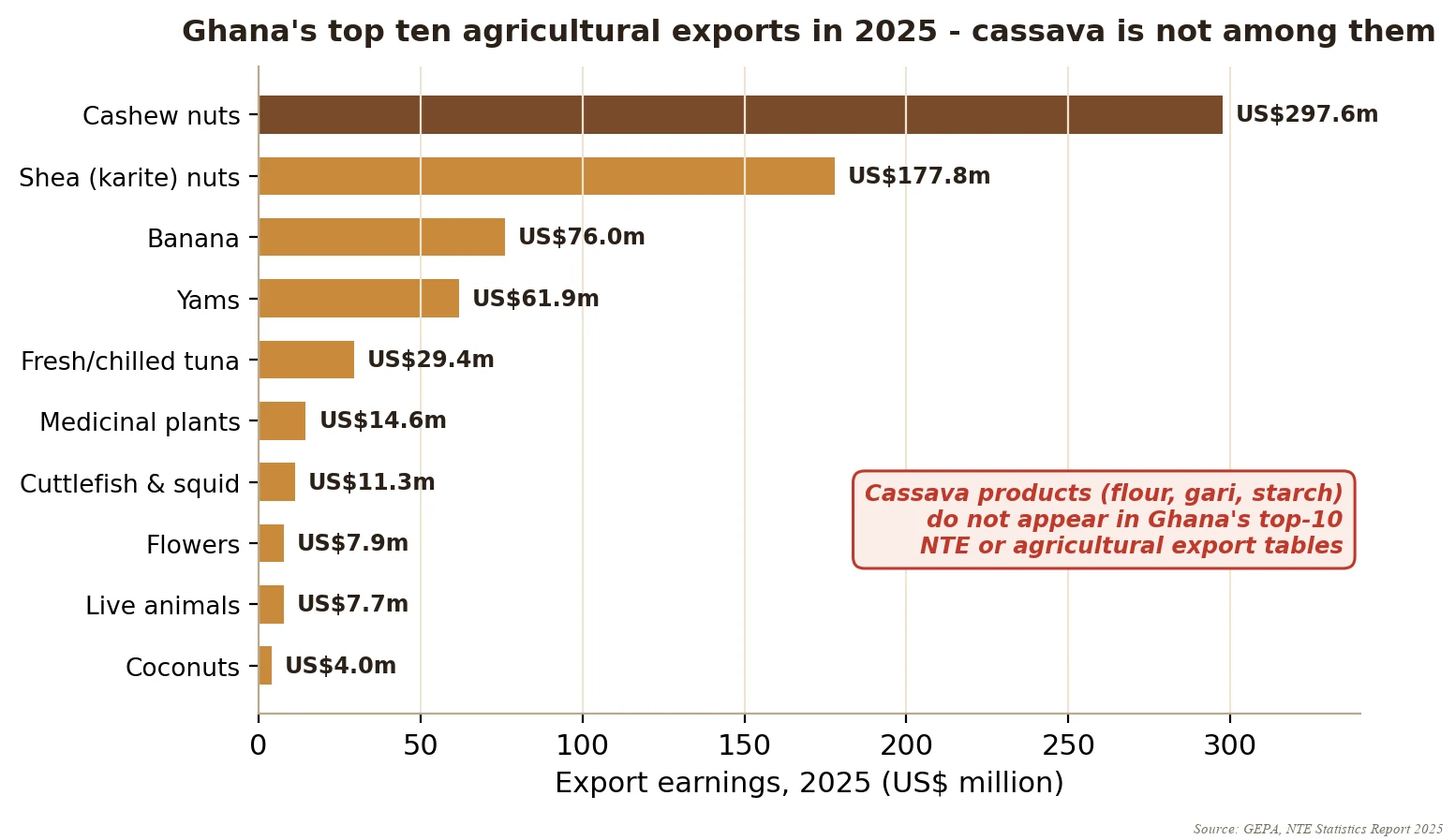
Ghana’s non-traditional exports reached about five billion dollars in 2025, led by cashew at close to three hundred million and shea at a hundred and seventy-eight (GEPA, 2026). Cassava, in any form, is nowhere in the top ten. The chart marks that absence rather than a ranking; it is the signal itself.
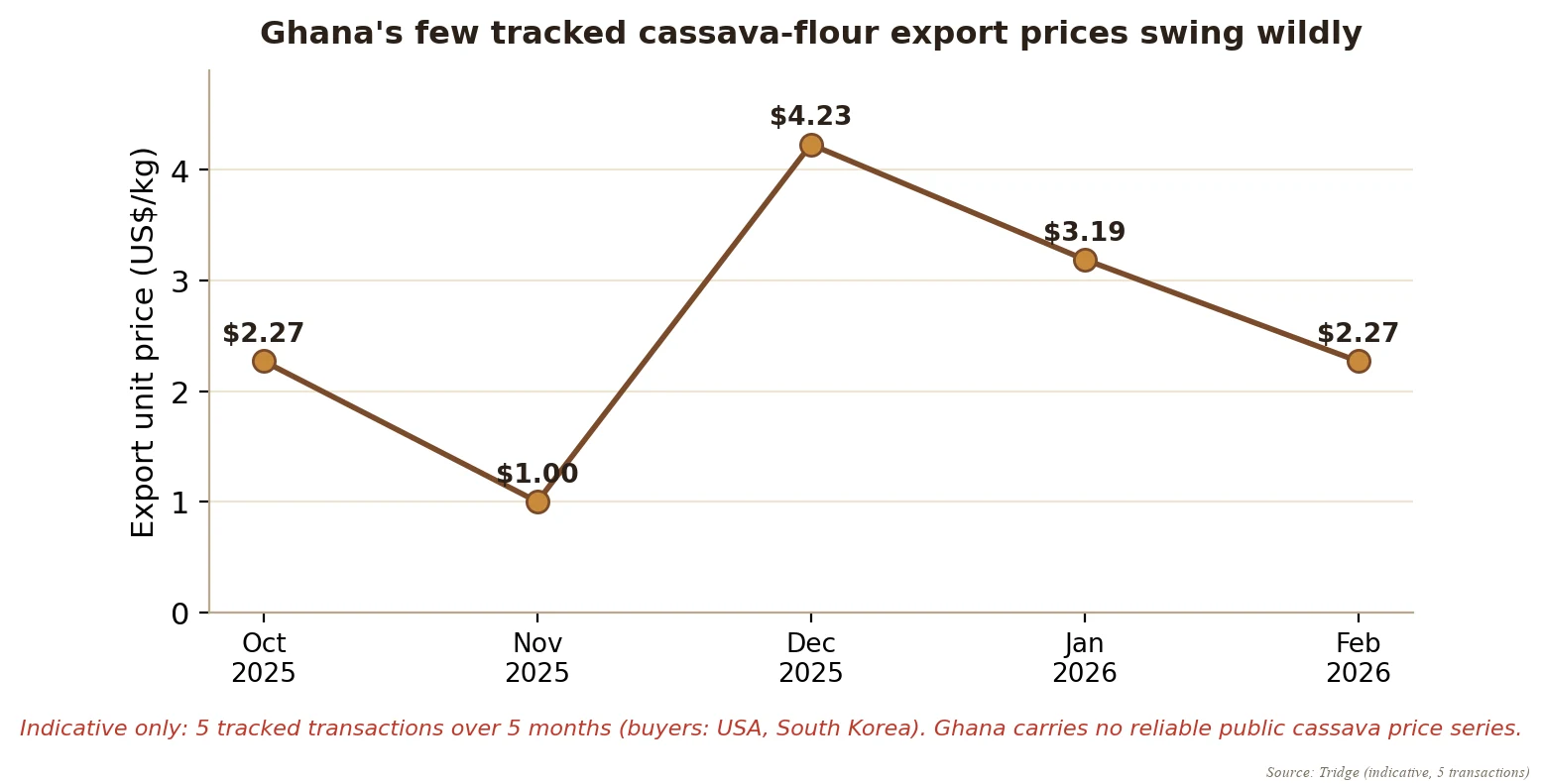
Five tracked export transactions from October 2025 to February 2026 swing from about a dollar to more than four dollars a kilo (Tridge, 2026). On a sample this thin, the line is noise. Until a regular export price series for cassava products exists, treat any single export quote as noise.
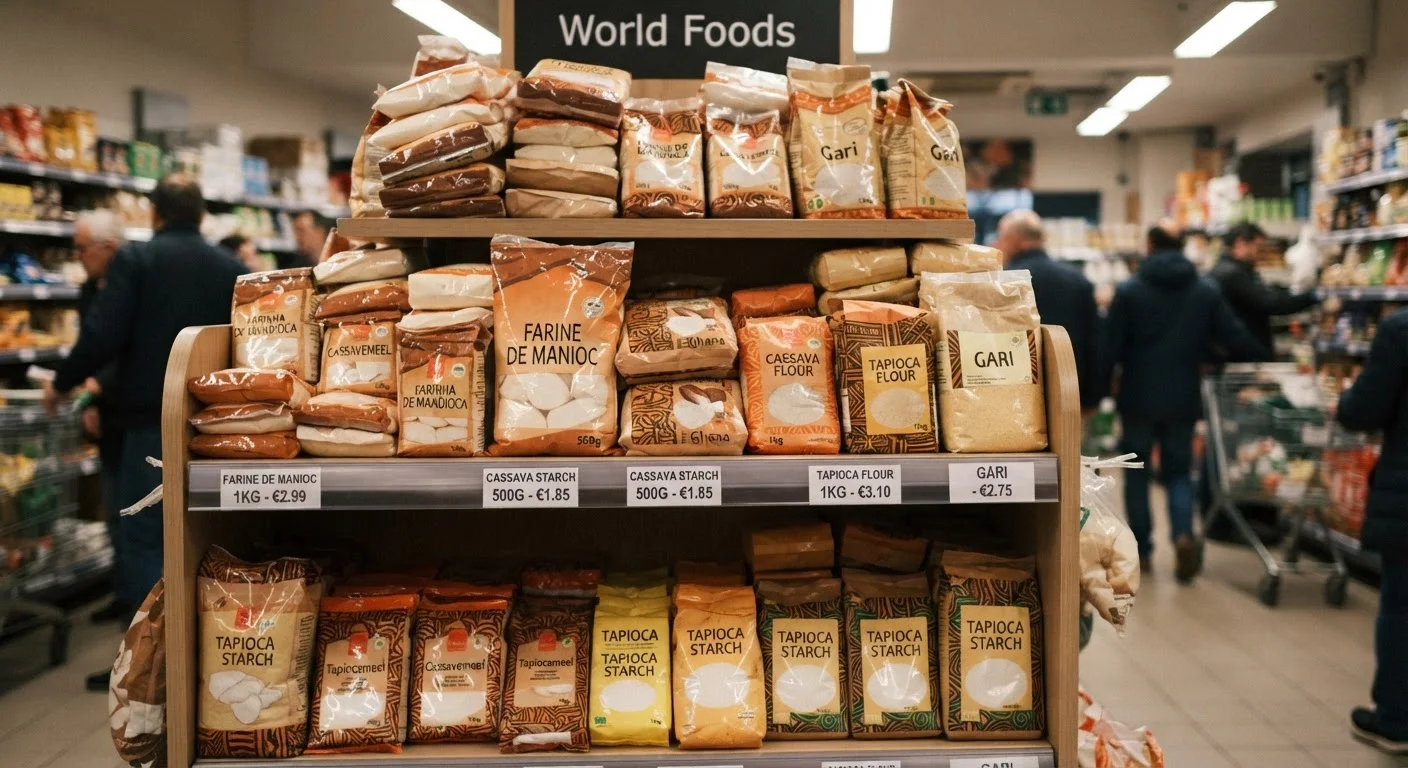
Where export does make sense, the segment matters enormously. Ghana’s leading cassava export is flour, but global demand for cassava flour is very small and drifting down, and the United States, which takes about half of world flour imports, is largely supplied by South American producers and offers Ghana none of the proximity and tariff advantages it enjoys in Europe.4 The real global prize is starch. Worldwide cassava-starch imports top one and three-quarter billion dollars and are still growing, and within that, food-grade starch is both larger in volume and better paid than industrial grade.5Ghana is not yet a significant supplier to any leading starch market, which has a flip side: there is no incumbent position to build on, and in several leading markets Nigeria is already the main West African competitor.
The competitors are clear. Thailand and Vietnam dominate global flour and starch supply, and Peru is the main competitor for cassava flour in Europe, though it sells in a higher price bracket.6 Ghana's genuine edges for a European buyer are a significant tariff advantage (lost in the UK after Brexit), geographic proximity and a much lower dependence on agro-chemicals than Vietnam, plus the simple value of being a second sourcing origin. The traditional route to market has been the ethnic African and Caribbean channel; the larger opening is the mainstream supermarket and the industrial bakery and confectionery trade. Table 18 sets out each segment and the play in it.
| Segment | Global market | Ghana's position | The play |
|---|---|---|---|
| Cassava flour | Small and declining; the USA is half of imports, supplied by South America | Ghana's leading cassava export, into a tiny niche | Sell to the region and diaspora rather than the commodity world market |
| Cassava starch | Large: over US$1.7bn of imports, growing ~3%; food-grade pays most | Not a significant supplier to any leading market | Target food-grade starch for Europe on proximity and clean production |
| Dried cassava / ethanol | China-dominated for ethanol feed; Ghana a net importer in multiples | Net importer | Substitute imports at home rather than chase export |
| Branded / convenience | Growing regional and diaspora demand | Live and moving (Kivo, Sunny Gold) | Build brands for West Africa and the diaspora |
Source: playbook synthesis from UNIDO/WACOMP Cassava Sector Export Marketing Plan (2021), ITC (2022) and company and trade-press sources on Kivo and Sunny Gold (notes 10 and 11).
The sharpest market read runs against the export dream, and it is that the competition is already inside the house. Ghana is a net importer of cassava products, driven by ethanol, whose imports outweigh its tiny exports many times over, so for ethanol the sensible strategy is import substitution rather than export promotion.7The same pattern is now spreading to starch: Nigeria's cassava-starch exports grew from under a thousand tonnes in 2022 to more than two thousand six hundred in 2023, and about 2,300 tonnes of that 2023 total, close to nine-tenths, went to Ghana, moving duty-free under the ECOWAS trade regime, so a Ghanaian starch producer’s first competitor is a Nigerian mill already selling into Ghana, well ahead of any Asian supplier.8
That regime works in both directions, and reading it properly is where the strategy turns. It is the channel Nigerian starch and gari take to Ghanaian shelves, and it is the same duty-free door through which a Ghanaian processor reaches the roughly 350-million-person ECOWAS market, now twelve countries since Burkina Faso, Mali and Niger left in January 2025, free of import duty for goods registered under the ECOWAS Trade Liberalisation Scheme.9 So the market intelligence resolves to a sequence: the nearest and most defensible market is the demand imports already meet at home, and the first true export step is regional and duty-free, taken well before the tariffed, price-competitive global markets the crop is so often pointed at.
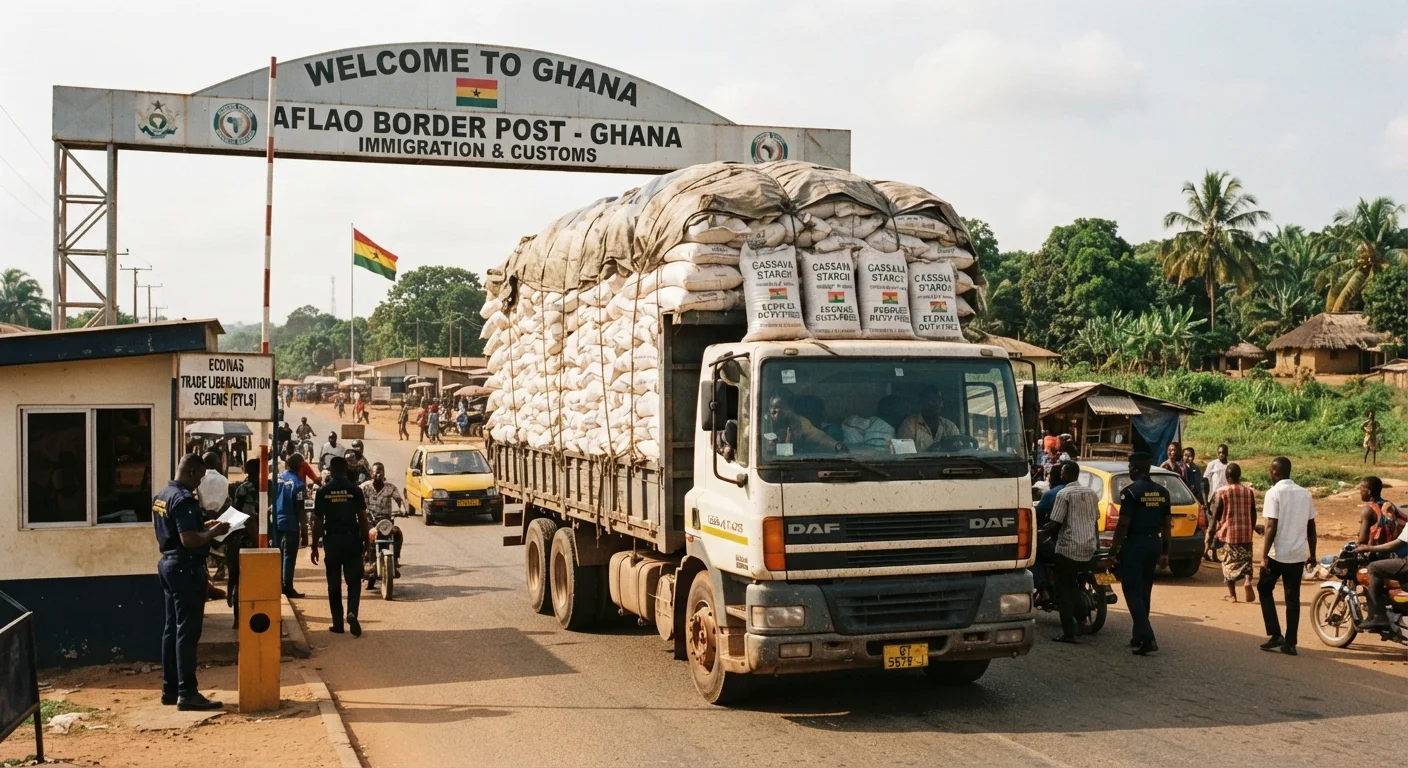
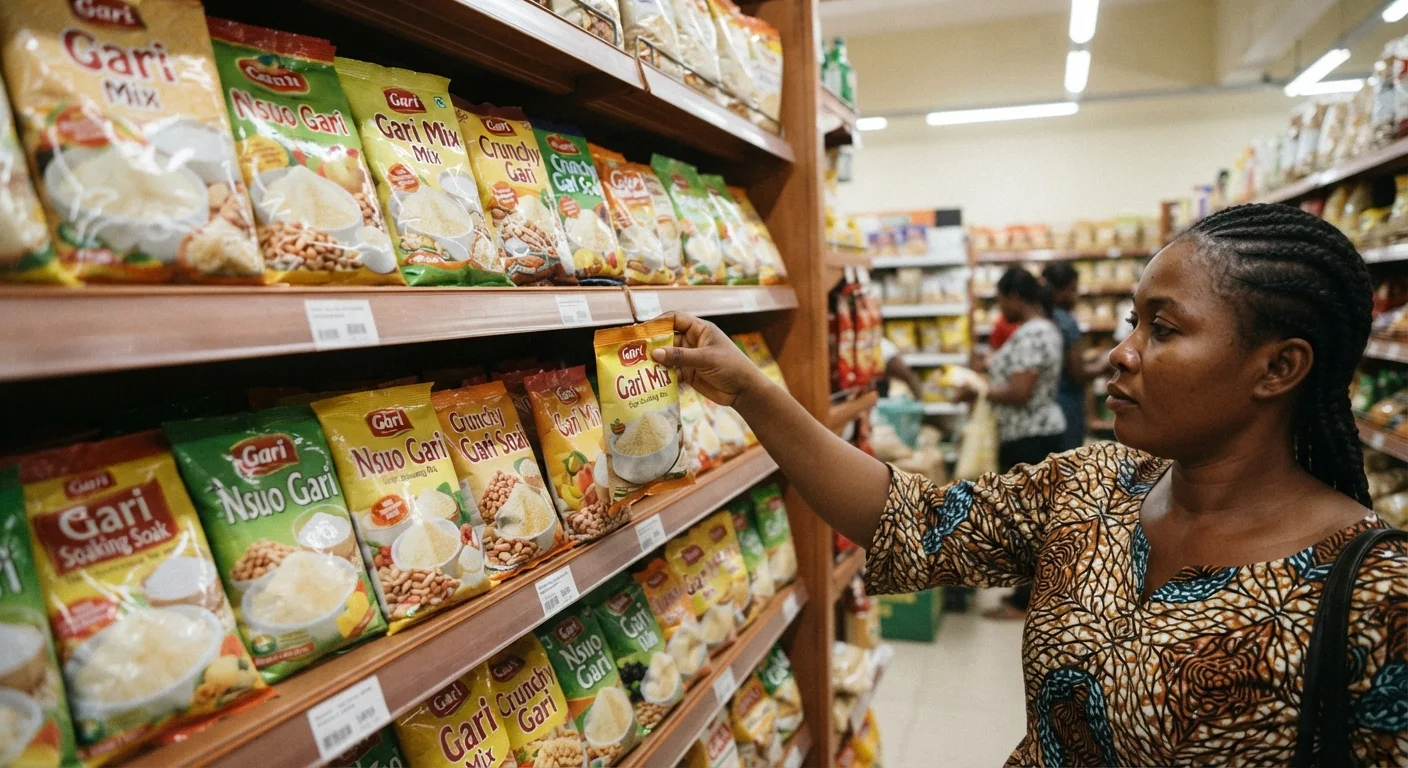
The liveliest current signal is not a commodity at all; it is branded, packaged, convenient cassava. Procus Ghana’s Kivo four-in-one gari soaking mix, a ready-to-eat sachet aimed at students and busy workers, already sells into Liberia, the Gambia and Sierra Leone, showed at Gulfood 2026 in Dubai, and signed a Premier League footballer as its brand ambassador.10Oxy Industries sells its Sunny Gold gari in retail sachets with a dedicated export contact.11 Around them sit small but real investments and a seat at the international table: Ghanaian value-chain delegations have attended Brazil's international cassava fair (FIMAN) since 2023, with another mobilised for November 2025, and new district-scale processing factories came on stream in 2025 and 2026.12
And the branded segment does not only grow, it pays: branded Nigerian gari is quoted at roughly GH¢500 to 1,200 a bag against about GH¢200 to 500 for local unbranded gari, a trade-press price range that suggests a real branding premium, one imported brands currently capture (Pillar 2). The market intelligence sits in that gap. The money in the moving market is the branding itself, and it is leaving with the importer, so a consumer brand for the region and the diaspora is where a new entrant should aim first.
Rank cassava’s markets by how reachable they are rather than how large they sound, and the usual export dream inverts. The domestic market is the biggest and nearest. The ECOWAS region is the next rung, duty-free and already buying branded convenience. The diaspora is a brand-led premium beyond it. Food-grade starch for Europe is the furthest rung, gated by standards and worth the climb only once the nearer ones are secured. The winning move is to work up the ladder from home.
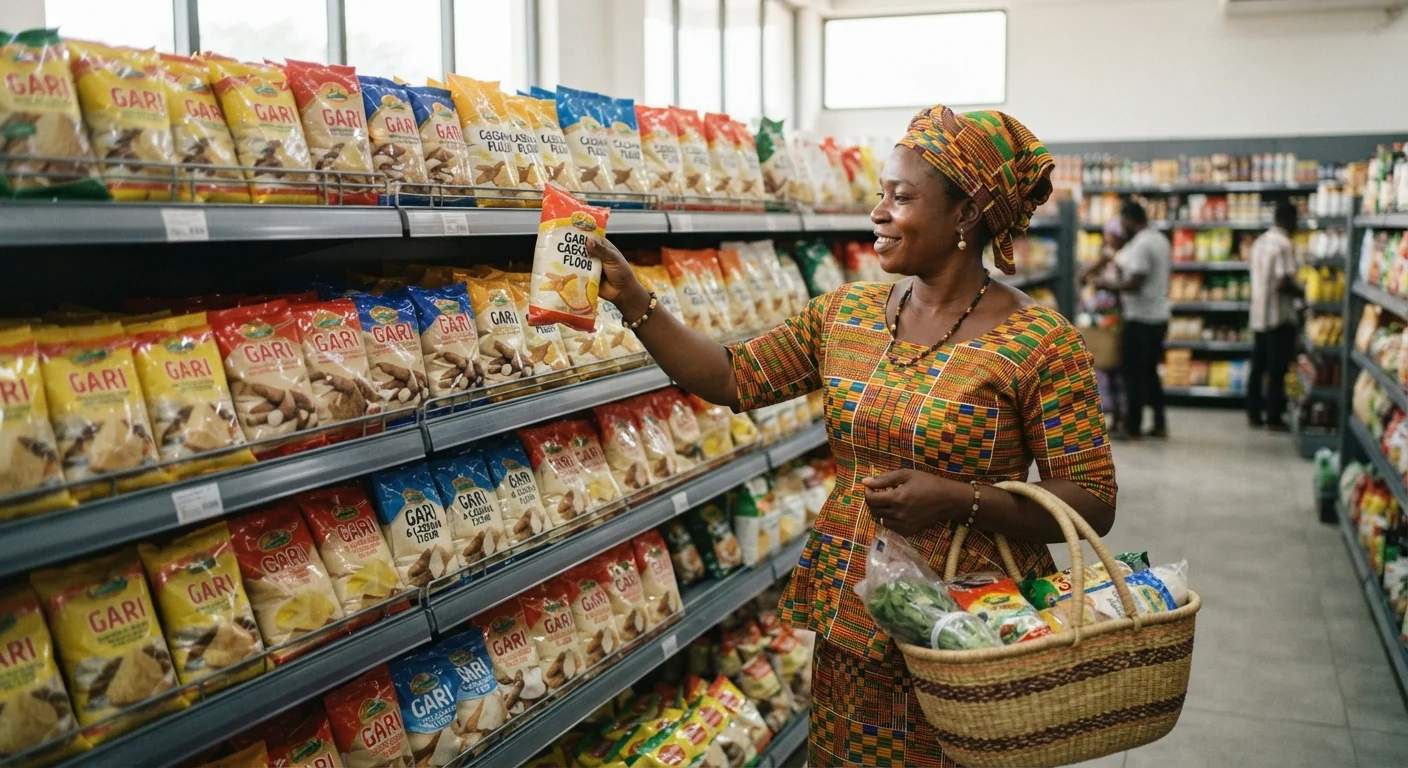
The instinct is to target the big Western commodity markets, but Ghana cannot beat Thai and Vietnamese prices on flour or industrial starch, and the buyers it can actually reach are regional and diaspora.
Anyone sizing a business on the big Western commodity markets, where Ghana cannot beat Asian prices, instead of the regional, diaspora and food-grade buyers it can reach.
Sell food-grade starch on proximity and clean-production credentials to Europe, and branded products to the region and the diaspora; do not fight a price war in the commodity flour trade.
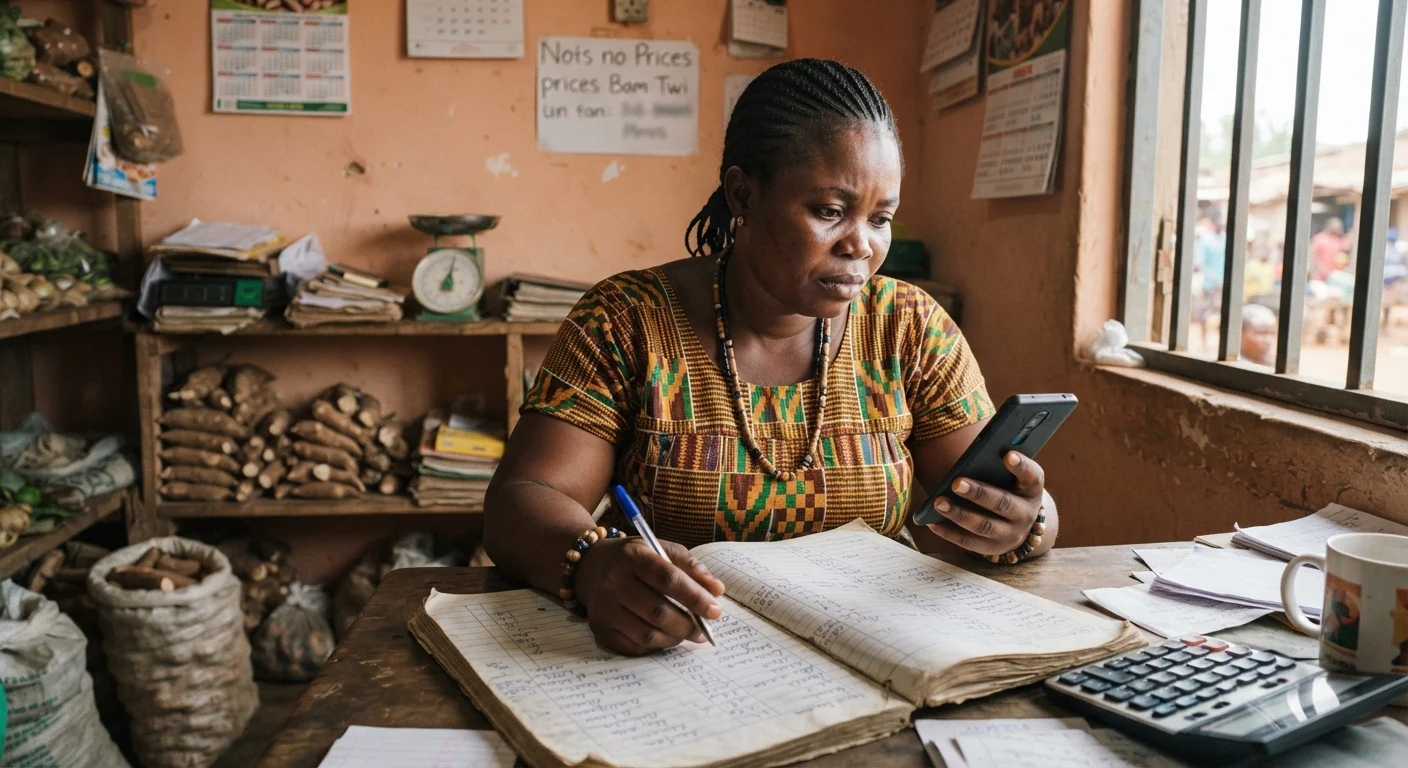
Cassava products barely register in official or commercial price data, so an exporter has no reliable benchmark and a single quote can be wildly off.
Any exporter or processor pricing off a single quote, since cassava products barely register in official or commercial price data.
Price off the domestic and regional markets you can see, build direct buyer relationships for real quotes, and treat one-off international prices as indicative only.
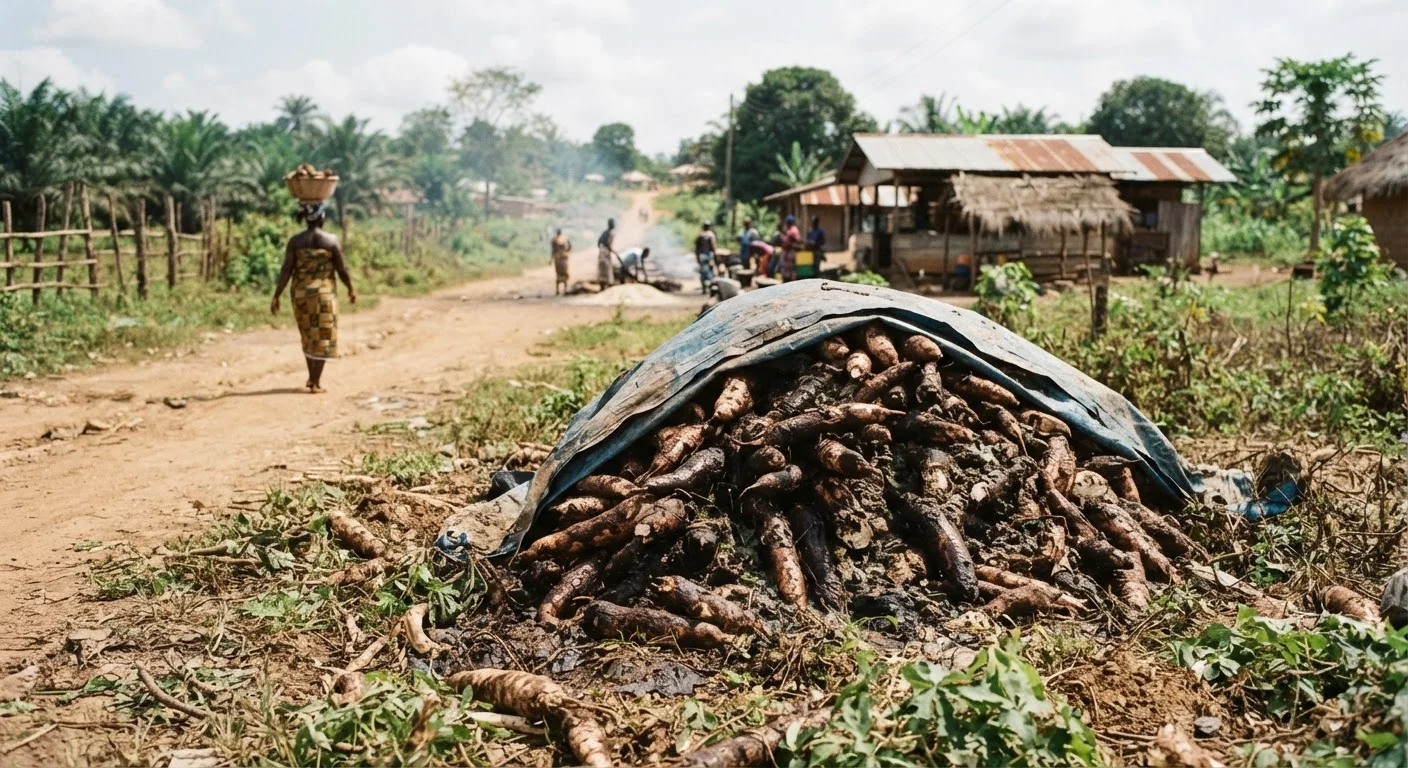
The headline market intelligence is an absence: cassava products are not in Ghana's top-ten exports and Ghana is invisible in global cassava price data. Read that as direction rather than failure.
The market is at home and regional, well short of the distant commodity export market; Ghana even imports cassava products (ethanol, and Nigerian starch), so import substitution is the biggest near-term opening.
In export terms, flour is a small and shrinking niche; cassava starch, a market of more than US$1.7 billion in imports, is the prize, food grade above all, and Ghana's edge for Europe is proximity and clean production, more than price.
The demand that is actually moving is branded, convenient cassava (Kivo, Sunny Gold) into regional and diaspora markets.
With no reliable price signal, treat single export quotes as noise and price off the markets you can see.
Where this connects.The products these markets buy, and the standards they demand, are Pillar 6’s; the surplus that has to find a buyer is Pillar 2’s, and the chain that must deliver it is Pillar 6’s. What to actually do about all of it, the strategy, the policy and the sequence, is the subject of the final pillar, Strategic Outlook (Pillar 8).