Ghana Agribusiness PlaybookBeef Cattle
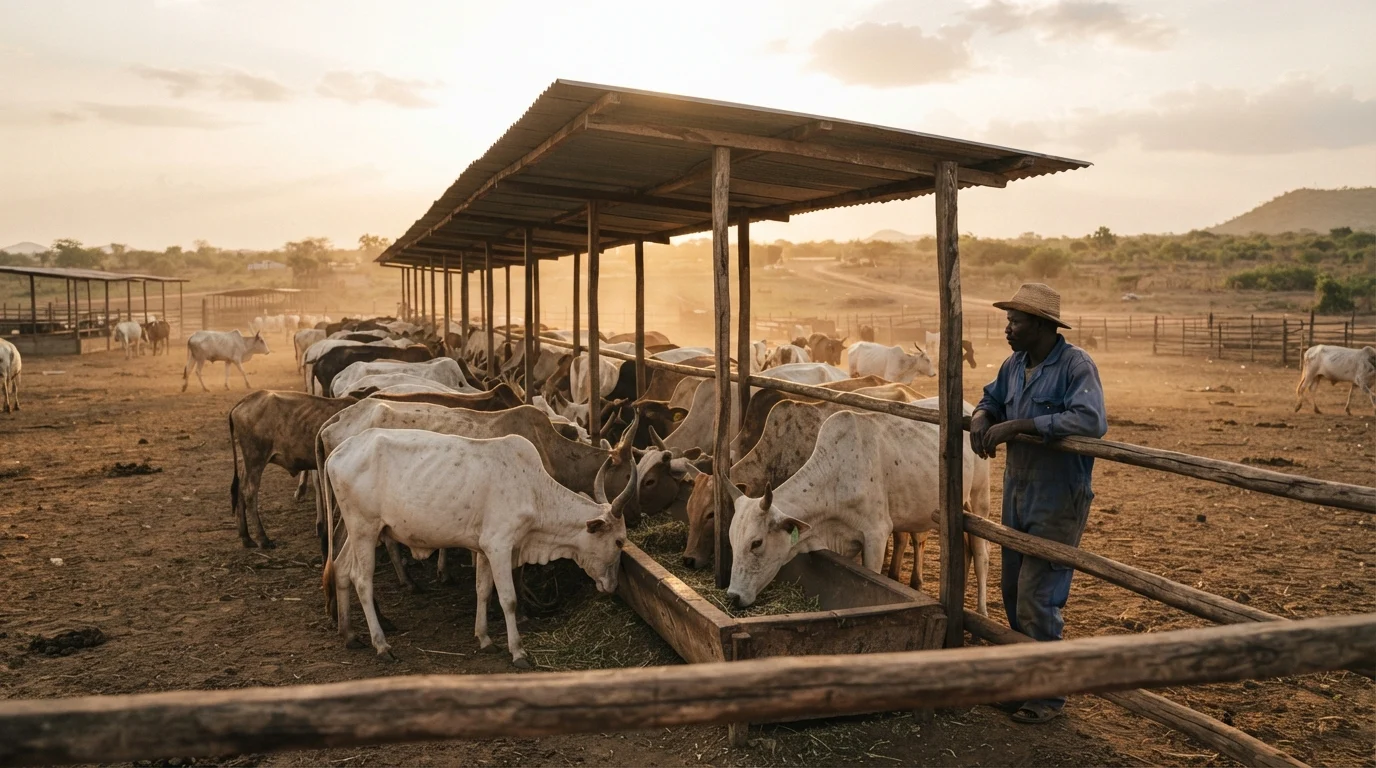
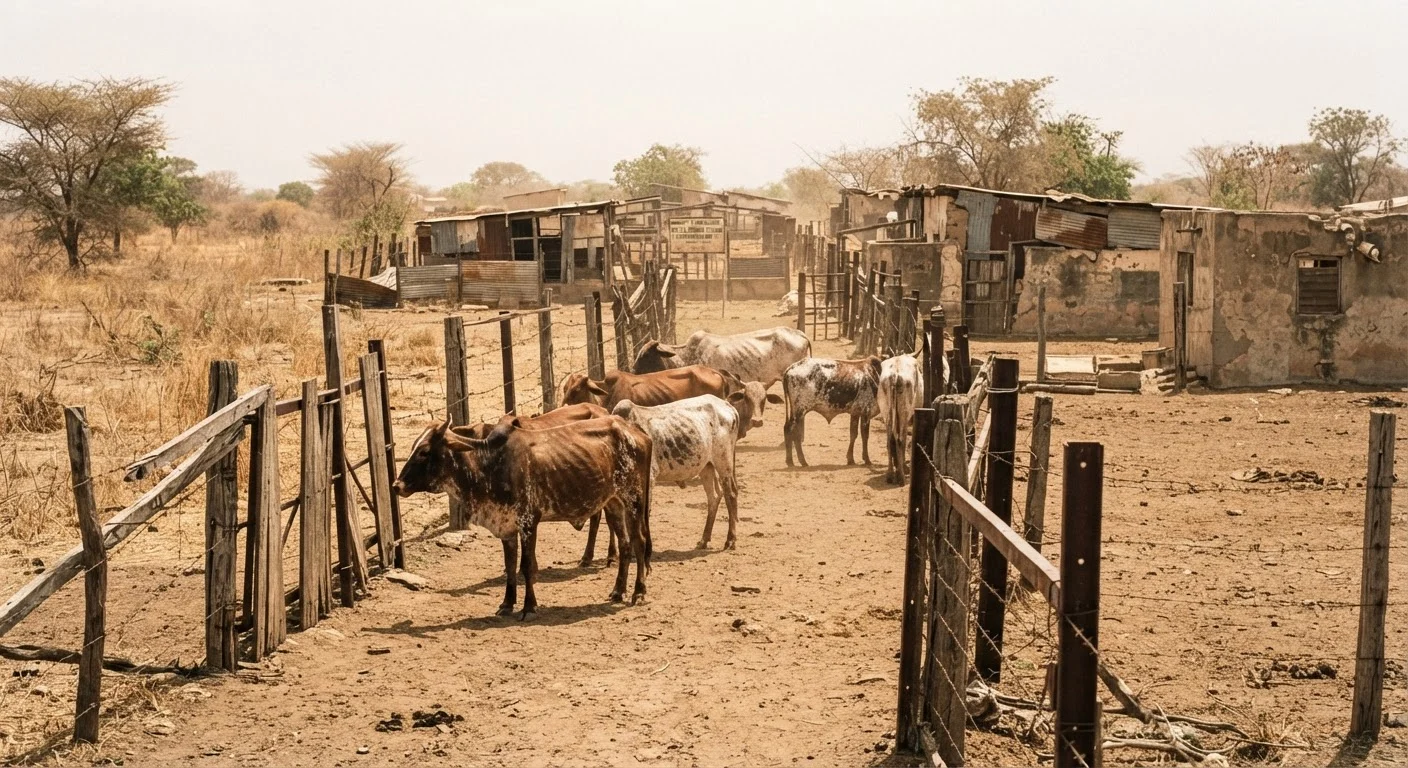
A finishing yard where lean northern animals are penned and fed for market
Beef Cattle · Pillar 04

Production Systems

Three ways to keep a beef animal, and they are three different businesses. Ghana has overwhelmingly chosen the cheapest, and that is why it has a herd but not a beef industry.
Production Systems · Pillar 04

There are three ways to keep a beef animal in Ghana, and they are not three points on one ladder; they are three different businesses. You can hold cattle loose on the savannah as walking wealth, the way almost everyone does; you can keep them closer and feed them a little; or you can pen them and finish them for meat, which almost nobody does.

The system is a choice about how much money and attention you put in and what you want out. Ghana has overwhelmingly chosen the cheapest, lowest-effort option, and that choice, rather than the breed or the weather, is why the country has a herd but not a beef industry.

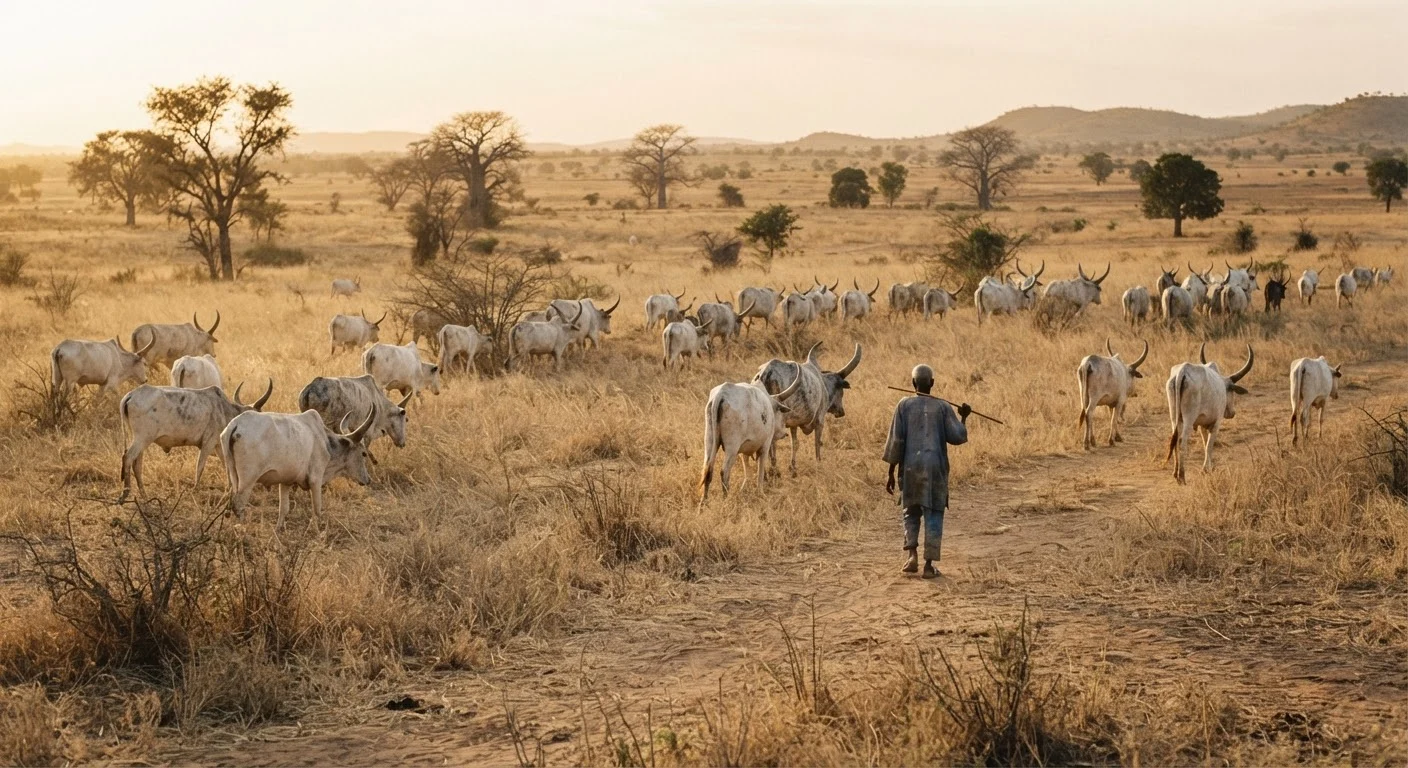
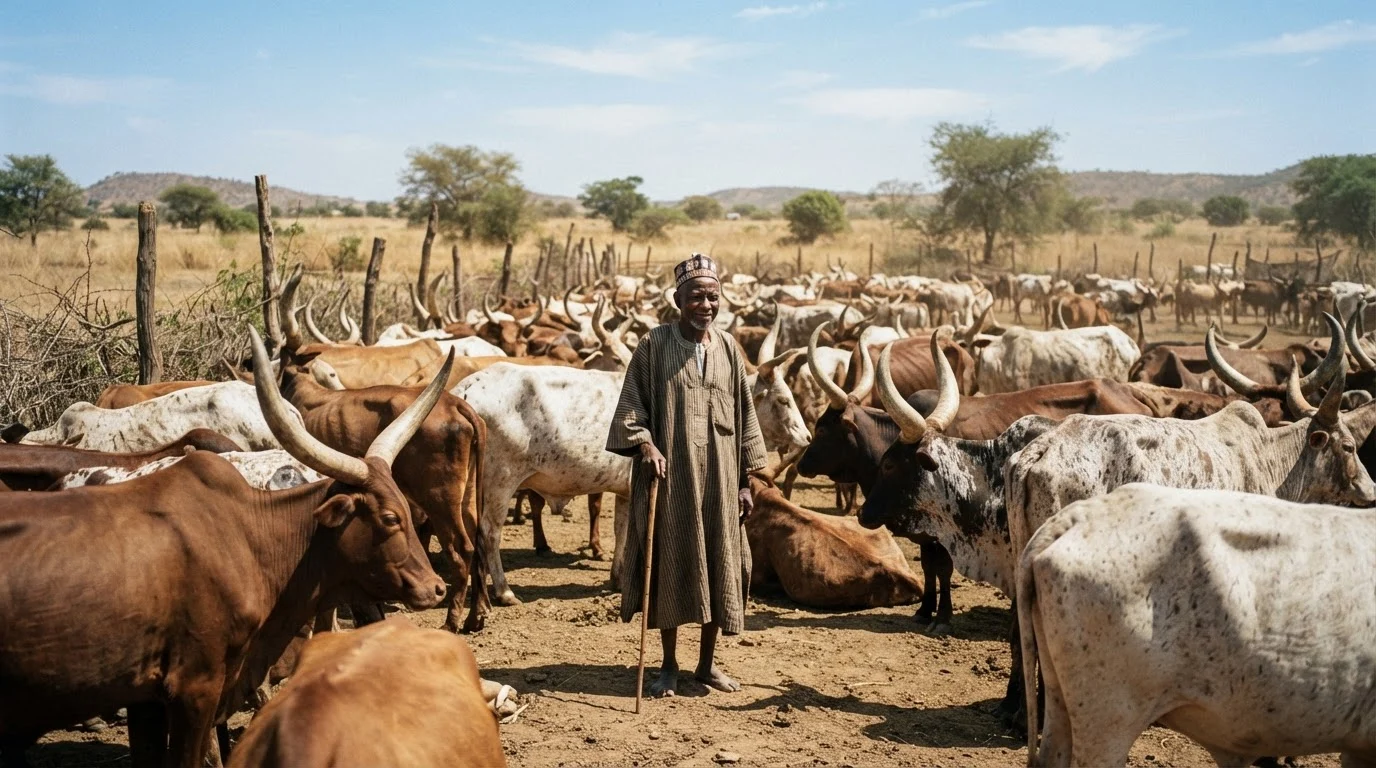
A loose herd of white and grey Sanga cattle grazing free across open northern Ghanaian savannah at golden hour, a single herder with a long stick walking behind them, scattered shea and baobab trees, dry pale grass, warm earthy tones, documentary photograph, natural light, no text, no watermark
Walking wealth, not meat
The choice: how much money and attention you put in, and what you want out.
~95%
of Ghana's beef comes from extensive, free-range, low-input keeping
~84%
of the herd sits in the northern savannah, furthest from the buyers
~11%
offtake rate, against roughly 30 percent for sheep and goats

🐄 Three ways to keep an animal, and the one Ghana barely uses 🐄

The first thing to fix in your head is that a production system is a capital decision.

About 95 percent of Ghana's beef comes from extensive, free-range, low-input keeping, with almost no dry-season feeding, on herds held as savings (MADE Northern Ghana, 2014), so the system that makes meat is the one Ghana almost does not have (MADE Northern Ghana, 2014; USDA FAS, 2023).

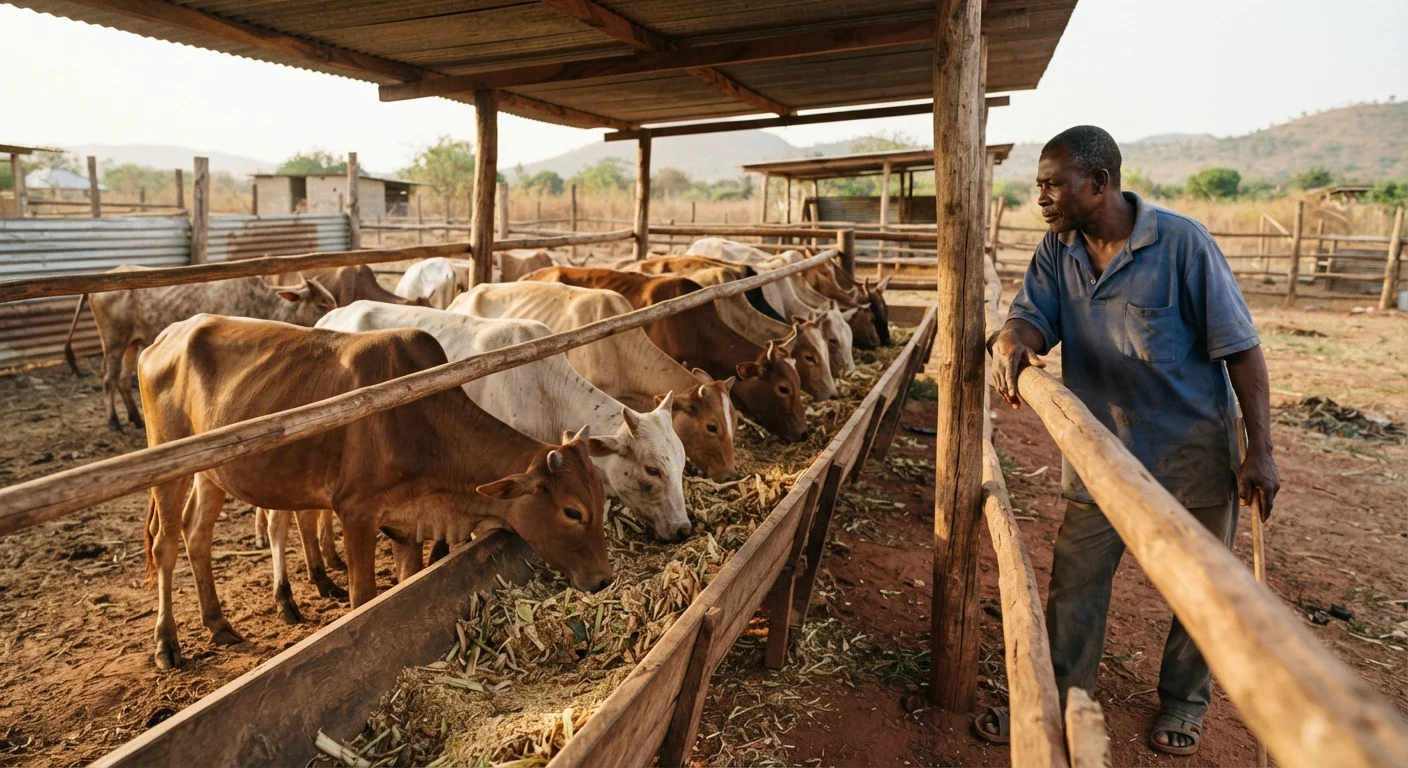
A small commercial cattle finishing pen in Ghana, a dozen lean Sanga steers standing at a wooden feed trough filled with chopped crop residue and concentrate, timber and steel rails, red laterite ground, corrugated shade roof overhead, a stockman leaning on the rail watching them feed, warm earthy tones, documentary photograph, natural light, no text, no watermark
The business Ghana almost does not have
The feedlot: the only system built to produce beef on purpose.
Read the three systems one at a time

Store wealth, spread risk

Extensive pastoral keeping, where cattle roam and graze free with a herder and no bought feed, costs almost nothing to run and returns almost nothing per animal; it exists to store value and spread risk, not to make meat.

Capital and effort
Very low; free grazing, a herder, no bought feed
Disease exposure
High; open contact, tsetse, ticks, herd mixing (Pillar 3)
Output
Slow growth, light carcass, high losses
Who it suits
Traditional owners; the ~95 percent
Table 5: The three systems read as three businesses: what you put in decides what you get out
SystemCapital and effortPurposeDisease exposureOutputWho it suits
Extensive pastoral / transhumantVery low; free grazing, a herder, no bought feedStore wealth, spread riskHigh; open contact, tsetse, ticks, herd mixing (Pillar 3)Slow growth, light carcass, high lossesTraditional owners; the ~95 percent
Agro-pastoralLow to moderate; some residues and supplement, closer herdingStore wealth plus some saleModerate; still grazes but more managedA little faster, a little heavierSettled smallholders near cropland
Feedlot / ranching (finishing)High; pens, bought feed, water, labour, vetMake meat, turn a marginLower if managed; controlled contact, dosed and vaccinatedFast weight gain, market-ready in a set windowCommercial finishers and investors

Sources: MADE Northern Ghana (2014); USDA FAS (2023); Vaskó et al. (2022); Roelen (2017).

What this means. Read the table as a menu of businesses rather than a scale from bad to good. The extensive system did not fail at finishing; it never tried. It is a savings vehicle that happens to use cattle, rational for the owner who wants a buffer rather than a margin. It cannot produce beef at the price and pace the market needs, because that was never its purpose. The commercial opening is the bottom row, the one almost nobody occupies: the finisher who chooses the meat business on purpose, and so avoids competing with two million animals kept for an entirely different reason.

🐄 Why almost everything is extensive, and what the cheap system costs 🐄

Arithmetic, not ignorance, explains why the extensive system dominates. Free grazing on communal land is nearly free, the herder is often family or a hired Fulbe herdsman paid in kind, and the animal needs no shed and no ration. Herds average about 42 head in the north and 22 in the south, and about 95 percent of output is extensive free-range keeping with no feed supplementation (Ghana Country Analysis; MADE, 2014 to 2018).

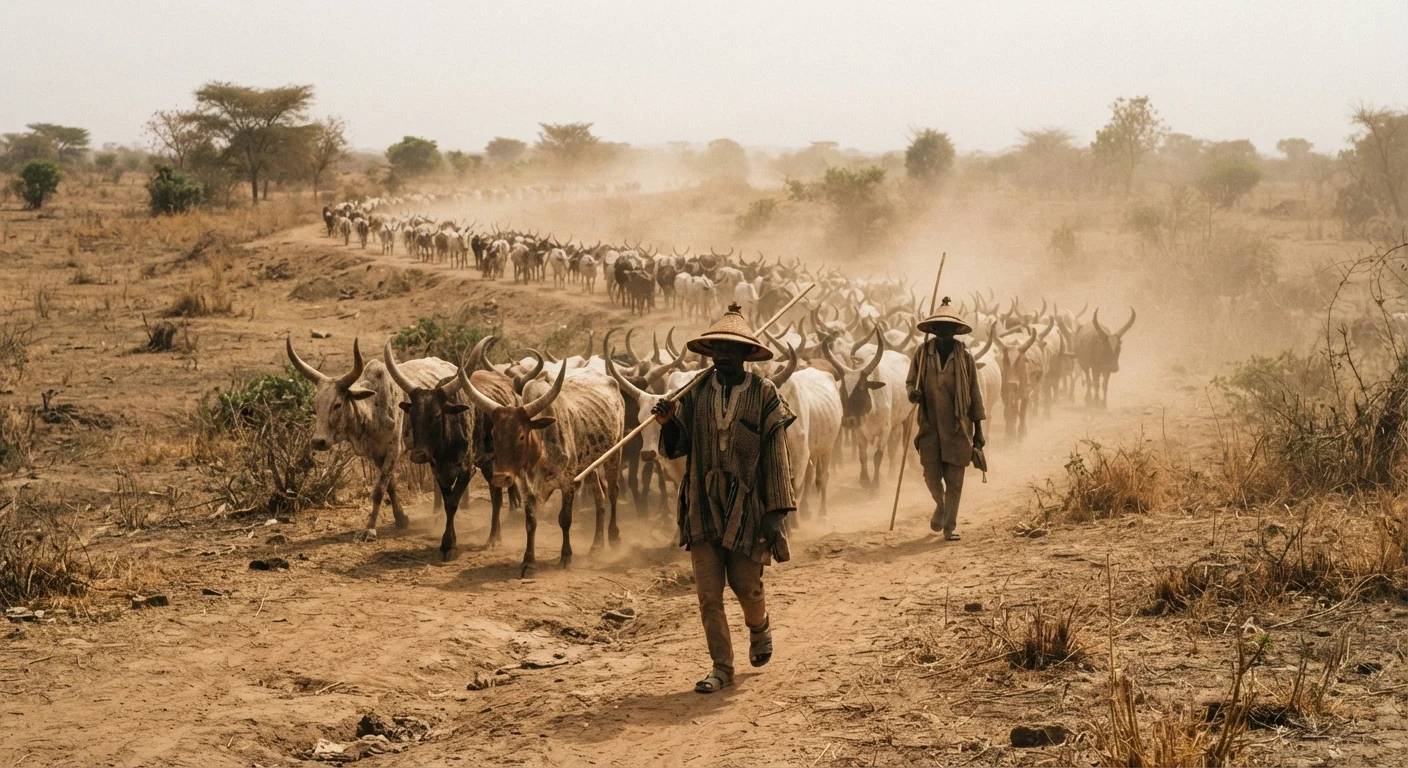
Some of the herd is transhumant, driven down from Mali, Niger and Burkina Faso once or twice a year to graze and trade (Vaskó et al., 2022). For an owner who wants a store of wealth, this is the sensible way to hold it: low cost in, low risk of ruin, cash available on the hoof when a crisis comes. The trouble is that whatever makes the system cheap also makes it a poor way to grow beef.

The cheap system carries three hidden bills. The animal grows slowly, taking years to reach a sellable size rather than months (the slaughter age is read in Pillar 1). It dies more often: cattle lose about 10 to 14 percent of the herd a year, much of it to preventable disease, and animal disease costs Africa on the order of US$9 billion a year (Nuvey et al., 2022 to 2023), much of it preventable and most of it borne by extensive herds with thin veterinary cover (Pillar 3).

And it loses condition every dry season, because there is no stored feed to carry it through the months when the grass browns off. Low input buys low output, thin margins and a herd that is always one bad season from a loss. That is the real cost of keeping cattle the cheap way, and it is a cost the finisher exists to remove.

A transhumant cattle drive crossing the dry Sahelian border country into northern Ghana, a long line of horned zebu cattle raising dust on a bare earth track, two Fulbe herders in wide hats walking alongside with staffs, hazy harmattan light, warm earthy tones, documentary photograph, natural light, no text, no watermark
Driven down once or twice a year
Transhumant: down from Mali, Niger and Burkina Faso to graze and trade.
42 and 22
head, the average herd in the north and in the south
10 to 14%
of the herd lost a year, much of it to preventable disease
US$9 bn
a year, what animal disease costs Africa

MARKET SIGNAL: THE CHEAP SYSTEM SITS WHERE FEED IS SHORT AND BUYERS ARE FAR. The geography reinforces the system.

About 84 percent of the herd sits in the northern savannah, on the communal rangeland where extensive grazing is cheapest and the buyers are furthest away (MADE Northern Ghana, 2014). That is why finishing has not emerged on its own: the animals are where feed is scarce in the dry season and cash is short, and the market is hundreds of kilometres south (Pillar 6). A finishing or agro-pastoral operation that brings measured feed to the northern herd, or moves lean animals closer to the southern market to finish them, works the gap the extensive system leaves open.

🐄 Keeping to store wealth, or finishing to make meat 🐄

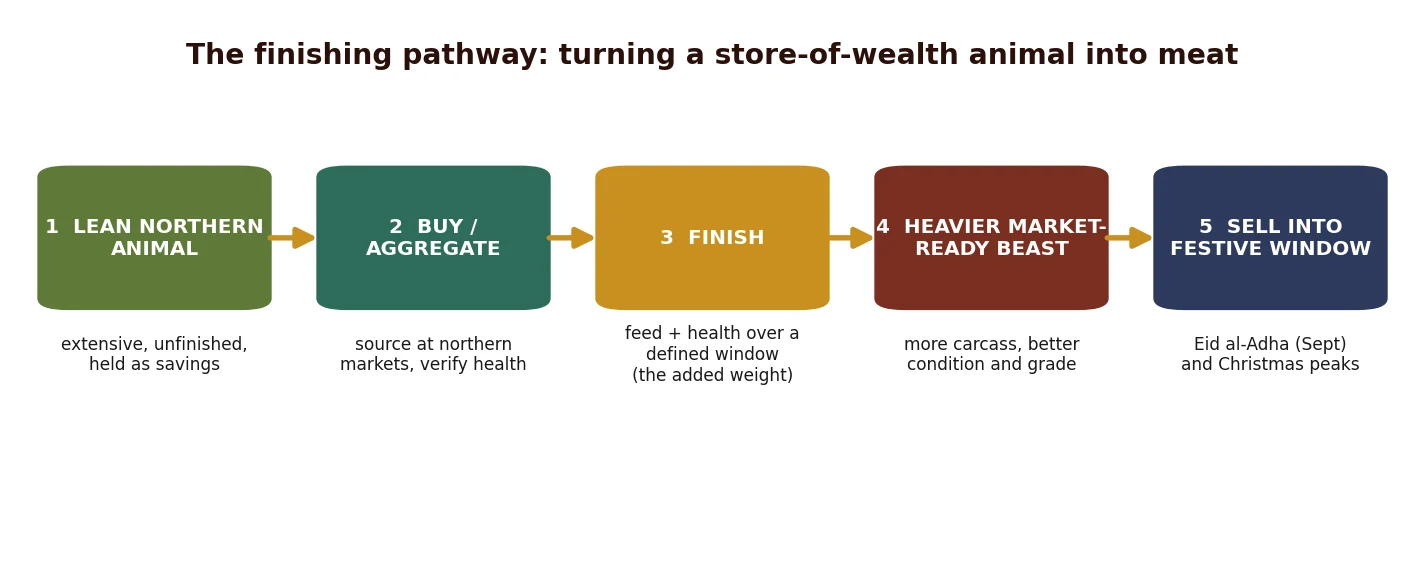
The finishing pathway: from store-of-wealth animal to market-ready beast
Figure 10 The finishing pathway: from store-of-wealth animal to market-ready beast
What this shows

Finishing turns a store-of-wealth animal into a heavier, market-ready beast in a defined window. It is the single step that converts the herd into a beef business.

This is the decision that defines the pillar. To keep is to hold an animal as savings and sell it only when you must; the store-of-wealth logic behind it is set out in Pillar 1 and shows up as an offtake rate of about 11 percent, well below the roughly 30 percent for sheep and goats, because cattle are held as a store of wealth rather than finished for sale (MADE Northern Ghana; Ministry of Food and Agriculture, SRID, 2014 to 2024). To finish is the opposite intent: to buy a lean animal specifically to add weight and condition over a defined window and sell it heavier, for a margin.

The keeper measures success in headcount and security; the finisher measures it in weight gained per day and in the gap between buy price and sale price. Same animal, opposite businesses. Ghana has millions of keepers and almost no finishers, which is precisely why the finishing step is the widest opening in the sector.

Finishing is nothing exotic, just a short, disciplined routine laid over an animal the country already has. You buy lean northern stock, settle and treat it, feed a measured ration of crop residues and concentrate for a set period, and sell into a known demand window such as Eid or Christmas (cattle prices spike at the two big festive windows, Eid al-Adha and Christmas, when a finisher sells best; Eid moves earlier each year and fell around the middle of 2026, so the sale must be planned months ahead (Roelen; live market search, 2017 to 2026)).

The few operators who fatten confirm both the shape and the drag of it: on the few farms that fatten cattle, medicine is the biggest cost at about 40 percent of the bill, and females are held about 50 months, a long, capital-slow cycle (Roelen, 2017). Get the routine right and a slow store-of-wealth beast becomes a market-ready carcass; the numbers behind that conversion, and why the buy price and death losses decide the profit, belong to Pillar 5.

The output the finisher is chasing is a heavier animal than the extensive system yields. A mature beast gives about 125 kilograms of carcass off roughly 200 to 250 kilograms liveweight, a dressing percentage near half (Oppong-Apane; Aboagye, 2002 to 2016).

~40%
of the bill is medicine on the few farms that fatten cattle
~50 months
females are held, a long, capital-slow cycle
🐄 The Opening: the meat business nobody is running 🐄
01

Commercial cattle finishing. Buy lean, feed to a standard for a defined window, and sell heavier and timed to the festive peak. This is the meat business the extensive system is not running, and the clearest, most repeatable margin in the sector (Pillars 5 and 6).

02

Agro-pastoral upgrading. Help settled smallholders add residues and a little supplement to their existing herds, lifting weight and survival without the full capital of a feedlot. It is the low bridge between the cheap system and the meat business.

03

Feed and fodder supply. A finishing tier needs a dry-season ration it cannot currently buy; the operator who bales, stores and sells crop residues and concentrate feeds the whole opening from below (Pillar 5).

🐄 The dry-season feed and nutrition gap 🐄

The one input that separates a keeping regime from a finishing regime is feed, and Ghana's cattle economy runs almost without it. The extensive herd eats what it walks over, so in the long dry season, when the savannah grass browns and loses its protein, animals stop growing and lose the weight they gained in the rains (Obese et al., 2018).

No stored fodder carries them through, so the year becomes a cycle of gain and loss that nets out slow. The cause is nutrition, not disease or breeding, and it explains why a Ghanaian beast takes years to finish what a fed animal finishes in months.

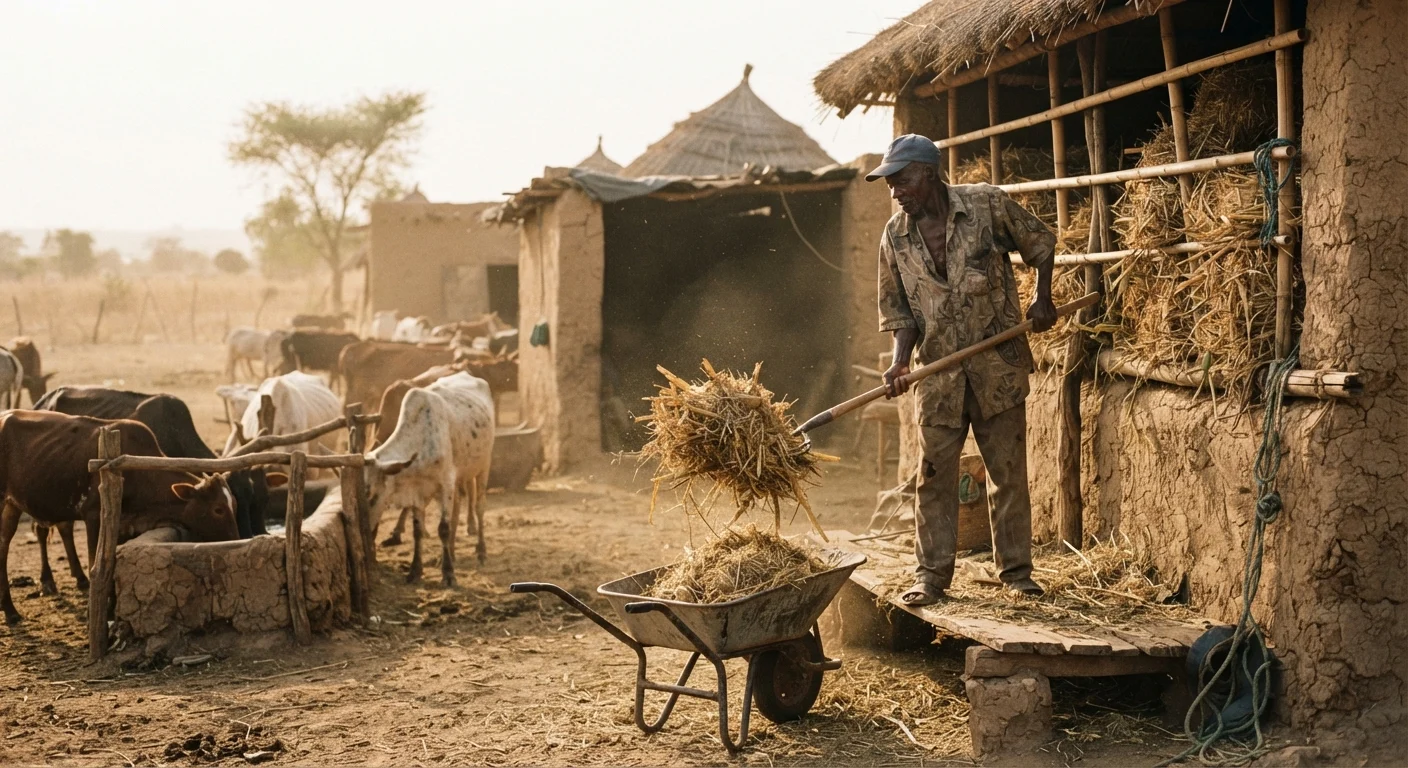
A Ghanaian farmer forking baled maize stover and groundnut haulm from a thatched storage rack into a wheelbarrow beside a mud-walled compound, dry season, cattle waiting at a nearby trough, golden dust in the air, warm earthy tones, documentary photograph, natural light, no text, no watermark
The ration the herd has never had
Stored feed: bale it, store it, sell it, and the whole opening becomes possible.
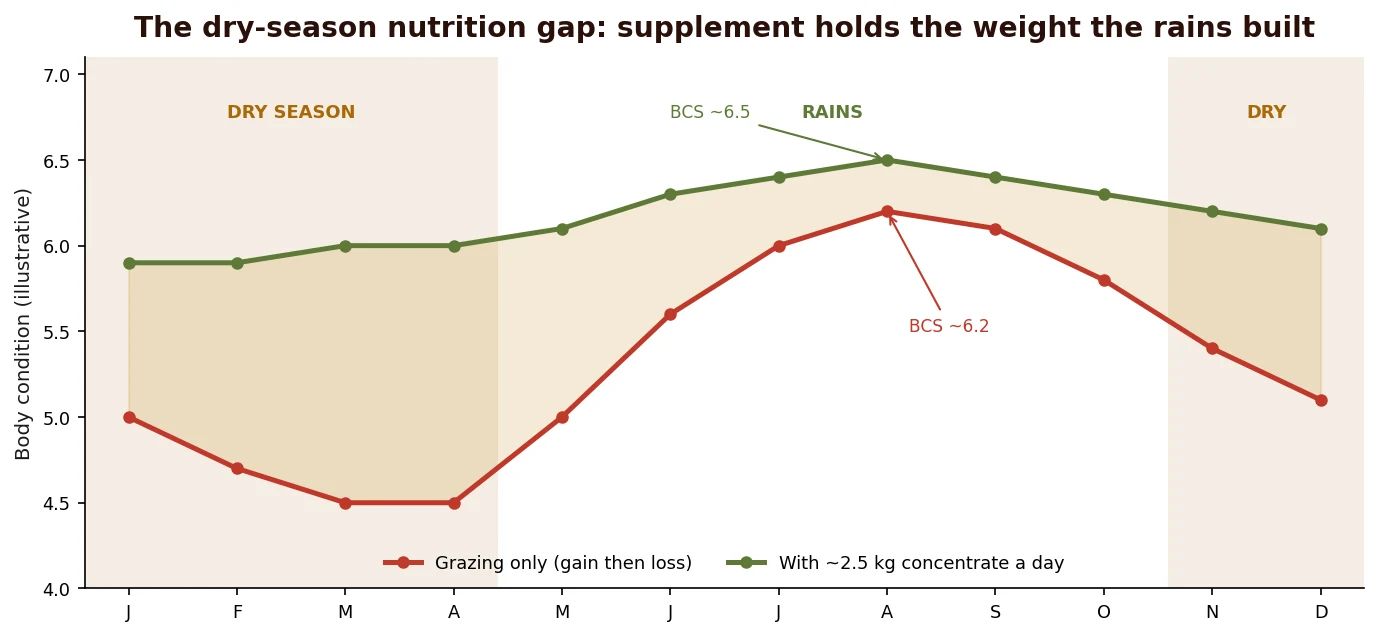
The dry-season nutrition gap and how supplementation closes it
Figure 11 The dry-season nutrition gap and how supplementation closes it
What this shows

A grazing-only beast gains weight in the rains and gives much of it back through the long dry season, while a lightly supplemented animal holds condition year round, so the constraint is feed, not the animal, and feed can be bought or grown.

The fix is proven and modest. A controlled Ghanaian trial found that cows given about 2.5 kilograms of concentrate a day held far better body condition, roughly 6.2 against 5.8 on the score, and produced more milk, about 1.94 against 1.55 litres a day, than cows left on natural pasture alone (Obese et al., 2018).

A steady top-up, well short of a full ration, is enough to lift performance. That is the thesis of finishing in one experiment: the animal can perform; feed is the constraint, and feed can be bought or grown. What that ration costs, and how it flows through to profit, is Pillar 5; the point here is that the gap exists and is closable.

What this means. Treat the dry-season feed gap as the entry point, not a background hardship. Because 95 percent of the herd gets no supplement, even a simple, reliable dry-season ration is a differentiator: it lifts growth and survival at once and is the physical thing that makes finishing possible. The opening runs beyond finishing cattle yourself: supply the feed, bale and store the crop residues, and offer the ration the extensive system has never had. Feed is the lever every other opportunity in this pillar pulls on.

2.5 kg
of concentrate a day is enough to hold far better body condition
6.2 vs 5.8
body condition score, supplemented against natural pasture alone

🐄 Why there is no commercial breeding farm to buy stock from 🐄

A would-be finisher quickly hits a wall that shapes the whole system: there is nowhere to buy improved stock. There are no commercial cattle breeding farms and the state's seven breeding stations underperform, so improved stock is scarce (Animal Production Directorate; MADE, 2014). The state's stations were meant to supply better-selected, faster-growing animals and artificial-insemination services; in practice they have not achieved the traits or the services intended, and their output is thin (MADE Northern Ghana, 2014).

The old state ranches built for this, Tadzewu and Branam and the Ghana Livestock Company, are defunct, a reminder that state-led ranching has been tried and has failed before (Thébaud & Corniaux, 2019). So the entrant either makes do with unimproved animals off the open market or, as northern farmers already do, smuggles breeding stock across the border from Burkina Faso.

This is a gap and an opening at once. The absence of any private breeding farm means an operator who can reliably supply improved, trypanotolerant-yet-faster-growing stock fills a vacuum the whole sector feels, and does so where the public sector has repeatedly stumbled. It also means finishing and breeding are, for now, the same opportunity from two ends: someone has to make the better animal that finishing pays to fatten. The scattered herder ranches being set up in Afram Plains South, meant partly to ease farmer-herder friction, are the nearest thing to a model, and they remain pilots rather than a supply (Thébaud & Corniaux, 2019).

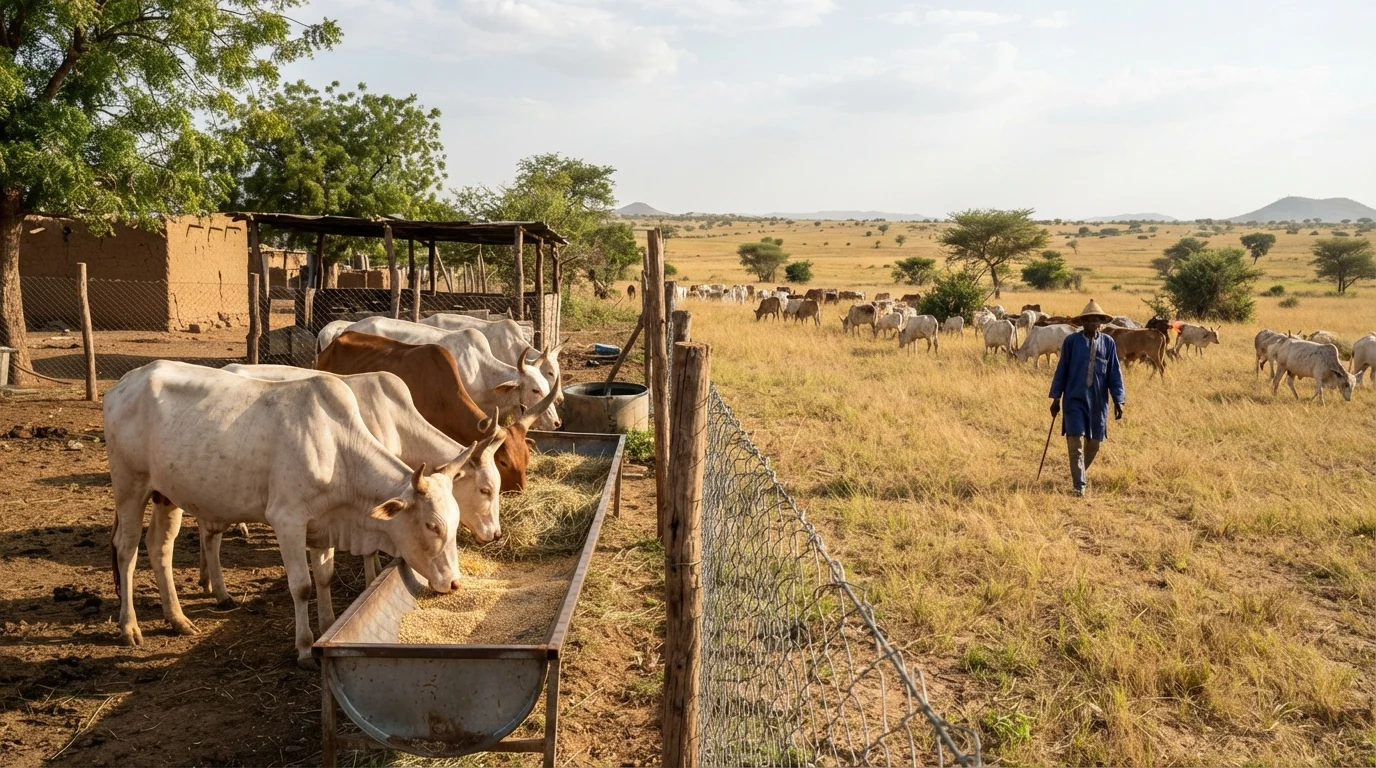
A penned finishing yard where lean northern animals are held and fed, against the open savannah herd
The system Ghana barely has
A penned finishing yard against the open savannah herd: the finishing system Ghana barely has and most needs.
7 stations
the state's breeding stations, which have not achieved the intended traits or services

🐄 The risks that sit inside the production-system choice 🐄

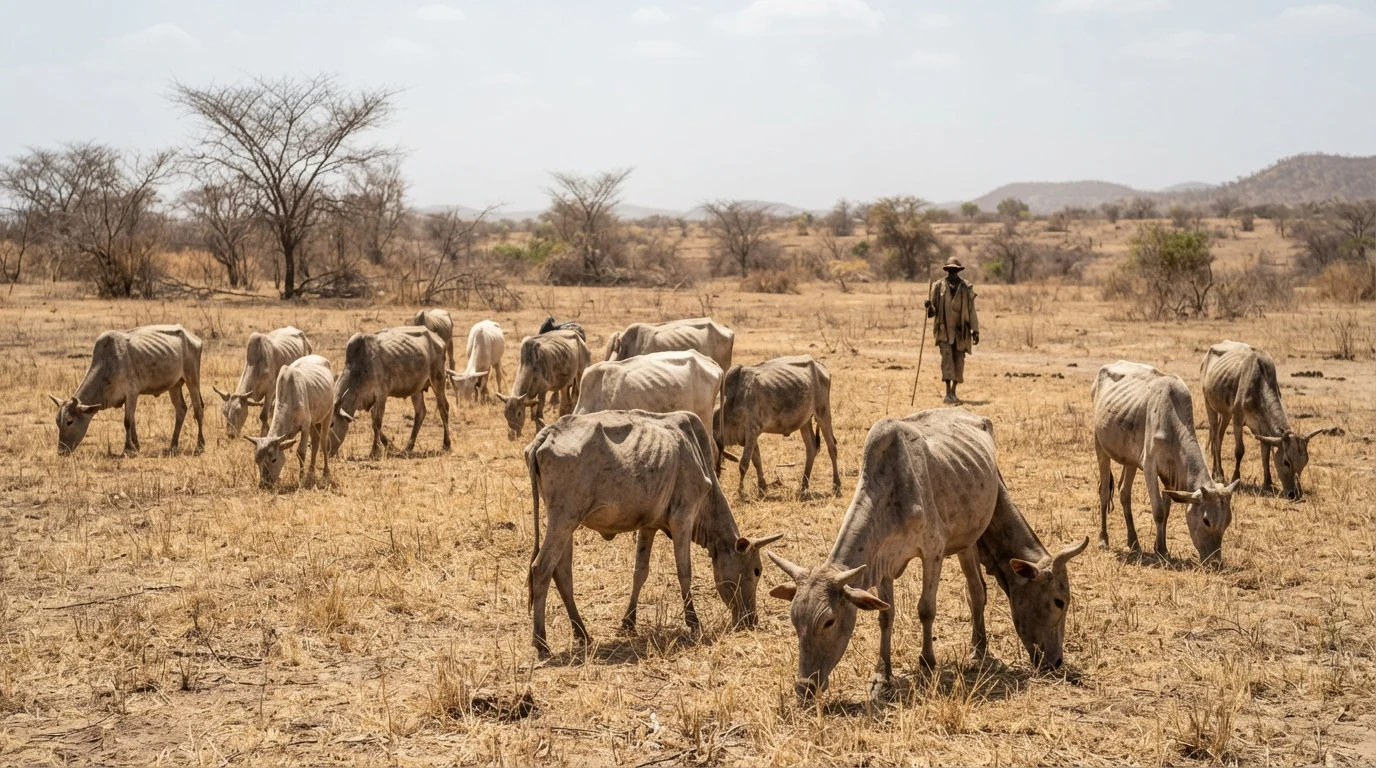
A herd grazing a browned-off dry-season field where the grass has lost its protein

The dry-season feed and nutrition gap

HIGH
What it is

Cattle in the extensive system eat only what they graze, so through the long dry season they lose the condition gained in the rains. A finisher who does not secure a dry-season ration will watch weight gain stall exactly when it is being paid for, and a keeper's animals thin out every year.

Evidence

Grazing-only cows lose condition in the dry season, while cows given about 2.5 kg of concentrate a day held body condition (about 6.2 versus 5.8) and gave more milk (Obese et al., 2018).

Who it hits

Every extensive keeper, and any finisher who buys animals without lining up stored feed first.

How to manage it, and the opening

Secure fodder before stock: bale and store crop residues, contract a concentrate supply, and budget feed as a core cost, not an afterthought (Pillar 5). The mirror-image opening is to be the one who supplies that ration.

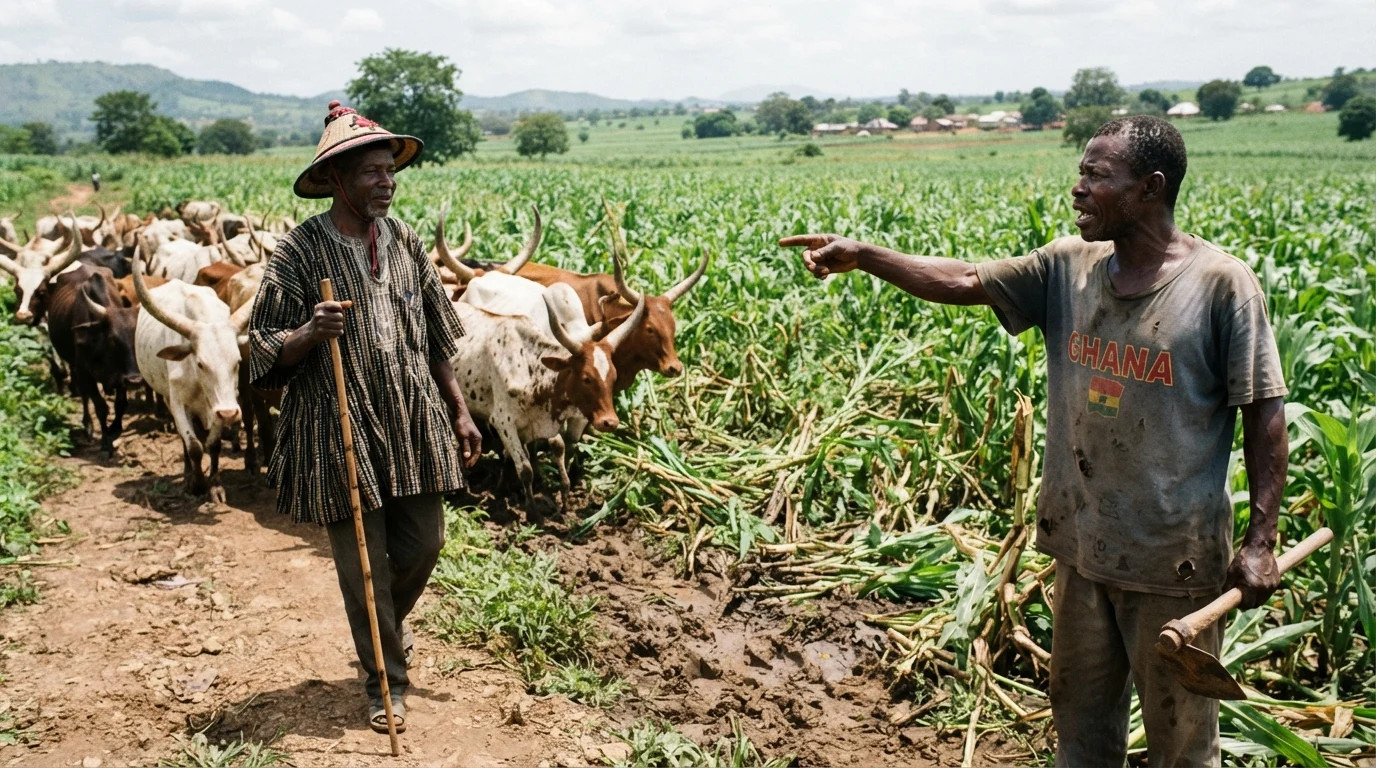
Cattle straying onto cropland where no land is reserved for grazing

Farmer-herder conflict over land and crops

HIGH
What it is

The extensive and transhumant systems depend on open grazing, but almost no land is reserved for it, so cattle stray onto cropland and trigger disputes that can turn violent. Any operation that relies on communal or transhumant grazing inherits this conflict, and the insecurity it brings raises the cost and risk of keeping cattle at all.

Evidence

No lands are reserved for grazing in Ghana except a few project areas, so transhumant cattle damage crops and range, a structural driver of farmer-herder conflict (MoFA, 2016).

Who it hits

Transhumant and extensive keepers, and settled farmers whose crops sit on the grazing routes.

How to manage it, and the opening

Move toward enclosed or agro-pastoral keeping with owned or leased grazing and stored feed, which cuts the reliance on open range. A penned finishing model sidesteps the conflict that free grazing cannot avoid.

No commercial breeder to buy improved stock from

MEDIUM
What it is

A finisher needs animals that grow fast when fed, but there is no private breeding farm to buy them from and the state stations underperform. Building a finishing business on whatever unimproved animals the open market offers caps the weight gain the system can deliver before it starts.

Evidence

There are no commercial cattle breeding farms and the seven state breeding stations have not achieved the intended traits or services (MADE Northern Ghana, 2014; APD).

Who it hits

New finishers and investors who assume improved, fast-growing stock can simply be sourced when needed.

How to manage it, and the opening

Select the best available local and Sanga-cross animals on condition and frame, and treat improved-stock breeding as a linked opportunity rather than a solved input (Pillar 1). Supplying that stock is itself the gap.

🐄 Key takeaways 🐄
01

A production system is a capital-and-purpose choice: extensive keeping stores wealth for almost no cost, and the feedlot makes meat for real money. They are different businesses, not steps on one ladder.

02

About 95 percent of Ghana's beef comes from the cheapest, lowest-input extensive system, which is rational for the owner but cannot produce beef at the price and pace the market needs.

03

The cheap system carries hidden bills: slow growth, high mortality and a dry-season loss of condition, because there is no stored feed to carry the animal through.

04

The feed gap is proven and closable. Modest supplementation, about 2.5 kg of concentrate a day, holds condition and lifts performance, so feed, not the animal, is the constraint.

05

There is no commercial breeding farm and the state's seven stations underperform, so finishing and improved-stock supply are the same wide opening from two ends.

Where this connects. The system chosen here sets the disease exposure that Pillar 3 must manage, since extensive open grazing is where foot-and-mouth, tsetse and tick pressure hit hardest. The finishing regime this pillar argues for is costed in Pillar 5, where the feed ration and the buy-versus-sale spread turn into a margin. And the store-of-wealth keeping that dominates today is the root of the low offtake read at the market in Pillar 2 and along the chain in Pillar 6.

Written for each reader

🐄 Practitioner intelligence 🐄

Hover any card to pause and lift it.

For students

Learn to see a herd and immediately ask which business it is running: is this animal being stored or being finished? The most useful skill you can build is reading body condition and estimating weight gain, because that is the language of the finishing business the country lacks. Understand why 95 percent of keeping is extensive, that it is a rational savings choice, not a mistake, so that you pitch finishing as a different business rather than a correction. Do not confuse a bigger herd with more beef; the two come apart exactly at the feed trough.

For entrepreneurs

First move: choose the finishing business on purpose, and secure the feed before you buy the stock. The classic newcomer error is to buy lean animals cheap, then discover there is no dry-season ration to grow them on, so the weight gain you are paying for never arrives. Start small and agro-pastoral if capital is tight, adding residues and a little concentrate to a handful of animals, and scale into a pen as the routine proves out. Avoid a business that leans on open transhumant grazing, because the farmer-herder conflict and the disease exposure that come with it are risks you cannot manage from inside the herd.

For investors

Ask which system a venture actually runs before you ask about its herd size, because an extensive operation dressed up as a beef business will never turn a finishing margin. Back the feedlot or integrated finishing model, the one built to make meat, and underwrite its feed supply as carefully as its stock, since the dry-season ration is the input that makes or breaks weight gain. Treat the missing breeding farm as both a risk and a thesis: a plan that assumes improved stock is available has misread the sector, while a plan that supplies it is filling a vacuum. The 10-year ranching tax concession (Pillar 7) improves the return on exactly the capital-heavy finishing model worth backing.

For ecosystem actors

The lever is feed and improved stock, the two inputs that let a keeping economy become a finishing one. Support dry-season fodder markets, baling and storage of crop residues, and the grazing reserves the policy framework promises but has not delivered, so that finishing becomes physically possible at scale. Rebuild breeding capacity, public or private, around the local trypanotolerant breeds rather than importing susceptible exotics, and measure success as the share of the herd that is finished and sold, not as headcount. The failure to avoid is subsidising more animals into a system that was never built to sell them.

Download full PDF
UpcomingThis document isn't available yet.