Ghana Agribusiness PlaybookBeef Cattle
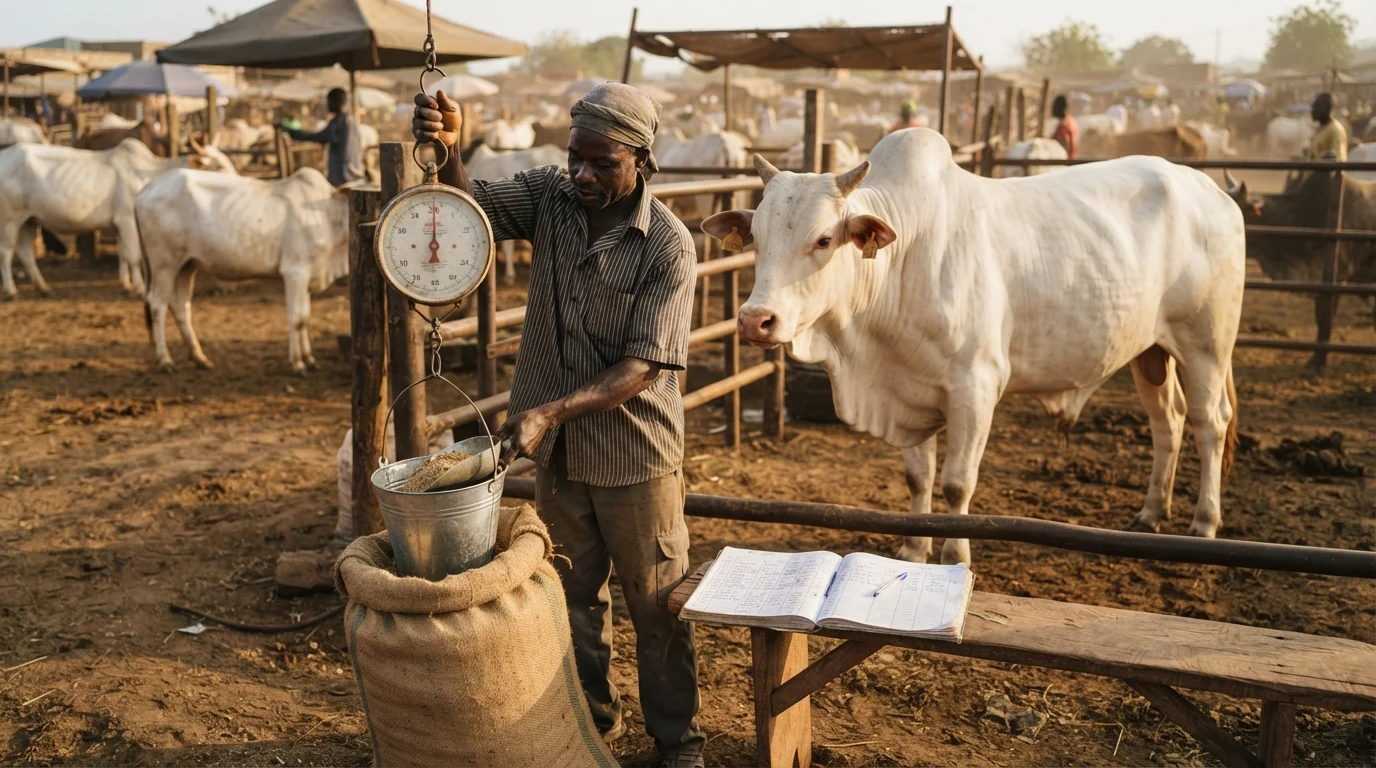
A cattle finisher weighing feed against the value of a market-ready beast
Beef Cattle · Pillar 05

Cost, Returns and Economics

The money is in the animal, not the feed. A finisher's margin turns on the buy price, the sale price and how many beasts die, and every figure here needs field validation.
Cost, Returns and Economics · Pillar 05

Cattle finishing can pay in Ghana, but nobody has published a budget to prove it, so the numbers here are built carefully and flagged as illustrative. The first thing to unlearn comes from poultry and fish, where feed is the whole game.

A beef finisher's economics turn instead on two prices, what the lean animal costs to buy and what the finished animal fetches to sell, and then on how many animals die and how much medicine costs. Ghana is a high-cost, slow-cycle producer, so the margin is made by buying lean animals cheap in the north, keeping death loss low, and selling into the festive price spikes. This pillar builds that case in numbers, and marks every figure red until the field can confirm it.

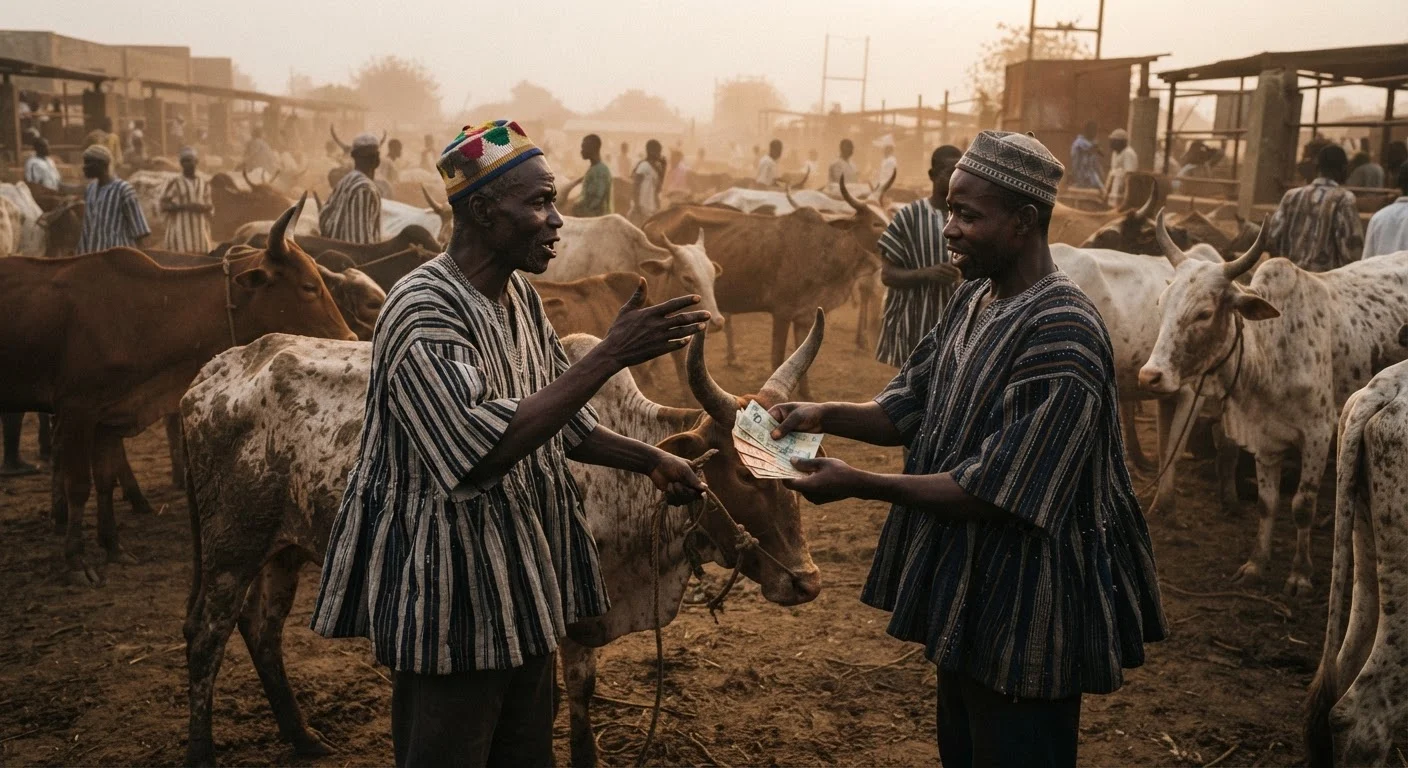
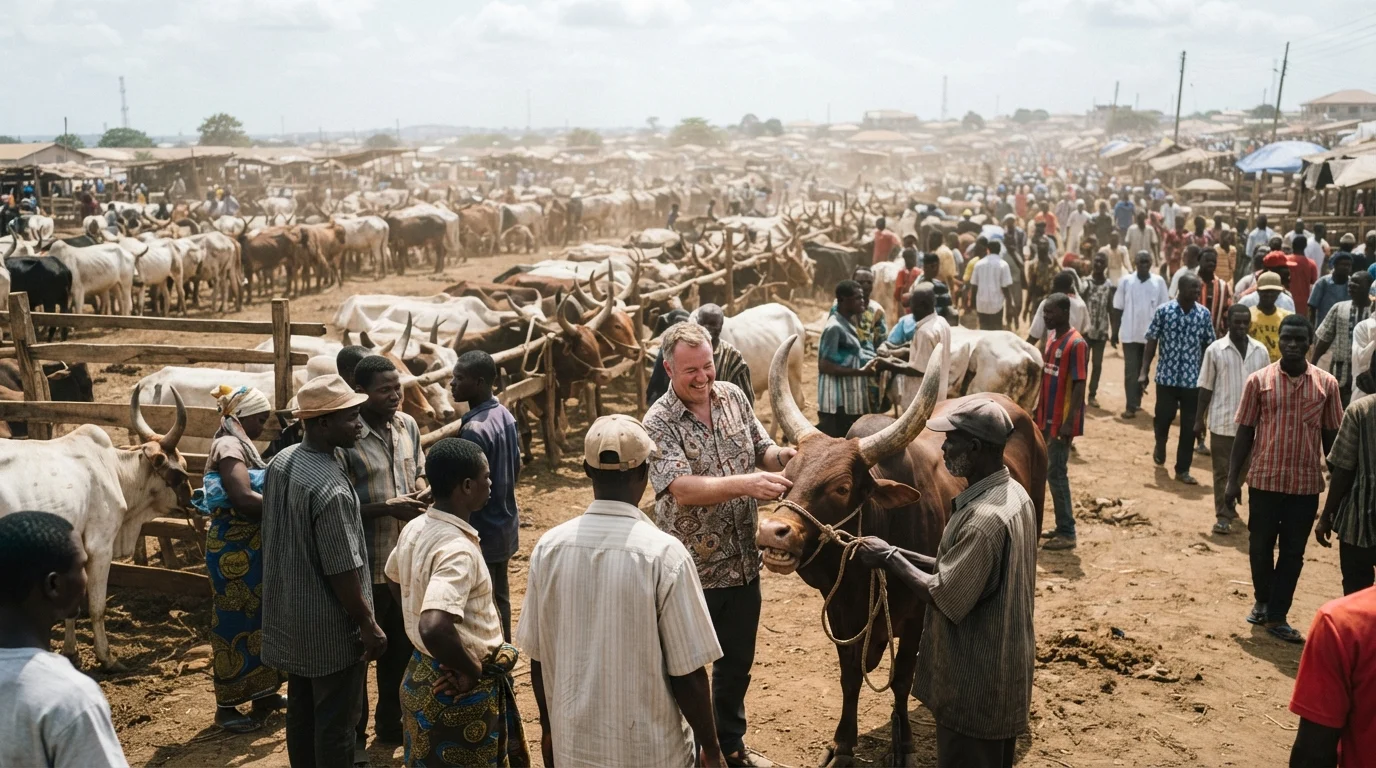
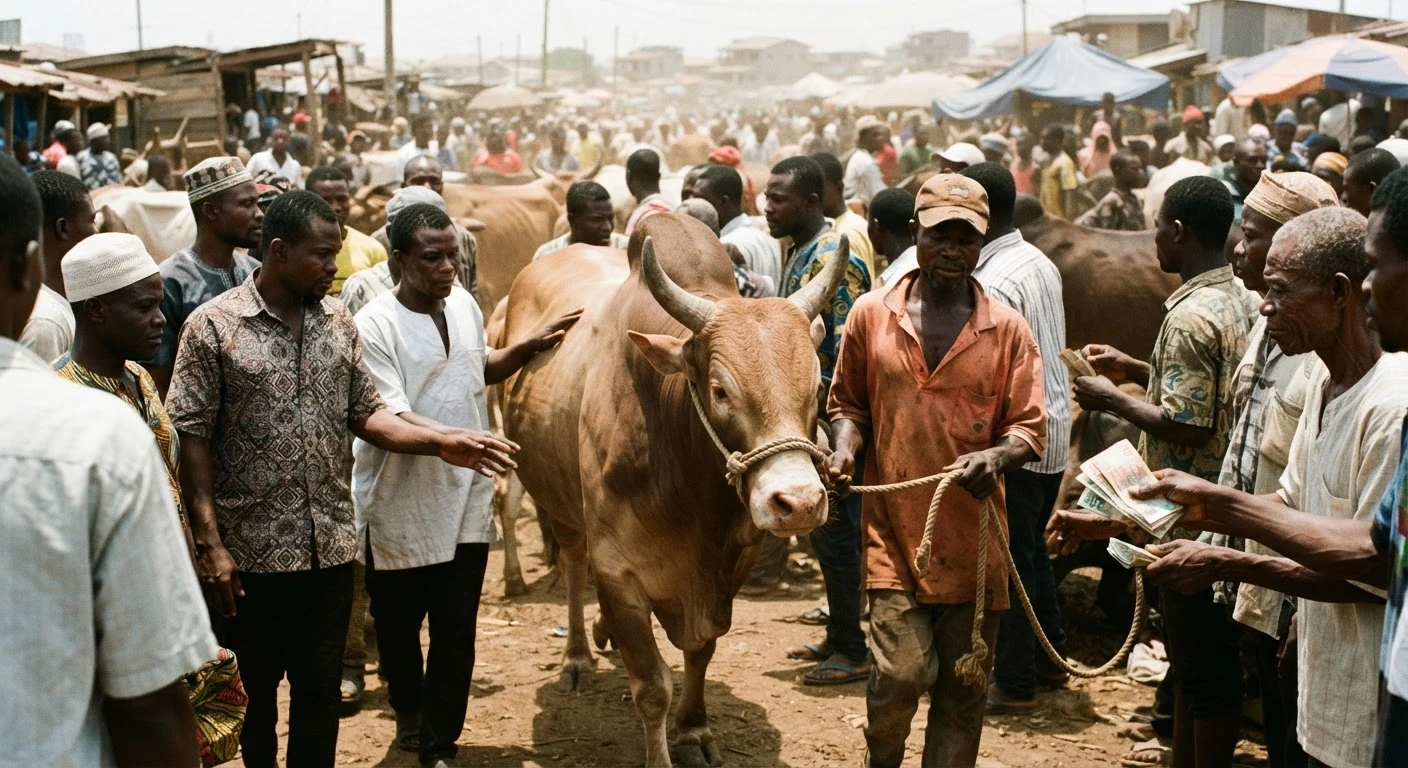
Dawn at a busy northern Ghana cattle market near Bawku, lean zebu and Sanga bulls tethered in dusty pens, traders in flowing smocks and skullcaps negotiating hard over a single bull, cedi notes counted from hand to hand, harmattan haze and red dust in the low light, documentary photograph
The money is in the animal
Where the margin is made: buying the lean animal cheap in the north.
GH¢4,000
indicative cost of a lean northern animal, the dominant cost line
~40%
of non-purchase spend is medicine, the biggest operating line (Roelen, 2017)
GH¢2,200
indicative net margin per surviving head, illustrative and unvalidated

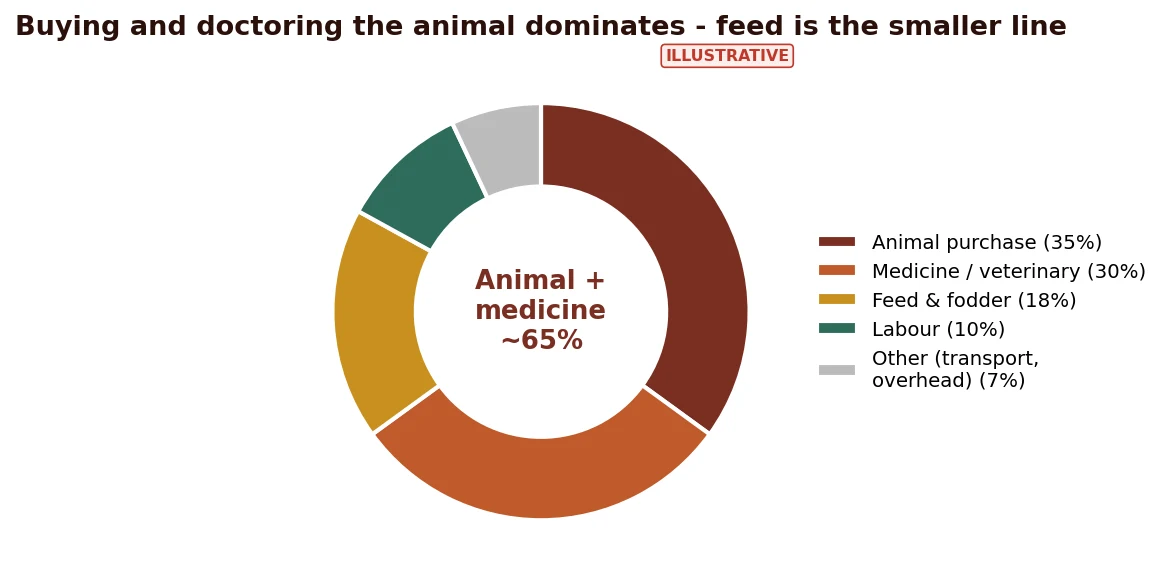
🐄 Where the money goes: the animal and the medicine, not the feed

Where a cattle finisher's money goes: the bought animal dominates, medicine leads the operating cost, feed is a smaller line than in poultry or fish
Figure 12 Where a cattle finisher's money goes: the bought animal dominates, medicine leads the operating cost, feed is a smaller line than in poultry or fish

Source: Roelen (2017).

What this shows

On the few farms that finish cattle, medicine and the animal itself dominate the cost. Feed is a smaller line than in poultry or fish, but disease is a bigger one.

Begin with the shape of the cost, because it catches a poultry or fish entrant off guard. On the few Ghanaian farms that actually finish cattle, medicine is the biggest cost at about 40 percent of the bill, and females are held about 50 months, a long, capital-slow cycle (Roelen, 2017). Read that carefully: the single biggest operating line is not feed, it is medicine and animal health, because the animal grazes for much of its keep but must be dewormed, vaccinated and treated in a disease environment that includes foot-and-mouth, trypanosomiasis and worse (Pillar 3).

Above that operating cost sits a far larger number still, the purchase of the animal itself. A finisher does not grow a calf from birth; the sensible model is to buy a lean, slow-grown northern beast and add weight to it, so the buying price of that animal dwarfs everything spent on it afterwards. Feed matters, but it is a smaller line here than in any bird or fish enterprise in this series.

~40%
of the bill is medicine on the few Ghanaian farms that actually finish cattle
~50 months
females are held before sale, a long, capital-slow cycle (Roelen, 2017)

What this means. The cost shape tells you where to be careful. Because the animal and the medicine dominate, a finisher wins or loses on how well they buy stock and how few animals they lose to disease. Shaving a few cedis off the feed bill barely moves the outcome. That is the opposite of the poultry playbook, where feed conversion is everything. Manage the purchase and the health of the animal well and the enterprise works; manage the feed brilliantly but buy badly or lose animals, and it does not.

🐄 An indicative fattening budget, built because none exists

Here is the honest problem at the centre of this pillar. No published Ghana cattle-fattening budget exists, so the numbers here are indicative and must be confirmed with field data (author synthesis, 2026). Ghana has a live-cattle trade worth billions and not one openly published enterprise budget that tells a would-be finisher what a cycle costs and returns.

So the table below is built from the parameters that are known, the northern buying range, the medicine share, the mortality rate, the southern selling range, and every figure in it is printed in red because it is indicative and must be validated with the field questionnaire before a cedi is committed. Treat it as a frame to test rather than a return to bank.

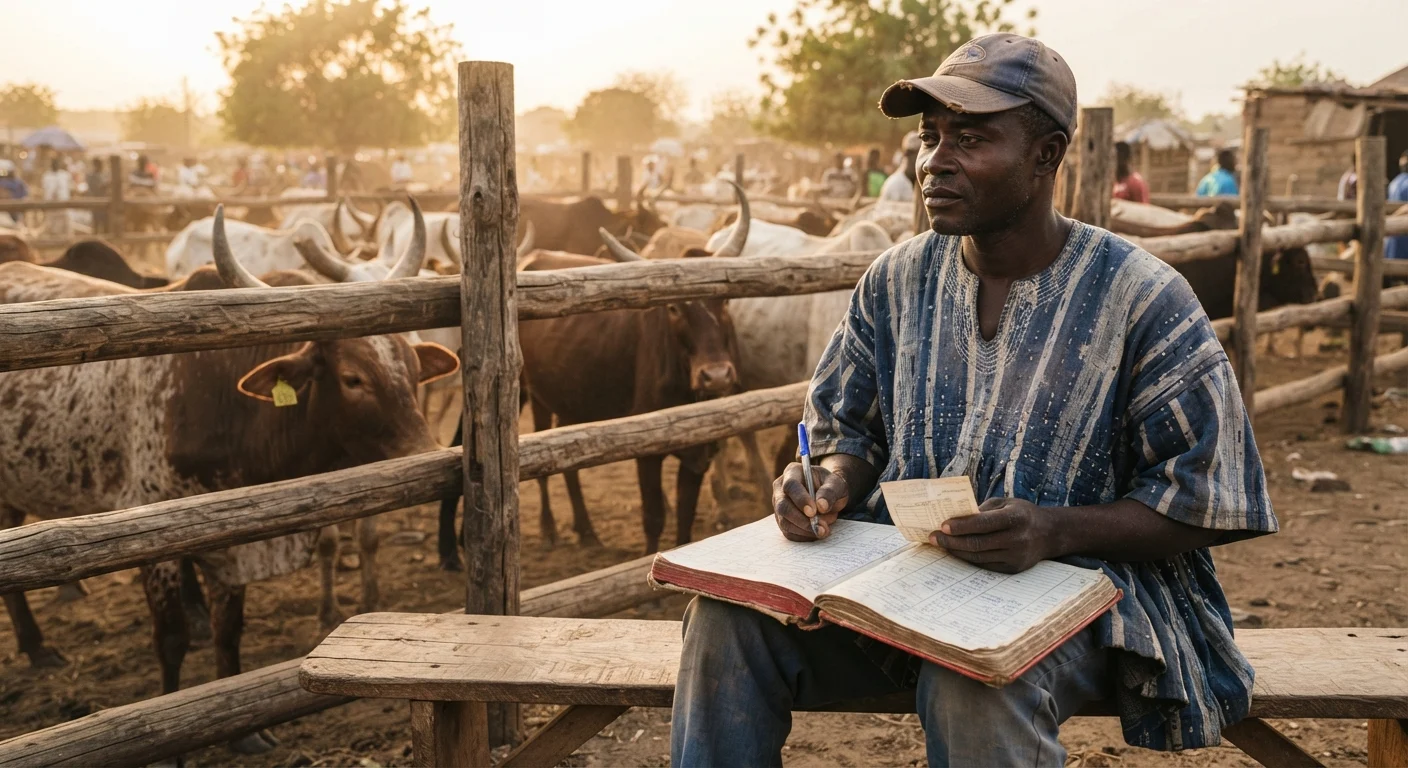
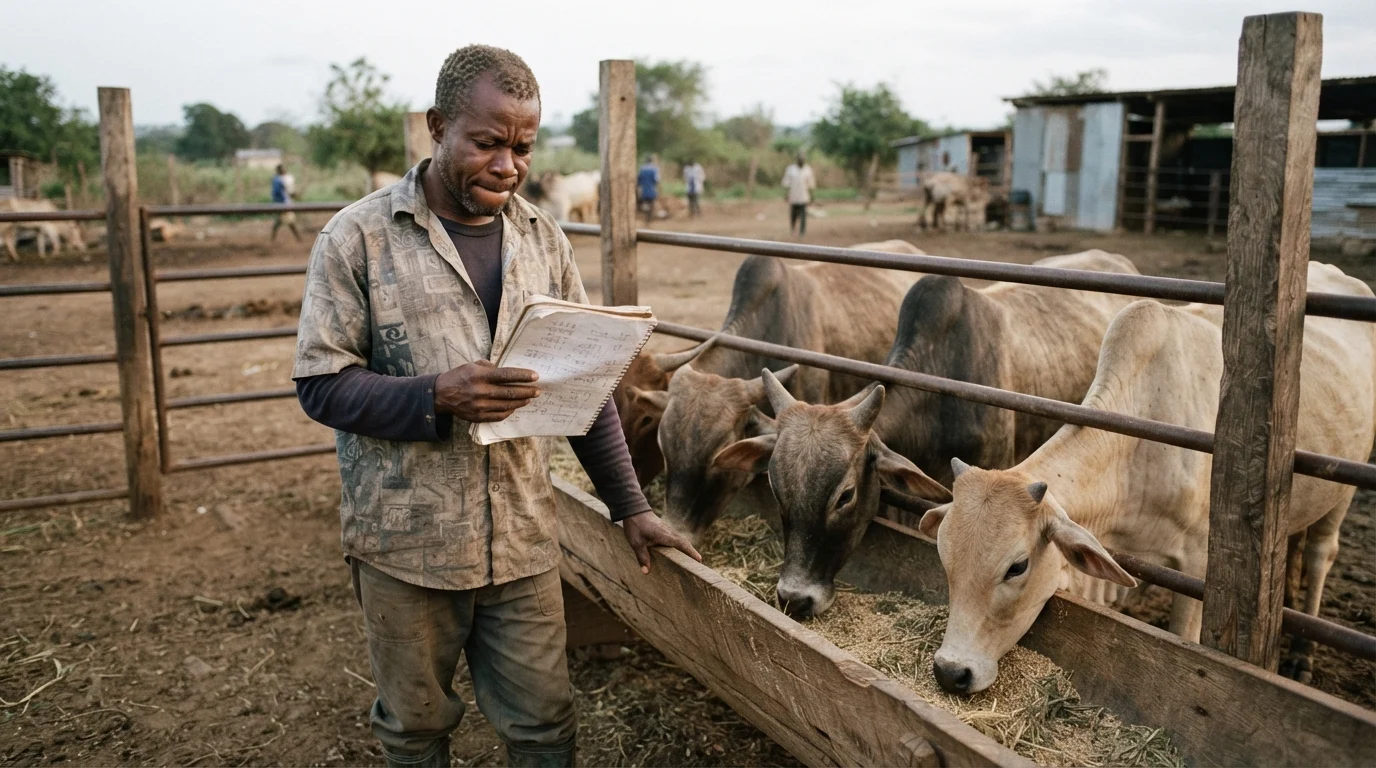
A Ghanaian cattle finisher sitting on a low wooden bench beside a timber kraal, writing buy prices and medicine costs into a worn hardback record book, a biro and a folded market receipt in his hand, finishing cattle behind the rail, warm late-afternoon light, documentary photograph
The data gap is the opening
A frame to test, not a return to bank: clean records of a few real cycles are information the whole sector lacks.
An entrant pricing a beef-finishing venture off assumed rather than measured costs, because no published Ghana budget exists
No published budget exists
GH¢6,300
indicative total cost per head, roughly a six-month finishing window
GH¢8,500
indicative sale of the finished animal, south, festive window
Table 6: An indicative per-head cattle-finishing budget, built from known parameters because no published Ghana budget exists.
Line item, one animal, roughly a six-month finishing windowWhy it sits where it does
Purchase of a lean northern animal4,000The dominant cost; the model lives or dies on buying this cheap in the north
Medicine, vet care and deworming700The biggest operating line, about 40 percent of non-purchase spend, the beef-specific cost
Feed, minerals and water550Smaller than in poultry or fish; grazing carries much of the keep
Labour and herding300Modest under extensive keeping; a hired herder often minds several animals
Transport, market fees and permits200Includes the informal vet-permit and police levies paid on the road
Mortality provision, about 12 percent loss550A real cost; every dead beast is a total write-off
Total cost per head6,300What the finisher has sunk before the animal is sold
Sale of the finished animal, south, festive window8,500The other big lever; timing the sale to Eid or Christmas lifts this
Net margin per surviving head2,200Illustrative only; swings from a loss to several thousand cedis on price and death loss

Sources: Parameters from Roelen (2017); Clingendael (2025); Ghana News Agency (2026); Mogre et al. (2024). Figures are author-constructed and indicative; no published Ghana cattle-fattening budget exists.

🐄 Opportunity: the data gap and the buy side 🐄
01

Publish the first credible Ghana finishing budget. The data gap is itself the opening: a finisher who keeps clean records of a few real cycles owns information the whole sector lacks, and can use it to raise finance others cannot (Pillar 7).

02

Buy-side discipline. Because the purchase price is the largest line, a business built around sourcing lean animals well and cheaply in the north, of known origin and health, captures margin before the feeding even begins (Pillars 1 and 6).

🐄 What moves profit most: buy price, then sale price, then death loss

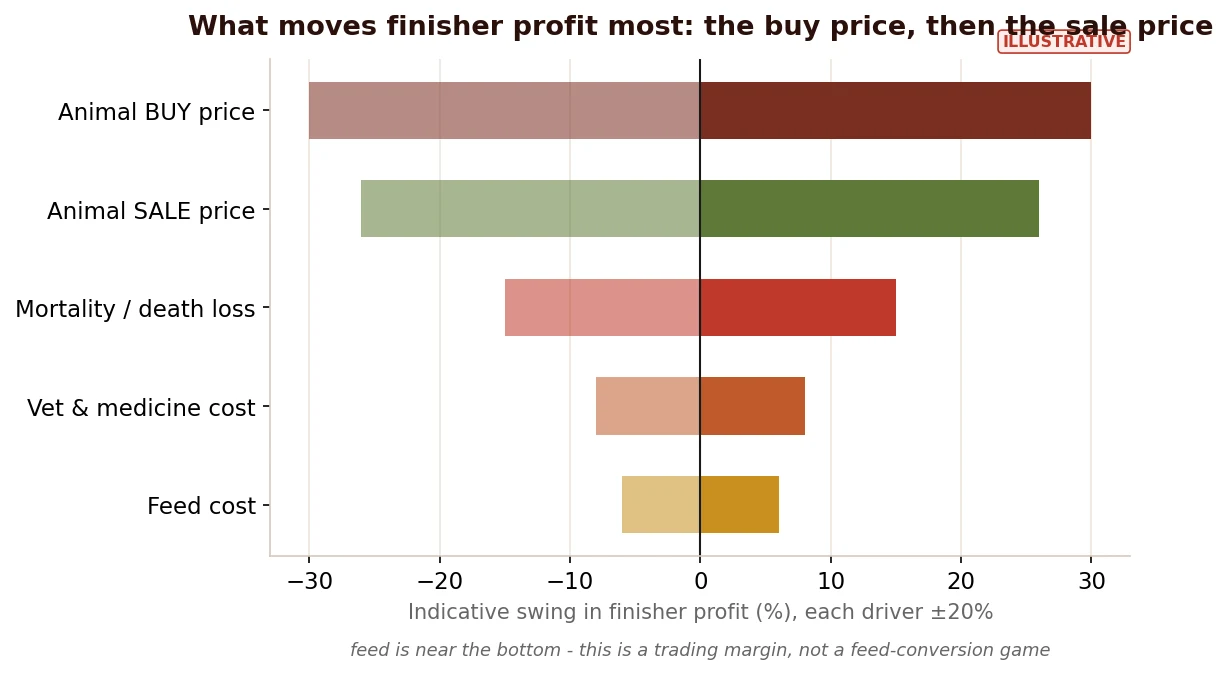
What moves a finisher's profit: buy price and sale price dominate, then mortality; the feed bill barely registers by comparison
Figure 13 What moves a finisher's profit: buy price and sale price dominate, then mortality; the feed bill barely registers by comparison

Source: Clingendael (2025); Ghana News Agency (2026); Nuvey et al. (2022 to 2023).

What this shows

A finisher's profit turns most on the buy price and the sale price of the animal, then on death losses. These are the numbers to watch.

The table has a base case, but the base case is the least interesting thing about it. What matters is what moves the answer, and the ranking is clear and unusual. First is the buy price of the animal. Because it is by far the largest line, a swing in what the lean beast costs in the north moves the margin more than anything else, and it is why an animal bought for about GH¢3,000 to 5,000 at a northern market resells for about GH¢6,400 to 17,000 in Accra or Kumasi, and most of that gap is captured after the animal leaves the north (Clingendael, 2025).

Second is the sale price. A mature cow fetched about GH¢20,000 to 25,000 in 2026, down from about GH¢30,000 in 2025 as the cedi firmed, with liveweight around GH¢22 to 46 a kilogram (Ghana News Agency, 2026), and a finished animal sold into a festive spike can fetch far more than one sold in a quiet month.

Third, and only third, is death loss: cattle lose about 10 to 14 percent of the herd a year, much of it to preventable disease, and animal disease costs Africa on the order of US$9 billion a year (Nuvey et al., 2022 to 2023), and because every dead animal is a total write-off, a bad mortality run can erase a whole cycle's profit. Notice what is not near the top: the feed bill. A finisher who obsesses over feed while ignoring the buy price, the sale timing and the death rate is watching the wrong numbers.

GH¢3,000 to 5,000
what a lean animal costs at a northern market (Clingendael, 2025)
GH¢6,400 to 17,000
what the same animal resells for in Accra or Kumasi (Clingendael, 2025)

Market signal: three numbers decide the enterprise, and feed is not one of them. The profit levers are also the diligence questions. Before backing any beef-finishing venture, ask three things in order: what does it pay for its animals and can it buy cheaper, what does it sell them for and can it time the sale to a festive window, and how many does it lose. A plan that has good answers to those three, and is honest that its budget is unproven, is worth more than a glossy one that leads with feed conversion and hides the buy price.

🐄 Why Ghana is a high-cost, slow-cycle producer 🐄

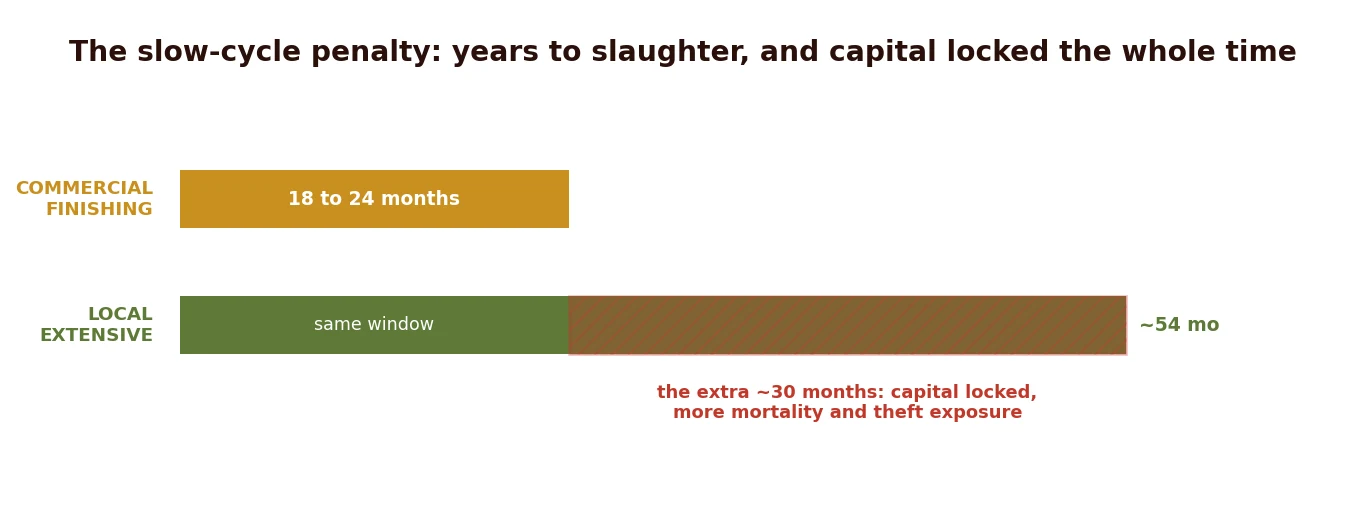
Beyond the thin data, hard economics work against finishing too. Two facts explain why. The first is time. Local breeds reach slaughter at about 48 to 54 months, and crosses at about 30 to 36 months, so the animal ties up cash for years (Aboagye, 2002), against roughly 18 to 24 months for a well-fed animal in a commercial system elsewhere. A finisher buys into an animal that has already spent years reaching a modest weight, and a mature beast gives about 125 kilograms of carcass off roughly 200 to 250 kilograms liveweight, a dressing percentage near half (Oppong-Apane; Aboagye, 2002 to 2016), so the beast yields only about its own half-weight in meat.

The second is loss. Cattle lose about 10 to 14 percent of the herd a year, much of it to preventable disease, and animal disease costs Africa on the order of US$9 billion a year (Nuvey et al., 2022 to 2023), far above the rate a commercial feedlot would tolerate, so a Ghanaian producer carries a death-loss cost that competitors abroad do not. Slow growth plus high loss is why the cost of putting a kilogram of Ghanaian beef on a hook is high, and why cheap frozen offal from Europe and cheaper Sahel cattle both undercut it at the market (Pillar 2).

The slow-cycle penalty: years to slaughter, and capital locked the whole time
Figure 14 The slow-cycle penalty: years to slaughter, and capital locked the whole time

Source: Aboagye (2002); Oppong-Apane; Aboagye (2002 to 2016); Nuvey et al. (2022 to 2023).

What this shows

A local animal takes about four and a half years to reach slaughter against under two in a commercial system, and those extra years are capital locked in living, mortal inventory earning nothing, which is the cost a finisher exists to cut.

48 to 54 months
for a local breed to reach slaughter, against roughly 18 to 24 in a commercial system
10 to 14%
of the herd lost a year, much of it to preventable disease (Nuvey et al., 2022 to 2023)

What this means. High-cost and slow-cycle is the gap a finisher exists to close. Every month cut off the finishing window and every point shaved off mortality directly narrows Ghana's cost disadvantage. The businesses that win here are the ones that treat slow growth and death loss as the two problems to attack, with better feeding in a defined window and better animal health, rather than accepting them as the way cattle have always been kept.

🐄 Where a finisher can cut cost, and by how much 🐄

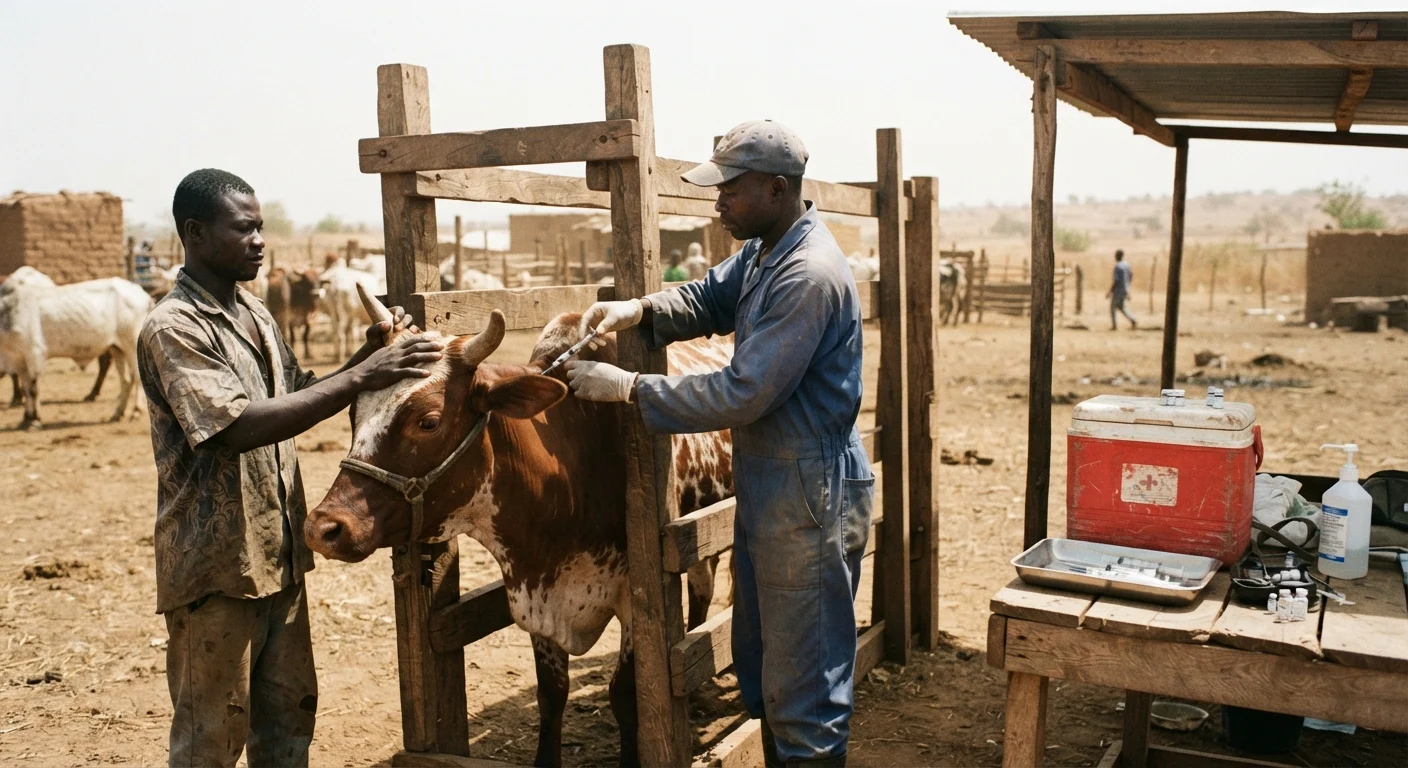
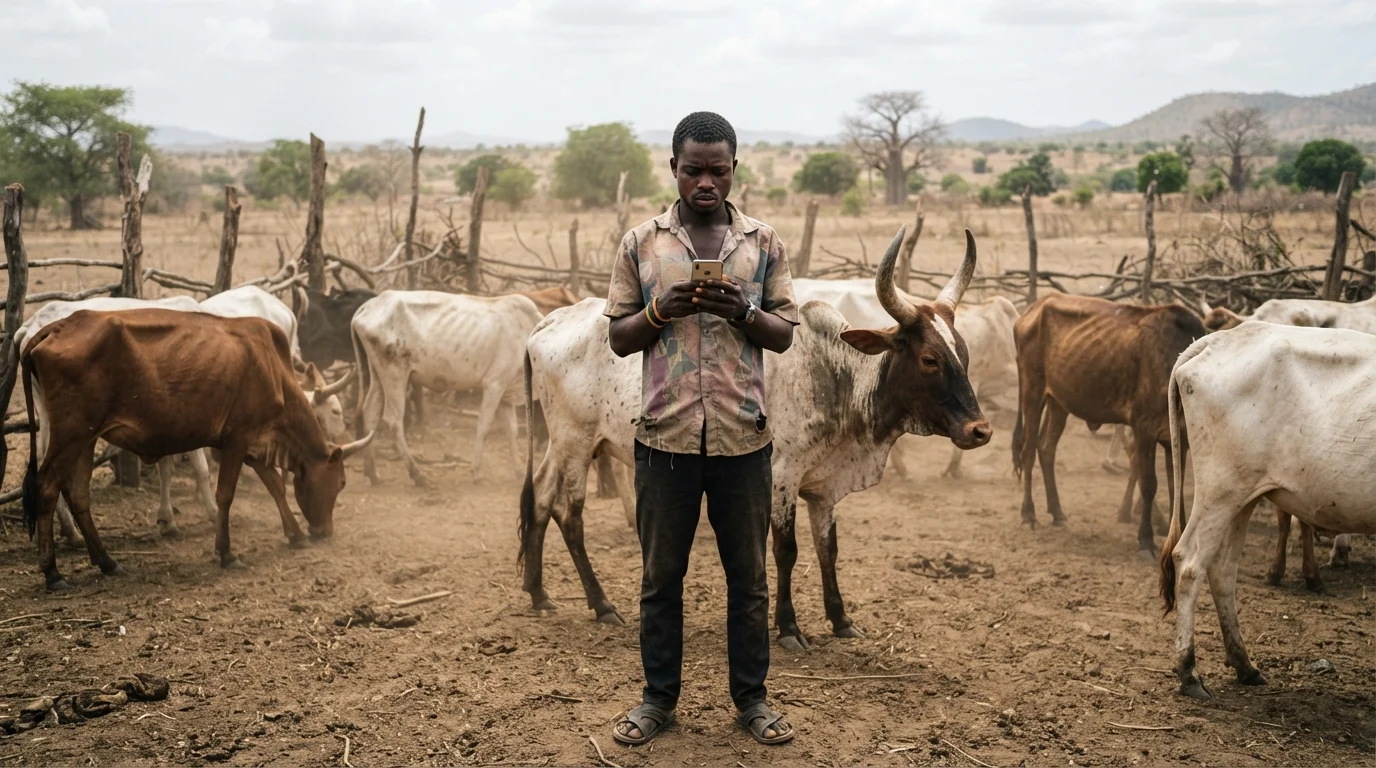
A Ghanaian animal-health technician in overalls vaccinating a newly bought lean bull in a timber crush on intake at a finishing yard, a second man steadying the animal's head, a cool box of vaccine and a syringe tray on a bench, dry-season dust and hard midday light, documentary photograph
The highest-return spend
Vaccination, deworming and quarantine on intake: the lever that attacks the 10 to 14 percent herd loss.

If the sensitivity finding says what moves profit most, its mirror says where a finisher can act. Because no field-validated budget exists, the levers below are indicative rather than proven, but the direction is clear and it matters. The two costs a finisher actually controls are the buy price of the animal and the death loss, and both are larger than the feed bill everyone worries about.

Cutting cost here is not about shaving the feed line; it is about buying the animal better and losing fewer of them, the same two numbers the sensitivity analysis put at the top. The figures in the table are illustrative and printed in red, to be tested against real farms rather than banked.

GH¢300 to 700
a head saved by buying counter-seasonally and in groups
GH¢200 to 400
a head saved by vaccination, deworming and quarantine on intake
Table 7: Where a finisher can cut cost, and roughly by how much.
Cost lineThe leverIndicative savingHow to validate
Purchase price4,000Buy counter-seasonally in the low post-harvest season and buy in groups or in bulk to cut the per-head price300 to 700Log paired buy prices across seasons and group sizes at northern markets
Mortality provision550Strategic vaccination, deworming and quarantine on intake; the single highest-return spend given the 10 to 14 percent herd loss200 to 400Record deaths per intake batch with and without a health protocol
Feed550Grazing plus crop residues, urea-treated straw and agro-industrial by-products such as brewers' spent grain and cotton-seed cake instead of bought concentrate100 to 250Weigh ration cost per kilogram of gain against a bought-concentrate baseline
Transport and road losses200Load properly, break the journey, carry fewer head and aggregate loads with others50 to 150Track loss and injury per trip against loading density and journey length
Working-capital costn/aShorten the finishing window and time the sale into the Eid or Christmas price spikeMargin lift, not a cost cutCompare net margin by finishing length and by sale month

Sources: Roelen (2017); Nuvey et al. (2022, 2023); live market search (2026). Cost figures illustrative, to be validated with field data.

🐄 Opportunity: the biggest cost-cutting lever 🐄
01

The biggest cost-cutting lever is itself a business. Because mortality is the single highest-return spend to attack, the animal-health services that cut it, on-demand vaccination, deworming and advisory, are a commercial opening in their own right, not just a cost line on the finisher's books (Pillars 3 and 8).

🐄 The festive window and the working-capital lock-up

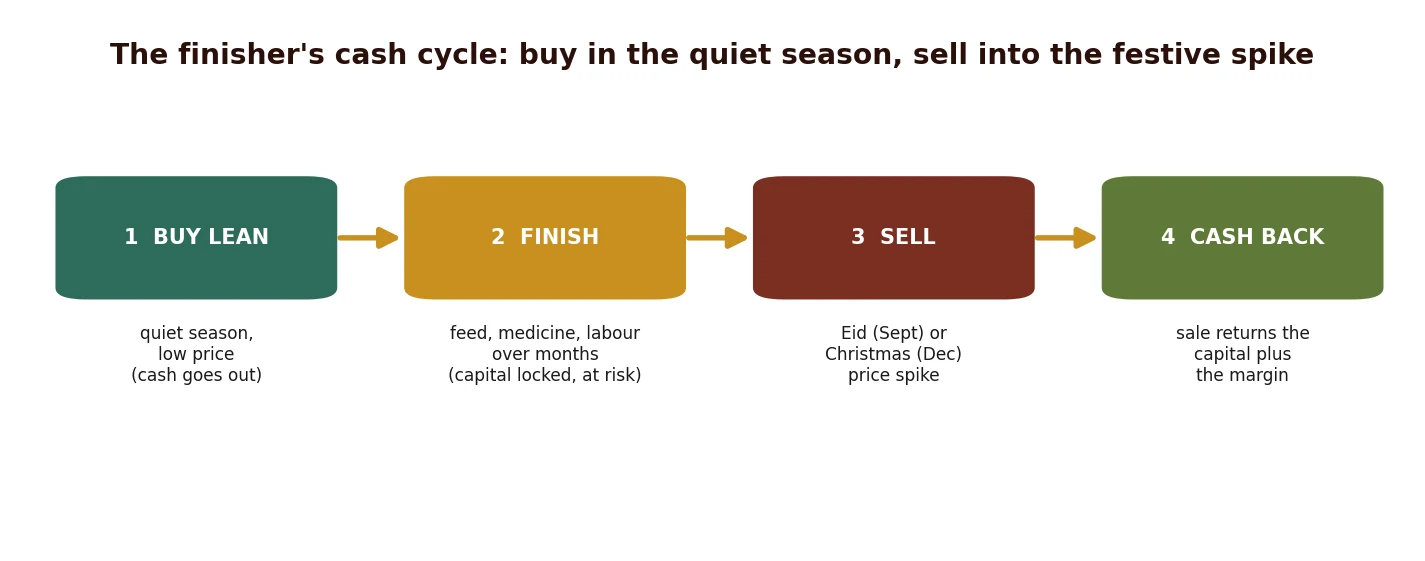
Two final economics shape when a finisher makes money and how much cash it takes to try. The first is timing. Cattle prices spike at the two big festive windows, Eid al-Adha and Christmas, when a finisher sells best; Eid moves earlier each year and fell around the middle of 2026, so the sale must be planned months ahead (Roelen; live market search, 2017 to 2026), the two windows when demand and prices climb together, so a finisher who buys lean in the quiet months and sells finished into September or December is working with the calendar rather than against it. Missing that window, and selling into a flat market, can be the difference between the profit in the table above and a loss.

The second is the working-capital lock-up. Because the animal is the dominant cost and the cycle runs for months, a finisher's cash is tied up in living, mortal inventory the whole time, at risk of disease and theft, and earning nothing until the sale. A finisher running ten animals has tens of thousands of cedis standing in a kraal for half a year, which is why finance and insurance, as much as husbandry, decide whether the business can scale (Pillar 7).

A finished, well-conditioned bull being led on a rope to sale at a crowded Accra livestock market in the days before Eid al-Adha, buyers pressing against the ropes and inspecting the animal, cedi notes changing hands, bright hard midday sun, documentary Ghana photograph
Eid and Christmas
Working with the calendar: buy lean in the quiet months, sell finished into the spike.
The finisher's cash cycle: buy lean in the quiet season, finish, sell into the festive spike
Figure 15 The finisher's cash cycle: buy lean in the quiet season, finish, sell into the festive spike

Source: Roelen; live market search (2017 to 2026).

What this shows

The finisher buys lean in the quiet, low-price season, carries the cost and risk through a finishing window, and sells into the Eid or Christmas price spike, so working with the calendar is half the margin.

A finisher's cash locked in living, mortal inventory standing in a kraal for months, earning nothing until the sale
Cash standing in a kraal
GH¢20,000 to 25,000
what a mature cow fetched in 2026, down from about GH¢30,000 in 2025 as the cedi firmed
GH¢22 to 46
a kilogram liveweight in 2026 (Ghana News Agency, 2026)

Market signal: the capital lock-up, not the husbandry, is what limits scale. The lock-up is why the cheapest way in owns no animals at all. A finisher can contract to fatten someone else's stock to a standard, or aggregate and sell on a service fee, and earn from the skill without carrying months of mortal capital. Owning the herd is the capital-heavy, slowest-turning version of the business; the service around it turns cash faster and risks less (Pillar 8).

🐄 Model it yourself 🐄

Numbers on a page are one thing. Move the levers yourself. Set the buy price of the lean northern animal, the sale price, the death loss and the feed bill to your own field numbers, add head, and watch the margin move. Then slam the feed slider from one end to the other and watch how little happens. That is the argument of this pillar in one gesture.

Tool 1

Finish a head of cattle

Slide the drivers that decide one animal over roughly a six-month finishing window: a lean northern beast bought, fed, medicated and sold south. Every dead animal is a total write-off carried by the ones that live. Overwrite every number with your own field prices.

GH¢6,295
Total cost per surviving head, including a GH¢545 mortality write-off
GH¢7,480
Revenue, 0.9 of 1 head reach the sale
35%
Return on investment over the finishing window
+GH¢2,205
Net margin per surviving head · GH¢1,940 across 1 head
Buy price first, sale price second, death loss third, and the feed bill barely registers. Across the ranges this pillar cites, the buy price of the lean northern animal swings the margin by about GH¢2,273 a head, while the entire feed bill, slammed from GH¢300 to GH¢900, swings it by GH¢600. A finisher who obsesses over feed while ignoring the buy price, the sale timing and the death rate is watching the wrong numbers.

Base case: the Pillar 5 Table 6 frame, one animal over roughly a six-month finishing window. A lean northern animal at GH¢4,000, medicine at GH¢700, feed at GH¢550, labour and herding at GH¢300, transport, market fees and permits at GH¢200, about 12 percent mortality, sold south into the festive window at GH¢8,500. Parameters from Roelen (2017); Clingendael (2025); Ghana News Agency (2026); Mogre et al. (2024). Figures are author-constructed and indicative; no published Ghana cattle-fattening budget exists, so the numbers here are indicative and must be confirmed with field data.

Tool 2

Where the money goes

The same animal, split into its parts. The bought animal dominates, medicine leads the operating cost, and feed is a smaller line than in any bird or fish enterprise in this series.

Purchase of the animalGH¢4,545

The dominant cost, and it carries the mortality write-off of the beasts that did not make it. A finisher does not grow a calf from birth; the buying price of the lean northern animal dwarfs everything spent on it afterwards.

72% of cost
Medicine, vet care and dewormingGH¢700

The biggest operating line, about 40 percent of non-purchase spend, the beef-specific cost. The animal grazes for much of its keep but must be dewormed, vaccinated and treated.

11% of cost
Feed, minerals and waterGH¢550

Smaller than in poultry or fish, because grazing carries much of the keep. Slam this slider to either end and watch how little the margin moves. That is the point of the whole pillar.

9% of cost
Everything elseGH¢500

Labour and herding, transport, market fees and permits, including the informal vet-permit and police levies paid on the road. Modest under extensive keeping.

8% of cost
72%
The bought animal as a share of total cost, the line that decides the enterprise
40%
Medicine as a share of non-purchase spend, the biggest operating line
The cost shape tells you where to be careful. Because the animal and the medicine dominate, a finisher wins or loses on how well they buy stock and how few animals they lose to disease. Shaving a few cedis off the feed bill barely moves the outcome. That is the opposite of the poultry playbook, where feed conversion is everything. Manage the purchase and the health of the animal well and the enterprise works; manage the feed brilliantly but buy badly or lose animals, and it does not.

Medicine, labour and herding, and transport, market fees and permits are held at the Table 6 per-head levels of GH¢700, GH¢300 and GH¢200 behind the sliders. The purchase line carries the mortality write-off, because every dead beast is a total write-off. Cost figures illustrative, to be validated with field data.

🐄 The risks that sit inside the finishing economics

The unproven fattening budget

HIGH
What it is

There is no published Ghana cattle-finishing budget, so every business plan in the sector rests on assumed numbers. An entrant who mistakes an illustrative model like the one here for a proven return can raise money against figures that real farms may not deliver.

Evidence

No open-access Ghana fattening enterprise budget exists; the model in this pillar is author-constructed and flagged red throughout (author synthesis, 2026; Roelen, 2017).

Who it hits

New entrants, lenders and investors pricing a beef-finishing venture off assumed rather than measured costs and returns.

How to manage it, and the opening

Treat every figure as a hypothesis to test. Run a small pilot, keep clean records of buy price, medicine, mortality and sale price, and validate with the field questionnaire before scaling. The reward for doing so is owning the first credible budget in the sector, which is itself a financing advantage.

The working-capital and slow-cycle squeeze

HIGH
What it is

Because the animal is the dominant cost and the cycle runs for months, a finisher's cash is locked in living inventory that earns nothing until sale, is exposed to disease and theft throughout, and grows only slowly. An undercapitalised entrant can run out of cash before the first sale.

Evidence

Local beasts reach slaughter at about 48 to 54 months and females are fattened around 50 months, a long, capital-slow cycle, while the herd loses about 10 to 14 percent a year (Aboagye, 2002; Roelen, 2017; Nuvey et al., 2022).

Who it hits

Thinly capitalised finishers and anyone scaling herd numbers faster than their cash and credit allow.

How to manage it, and the opening

Size the working capital for the full cycle before buying a single animal, not just the purchase. Start small, finish in a defined window to turn cash faster, and consider contracting to fatten others' stock so you earn the skill margin without carrying all the capital. Match the sale to the festive window so cash returns when prices peak.

🐄 Key takeaways 🐄
01

A beef finisher's economics turn on two prices, the buy price and the sale price of the animal, while the feed bill that dominates poultry and fish barely moves them.

02

On the farms that do finish cattle, medicine is the biggest operating cost at about 40 percent, and the bought animal itself is the largest line of all.

03

No published Ghana fattening budget exists, so the indicative model here, a lean animal bought at about GH¢4,000 and sold at about GH¢8,500, is illustrative and must be field-validated.

04

Profit moves most on buy price, then sale price, then death loss; Ghana is a high-cost, slow-cycle producer, with animals taking 48 to 54 months and losing 10 to 14 percent a year.

05

The festive spikes at Eid and Christmas are the finisher's selling window, and the working-capital lock-up, not the husbandry, is what limits scale.

Where this connects. The high-cost, slow-cycle economics here are set by the slow, lean animal of the production systems in Pillar 4, and they explain why local beef struggles against imports and cross-border cattle at the market in Pillar 2. The buy-low, sell-high margin that a finisher chases is the same north-to-south climb that the dealers capture along the value chain in Pillar 6, which is where a finisher who wants the whole margin must eventually reach.

Written for each reader

🐄 Practitioner intelligence 🐄

Hover any card to pause and lift it.

For students

If you want to understand beef economics, stop thinking like a poultry or fish student, where feed is everything. Here the money is in the animal itself: what it costs to buy and what it sells for. Learn the northern buying range and the southern selling range, and the gap between them, because that gap is the business. Build your own version of the budget in this pillar and mark it clearly as illustrative, then go and test one line of it on a real farm; the habit of separating an assumed number from a measured one is the single most valuable skill in a sector with no published budget.

For entrepreneurs

First move: pilot small and record everything. Buy a handful of lean northern animals, finish them in a defined window, and keep clean numbers on buy price, medicine, mortality and sale price, because no one else has them. Watch the three levers in order, buy price, sale timing, death loss, and do not let the feed bill distract you. The trap that ruins entrants is under-sizing the working capital: your cash is locked in living inventory for months, so budget for the whole cycle, not just the purchase, and time your sale to the festive spike. If capital is tight, contract to fatten others' animals rather than owning them.

For investors

Diligence starts by refusing to take the budget on faith, because there is no published Ghana fattening budget to check it against. Ask what the venture pays for its animals and whether it can buy cheaper, what it sells them for and whether it times the festive window, and what its mortality runs at; those three numbers, rather than the feed model, decide the return. Underwrite the working-capital lock-up explicitly, because a slow, months-long cycle in mortal inventory is where thinly funded ventures die. Back the operator who keeps real records and is honest that the model is unproven over the one who leads with a confident, unvalidated return.

For ecosystem actors

The lever is data and finance built for a slow, unproven cycle. The sector has no published finishing budget, so any programme that funds a handful of pilot finishers to keep and share real cost records would de-risk every entrant that follows. Design working-capital products, guarantees and insurance around a months-long cycle in living inventory rather than the short turns of crops or poultry, and measure success as finished animals sold at a documented margin, not as headcount. The failure to avoid is pushing finishing on entrants without the capital to survive the cycle or the records to prove it pays.

Download full PDF
UpcomingThis document isn't available yet.