Ghana Agribusiness PlaybookCocoa
A cocoa farmer holding a split-open pod in a lightly shaded farm, cocoa pods hanging in clusters on the trees around him, documentary photograph
Cocoa · Pillar 04

Planting Regime and Agronomy

Ghana's cocoa agronomy is a complete package that almost nobody follows, and the distance between each recommendation and what farms actually do is the yield gap and where the money is.
Planting Regime and Agronomy · Pillar 04

Ghana’s cocoa agronomy is a complete package that almost nobody follows. The shade target is missed on every farm measured, the fertiliser rate reaches two farmers in five, and the quality standard specifies no fermentation method at all. This pillar sets each recommendation beside its measurement and prices the difference, because that distance is the yield gap and it is where the money is.

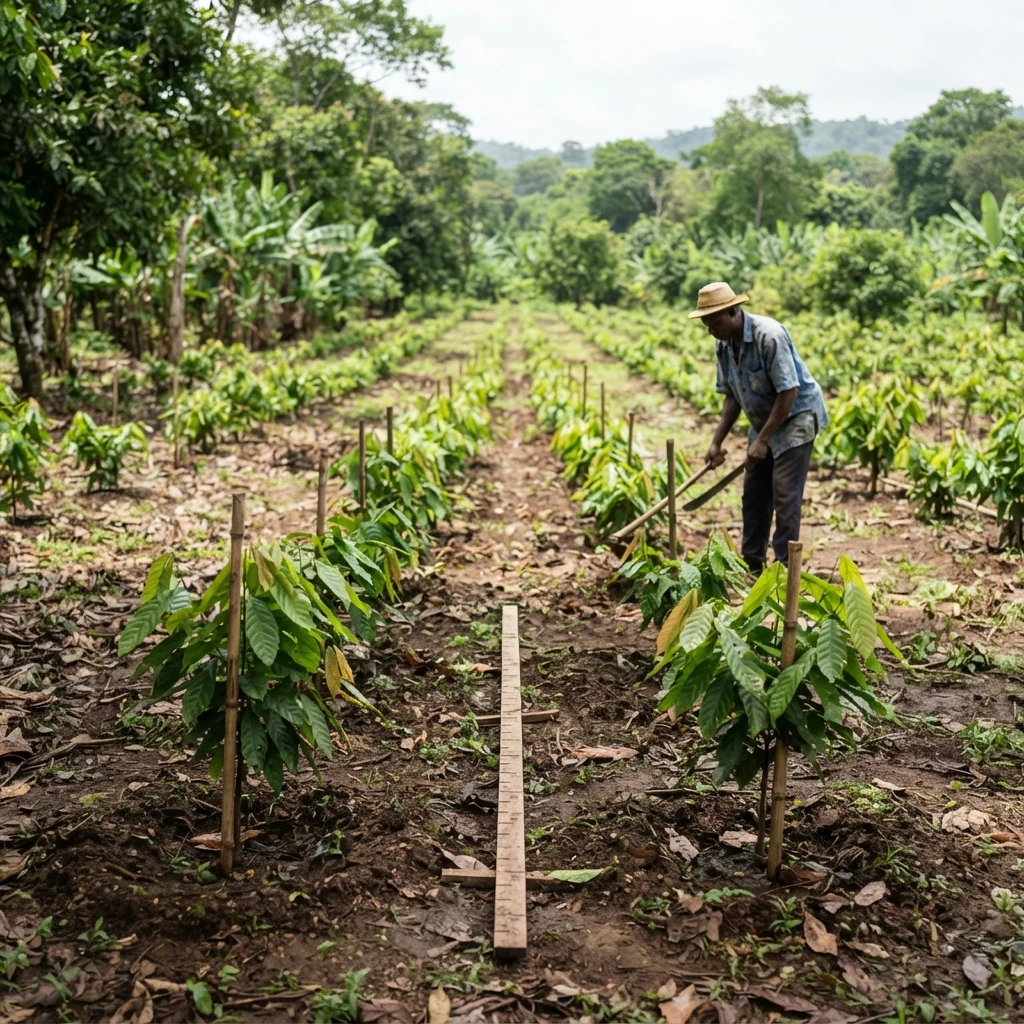
A Ghanaian cocoa farmer measuring row spacing with a long wooden measuring stick between newly planted seedlings, a machete in hand, documentary photograph
The recommendation, and the tape measure
Almost nobody in the district can say what a farm's shade or spacing actually is until someone measures it.
717 kg/ha
what 93 measured Ghanaian farms actually yield
86%
the gap between actual and modelled water-limited potential
5,294 kg/ha
the modelled ceiling, never harvested on a Ghanaian farm

The gap, and the two things measured to close it

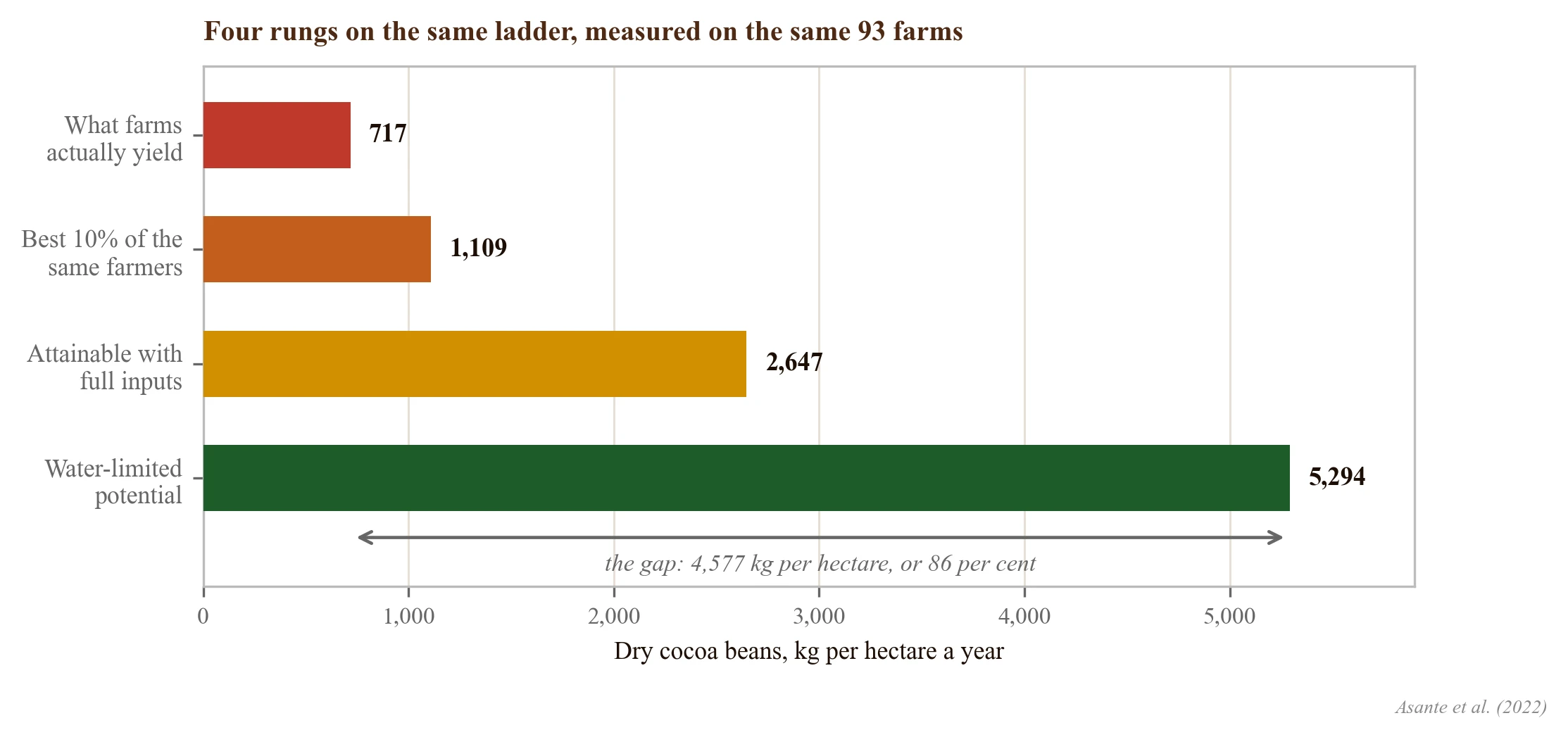
Ninety-three georeferenced Ghanaian farms, measured across the 2012/13 and 2013/14 seasons, yielded a mean of 717 kg per hectare against a modelled water-limited potential of 5,294 kg per hectare on their own soils and their own rainfall, a gap of 4,577 kg per hectare, or 86 per cent. Read the ladder from the bottom. The best tenth of the same farmers already reach 1,109 kg per hectare, using nothing their neighbours cannot get. That is the rung to underwrite. The modelled ceiling has never been harvested in Ghana.1

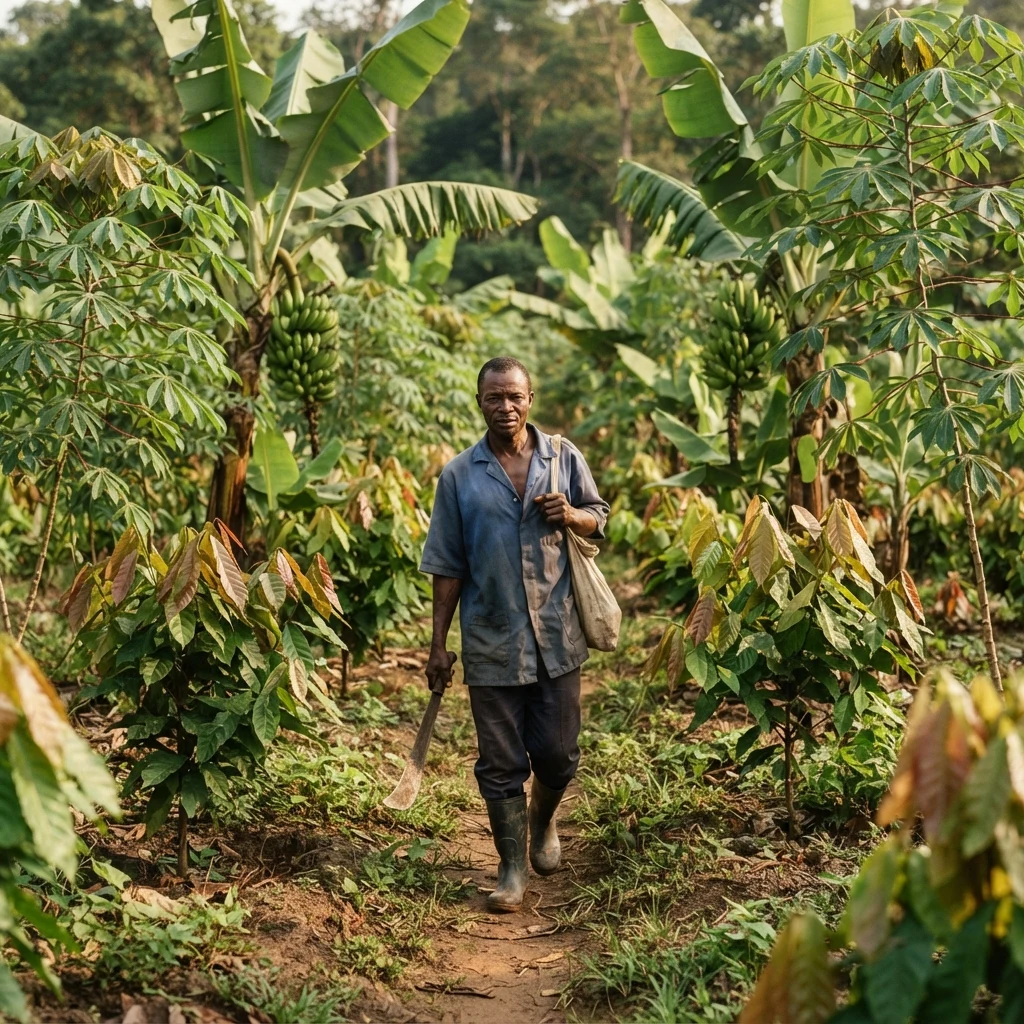
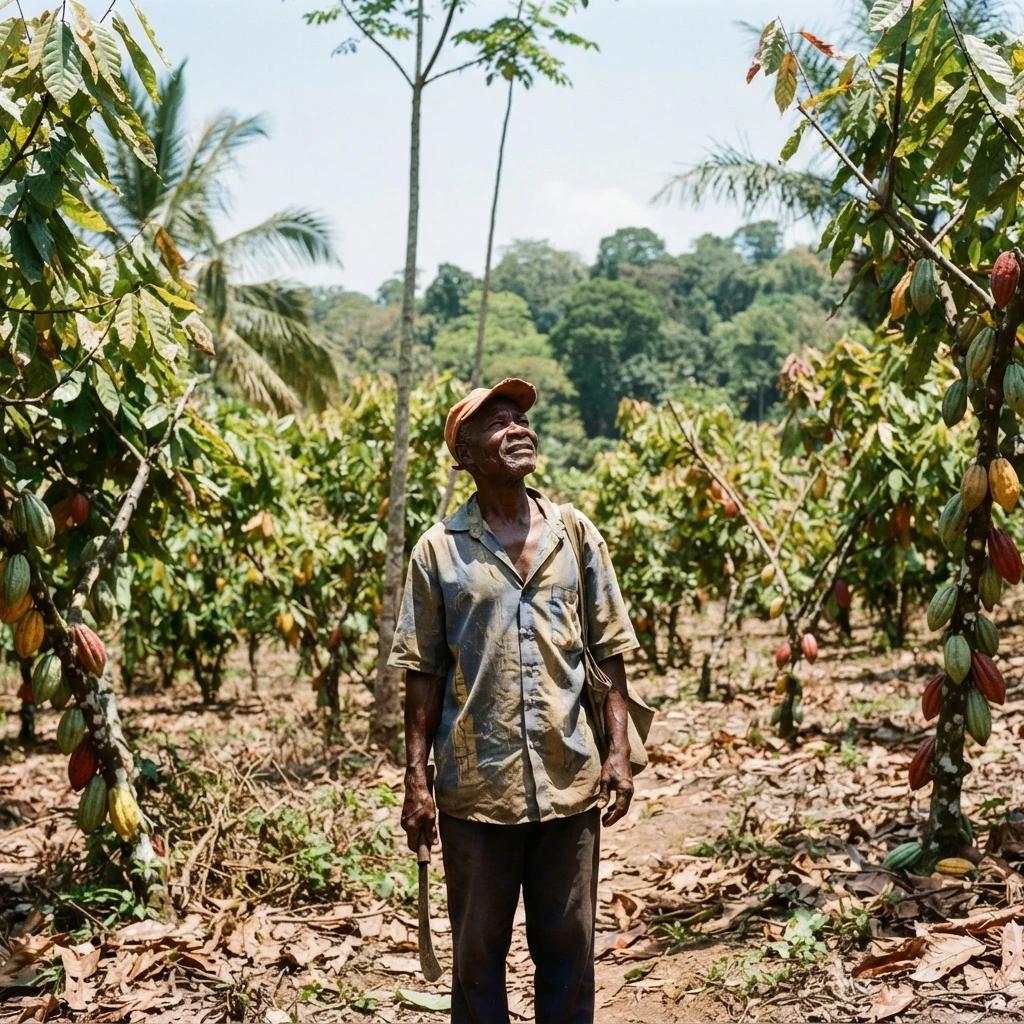
A Ghanaian cocoa farmer walking along a path through a cocoa farm intercropped with banana and plantain, a cutlass in one hand, documentary photograph
The rung to underwrite
1,109 kg per hectare has already been reached by ordinary farmers, using nothing their neighbours cannot get.
1,109 kg/ha
the top decile of the same 93 farmers, the rung to underwrite
~25-33%
of the variation between farms that management variables explained, together
The yield ladder, measured and modelled on the same 93 Ghanaian farms: actual, top decile, attainable with full inputs, and water-limited potential
Figure 6 The yield ladder, measured and modelled on the same 93 Ghanaian farms.
What this shows

Actual and top-decile yields are measured on 93 farms over two crop years; the attainable and water-limited figures are modelled for the same farms. The top rung has not been achieved on a Ghanaian farm and is a physical ceiling, not a target.

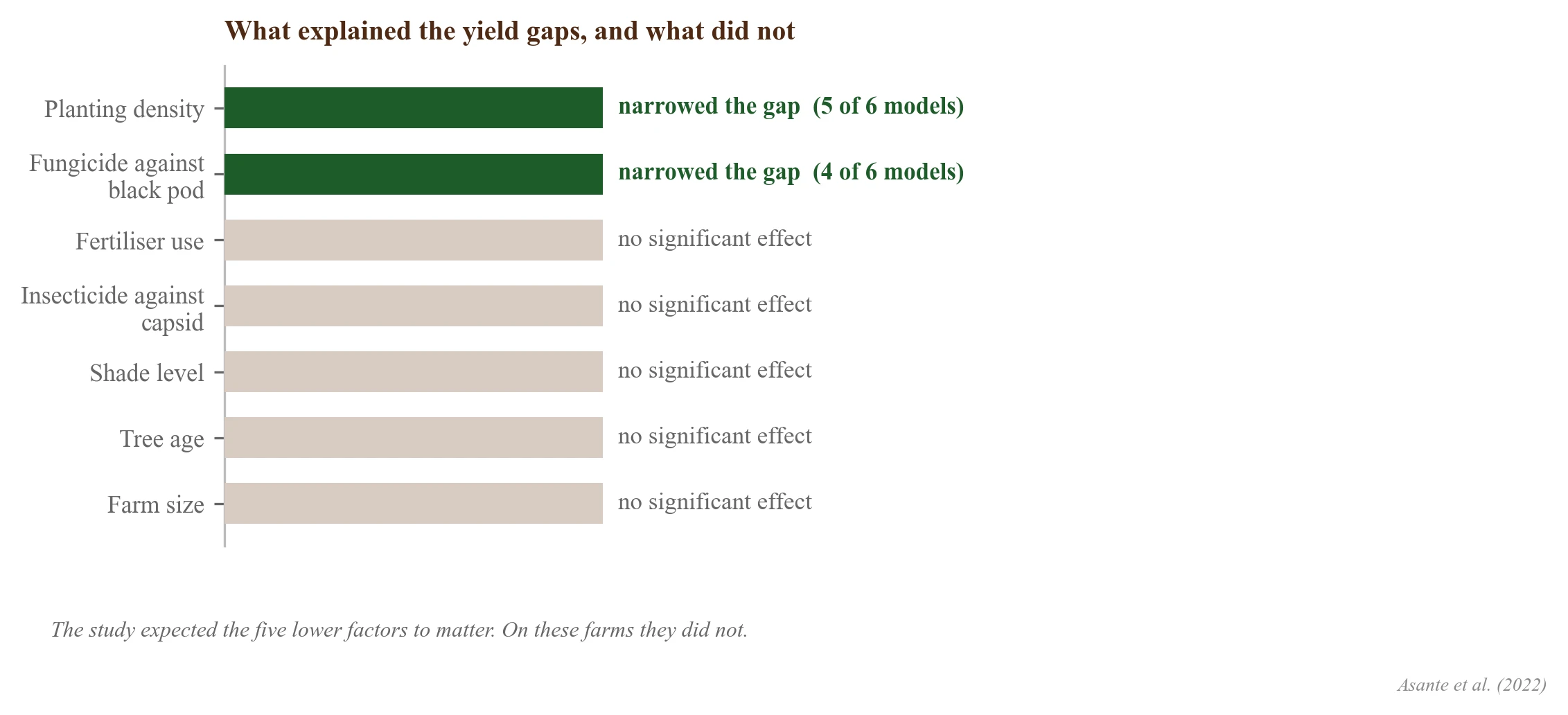
The same study tested seven management factors against the gap. Two narrowed it: planting density, significant in five of the six models, and fungicide against black pod, significant in four. Fertiliser use, capsid insecticide, shade level, tree age and farm size showed no significant effect on the yield gap, contrary to the authors’ own hypothesis. Management variables together explained about a quarter to a third of the variation between farms. So the spending order is: spacing and black pod first, everything else unproven at the level of the farm population until establishment is right.2

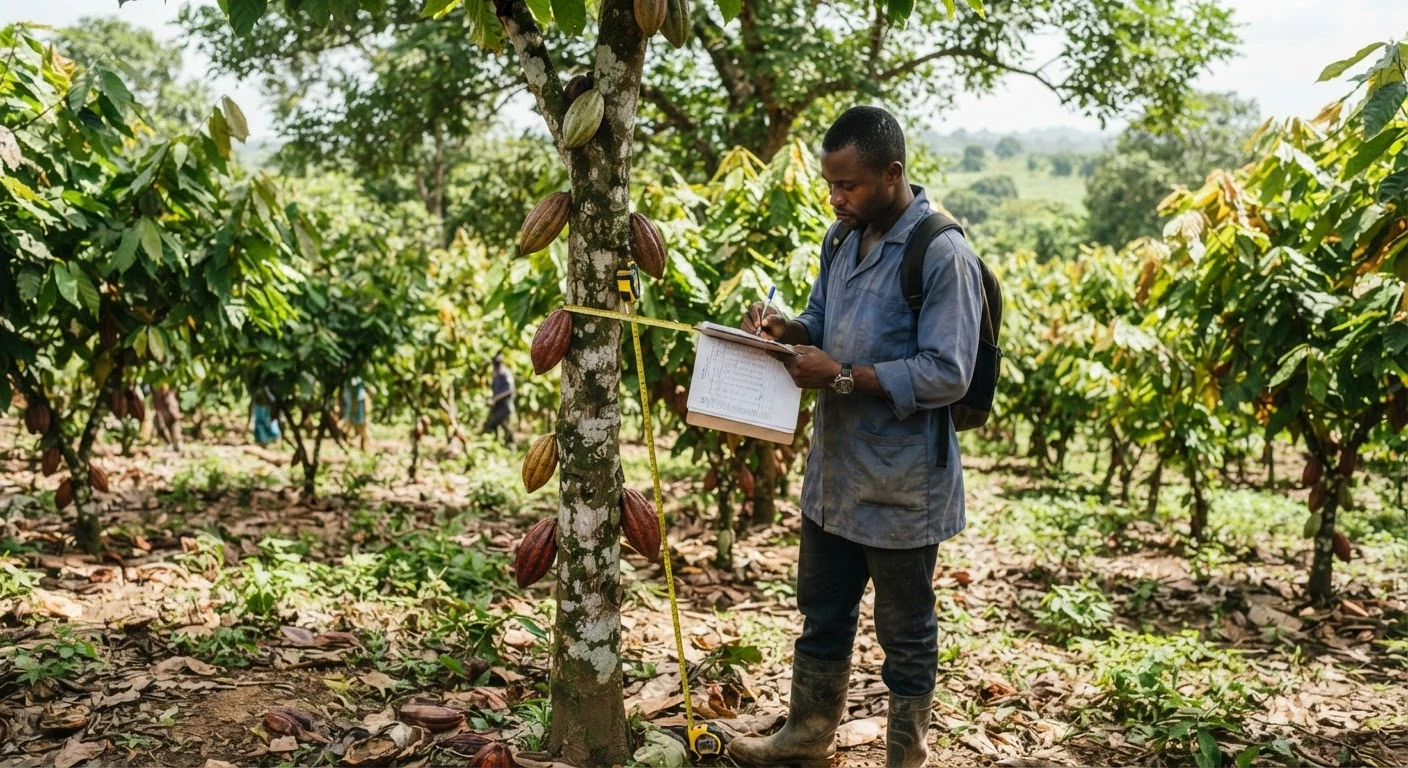
A field researcher with a clipboard and a measuring tape recording tree counts and canopy notes on a Ghanaian cocoa farm, documentary photograph
93 farms, measured twice
The yield ladder and the seven-factor verdict both come from the same measured farms.
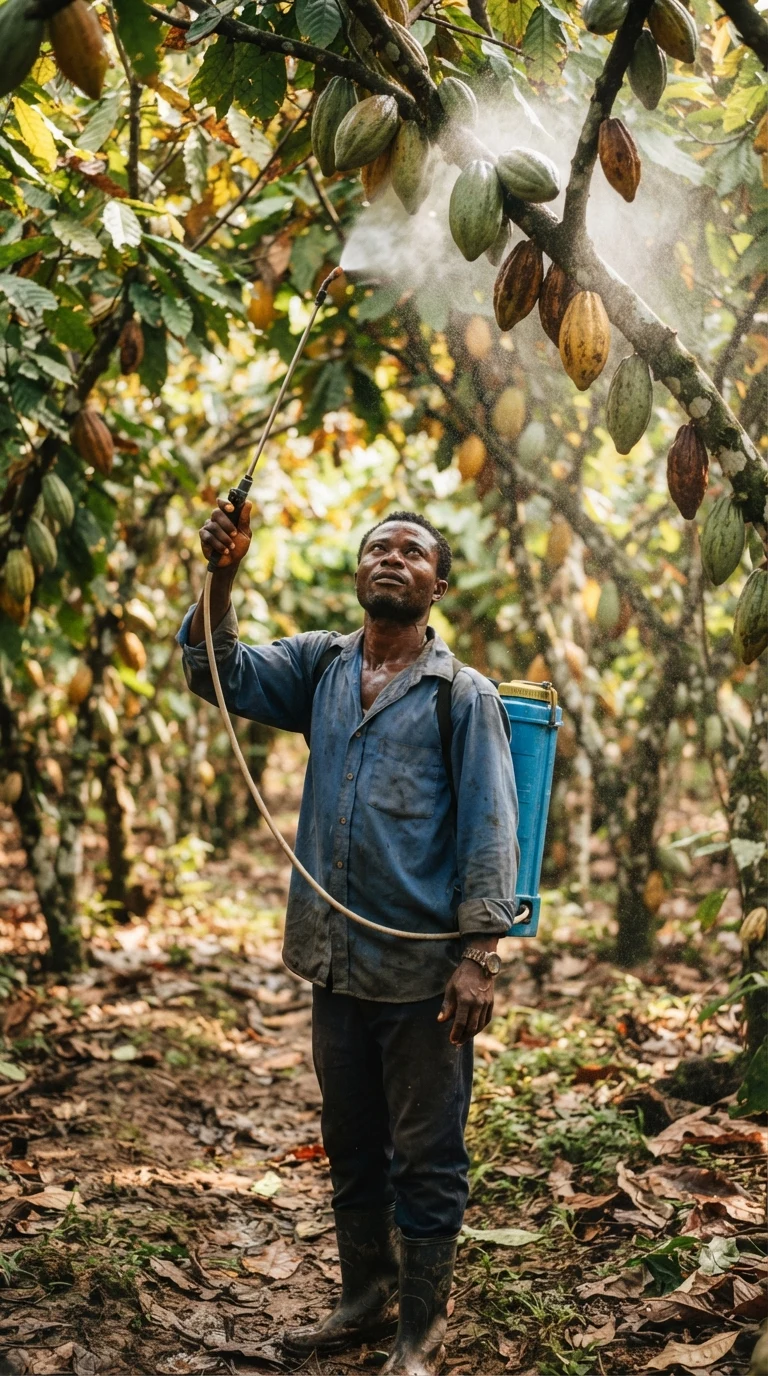
A Ghanaian cocoa farmer wearing a backpack sprayer, spraying fungicide upward onto cocoa tree pods to protect against black pod disease, documentary photograph
One of two that worked
Fungicide against black pod narrowed the gap in four of six models.
The verdict on seven management factors tested against the yield gap: planting density and black pod fungicide narrowed the gap, five factors showed no significant effect
Figure 7 The verdict on seven factors, from mixed-effects models across 93 farms.
What this shows

Verdicts come from mixed-effects models of the relative yield gaps. Density was significant in five of the six models tested and black pod fungicide in four; neither was significant in the absolute water-limited model, which retained only rainfall and minimum temperature. No significant effect means the factor did not explain the gap across these farms. It is not evidence that the factor does not matter on a farm where everything else is already right.

What is recommended, and what is actually in the ground

A Ghanaian cocoa farmer standing among heavily fruiting cocoa trees under near-full sun with almost no shade canopy overhead, documentary photograph
Near-full sun, called agroforestry
Not one of 93 measured farms reached the shade recommendation.

Shade is the clearest case and the most commercially consequential. CRIG recommends shade cover of 40 per cent, defined as percentage light interception3, and the farmer-training manual recommends about 70 per cent shade for the first three years and 30 to 40 per cent from year four4. Measured on the 93 farms, radiation interception by shade trees was a mean of 7 per cent, ranging from 0 to 31 per cent5. Not one farm reached the recommendation. Ghana runs a near-full-sun estate its own documentation describes as agroforestry. That matters twice: the certification and deforestation regimes in Pillar 3 are written against a shaded system, and the full-sun advantage does not last.

The full-sun gain expires, because yield in unshaded farms declines after 10 to 15 years and the farm is virtually unproductive after 18 to 29, against decline only after 25 years in the shaded system.6

40%
light interception CRIG recommends
7%
mean measured across 93 farms, range 0 to 31
Table 4: Five recommendations, set against the measurement of what farms actually do
PracticeWhat is recommendedWhat was measuredWhat it changes for a plan
Shade40 per cent light interception; 30 to 40 per cent from year fourMean 7 per cent, range 0 to 31, across 93 farmsNo farm complied. Treat a shaded-system claim as unevidenced until measured.
Planting density1,111 trees per hectare, at 3 m by 3 mMean 1,221, range 276 to 3,626The mean looks compliant; the spread is the problem. Count trees before pricing.
Granular fertiliser375 kg per hectare, broadcast once at the onset of the rains39 per cent of households, once a year, 82 per cent of them given it freeThe binding constraint is delivery and targeting, not the rate.
PruningFormation pruning in years 2 to 3, sanitary pruning from year 482 per cent of households, 3.03 labour days a hectareThe only one with majority compliance. No source here gives its yield effect.
Fermentation and dryingNo duration, method or turning schedule is specified100 per cent of households ferment and dryThe standard regulates the bean, not the process. Build a flavour claim yourself.

Sources: Amponsah-Doku et al. (2022), citing CRIG; Asare and David (2011); Asante et al. (2022); Bymolt, Laven and Tyszler (2018); Arthur, Dogbatse and Padi (2024); GSA and COCOBOD (2023). Recommendations and measurements come from different studies in different years and are not paired observations of the same farms.

Density is the cheapest of the five to get right and the most expensive to get wrong. The recommendation is 1,111 trees per hectare, at three metres by three metres7; surveyed farms carry 276 to 3,626 trees per hectare8, averaging 1,221 trees per hectare. A mean that sits on the recommendation hides farms at a quarter of it and farms at three times it. The opposite error is measured too: on 66 farms, more than seven trees per 23.4 square metres reduced yield9, because a crowded stand traps the humidity black pod wants. The two evidenced levers are closer to one, and spacing is set with a planting line on a single morning and cannot be revised afterwards.

What fertiliser returns, and what the season costs in labour

Fertiliser carries the largest measured response here, and its condition is worth more than its number. Granular fertiliser at 375 kg per hectare, broadcast once at the start of the rains, raised yield by 73.5 per cent, from 426 to 739 kg per hectare a year over ten crop years on 99 farms. Pooling fertilised plots against unfertilised regardless of type, the difference was 98 per cent, from 399 to 792 kg per hectare a year, across 157 farms; granular and foliar did not differ outside Brong Ahafo. But the trial admitted only recommended mixed-hybrid trees aged eight to fifteen years under light or no shade. That is why the 93-farm survey found nothing and the trial found close to a doubling. Fertiliser pays on a correctly established farm and vanishes into the variance on one that is not, so financing inputs without verifying establishment underwrites the wrong half of the problem.10

One rate is recommended nationally, and that single formulation suits only 6 per cent of the land cropped with cocoa, so production is not optimised on the other 94 per cent, and at least 30 location-specific formulations are required. That is an opening and a warning at once. An agronomy service that soil-tests before it sells is selling what the national programme does not, and any yield model that assumes the recommended rate is right for its district is assuming the 6 per cent case.11

73.5%
granular fertiliser yield increase over 10 crop years, 99 farms
98%
fertilised vs unfertilised yield difference, 157 farms
6%
of cocoa land the single national fertiliser formulation actually suits
30+
location-specific formulations the review says are required
53.17 days/ha
labour Ghanaian cocoa households use a year, of which weeding alone takes 11.94 days, 7.73 hired

Labour is what this pillar hands to the cost model in Pillar 5. Ghanaian cocoa households use 53.17 labour days per hectare a year, of which weeding alone takes 11.94 days a hectare, 7.73 of them hired, against 8.75 for pod breaking and 8.02 for harvesting. Two cautions before it enters a budget: it averages in households that did not do the activity, and it excludes fermenting and drying by the authors’ deliberate choice. A separate study cited in the same chapter reports 120 labour days per hectare for Ghana. They are not measuring the same thing, and 53 days is not the labour requirement of a well-managed farm. Weeding is the line to attack either way, being both the largest operation and the one most dependent on hired hands.12

Quality is regulated at the endpoint, not at the process

Ghana’s national cocoa standard specifies no fermentation duration, no turning schedule, no heap, box or basket method and no drying time. Part 1 requires only that the recognised entity ensure competence in appropriate fermentation techniques; Part 2 defines a finished bean by outcome alone, fermented and dried to a maximum moisture content of 8 per cent by mass, within grade limits of 3 per cent mouldy, 3 slaty and 3 insect-damaged or germinated for Grade 1, against 4, 8 and 6 for Grade 2. Beans that exceed the Grade 2 limits are classed substandard; a separate international-trade table (Good fermented 5 and 5 per cent, Fair fermented 10 and 10) bars any lot beyond its limits from export, unless a buyer requests that category. The only physical requirements in either volume concern hygiene and contamination, not quality: raised platforms at least 100 metres from any source of fire, filling station, cereal mill or coal-tar depot.13

The absence of any process standard is at once the opening and the risk here. Grade is a defect count, not a flavour measure, so two lots at the same grade may have fermented for different lengths of time. An operator wanting a flavour premium has to write the protocol, run it and verify it privately; the standard will not do it. The operation is universal, with 100 per cent of Ghanaian cocoa households reporting fermenting and drying in the past year, yet no source held for this playbook gives the share of Ghanaian lots that fail Grade 1. This playbook will not invent it.14

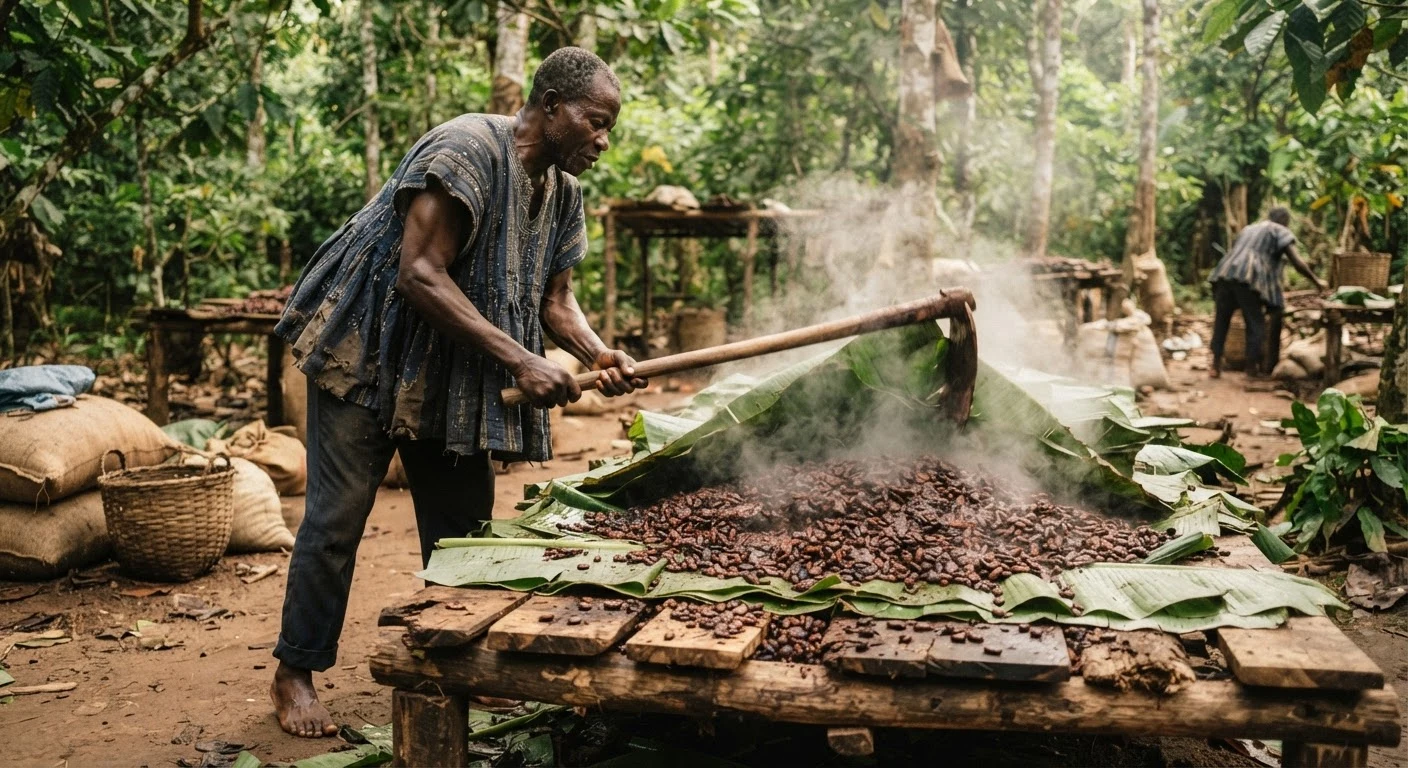
A Ghanaian farmer turning a heap of fermenting cocoa beans covered with banana leaves on a wooden platform, steam rising, documentary photograph
No duration is specified
The standard regulates the bean, not the fermentation process that makes it.
8%
maximum moisture content, the only bean-outcome quality figure the standard fixes
3/3/3
Grade 1 defect limits: per cent mouldy, slaty, insect-damaged or germinated
100%
of Ghanaian cocoa households reporting fermenting and drying in the past year
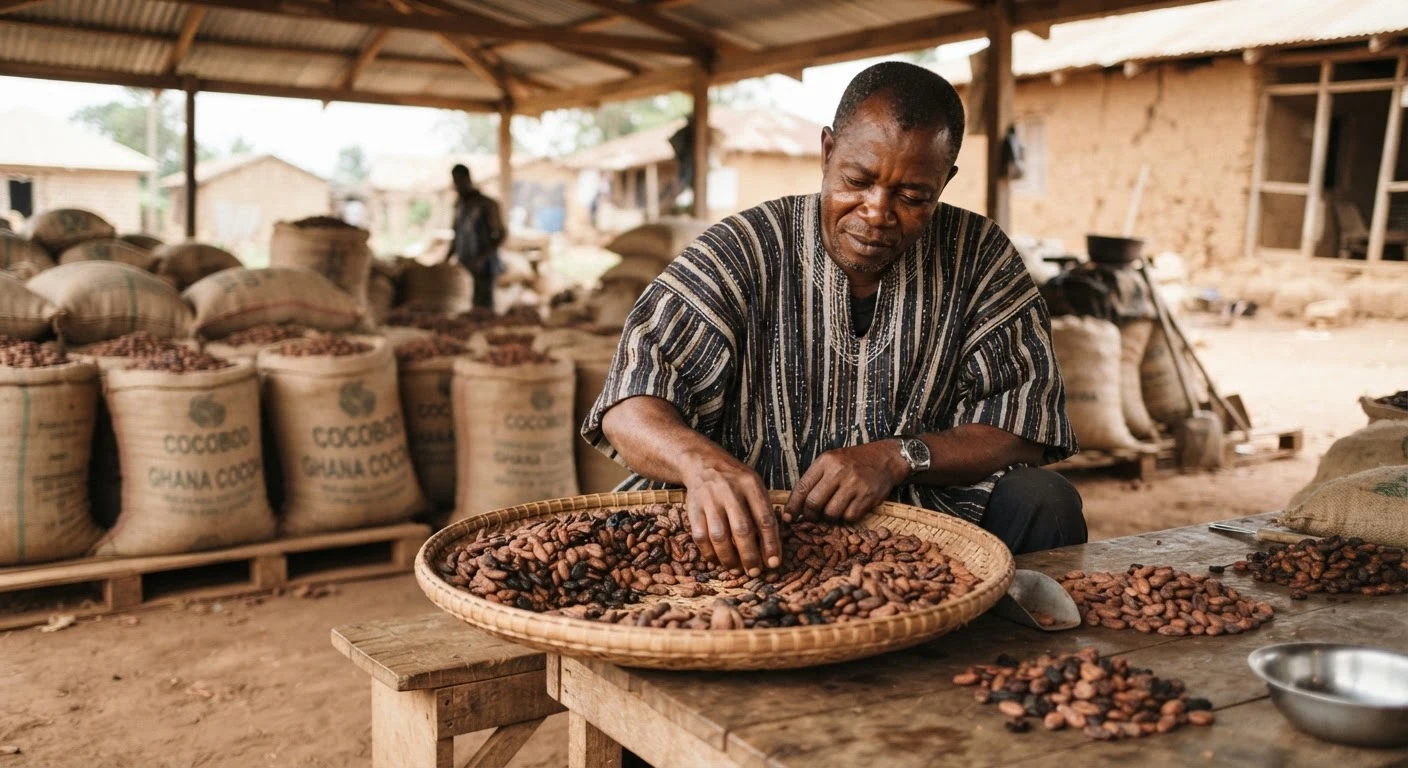
A Ghanaian cocoa grader sorting dried cocoa beans by hand on a wide tray, checking for mould and insect damage, sacks of graded beans stacked nearby, documentary photograph
Graded by defect, not by flavour
Grade is a defect count. Two lots at the same grade can taste nothing alike.

The risks that sit inside the planting regime

A Ghanaian cocoa farmer standing among heavily fruiting cocoa trees under near-full sun with almost no shade canopy overhead, documentary photograph

Underwriting a shaded system that is not in the field

HIGH
What it is

A plan, a certification application or a carbon or agroforestry claim assumes the shade regime the national recommendation describes, on farms that do not carry it.

Evidence

CRIG recommends 40 per cent light interception. Measured radiation interception across 93 farms averaged 7 per cent with a maximum of 31, so no farm in the sample complied.

Who it hits

Anyone certifying, financing an agroforestry premium, or modelling a farm's productive life beyond fifteen years.

How to manage it, and the opening

Measure interception on the actual blocks before the claim is made, not after. Where the farm is effectively full sun, model the shorter productive life and budget the shade planting as a capital item rather than assuming it is already there.

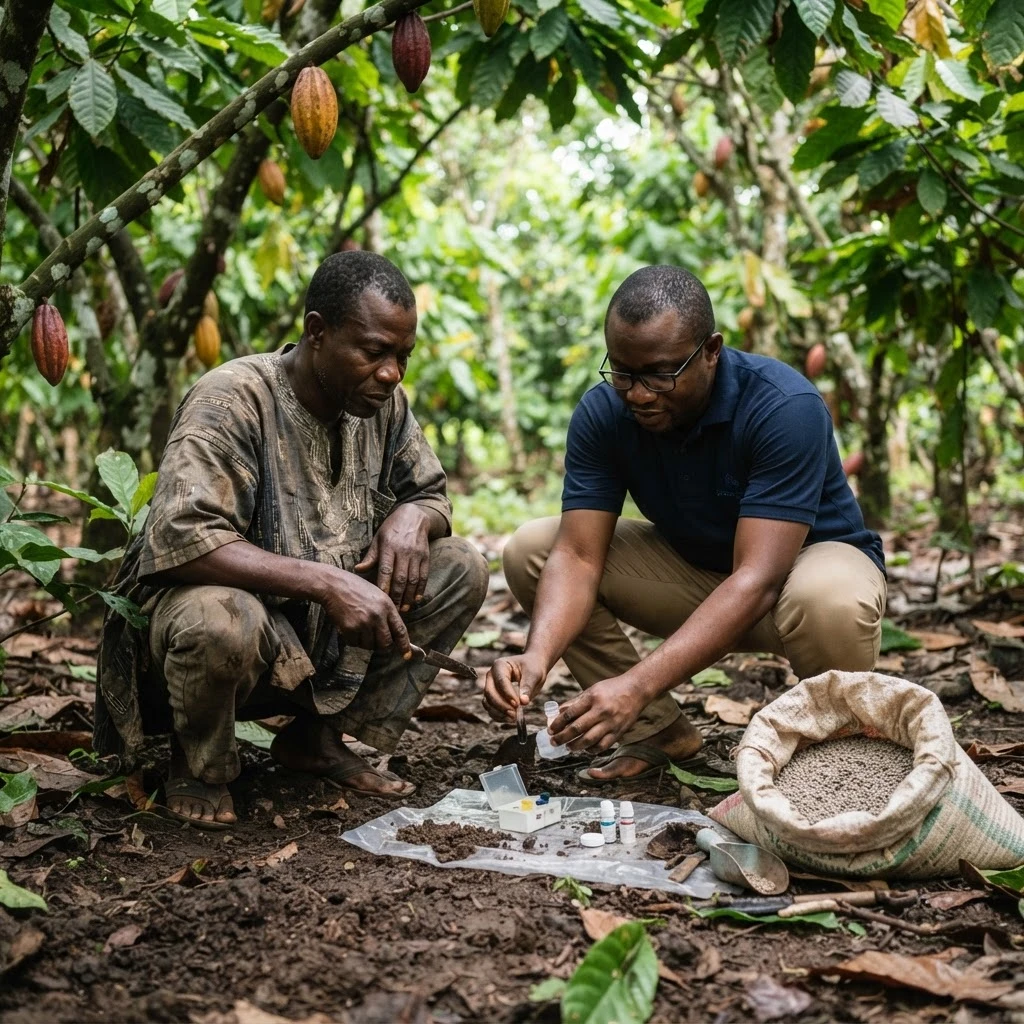
Two Ghanaian cocoa farmers crouched over a soil-testing kit laid out on a plastic sheet on the ground, a sack of granular fertiliser open beside them, documentary photograph

Planning off the national fertiliser rate

MEDIUM
What it is

A budget or a service offer is built on the single recommended national formulation and rate, on the assumption that it is agronomically right for the district in question.

Evidence

The one national formulation suits about 6 per cent of the land cropped with cocoa, and at least 30 location-specific formulations are required. The measured response of 73.5 to 98 per cent was obtained only on hybrid trees aged eight to fifteen years under light or no shade.

Who it hits

Input suppliers, agronomy services and any lender financing an input package against a projected yield uplift.

How to manage it, and the opening

Soil-test the block and price the test into the service. Quote a response only where the trees match the trial's description, and treat the free national allocation as a floor the service sits on top of rather than as the plan.

Openings: where the gap between recommendation and practice pays
01

Sell measurement, not land. If you are entering cocoa, start by selling measurement rather than buying it. A densitometer app for canopy interception and a thirty-metre tape let you tell a farm what its shade and its spacing actually are, which almost nobody in the district knows. The margin is not in the fertiliser, which about a third of farmers already receive free, but in soil-testing, spacing correction and black pod timing, the only two levers the evidence supports, plus the test that tells you the rate. Charge per block; you come out with a district-level dataset that no agency holds.

02

Soil-test before you sell. One rate is recommended nationally, and that single formulation suits only 6 per cent of the land cropped with cocoa, so production is not optimised on the other 94 per cent, and at least 30 location-specific formulations are required. That is an opening and a warning at once. An agronomy service that soil-tests before it sells is selling what the national programme does not, and any yield model that assumes the recommended rate is right for its district is assuming the 6 per cent case. Diagnostics also give private agronomy services something to sell against.

03

Write the protocol the standard will not. Grade is a defect count, not a flavour measure, so two lots at the same grade may have fermented for different lengths of time. An operator wanting a flavour premium has to write the fermentation protocol, run it and verify it privately; the national standard specifies no duration, method or turning schedule and will not do it for them.

Key takeaways
01

Shade is the sharpest recommendation-versus-practice gap in Ghanaian cocoa. Forty per cent light interception is recommended; measurement across 93 farms found a mean of 7 per cent and a maximum of 31. No farm complied.

02

The yield ladder runs 717 kg per hectare actual, 1,109 for the best tenth of the same farmers and 5,294 modelled. Underwrite the 1,109; it has been achieved by ordinary farmers on ordinary farms.

03

Only two of seven tested factors narrowed the gap, planting density and black pod fungicide, and overcrowding raises the humidity black pod needs. Spacing and spraying are closer to one decision than two.

04

Fertiliser measured 73.5 per cent more yield with granular over ten seasons and 98 per cent fertilised against unfertilised across 157 farms, but only on hybrid trees aged eight to fifteen under light or no shade. The condition is the finding.

05

The national standard sets no fermentation duration, turning schedule, method or drying time. It regulates an 8 per cent moisture endpoint and a defect count, so quality is policed at the outcome and flavour is nobody's contractual obligation.

Written for each reader

Practitioner intelligence

Hover any card to pause and lift it.

For students

If you are entering cocoa, start by selling measurement rather than buying land. Two instruments, a densitometer app for canopy interception and a thirty-metre tape, let you tell a farm what its shade and its spacing actually are, which almost nobody in the district knows. Charge per block. The mistake first-timers make is assuming farms run the recommended regime because extension teaches it; the measurements say otherwise. You come out with a district-level dataset that no agency holds.

For entrepreneurs

Sign the offtake and the per-hectare service contract before buying an input. The margin is not in the fertiliser, which about a third of farmers already receive free, but in soil-testing, spacing correction and black pod timing, which are the only two levers the evidence supports plus the test that tells you the rate. Price weeding labour into every quote at the going hired rate. The trap is quoting a yield uplift from the fertiliser trial on farms that do not match its trees.

For investors

The return mechanism is establishment quality, not input volume: fertiliser response is conditional on decisions taken years earlier, so value accrues to whoever controls the block. Three diligence asks. Measured canopy interception and tree count per hectare on the actual plots. Tree age against the trial's eight-to-fifteen-year window. Whether the fertiliser plan rests on a soil test or the national rate. Release against measured density and a first-season yield audit, and underwrite to 1,109 kg per hectare, not to modelled potential.

For ecosystem actors

The lever is district-level soil diagnostics feeding location-specific fertiliser blends, which the review evidence says are needed at a minimum of thirty and which have not been adopted. The measurable outcome is the share of the cocoa area under a formulation matched to its soil, currently about 6 per cent. The failure to avoid is funding another free-fertiliser tonnage target, which buys a distribution number and no agronomy. Diagnostics also give private agronomy services something to sell against.

Where this connects. Pillar 1 owns the planting material that goes into this regime and the ageing tree stock that has to be replaced. Pillar 3 owns black pod, swollen shoot and the certification regime that assumes the shade this pillar shows is not there. Pillar 5 costs the labour days and the fertiliser bill set out here.

Footnotes
  1. Paulina A. Asante et al., "The Cocoa Yield Gap in Ghana: A Quantification and an Analysis of Factors That Could Narrow the Gap," Agricultural Systems 201 (2022): 103473, https://doi.org/10.1016/j.agsy.2022.103473.
  2. Asante et al., "The Cocoa Yield Gap in Ghana."
  3. Betty Amponsah-Doku et al., "Improving Soil Health and Closing the Yield Gap of Cocoa Production in Ghana: A Review," Scientific African 15 (2022): e01075, https://doi.org/10.1016/j.sciaf.2021.e01075.
  4. Richard Asare and Sonii David, Good Agricultural Practices for Sustainable Cocoa Production: A Guide for Farmer Training. Manual No. 1: Planting, Replanting and Tree Diversification in Cocoa Systems (Development and Environment Series No. 13-2010. Hørsholm, Denmark: Forest and Landscape Denmark, University of Copenhagen, 2011).
  5. Asante et al., "The Cocoa Yield Gap in Ghana."
  6. Amponsah-Doku et al., "Improving Soil Health."
  7. Asare and David, Good Agricultural Practices, Manual No. 1.
  8. Asante et al., "The Cocoa Yield Gap in Ghana."
  9. Eric Kwabena Doe et al., "Soil Health and Synergy of Ecological Determinants of Green Cocoa Productivity in Different Soil Ecotypes in Ghana," Frontiers in Sustainable Food Systems 7 (2023).
  10. A. Arthur, J. A. Dogbatse, and F. K. Padi, "Impact of Fertiliser Application on Cocoa Yields in Ghana: An Analysis of Cocoa Bean Yields in Farmers' Plantations," Australian Journal of Crop Science 18, no. 3 (2024): 139-44, https://doi.org/10.21475/ajcs.24.18.03.PNE3958.
  11. Amponsah-Doku et al., "Improving Soil Health."
  12. Roger Bymolt, Anna Laven, and Marija Tyszler, "Cocoa Production Practices," in Demystifying the Cocoa Sector in Ghana and Côte d'Ivoire (Amsterdam: Royal Tropical Institute, 2018), chap. 8.
  13. Ghana Standards Authority (GSA) and Ghana Cocoa Board (COCOBOD), National Implementation Guide for GS ARS 1000. Part 1: Requirements for Cocoa Farmer as an Entity/Farmer Group/Farmer Cooperative, Management Systems and Performance; Part 2: Requirements for Cocoa Quality and Traceability; Part 3: Requirements for Cocoa Certification Schemes (GS IG 1:2023, GS IG 2:2023 and GS IG 3:2023, First Edition. Accra: Ghana Standards Authority, 2023).
  14. Bymolt, Laven, and Tyszler, "Cocoa Production Practices."
Download full PDF
UpcomingThis document isn't available yet.