Ghana Agribusiness PlaybookCocoa
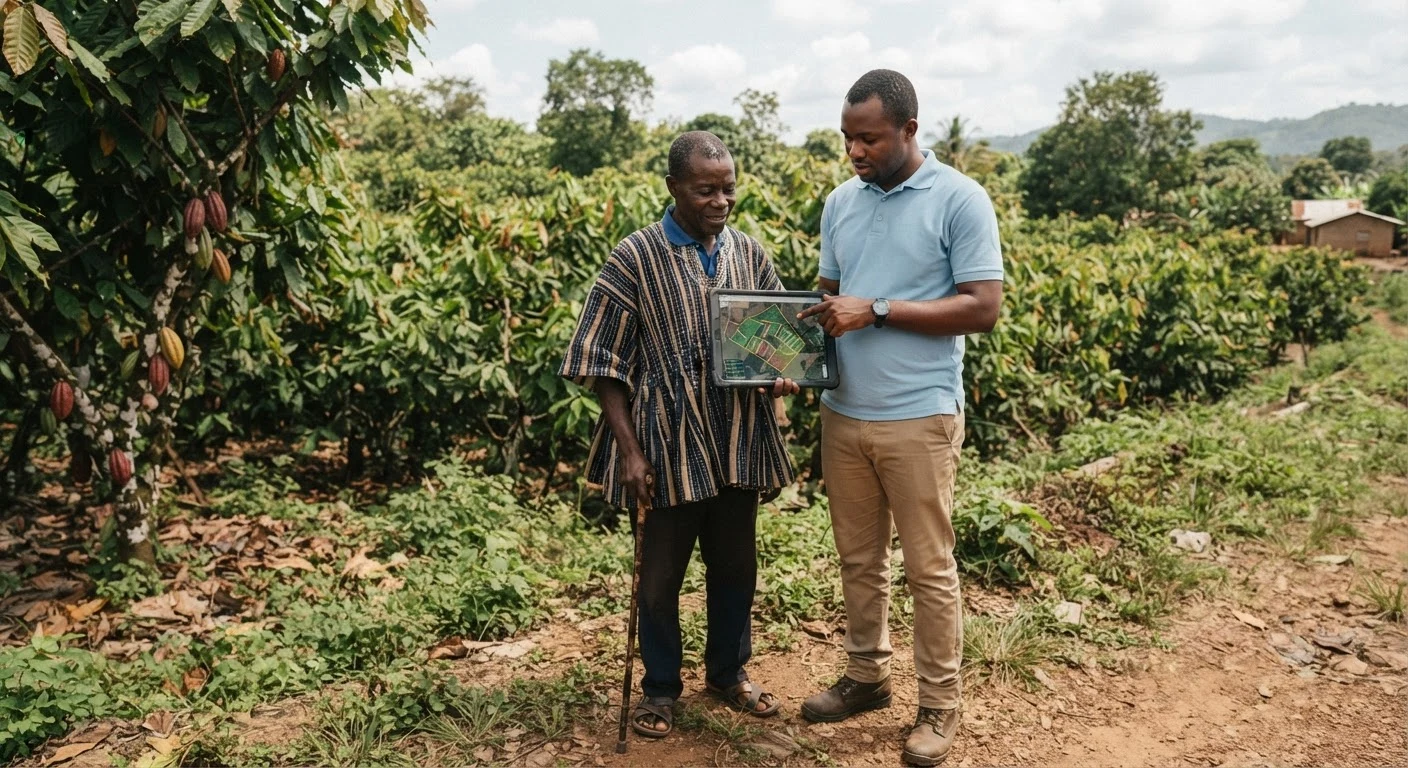
A Ghanaian cocoa farmer and an extension officer looking together at a smartphone showing a farm-record app, cocoa trees around them, documentary photograph
Cocoa · Series intelligence

Strategic Outlook

The value has moved from the field to the compliance and grinding steps, and this closing pillar reads the state's own forecasts and the February 2026 reforms against the EU deforestation deadline into a ranked set of openings.
Strategic Outlook · Pillar 08

This closing pillar sets out where Ghana’s cocoa sector is actually heading and what a serious operator should do about it. It reads the production numbers against the state’s own forecasts, places the crop inside a macro economy that is recovering faster than the tree stock, works through the February 2026 reforms that rewrote how COCOBOD prices, finances and processes the crop, and sets the binding external deadline of the European deforestation rules against that internal reform clock. It then compresses the whole book into a PESTLE and SWOT reading, three plain scenarios, a ranked set of strategic openings, and the digital tools a Ghanaian cocoa business can genuinely use this season rather than the ones that only work on somebody else’s balance sheet.

A Ghanaian cocoa exporter reviewing a laptop showing a farm traceability map, a small stack of jute sample sacks of cocoa beans on the desk, documentary photograph
Field to compliance, and grinding
The value has moved from the field to the compliance and grinding steps.
70%
the guaranteed farmer share of gross FOB the reform hard-wires
50%
of beans that must be processed locally from 2026/27
Sep '26
when the enabling COCOBOD Bill is due; track its passage

Where the sector is heading

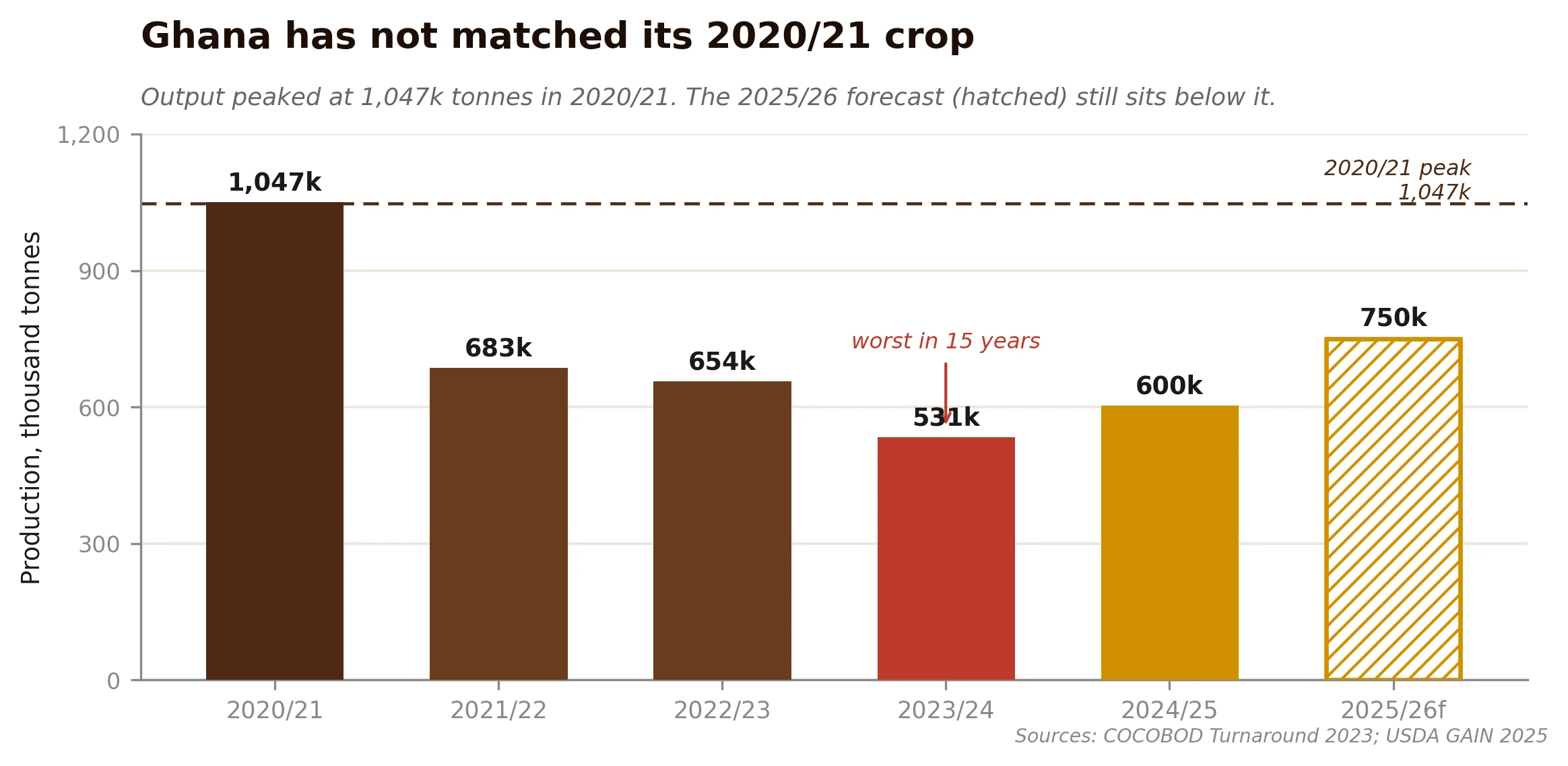
Ghana’s cocoa output has not recovered to the level it reached five years ago, and the official forecast does not expect it to. Production peaked at 1.047 million tonnes in 2020/211on the back of the productivity-enhancement programmes and a good weather run, then fell to about 531,000 tonnes in 2023/24, which the United States Department of Agriculture’s Accra post records as the worst season in fifteen years2. The recovery now under way is real but partial: the same post forecasts 600,000 tonnes for 2024/25 and 750,000 tonnes for 2025/26, a twenty-five per cent rebound that still leaves the crop nearly three hundred thousand tonnes short of its own record3. The strategic reading is that the ceiling has dropped. Planning a cocoa business against the 2020/21 peak overstates the volume the tree stock can deliver; the disease-and-age problem has reset the working baseline, and the opportunity sits in the value captured per tonne rather than in a return to record tonnage.

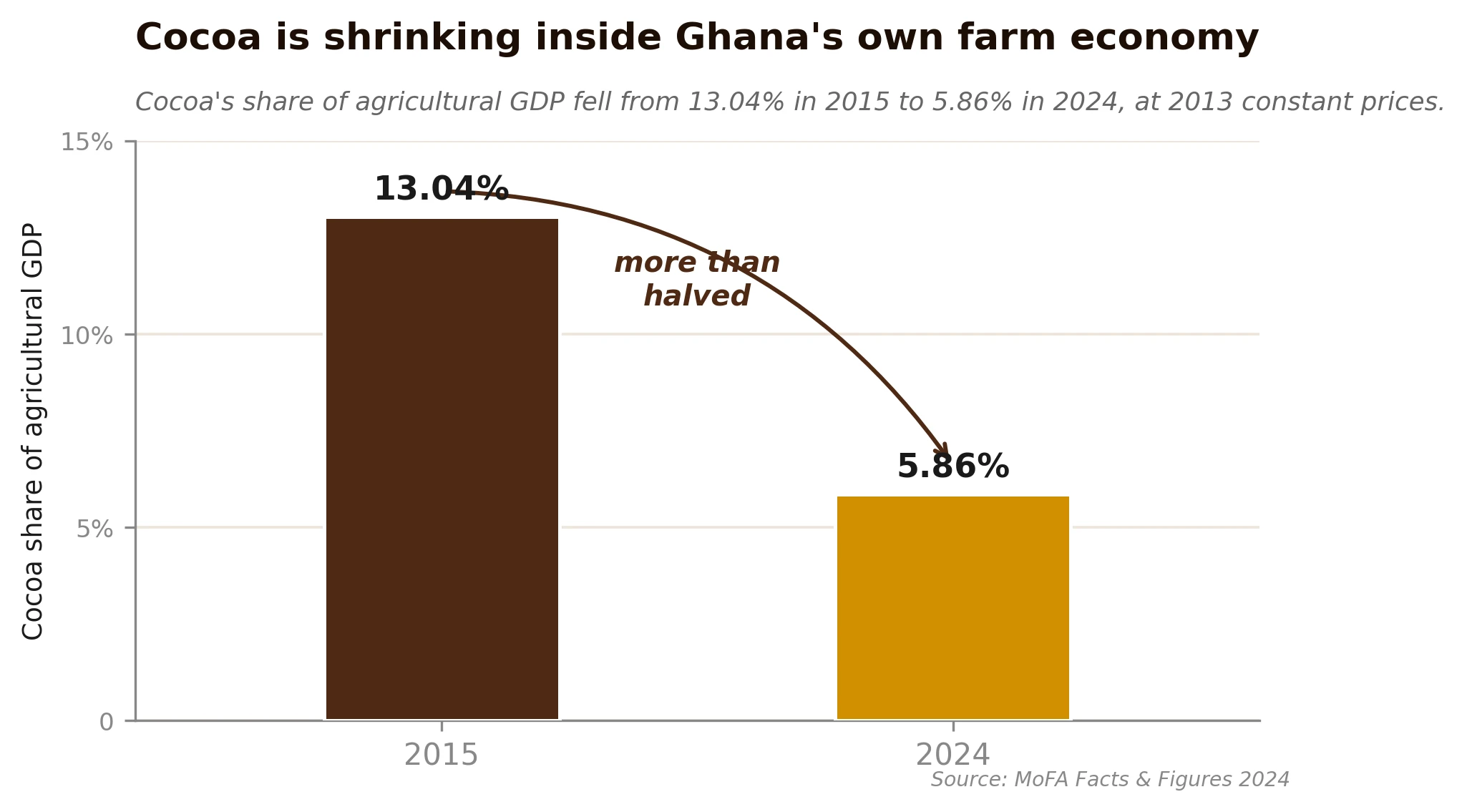
The deeper shift is that cocoa is shrinking inside Ghana’s own farm economy. Cocoa’s share of agricultural gross domestic product fell from 13.04 per cent in 2015 to 5.86 per cent in 20244, more than halving over the decade even before the price shock of early 2026. The subsector did grow 14.3 per cent in 2025 as the crop recovered off its low base, helping agriculture more than double its pace to 6.8 per cent, but that is a bounce from a trough rather than a return to weight in the economy5.

The same trend shows in the export book. Cocoa earned US$2.3 billion in the first half of 2026 while gold alone earned US$12.5 billion, more than five times as much and sixty-eight per cent of all exports6. Cocoa is no longer the commodity the national accounts lean on, which changes the negotiating position of everyone in the chain. The crop still matters to the farm households and southern regions that depend on it, but it no longer commands the fiscal urgency it once did, and a business plan that assumes the state will always step in to protect cocoa first is reading an economy that has already moved on to gold.7

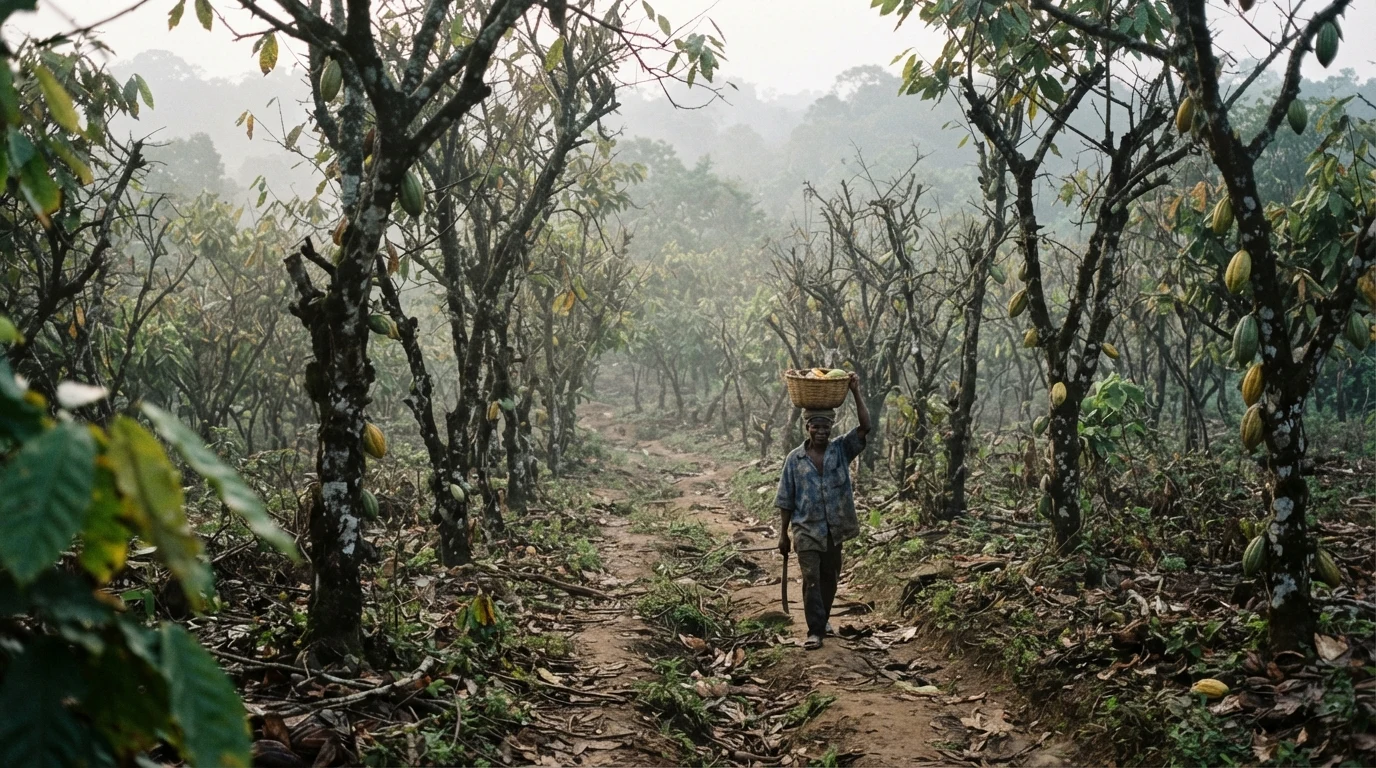
A wide view of an aging cocoa farm in Ghana with sparse pods and patchy canopy, a farmer walking a dirt path between the rows, documentary photograph
The ceiling has dropped
Value per tonne, not a return to record tonnage, is where the opportunity sits.
1,047kt
the 2020/21 peak, before disease and age cut the ceiling
531k t
the 2023/24 trough, the worst season in fifteen years
750k t
the 2025/26 forecast, a partial recovery
13.04% → 5.86%
cocoa's share of agricultural GDP, 2015 to 2024
US$2.3bn
cocoa's export earnings in H1 2026, against gold's US$12.5bn
Ghana's cocoa production by season from the 2020/21 peak of 1,047 thousand tonnes through the 2023/24 trough of 531 thousand tonnes to the USDA 2025/26 forecast of 750 thousand tonnes, still below the peak
Figure 14 Ghana has not matched its 2020/21 crop, and the official forecast does not expect it to. The dashed line marks the peak so the forecast bar visibly falls short of it: the rebound is genuine but the ceiling has fallen, so the strategy is value per tonne, not a return to record volume.
What this shows

Output peaked at 1,047 thousand tonnes in 2020/21 (COCOBOD, 2023), fell to about 531 thousand tonnes in 2023/24, the worst season in fifteen years, and the USDA forecast recovers only to about 750 thousand tonnes for 2025/26 (USDA FAS, 2025). Source: COCOBOD (2023); USDA FAS (2025).

Cocoa's share of Ghana's agricultural GDP falling from 13.04 per cent in 2015 to 5.86 per cent in 2024
Figure 15 Cocoa’s declining weight in Ghana’s farm economy. Its share of agricultural GDP more than halved in a decade, from 13.04 per cent in 2015 to 5.86 per cent in 20248. The negotiating weight that came with being the lead crop has gone with it: a business plan that assumes the state will always protect cocoa first is reading an economy that has already moved on to gold.
What this shows

Source: MoFA (2024), Table 8.1, 2013 constant prices.

The macro and fiscal frame

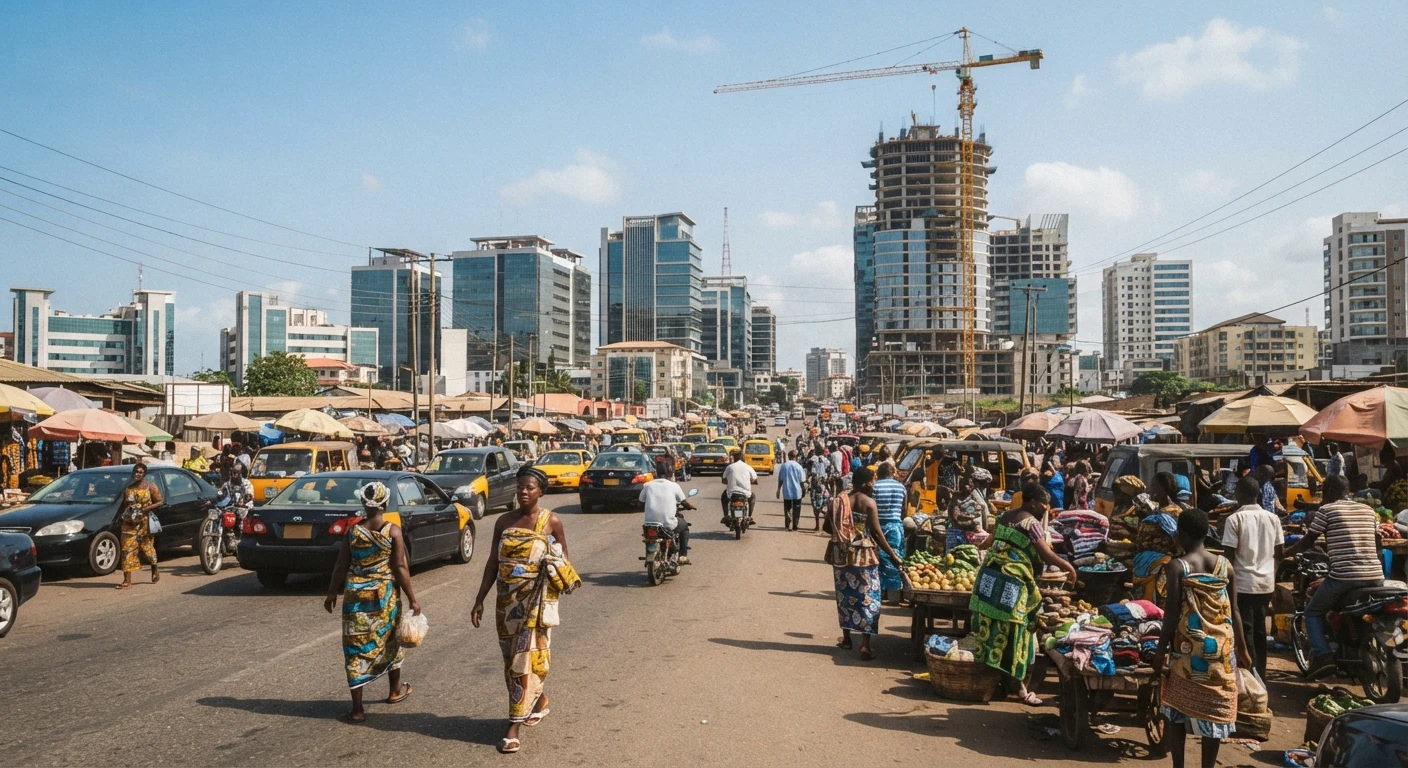
A wide shot of a busy Accra street with modern office buildings and a construction crane in the background, market traders and cars in the foreground, documentary photograph
Two clocks, different speeds
The economy is stabilising faster than the cocoa tree stock is recovering.
61.8% → 45.0%
public debt as a share of GDP, end-2024 to June 2026
23.8% → 5.7%
inflation, December 2024 to June 2026

Ghana is emerging from its debt crisis faster than it is fixing its cocoa tree stock, and the two clocks now run at different speeds. The International Monetary Fund’s Extended Credit Facility, the US$3 billion programme approved in May 2023, completed its sixth and final review on 27 July 2026 with a last disbursement of about US$371 million, and the country’s risk of debt distress was reassessed to moderate9. A non-financing successor arrangement, a thirty-six-month Policy Coordination Instrument, is proposed to anchor the reform agenda beyond the programme, alongside a completed 2026 Article IV consultation and a legislated commitment to hold public debt at forty-five per cent of GDP through 203410.

The headline macro numbers behind that recovery are strong. Public debt fell from 61.8 per cent of GDP at the end of 2024 to 45.0 per cent by June 2026, meeting the statutory target years early; inflation fell from 23.8 per cent in December 2024 to 5.7 per cent in June 2026; and the economy passed US$100 billion for the first time in 202511. The macro recovery matters to a cocoa operator for one blunt reason: it removes the excuse that the sector’s problems are just the national crisis in miniature.12

With the wider economy stabilised, the Fund has named cocoa as unfinished business in its own right, calling for a stronger legislative framework, more frequent farmgate price adjustments, and measures to secure COCOBOD’s long-term financial sustainability13. The Bank of Ghana still carries significant loss-making exposure to COCOBOD, which is exactly why the board’s finances have become a fiscal-risk item rather than a sector footnote14. For an entrant this reframes the risk. The sovereign is a more reliable counterparty than it was three years ago, but the cocoa institution inside that sovereign is the weak link, so the diligence belongs on COCOBOD’s balance sheet and reform delivery, not on Ghana’s.

COCOBOD’s own distress and the February 2026 reforms

COCOBOD entered 2026 in genuine financial distress, and the reforms announced in February are a direct response to how close the board came to failure. The immediate trigger was the collapse of the 2023/24 crop: the board projected 800,000 tonnes and sold 786,672 tonnes forward in contracts, but produced only 432,145 tonnes, a forty-five per cent shortfall that forced 333,767 tonnes of contracts to roll over at an average of about US$2,661 a tonne and cost the sector over a billion dollars that would have reached farmers15. That 432,145-tonne figure is the board’s own contract-accounting number for the crop it had sold against, and it is used here only for that contract-loss story; the production narrative above uses the USDA fifteen-year-low series of about 531,000 tonnes.16

The thirty-two-year offshore syndicated loan had already failed, the stop-gap model that made buyers pre-finance the crop proved unsustainable, and by 2024 the board could not meet a loan tranche and defaulted even on a US$70 million bridge from the Ministry of Finance17. The distress reached the board’s paper as well: the 2023 Cocoa Bills were themselves restructured that year, an exchange the government’s own debt accounting records as still sitting on COCOBOD’s balance sheet18. When the world price then fell below the roughly US$6,400 a tonne it costs to move Ghana’s cocoa from farm to port, the board was selling at a loss into a market that no longer wanted an over-priced bean.

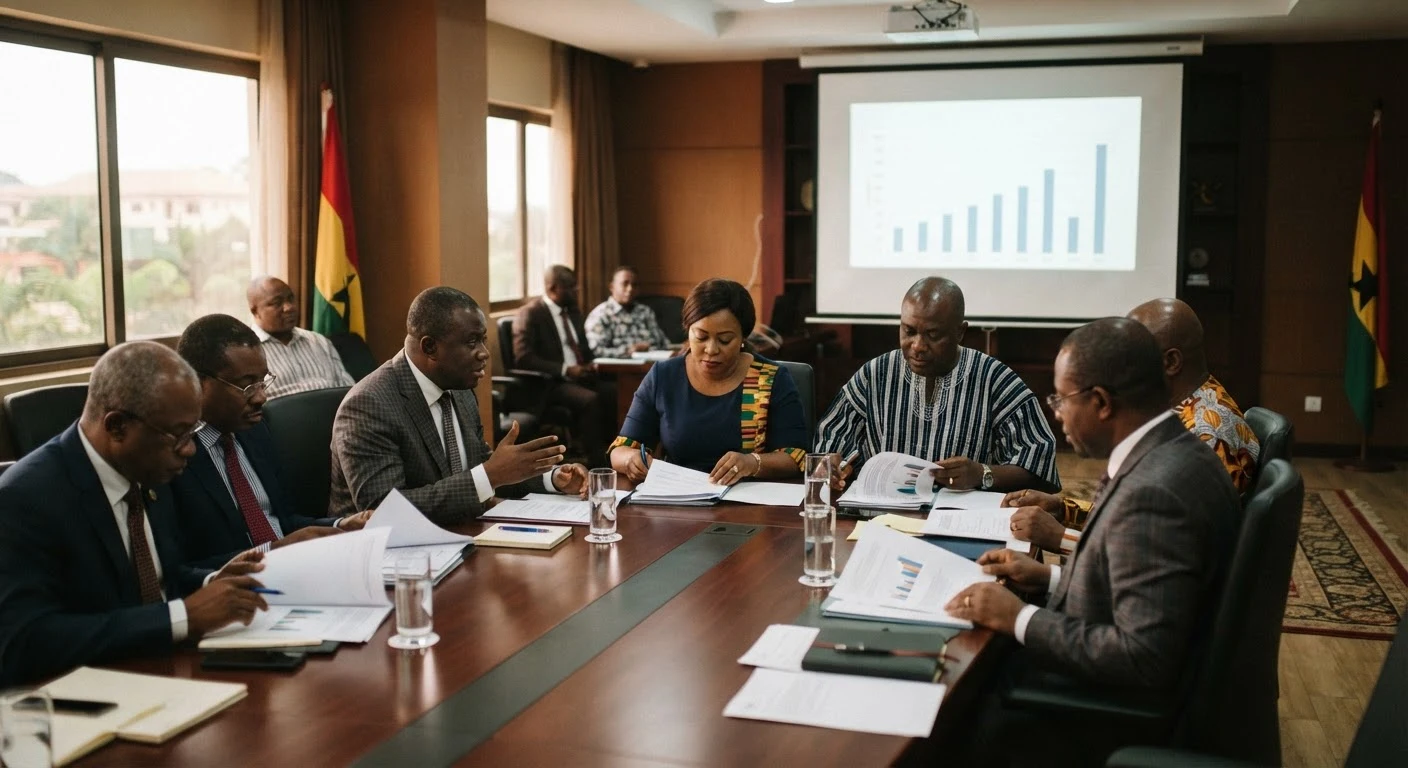
A formal Ghanaian government meeting room, officials in business attire seated around a long table reviewing printed policy documents, documentary photograph
How close the board came to failure
A forty-five per cent contract shortfall in 2023/24 cost the sector over a billion dollars.
786,672 t
sold forward in contracts for 2023/24
432,145 t
actually produced, a 45% contract shortfall
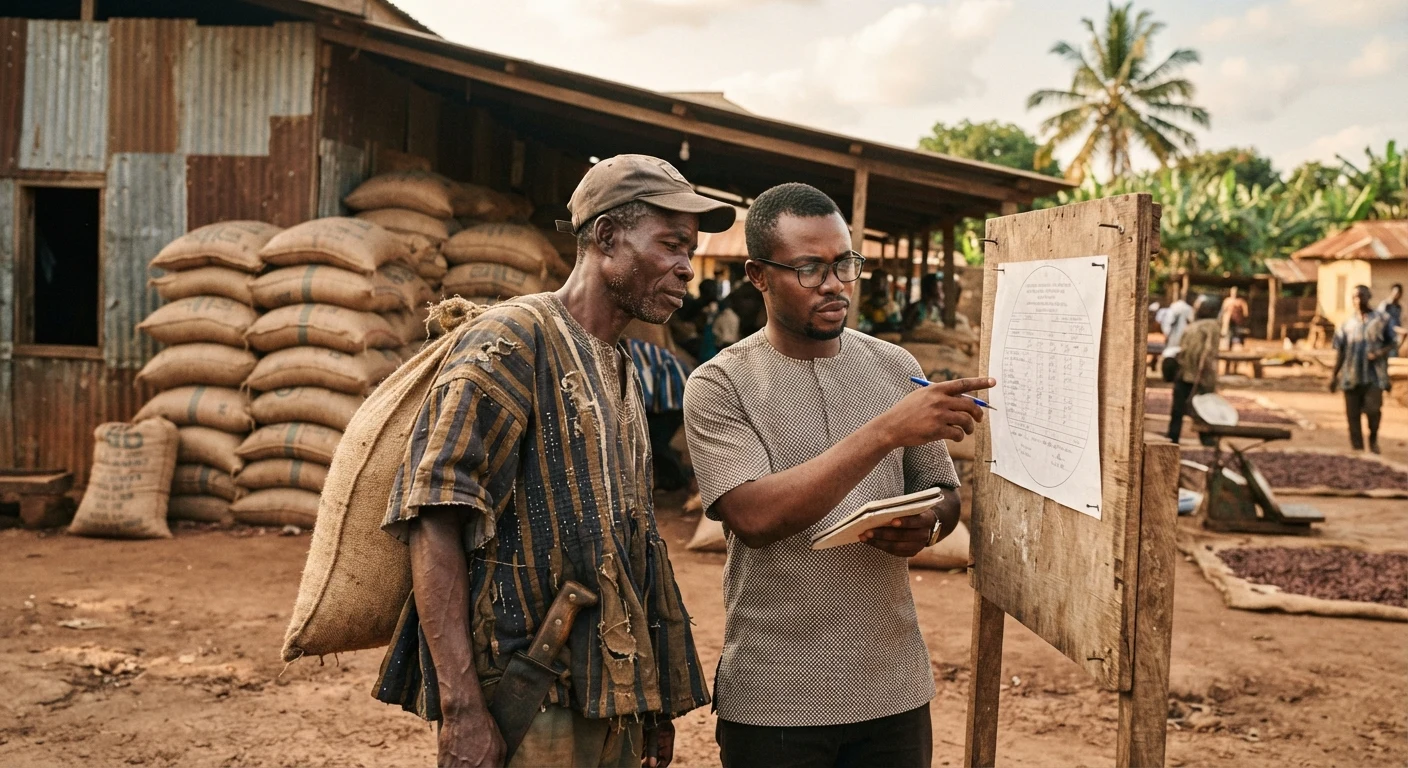
A Ghanaian cocoa farmer and a licensed buying company clerk reading a freshly posted producer price circular pinned to a notice board outside a rural purchasing shed, documentary photograph
The mechanism working in real time
A smaller cheque, but a guaranteed 70 per cent of it, protects the slice, not the level.

The Cabinet response of 11 to 12 February 2026 is the most consequential change to how Ghana runs cocoa in a generation, and it moves on five fronts at once. On price, a new COCOBOD Bill introduces an automatic mechanism that adjusts the producer price with the world price and exchange rate and guarantees farmers a minimum of 70 per cent of the gross free-on-board price, ending the era of a fixed annual figure set by committee. On finance, the offshore syndicated loan is abandoned in favour of domestic Cocoa Bonds that raise a revolving fund COCOBOD turns over at least once a season, and the indigenous Licensed Buying Companies pushed out under the failed model are to be revived, led by a restored state-owned Produce Buying Company. On processing, a minimum of half of all beans processed locally from the 2026/27 season is mandated, the rest of the 2025/26 crop was directed straight to domestic grinders, and the state-owned Cocoa Processing Company is to be revived as the lead processor. On the balance sheet, about GH¢5 billion of legacy debt owed to the Ministry of Finance and the Bank of Ghana is converted to equity, and the cocoa-roads liabilities that did much of the damage are cut from GH¢21.7 billion to GH¢4.35 billion and moved to the Ministry of Roads. And on accountability, the Attorney General was directed to run concurrent forensic and criminal investigations into eight years of COCOBOD activity.1920

The same release shows the price mechanism working in real time, which is the clearest evidence the reform is more than an announcement. On 12 February 2026, with the world price down from around US$7,200 to about US$4,100 a tonne, the Producer Price Review Committee reset the producer price to GH¢41,392 a tonne, or GH¢2,587 a bag, set at 90 per cent of a gross free-on-board price of US$4,20021to cushion the farmer through the fall. That is the double-edged finding that closes the book: the reform lowered the cedi price the farmer receives while raising the farmer’s share of a smaller pie, which protects the grower’s slice but cannot protect the grower from a falling world market. The legislative counterpart is on a clock. The Mid-Year Fiscal Policy Review commits the Ministry of Finance to submit amendments to the COCOBOD Act, covering governance and audit, producer-pricing and stabilisation rules, and limits on quasi-fiscal spending, by the end of September 202622. The whole reform therefore has a date attached, and the entrant who tracks whether that Bill actually passes is reading the single most important governance signal in the sector.

GH¢41,392/t
the reset producer price, 12 February 2026
US$7,200 to US$4,100/t
the world price fall that forced the reset

What this means. The February 2026 reforms are real enough to price a business against, but they are still Cabinet decisions and a draft Bill, not settled law. The one number that tells you whether they will hold is the COCOBOD Bill, due by the end of September 2026: track its passage, not the announcement. Everything the investment case rests on, the price floor, the local processing mandate, the domestic bond and the debt clean-up, is written into that Bill.

The policy trajectory

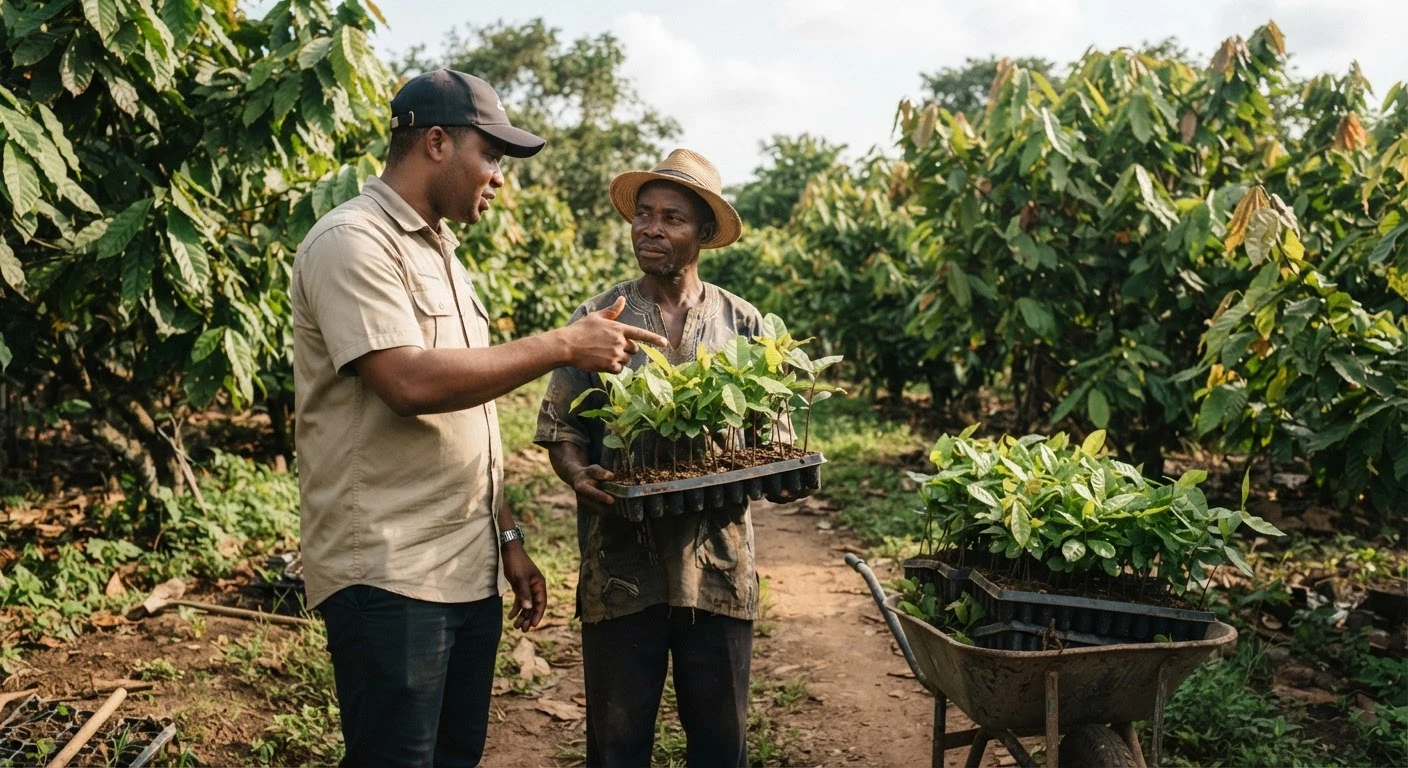
A Ghanaian extension officer showing a smallholder farmer young cashew and rubber tree seedlings ready for planting beside an established cocoa farm, documentary photograph
A state hedge against cocoa itself
COCOBOD is the implementing agency for a project spreading farm income beyond cocoa.
US$200m
the Tree Crop Diversification Project
US$75m
committed in 2026 to rehabilitate diseased farms
25k ha
of diseased and aging cocoa farms targeted

The February reforms did not appear from nothing; they extend a policy direction the board and its partners had already set. The COCOBOD Turnaround Strategy fixed the principle that the farmgate price should sit at between sixty and seventy per cent of the gross free-on-board price within a legally binding framework, which is the rule the 2026 automatic mechanism now hard-wires23. Under the IMF programme the board had already streamlined its cocoa-roads portfolio from about GHS21 billion to GHS6 billion by late 2025, the same rationalisation later completed to the GH¢4.35 billion noted above, cut industry costs to 21.8 per cent of gross free-on-board, established a cocoa desk at the Ministry of Finance, and moved its supervisory ministry from Food and Agriculture to Finance, so the February package tightened an existing grip rather than starting one24. The strategic point is continuity: the price, cost and governance reforms are three years deep and now programme-anchored, which makes them more likely to survive a change of minister than a single Cabinet announcement would be.

Running alongside the cocoa-specific reforms is a state hedge against cocoa itself. The World Bank’s Ghana Tree Crop Diversification Project, a US$200 million programme implemented by COCOBOD and the Tree Crops Development Authority, exists to build economic and climate resilience in tree-crop value chains other than cocoa, putting most of its money into productivity and climate resilience and a further slice into post-harvest value addition and market access25. That the country’s cocoa regulator is the implementing agency for a project designed to spread farm income across cashew, rubber and coconut tells an entrant something the reform documents do not say out loud: the state is preparing for a future in which cocoa is one tree crop among several rather than the crop. The project also has a 2026 implementation record, with about US$75 million committed to rehabilitate roughly 25,000 hectares of diseased and aging cocoa farms26 and a digital traceability component built on the same vehicle27.

EUDR as the binding external deadline

Every reform inside Ghana runs against a deadline set outside it. The European Union’s deforestation regulation applies from 30 December 2026 for large operators and 30 June 2027 for smaller ones, and it lands hardest on the same concentrated southern regions where Ghana’s cocoa is grown28. The external clock and the internal reform clock are the same clock: a farmer whose beans cannot be traced to a deforestation-free plot cannot be sold into Ghana’s most valuable market, whatever the producer price.29

Ghana’s answer is the Ghana Cocoa Traceability System, built by COCOBOD with German and European Union support and explicitly accelerated to align with the regulation, which mapped more than forty thousand farms and registered more than twenty thousand farmers in its pilot before moving to a national rollout across eight buying companies that handle about sixty per cent of purchases30. The strategic opening is that traceability compliance and the domestic reform agenda both require the same thing, a complete digital record of who farms what and where, so the entrant who builds or plugs into that record is solving the market-access problem and the reform problem in a single move.31

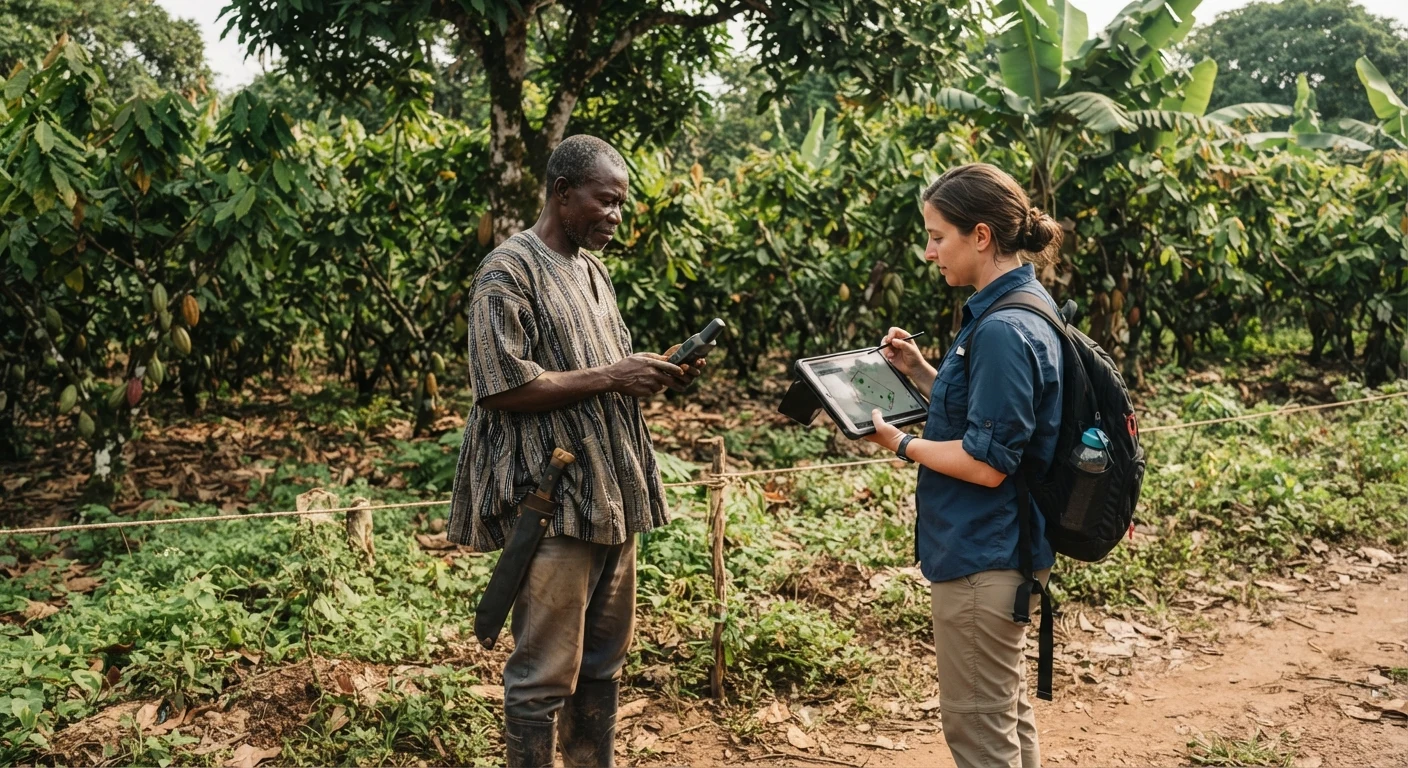
A Ghanaian cocoa farmer and a field agent standing at the edge of a cocoa farm using a handheld GPS device and a tablet to map the plot boundary, documentary photograph
One record, two problems solved
The GCTS has mapped over 40,000 farms; the eight covered buyers handle about 60% of purchases.
30 Dec 2026
EUDR applies for large operators; 30 June 2027 for SMEs
~60%
of purchases covered by the traceable buying companies so far

PESTLE: the forces around the sector

The forces around Ghanaian cocoa can be read on a single page, and two of the figures the table below carries are worth stating in the prose first because they set the tone. The world price fell from about US$5,018 a tonne in January 2026 to US$3,241 in March, with the World Bank projecting roughly US$3,800 for the year32; and swollen shoot disease covers about 400,000 hectares while aging trees have cut yields to roughly a quarter of potential, the production ceiling diagnosed above33. Every other figure in the PESTLE grid is stated and cited in the sections above.

US$5,018 → US$3,241/t
the world price fall, January to March 2026
400,000 ha
under swollen shoot disease, yields near a quarter of potential
Table 13: PESTLE snapshot for Ghana cocoa
ForceWhat it means for cocoa
PoliticalA state that has just rewritten the sector by Cabinet decision: the February 2026 reforms revive the state buyer (PBC) and processor (CPC), mandate local processing, and put COCOBOD under the Ministry of Finance. Delivery, not intent, is the open question, and it hangs on a COCOBOD Bill due by end-September 2026.
EconomicA stabilised macro economy (debt at 45 per cent of GDP, inflation near 5.7 per cent, the cedi steadier) sits over a cocoa institution still in distress; the world price fell from about US$5,018 a tonne in January 2026 to US$3,241 in March, with the World Bank projecting roughly US$3,800 for the year.
SocialMore than 760,000 smallholder families depend on the crop, concentrated in the southern belt; the February price reset protected the farmer's share of a smaller pie but not the cash value of the cheque.
TechnologicalA live national traceability system and farmer database (the Cocoa Management System within the GCTS), satellite deforestation mapping, and commercial farm-advisory tools exist and are being deployed; the binding precondition is a complete farm record, not a new model.
LegalEUDR applies from 30 December 2026 (large) and 30 June 2027 (SME); domestically, a new COCOBOD Bill hard-wires the 70-per-cent-of-FOB price floor, the 50 per cent local-processing mandate, and a ban on quasi-fiscal spending.
EnvironmentalSwollen shoot disease covers about 400,000 hectares and aging trees have cut yields to roughly a quarter of potential; the crop's exposure to deforestation scrutiny and climate variability is the reason both the reform and the diversification project exist.

Source: Author synthesis of Pillars 1 to 8. Every figure in this table is stated and cited in the body prose of this playbook; the PESTLE reading itself is the authors' judgement on that evidence.

SWOT: the sector at a glance

The same evidence resolves into a SWOT the moment it is read from the point of view of an operator deciding whether to commit capital. One figure the table carries is worth stating in prose because it is the competitive fact behind the threat column: Cote d’Ivoire set its 2025/26 farmgate about twenty per cent above Ghana’s on 1 October 2025, which is what forced Ghana’s own October price revision and later its February cut.3435

Table 14: SWOT for a Ghana cocoa venture
QuadrantThe reading
StrengthsThe world's second-largest supplier with a reputation for bean quality; an administered price that now guarantees farmers a fixed share of FOB; installed grinding capacity already in the ground; a state actively reforming, financing and de-risking the sector.
WeaknessesA tree stock hit by disease and age, with yields near a quarter of potential; a regulator that recently defaulted and is being rebuilt; grinding plants that sit idle; almost all value captured downstream of the border.
OpportunitiesThe 50 per cent local-processing mandate creates guaranteed domestic demand for beans and a policy tailwind for value addition; traceability compliance opens the EU market to whoever holds the farm record; diversification finance is flowing through the Tree Crop project; the price floor makes farmer income more predictable.
ThreatsEUDR exclusion from the top market if traceability slips; a world price the country does not set and cannot cushion indefinitely; reform-delivery risk if the COCOBOD Bill stalls or the domestic bond under-funds the crop; competition from Cote d'Ivoire, which priced about 20 per cent above Ghana in 2025.

Source: Author synthesis of Pillars 1 to 7, with the reform and macro facts cited in the body above. The SWOT reading is the authors' judgement on that evidence.

Three scenarios to 2030

The forces above do not resolve into a single forecast, so they are set out here as three plain scenarios rather than a prediction. Each turns on the same small set of hinges: whether the COCOBOD Bill passes, whether the domestic bond funds the crop, whether traceability reaches national coverage before the EUDR dates, and whether rehabilitation lifts output toward the forecast. The figures each scenario leans on, the 750,000-tonne forecast, the end-September 2026 Bill deadline and the EUDR dates, are all cited in the sections above.

Table 15: Strategic scenarios for Ghana cocoa to 2030
ScenarioWhat has to happenWhat it looks like for an operator
Managed recovery (central case)The COCOBOD Bill passes on schedule, the domestic Cocoa Bond funds the crop, traceability reaches national coverage before the EUDR dates, and rehabilitation lifts output toward the 750,000-tonne forecast.Cocoa is a smaller but better-run business: a predictable price floor, a working export route to Europe, and real domestic grinding demand. The winners are traceability-ready aggregators and processors positioned before the mandate bites.
Reform stallThe Bill slips past end-September 2026, the bond under-funds the crop, or traceability coverage lags the EUDR deadline.Farmers face payment delays and buyers face a funding gap; some Ghanaian cocoa is shut out of the EU market and diverted to lower-value buyers. The operator who kept a cash buffer and a non-EU sales channel survives; the one who assumed the old syndicated-loan rhythm does not.
Structural declineDisease and aging outrun rehabilitation, the world price stays low, and diversification pulls farm income toward cashew, rubber and coconut faster than cocoa recovers.Cocoa settles below the forecast as a legacy crop; the state's attention and money follow gold and the diversification tree crops. Value capture, not volume, is the only cocoa strategy that still works, and the exit is toward the tree crops the state is already funding.

Source: Author synthesis of the production, reform, macro and EUDR evidence in this pillar; the scenarios describe a range of outcomes, not forecasts.

The strategic openings

The openings that follow are ranked by ease of entry and by the value each captures, and each rests on evidence cited in this pillar’s prose: the 50 per cent processing mandate and the idle grinding capacity behind it, the EUDR and domestic-reform demand for a farm record, the 400,000 hectares of disease the Tree Crop project is funding against, and the US$200 million the state is channelling into the other tree crops.

Table 16: Ranked strategic openings in Ghana cocoa
Rank and openingWhat the evidence saysWhat it requiresWho it suits
1. Local grinding and value additionThe mandate requires 50 per cent of beans processed locally from 2026/27, and idle state grinding capacity plus revived buyers create guaranteed feedstock; value is captured downstream of the border.Processing capital, a bean-supply agreement with COCOBOD or an LBC, and a product with a buyer.Established food processors and industrial investors with balance-sheet and offtake.
2. Traceability-ready aggregationEUDR compliance and the domestic reform both need a complete farm record; the GCTS covers only part of the chain, and buyers handling the other forty per cent of purchases need to catch up.A digital farm register, purchasing-clerk relationships, and integration with the Cocoa Management System.Aggregators, cooperatives and agtech firms who can build and hold a farm record.
3. Farm rehabilitation and input supplyDisease covers 400,000 hectares and the Tree Crop project is funding rehabilitation of diseased and aging farms; yields sit near a quarter of potential.Access to disease-resistant planting material, agronomy capacity, and a link to the rehabilitation programme.Nurseries, input suppliers and service providers with technical depth.
4. Diversification into the other tree cropsThe state's own flagship project channels US$200 million into cashew, rubber and coconut as a hedge against cocoa concentration.A tree-crop value-chain plan and patience for a longer horizon than cocoa.Investors willing to follow where the state's diversification money is already going.

Source: The reform, production, EUDR and diversification evidence is cited in the body prose above; the ranking is the authors' judgement against ease of entry and value captured.

The reading of that table is the reading of the whole book. The value in Ghana’s cocoa sector no longer sits in growing more beans, because the tree stock cannot deliver the old peak and the world price is not Ghana’s to set. It sits in the two things the reforms have just made bankable, processing beans inside the country and holding the traceable farm record that keeps them sellable to Europe. Do not plan to beat the world price; plan to own the compliance and the grinding step that the world price cannot take away.

Openings, ranked
01

Local grinding and value addition. The 50 per cent processing mandate from 2026/27 and idle state grinding capacity create guaranteed feedstock for a bean-supply agreement with COCOBOD or a Licensed Buying Company. It needs processing capital and a product with a buyer, and suits established food processors and industrial investors with balance-sheet and offtake.

02

Traceability-ready aggregation. EUDR compliance and the domestic reform both need a complete farm record, and the Ghana Cocoa Traceability System covers only part of the chain, so the buyers handling the other forty per cent of purchases need to catch up. It needs a digital farm register and integration with the Cocoa Management System, and suits aggregators, cooperatives and agtech firms who can build and hold a farm record.

03

Farm rehabilitation and input supply. Disease covers 400,000 hectares and the Tree Crop project is funding rehabilitation of diseased and aging farms, with yields near a quarter of potential. It needs access to disease-resistant planting material and agronomy capacity, and suits nurseries, input suppliers and service providers with technical depth.

04

Diversification into the other tree crops. The state's own flagship project channels US$200 million into cashew, rubber and coconut as a hedge against cocoa concentration. It needs a tree-crop value-chain plan and patience for a longer horizon than cocoa, and suits investors willing to follow where the state's diversification money is already going.

AI and digital: what a cocoa business can adopt now

A Ghanaian cocoa extension agent showing a farmer a tablet displaying a satellite map with highlighted farm plots, standing at the edge of a cocoa farm, documentary photograph
A record, not a model
Register the farm first; the satellite feed and the AI advisory add nothing to a farm that cannot be located.
Register, connect, then layer
the realistic order of adoption for a Ghanaian cocoa business

The digital opening in cocoa is not speculative, because the core platform is already being built and funded by the state. The Cocoa Management System within the Ghana Cocoa Traceability System is a farm-to-port digital register that COCOBOD is rolling out nationally with German and European Union backing, and it exists to do exactly what both EUDR and the domestic reforms require, which is to attach a verifiable identity to every farm and every bag.3637Above that register sit satellite tools that are already in this book’s evidence: the deforestation mapping cited in Pillar 6 is the same class of remote sensing that traceability platforms use to flag farms encroaching on forest reserves38. Commercial vendors are marketing the next layer into Ghana now, with one offering blockchain traceability with satellite deforestation flagging and another promoting an artificial-intelligence advisory tool for pest, disease and weather alerts, though neither carries an independently verified Ghanaian adoption figure and both should be treated as vendor precedent rather than proof.

The discipline that this playbook applies to the value chain applies here too: the precondition for all of it is a record, not a model. A satellite feed and an artificial-intelligence advisory add nothing to a farm that cannot be located, matched to a farmer, and tied to a payment; they add a great deal to a farm that can. The realistic order of adoption for a Ghanaian cocoa business is therefore the same as the reform’s own sequence: register the farms and their boundaries first, connect them to a payment and purchasing record, then layer traceability verification and advisory analytics on top. The operator who builds that record is not buying technology for its own sake, but assembling the single asset that the mandate, the market-access rules and the new financing model all depend on.

The risks that sit inside the outlook

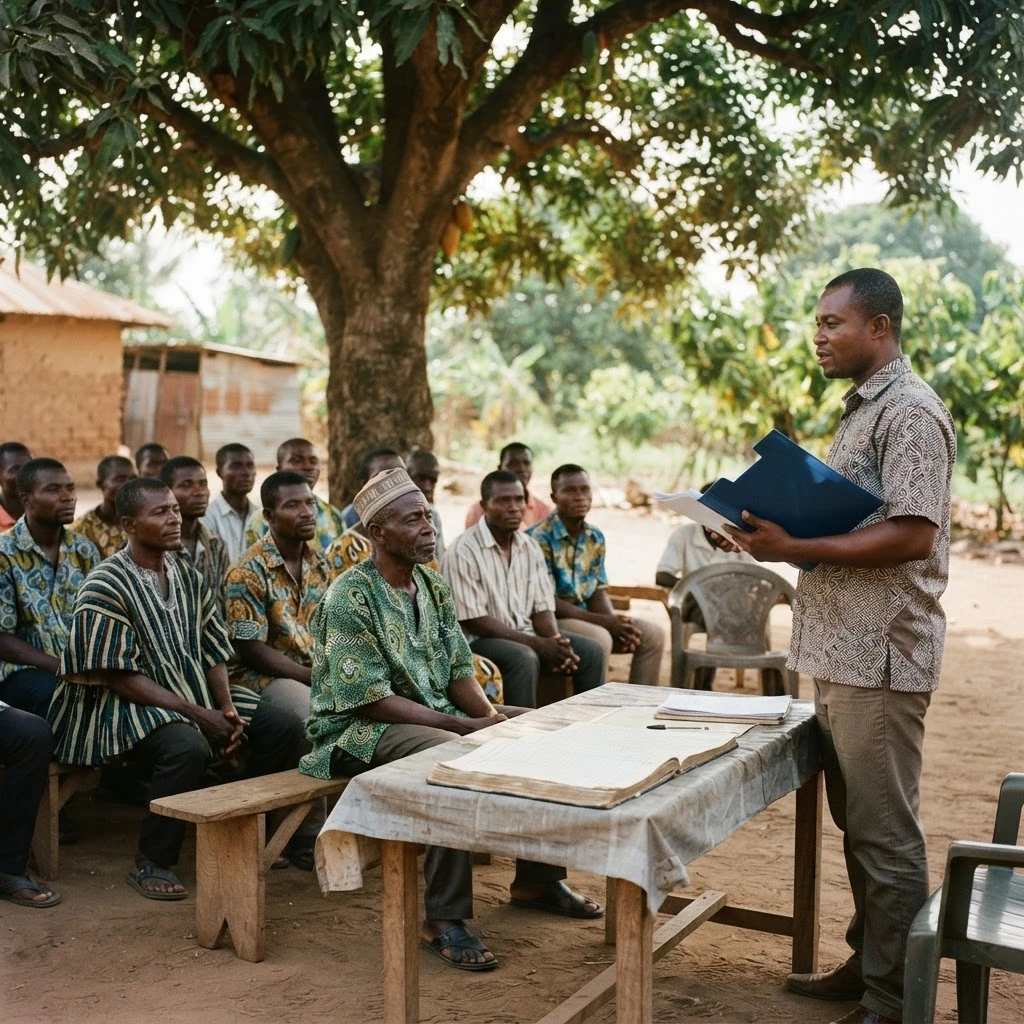
A Ghanaian government extension officer addressing a group of seated cocoa farmers under a shade tree beside a table with an open ledger book, documentary photograph

Reform-delivery and policy discontinuity

HIGH
What it is

The entire investment case rests on reforms that are Cabinet decisions and draft legislation rather than settled law, and a change of government or a stalled Bill can unwind them.

Evidence

The price floor, the local-processing mandate, the debt-to-equity conversion and the revived state buyer and processor were announced together in February 2026, and the enabling COCOBOD Bill is committed only to end-September 2026; the same sector defaulted on its own obligations two years earlier, so its promises carry a track record of slippage.

Who it hits

Anyone whose returns depend on the 50 per cent processing mandate creating guaranteed demand, on the price floor holding, or on the domestic bond funding the crop on time.

How to manage it, and the opening

Model the business once with every reform delivered and once with none, and proceed only if the second version still works; track passage of the COCOBOD Bill as the key governance signal, and position early as the private counterparty the state programmes will need.

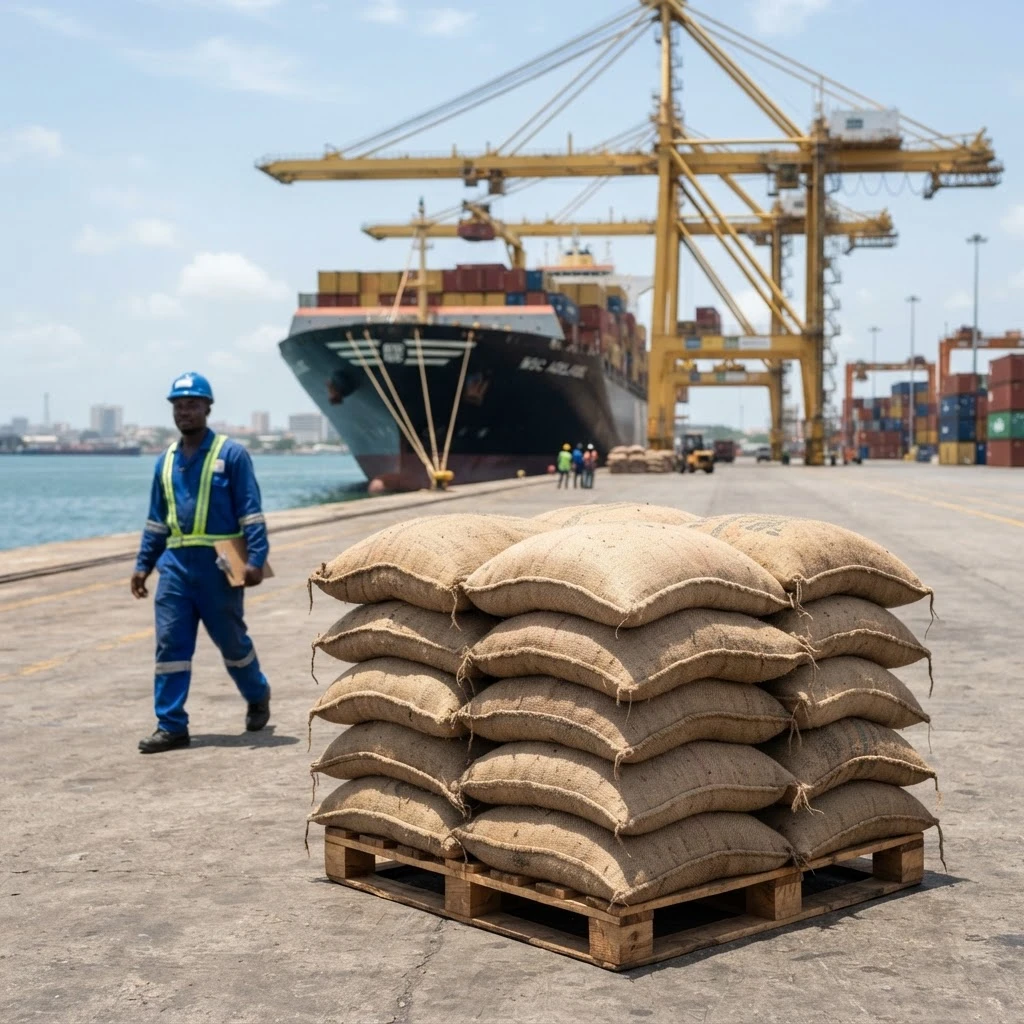
A Ghanaian port worker walking past a pallet of stacked jute sacks of cocoa beans with a cargo ship and container cranes behind him, documentary photograph

EUDR market exclusion

HIGH
What it is

From the end of 2026 cocoa that cannot be traced to a deforestation-free plot cannot enter the European market, whatever its price or quality.

Evidence

The regulation applies from 30 December 2026 for large operators and 30 June 2027 for smaller ones, it lands on the concentrated southern belt where Ghana’s cocoa grows, and the national traceability system still covers only part of the chain as the deadline approaches.

Who it hits

Exporters and the buyers behind them first, then farmers outside the registered coverage whose beans lose access to the highest-value market.

How to manage it, and the opening

Get inside the Cocoa Management System coverage early, build the farm record that compliance requires, and treat the buyers still outside the traceable sixty per cent as the addressable gap rather than a lost cause.

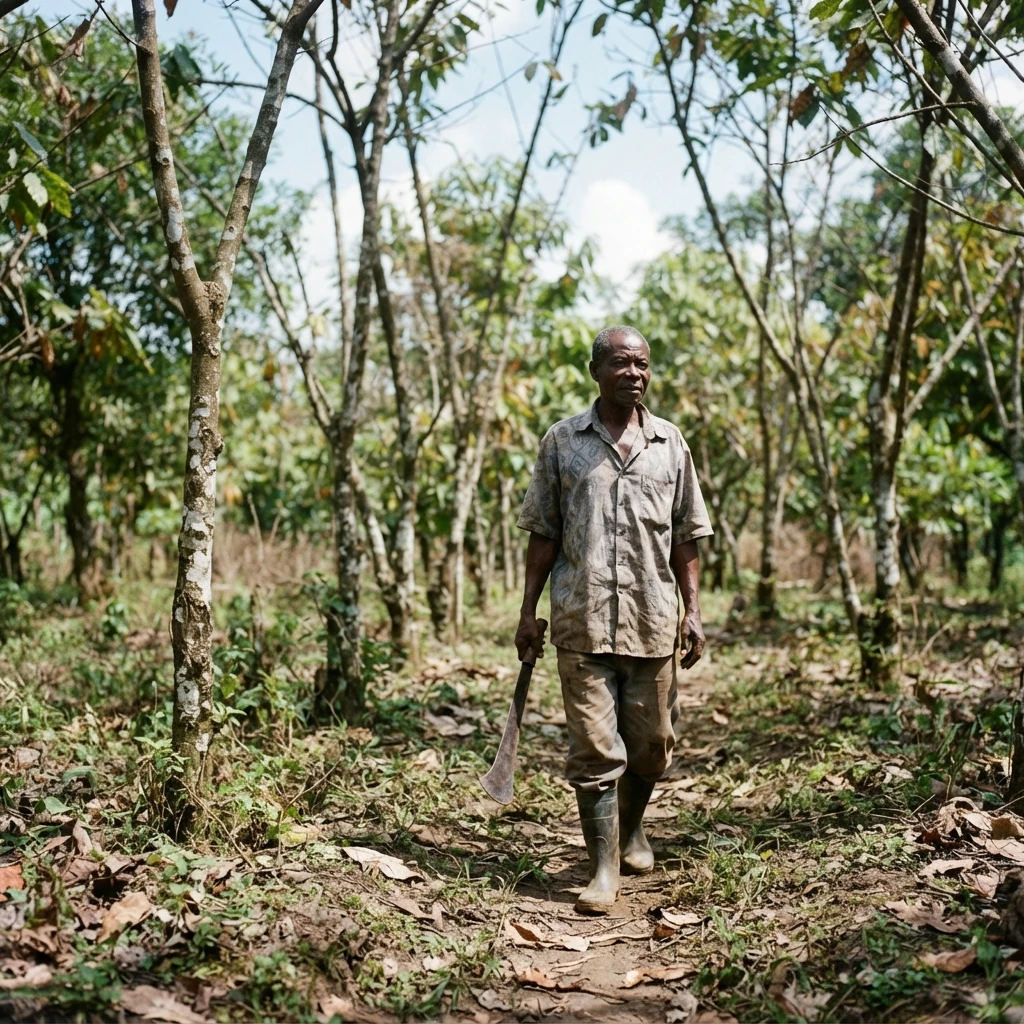
A Ghanaian cocoa farmer walking with a machete through an aging cocoa farm with sparse, patchy tree canopy, documentary photograph

Production ceiling from disease and aging trees

MEDIUM TO HIGH
What it is

The tree stock cannot deliver the volumes of five years ago, so any plan built on the 2020/21 peak overstates the beans that will actually exist.

Evidence

Output fell to a fifteen-year low in 2023/24 and the official forecast recovers only to about seventy per cent of the record; swollen shoot disease covers hundreds of thousands of hectares and yields sit near a quarter of their potential.

Who it hits

Processors and aggregators who size capacity or contracts against historic tonnage, and any plan that assumes supply grows back to the peak.

How to manage it, and the opening

Size the business against the forecast rather than the record, secure bean supply by contract rather than assuming a spot surplus, and read the rehabilitation programme as the supply-side bet worth backing.

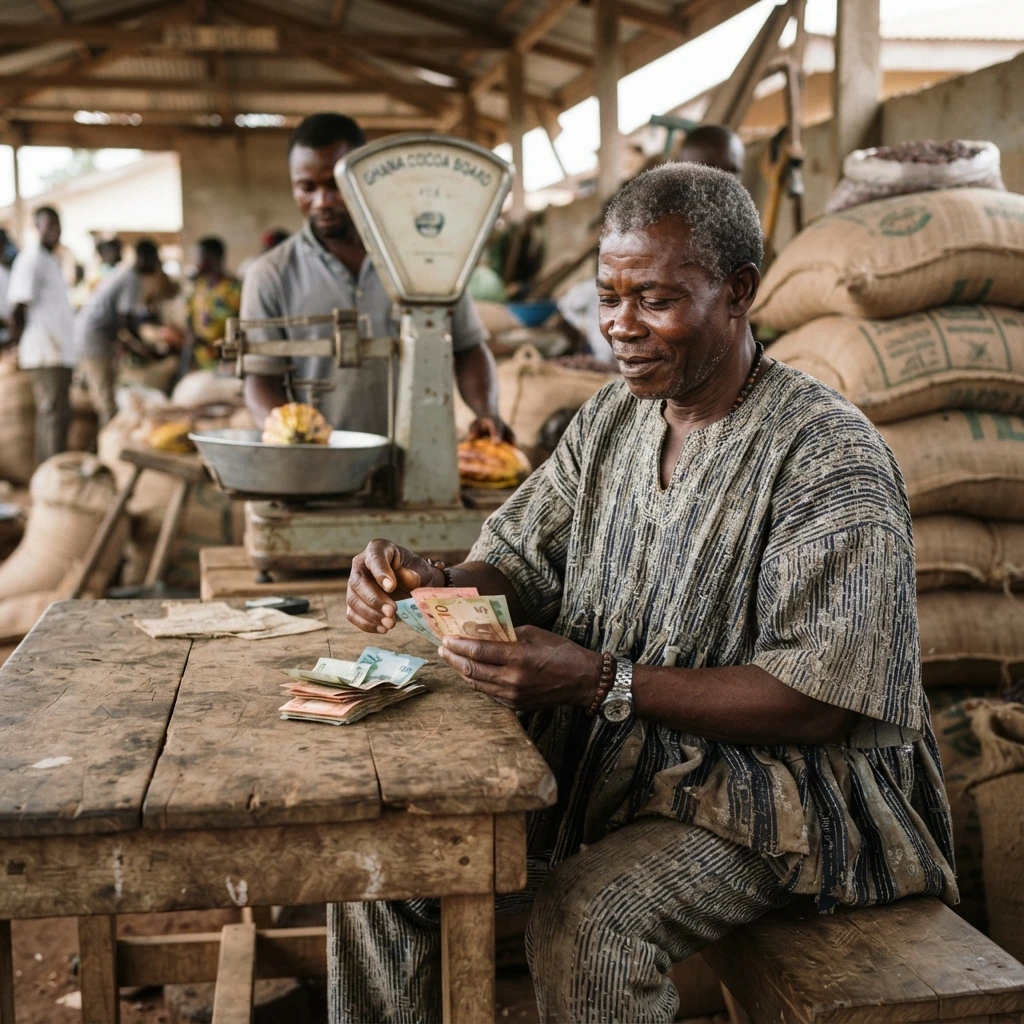
A Ghanaian cocoa farmer counting a small stack of cedi banknotes beside a weighing scale at a licensed buying company shed, sacks of beans stacked behind him, documentary photograph

World-price exposure the state cannot cushion

MEDIUM
What it is

Ghana takes the world price it does not set, and the reforms protect the farmer's share of that price without protecting its level.

Evidence

The world price fell by roughly a third inside three months in early 2026, forcing an emergency downward reset of the producer price even as the farmer’s share of FOB was raised; the state’s own price mechanism passes the market through rather than absorbing it.

Who it hits

Everyone whose margin is a spread over the bean price, and farmers whose cash income falls with the market even when their percentage share rises.

How to manage it, and the opening

Build a business on the value-addition and compliance steps the world price cannot erode, and treat the guaranteed FOB share as income stability, not price insurance.

Key takeaways
01

The strategic outlook for Ghana cocoa is a smaller, better-governed sector whose value has moved from the field to the processing and compliance steps. Production is recovering toward a forecast that still sits below the 2020/21 peak, and cocoa's share of the farm economy has more than halved in a decade.

02

The February 2026 reforms are the most important development in a generation, hard-wiring a 70-per-cent-of-FOB price floor, a 50 per cent local-processing mandate, a domestic bond financing model, and a debt-to-equity clean-up, with the enabling COCOBOD Bill due by the end of September 2026. Track the Bill, not the announcement.

03

The binding external deadline is EUDR, and the traceable farm record is the single asset that satisfies the mandate, the market-access rules and the new financing model at once. The entrant who holds that record is solving three problems in one move.

04

The openings that follow are local grinding, traceability-ready aggregation, farm rehabilitation and, for the patient, the tree crops the state is already funding as its hedge against cocoa itself. Do not plan to beat the world price; own the compliance and the grinding step it cannot take away.

Written for each reader

Practitioner intelligence

Hover any card to pause and lift it.

For students

Read this pillar as a lesson in separating a crop's importance from its leverage. Cocoa still matters to Ghana, but its share of agricultural GDP has more than halved and gold now earns five times as much, so the state's fiscal urgency has moved. The analytical habit to build is to ask, of any sector, not only whether it is large but whether it is still the thing the national accounts depend on, because that is what decides how much the state will spend to protect it.

For entrepreneurs

Do not build a plan on a return to record tonnage or on beating the world price; neither is available. Build it on the two steps the February reforms have just made bankable: grinding beans inside the country under the 50 per cent mandate, and holding the traceable farm record that keeps beans sellable into Europe. Model the business once assuming every reform lands and once assuming none does, and only proceed if the cautious version still works, because the reforms are a Bill and not yet law.

For investors

Two things decide a cocoa position here. The first is reform delivery: the price floor, the local-processing mandate and the domestic bond are all written into a COCOBOD Bill due by end-September 2026, so its passage is the single governance signal to underwrite, and the sovereign is now a stronger credit than the cocoa institution inside it. The second is that the value has left the field: price a position on the processing and compliance steps that survive a falling world price, not on tonnage or on the administered farm-gate trade.

For ecosystem actors

The highest-value public move is the farm record itself. The Cocoa Management System that EUDR compliance, the domestic reforms and the new financing model all depend on is one asset seen three times, and it is being built now but reaches only part of the chain. Fund the completion of that register and the buyers still outside the traceable sixty per cent before funding new plant or new subsidy, because the record is the precondition every downstream benefit now rests on.


Where this connects.The administered producer price this pillar’s reforms reset is Pillar 2’s subject; the idle state grinding capacity behind the local-processing mandate is measured in Pillar 2 and priced against the downstream value split in Pillar 6; the value that leaks downstream of the border is Pillar 6’s subject; the disease and EUDR exposure that resets the production ceiling is carried in Pillar 3, with the ageing tree stock behind that ceiling in Pillar 4; and the cost and financing detail behind the reform, including the cost model, belongs to Pillar 5. This closing pillar is where the eight pillars of the Ghana cocoa playbook meet: a smaller crop, a state actively rewriting the rules, and a value that has moved from the field to the compliance and grinding steps a serious operator can still own.

Footnotes
  1. COCOBOD, Turnaround Strategy Paper.
  2. Taylor, Beillard, and Galloway, Ghana: Cocoa Sector Overview.
  3. Taylor, Beillard, and Galloway, Ghana Cocoa Beans Semi-Annual.
  4. Ghana Ministry of Food and Agriculture (MoFA), Agriculture in Ghana: Facts and Figures (2024 Edition) (Accra: MoFA, 34th ed., 2025).
  5. Ghana Ministry of Finance (MoFEP), Mid-Year Review of the Budget Statement and Economic Policy of the Government of Ghana for the 2026 Financial Year (Accra: Ministry of Finance, 2026).
  6. Ministry of Finance, 2026 Mid-Year Fiscal Policy Review.
  7. Ministry of Finance, 2026 Mid-Year Fiscal Policy Review.
  8. MoFA 2024, Table 8.1, 2013 constant prices.
  9. Ghana Business News, IMF Completes Sixth and Final Review of Ghana's Extended Credit Facility (Accra: Ghana Business News, 2026).
  10. International Monetary Fund, Staff Statement on Ghana: 2026 Article IV Consultation and Proposed Policy Coordination Instrument (Washington, DC: International Monetary Fund, 2026).
  11. Ministry of Finance, 2026 Mid-Year Fiscal Policy Review.
  12. Ministry of Finance, 2026 Mid-Year Fiscal Policy Review.
  13. IMF, Staff Statement on Ghana.
  14. International Monetary Fund, Ghana: Fifth Review under the Arrangement under the Extended Credit Facility (Washington, DC: International Monetary Fund, IMF Country Report No. 25/343, 2025).
  15. Ghana Ministry of Finance (MoFEP), Government's Comprehensive Reforms of the Cocoa Sector (Accra: Ministry of Finance, 2026).
  16. Ministry of Finance, Comprehensive Reforms of the Cocoa Sector.
  17. Ministry of Finance, Comprehensive Reforms of the Cocoa Sector.
  18. Ghana Ministry of Finance (MoFEP), 2023 Annual Public Debt Report (Accra: Ministry of Finance, 2024).
  19. Ministry of Finance, Comprehensive Reforms of the Cocoa Sector.
  20. Ministry of Finance, Comprehensive Reforms of the Cocoa Sector.
  21. Ministry of Finance, Comprehensive Reforms of the Cocoa Sector.
  22. Ministry of Finance, 2026 Mid-Year Fiscal Policy Review.
  23. COCOBOD, Turnaround Strategy Paper.
  24. IMF, Ghana: Fifth Review under the Extended Credit Facility.
  25. World Bank, Ghana Tree Crop Diversification Project: Project Appraisal Document (Washington, DC: World Bank, Report No. PAD5326, 2023).
  26. Citinewsroom, COCOBOD Commits Funds to Rehabilitate Diseased and Aging Cocoa Farms under the Tree Crop Project (Accra: Citinewsroom, 2026).
  27. Ghana Cocoa Board (COCOBOD), Tree Crop Diversification Project: Digital Traceability Component (Accra: Ghana Cocoa Board, 2026).
  28. European Commission, EUDR Simplification Review, COM(2026) 191 final.
  29. European Commission, EUDR Simplification Review, COM(2026) 191 final.
  30. EU Sustainable Cocoa Programme, Ghana Cocoa Traceability System: From Pilot to National Rollout (Bonn and Accra: EU Sustainable Cocoa Programme, implemented by GIZ, 2026).
  31. Sustainable Cocoa Programme, Ghana Cocoa Traceability System.
  32. Ministry of Finance, 2026 Mid-Year Fiscal Policy Review.
  33. COCOBOD, Turnaround Strategy Paper.
  34. Ministry of Finance, Comprehensive Reforms of the Cocoa Sector.
  35. Ministry of Finance, Comprehensive Reforms of the Cocoa Sector.
  36. Sustainable Cocoa Programme, Ghana Cocoa Traceability System.
  37. COCOBOD, TCDP Digital Traceability.
  38. Kalischek et al., “Cocoa Plantations Are Associated with Deforestation.”
Download full PDF
UpcomingThis document isn't available yet.