Ghana Agribusiness PlaybookCocoa
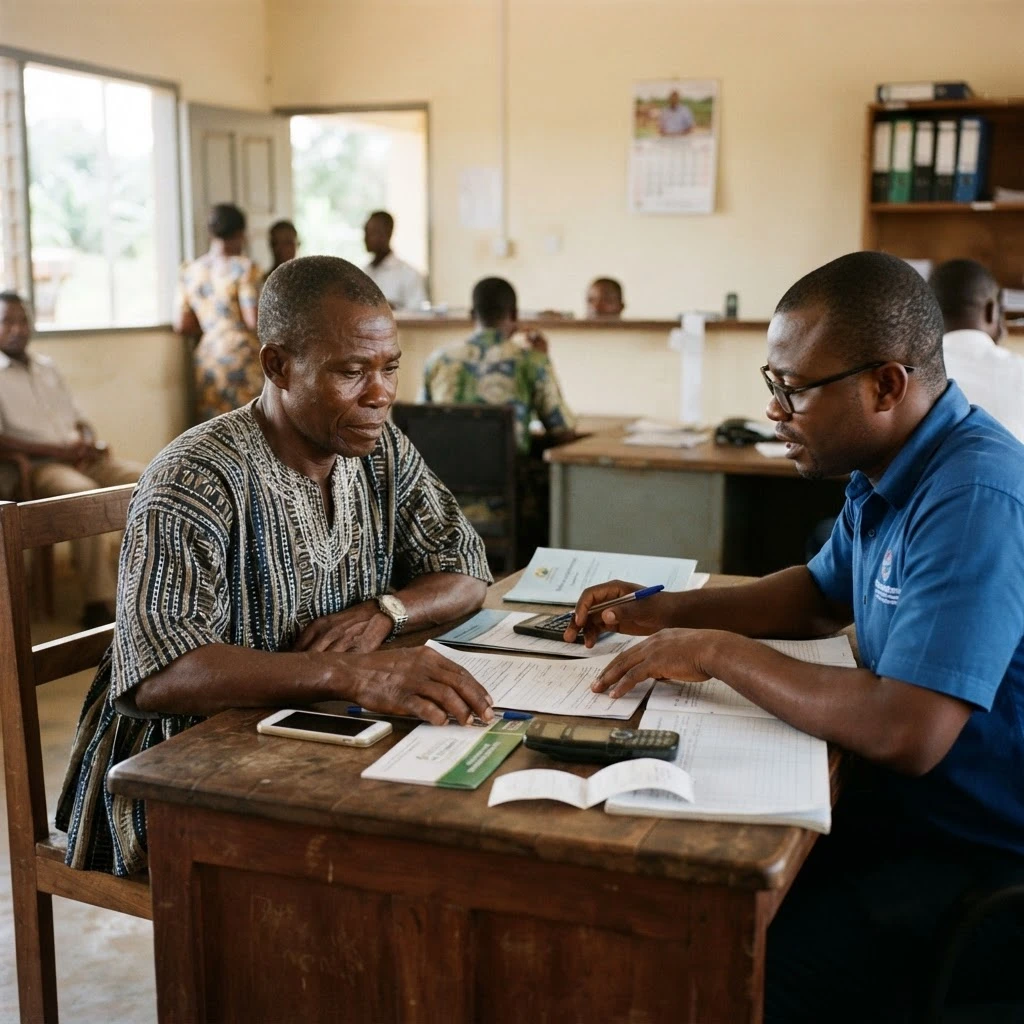
A cocoa buying clerk weighing a farmer's sack on a hanging scale, cedi notes and a ledger open on the table beside them, documentary photograph
Cocoa · Pillar 05

Cost, Returns and Economics

The price is set, not discovered: a committee fixes the farmgate rate to the cedi, but no held source measures what a Ghanaian farm actually spends, so the cost side works from Fairtrade's model, the one costed estimate the sector has.
Cost, Returns and Economics · Pillar 05

The economics of cocoa in Ghana turn on one number a plan can trust and a second it cannot. A committee sets and publishes the producer price, so the revenue side is knowable to the cedi. No held source measures what a working Ghanaian farm spends across a season, so the cost side works from Fairtrade’s model, the one costed estimate available for a Ghanaian cocoa farm.

The one number a budget can trust is the producer price, because a government committee sets it and publishes it, so the revenue side of a cocoa budget is knowable to the cedi before a single pod is cut. The one it cannot trust is the cost of growing the crop, because no held source measures what a working Ghanaian cocoa farm actually spends across a season, so the cost side works from Fairtrade’s model, the one costed estimate available for a Ghanaian cocoa farm. The revenue side is firm because the price is published; the cost side is not, because no field survey has measured it, so the first move for a serious entrant is to measure it.

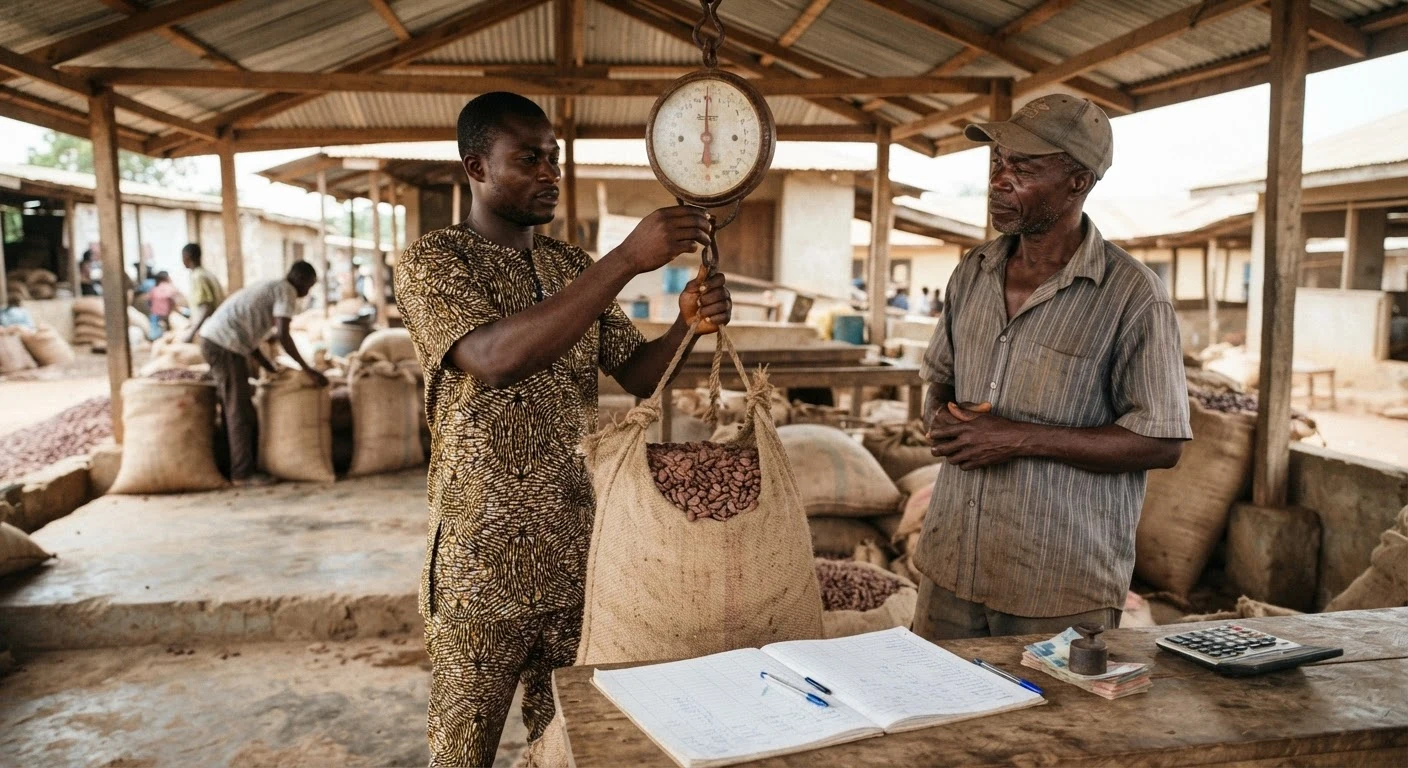
A Ghanaian cocoa buying clerk weighing a jute sack of dried cocoa beans on a hanging scale at a rural licensed buying company shed, a farmer watching, a ledger book and cedi banknotes on a wooden table, documentary photograph
A price you can trust, a cost you cannot
The scale and the ledger settle the revenue side to the cedi; nothing settles the cost side.
GH¢41,392/t
the current 2026 light-crop farmgate price, both grades
70%
the farmer's share of gross FOB, up from 63.9%
-29%
the fall in the cedi price from the October 2025 peak

The price is set, not discovered

Ghana does not let the world market pay its farmers directly. The Producer Price Review Committee, chaired by the Finance Minister, fixes a single farmgate price for the season as a share of the gross free-on-board (FOB) export value, and every licensed buyer pays that price at the shed. For the 2025/26 season the committee opened the price at GH¢51,660 per tonne, which is GH¢3,228.75 for a 64 kg bag and US$5,040 per tonne at the rate of the day, a rise of 62.58 per cent in dollar terms over the US$3,100 per tonne paid the season before. That opening price was pegged at 70 per cent of the gross free-on-board value, up from 63.9 per cent the season before.1

The share is the part of that announcement that matters most for a farmer’s economics, and it moved in the farmer’s favour. This is the mechanism to hold in view for the rest of the pillar: in Ghana the farmer’s income is a policy decision about a percentage of FOB, not a market outcome, so the questions that decide farm income are what the FOB value is, what exchange rate the committee applies, and what share it chooses to pass through. The 70 per cent is a guaranteed floor rather than a ceiling2. When the world price fell in early 2026 the fixed cedi price ended up at a higher share of the reduced free-on-board value, a realised figure Pillar 8 takes from the February 2026 sector reforms; for a plan the dependable number is the 70 per cent guarantee, because any share above it reflects a fall in the export price rather than a policy gain.3

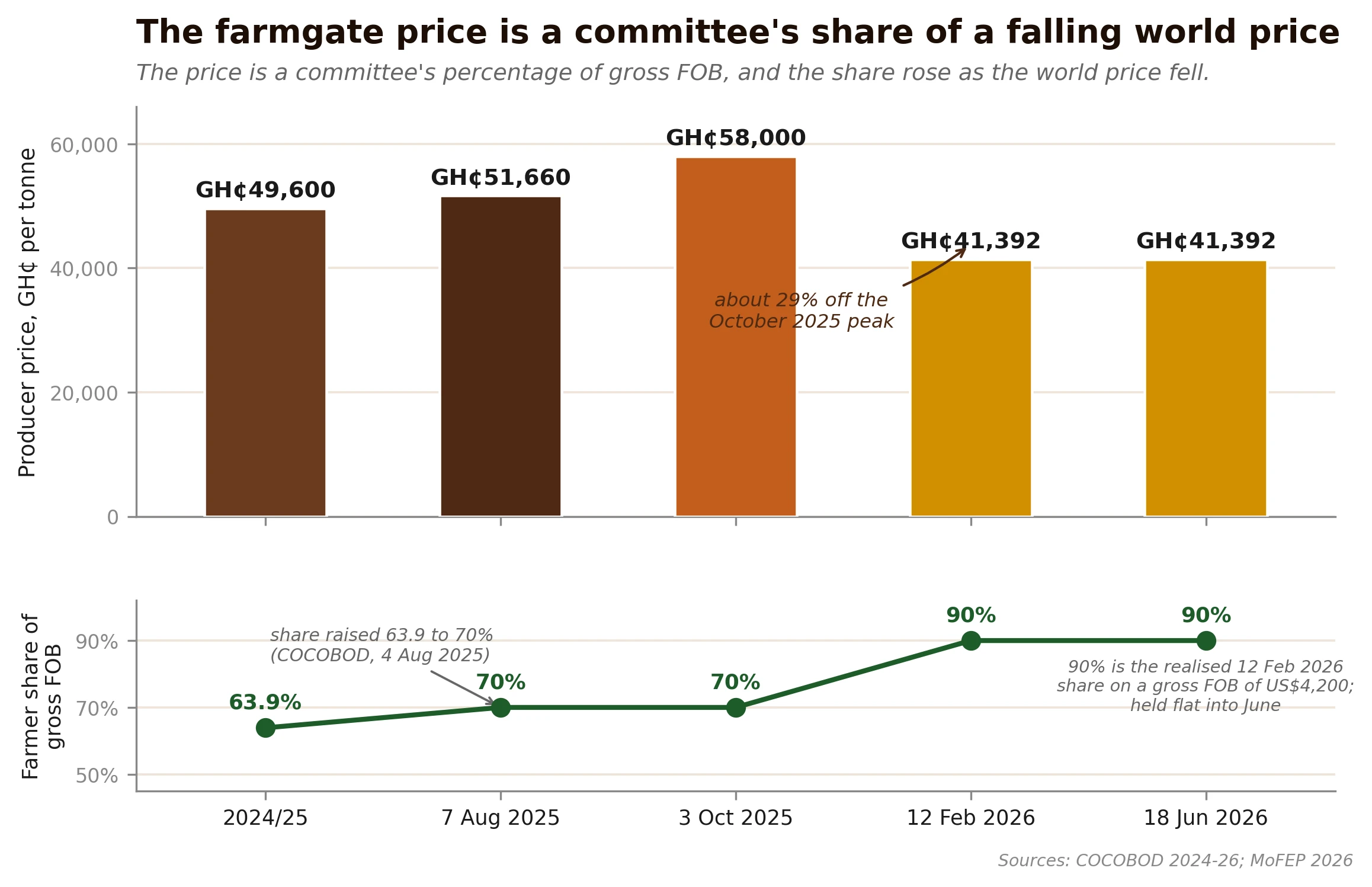
The 2025/26 season then showed how fast the administered price can move once it is set. In October 2025 the review committee raised the price about 12.27 per cent to GH¢58,000 per tonne, GH¢3,625 a bag, after Cote d’Ivoire announced a farmgate price roughly 20 per cent above Ghana’s and the committee recomputed its 70 per cent share at a weaker cedi4. By the 2026 light-crop season the price had gone the other way, fixed at GH¢2,587 for a 64 kg bag, which is GH¢41,392 per tonne for both Grade I and Grade II beans5, and purchases opened at the buying centres on 18 June 2026. Set against the October peak, that is a fall of about 29 per cent, the first time in several seasons the price has dropped mid-cycle rather than held or risen.

What did not fall

COCOBOD’s stated funding reform preserves the 70 per cent FOB price-to-farmer share and adds periodic, potentially quarterly, price reviews tied to the world price and the exchange rate, so the cedi price is now expected to track the market up and down within a fixed pass-through rather than sitting still for a season6. The price is no longer a fixed annual figure to be assumed once. It is a managed variable that can be cut inside a season when world prices soften, so a budget built on the opening price of a season carries real downside, and a loan whose repayment is timed to a single price assumption is exposed to a mid-season revision the borrower does not control. The seasonal shape of the administered price, not its level on any one day, is the risk a cocoa plan has to carry.7

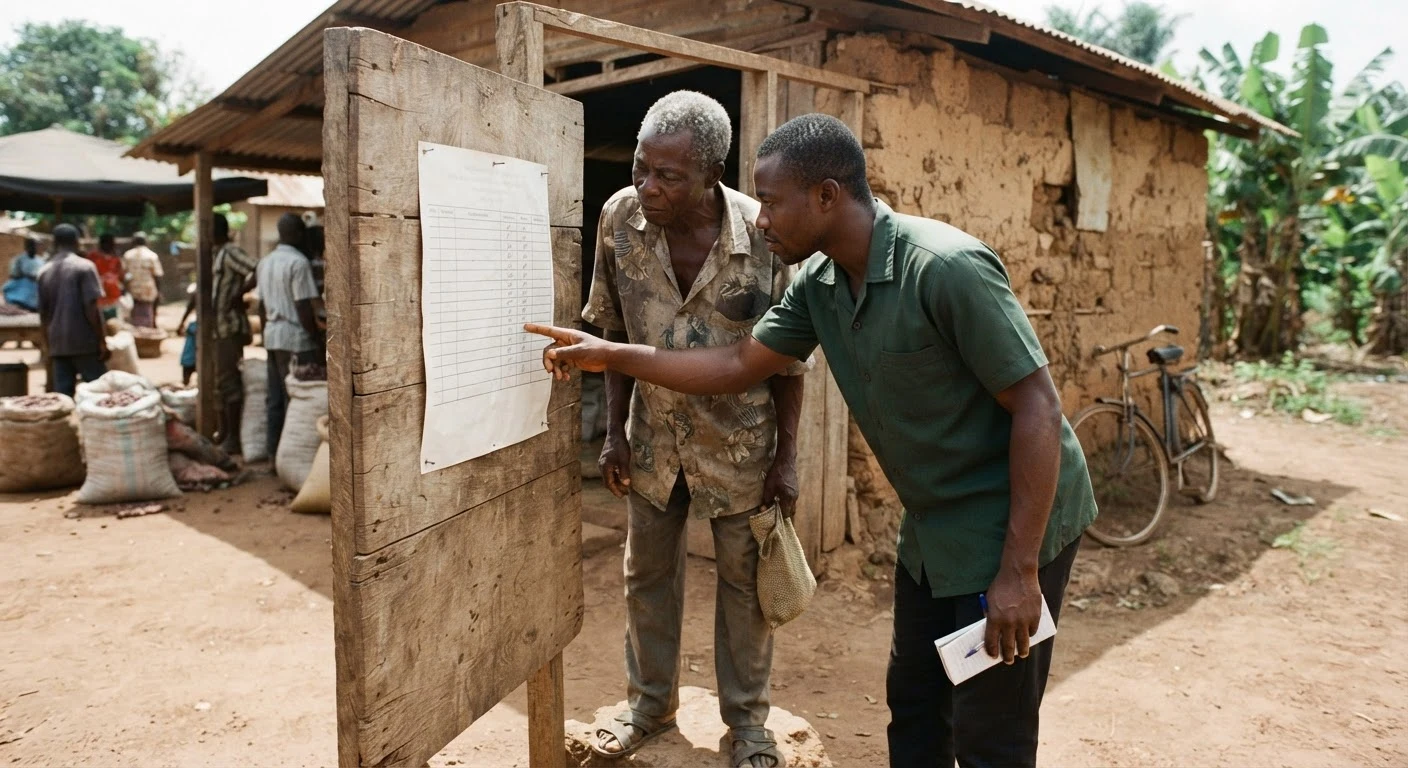
A Ghanaian cocoa farmer and a licensed buying company clerk looking closely at a newly posted price circular pinned to a notice board outside a rural purchasing shed, documentary photograph
Watch the notice board
The price a farmer plans against is whatever the latest circular says, not what it said last season.
GH¢51,660 → 58,000 → 41,392
the 2025/26 price path per tonne: opening, mid-season peak, current
63.9% → 70%
the farmer's FOB share, raised across the same season
The administered farmgate price through 2025/26, a percentage of FOB set by committee, with the cedi price falling about 29 per cent from the October 2025 peak even as the FOB share rose
Figure 8 The administered farmgate price through 2025/26, a percentage of FOB set by committee. The FOB share rose from 63.9 to 70 per cent, yet the cedi price still fell about 29 per cent from the October peak.
What this shows

An administered price, set by committee as a share of gross FOB, not a market outcome. The 2023/24 and 2024/25 rungs are Fairtrade’s farmgate figures; the 2025/26 rungs are the COCOBOD opening (August 2025), the MoFEP mid-season review (October 2025) and the current light-crop price (June 2026). The world-price peak/trough series belongs to Pillar 7 and is not shown here.

What a living income would require, and the gap the price leaves

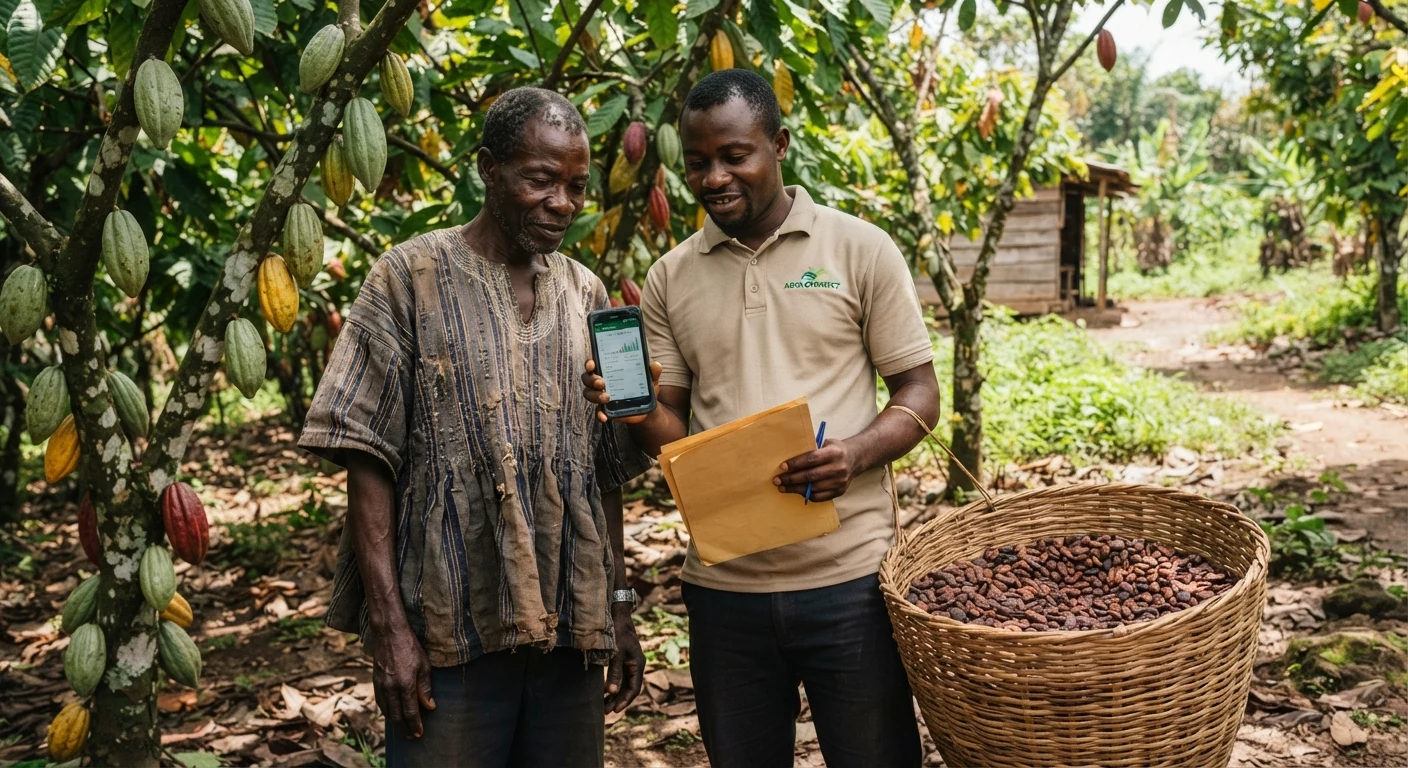
A Ghanaian cocoa farmer and a field agent standing in a cocoa farm looking at a smartphone showing a farm record app, documentary photograph
The gap is the point
The reference price exists to measure exactly this distance, and it is currently open.
GH¢45.4/kg
the 2026/27 Living Income Reference Price for Ghana
GH¢28,719
cocoa's expected share of a household's living income, at 44%
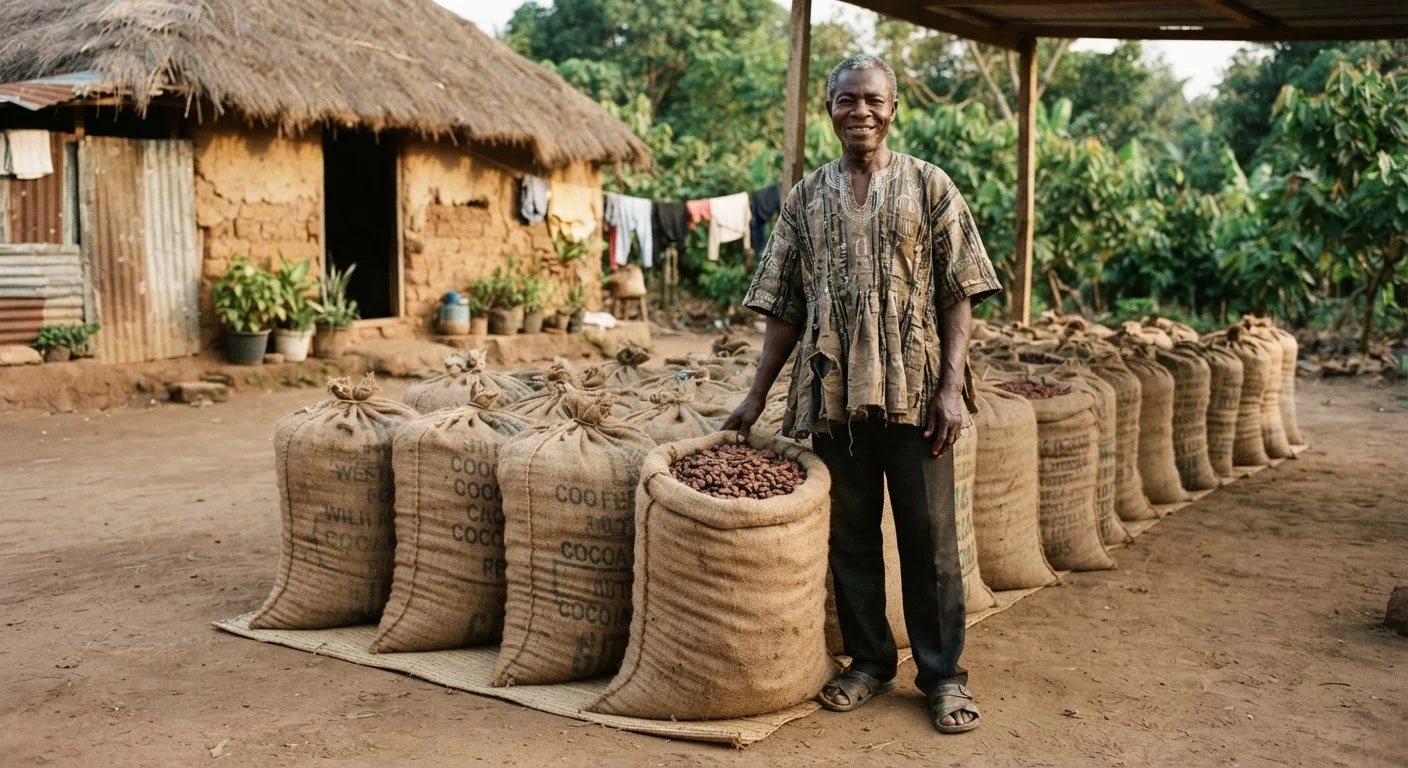
A Ghanaian cocoa farmer standing beside a season's worth of harvested cocoa beans in several full jute sacks lined up outside his home, documentary photograph
An average season
About 870 kg a year is the measured volume the whole arithmetic below rests on.
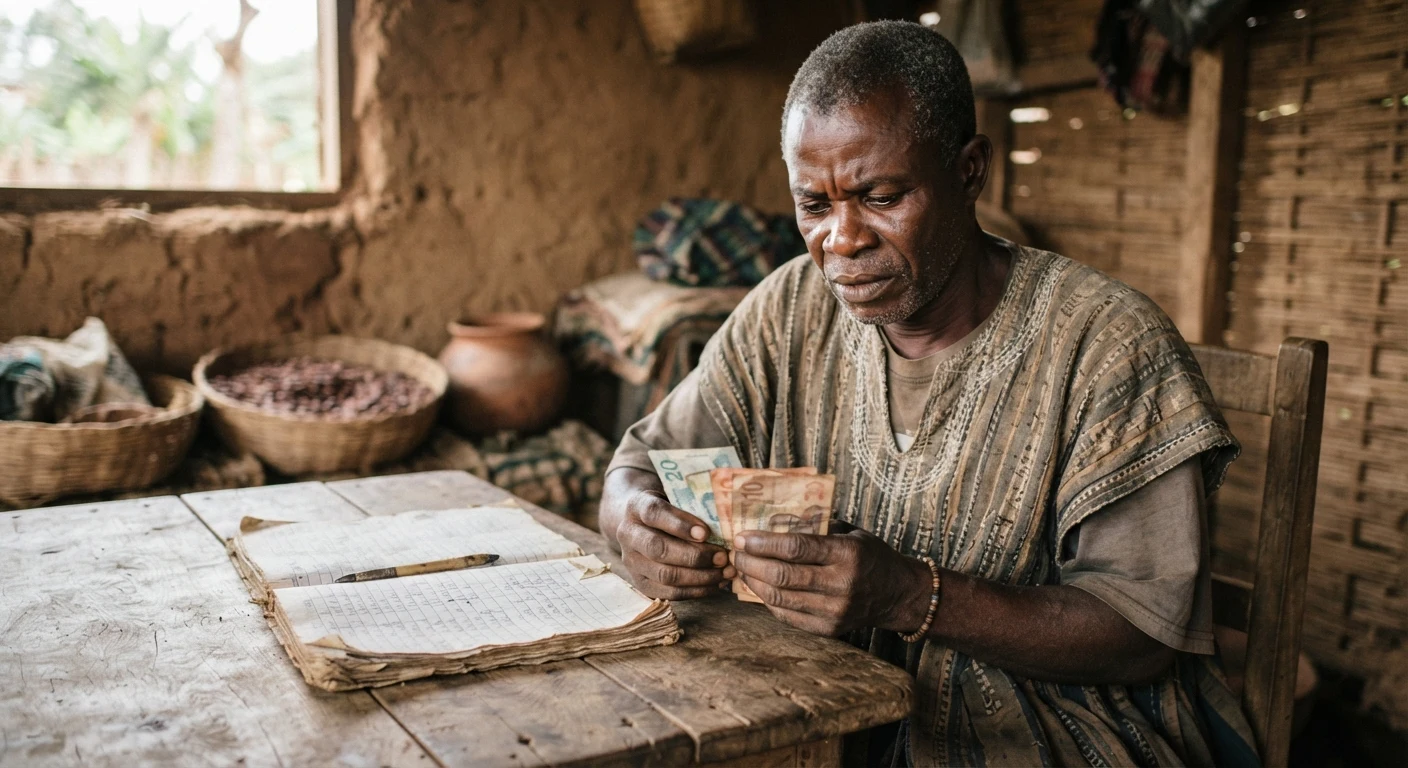
A Ghanaian cocoa farmer counting a small stack of cedi banknotes at a table, a worn ledger book open beside him, documentary photograph
GH¢3,500 short
An average farm's net still lands under the cocoa share of a living income.

Fairtrade publishes a second price for the same bean that is not what the market pays but what a farmer would need. The Living Income Reference Price for Ghana, revised in April 2026 and effective from the start of the 2026/27 season, is GH¢45.4 per kilogram at farmgate, about US$3.95. That is a small rise on the 2025 figure of GH¢42.4 in cedi terms, and the near-50 per cent jump that looks dramatic in dollars is mostly a currency effect: the reference price rose 47 per cent in US dollars but only 7 per cent in local currency, because the cedi steadied after years of depreciation8.9

The reference price is built from a full-household living income of GH¢65,360 a year for a household of five, of which only the cocoa-attributable share is expected to come from the crop. Because a cocoa household spends only part of its labour on cocoa, the model assigns 44 per cent of the living income to the crop, which is GH¢28,719 of net income that cocoa should deliver, on top of the modelled cost of producing it. Set against that, the current administered farmgate price of about GH¢41.4 per kilogram sits roughly GH¢4, or about 10 per cent, below the new reference price of GH¢45.4. The gap is the point. When international prices were high the regulated price ran above the reference price and no top-up was needed, but prices dropped during the review and the administered price now sits under the living-income line, which is exactly the situation the reference price exists to measure. In a regulated market Fairtrade does not replace the government price; it publishes a differential, the distance between the regulated price and the reference price, that a committed buyer pays on top of contract volumes10. The opening for a Ghanaian aggregator or cooperative is to be the counterparty that can capture and pass through that differential, because it only flows to buyers who commit to it on documented volumes, and it dilutes across a cooperative’s total sales if only part of the crop is sold on those terms.11

How far the administered price carries an average farm toward that living-income target works from a real price on the revenue side and Fairtrade’s modelled averages for the volume and cost sides. On Fairtrade’s figures an average Ghanaian Fairtrade farm produces about 870 kg of cocoa a year. That 870 kg is a measured total volume, not the product of the average 1.3-hectare area and the 465 kg/ha yield recorded for Fairtrade farmers, which alone would give closer to 600 kg; Fairtrade itself notes that reaching 870 kg on 1.3 hectares would imply a yield nearer 650 kg/ha. Valuing that 870 kg at the current administered price of GH¢41.39 per kilogram gives revenue of about GH¢36,000, and taking off the modelled cost of production of GH¢10,810 leaves a net of about GH¢25,200, which lands roughly GH¢3,500 short of the GH¢28,719 that the reference price identifies as cocoa’s share of a living income12. That arithmetic combines the administered price with Fairtrade’s modelled volume and modelled cost, and what it shows is that at the current price an average Fairtrade farm growing an average crop does not quite reach the cocoa portion of a living income, and closes the gap only by producing more kilograms, not by waiting for a better price it does not set.13

What is actually known about the cost of growing the crop

No held source measures the cost of running a commercial Ghanaian cocoa farm across a season, so the one costed estimate available is Fairtrade’s model, which puts the total cocoa farm investment on an average 1.3-hectare farm at GH¢10,810: the modelled cost of implementing a defined package of good agricultural practices, with hired labour costed at a living wage. What farms actually spend is lower, GH¢7,315 against the modelled GH¢10,810, because real adoption of the practice package is low14. The figure also moves with the model behind it: under the earlier January 2025 method the same cost of sustainable production was put at GH¢17,522, and the 2026 revision cut it by changing how farm size and labour were treated15.

A single budget can be built from the held components, the administered price on the revenue side and Fairtrade’s modelled cost and volume on the cost side, and it shows where a farm’s economics are sensitive. The productivity assumptions behind it sit lower than the ambition: Fairtrade’s realistic near-term yield target for Ghana is 600 kg/ha, against actual yields under 400 kg/ha in the Cocoa Household Income Study that COCOBOD and SWISSCO ran, and a target of 800 kg/ha is judged achievable only over a longer horizon16. The economics improve with kilograms per hectare far more reliably than with the price, so the agronomy of Pillar 4, density and disease control, is also the cost economics of Pillar 5.17

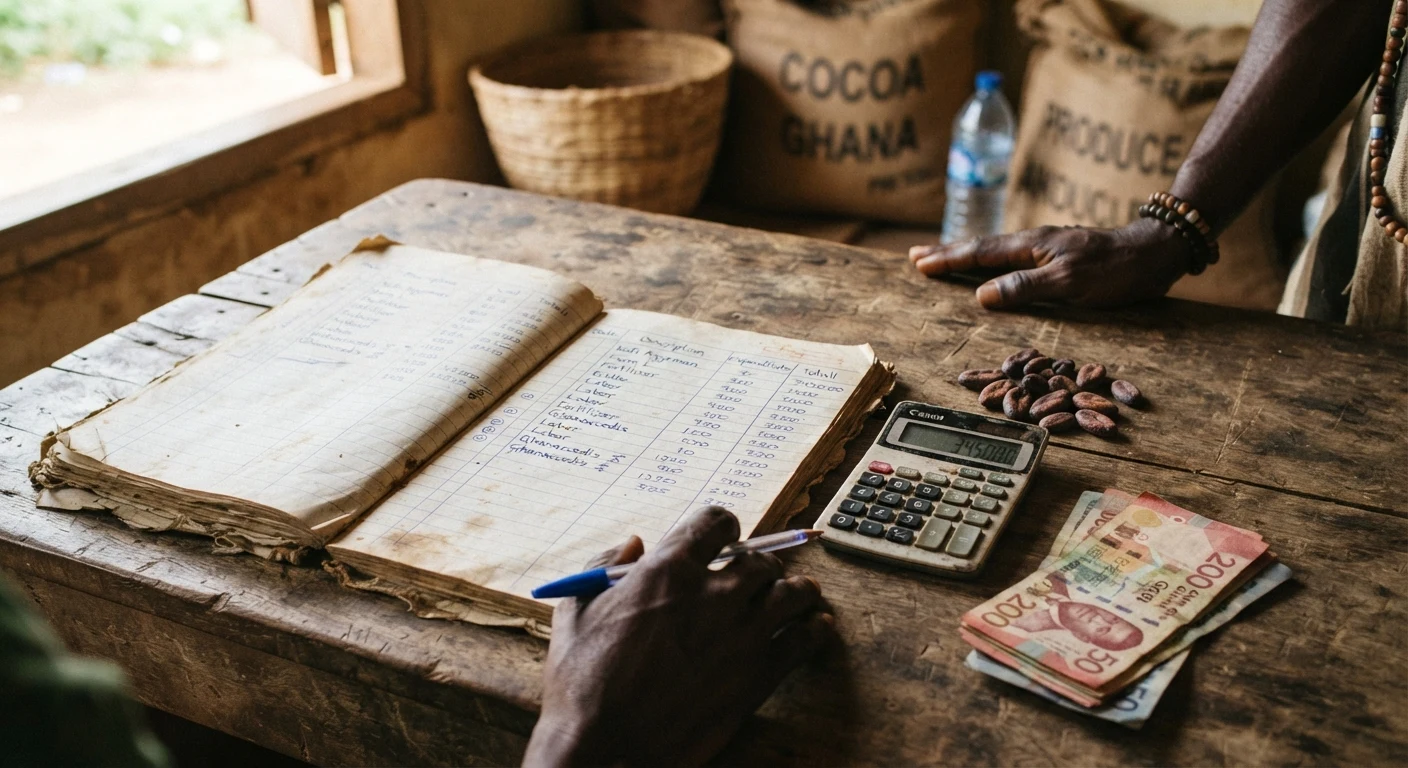
A Ghanaian cocoa farmer's worn field ledger open on a table with handwritten cost entries, a calculator, cedi banknotes and dried cocoa beans, documentary photograph
Modelled, not surveyed
No held source measures what a working farm spends; the only cost anchor is a model, not a recorded budget.
GH¢10,810
Fairtrade's modelled cost of production on 1.3 ha
GH¢7,315
the actual recorded farm investment, against that model
Table 5: The numbers this pillar is built on, and where each comes from
MeasureFigureWhat it is and where it comes from
Current producer priceGH¢41,392/tonne (GH¢2,587 per 64 kg bag; ~GH¢41.39/kg)The fixed 2026 light-crop farmgate price, both grades; Ghana News Agency, 16 June 2026. Cited through the pillar as the current price.
Farmer share of FOB70 per cent (up from 63.9 per cent)The pass-through the review committee applies; COCOBOD, 4 August 2025. No held source shows a higher share.
2025/26 price pathGH¢51,660 → GH¢58,000 → GH¢41,392 per tonneOpening (Aug 2025), mid-season review (Oct 2025), current (Jun 2026); COCOBOD, MoFEP and Ghana News Agency.
Living Income Reference PriceGH¢45.4/kg (USD 3.95), from 2026/27What a farmer would need at farmgate; Fairtrade International, April 2026. About 10 per cent above the current price.
Living income benchmarkGH¢65,360/yr (household of 5)Full-household living income; Fairtrade, April 2026. Cocoa's expected share is GH¢28,719 at a 44 per cent labour share.
Cost of production (Fairtrade model)GH¢10,810 on 1.3 haFairtrade's modelled GAP-package cost; actual recorded investment is GH¢7,315.
Net over cost~GH¢25,200 on 870 kgPlaybook arithmetic: 870 kg times GH¢41.39/kg minus GH¢10,810. Falls about GH¢3,500 short of the living-income cocoa share.

Sources: Ghana News Agency (16 June 2026); COCOBOD producer price release (4 August 2025); Ministry of Finance (2 October 2025); Fairtrade International, Living Income Reference Prices for Cocoa, April 2026 edition. The cost of production and the net over cost work from Fairtrade's model, the one costed estimate available for a Ghanaian cocoa farm.

Model it yourself

Numbers on a page are one thing. Move the levers yourself. Set the season’s harvest, the administered price and the cost of production to your own field figures, then swing them one at a time. Push the price slider to the top and watch the living-income gap close, then remember the review committee can undo that in a single circular, and push the harvest instead and watch it close on a lever the farmer holds. That is the argument of this pillar in one gesture.

Tool 1

Does the farm reach a living income?

Slide the three levers a plan can hold: the season’s harvest in kilograms, the administered producer price, and the modelled cost of growing the crop. Watch the net move against the cocoa share of a living income, GH¢28,719. Overwrite every number with your own field figures.

GH¢36,018
Revenue, 870 kg at GH¢41.4/kg
GH¢25,208
Net over cost, after the GH¢10,810 cost of production
GH¢3,51188% of target
short of the cocoa living-income share of GH¢28,719
The farm lands GH¢3,511 short of the cocoa living-income share at these numbers, which is the base-case story of this pillar. Notice which lever closes it. Pushing the price up the slider closes the gap, but that is a price the farmer does not set and one that was cut about 29 per cent inside the 2026 season, so it is not a plan. Pushing the harvest up, more kilograms per hectare from the agronomy of Pillar 4, closes the same gap on a lever the farmer controls. That is the binding lever: yield, not a better price.

Base case: the Pillar 5 headline, per 1.3-hectare farm. Fairtrade’s measured average output of about 870 kg valued at the administered 2026 light-crop price of about GH¢41.4/kg gives revenue near GH¢36,000; taking off the modelled GH¢10,810 cost of production leaves a net of about GH¢25,200, roughly GH¢3,500 short of the GH¢28,719 cocoa share of a living income. The revenue side is firm because the price is published; the cost side works from Fairtrade’s model, the one costed estimate for a Ghanaian cocoa farm. Sources: Fairtrade International (April 2026), COCOBOD (Aug 2025), Ghana News Agency (June 2026).

Tool 2

What swings the net most

The same model, re-run as a sensitivity read. Each bar is how far the net moves when that one lever runs across its documented range, holding the other two where you left them. One lever leads, and it is the one the farmer actually controls.

1. The harvest, in kilogramsGH¢21,528

How many kilograms the farm actually brings in, driven by yield per hectare and the area under a bearing crop. It is the widest lever and the one the farmer controls, which is why closing the living-income gap runs through the agronomy of Pillar 4, planting density and black-pod control, not through the price.

2. The administered producer priceGH¢20,010

The price the review committee sets, not one the farmer discovers. It moves the net, but it is a policy decision that can be cut inside a season, as it was by about 29 per cent at the 2026 light-crop review, so a plan built on it carries real downside.

3. The cost of productionGH¢10,207

The cost from Fairtrade's model, the one costed estimate for a Ghanaian cocoa farm. It moves between Fairtrade's actual recorded GH¢7,315 and the superseded GH¢17,522 model, and it swings the net least of the three.

GH¢21,528
What the full harvest range, about 400 to 800 kg/ha, does to the net
GH¢10,207
What the full cost range does, the smallest swing of the three
The harvest in kilograms swings the net most, ahead of the administered price, and the modelled cost moves it least. The reading for a farm is the argument of this whole pillar in one gesture: the net turns on kilograms more reliably than on a price the farmer does not set and cannot defend, so the agronomy of Pillar 4, planting density and black-pod disease control, is also the cost economics of Pillar 5. Slide the price to the top of its range and watch the gap close, then remember the review committee can undo that move in a single circular; slide the harvest instead and the gain is one the farmer holds.

Sensitivity holds two levers at their current value and runs the third across its documented band: the harvest from about 400 to 800 kg/ha on the 1.3-ha area, the price across the GH¢35 to GH¢58 range on the Sensitivity sheet, and the cost between Fairtrade’s actual recorded GH¢7,315 and the superseded GH¢17,522 model. Kilograms and price both act on revenue, but the harvest band is wider and the price is administered, so kilograms lead.

Financing the crop, from the shed to the sector

The finance problem in Ghanaian cocoa is not that no institution lends, but that the terms rarely fit a smallholder. The Bank of Ghana states the constraint plainly: interest rates on agricultural loans stay prohibitive because of how risky the sector is perceived to be, and collateral requirements are almost impossible for value-chain actors to meet, on top of climate, price and financial-literacy risks that make repayment uncertain. The public answer to that is GIRSAL, the Ghana Incentive-Based Risk-Sharing System for Agricultural Lending, a credit guarantee scheme that shares the lender’s downside rather than lending directly. Over its first five years GIRSAL issued guarantees worth more than GH¢604.53 million to 17 financial institutions, covering up to 70 per cent of credit default risk, and on the back of those guarantees banks channelled GH¢1.18 billion of loans to about 137 agribusinesses across 72 districts and 15 regions. The guarantee covers up to 70 per cent of the default, not 70 per cent of the loan, which is the distinction that decides whether it actually changes a lending decision18.19

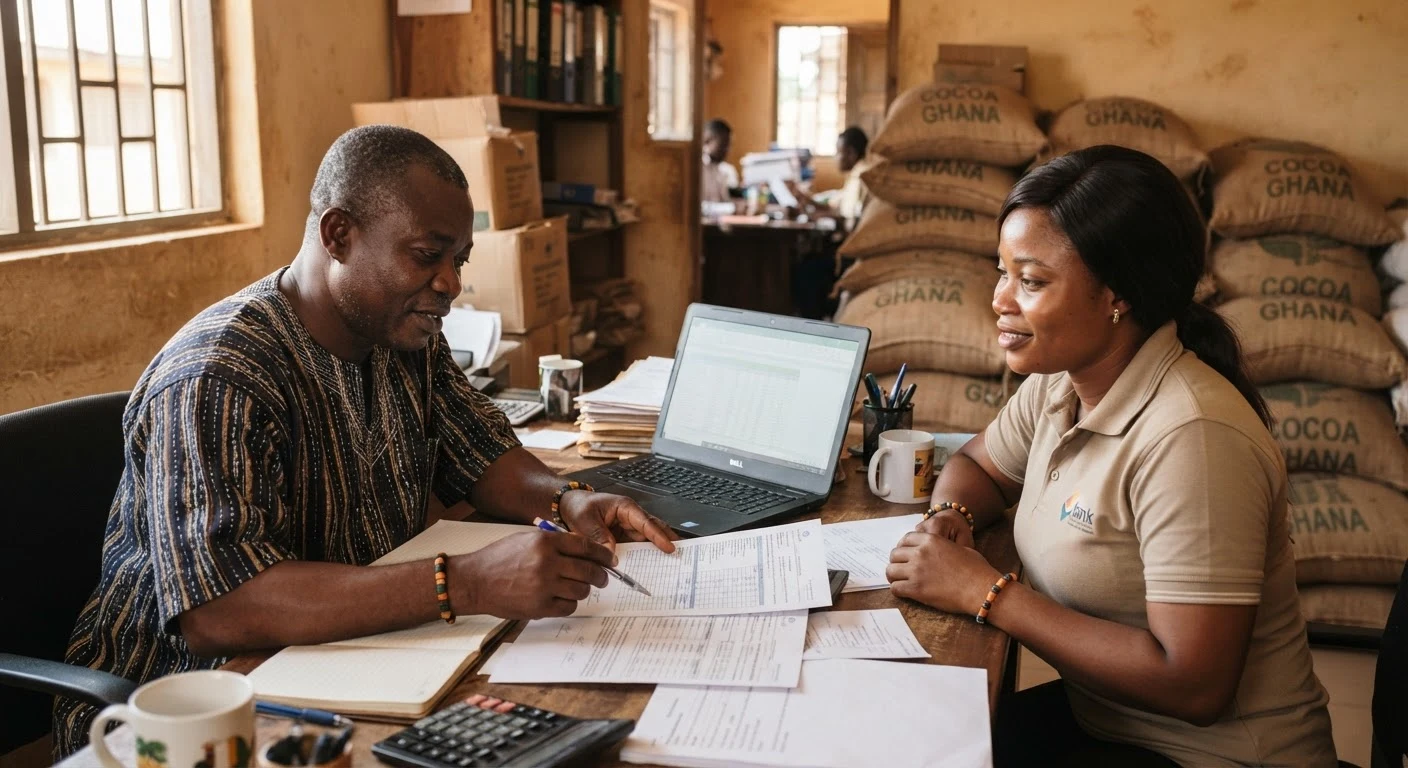
A Ghanaian cocoa cooperative manager and a bank loan officer reviewing financing documents at a desk, stacked jute sacks of cocoa beans in the background, documentary photograph
Guaranteed, not cheap
GIRSAL shares up to 70 per cent of the default risk; the guarantee is worth asking for by name.
GH¢604.53m
GIRSAL guarantees issued over its first five years
GH¢1.18bn
loans channelled to about 137 agribusinesses on the back of them
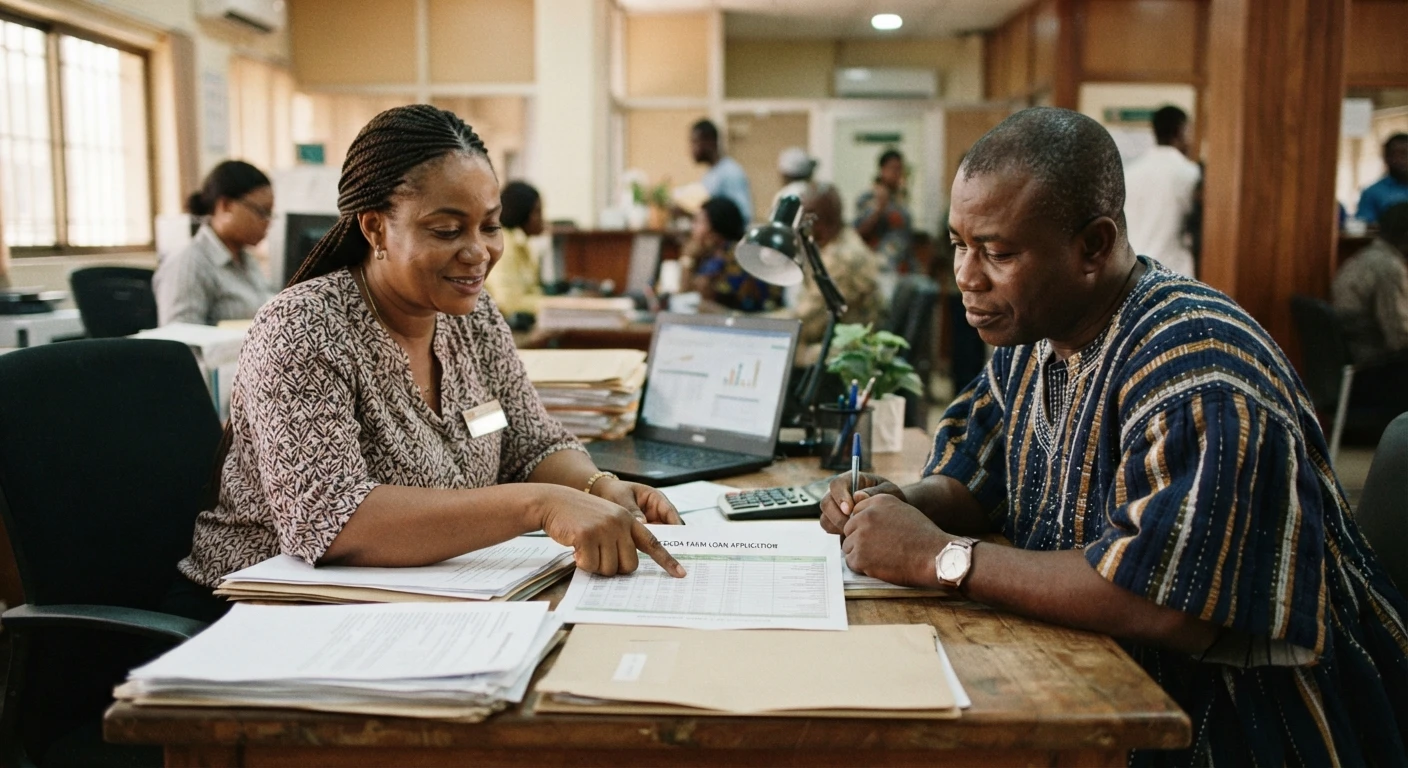
A Ghanaian bank loan officer and a cocoa cooperative manager reviewing loan documents together at a desk in a bank branch, documentary photograph
Ask for it by name
A zero-weighted guarantee and an extended obligor limit are what let a bank say yes.

Two regulatory moves are what make that guarantee usable rather than symbolic. The Bank of Ghana gave GIRSAL’s Credit Risk Guarantee a zero-per-cent risk weighting for capital adequacy purposes in 2021, and recognised it as acceptable collateral for the Single Obligor Limit under section 62(9) of Act 930 in December 2022, which lets a partnering bank extend that limit to 25 per cent from 10 per cent on the strength of the guarantee20. Those two changes let a bank lend more to cocoa without carrying the capital cost it otherwise would, which is the mechanism a cocoa aggregator or cooperative should understand before approaching a lender, because it means the guarantee is worth asking for by name.21

The sector’s own financing is being rebuilt at the same time. COCOBOD is moving away from more than thirty years of offshore syndicated pre-export loans, which required collateralising 70 to 92 per cent of the crop to foreign lenders, toward a domestic model funded by cedi commercial paper and notes with a revolving target near US$1 billion, starting in 2026/2722. Alongside it, the IFAD and World Bank AgriConnect Compact, launched in June 2026, names cocoa among its priority value chains and targets US$3.5 billion of first-phase investment to 2030 with smallholder finance access as one component23. For an entrant the practical reading is that cocoa financing over the next few seasons is a transition rather than a settled system, which creates both an execution risk, if the domestic bond market cannot fund the crop as reliably as the syndicated loan did, and an opening, because the shift toward domestic institutions and named programmes brings decisions closer to home and puts guarantee-backed lending within reach of firms that could not access an offshore syndication.

A Ghanaian financial analyst at a trading desk reviewing bond and treasury documents on a monitor in an office, Accra skyline through the window, documentary photograph
Onshore, from 2026/27
COCOBOD is swapping offshore syndication for a domestic revolving model near US$1bn.

The digital and AI opening: build the record before the model

A Ghanaian cocoa farmer and a field agent reviewing a farm record on a smartphone in a cocoa farm, a basket of dried beans nearby, documentary photograph
The record is the asset
The traceability register and mobile-money payments are the raw material a credit model needs.
A record, not a model
the precondition for both an AI credit score and a real cost budget

The financing gap and the cost-measurement gap are the same gap seen twice, and both are closed by a record rather than a model. A lender cannot price a farmer it cannot see, and no one can validate a cost of production that no one writes down, so the highest-value digital work in cocoa economics is the unglamorous work of capturing farmgate transactions, yields and input purchases at the farmer level. The pieces already exist in Ghana. The Bank of Ghana’s own account of GIRSAL points to its Digital Finance and Insurance pillars, to mobile banking for financial inclusion, to mobile-based insurance against crop failure and weather, and to warehouse receipt and outgrower schemes as the value-chain financing structures to expand. The same source describes the credit-scoring use directly: data analytics and artificial intelligence can assess a farmer’s creditworthiness by drawing on credit reference bureaux, weather patterns and historical yields, so that a lender can tailor terms to an individual rather than price the whole sector as uniformly risky24.25

None of that runs without the underlying data, and this is where the cocoa sector has an advantage it is not yet using. The Ghana Cocoa Traceability System and the wider farmer database work built for EUDR compliance are, in effect, a national farmer register that ties a grower to a farm, a polygon and a delivery history. That register is the raw material an AI credit model needs, and a mobile-money farmgate payment leaves the dated repayment trail a lender asks to see first. The precondition for any of this is a record, not a model: the algorithm that scores a cocoa farmer for a loan, or the spreadsheet that finally prices a real cost of production, is worthless until the transaction and yield data exist to feed it. The opening is not to buy a clever model. It is to be the aggregator or cooperative that first keeps clean per-farm records across a group of growers, because that dataset is the only one in the sector a lender would price against, and it is itself the asset.

The risks that sit inside the cost and financing picture

A Ghanaian cocoa farmer and a loan officer reviewing paperwork and a calculator at a desk, documentary photograph

Credit access and collateral barriers

HIGH
What it is

Cocoa farmers and the firms that buy from them cannot borrow on terms that fit the crop, so working capital is short at exactly the points in the season when beans have to be bought and paid for.

Evidence

The central bank states that agricultural interest rates remain prohibitive and that collateral requirements are almost impossible for value-chain actors to meet, and that risk, not lack of lenders, is the binding constraint. GIRSAL’s guarantee covers up to 70 per cent of default risk precisely because that risk is what stops banks lending.

Who it hits

Smallholders first, then the licensed buyers and cooperatives who front the cash to buy their beans, and any new entrant without collateral or a lending history.

How to manage it, and the opening

Ask for a GIRSAL-backed facility by name, because the guarantee carries a capital and single-obligor advantage a bank can act on, and build the mobile-money payment trail that turns an unbanked grower into a borrower a lender can price.

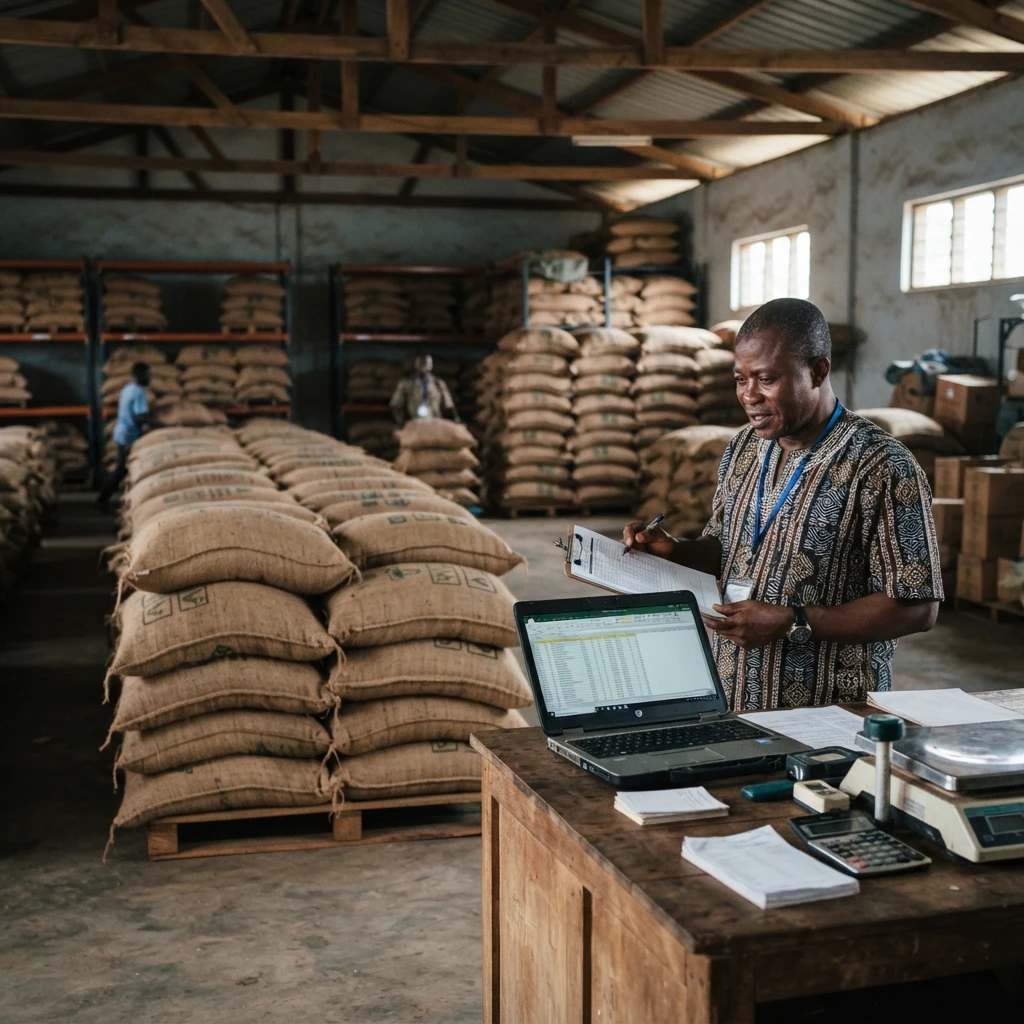
A Ghanaian warehouse worker recording stacked jute sacks of cocoa beans on a laptop and clipboard, documentary photograph

Financing-model transition

MEDIUM
What it is

The way the whole crop is financed is changing at once, from offshore syndicated loans to a domestic bond and commercial-paper model, and a transition can fund the crop less reliably than the system it replaces before it settles.

Evidence

COCOBOD is replacing more than thirty years of syndicated pre-export borrowing, which collateralised most of the crop to foreign lenders, with a domestic revolving model near US$1 billion from the 2026/27 season, while separately a large IFAD and World Bank compact brings new money into cocoa. The old model’s reliability is being swapped for a new one still being built.

Who it hits

Buyers who depend on timely seasonal financing to pay farmers, and farmers who face payment delays if the domestic funding arrives late or short.

How to manage it, and the opening

Do not assume the pre-financing rhythm of past seasons holds, keep a cash buffer or a committed facility across the transition, and treat the shift onshore as a chance to build a direct relationship with the domestic institutions and programmes now doing the funding.

Ranked openings: where the economics point
01

Capture and pass through the Fairtrade differential. The administered price sits about 10 per cent below the 2026 living-income reference price, and the differential only flows to buyers who commit on documented volumes. It suits a certified cooperative or aggregator with documented volumes and a buyer relationship.

02

Own the farm-record dataset. No field-validated cost of production exists, and lenders and AI scoring both need per-farm transaction and yield records that do not yet exist. It requires mobile-money farmgate payments, use of the cocoa traceability register, and disciplined record-keeping, and suits aggregators, cooperatives and agtech firms working at farmer level.

03

Use guarantee-backed lending by name. GIRSAL covers up to 70 per cent of default risk and carries a 0 per cent capital weighting and an extended single-obligor limit for partnering banks. It requires a bankable plan and a partnering financial institution, and suits processors, aggregators and larger farmer organisations.

04

Position for the financing transition. COCOBOD is shifting to a domestic ~US$1bn model and IFAD and the World Bank are funding cocoa; decisions are moving onshore. It requires readiness to work with domestic institutions and named programmes, and suits Ghanaian firms previously shut out of offshore syndications.

Key takeaways
01

In Ghana the farmer's income is a policy decision, not a market outcome: the review committee sets the farmgate price at 70 per cent of gross FOB, and that share rose from 63.9 per cent, so the number that moves farm income is the pass-through, not the world price directly. The 70 per cent is a guaranteed floor; the higher realised share at the February 2026 reset, set out in Pillar 8, reflects a fall in the export price, not a policy gain.

02

The administered price is now a managed variable that can be cut inside a season. It ran GH¢51,660 to GH¢58,000 to GH¢41,392 per tonne across 2025/26, a fall of about 29 per cent from the peak, so a budget built on an opening price carries real downside.

03

The current price of about GH¢41.4/kg sits roughly 10 per cent below the 2026 living-income reference price of GH¢45.4/kg, so the Fairtrade differential mechanism is now live for buyers who commit to it.

04

No field survey has measured what a Ghanaian cocoa farm spends, so the cost side works from Fairtrade's model, the one costed estimate the sector has: GH¢10,810 on 1.3 ha, against GH¢7,315 actually recorded. A net of about GH¢25,200 on an average 870 kg crop falls short of the GH¢28,719 that cocoa should contribute to a living income, and closes only by growing more kilograms.

05

Financing is guaranteed rather than cheap: GIRSAL covers up to 70 per cent of default risk, has channelled GH¢1.18 billion of guarantee-backed loans, and carries capital and single-obligor advantages a bank can use. Ask for it by name.

06

The digital opening is a record, not a model. The cocoa traceability register plus mobile-money payments are the dataset an AI credit score and a real cost budget both need; whoever keeps the cleanest per-farm records owns the only asset a lender in this sector can price.

Written for each reader

Practitioner intelligence

Hover any card to pause and lift it.

For students

The pillar is a lesson in reading an administered market, where price is a formula on FOB rather than a market clearing, and in telling a surveyed figure from a modelled one. The cost of production here is modelled, and the gap between GH¢10,810 modelled and GH¢7,315 actually recorded is the whole lesson in source quality. Learn to ask of any cocoa number whether it was measured on a farm or built in a spreadsheet.

For entrepreneurs

Build revenue on the published producer price, which is real, and measure your own cost and margin from the first season, because no field survey has yet measured what a Ghanaian farm spends. The money is in kilograms and in the differential, not in a price you cannot set. Keep dated records from the first season, because they are what a lender and a certifier both ask for, and because the per-farm dataset is itself the asset.

For investors

Demand a field-validated cost of production for the specific district and yield level before committing, because no public figure yet measures it. The economics are real on the revenue side and unmeasured on the cost side, so the highest-value diligence is a costed budget and the records behind it. Size the mid-season price revision into the downside: the price is a managed variable, not a fixed annual figure.

For ecosystem actors

The guarantee cannot do its job for a borrower nobody can price. Fund the record-keeping and the farmer register first, use GIRSAL and the new domestic financing to de-risk lending, and publish a real cocoa enterprise budget so entrants plan against numbers rather than a model. The failure to avoid is subsidising a model before the data exist to feed it.

Where this connects.The yield and disease control costed in Pillar 4 are the real lever on these economics, because at an administered price the only way to close the living-income gap is more kilograms per hectare. The 70 per cent FOB share the farmer receives is Pillar 2’s subject, and the downstream value split beyond it is settled in Pillar 6, where the question of who captures the value along the chain is answered. The world price that Ghana does not set, and the volatility that forced the mid-season cut, are Pillar 7. The EUDR compliance that the traceability register was built for, and the financing reform that will fund the next few seasons, run into the strategic outlook of Pillar 8.

Footnotes
  1. COCOBOD, Producer Price for 2025/2026 Season.
  2. COCOBOD, Producer Price for 2025/2026 Season.
  3. COCOBOD, Producer Price for 2025/2026 Season.
  4. Ghana Ministry of Finance (MoFEP), Review of Producer Price of Cocoa for the 2025/2026 Season (Accra: Ministry of Finance, 2025).
  5. Ghana News Agency, COCOBOD Fixes Cocoa Price.
  6. Ghana Cocoa Board (COCOBOD), Cocoa Sector Funding Reform (Statement to the ACFIF Conference, Accra, 2026).
  7. COCOBOD, Cocoa Sector Funding Reform.
  8. Fairtrade International, Living Income Reference Prices for Cocoa from Ghana and Côte d'Ivoire: Explanatory Note (Bonn: Fairtrade International, April 2026 edition, 2026).
  9. Fairtrade International, Living Income Reference Prices for Cocoa.
  10. Fairtrade International, Living Income Reference Prices for Cocoa.
  11. Fairtrade International, Living Income Reference Prices for Cocoa.
  12. Fairtrade International, Living Income Reference Prices for Cocoa.
  13. Fairtrade International, Living Income Reference Prices for Cocoa.
  14. Fairtrade International, Living Income Reference Prices for Cocoa.
  15. Fairtrade International, Living Income Reference Prices for Cocoa from Ghana and Côte d'Ivoire: Explanatory Note (Bonn: Fairtrade International, January 2025 edition, 2025).
  16. Fairtrade International, Update of West Africa Cocoa Living Income Reference Prices: Frequently Asked Questions (Bonn: Fairtrade International, 29 January 2025, 2025).
  17. Fairtrade International, West Africa Cocoa Living Income Reference Prices: FAQ.
  18. Ernest Addison, Remarks at the 5th Anniversary of the Ghana Incentive-Based Risk-Sharing System for Agricultural Lending (GIRSAL) (Accra: Bank of Ghana, 2024).
  19. Addison, Remarks at the 5th Anniversary of GIRSAL.
  20. Addison, Remarks at the 5th Anniversary of GIRSAL.
  21. Addison, Remarks at the 5th Anniversary of GIRSAL.
  22. COCOBOD, Cocoa Sector Funding Reform.
  23. International Fund for Agricultural Development (IFAD) and World Bank, AgriConnect Compact: Ghana (Rome and Washington, DC: IFAD and World Bank, 2026).
  24. Addison, Remarks at the 5th Anniversary of GIRSAL.
  25. Addison, Remarks at the 5th Anniversary of GIRSAL.
Download full PDF
UpcomingThis document isn't available yet.