Ghana Agribusiness PlaybookCocoa
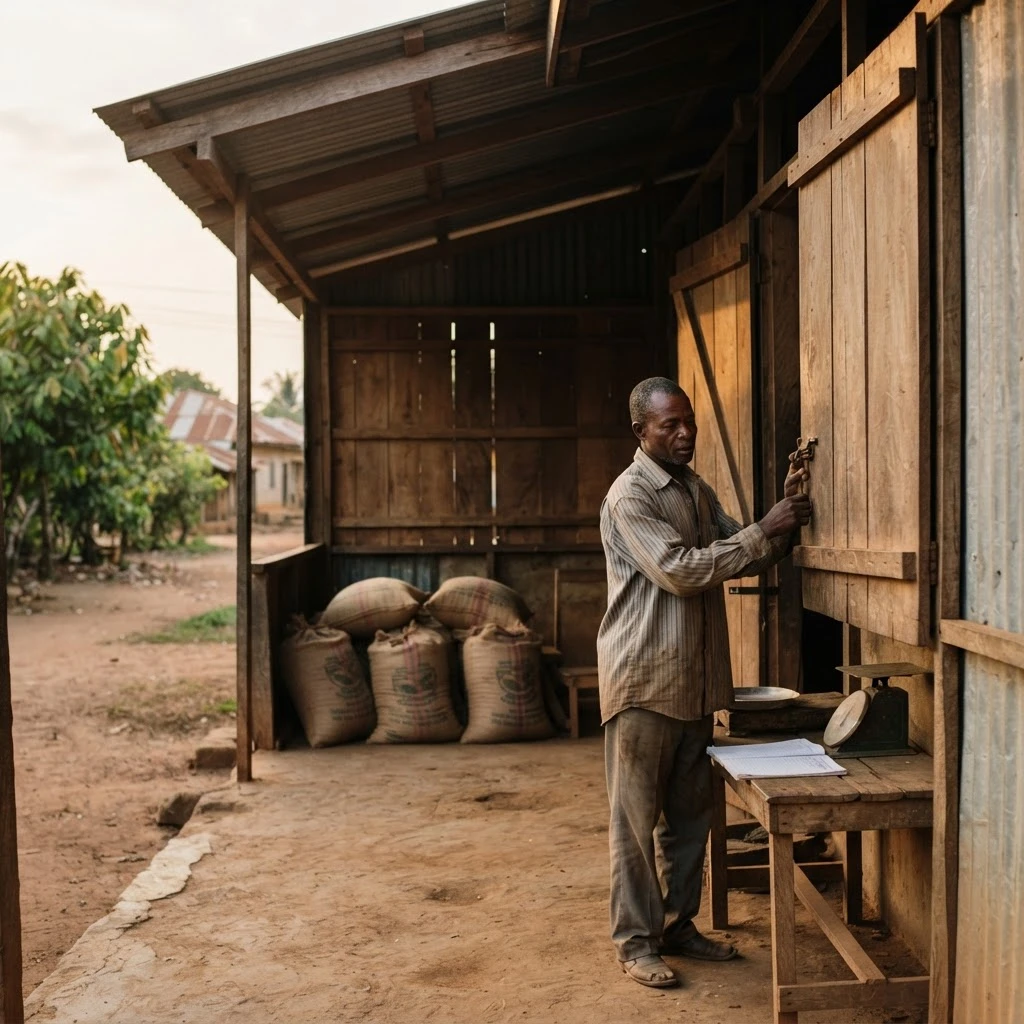
A Ghanaian licensed buying company clerk and an elderly farmer standing together outside a rural cocoa purchasing shed at golden hour, both looking at an open ledger book the clerk is holding, documentary photograph
Cocoa · Series intelligence

Business and Market Intelligence

Ghana is a price taker abroad and a price setter at home: the price comes from a world reference no origin controls, and the door into the trade is a licence tier and a certification record, not a warehouse.
Business and Market Intelligence · Pillar 07

A new entrant into Ghanaian cocoa needs two facts before committing capital: the price it will receive is not one the Ghanaian market discovers, and the door into the trade is a licence rather than a warehouse. Ghana takes its price from a world reference it cannot move, administers a producer price on top of it through a committee, and gates the export side by tonnage thresholds and association memberships.

This pillar sets out how the price is formed, what the licence tiers require, who already holds the buying and grinding positions, what certification now costs as a condition of market access, and how the sector finances the crop it forward-sells. Ghana is a price taker abroad and a price setter at home, and reading which is which decides where an entrant can actually compete.

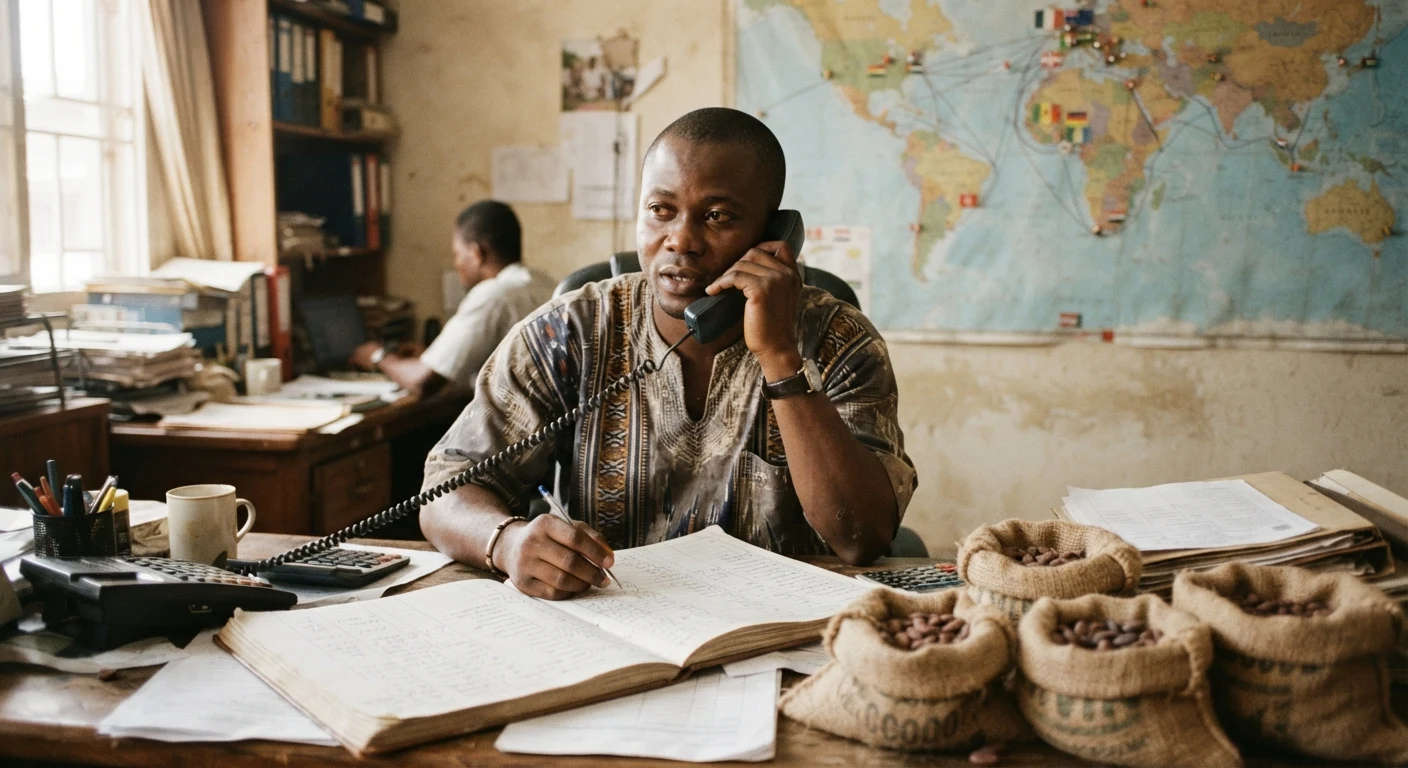
A Ghanaian cocoa export company trading clerk on a landline phone at a cluttered desk, a world map pinned to the wall behind him, sample jute sacks of dried cocoa beans and a ledger book on the desk, documentary photograph
Price taker abroad, price setter at home
The world sets the reference; a committee in Accra sets what the farmer actually receives.
$400/t
the Living Income Differential, fixed since 2020/21
70%
minimum share of Net FOB the producer-price committee targets
10,000t
minimum internal purchases over 2 crop years to qualify as an exporter

Where the price signal comes from

Ghana’s cocoa is priced by reference to the London terminal price plus Ghana’s origin premium plus the Living Income Differential, converted at the applicable exchange rate, and the same formula governs both spot and forward sales1. The Living Income Differential is a fixed markup of about US$400 per tonne on top of the futures-market price, agreed in 2019 and effective from the 2020/21 harvest, and the two producing countries set a floor export price of US$2,600 per tonne that already includes it2. On top of that sits Ghana’s origin premium, which moves with quality and delivery reliability and stood at GBP 20 per tonne above the ICE EU terminal market in May 2023.

The reference price is therefore a world number, and Ghana’s ability to influence it is small. Together with Cote d’Ivoire, Ghana produces the majority of the world’s cocoa, yet over the past half-century the real terminal-market price has fallen an average of about 2 per cent per year, and producing origins retain returned value of only about 5 per cent of the finished product’s price3. That is the structural fact behind the Living Income Differential: it exists because the world price does not on its own return a living income, and the two governments added a flat premium rather than wait for the market to reprice their beans.4

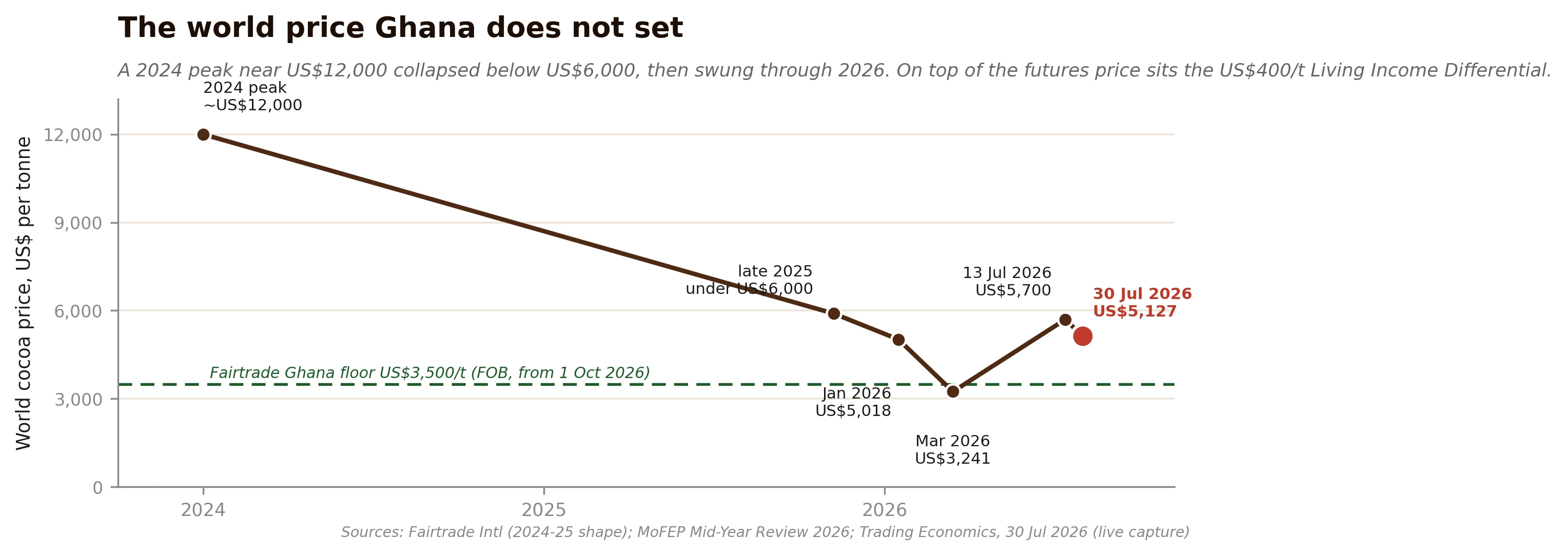
The recent swing shows how little the origin controls the number. World cocoa fell from about US$12,000 per tonne in 2024 to under US$6,000 per tonne by late 20255, a collapse that stranded stock and reset certification floors even though Ghana’s administered price had already been fixed for the season. The precise daily peak and trough of that series are not re-verifiable from any source held for this playbook, so the figure below is built on the held directional shape and the policy floors, not on a printed daily price.6

The domestic price, set separately

The domestic producer price is a separate, administered number, set each October by the Producer Price Review Committee, whose stated objective is to pay farmers a minimum of 70 per cent of the Net FOB price, with Net FOB calculated as the projected free-on-board value less direct farm-service costs such as disease and pest control and jute bags. Because the price is guaranteed and fixed within the season while the international market floats, COCOBOD carries the price risk itself. No hedging instrument reaches the farmer or the buying company: price risk is warehoused centrally at COCOBOD, and there is no Ghanaian futures venue on which anyone lower down the chain can lay it off.78

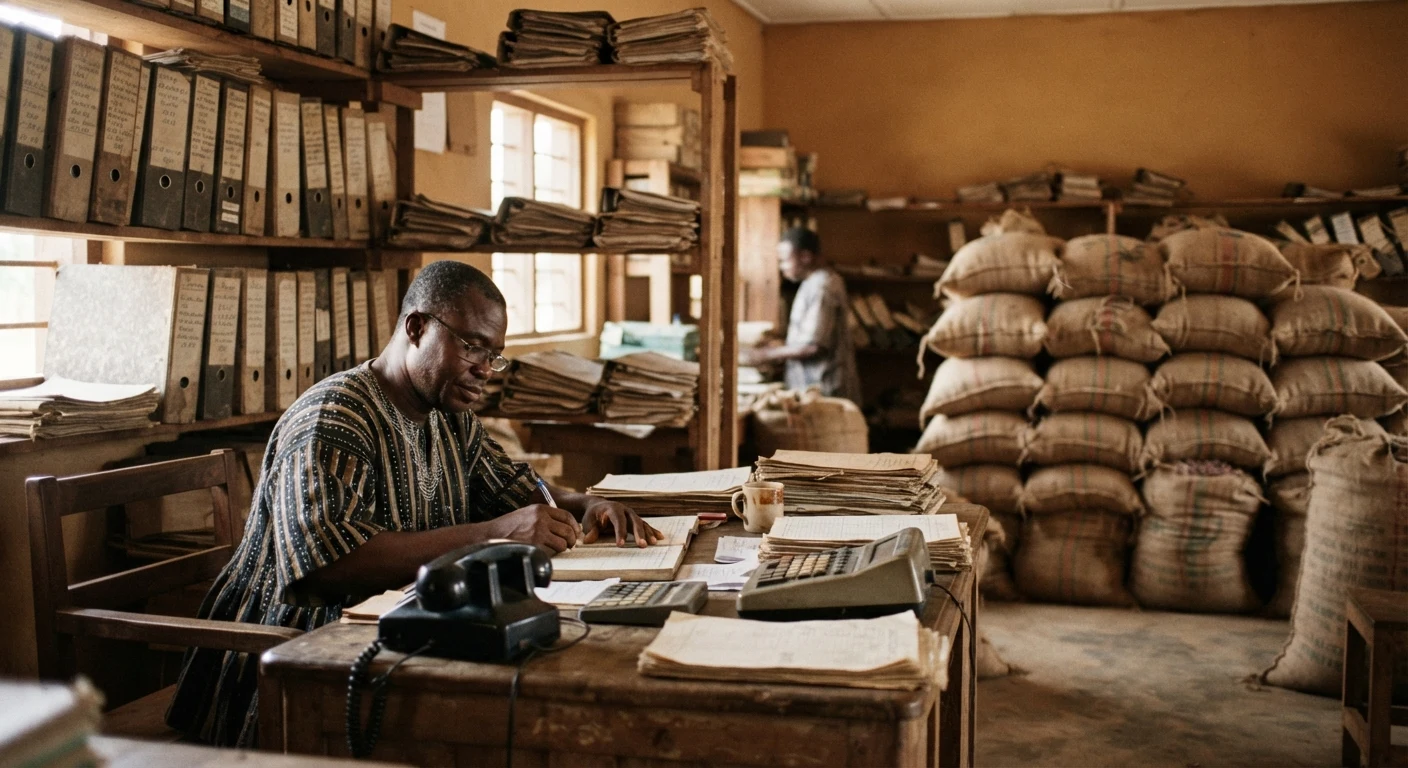
Inside a Ghanaian licensed buying company office, binders of shipping and export documents stacked on shelves, a rotary telephone and calculator on a worn wooden desk, jute sacks of cocoa beans stacked against the wall, documentary photograph
Not a competitive lever
The price to the farmer is fixed and identical for every buyer; no one wins by offering more.
-2%/yr
average annual real decline in the terminal cocoa price over the past half-century
~5%
the share of the finished product's price that producing origins retain
The world cocoa price Ghana does not set, from about US$12,000 per tonne in 2024 to under US$6,000 by late 2025, with the Living Income Differential and floor export price shown as the policy layer added on top
Figure 13 The world price Ghana does not set, with the policy layer added on top.
What this shows

The world price Ghana takes but does not set. The directional shape is held: world cocoa fell from about US$12,000 per tonne in 2024 to under US$6,000 by late 2025 (Fairtrade International). The annotated layer is policy, not the traded market: the US$400 Living Income Differential and the US$2,600 floor export price (Boysen et al. 2021), and Fairtrade’s new Ghana floor of US$3,500 per tonne FOB from 1 October 2026. The dailies through July 2026 are the live-captured series the underlying figure carries, sourced on the chart itself to MoFEP’s mid-year review and a same-day market read; they are shown here as the build-time capture the pillar's own figure note calls for, not as a separately verified playbook figure.

What it takes to get a licence

A Ghanaian cocoa export company owner reviewing a thick stack of official certificates and paperwork at a desk, a company seal and manila folders nearby, a calendar on the wall, documentary photograph
Regulation, not capital alone
A tonnage bar and a document checklist held at COCOBOD decide who exports.
2,500t
minimum financial capacity to register as a CMC buyer, per crop year
50t
the minimum shipment lot on a CMC contract, to any main port

Entry into the export trade is defined by regulation, not by capital alone. A company wishing to export cocoa must first be a Licensed Buying Company, must have bought cocoa internally for at least two crop years, and must have purchased a minimum of 10,000 tonnes per year across the two immediately preceding consecutive crop years, alongside demonstrated technical capacity and adequate finance. Applications are assessed by the Cocoa Sector Marketing Committee, which recommends licences to COCOBOD and draws its members from COCOBOD, the Ministry of Finance, a banker, a cocoa-marketing expert, the Quality Control Division, farmers and the private sector. A licence runs for an initial two years and renews annually against continued compliance, and a licence left unused for two consecutive years is suspended and then withdrawn910.

The threshold matters because it defines a tiered market rather than an open one. CMC, together with the LBCs licensed to export and any exporting company they jointly form, are the sole legal exporters of cocoa beans; an LBC that does not clear the tonnage bar sells its quota through a licensed exporter or through CMC. A new buyer therefore enters at the LBC tier, competes for internal purchases for years, and only then qualifies to export in its own name. Overseas buyers face their own gate: an external buyer must be a member of the London or New York cocoa association, or another recognised association, and must show financial standing verifiable through banking channels before a licensed exporter may sell to it. Every sales contract is registered with COCOBOD, monthly returns of tonnage, value, destination and grade are filed within seven days of month-end, and export-price guidance comes from a confidential Export Sales Committee whose decisions are shared with licensed exporters only1112.

Selling to CMC as a registered buyer, rather than exporting, is the lower rung, and it carries its own numbers. A firm applying to be a CMC buyer must show financial capacity to purchase at least 2,500 tonnes per crop year, plus bankers’ details for due diligence, and its buying licence renews each crop year. The minimum shipment lot on a CMC contract is 50 tonnes to any main port, bean sales run in three-monthly shipment windows and product sales in two-monthly windows. To become an LBC in the first place, a company files with the COCOBOD Chief Executive a certificate of incorporation, its company regulations under the Companies Act, bankers’ letters of comfort, a tax-clearance certificate, a five-year business plan with feasibility report and its latest statement of account. A processor applies instead for a Beans Supply Agreement with the same documents but a ten-year business plan and a list of the off-takers for the products it intends to make1314.

The practical route for a foreign firm is not the raw-bean tier at all. Only CMC or a locally incorporated licensed exporter may lawfully export raw beans, so a foreign entrant either takes a local partnership, an offtake agreement or a trade-finance position with a licensed exporter, or it processes. Once beans are converted into liquor, butter, powder or finished product, the licensed processor gains much freer ability to sell directly to international buyers, which makes processing the more accessible door for outside capital than raw-bean export1516.

Who already holds the positions

The buying and grinding positions in Ghana are concentrated and largely spoken for. About sixty-three Licensed Buying Companies work with the Board, and because the purchase price is fixed by regulation, they compete on volume rather than price; profitability rests on the volume handled and the seed-fund margin, not on any price a buyer can offer a farmer. That structure rewards scale and balance-sheet depth, and it squeezes the smaller and less-capitalised LBCs, who cannot use price to win purchases and struggle to fund the working capital that volume demands1718.

At the grinding end, three multinationals hold the Tema cluster, reported at roughly 75,000 tonnes of capacity for Cargill, 65,000 for Barry Callebaut and 75,000 for Olam, against installed national grinding capacity of about 505,000 tonnes and actual 2024/25 grindings of only about 210,000 tonnes. COCOBOD has committed over US$200 million toward domestic processing through 2028 to close that gap. These figures come from vendor-facing market intelligence and should be read as directional rather than audited1920.

The most consequential shift in the buyer landscape is at the state level. Under reforms announced in February 2026, the state-owned Produce Buying Company is being repositioned as the sector’s leading buyer, alongside a rule requiring 50 per cent of beans to be processed locally from the 2026/27 season21. The timing is difficult: the same PBC has seen its market share reportedly fall from about 30 per cent to under 5 per cent, the sector carries over GH¢33 billion in debt, Licensed Buying Companies are owed roughly US$185 million by COCOBOD, and some farmers are unpaid for up to two seasons. In early 2026 roughly 50,000 tonnes of Ghanaian cocoa sat unsold out of more than 530,000 tonnes sold, because a farmgate price of GH¢51,660 per tonne priced Ghana above competing origins and international buyers moved to cheaper beans22. For an entrant, the counterparty risk is the headline: the solvency of the specific LBC matters more than the reputation of the sector.

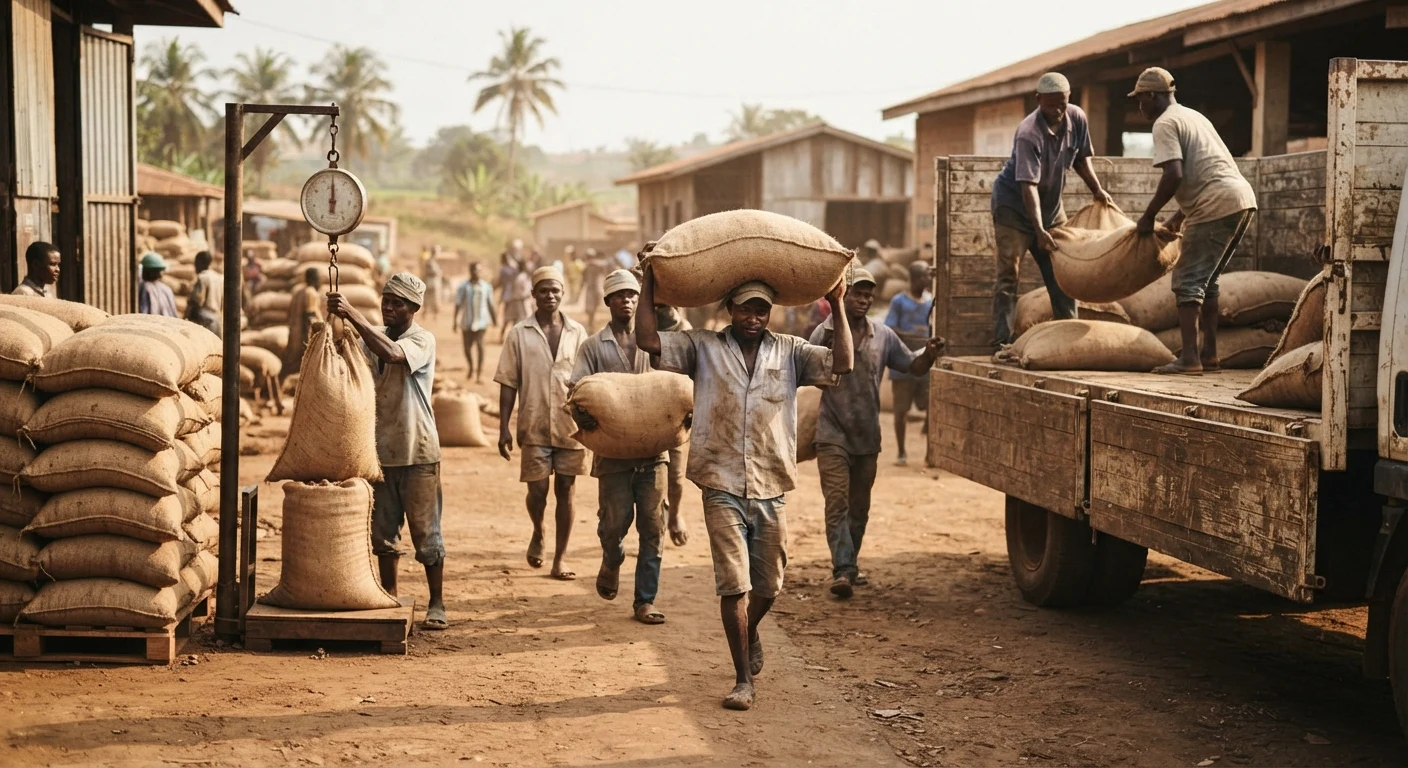
Workers carrying plain unmarked jute sacks of cocoa beans across a busy Ghanaian licensed buying company yard toward a flatbed truck, a hanging scale and stacked sacks nearby, morning light, documentary photograph
Competing on volume, not price
About 63 LBCs work with the Board; the fixed price leaves scale as the only lever.
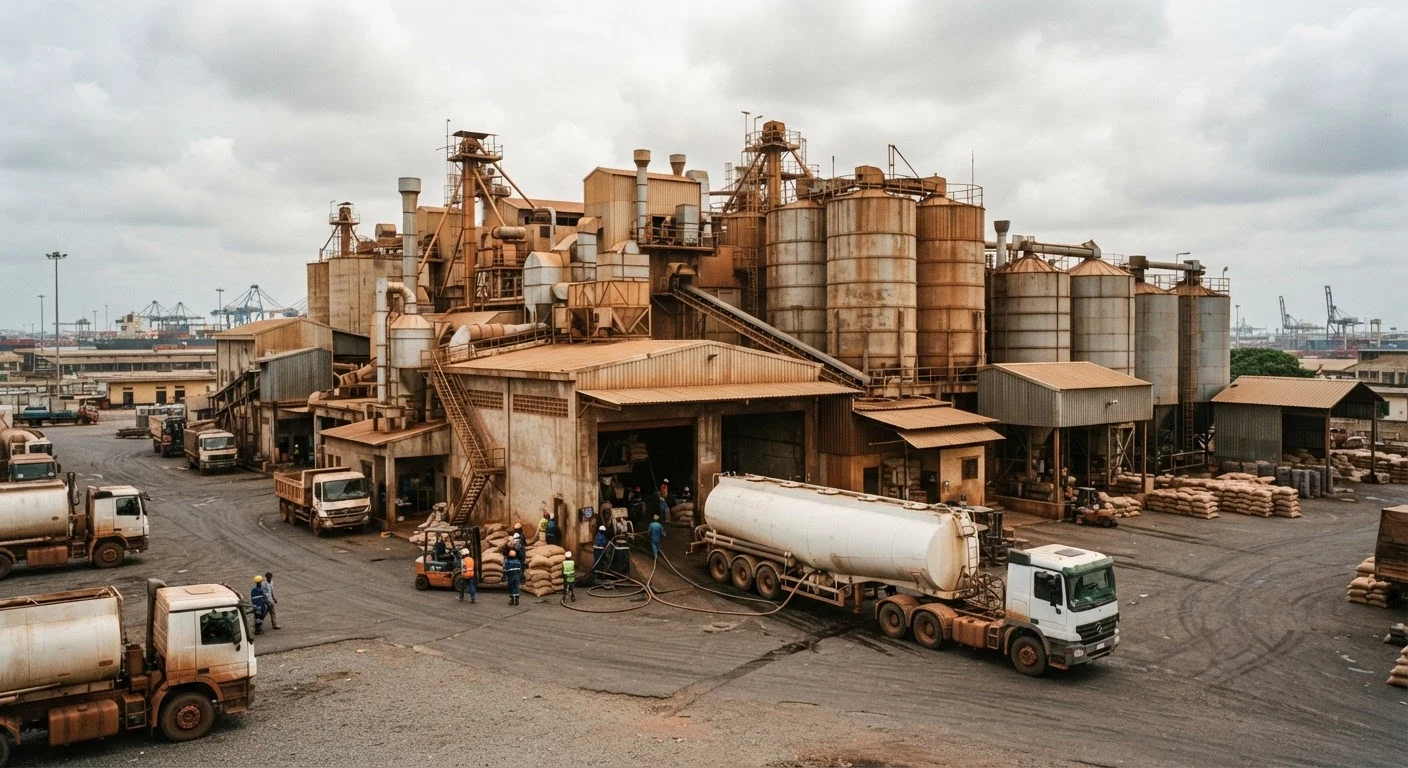
Exterior of a large industrial cocoa grinding and processing plant at Tema, Ghana, storage silos, loading bays and parked trucks, overcast harbour-industrial light, documentary photograph
Idle capacity, held positions
Three multinationals hold the Tema cluster against a grinding capacity running well under half full.
GH¢33bn
sector debt the buying layer is carrying
US$185M
owed to Licensed Buying Companies by COCOBOD
Table 11: The evidence this pillar is built on, and where each figure comes from
MeasureFigureWhat it is and where it comes from
Living Income DifferentialAbout US$400/tonneFlat markup on the futures price, agreed 2019, effective 2020/21; Aning 2023 and Boysen et al. 2021.
Floor export price incl. LIDUS$2,600/tonneTwo-country floor that already contains the US$400 LID; Boysen et al. 2021.
Ghana origin premiumGBP 20/tonne (May 2023)Quality and reliability premium above the ICE EU terminal market; Aning 2023.
Producer-price targetMin 70% of Net FOBAdministered objective of the Producer Price Review Committee; Aning 2023. The realised share lives in Pillar 2.
Export-licence tonnage bar10,000 t/year, over 2 crop yearsMinimum internal purchases to qualify as an exporter; COCOBOD 2004.
CMC buyer minimum2,500 t/crop yearFinancial-capacity test to register as a CMC buyer; Aning 2023.
Minimum shipment lot50 tonnesSmallest CMC contract lot to a main port; Aning 2023.
Licensed Buying CompaniesAbout 63 (2023)Number working with the Board; Aning 2023.
Installed grinding capacityAbout 505,000 t (~210,000 t ground 2024/25)Directional vendor figure; papaverAI 2026.
Fairtrade Minimum Price, GhanaUS$3,500/tonne FOBMandatory from 1 Oct 2026, up from US$2,400; Fairtrade International 2025.

Sources: Aning, ICCO Ghana Country Report (2023); Boysen et al., EC JRC (2021); COCOBOD, Export of Cocoa Regulations (2004); papaverAI market intelligence (2026); Fairtrade International, Cocoa Price Announcement (2025). Each figure is cited again in the body prose where it is used.

Table 12: The buyer and trader landscape a new entrant meets
ActorPosition in the chainWhat it means for an entrant
CMCSole external seller of Ghana's cocoa; runs the forward sales bookEvery export route runs through or past CMC; the trading desk sets the offer.
Multinational grinders (Cargill, Barry Callebaut, Olam)Hold the Tema grinding cluster and direct-sourcing programmesProcessing capacity and buyer relationships are already held; compete on service, not price.
Indigenous LBCs (PBC, FEDCO and others)Internal buying at the fixed producer priceThe realistic entry tier; competition is on volume and logistics, and several are financially stressed.
Produce Buying Company (state)Being repositioned as lead buyer under the February 2026 reformsTerms are shifting toward a revived state buyer; watch how quota and seed fund are allocated.
Global manufacturers (Mars, Mondelez, Nestle, Hershey, Ferrero, Lindt)Set sustainability and traceability terms as end-buyersThey define the certification bar an exporter must clear to reach shelves.

Sources: Aning (2023) for CMC and the LBC layer; papaverAI (2026) for the Tema grinders; Citi Newsroom (2026) for the PBC repositioning; the manufacturer roster is compiled from the certification and buyer references cited in this pillar's prose. Positions are the authors' reading of that evidence.

What this means. Read this market by where the price is made and where the licence is granted, and note they are two different places. The price is a world number Ghana cannot move plus an administered share it sets by committee, so no entrant competes on the farm-gate price. The licence is a tonnage bar and a document checklist held at COCOBOD, so the raw-bean export tier is effectively closed to a newcomer and processing is the accessible door. The one live opening in the incumbent landscape is counterparty distress: the buying layer an entrant would transact with is the layer now owed money and unable to pay.

Certification and traceability as the price of market access

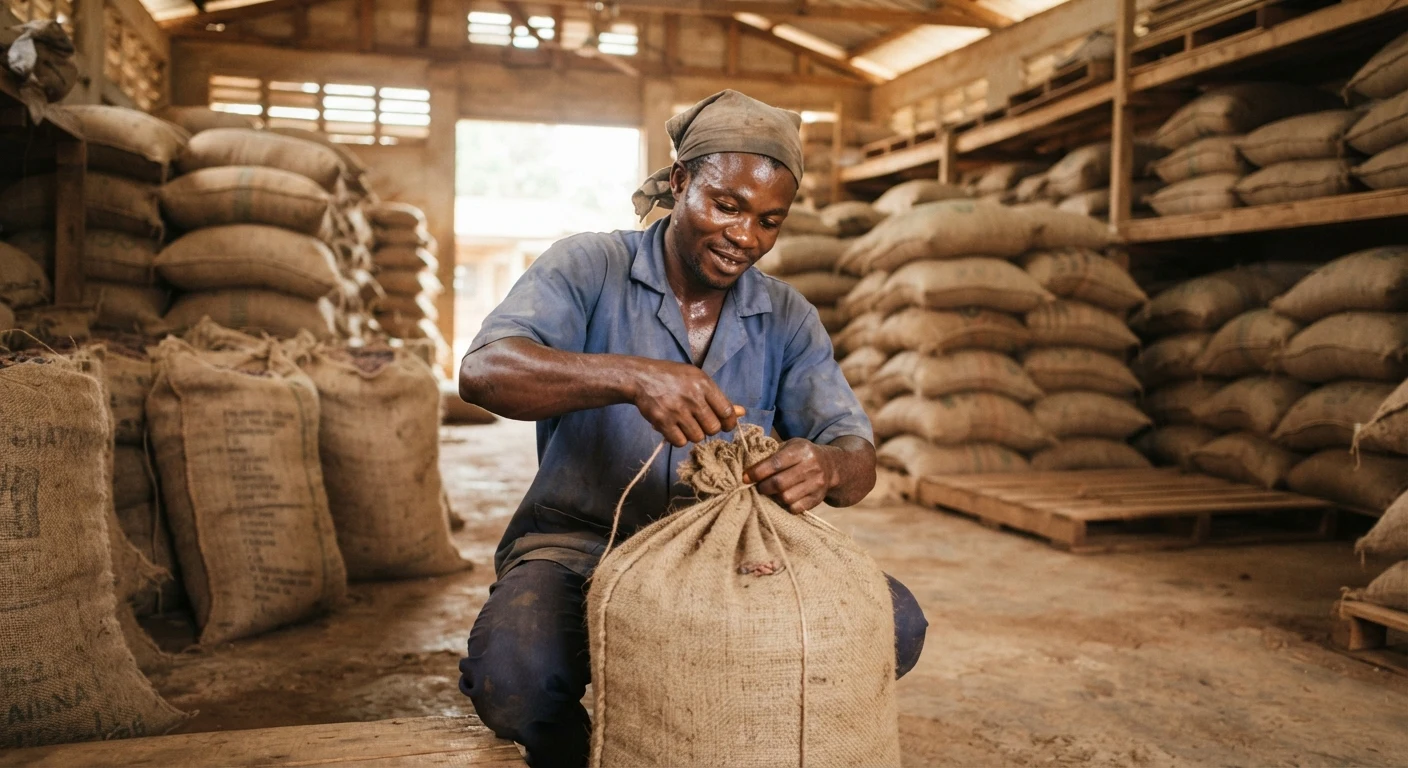
A Ghanaian cocoa cooperative warehouse worker tying closed a plain jute sack of certified cocoa beans by hand in a dedicated storage warehouse, shelves and stacked sacks around him, documentary photograph
A precondition, not a badge
CMC labels sustainability-programme beans as special and holds dedicated organic warehouses.
US$3,500/t
Fairtrade's Minimum Price for Ghana FOB, from 1 October 2026
EUR 64/t
Rainforest Alliance's mandatory cocoa premium floor for Ghana from 2026/27

Selling into the premium markets now depends on proving where a bean came from, not only on its grade. Ghana is implementing ARS-1000, the African Regional Standard for sustainable and traceable cocoa developed through ARSO from January 2020, which certifies the farmer as an entity, farmer group or cooperative. The standard is built to answer deforestation, climate change, the worst forms of child labour, farmer-business capacity and the traceability and quality of the bean; conformity is audited only by certification bodies that themselves meet the standard, and the ARS-1000 Implementation Guide Part 3 treats a working management system for sustainable and traceable production as the precondition for market acceptance rather than an optional badge2324.

The buyer-facing certifications carry hard numbers an exporter can plan against. Fairtrade’s Minimum Price for Ghana rises to US$3,500 per tonne FOB from 1 October 2026, with a Premium of US$275 per tonne and an Organic Differential of US$450 per tonne, up from the current US$2,400 Minimum Price, US$240 Premium and US$300 Organic Differential, and a new rule fixes 40 per cent of the Premium as cash paid directly to cooperative members25. Rainforest Alliance sets a mandatory cocoa premium floor of EUR 63 per tonne for the 2023 to 2026 harvests, rising to EUR 64 from 2026/27 for African countries including Ghana, or US$70 per tonne for the rest of the world, whichever is higher, with at least 40 per cent reaching group members directly and a cocoa royalty of US$15.70 per tonne26. Certified cocoa moves through CMC, which labels sustainability-programme beans as special, builds the stacks accordingly and holds dedicated organic warehouses27.

The European market makes traceability a condition of entry rather than a premium. Bulk cocoa into Europe must meet EUDR traceability compliance alongside food-safety, contaminant, pesticide and moisture limits28. Roughly three-quarters of Ghana’s 2024 export volume went to the EU29, so the compliance bar governs access to the main market. The value case for meeting it is unforgiving on its own: less than 7.5 per cent of the chain’s margin is generated in producing countries while retailers capture about 90 per cent, which is why the traceability record is worth building as the thing that keeps an exporter inside the EU market at all, not as a route to a larger slice.

The precondition for all of this is a record. A farmer group cannot be certified, and a consignment cannot be shown EUDR-compliant, without mapped plots and a chain of custody that ties beans back to those plots. Cargill reports 70 per cent of its direct-supply farmers GPS-mapped with polygon mapping toward a deforestation-free chain, which shows the mapping is operationally normal for a large buyer, but the same record is what a smaller exporter must hold before it can sell into the premium tiers at all3031.

Forward-selling and how the crop is financed

The forward sale is the instrument that finances the whole Ghanaian crop, and it is executed centrally rather than by any individual buyer. Before each main season COCOBOD raises pre-export offshore syndication finance by hypothecating its forward-sales receivables through a consortium of banks, an annual trade-finance facility of up to US$2 billion at about 100-plus basis points over LIBOR, passed down to the LBCs as a seed fund. The facility has run at US$1,300 million in 2018/19, US$1,500 million in 2019/20, US$1,300 million in 2020/21, US$1,500 million in 2021/22 and US$1,130 million in 2022/23. Seed-fund allocations are sized against a standard turnover ratio of 2.2, LBCs post bank letters of guarantee to draw them, and the fund is priced at the Bank of Ghana policy rate give or take a percentage point3233.

The cycle strands cash predictably, and any entrant financing purchases needs to model it. Around February COCOBOD begins deducting the facility from the Cocoa-Take-Over Receipts even though roughly 30 per cent of the crop is still unbought and only about half of the 70 per cent already purchased has been evacuated, delivered and paid for. The nominal payment period on a take-over receipt is 48 to 72 hours but in practice can run to weeks, so a buying company routinely finds itself carrying stock it has paid for but not been reimbursed for, and turns to local overdrafts to bridge the gap while foreign-owned LBCs draw on parent lines of credit instead. The assumed 2.2-times turnover of the seed fund is optimistic against these bottlenecks, which is a large part of why the smaller LBCs run short3435.

The financing model is now being rebuilt, and that is the single most important forward-looking piece of market intelligence in this pillar. COCOBOD is finalising a new funding model for 2026/27 to replace the decades-old syndicated loan, which had required between 70 and 92 per cent of the crop to be collateralised offshore, and is moving toward periodic producer-price reviews, commercial paper and notes and domestic institutional investors while keeping the policy of paying farmers 70 per cent of FOB36. The shift follows COCOBOD abandoning the 32-year syndicated-loan practice for 2024/25 after failing to secure a US$1.5 billion facility, with a roughly US$1 billion domestic bond and pension-fund and cedi-note financing planned in its place37. Anyone structuring a pre-financing deal with COCOBOD from 2026/27 will be doing it against domestic instruments and quarterly price reviews rather than the old annual offshore syndication.

A Ghanaian cocoa board finance officer and a bank representative in business attire reviewing a loan agreement document together at a conference table, a window overlooking Accra behind them, documentary photograph
Rebuilt mid-flight
A 32-year offshore syndication is being replaced by a domestic bond and notes model.
US$2bn
the annual pre-export syndication facility's ceiling, at its peak years
US$1bn
the roughly-sized domestic bond model planned from 2026/27

Market intelligence and the digital opening

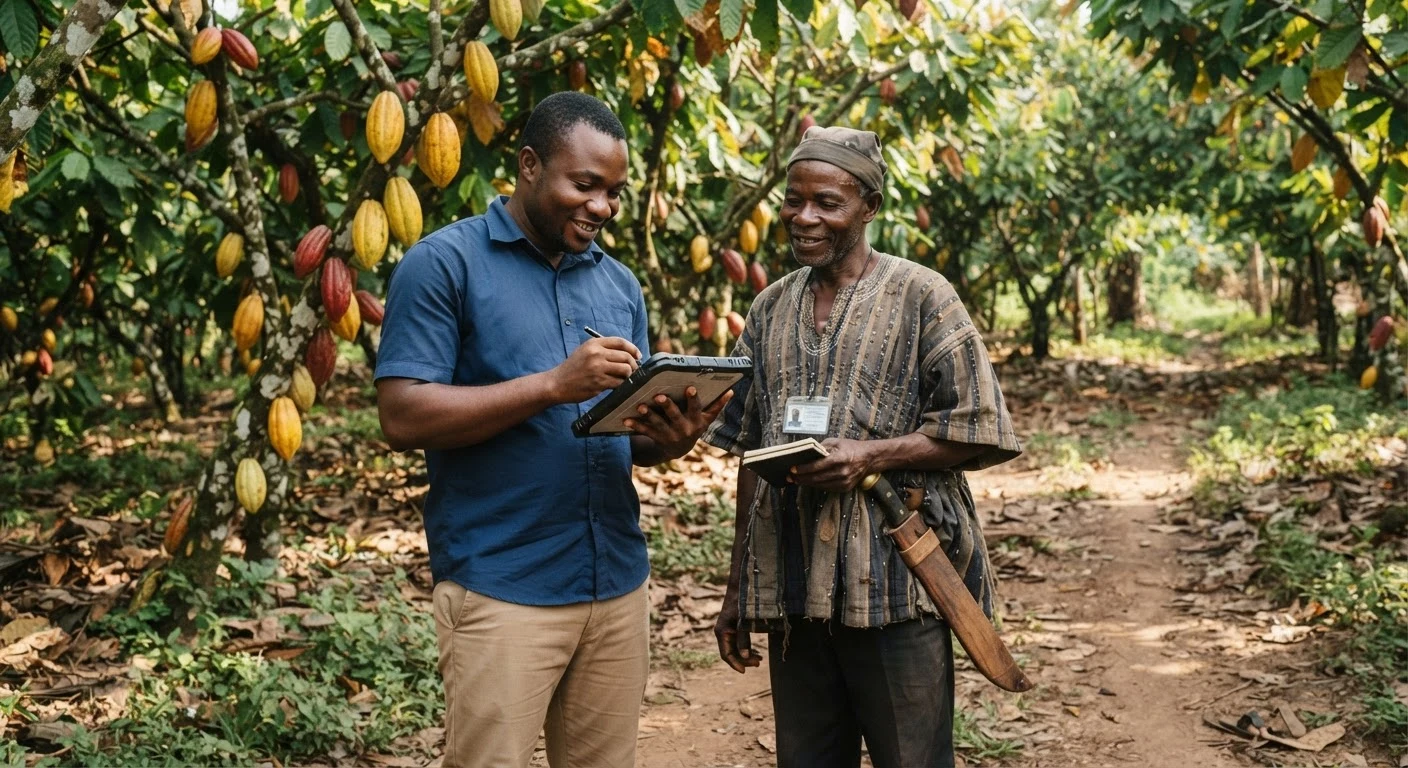
A Ghanaian agricultural field agent entering farmer registration details into a rugged handheld tablet at the edge of a cocoa farm, a farmer standing beside him, cocoa trees with pods around them, documentary photograph
Collect the record first
The traceability register and a maintained price series are the same missing asset seen twice.
Collect first, model second
the sequence both the credit-scoring and the forecasting opening depend on

The feasible digital opening in this pillar is traceability infrastructure, and its precondition is a record rather than a model. Every premium the certifications pay and every EUDR consignment the EU accepts rests on mapped plots and a chain of custody, and the large buyers already run this: Cargill’s polygon mapping of direct-supply farmers is a working example of the farm-to-first-purchase record that ARS-1000 and EUDR both demand3839. The opening for a Ghanaian entrant is not to build a better mapping algorithm but to hold the record itself, because the farmer group that can produce a mapped, auditable supply base is the one a certified buyer can transact with, and the one that cannot is locked out of the premium market regardless of bean quality.

The second opening is on the price and financing side, where the sector’s own information asymmetry is the product. Ghana’s producer price is administered and its financing is being rebuilt around domestic instruments and quarterly reviews, which means the operators who track the exchange rate, the producer-price calendar and the new financing terms week by week hold information the smaller buyers do not. The task is collection and discipline rather than invention: a maintained, honest read on the cedi margin between field cost and export return is worth more to a lender underwriting a buying company than it is to the buying company itself, and the lender can pay for it. The AI layer that sits on top of this, forecasting the producer-price decision or the certification-premium spread, is a genuinely useful product but a technically ordinary one, and it is blocked by the same missing input: it needs a maintained price and cost series to forecast from, so the sequence is to collect the record first and model it second.

The risks that sit inside the market

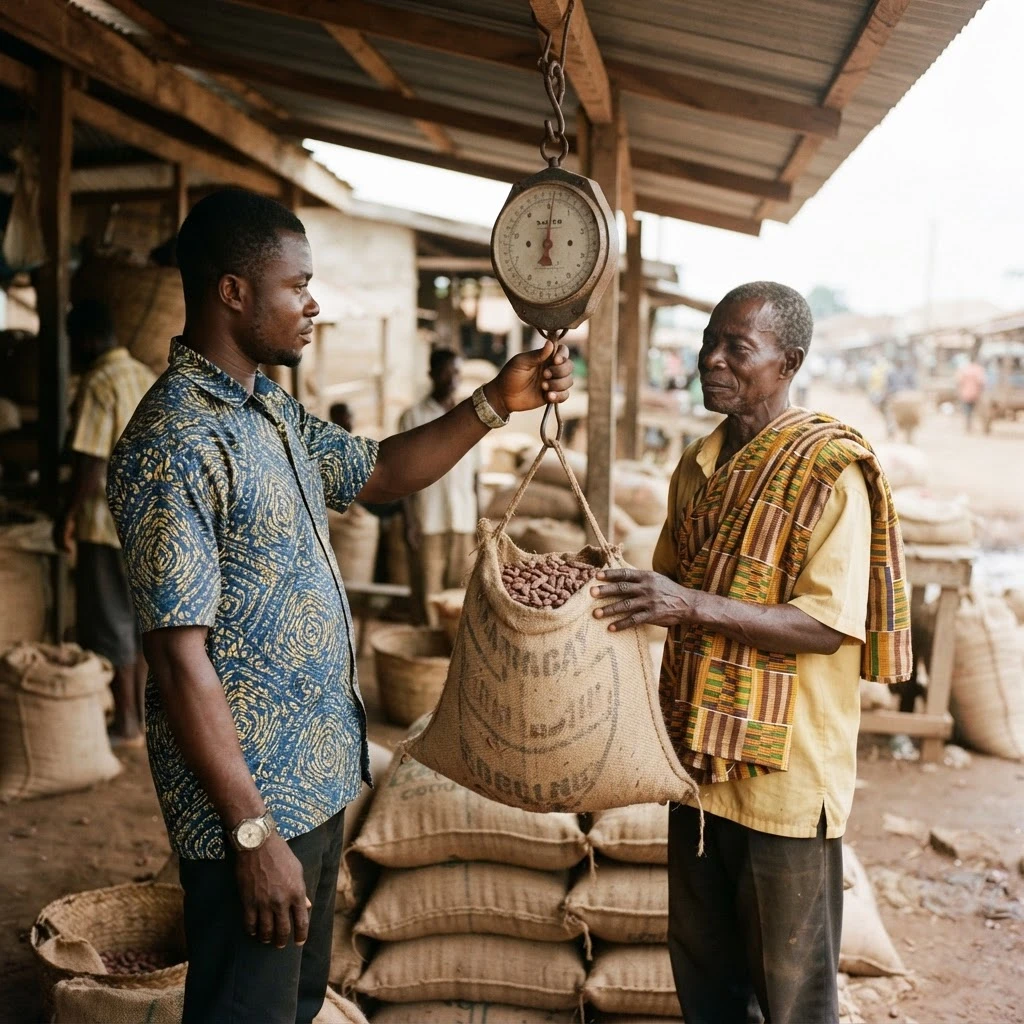
A Ghanaian cocoa buying clerk weighing a sack of beans on a hanging scale for a farmer at a rural licensed buying shed, documentary photograph

The world price moves against a fixed domestic price

HIGH
What it is

Ghana takes its reference price from a world futures market it cannot move, then commits to an administered producer price for the season, so a mid-season collapse in the world price leaves the guaranteed domestic price stranded above what buyers will pay.

Evidence

In early 2026 roughly 50,000 tonnes of Ghanaian cocoa sat unsold because the farmgate price exceeded competing origins and buyers moved to cheaper beans, after the world price fell from about US$12,000 per tonne in 2024 to under US$6,000 by late 2025.

Who it hits

Exporters and buying companies holding stock bought at the domestic price, and COCOBOD, which carries the price risk centrally.

How to manage it, and the opening

Track the exchange rate and the producer-price calendar as the two numbers that set the cedi margin, keep purchasing paced to confirmed offtake rather than to seed-fund availability, and treat the annual price decision as the main planning event, not the daily terminal quote.

A Ghanaian licensed buying company clerk locking up a purchasing shed at dusk, sacks of beans stacked beside him, documentary photograph

Counterparty insolvency in the buying layer

HIGH
What it is

The buying company an entrant transacts with may itself be owed money by COCOBOD and unable to pay farmers, so a counterparty that looks like a routine trade partner can be carrying a balance sheet that cannot settle.

Evidence

The sector carries over GH¢33 billion in debt, Licensed Buying Companies are owed roughly US$185 million by COCOBOD, some farmers are unpaid for up to two seasons, and the once-dominant state buyer’s market share has fallen from about 30 per cent to under 5 per cent.

Who it hits

Anyone extending trade credit, offtake finance or advance payment to a Ghanaian LBC, and farmers at the end of the chain.

How to manage it, and the opening

Underwrite the specific counterparty rather than the sector, take security or shorten payment cycles where the balance sheet is uncertain, and watch how seed fund and quota are reallocated as the revived state buyer is repositioned.

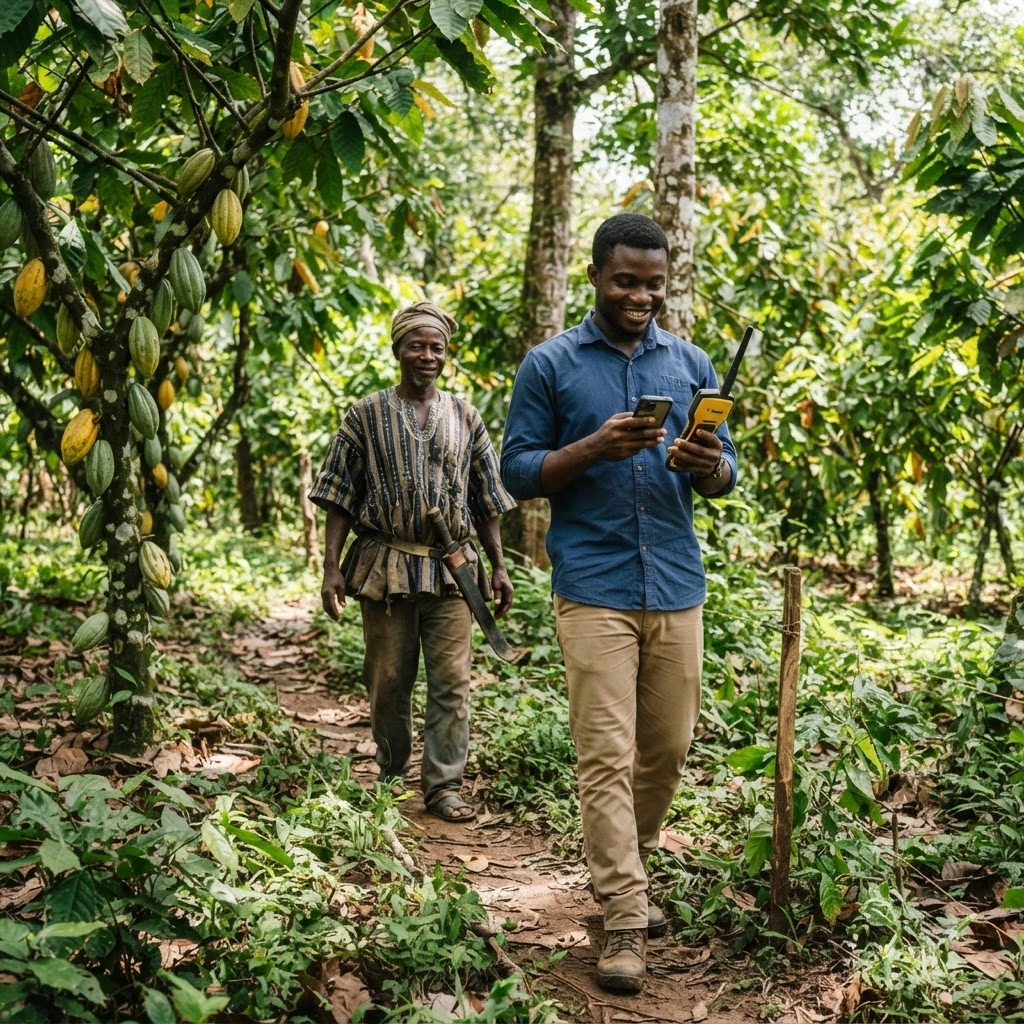
A Ghanaian farmer and a field agent with handheld devices walking together through a cocoa farm path, documentary photograph

Traceability failure closes the main market

HIGH
What it is

The EU is Ghana's largest cocoa market and now conditions entry on EUDR traceability, so a consignment that cannot be traced to mapped plots is excluded from the sale rather than discounted.

Evidence

About three-quarters of Ghana’s 2024 export volume went to the EU, and both the EUDR and the ARS-1000 standard treat a mapped, auditable chain of custody as the precondition for acceptance rather than as a premium feature.

Who it hits

Exporters and farmer groups without a plot-mapped, documented supply base, and any buyer sourcing from them.

How to manage it, and the opening

Build the farm-to-first-purchase record first, because it is the thing that keeps a consignment inside the EU market at all; the certification premiums are a secondary return on a record that has to exist regardless.

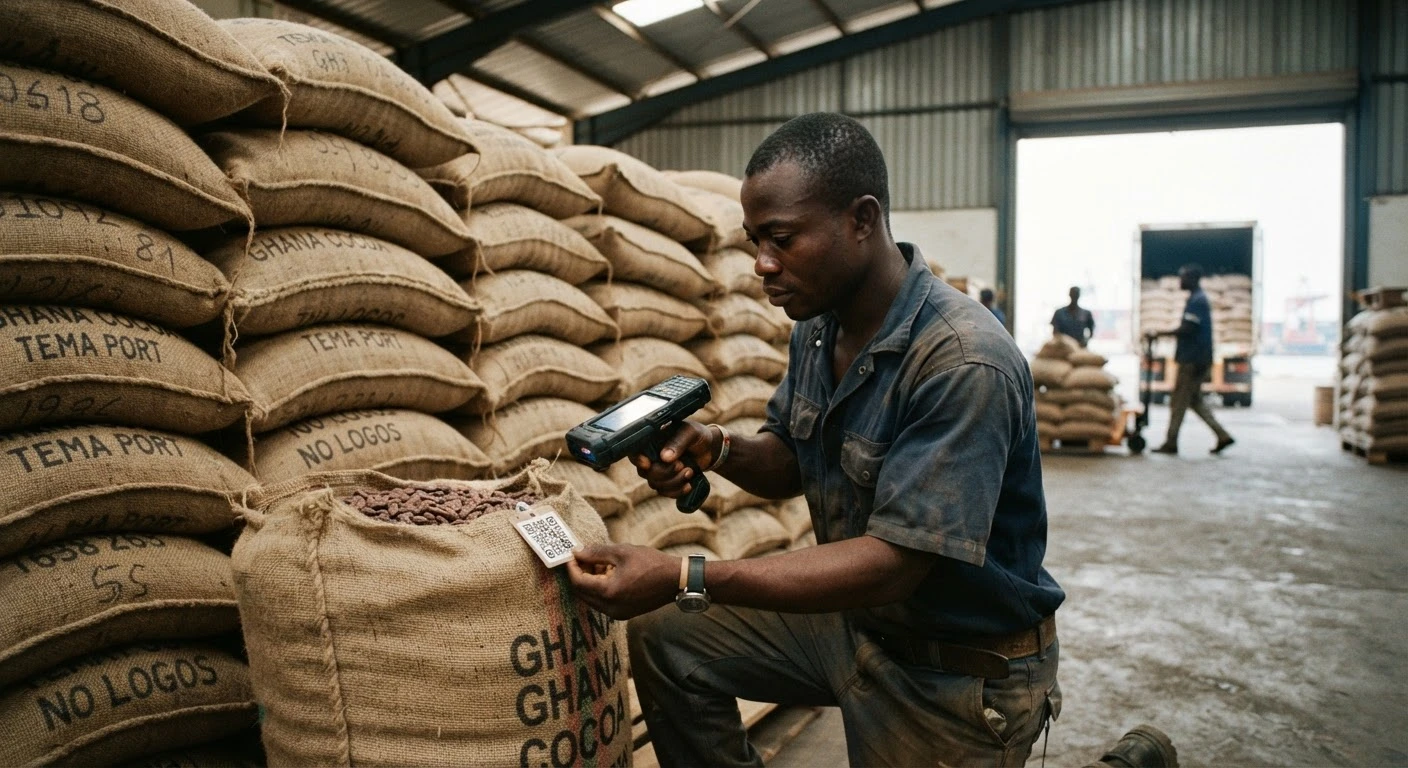
A Ghanaian cocoa export warehouse worker scanning a QR tag on a jute sack of cocoa beans with a handheld device, stacked traceable sacks and a loading bay behind, documentary photograph
The record is the market access
A mapped, auditable chain of custody is now the precondition for EU acceptance, not a premium feature.
Ranked openings: where the market opens for a new entrant
01

Take the door that is actually open: process, don't export raw beans. Only CMC or a locally incorporated licensed exporter may lawfully export raw beans, so a foreign entrant either takes a local partnership, an offtake agreement or a trade-finance position with a licensed exporter, or it processes. Once beans are converted into liquor, butter, powder or finished product, the licensed processor gains much freer ability to sell directly to international buyers.

02

Hold the mapped, auditable traceability record. The opening for a Ghanaian entrant is not to build a better mapping algorithm but to hold the record itself, because the farmer group that can produce a mapped, auditable supply base is the one a certified buyer can transact with, and the one that cannot is locked out of the premium market regardless of bean quality.

03

Underwrite the specific counterparty; distress itself is the live opening. The buying company an entrant transacts with may itself be owed money by COCOBOD and unable to pay farmers, so the solvency of the specific counterparty matters more than the reputation of the sector. Terms are being rewritten toward local processing and a revived state buyer at exactly the moment the incumbent financing model has broken.

04

Sell the price-and-cost intelligence to the lender, not only to the buyer. A maintained, honest read on the cedi margin between field cost and export return is worth more to a lender underwriting a buying company than it is to the buying company itself, and the lender can pay for it. The task is collection and discipline, not invention.

Key takeaways
01

Ghana is a price taker abroad and a price setter at home. The price is the London terminal reference plus an origin premium plus the US$400 Living Income Differential, and on top of it a committee administers a producer price at a minimum of 70 per cent of Net FOB. No entrant competes on the farm-gate price; the numbers to watch are the exchange rate and the annual producer-price decision.

02

The door into the export trade is a licence, not a warehouse. Exporting requires a Licensed Buying Company that has bought at least 10,000 tonnes a year over two crop years; raw-bean export is reserved to CMC and locally incorporated exporters, which makes processing the accessible door for outside capital.

03

The positions are held and stressed. About sixty-three LBCs compete on volume, three multinationals hold the Tema grinding cluster against roughly 505,000 tonnes of installed capacity running near 210,000, and a February 2026 reform is reviving the state Produce Buying Company inside a sector carrying over GH¢33 billion in debt. Counterparty solvency is the headline risk.

04

Certification and traceability are now the price of market access, not a premium. Fairtrade's Ghana Minimum Price rises to US$3,500 per tonne FOB from October 2026, but the binding condition is EUDR traceability into the EU, which takes about three-quarters of Ghana's exports. The reachable opening is to hold the mapped, auditable record itself.

05

The crop is financed by a central forward sale now being rebuilt. COCOBOD is replacing the offshore syndicated loan with a domestic model and quarterly price reviews from 2026/27, so anyone pre-financing against Ghanaian cocoa is doing it against domestic instruments rather than the old annual syndication.

Written for each reader

Practitioner intelligence

Hover any card to pause and lift it.

For students

This pillar is a lesson in reading an administered market that still sits inside a world one. The price has two layers a student should be able to separate: a world reference Ghana cannot move, and a committee-set share on top of it. Learn to ask, of any cocoa price you are shown, whether it is the world number, the FOB, the administered producer price or a certification floor, because they move independently and mean different things.

For entrepreneurs

Do not build a plan on beating the farm-gate price, because it is fixed and identical for every buyer. Build it on a door you can actually open: processing rather than raw-bean export, and the traceability record that certified buyers now require. Before you contract with any Ghanaian LBC in 2026, underwrite that specific counterparty, because the layer you would trade with is the layer now owed money and unable to pay.

For investors

Price two things into any cocoa position here. The first is that the producer price is a managed variable that can be cut inside a season when the world price falls, so a plan built on an opening price carries real downside. The second is counterparty risk in the buying layer: an LBC owed money by COCOBOD is a weaker credit than the sector's reputation implies. The financing transition to domestic instruments from 2026/27 is the change to track, because it moves the terms of every pre-financing deal.

For ecosystem actors

The highest-value public move is the record, not another subsidy. The traceability register that certification and EUDR both demand, and the maintained price-and-cost series that a credit model would forecast from, are the same missing asset seen twice. Fund the collection and the discipline first; the AI layer that forecasts the producer-price decision or the premium spread is ordinary once the series exists and worthless until it does.

Where this connects. The realised farmer share of FOB and the 2025/26 producer price are set out in Pillar 2, which carries the price story in full, while the February 2026 reforms that reset that price belong to Pillar 8; this pillar references the administered 70-per-cent-of-Net-FOB target rather than retelling it. The idle grinding capacity behind the Tema cluster is measured in Pillar 2, and the downstream value split in Pillar 6. The EUDR timeline and its concentration on the southern cocoa regions are carried in Pillar 3, and the strategic reading of the financing transition and the local-processing mandate belongs to Pillar 8.

Footnotes
  1. Aning, Feasibility Study on Africa Cocoa Exchange (AfCX): Ghana Country Report.
  2. Ole Boysen et al., Impacts of the Cocoa Living Income Differential Policy in Ghana and Cote d'Ivoire (Luxembourg: Publications Office of the European Union, EUR 30812 EN, European Commission Joint Research Centre, 2021), https://doi.org/10.2760/57548.
  3. Aning, Feasibility Study on Africa Cocoa Exchange (AfCX): Ghana Country Report.
  4. Aning, Feasibility Study on Africa Cocoa Exchange (AfCX): Ghana Country Report.
  5. Fairtrade International, Cocoa Price Announcement (Bonn: Fairtrade International, 2025).
  6. Fairtrade International, Cocoa Price Announcement.
  7. Aning, Feasibility Study on Africa Cocoa Exchange (AfCX): Ghana Country Report.
  8. Aning, Feasibility Study on Africa Cocoa Exchange (AfCX): Ghana Country Report.
  9. Ghana Cocoa Board (COCOBOD), Export of Cocoa Regulations (Accra: Ghana Cocoa Board (FAOLEX Database, FAO), 2004).
  10. COCOBOD, Export of Cocoa Regulations.
  11. COCOBOD, Export of Cocoa Regulations.
  12. COCOBOD, Export of Cocoa Regulations.
  13. Aning, Feasibility Study on Africa Cocoa Exchange (AfCX): Ghana Country Report.
  14. Aning, Feasibility Study on Africa Cocoa Exchange (AfCX): Ghana Country Report.
  15. Chambers and Partners, Agribusiness Law: Ghana - Cocoa Export and Processing (Chambers and Partners, Practice Guides, n.d.).
  16. Chambers and Partners, Agribusiness Law: Ghana.
  17. Aning, Feasibility Study on Africa Cocoa Exchange (AfCX): Ghana Country Report.
  18. Aning, Feasibility Study on Africa Cocoa Exchange (AfCX): Ghana Country Report.
  19. papaverAI, Ghana Cocoa Grinding and Processing: Market Intelligence Brief (papaverAI, 2026).
  20. papaverAI, Ghana Cocoa Grinding: Market Intelligence Brief.
  21. Citi Newsroom, Government Repositions Produce Buying Company as Lead Cocoa Buyer (Accra: Citi FM/Citi Newsroom, 2026).
  22. GBC Ghana Online, Cocoa Sector Debt and Unsold Stock Weigh on Ghana's 2025/26 Season (Accra: Ghana Broadcasting Corporation, 2026).
  23. GSA and COCOBOD, National Implementation Guide for GS ARS 1000.
  24. GSA and COCOBOD, National Implementation Guide for GS ARS 1000.
  25. Fairtrade International, Cocoa Price Announcement.
  26. Rainforest Alliance, Cocoa Sustainability Differential and Investments: Requirements and Guidance (Rainforest Alliance, 2026).
  27. Aning, Feasibility Study on Africa Cocoa Exchange (AfCX): Ghana Country Report.
  28. Centre for the Promotion of Imports from Developing Countries (CBI), The European Market Potential for Cocoa (The Hague: CBI, Netherlands Ministry of Foreign Affairs, n.d.).
  29. Taylor, Beillard, and Galloway, Ghana: Cocoa Sector Overview.
  30. Cargill, Incorporated, Cocoa (2025 Impact Report. Minneapolis: Cargill, 2025).
  31. Cargill, Cocoa (2025 Impact Report).
  32. Aning, Feasibility Study on Africa Cocoa Exchange (AfCX): Ghana Country Report.
  33. Aning, Feasibility Study on Africa Cocoa Exchange (AfCX): Ghana Country Report.
  34. Aning, Feasibility Study on Africa Cocoa Exchange (AfCX): Ghana Country Report.
  35. Aning, Feasibility Study on Africa Cocoa Exchange (AfCX): Ghana Country Report.
  36. Prince Narh, COCOBOD Finalises New Funding Model to Replace Syndicated Loan (Accra: Citinewsroom, 2026).
  37. Taylor, Beillard, and Galloway, Ghana: Cocoa Sector Overview.
  38. Cargill, Cocoa (2025 Impact Report).
  39. GSA and COCOBOD, National Implementation Guide for GS ARS 1000.
Download full PDF
UpcomingThis document isn't available yet.