Ghana Agribusiness PlaybookGoats & Sheep
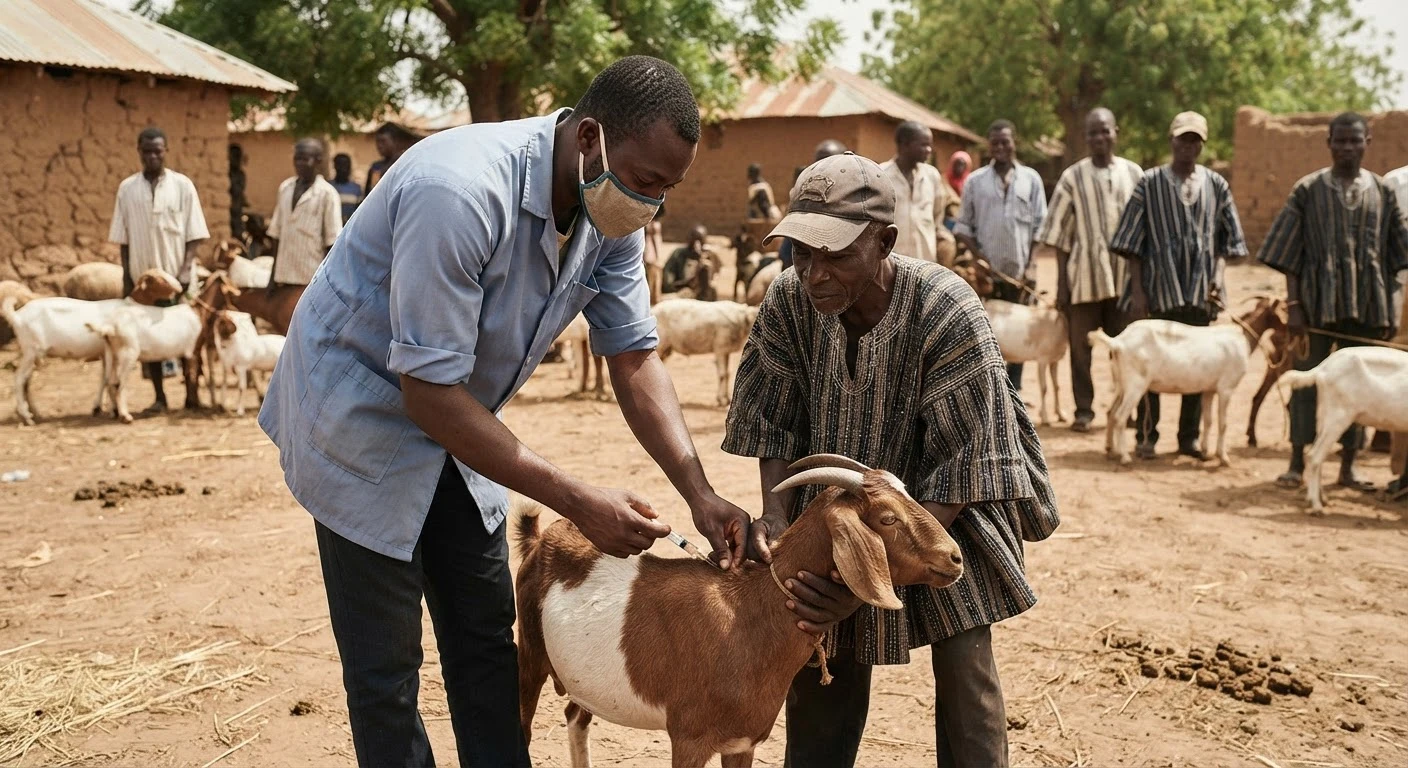
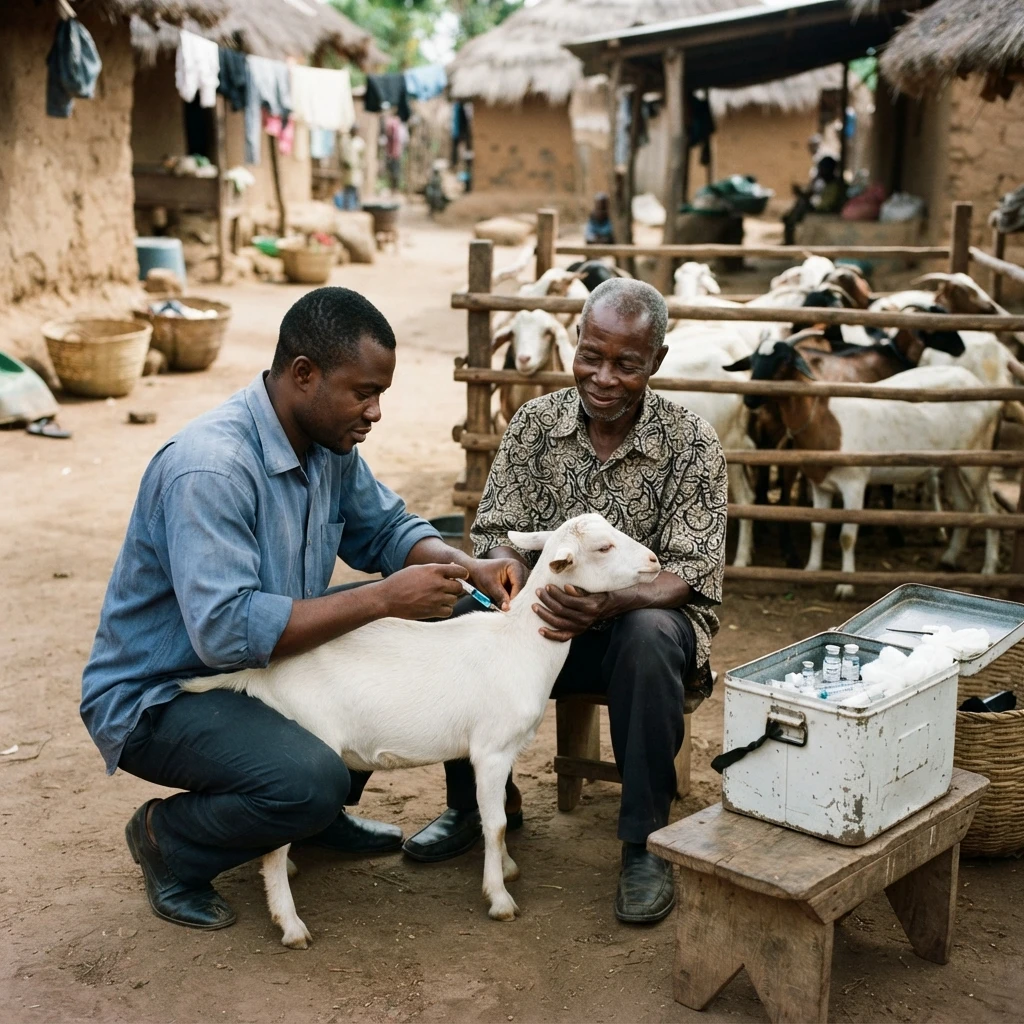
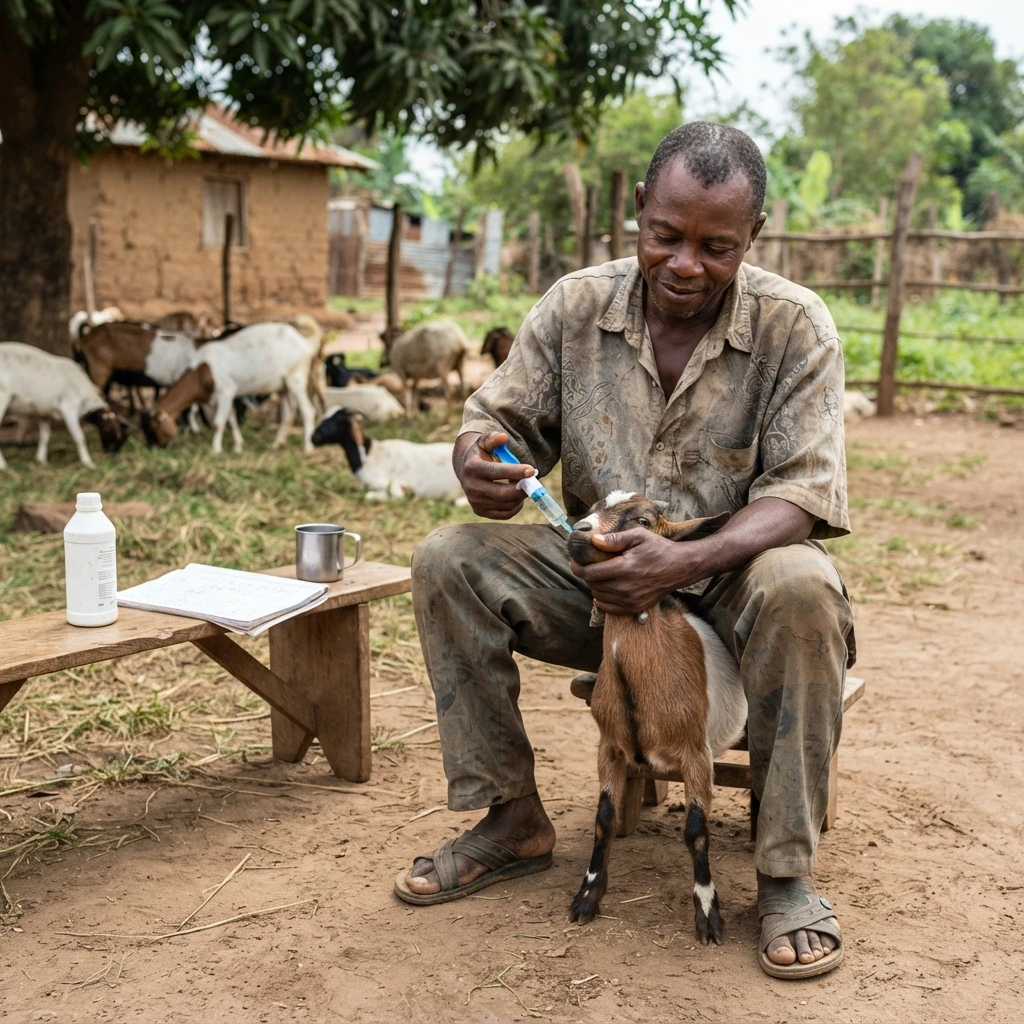
A community animal health worker vaccinating a goat while its keeper holds it steady, a cold-box of vaccine vials open beside them
Goats & Sheep · Pillar 03

Disease, Health and Biosecurity

Peste des petits ruminants and internal parasites drain more value from this sector than low prices ever do, and a vaccine dose costing cents still reaches barely one goat in three once the farmer has to pay for it.
Disease, Health and Biosecurity · Pillar 03

The biggest threat to a small-ruminant business in Ghana is not the market; it is keeping the animals alive. Disease and young-stock death drain more value from the sector than low prices ever do. Two diseases dominate. The first is peste des petits ruminants, a viral disease also known as kata1, endemic across Ghana and the sector’s single biggest named killer. The second is internal parasitic worms, which are everywhere and quietly cut growth, fertility and survival. On top of these sit theft, dry-season feed shortage and high kid and lamb mortality. The good news is that the worst losses are preventable with vaccination, deworming and basic husbandry, which means health is the area where a serious keeper can most easily out-perform the casual majority.

A veterinary officer vaccinating a goat held firmly by a farmer at an outdoor livestock vaccination event in northern Ghana, other goats and farmers queued nearby, documentary photograph
Preventable, mostly
The worst losses are preventable: vaccination, deworming and basic husbandry.
10%
average all-cause disease mortality farmers reported across their ruminants in twelve months
40%
of small-ruminant farmers name PPR as the likely cause of their most recent deaths
13.2%
median PPR mortality within an affected flock (range 4.9-26.3%)

🐐 PPR: the flock-killer that decides who profits 🐐

Peste des petits ruminants is the disease that dominates the sector, and Ghana’s own evidence puts a number on it. Farmers in a three-district survey across the main livestock belts reported an average of 10 percent all-cause disease mortality across the ruminants they keep, cattle included, over twelve months2, and PPR is the disease they most often hold responsible for it: it is named by 40 percent of small-ruminant farmers as the most likely cause of their most recent animal deaths, and it is reported by farmers at about half the animals in an affected herd in a farming year, on a wide spread of answers. That 10 percent is a whole-herd, all-disease figure and should not be read as PPR’s own kill rate; what the evidence establishes is that PPR is the named cause more often than any other disease.

Within a flock it has actually reached, mortality runs at a median of 13.2 percent of an affected flock, with an inter-quartile range of 4.9 to 26.3 percent and an observed maximum of 63 percent3; the larger figure sometimes quoted, up to 90 percent, with morbidity reaching 100 percent, in the worst situations recorded anywhere4, and the same source adds that where the disease is endemic the mortality rate may be lower. Ghana is such a place: the disease is endemic here and the circulating virus is lineage II5.

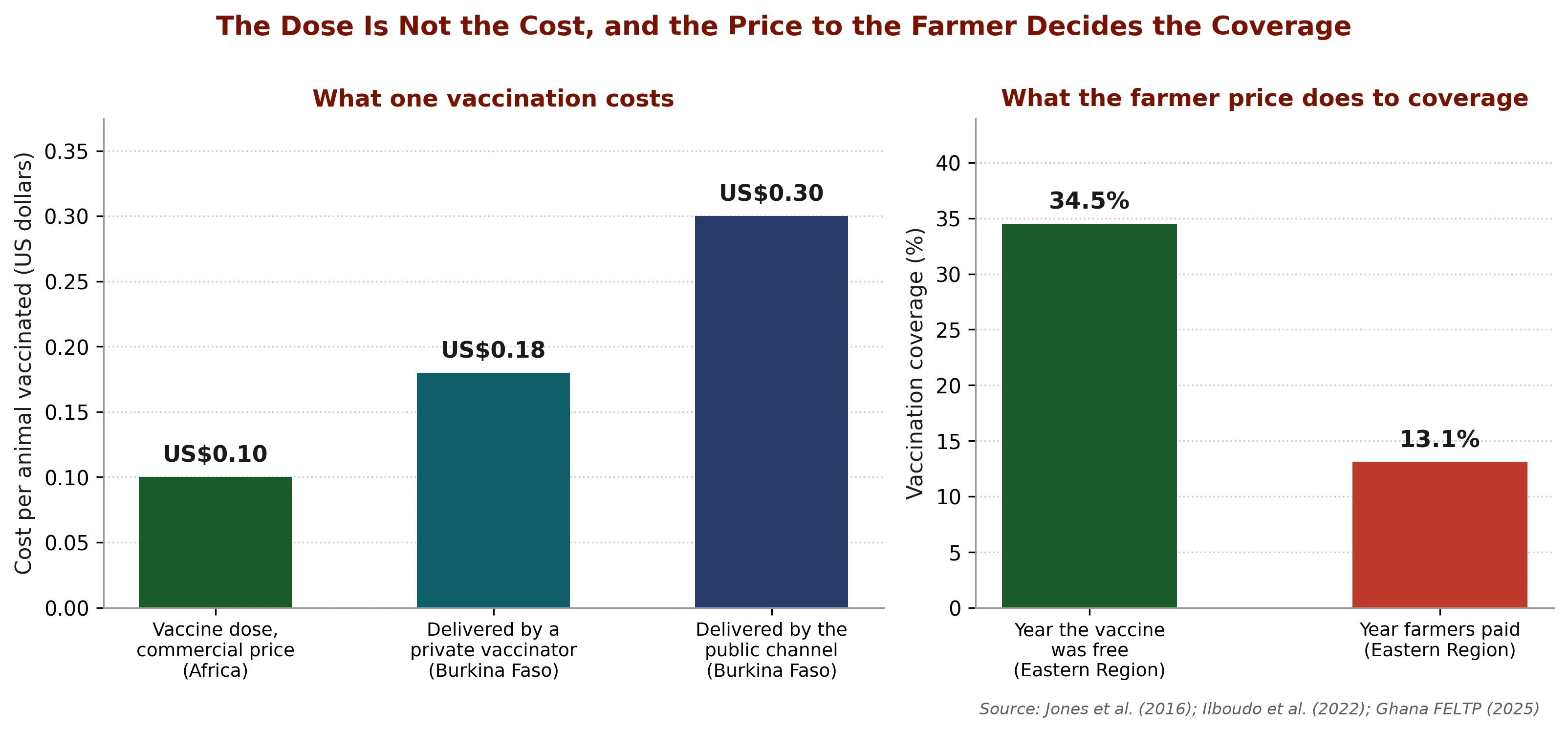
Coverage more than halved once farmers were charged. A conference abstract analysing surveillance data from the Eastern Region over 2020 to 2024 recorded 2,130 suspected cases there; goats carried 82.3 percent of recorded cases, 1,754 of 2,1306, and the same abstract found that vaccination is the decisive lever: in that region it reached 34.5 percent coverage in 2023, when the vaccine was free, but fell to 13.1 percent coverage in 2024, when farmers paid. What decides whether a flock is protected is the price at the point of use, not the price of the dose. PPR is the subject of a global eradication programme targeting 20307.

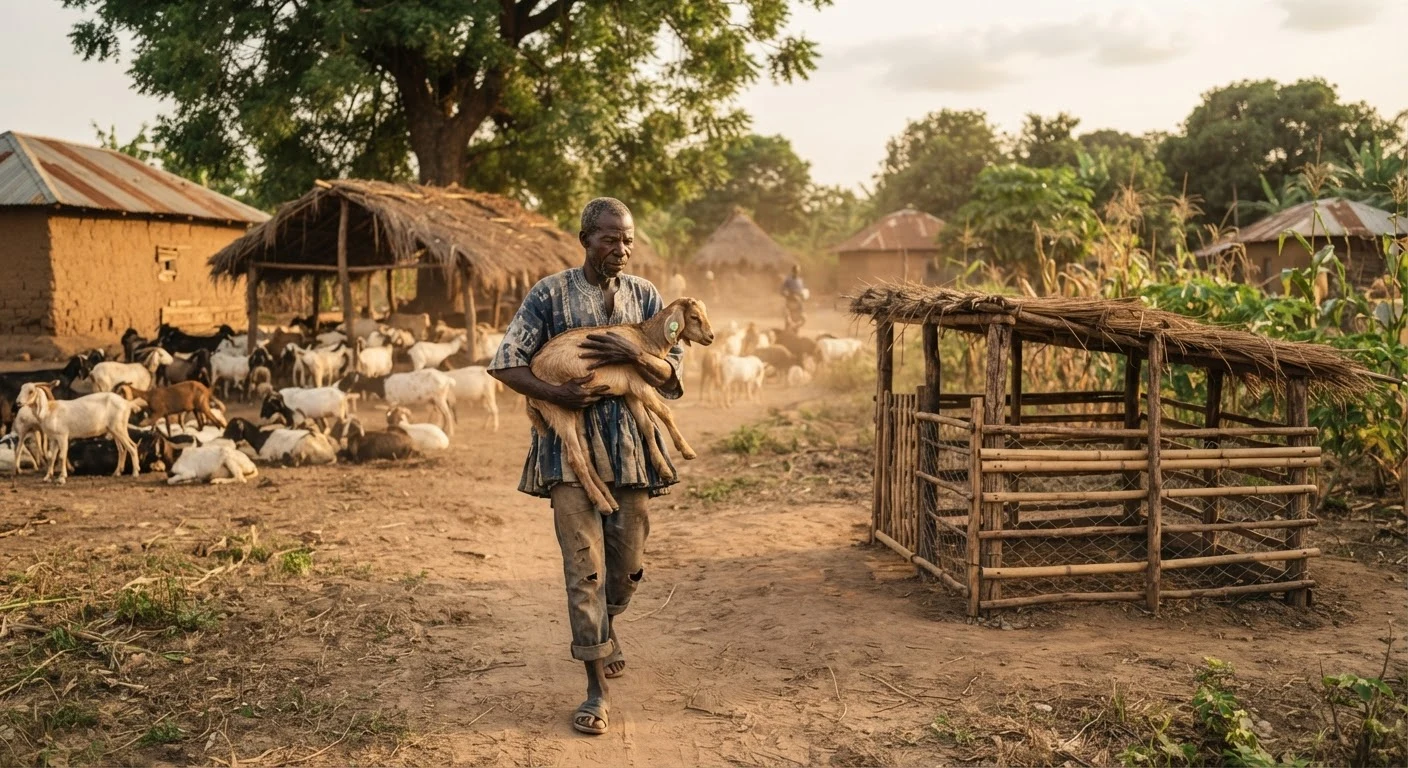
A farmer carrying a visibly weak goat to a separate small isolation pen away from the main flock, rural Ghana, documentary photograph
Goats carry most of the cases
82.3% of recorded cases: Eastern Region surveillance, 2020-2024.
US$0.10
cost of the PPR vaccine dose at commercial prices in Africa
34.5% to 13.1%
Eastern Region vaccination coverage, free (2023) versus farmer-paid (2024)
Two panels: PPR vaccine dose and delivery cost breakdown, and PPR vaccination coverage before and after farmers paid, Eastern Region, Ghana
Figure 3 Free vaccination more than doubles coverage, and the dose itself costs only cents
What this shows

The panels separate the cost of the vaccine from the cost of getting it into an animal, then show that neither decides coverage. The dose is about US$0.10 at commercial prices in Africa, while delivery measured in Burkina Faso costs US$0.18 privately and US$0.30 through the public channel, so most of the real cost is logistics rather than pharmacy. The right panel is Eastern Region surveillance: coverage more than halved the year farmers were charged. Every country label sits in a tick label because two of the three cost bars are not Ghanaian.

A private channel for exactly that access gap already operates in Ghana. Cowtribe, founded in Tamale in 2016, lets farmers subscribe by phone to a schedule of vaccinations and veterinary visits that a partner vet then delivers, priced from about US$3.27 per livestock unit, where one unit is one cow or ten goats or fifty chickens8, and had reached about 31,000 farmers on the customer base, of whom about 1,000 were paid subscribers by 2019. The International Livestock Research Institute was still partnering with it on vaccine delivery to women farmers in 20239, though its size today is not published.

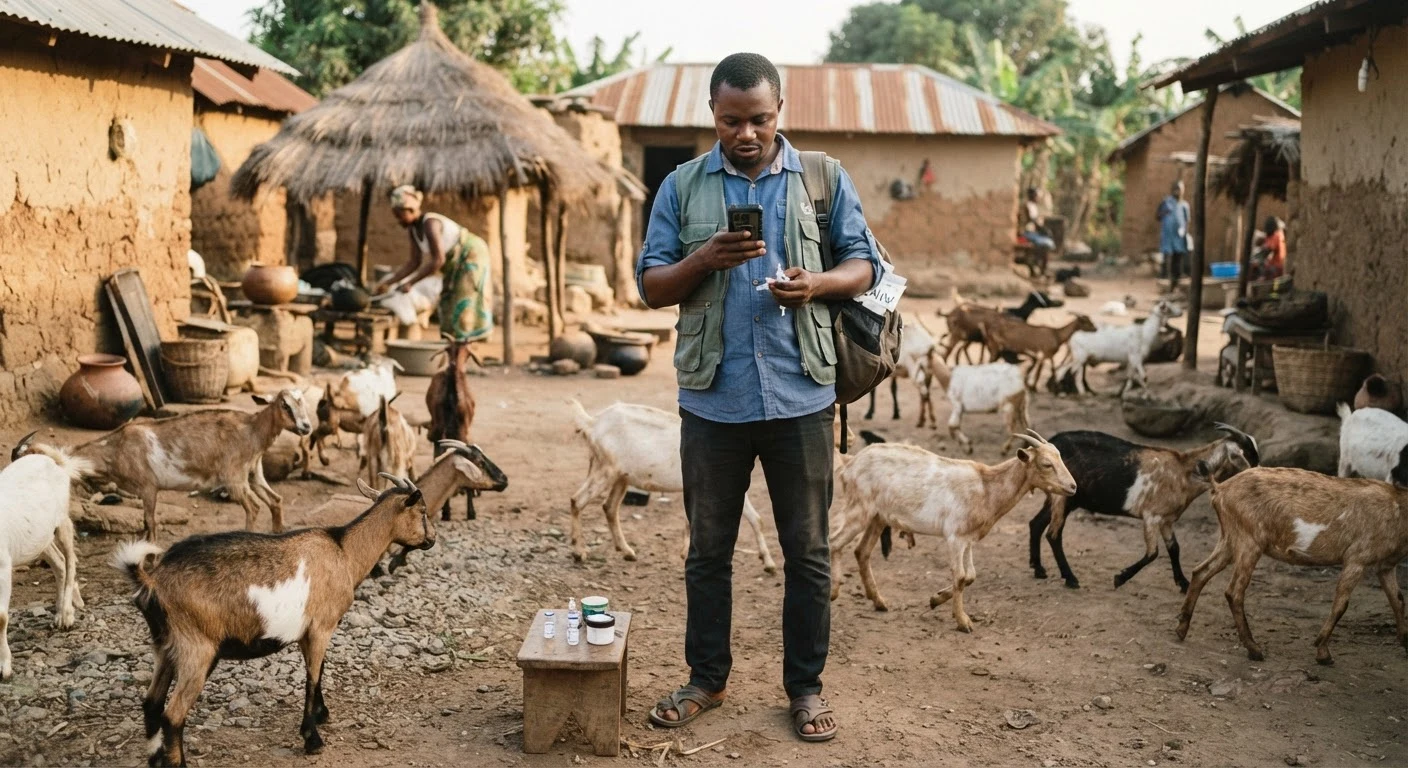
A community animal health worker in Ghana using a mobile phone to record a vaccination visit while goats mill around a rural compound, documentary photograph
US$3.27
Cowtribe's subscription price per livestock unit (1 cow = 10 goats = 50 chickens)
31,000
farmers on Cowtribe's customer base by 2019, about 1,000 paid subscribers

🐐 Worms, and the other diseases making the priority list 🐐

A farmer administering an oral dewormer drench to a goat using a dosing gun, in a fenced Ghanaian farmyard, documentary photograph
Cheap relative to what it protects
Routine deworming: the constant, unglamorous defence.
~52%
of cattle, sheep and goats sampled at one Techiman slaughterhouse carried gastrointestinal worms
98.2%
of 110 Djallonke sheep sampled at Ayeduase, Kumasi, carried gastrointestinal parasites

If PPR is the dramatic killer, internal parasitic worms are the constant drain. A study at the Techiman slaughterhouse, so far published only as a preprint, found gastrointestinal worms in about 52 percent of the cattle, sheep and goats sampled at one slaughterhouse10, most of them cattle. The sheep-and-goat picture is worse, not better: a study of Djallonke sheep at Ayeduase in Kumasi, in the forest zone, found gastrointestinal parasites in 98.2 percent of 110 Djallonke sheep sampled, with strongyle nematodes in 94.5 percent11and coccidia in a further 51.8 percent.

Worms rarely kill outright, but they slow growth, lower fertility and weaken animals so that other diseases finish them. Alongside worms sit contagious caprine pleuropneumonia and the pneumonia complex, mange and other skin parasites, foot rot and orf. A recent review of small-ruminant diseases across sub-Saharan Africa lists this same set as the priority problems for smallholders, and the practical defence is the same everywhere: routine deworming, vaccination, clean dry housing and quick separation of sick animals121314.

Table 5: The Main Health and Risk Threats, and What to Do
ThreatEffectManagementCost signal
PPR (kata)Endemic; about half the animals in an affected herd a year; the disease farmers most often name as the cause of recent deathsVaccinate on a calendar; the decisive leverAbout US$0.10 per animal
Internal worms (helminths)Found in about half of the mostly-cattle animals sampled at one abattoir and in 98.2 percent of Djallonke sheep sampled in Kumasi; slow growthRoutine deworming, pasture rotationLow per dose; high if ignored
CCPP and pneumoniaRespiratory deaths, especially in youngVaccination, dry housingModerate
Mange and skin parasitesWeight loss, hide damageDipping, treatmentLow
Theft and predationDirect loss of stockNight housing, herding, guardingLoss avoidance
Dry-season feed shortageWeight loss, weak breedingFodder storage, supplementationFeed cost vs weight loss

Sources: Nuvey et al. (2023), whose 10 percent is all-cause disease mortality across all ruminants kept, not PPR's own rate; Jones et al. (2016); Yaawie et al. (2025), Eastern Region only, so not a national rate; Dwaah et al. (2025), a preprint whose sample is 85 percent cattle; Owusu et al. (2016); Kimeli et al. (2025).

Most of these losses are preventable. The keepers who vaccinate, deworm and house their animals well out-survive and out-earn those who do not.

🐐 Mortality, theft and the weather 🐐

Even without an outbreak, ordinary losses are heavy. Mortality runs at 32.3 percent in goats and 20.4 percent in sheep in the traditional system15, figures the policy document itself attributes to a 2008 count and sets against post-weaning mortality of 0.2 to 3.3 percent on the ministry’s own breeding stations under improved management, which is the size of the prize. Roughly one kid in five dies before weaning, and it has hardly moved in thirty years: 22 percent mortality on a station trial16 and 79.9 percent survival on 675 Accra Plains records to 201217. For survival to a full year the nearest monitored series is Nigerian and old, with only about 55 percent of lambs and kids surviving to one year in monitored humid-zone flocks in Nigeria, with 20 to 30 percent dying before weaning.

Theft is a serious problem: in northern studies, losses to mortality and theft together wiped out more than half of the market benefit that flocks would otherwise have produced18. The dry season strips the natural grazing and the dry-season feed gap weakens animals just as the festival demand builds. Climate change is making the dry north significantly hotter, with more variable rainfall, though the same projection has the northern half of the country becoming wetter rather than drier19. It is often assumed this is pushing northern households out of cattle and into small ruminants. Do not build a plan on that; it is unproven.

The profit is in the survival rate.Annual mortality runs at 32.3 percent of the flock in goats and 20.4 percent in sheep, and disease and theft together can erase more than half a flock’s potential value. That is not a market problem; it is a management problem, and it is where the money leaks out. A keeper who vaccinates against PPR, deworms on a calendar, houses animals at night against theft and the weather, and stores dry-season feed will lose far fewer animals than the casual majority. In a sector where most keepers do none of these things well, basic animal health is the cheapest and surest way to out-earn the competition.

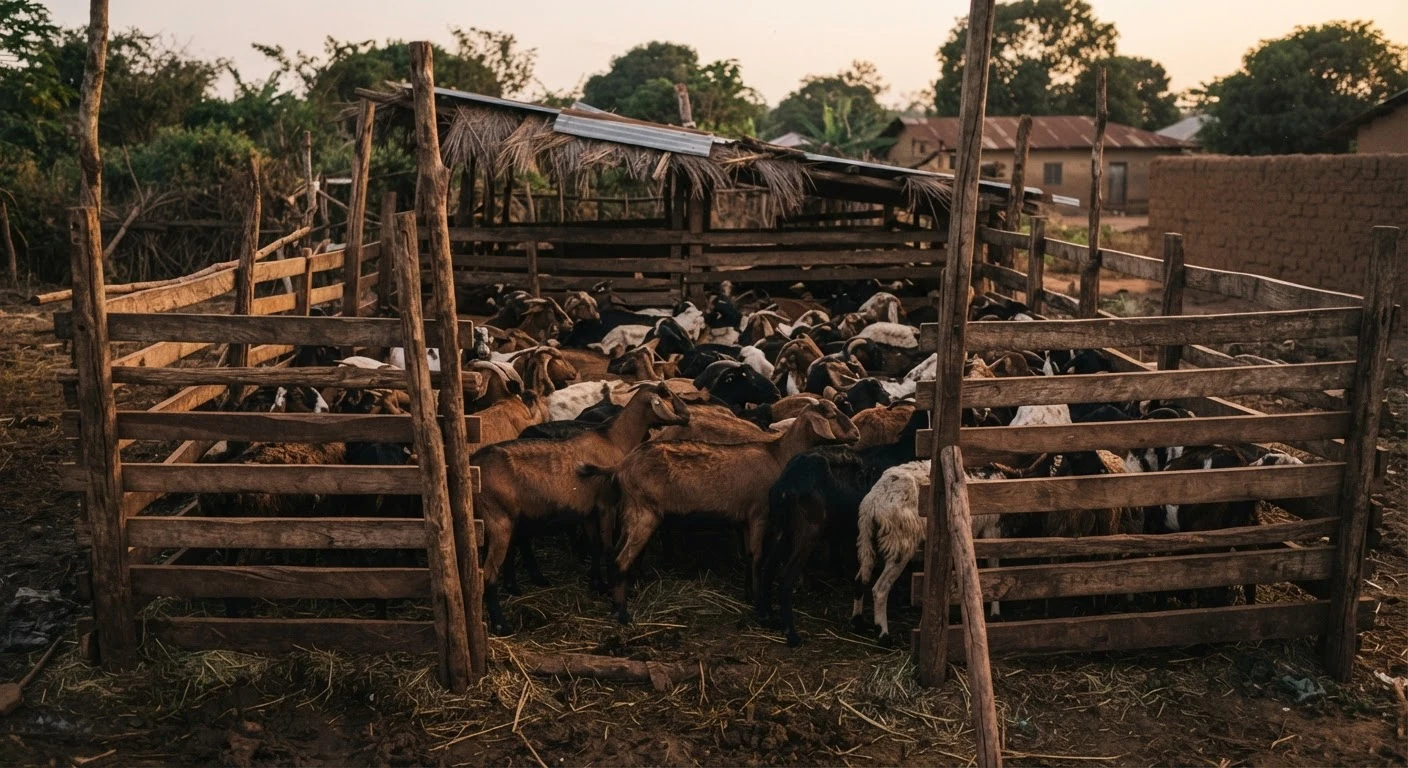
A simple wooden night housing pen crowded with goats and sheep at dusk on a small Ghanaian farm, documentary photograph
Against theft and the weather
Night housing: one fix for two different risks.
32.3%
annual goat mortality, traditional system
20.4%
annual sheep mortality, traditional system
0.2-3.3%
post-weaning mortality on improved-management breeding stations
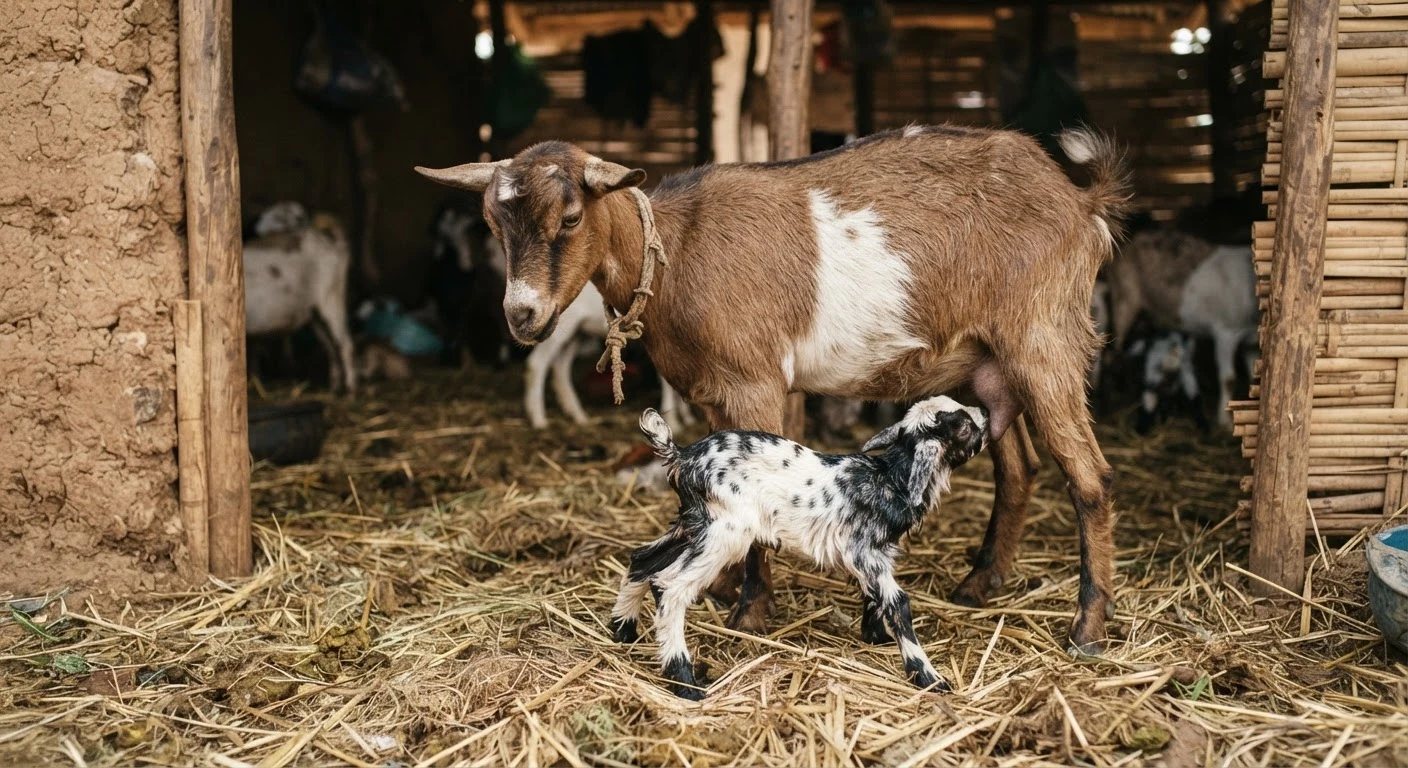
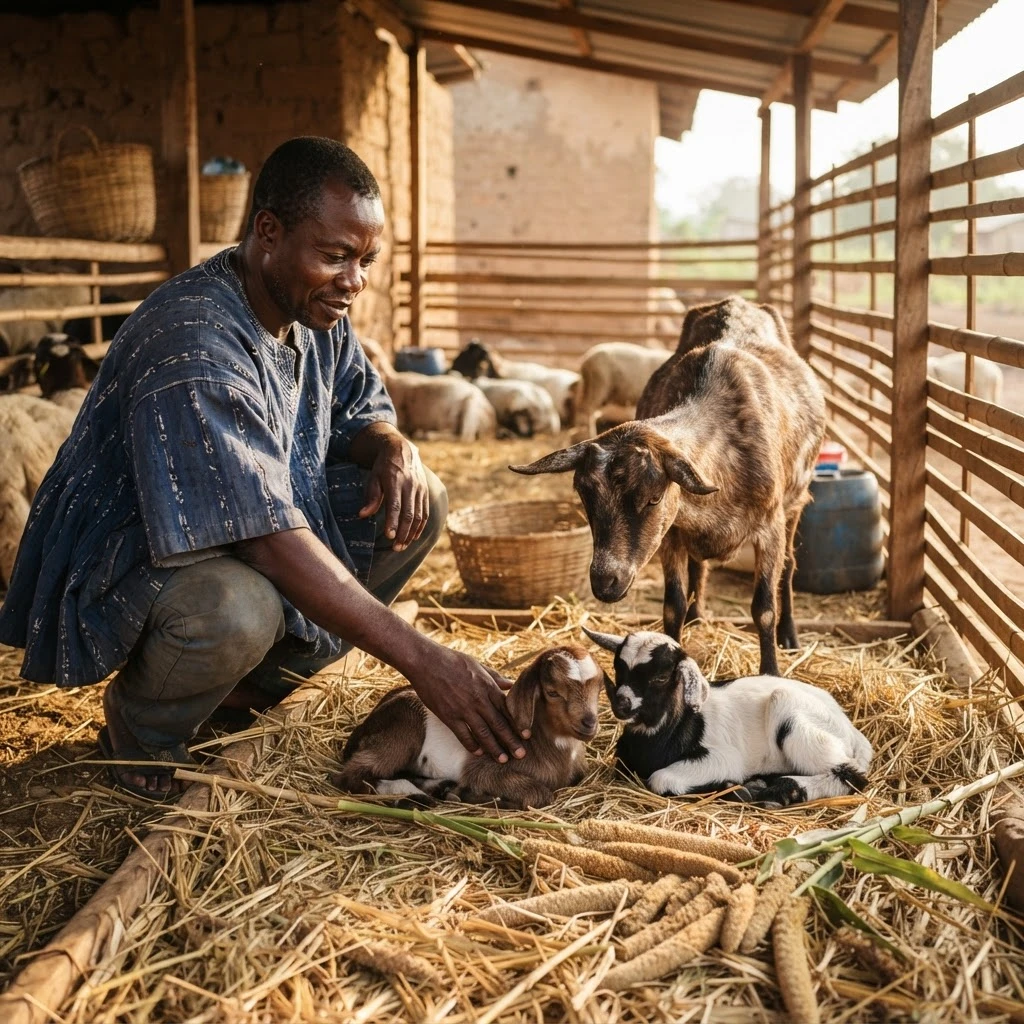
A newborn kid goat suckling from its mother in a straw-lined shelter on a Ghanaian farm, documentary photograph

🐐 The risks that sit inside the health and biosecurity decision 🐐

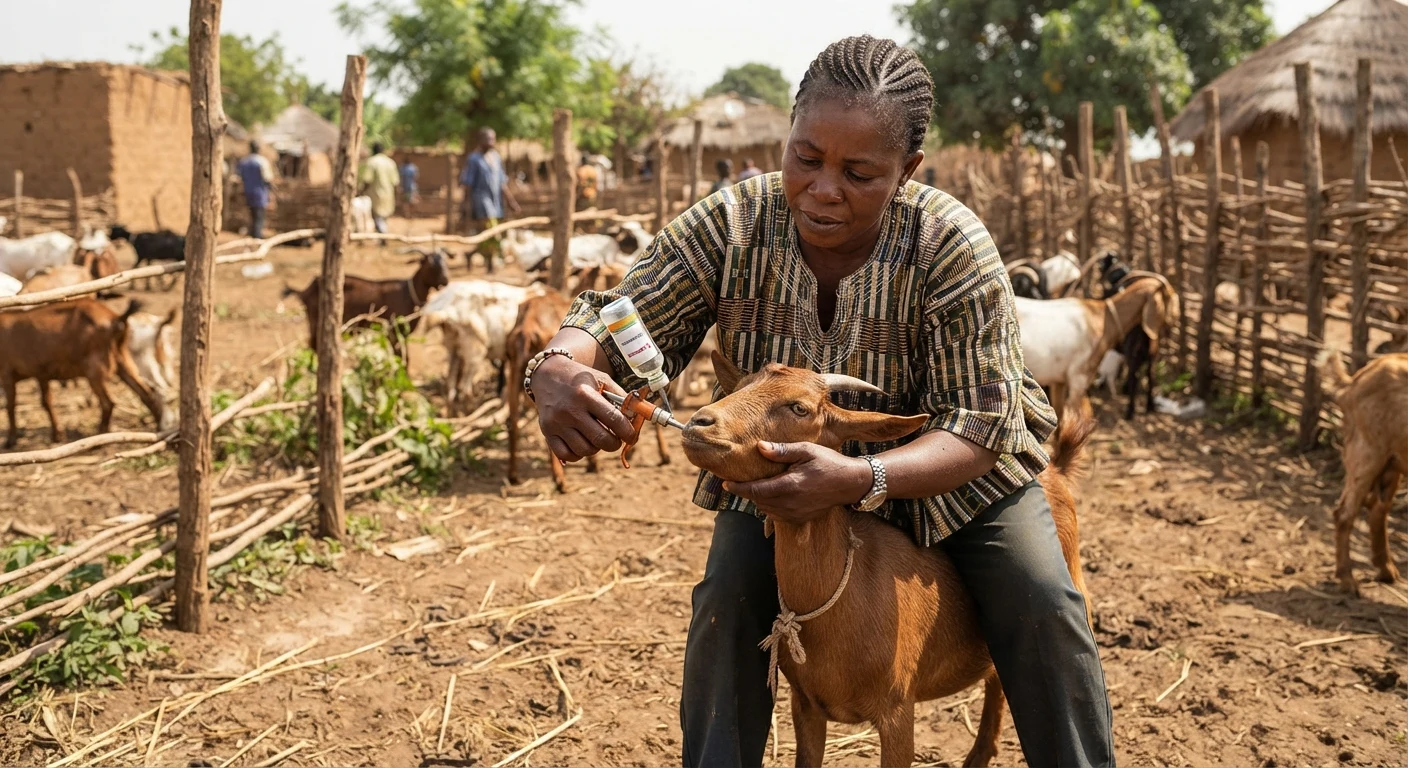
A veterinary worker giving a goat a vaccination injection while a farmer holds it steady, rural Ghana, documentary photograph

Peste des petits ruminants (PPR, or kata)

VERY HIGH
What it is

A fast-spreading viral disease of goats and sheep, endemic in Ghana and the single biggest named killer in the sector.

Evidence

Farmers put PPR at about half the animals in an affected herd in a farming year, and it is named by 40 percent of farmers as the likely cause of their most recent losses; those farmers reported losing an average 10 percent of the ruminants they keep to disease of all kinds over twelve months, an all-cause figure rather than PPR’s own20. Within a flock it has actually reached, mortality runs at a median 13.2 percent; the 90 percent sometimes quoted is the ceiling for the worst situations recorded anywhere, and that source notes it may be lower where the disease is endemic, as it is in Ghana21. In Eastern Region surveillance for 2020 to 2024, goats carried 82.3 percent of recorded cases, and vaccination coverage fell from 34.5 percent in 2023, when the vaccine was free, to 13.1 percent in 2024, when farmers paid. Those are regional figures and do not stand in for a national rate22.

Who it hits

Every keeper, but hardest the smallholder with no health plan, who now loses a share of the flock every year rather than occasionally. Goats more than sheep.

How to manage it, and the opening

Vaccinate on a calendar, not only after a scare. The vaccine costs only about US$0.10 a dose, though delivery has been costed at US$0.18 to US$0.30 an animal in Burkina Faso23, so the barrier is access and cost-sharing, not the pharmacy price. Use free or subsidised vaccine where available, separate sick animals fast, and quarantine new stock.

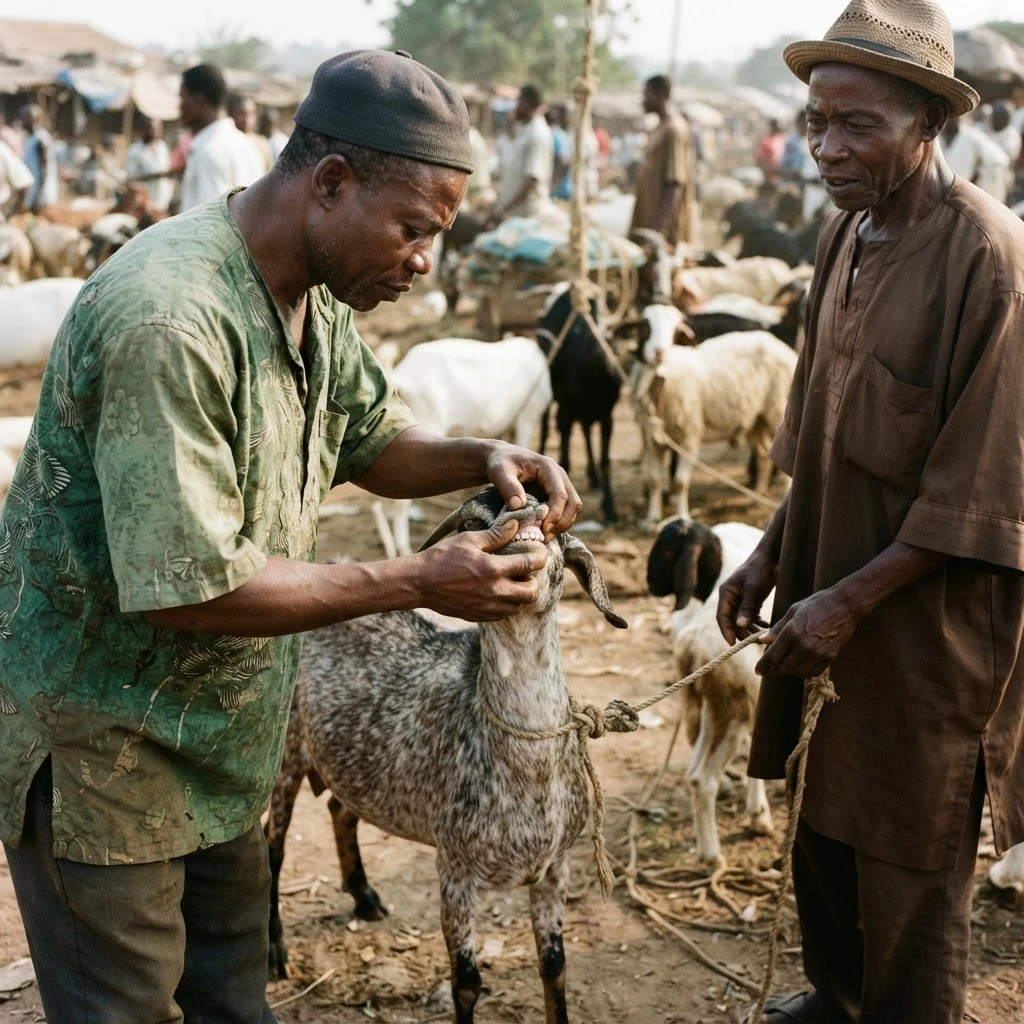
A farmer inspecting a goat closely by a fence in a Ghanaian farmyard, documentary photograph

Internal parasites (worms)

HIGH
What it is

Gastrointestinal worms are everywhere and quietly drain the flock: they slow growth, lower fertility and weaken animals so other diseases finish them.

Evidence

Gastrointestinal worms were found in about 52 percent of the cattle, sheep and goats sampled at one slaughterhouse, a preprint whose sample is 85 percent cattle, and in 98.2 percent of Djallonke sheep sampled at Ayeduase in Kumasi. Strongyle worms are the dominant parasite of Ghanaian flocks2425.

Who it hits

All flocks, especially young stock and animals on wet, overgrazed pasture. The loss is slow and easy to miss.

How to manage it, and the opening

Deworm on a calendar, not only when animals look sick; rotate or rest pasture where possible; keep housing dry. Routine deworming is cheap relative to the growth and fertility it protects.

A farmer crouching among several goats and young kids in a fenced pen, rural Ghana, documentary photograph

Young-stock mortality

HIGH
What it is

Ordinary death of kids and lambs before weaning, from disease, poor nutrition, cold or neglect. The biggest quiet drain on a breeding flock.

Evidence

Mortality runs at 32.3 percent in goats and 20.4 percent in sheep in the traditional system. Ghanaian pre-weaning survival sits near four fifths, on a 1980 station trial and 675 Accra Plains records to 2012; the nearest monitored survival-to-one-year series is Nigerian, at about 55 percent of lambs and kids surviving to one year, with 20 to 30 percent dying before weaning. Losses to mortality and theft together can erase more than half of a flock's market benefit.

Who it hits

Breeding flocks above all: every kid or lamb lost is lost flock growth and income.

How to manage it, and the opening

Keep young stock alive: shelter against cold and rain, ensure the dam is fed and the kid suckles early, deworm and vaccinate, and house at night. Record deaths by age and month, since the district figure does not yet exist. Survival is where a breeding business is won or lost.

A Ghanaian farmer checking a goat's health by a fence at a rural farmstead, no vaccination record in hand, documentary photograph
🐐 Openings: where animal health pays 🐐
01

Subscription animal health, on the Cowtribe model. Coverage more than halved the year farmers were charged for PPR vaccine, which is a signal about timing and cash flow rather than about willingness to pay. A small regular subscription that removes the lump-sum moment is the answer already proven in this country.

02

Quarantine and resale yards. This pillar tells a buyer to purchase in small lots and quarantine every new animal, and almost no buyer can do that. A yard that holds, observes and certifies incoming stock for two weeks is selling exactly the risk reduction the chain needs and cannot produce for itself.

03

Vaccination-day logistics. The dose costs about ten US cents and delivery has been costed at two to three times that elsewhere in West Africa, so the expense is the round, not the vial. Whoever aggregates enough animals into one round makes the economics work for a vet who currently cannot justify the trip.

04

The digital and AI angle. The feasible AI here is a reminder engine, not a diagnosis engine. Vaccination and deworming are calendar problems, and a service that holds each flock's dates and sends the prompt by SMS needs no model at all to begin. Image-based diagnosis of skin and eye conditions is real elsewhere but has no Ghanaian small-ruminant training set behind it, so treat it as a later phase built on the records the reminder service generates.

🐐 Key takeaways 🐐
01

Keeping animals alive, not selling them, is the hardest part of the business; disease and young-stock death drain more value than low prices.

02

PPR (kata) is endemic and chronic rather than an occasional wipeout: it reaches about half the animals in an affected herd a year and is the disease farmers most often name as the cause of their recent deaths, out of an average tenth of the ruminants they keep lost to disease of all kinds each year, with a median 13.2 percent of an affected flock lost. In Eastern Region surveillance, goats carried 82.3 percent of recorded cases and coverage more than halved the year farmers were charged, 34.5 percent in 2023 against 13.1 percent in 2024, on regional figures that do not stand in for a national rate.

03

The PPR dose costs about US$0.10, but delivering it has been costed at US$0.18 to US$0.30 an animal in Burkina Faso, so access and cost-sharing, not price, are the barrier.

04

Internal worms infect about half of the cattle, sheep and goats sampled at one slaughterhouse and 98.2 percent of Djallonke sheep sampled in Kumasi, and quietly cut growth and fertility; routine deworming is the defence.

05

Annual mortality of 32.3 percent in goats and 20.4 percent in sheep, against 0.2 to 3.3 percent post-weaning on the ministry's own breeding stations, plus theft and dry-season feed gaps, mean survival management is the surest route to out-earning the market; the only Ghanaian pre-weaning figure is a 22 percent station mortality recorded in 1980 and again on 675 records kept to 2012.

Written for each reader

🐐 Practitioner intelligence 🐐

Hover any card to pause and lift it.

For students

If you are thinking of entering, budget for a vaccination and deworming calendar before you budget for animals: it is a smaller sum than most first-timers expect, and it is the single spend that decides whether a flock survives its first year. The first-timer mistake is buying stock cheaply because it looks thin or unwell, then losing it within weeks. If you have no capital for a flock yet, offer a paid deworming and vaccination round to neighbours' flocks first: it builds the health judgement and the local reputation a keeper needs before owning animals at scale.

For entrepreneurs

Make animal health your first investment, not an afterthought. Budget for PPR vaccination, a deworming calendar and night housing from day one; these cost little and prevent the losses that sink most flocks. If you can keep survival high in a market where most cannot, you will out-earn larger but poorly managed competitors.

For investors

Underwrite the survival rate before the herd size. A business plan that assumes low mortality without a funded health and housing system is not credible. The strongest investments pair a flock with a veterinary and feeding protocol; the cheap PPR vaccine and routine deworming are high-return spending.

For ecosystem actors

The single highest-return public action in the sector is free or subsidised PPR vaccination delivered at scale, given the evidence that free vaccine more than doubled uptake. Pair it with accessible veterinary services and theft prevention, and channel both through the Feed Ghana Programme.

Where this connects.The health risk of buying stock blind, priced here, is what Pillar 1 argues against when it says to buy in small lots from named sources and quarantine every new animal. Night housing appears here as a disease and weather measure and again in Pillar 4 as the same fix for theft, its highest-return use on the farm. What survival is worth in cedis, and who captures the value a sick or thin animal loses before it reaches market, is carried through Pillar 5’s costs and Pillar 6’s value chain.

Footnotes
  1. Center for Food Security and Public Health, Peste des petits ruminants, Iowa State University College of Veterinary Medicine (2024, July), accessed 29 July 2026, https://www.cfsph.iastate.edu/Factsheets/pdfs/peste_des_petits_ruminants.pdf.
  2. Nuvey et al., "Management of diseases" (2023).
  3. Jones, B. A., Rich, K. M., Mariner, J. C., Anderson, J., Jeggo, M., Thevasagayam, S., Cai, Y., Peters, A. R., and Roeder, P, "The economic impact of eradicating peste des petits ruminants: A benefit-cost analysis," PLOS ONE 11(2), e0149982 (2016), https://doi.org/10.1371/journal.pone.0149982.
  4. World Organisation for Animal Health, and Food and Agriculture Organization of the United Nations, Global strategy for the control and eradication of peste des petits ruminants, FAO and OIE (2015), https://openknowledge.fao.org/.
  5. Dundon, W. G., Diallo, A., and Cattoli, G, "Peste des petits ruminants in Africa: A review of currently available molecular epidemiological data," Archives of Virology 165, 2147-2163 (2020), https://doi.org/10.1007/s00705-020-04732-1.
  6. Yaawie, T., Asante, R. A., Dapaa, S., Akowuah, G., Bosoka, S., Odikro, M., Adetor, E., Seidu, J., Abdullah, S. J., and Sackey, S, "Analysis of peste des petits ruminants surveillance and vaccination coverage data, Eastern Region, Ghana," Journal of Interventional Epidemiology and Public Health 9(ConfProc7), Abstract 012 (2026), https://doi.org/10.37432/JIEPH-CONFPRO7-0012. Proceedings of the 8th Ghana Field Epidemiology and Laboratory Training Programme Scientific Conference, Accra, 10 to 11 December 2025.
  7. Food and Agriculture Organization of the United Nations, and World Organisation for Animal Health, Peste des petits ruminants global eradication programme: Contributing to food security, poverty alleviation and resilience, Five years (2017 to 2021) (2016), https://www.woah.org/app/uploads/2021/03/en-gep-ppr-finalweb.pdf. The imprint page reads Rome, 2016 and the copyright line reads FAO and OIE, 2016; the 2021 in the file name and web address is the programme's end year and the site's upload date, not the publication year.
  8. Idris, A, Meet Cowtribe, the startup aiming to solve Africa's animal vaccination problem, TechCabal (2019, 21 October), https://techcabal.com/2019/10/21/meet-cowtribe-the-startup-aiming-to-solve-africas-animal-vaccination-problem/.
  9. Kimani, J., and Galie, A, ILRI research project in Ghana is identifying approaches that benefit women in vaccine delivery, International Livestock Research Institute (2023, 2 March), https://www.ilri.org/news/ilri-research-project-ghana-identifying-approaches-benefit-women-vaccine-delivery.
  10. Dwaah, P. K., Awua-Boateng, N. Y., Djang-Fordjour, H., Bakyaayele, S., and Mohammed, A-N, Epidemiological assessment of gastrointestinal parasites in livestock at Techiman Slaughterhouse, Ghana: A One Health perspective, Research Square (Preprint) (2025), https://www.researchsquare.com/article/rs-8117981/v1.
  11. Owusu, M., Sekyere, J. O., and Adzitey, F, "Prevalence and burden of gastrointestinal parasites of Djallonke sheep in Ayeduase, Kumasi, Ghana," Veterinary World 9(4), 361-364 (2016), https://doi.org/10.14202/vetworld.2016.361-364.
  12. Kimeli, P., Mwacalimba, K., Tiernan, R., Mijten, E., Miroshnychenko, T., and Poulsen Nautrup, B, "Important diseases of small ruminants in sub-Saharan Africa: A review with a focus on current strategies for treatment and control in smallholder systems," Animals 15(5), 706 (2025), https://doi.org/10.3390/ani15050706.
  13. Challaton, K. P., Boko, K. C., Akouedegni, C. G., Alowanou, G. G., Kifouly, A. H., and Hounzangbe-Adote, M. S, "Common infectious and parasitic diseases in goats of tropical Africa and their impacts on production performance: A review," World's Veterinary Journal 13(3), 425-440 (2023), https://doi.org/10.54203/scil.2023.wvj47.
  14. Nuvey et al., "Management of diseases" (2023).
  15. Ministry of Food and Agriculture, Livestock development in Ghana (c. 2016).
  16. International Livestock Centre for Africa, Small ruminants (1980).
  17. Hagan et al., "Effects of non-genetic factors" (2014).
  18. Adams, F., Ohene-Yankyera, K., Aidoo, R., and Wongnaa, C. A, "Economic benefits of livestock management in Ghana," Agricultural and Food Economics 9, 17 (2021), https://doi.org/10.1186/s40100-021-00191-7.
  19. Desjonqueres, C., Zhao, H., Kosmidou-Bradley, W., and Corral, P, Ghana's climate vulnerability profile, World Bank (2024, May).
  20. Nuvey et al., "Management of diseases" (2023).
  21. Jones et al., "The economic impact of eradicating" (2016).
  22. Yaawie et al., "Analysis of peste des petits" (2026).
  23. Ilboudo, G. S., Kane, P. A., Kotchofa, P., Okoth, E., Maiga, A., and Dione, M, "Cost estimates of peste des petits ruminants vaccination programme in Burkina Faso," Animals 12(16), 2152 (2022), https://doi.org/10.3390/ani12162152.
  24. Dwaah et al., Epidemiological assessment of gastrointestinal parasites (2025).
  25. Owusu et al., "Prevalence and burden of gastrointestinal" (2016).
Download full PDF
UpcomingThis document isn't available yet.