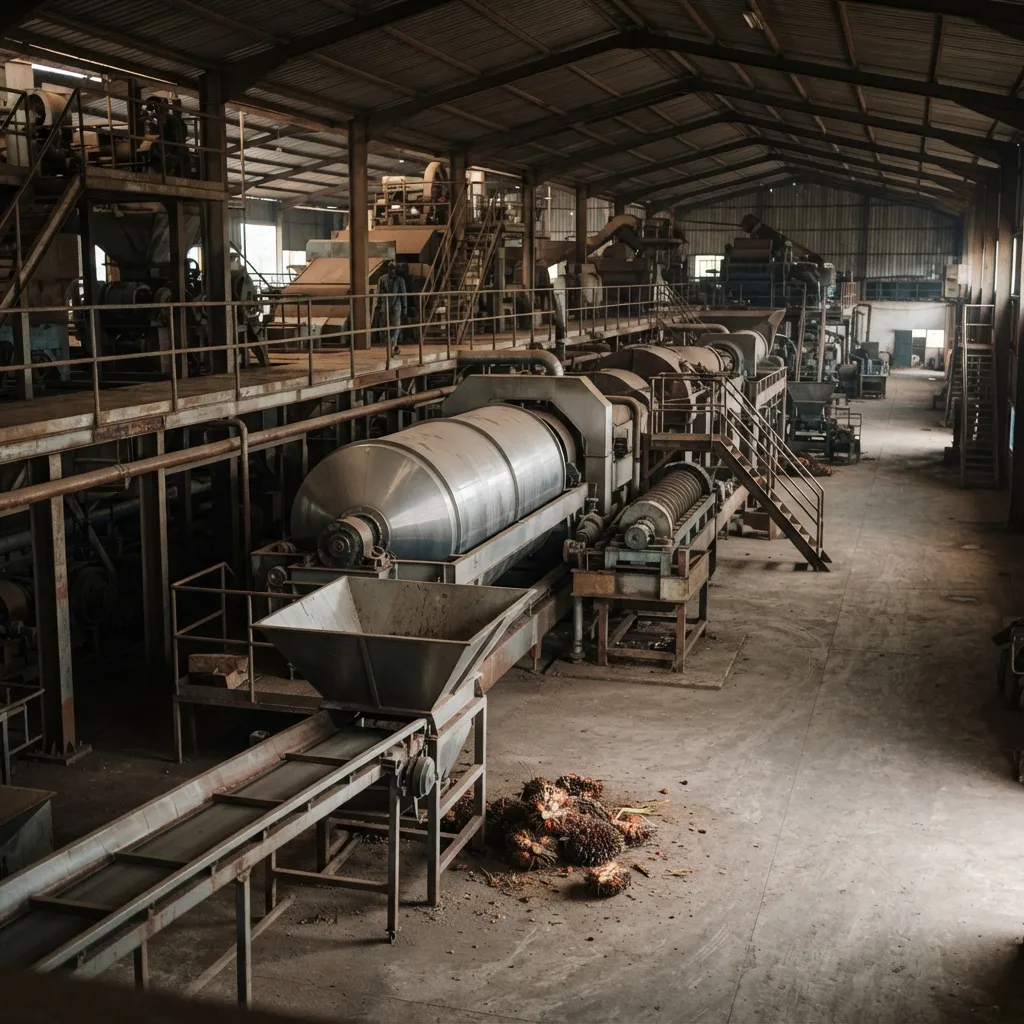
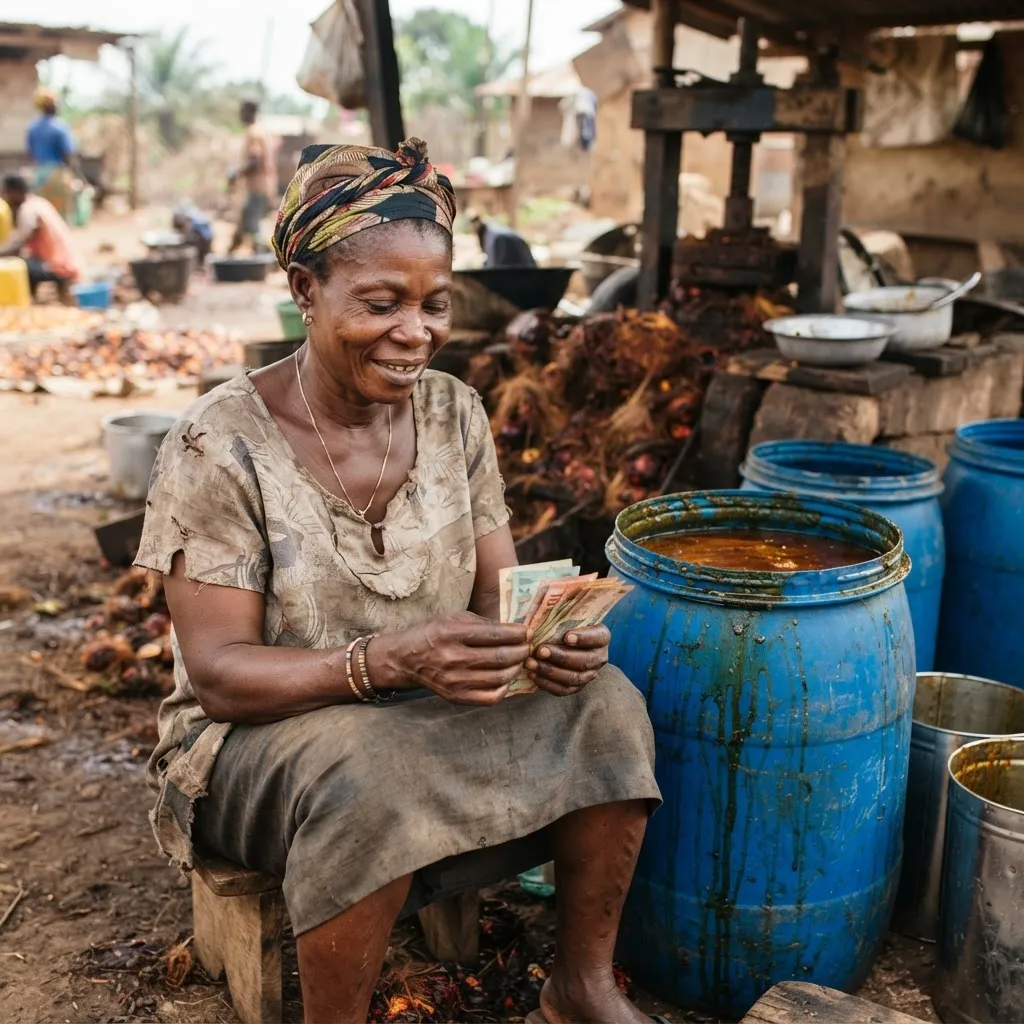
If you are entering with little money, the numbers point to a service, not an asset. The highest-return move in the crop is lifting extraction and cutting the cost leaks, and that is knowledge work: mill assessment, quality testing, cost analysis, aggregation. Learn to read a simple cost-and-returns model and you can advise a mill or a cooperative on the very cuts this pillar maps. The mistake first-timers make is buying the asset before they understand its economics; understand the economics and you can be paid to improve everyone else's.
This is the pillar that turns everything before it into cash. It sets out the three ways to make money in oil palm, what each costs, and what each returns. It then does the thing most guides skip, a plain cost-cutting analysis of where a Ghanaian palm oil business bleeds money and how to stop it.

🌴 Three ways in, three very different cheques 🌴

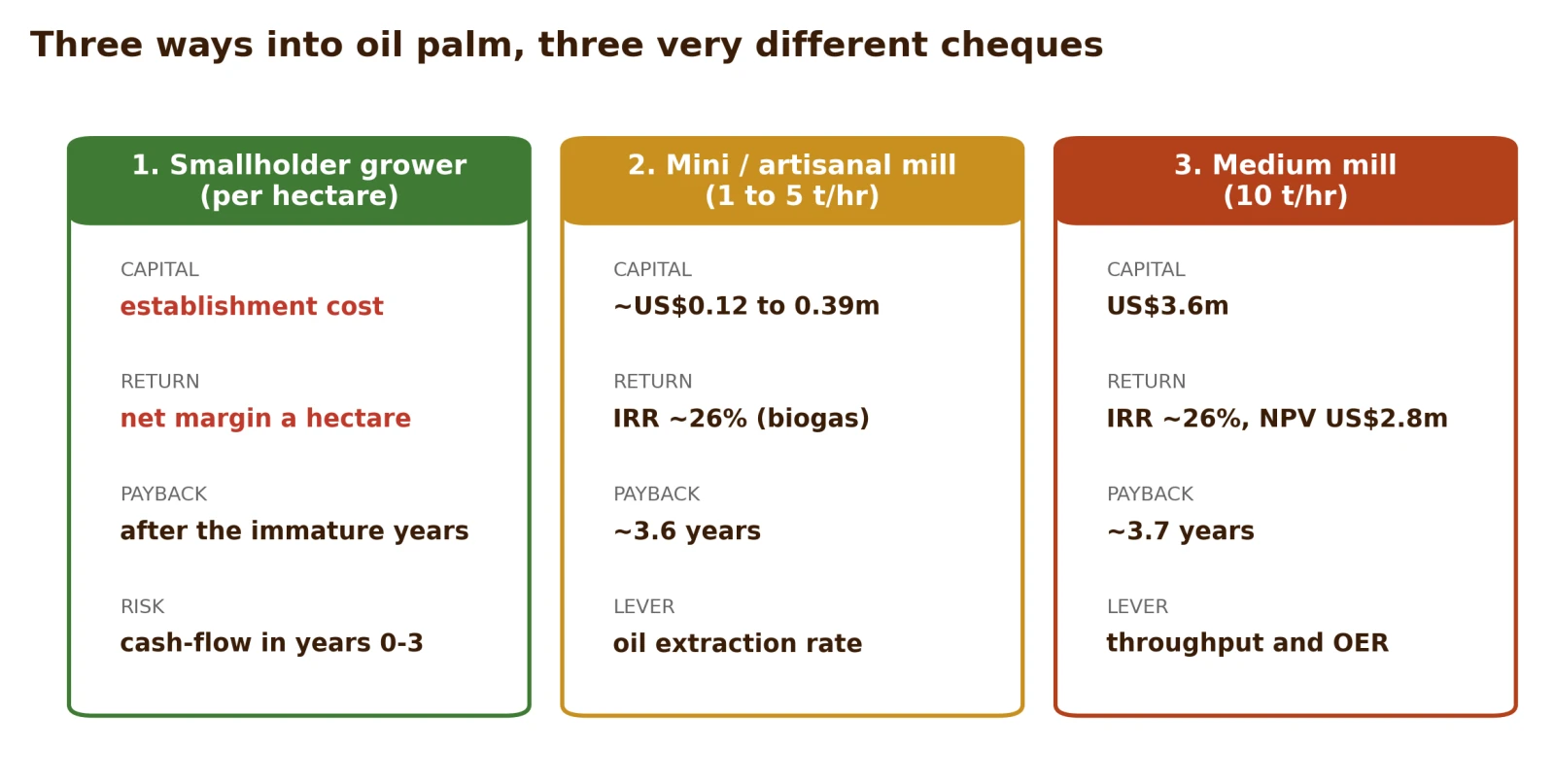
The three main ways into oil palm need very different amounts of money and patience, but the returns can be similar. The cheapest routes in, service and aggregation, are also the ones this playbook rates most highly.
There is no single oil palm business. There are at least three, and they need very different amounts of money, patience and skill. A smallholder grows fresh fruit bunches and sells them. A mini-mill buys bunches and squeezes out oil. A medium mill does the same at industrial scale. The returns can be similar; the cheques are not.
The mill numbers are real and recent. A medium, 10-tonne-an-hour mill in Ghana was modelled at a capital cost of about US$3.6 million, an internal rate of return of about 26 percent and a payback of about 3.7 years (GSOPP, 2019). A smallholder-scale mill returns about 26 percent on a biogas system, or about 40 percent on the diesel variant of the same Nigerian study (Anyaoha & Zhang, 2022). The grower's return, by contrast, is a per-hectare margin that only turns positive after the immature valley of Pillar 4.
🌴 Ghana makes palm oil dear, and that is the opportunity 🌴
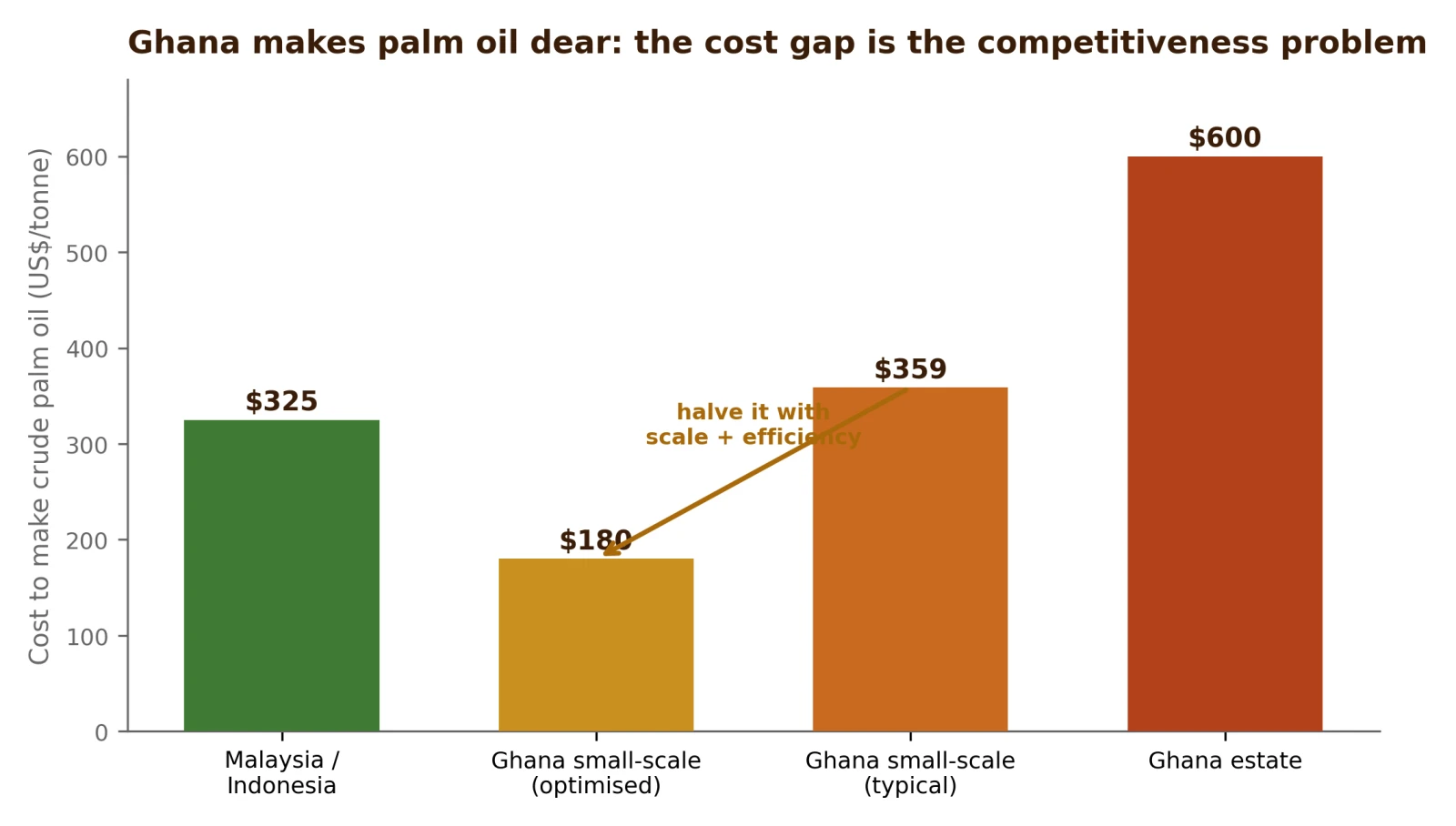
Before counting profit, count cost, because Ghana has a cost problem. A typical small-scale Ghanaian mill spends about US$359 to make a tonne of crude palm oil, and an estate about US$600, against roughly US$300 to 350 in Malaysia and Indonesia (MASDAR, 2011). That gap is why imported oil keeps undercutting local oil on price.
But the same source shows the way out. Doubling a small mill's output roughly halves its unit cost, to about US$180 a tonne. Ghana's high cost is not fate. It is low extraction, sub-scale mills, costly transport and expensive finance, every one of which can be cut.
Inside those costs, the pattern is consistent. For a miller, the fresh fruit bunch itself is about 70 percent of the running cost and labour about 20 percent (Djokoto & Zigah, 2021). At the GSOPP mill, bunches cost about US$102 a tonne and the milling about US$42 a tonne of crude palm oil (GSOPP, 2019). The one measured Ghana processor study found a gross margin of about GH¢197 a batch, almost all of it from the oil.

A typical small-scale Ghanaian mill costs about twice a Malaysian one to run. Doubling output roughly halves the unit cost, to about US$180 a tonne (MASDAR, 2011). The high cost is the opportunity, not the verdict.
🌴 The six cost leaks, and the fix for each 🌴
Every leak below is a cost a Ghanaian operator carries and a competitor does not. Fixing them is the difference between a business that survives on subsidy and one that stands on its own.
| Where the money leaks | What it costs | The fix | The prize |
|---|---|---|---|
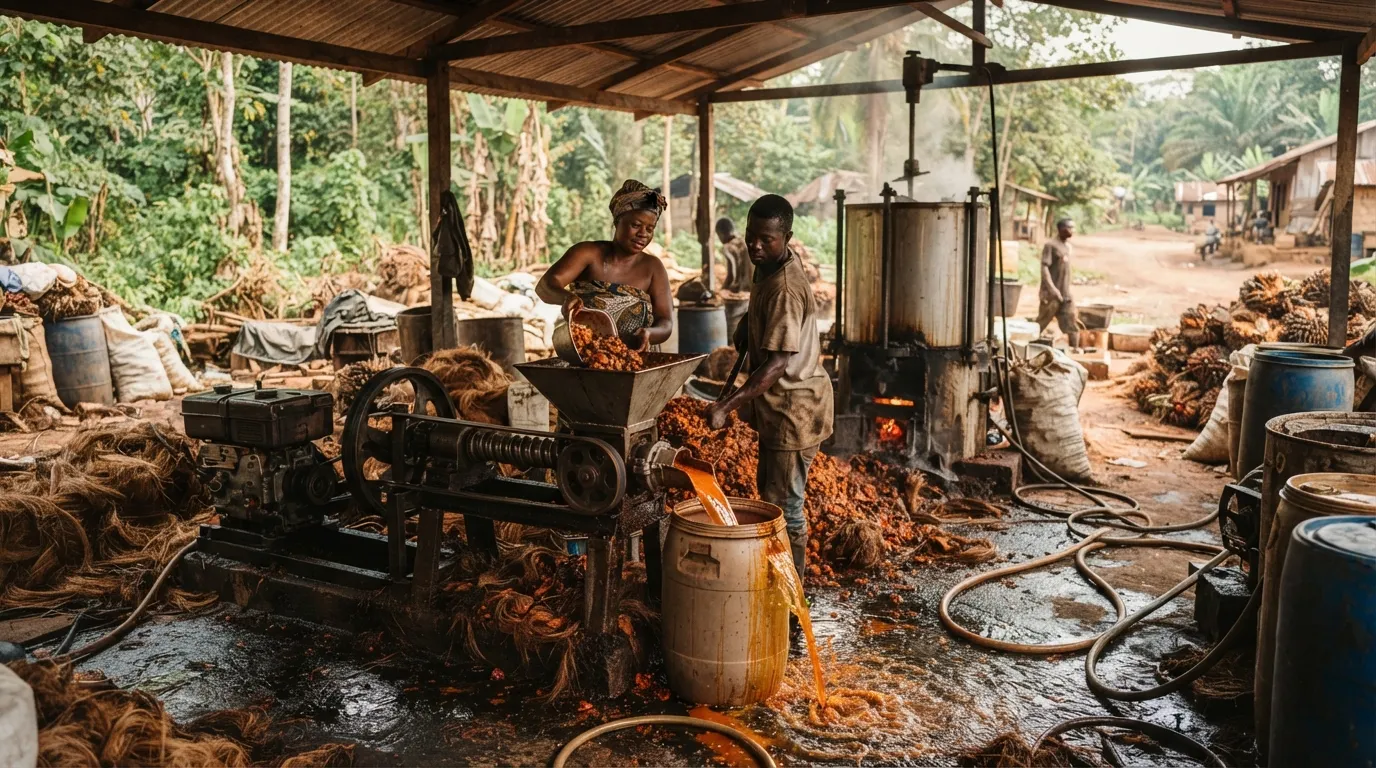
| Low oil extraction | artisanal mills leave half the oil in the fibre (about 11% out, not 20%) | a better press or an upgraded mill | nearly double the oil from the same fruit |
| Late milling | free fatty acid rises, so the oil is downgraded to the low red-oil price | collect and mill within 24 hours; site mills near the fruit | sell at the refined, not the red-oil, price |
| Transport | hauling bunches to a distant mill can take about 20% of the fresh-fruit-bunch price | site or share a mill near the fruit; aggregate loads | keep the fifth that transport eats |
| Bought fertiliser | a cash cost every season | recycle empty fruit bunches and mill waste to the field | cheaper nutrients, a closed loop |
| Sub-scale milling | about US$359 a tonne, against US$180 at double the output | raise throughput, or mill cooperatively | roughly halve the unit cost |
| Costly finance | high interest through the years before the palm pays | GIRSAL guarantees and the policy moratorium | a lower cost of capital |
Sources: MASDAR (2011); GSOPP (2019); Rhebergen et al. (2020); GIRSAL (2024).
🌴 The biggest lever by far is oil extraction 🌴

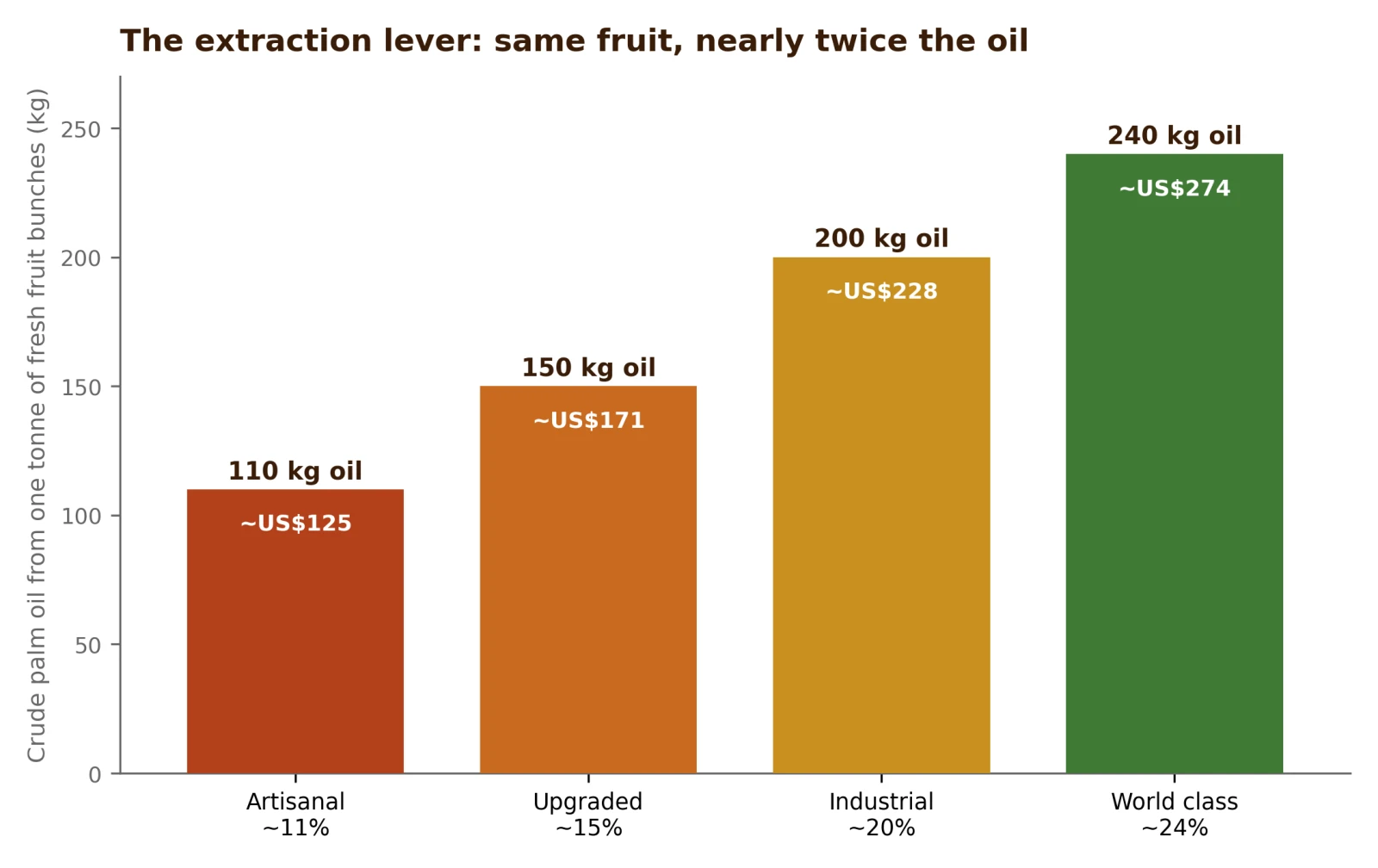
Lifting extraction from an artisanal 11 percent to an industrial 20 percent nearly doubles the oil, and the revenue, from the very same fresh fruit bunches. It is the single biggest cost-cutting lever in the crop.

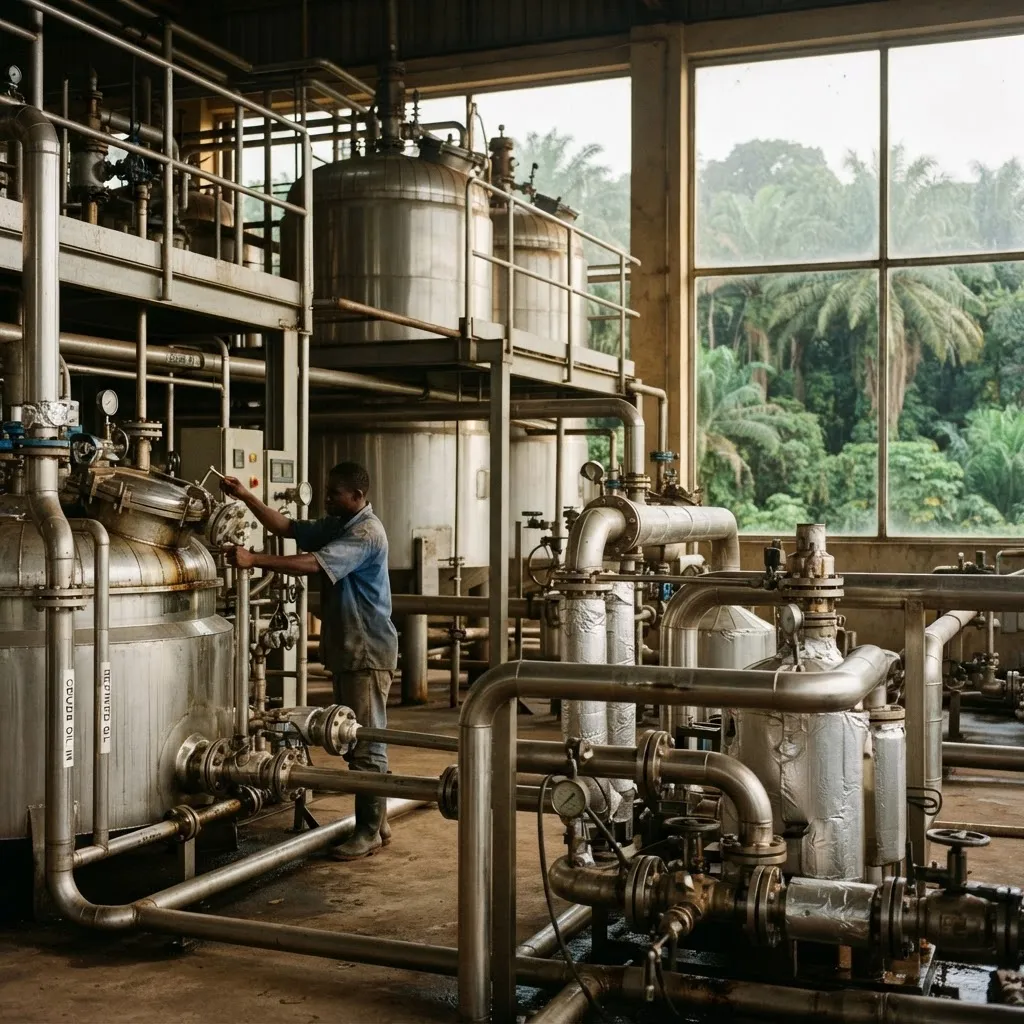
Of all those leaks, one dwarfs the rest. Extraction rate is the difference between only about 7 to 13 percent, an average near 11 (MASDAR, 2011), at an artisanal mill and about 19 to 24 percent, with GOPDC running at about 21.6 percent (Roundtable on Sustainable Palm Oil, 2016), at an industrial one.
From the very same tonne of fresh fruit bunches, the industrial mill pulls out nearly twice the oil, and nearly twice the revenue. No agronomy, no price move, no subsidy comes close to that. For anyone with capital, the message is blunt: do not chase more land or more fruit first. Chase extraction.

🌴 Model it yourself 🌴
Numbers on a page are one thing. Move the levers yourself. Enter the capital you have to see which business is in reach, then model a mill to watch extraction turn a loss into a margin from the very same fruit.
What can this capital start?
Enter the money you have to put in. The tiers your budget can reach light up, with the real return each one has shown.
Certified seedling nursery, fresh fruit bunch aggregation, kernel oil, disease surveillance or traceability. Knowledge and logistics, not a big asset.
- Lowest capital, fastest start
- Sells into the milling and quality gap
- The openings this playbook rates highest
Plant and grow fresh fruit bunches on a few hectares. A per-hectare margin that only turns positive after the immature valley of Pillar 4.
- Positive only after ~4 years
- Margin thinner and slower than a mill
- Yield and extraction decide the return
Buy bunches and press out oil at small scale. A smallholder-scale mill returned about 26% on a biogas system, or about 40% on the diesel variant.
- IRR about 26% to 40%
- Anyaoha and Zhang (2022)
- Lift extraction to win on price and freshness
Industrial milling at scale. A 10-tonne-an-hour mill in Ghana was modelled at about US$3.6m capital, a 26% IRR and a 3.7-year payback.
- IRR about 26%, payback ~3.7 years
- GSOPP (2019)
- Only pays with secured, close feedstock
Capital bands are indicative, to place the reader; the return figures are sourced (GSOPP, 2019; Anyaoha & Zhang, 2022).
Model a mill: extraction before expansion
Slide the levers. Watch what raising the oil extraction rate does to your oil, your unit cost and your margin, from the very same fruit.
Indicative model to show the shape of the economics and rank the levers, not validated field magnitudes. Fruit at US$120/t and milling at US$30/t of fruit; kernel oil at about 4.5% of fruit and US$2,416/t (World Bank, 2026).
🌴 Financing the wait, and what moves the money most 🌴
Oil palm money is made over decades but spent up front, so finance is not a detail, it is the business. For the first time the money is being made available. The 2026 to 2032 policy carries a US$500 million Oil Palm Development Finance Window covering up to 70 percent of project cost with a five-year moratorium (Government of Ghana, 2025).
GIRSAL guarantees up to 70 percent of a loan's credit risk, with over GH¢604 million in guarantees supporting about GH¢1.18 billion of agribusiness loans since 2019 (GIRSAL / Bank of Ghana, 2024). Cheaper, more patient capital bridges the immature valley for the grower and lowers the cost of the mill for the processor.

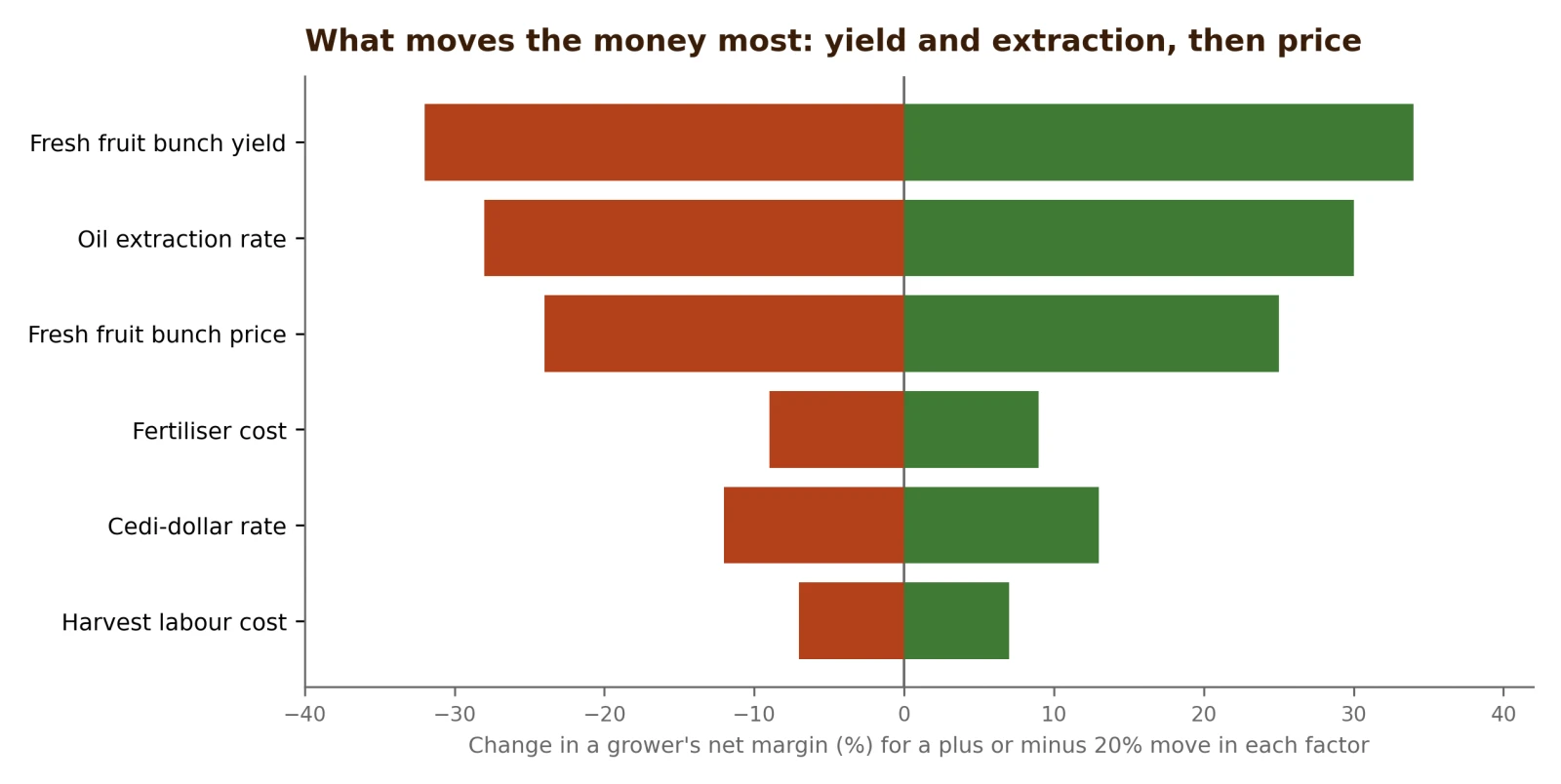
A grower's margin swings most on yield and extraction, then on the fresh-fruit-bunch price, and much less on the smaller cost lines. Protect the yield, secure a good mill, and worry about the rest second.
Upgrade or share a mill for extraction. The single highest-return move in the crop is lifting oil recovery from an artisanal 11 percent toward 20, on fruit that already exists. Secure the fresh-fruit-bunch supply and an offtake before you spend on the plant.
Aggregate and guarantee supply. The mistake is building capacity against the national deficit without a close, secured, good-quality fruit supply. The opening is the aggregation and outgrower model that keeps a mill full, which is a business in its own right.
Take the kernel value, not just the oil. Palm kernel oil sells for about twice the crude price on a raw material the mills already discard. A low-extraction, single-product operator leaves that money in the fibre.
Sell the cost-cutting as a service. Mill assessment, quality testing, cost analysis and aggregation are knowledge work that needs little capital and is paid to improve everyone else's economics. The cheapest route in, and the one the numbers point to.
🌴 The risks that sit inside the numbers 🌴
Building capacity against a headline gap
HIGHThe tempting mistake is to read the national deficit, build a mill or refinery, and then find there is not enough fresh fruit bunch nearby, or not of good enough quality, to fill it. Capacity without secured, close, good feedstock runs half-empty and loses money.
The GSOPP mill had to haul fruit more than 80 kilometres and buy in outside bunches to run, with transport taking about a fifth of the fresh-fruit-bunch price (GSOPP, 2019).
Mill and refinery investors who size to the deficit rather than to a secured fruit supply.
Lock the fresh-fruit-bunch supply and an offtake to a quality specification before spending on capacity, and site the mill inside the fruit, not the map. The opening is the aggregation and outgrower model that guarantees supply.
Thin margins in a volatile market
MEDIUM-HIGHOil palm returns are real but not fat, and they sit on top of a monthly fresh-fruit-bunch price, a world crude-palm-oil price and a moving exchange rate. A low-extraction, single-product operator with no cost buffer can be tipped into loss by any one of them.
The fresh-fruit-bunch price is reset monthly by the Authority; crude palm oil tracks the world benchmark; and the cedi has swung materially against the dollar (TCDA, 2026; World Bank, 2026).
Undercapitalised, low-efficiency operators selling one product on price.
Cut the controllable costs first, extraction and logistics, take the kernel value as well as the oil, and use the minimum-price floor and forward offtake to steady the top line.
There are three oil palm businesses, not one. Growing, mini-milling and medium-milling need very different capital, and the mill models return about 26 percent, while the grower's margin is thinner and slower.
Ghana makes palm oil dear, about US$359 a tonne at small scale against US$300 to 350 abroad. That cost gap, not the field, is why imports win on price.
The cost gap is fixable. Six leaks, low extraction, late milling, transport, bought fertiliser, sub-scale and costly finance, can each be cut, and together they are the whole competitiveness gap.
Extraction is the biggest lever by far. Lifting it from 11 to 20 percent nearly doubles the oil and the revenue from the same fruit. Chase extraction before expansion.
Finance is now available, the US$500 million window and GIRSAL guarantees, and it changes the return. Build the cost of capital into the plan, do not ignore it.