Ghana Agribusiness PlaybookOil Palm
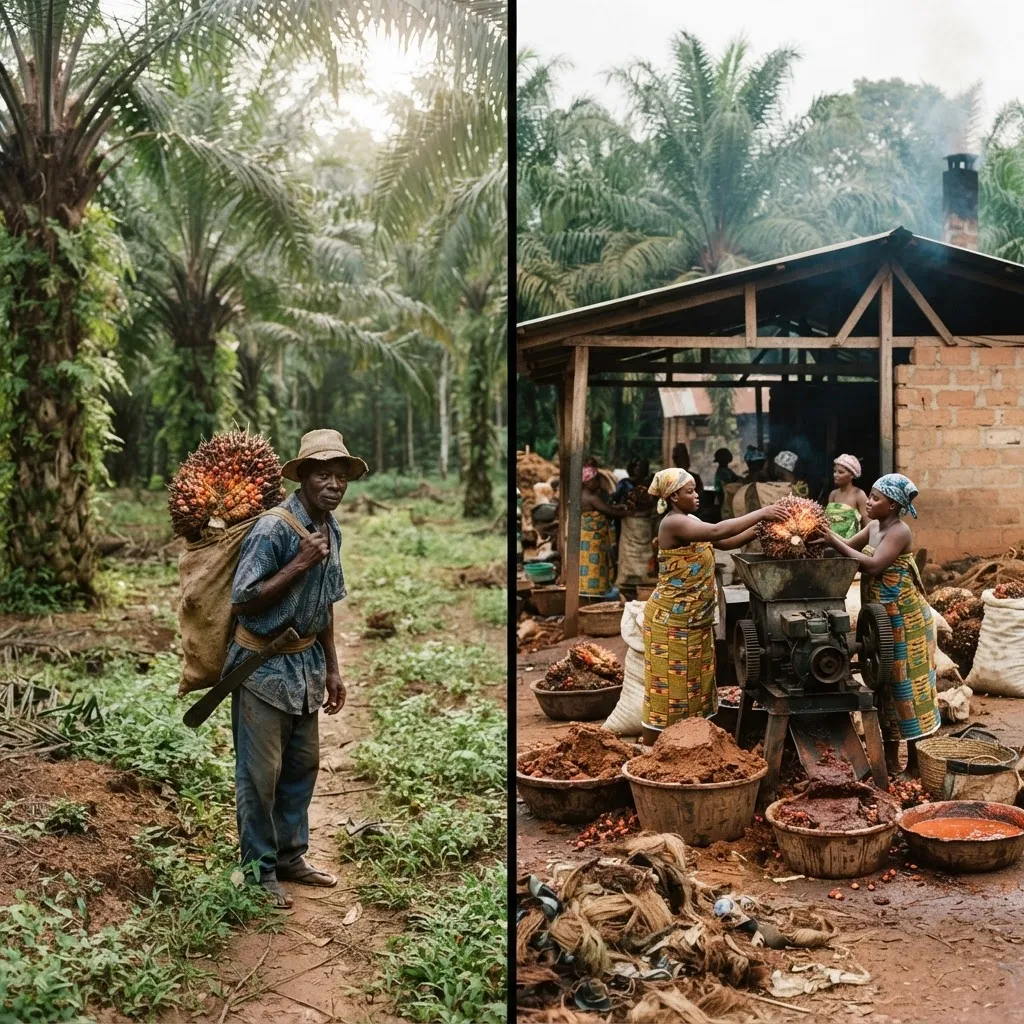
An agribusiness operator reviewing an oil palm milling and refining plan
Oil Palm · Series intelligence

Strategic Outlook

How to venture in: the frameworks, the entry map and the mistakes to avoid.
Strategic Outlook: the decade ahead · Pillar 08

Ghana's oil palm sector is at an unusual moment. For once, policy money, a rising price and a large unmet demand are all pointing the same way. Where the sector goes over the next decade will not be decided by the crop or the climate, but by a few choices about where that money and effort are aimed. This pillar steps back from the field to the whole picture, and to the decade to 2032.

Strip the sector to one sentence and it is this: Ghana grows enough oil palm to feed itself, but captures little of the value, because the constraint is the chain, not the field.

A Ghanaian oil palm strategist reviewing sector plans and market charts at a plantation edge
The moment is unusual
The decade to 2032: Policy money, a rising price and unmet demand point the same way; the decade is decided by where the money is aimed.
2032
the policy's target year for oil palm self-sufficiency
US$500m
the Oil Palm Development Finance Window, up to 70 percent of project cost
66%
of the chain's gross profit goes to brand owners and retailers, smallholders almost none

The country runs a palm-oil deficit while importing the refined oil it could make; it works three-quarters of the land for well under half the oil; and it sits at the low-value end of a chain where brand owners and retailers take about 66 percent of the chain's gross profit, refiners about 16 percent, plantations about 13 percent and smallholders almost none (Rijk et al., 2021).

Everything strategic follows from fixing that, and the tools to fix it are, for the first time, arriving together.

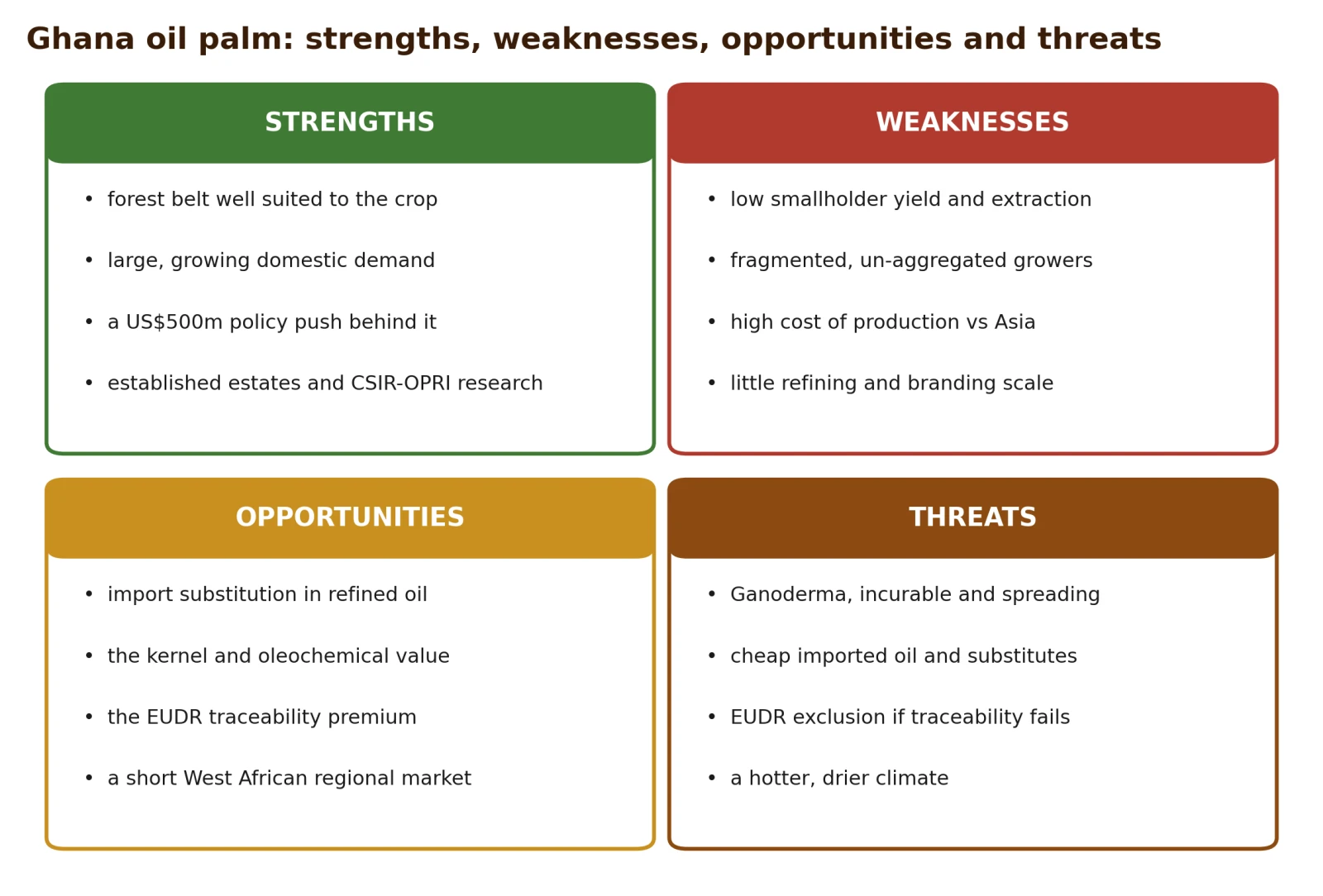
🌴 Strengths, weaknesses, opportunities and threats 🌴

A strategic reading of Ghana's oil palm sector: strengths, weaknesses, opportunities and threats
Figure 27 A strategic reading of Ghana's oil palm sector
What this shows

The pattern in the grid is clear. Ghana's strengths and opportunities are real and large, but almost all of the weaknesses, and the way to seize the opportunities, sit at the same place: milling, refining and aggregation. The threats, led by Ganoderma and the risk of being shut out of the European market, are manageable but only if acted on early.

66%
of the chain's gross profit goes to brand owners and retailers
13%
to plantations, about 16 percent to refiners, and almost none to smallholders

🌴 Three futures to 2032 🌴

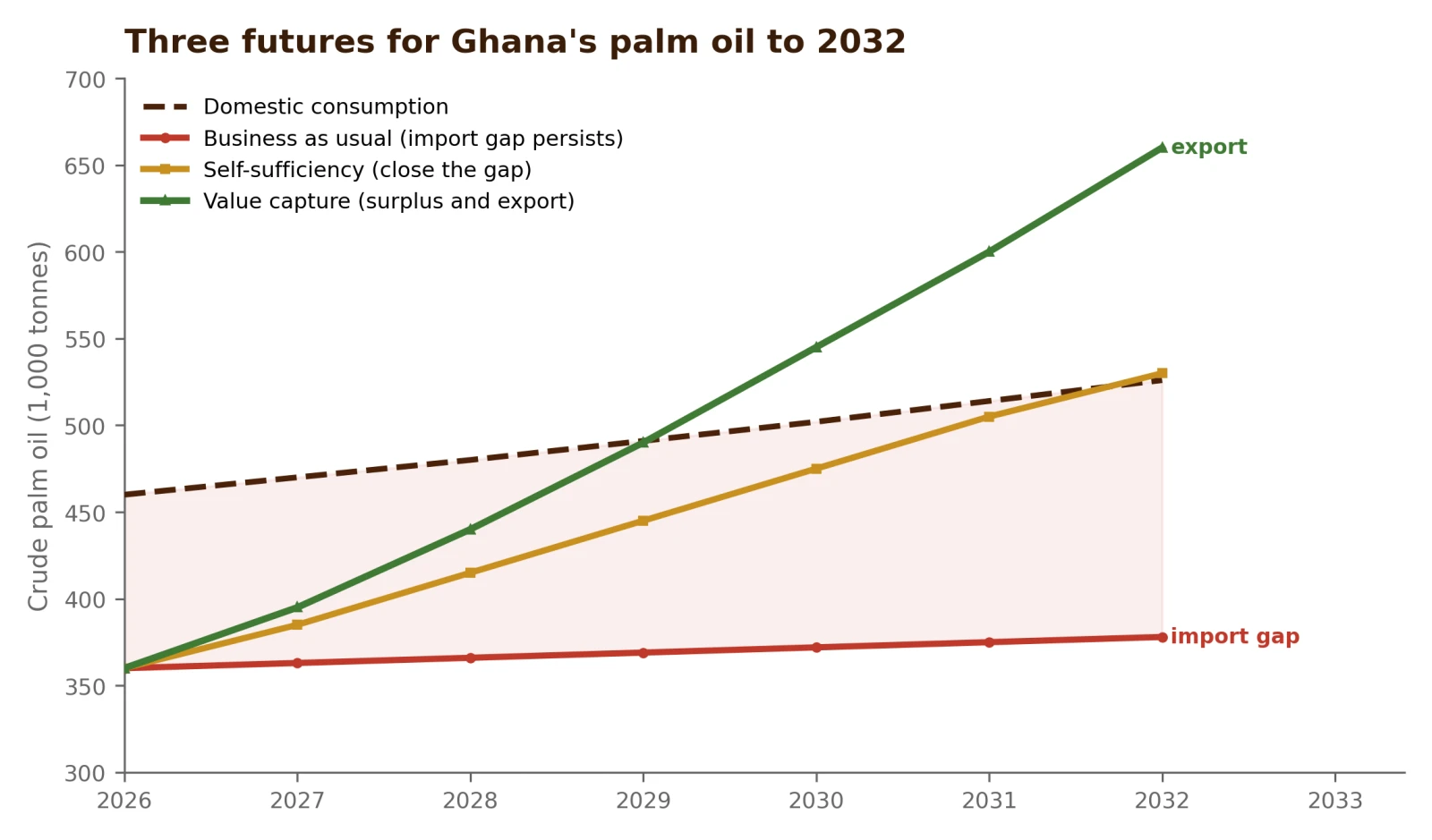
The policy sets a target of self-sufficiency by 2032. Whether Ghana reaches it, overshoots it, or misses it depends on one choice: whether the money builds milling and refining, or just more plantings. The three scenarios below turn on that single decision.

Three indicative scenarios for Ghana's crude palm oil output to 2032, against rising consumption
Figure 28 Three indicative scenarios for Ghana's crude palm oil output to 2032, against rising consumption
What this shows

The scenario lines are indicative, drawn to show the choices, not to forecast tonnages. The gap between them is the difference between spending on plantings alone and spending on the milling, refining and aggregation that turn fruit into value.

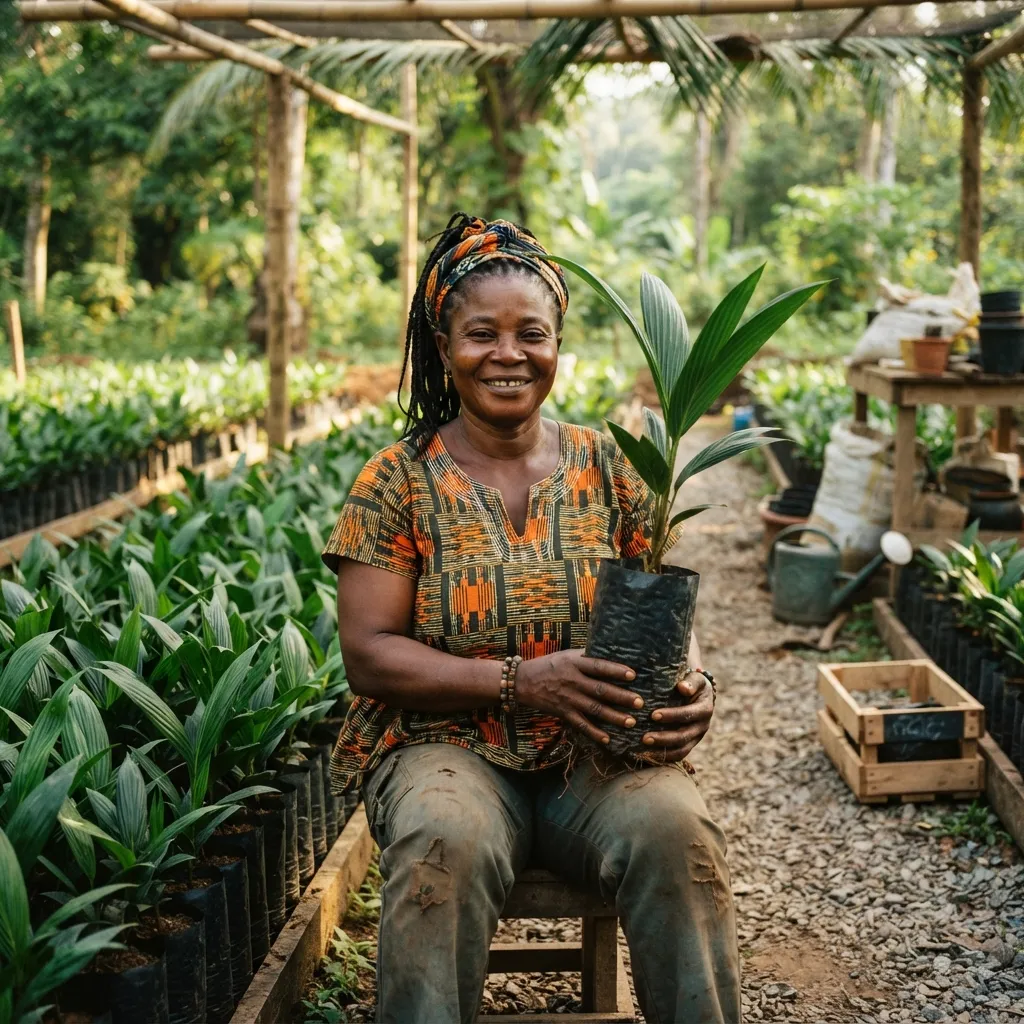
A large certified oil palm seedling nursery with rows of young Tenera palms
The seedling bottleneck
The 100,000-hectare drive needs roughly 15 million seedlings against a certified supply near one million a year.
🌴 The three scenarios that turn on one decision 🌴
01

Business as usual. Yields and extraction stay low, the policy money goes mostly to new plantings, and milling stays artisanal. Output creeps up but never catches demand, and Ghana keeps importing. The deficit becomes permanent.

02

Self-sufficiency. The yield gap is closed on existing land, extraction is lifted, and enough industrial milling and refining is built to turn the fruit into clean oil. Ghana meets its own demand by about 2032, and the import bill falls to near zero. This is the policy's stated goal.

03

Value capture. Self-sufficiency, plus a deliberate push into refining, kernel oil, oleochemicals and traceable, deforestation-free supply. Ghana not only feeds itself but exports a surplus into the short West African market and up the value ladder, the path Cote d'Ivoire took. This is the prize, and it is reachable.

Two things sit across all three lines. The self-sufficiency and value-capture paths both run into a seedling bottleneck, since the 100,000-hectare drive needs roughly 15 million seedlings against a certified supply near one million a year (Pillar 1); and all three sit under a slow climate headwind, with yields exposed to a hotter, drier decade (Pillar 3). One external force helps, though: Indonesia's biodiesel mandates are tightening world palm oil supply and holding prices up, which only strengthens the case for making oil at home rather than importing it (World Bank, 2026).

🌴 The policy test: where the money points 🌴

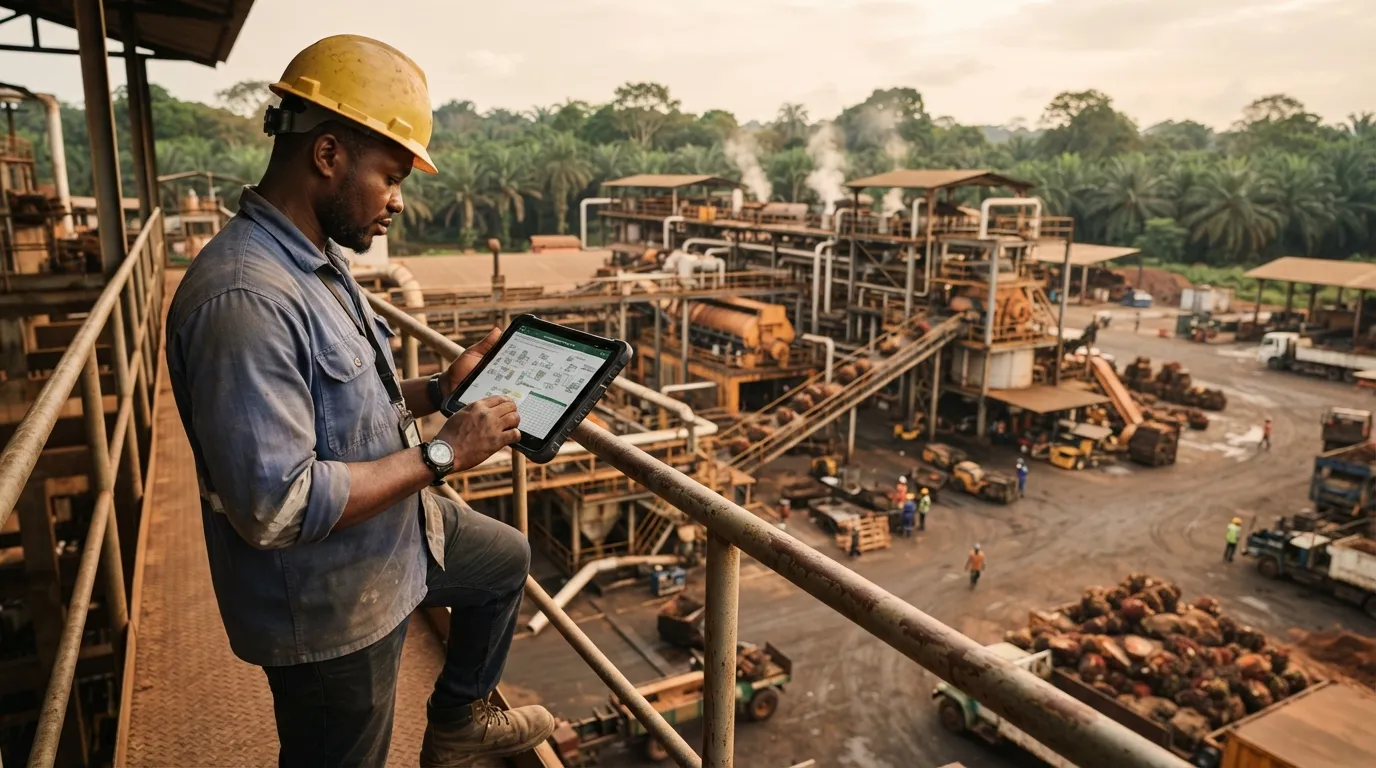
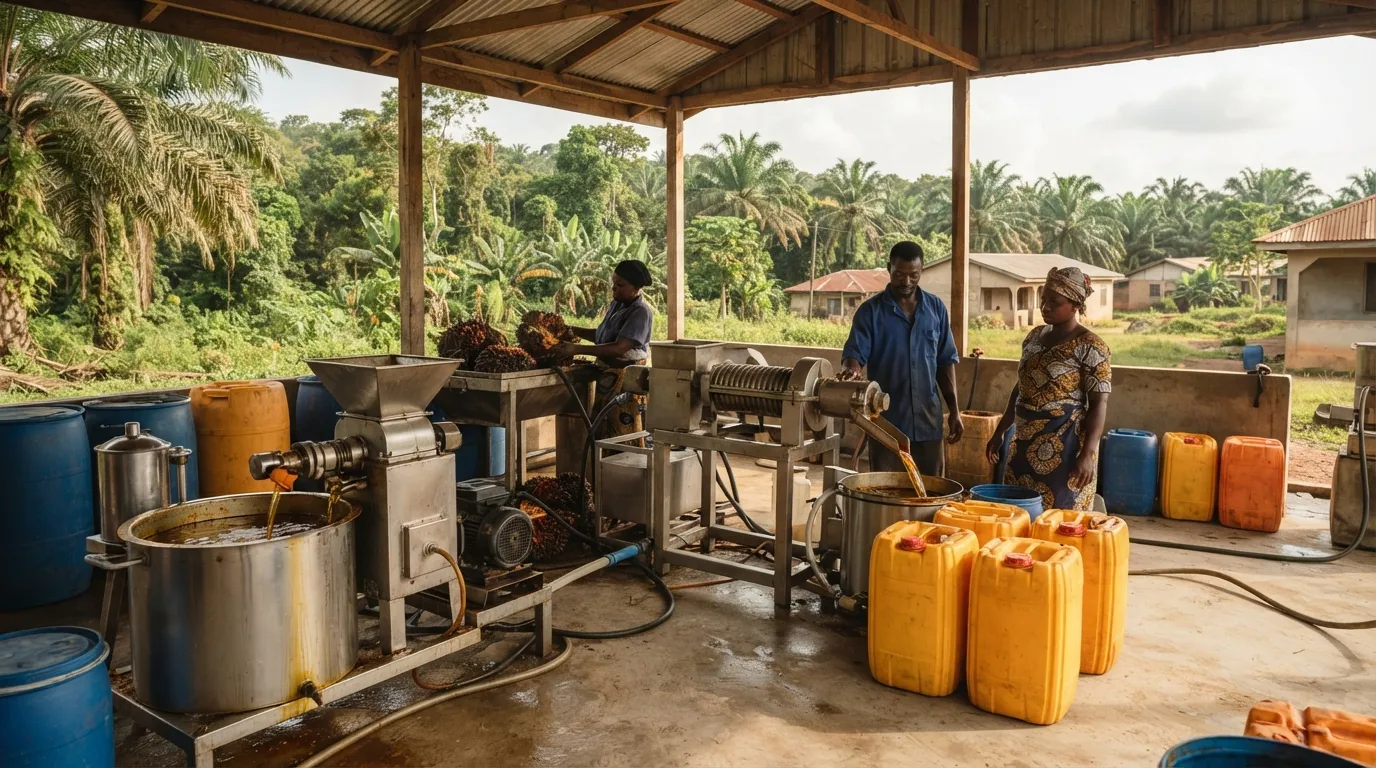
A modern industrial palm oil mill and refinery turning fresh fruit bunches into clean oil
Too little processing
The decade ahead: whether Ghana closes the gap or exports a surplus turns on building milling and refining, not just more plantings.

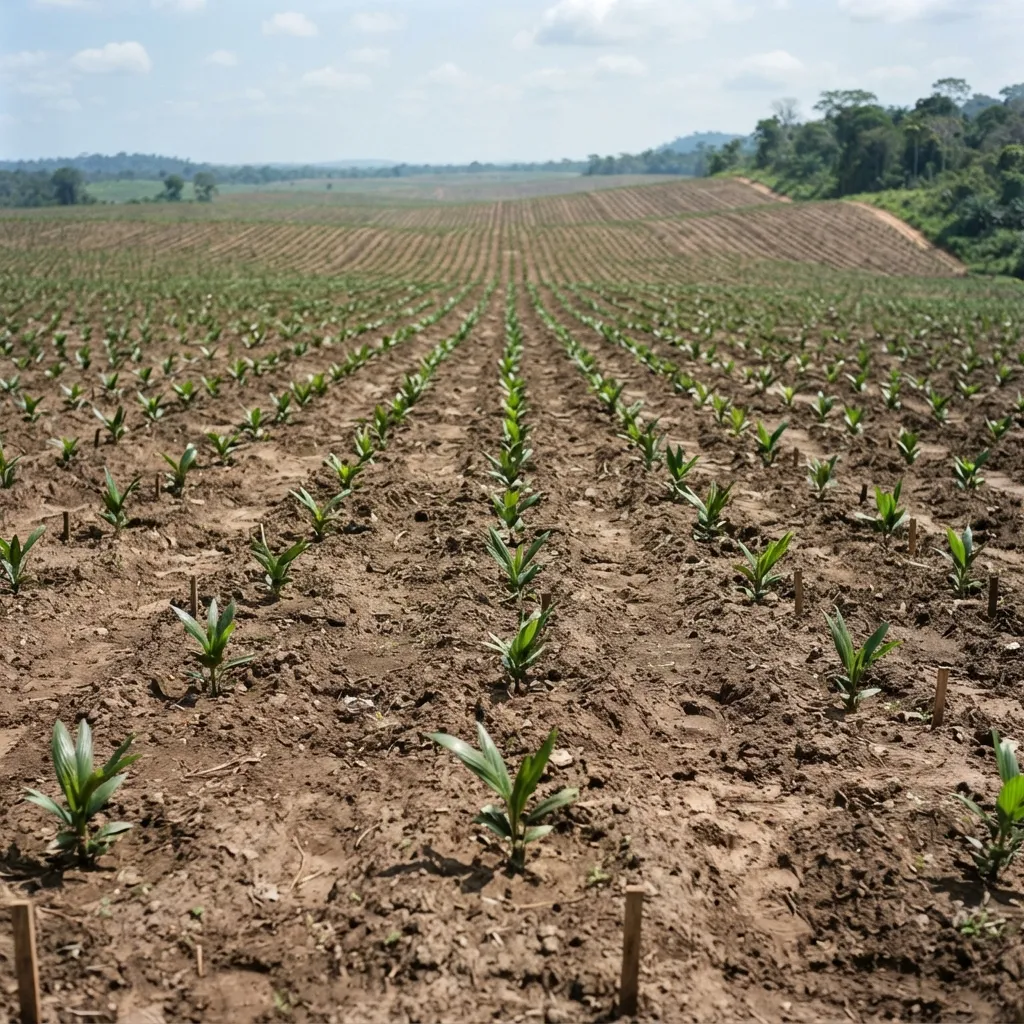
The National Policy on Integrated Oil Palm Development carries a US$500 million Oil Palm Development Finance Window covering up to 70 percent of project cost with a five-year moratorium (Government of Ghana, 2025), and it targets about 100,000 hectares of new plantations, about 250,000 jobs and self-sufficiency by 2032.

The single most important thing about it is not the size of the fund but where it points. Spent on planting alone, it produces the business-as-usual future: more low-yield fruit that low-extraction mills turn into red oil no branded buyer wants. Spent on the milling, refining, aggregation and disease surveillance that this playbook keeps returning to, it produces self-sufficiency and then value capture. The lesson of Pillar 6 is that Ghana's problem was never too little planting; it was too little processing.

What this means

This is the strategic crux of the whole entry. Ghana has tried planting drives before and stayed a net importer, because the fruit was never the binding constraint. The decade ahead will be decided by whether the state, the estates and private investors put their money into the middle and top of the chain, where the value and the deficit both sit, rather than the bottom, which is already full.

70%
of project cost covered, with a five-year moratorium
250,000
jobs the policy targets alongside self-sufficiency by 2032

🌴 The EUDR horizon: a sorting mechanism 🌴

Running underneath the decade is the European deforestation regulation, under which large and medium operators must comply from 30 December 2026 and micro and small enterprises from 30 June 2027, against a deforestation cut-off of 31 December 2020 (Regulation (EU) 2023/1115, as amended by 2025/2650, 2025).

It will sort Ghana's producers into those who can prove a clean, traceable, deforestation-free supply chain and those who cannot. Read defensively it is a threat, another door closing. Read strategically it is a sorting mechanism that hands a premium and a defensible market to whoever solves traceability first. The estates and outgrower schemes that treat it as an opportunity, not a burden, will pull ahead.

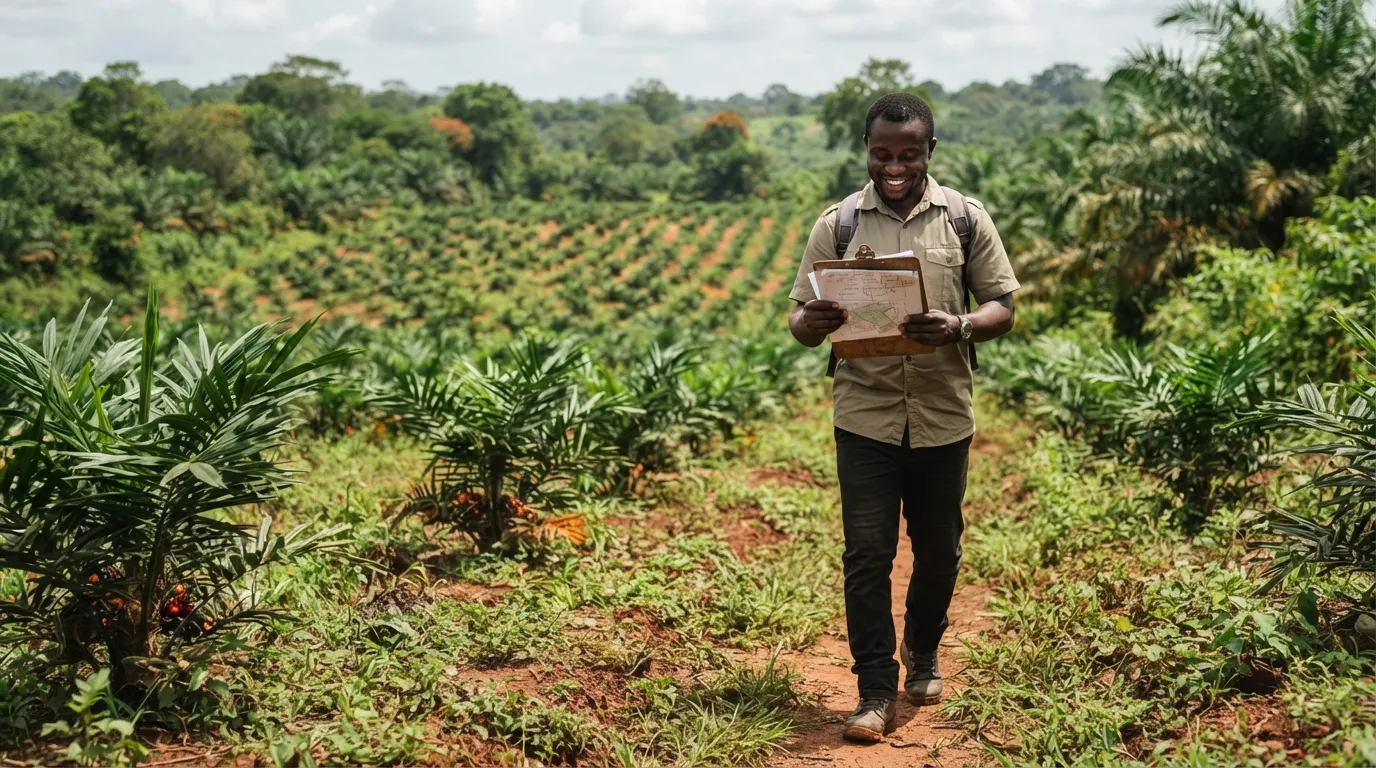
A field officer geolocating smallholder oil palm plots on a tablet for traceability
Solve traceability first
Traceability solved early is a premium, not a burden; it hands a defensible market to whoever gets there first.
Dec 2026
large and medium operators must comply with the EUDR
Jun 2027
micro and small enterprises must comply
Dec 2020
the deforestation cut-off date the record runs against

🌴 What to do: the priorities 🌴

The last judgement is the most practical: for each actor in the sector there is one move that returns more than any other. Read the table as a set of instructions, not a menu.

Table 10: The single highest-return strategic move for each actor in the sector
ForThe single highest-return moveWhy it matters
Government and donorsFund milling, refining, aggregation and disease surveillance, not just plantingit is the binding constraint; planting alone repeats past failure
InvestorsBack the middle and top of the chain, with secured feedstock and a funded runwaythe return climbs up the chain; the value is not in fruit
The estatesSolve traceability early and expand outgrower millingthe EUDR premium and a secured supply both reward it
EntrepreneursTake a low-capital service or aggregation opening nowthe sweet spot is uncontested and policy-backed today
CSIR-OPRI and TCDAScale certified, tolerant planting material and enforce the seed systemit lifts the whole yield curve and hedges Ganoderma and climate

🌴 The risks that sit inside the outlook 🌴

Misdirected policy money

HIGH
What it is

The largest strategic risk is that the US$500 million, and the effort around it, goes mostly to new plantings rather than to the milling, refining and aggregation that are the real constraint. That would repeat the sector's history: more fruit, still imported oil, and a deficit that never closes.

Evidence

Ghana has run planting drives before and remained a net importer; the value and the deficit both sit in processing, not production (Pillars 2, 6).

Who it hits

The whole sector, and the public purse.

How to manage it

Direct the fund and the guarantees to milling, refining, aggregation and surveillance; measure success by the share of fruit milled industrially and the import bill, not by hectares planted.

Exclusion from the European market

MEDIUM-HIGH
What it is

If Ghana's fragmented smallholder base cannot be mapped and made traceable in time, its oil is shut out of the European Union, and the premium goes to competitors who solved it. The domestic and regional market remains, but the highest-value door closes.

Evidence

The European deforestation regulation requires plot-level geolocation and a deforestation-free record from 31 December 2020; large and medium operators must comply from 30 December 2026 (Regulation (EU) 2023/1115, as amended).

Who it hits

Estates and outgrower schemes that export to the European Union, and the smallholders who supply them.

How to manage it

Build a national farm-geolocation and traceability system now, and treat early compliance as a competitive advantage rather than a cost.

🌴 Key institutions and operators 🌴

The organisations a practitioner, investor or student will meet across the Ghana oil palm sector.

Table 11: Who does what in the Ghana oil palm sector
InstitutionRole
CSIR-Oil Palm Research Institute (Kade)national oil palm research; breeds and supplies certified Tenera planting material
Tree Crops Development Authority (TCDA)regulates oil palm; sets the monthly minimum fresh-fruit-bunch price; licenses actors
Ministry of Food and Agriculture (MoFA)sets agricultural policy, including the National Oil Palm Policy 2026-2032
Ghana Sumatra Ltd (Kusi, Kade)the licensed commercial multiplier of certified oil palm seed
GOPDC (Presco / SIAT)the largest estate, with a mill and refinery in the Eastern Region
BOPP (Wilmar) and TOPP (Unilever)large estates and mills in the Western and Central regions
NORPALM and Juaben Oil Millsfurther estates and mills in the belt
GIRSALthe agricultural credit-risk guarantee scheme, covering up to 70 percent of a loan
Ghana Investment Promotion Centre (GIPC)investment promotion and agro-processing tax incentives
OPDAG and Solidaridadthe industry association and the development partner behind the minimum-price mechanism
🌴 Key takeaways 🌴
01

Ghana grows enough oil palm to feed itself but captures little of the value. The binding constraint is the chain, not the field, and every strategic choice follows from that.

02

The decade to 2032 turns on one decision: whether the policy money builds milling, refining and aggregation, or just more plantings. Only the first reaches self-sufficiency and value capture.

03

The value-capture future, feeding Ghana and exporting a surplus up the value ladder, is real and reachable. It is the path Cote d'Ivoire took, and it starts with processing, not planting.

04

The EUDR will sort producers into those who can prove clean, traceable supply and those who cannot. Solved early, it is a premium, not a threat.

05

The single biggest strategic risk is misdirected money: another planting drive that leaves the milling and refining bottleneck untouched. Success should be measured in oil processed and imports displaced, not hectares planted.

This outlook rests on the whole playbook: the yield and material of Pillars 1 and 4, the demand and deficit of Pillar 2, the disease and regulatory risks of Pillar 3, the cost and returns of Pillar 5, the value chain of Pillar 6, and the openings of Pillar 7. Together they make the case that Ghana's oil palm future is a processing story waiting to be written.

Written for each reader

🌴 Practitioner intelligence 🌴

Hover any card to pause and lift it.

For students

The strategic picture is your opportunity map for a career, not just a venture. The sector will spend the next decade building the milling, refining, aggregation, quality and traceability capacity it now lacks, which is precisely the set of skills a graduate can build. Position yourself for the future the sector is trying to reach, the processing-and-services economy, not the low-value production past it is trying to leave.

For entrepreneurs

Build for the value-capture future, because that is where the policy and the money are pushing. Every opening in Pillar 7 is a step toward it. The entrepreneurs who win the decade will be those who positioned early in processing, kernel oil, aggregation and traceability, while the openings were still uncontested and the policy tailwind was strongest.

For investors

Treat the policy window and the EUDR as the two forces shaping the decade. They both reward the same thing: integrated, traceable, processing-led businesses. Weight the portfolio toward the self-sufficiency and value-capture scenarios, and away from pure production, and price in the strategic risk that public money is misdirected to planting, which would slow the whole sector's re-rating.

For ecosystem actors

This whole pillar is written for you. The decade's outcome is mostly in public and institutional hands: where the fund goes, whether traceability is built as a shared system, whether the seed and surveillance institutions are resourced. The highest-return public strategy is to spend on the constraint, processing and the chain, not the symptom, and to measure success in oil processed, imports displaced and traceable export volume, not in hectares announced.

Download full PDF
UpcomingThis document isn't available yet.