If you want to understand this business, learn to build and read the cost model before you ever buy a bird. Take the indicative cycle here, put in real feed and chick prices you gather from a local market, and see how thin the margin is and what moves it. The trap is being dazzled by the revenue line and ignoring that feed and the exchange rate decide whether it becomes profit. What you gain is the single most useful skill in agribusiness, the ability to tell a real margin from a hopeful one, which makes you valuable to any farm or investor.
Everything in the last four pillars now meets the balance sheet. The imported chick, the feed, the feed conversion gap and the birds lost to disease all become one number: what a cycle costs and what it earns.
This pillar builds that number for a typical 1,000-bird cycle. Every figure here is indicative, because Ghana has no single audited cost dataset, so treat these as a planning frame to be replaced with your own field numbers, not as a promise of profit.

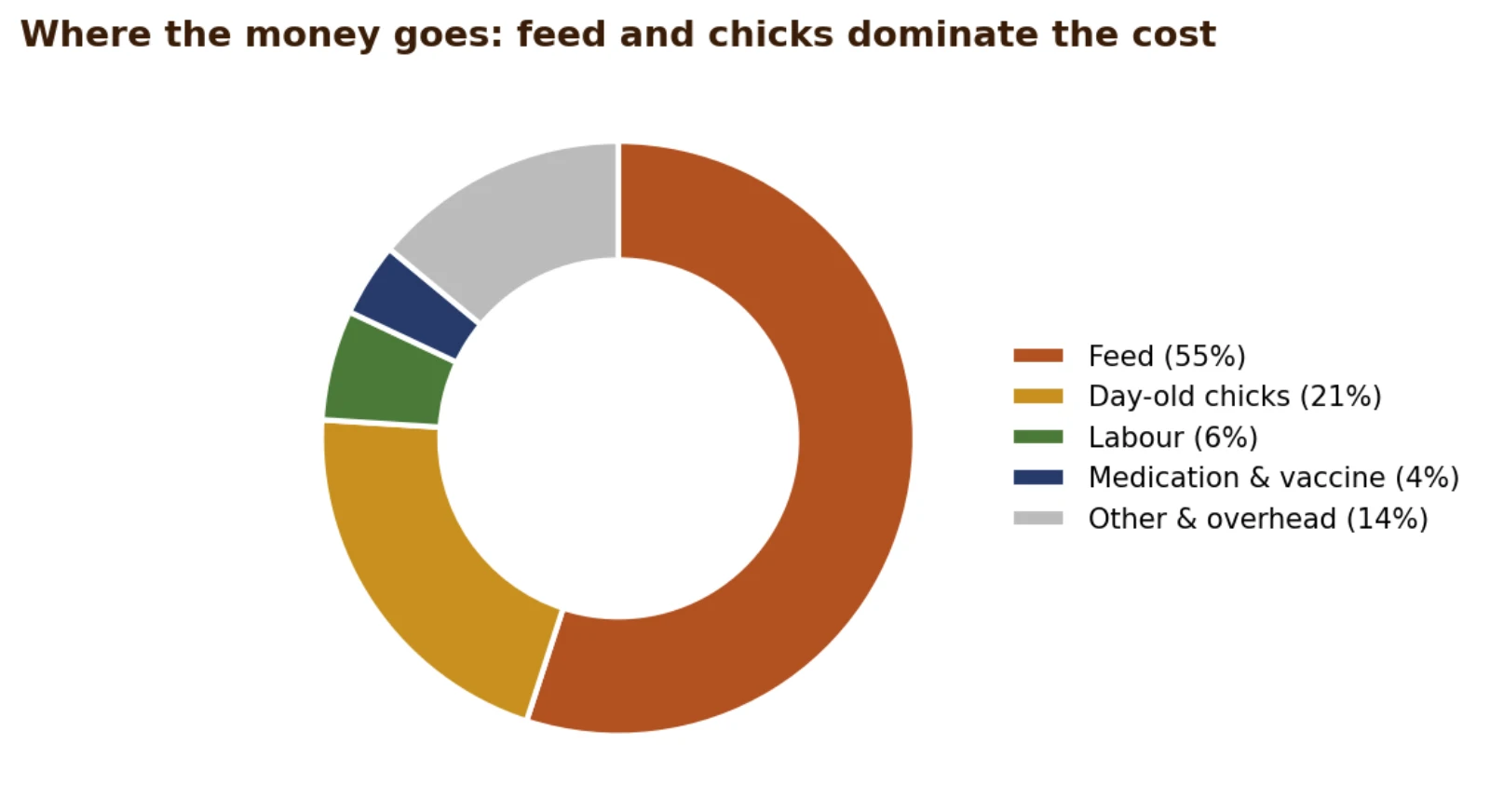
🐔 Where the money goes: feed is the whole game 🐔

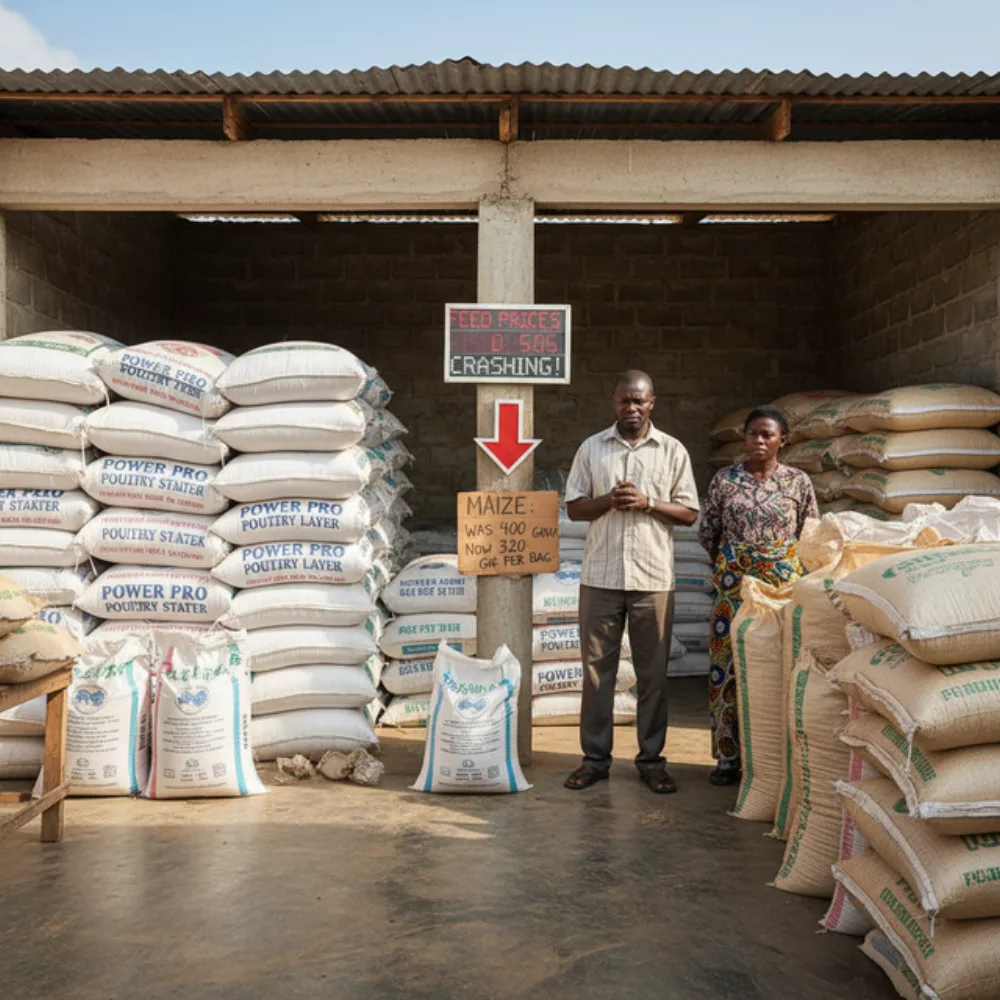
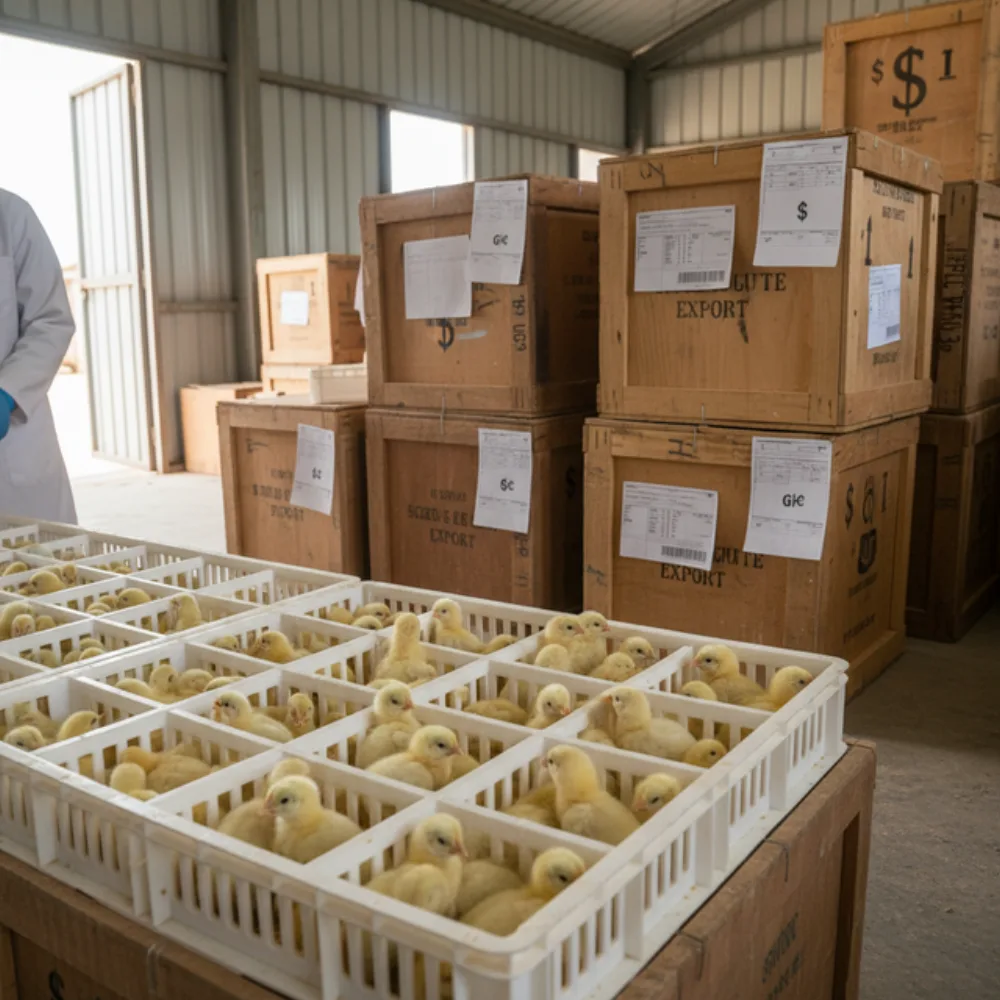
Read the cost structure as a to-do list ranked by size. Feed is the biggest single cost by far, so a small gain in feed conversion beats a large saving on anything else. The chick is the next fifth, and it is imported and dollar-priced. The two biggest costs are the two most exposed to management and to the exchange rate, which is exactly why the local bird struggles to undercut the import, and why efficiency, not scale, is the first place to look for profit.
One cost swamps all the others: feed is roughly half to two-thirds of the cost of raising a broiler, about 48 to 67 percent (Anang et al.; Chibanda et al., 2013 to 2024), with the day-old chick the next largest at roughly a fifth.
Together, feed, chicks and labour make up about 90 percent of the cost of raising a broiler (Anang et al., 2013). That single fact sets the strategy for the whole enterprise: because feed is the game, the feed conversion ratio from Pillar 1 is the biggest profit lever a farmer holds, and every wasted kilogram of feed is money that never comes back.
🐔 A cycle in numbers: the indicative 1,000-bird model 🐔
The table below builds a single 1,000-bird cycle on a consistent, conservative basis: birds sold at about 2.4 kilograms liveweight after about 10 percent mortality, a field feed conversion ratio near 2.0 (between the well-run 1.65 of Pillar 1 and the 2.1 to 2.4 of typical Ghanaian farms), feed at about GH¢11.80 a kilogram and chicks at about GH¢20 each.
The full, editable version is the companion Cost and Returns Model, built to be overwritten with your own numbers. Every cedi figure in the table is an indicative 2026 estimate, not audited data. The profit is thin and highly sensitive to feed price, the exchange rate, mortality and the feed conversion ratio.


🐔 Table 10: what one 1,000-bird cycle costs and earns 🐔
| Line (per 1,000-bird cycle) | Basis | Amount (GH¢) |
|---|---|---|
| Day-old chicks | 1,000 at about GH¢20 | 20,000 |
| Feed | about 4.3 tonnes at about GH¢11.80/kg | 51,000 |
| Medication and vaccination | about GH¢4 a bird | 4,000 |
| Brooding fuel, power and water | per cycle | 3,500 |
| Litter and bedding | per cycle | 1,500 |
| Labour | per cycle | 6,000 |
| Transport and marketing | per cycle | 3,000 |
| Miscellaneous and depreciation | per cycle | 4,000 |
| TOTAL COST | 93,000 | |
| Revenue | 900 birds x 2.4 kg x about GH¢55/kg live | 118,800 |
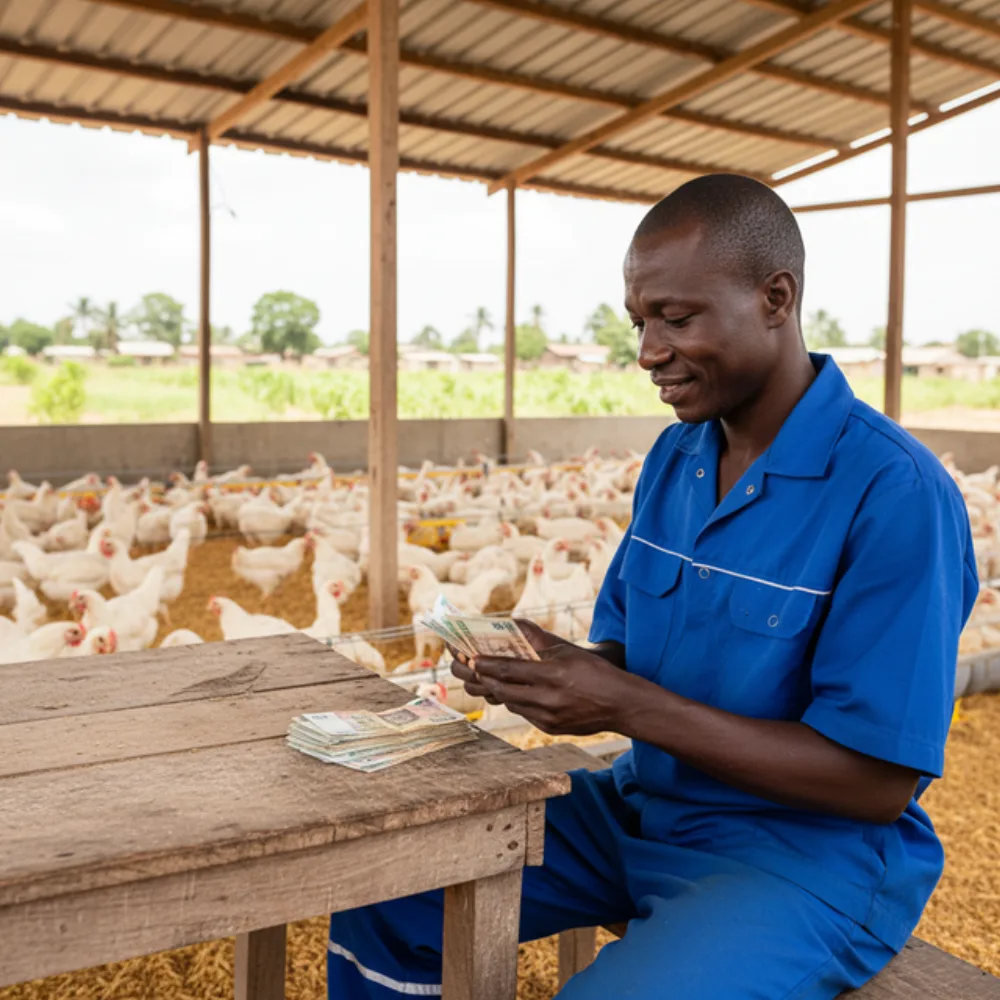
| NET PROFIT (indicative) | before financing and land | 25,800 |
| Return on the cycle | profit over cost | about 28% |
| Break-even live price | the price that just covers cost | about GH¢43/kg |
Indicative estimate: every cedi figure is an indicative 2026 estimate, not audited data. The profit is thin and highly sensitive to feed price, the exchange rate, mortality and the feed conversion ratio. Treat the return as a possibility under good management, not a guarantee.
Sources: Anang et al. (2013); Chibanda et al. (2024); indicative 2026 levels.
🐔 Model it yourself 🐔
Numbers on a page are one thing. Move the levers yourself. Set the feed price, the feed conversion ratio, the chick cost, the sale price and the batch size to your own field numbers, and watch a thin margin turn to profit or loss in front of you.
Build a broiler cycle
Slide the five drivers that decide a cycle. The model runs a batch at about 10 percent mortality, birds sold at about 2.4 kg liveweight. Overwrite every number with your own field prices.
Indicative planning frame, not audited data. Base case: feed about GH¢11.80/kg, feed conversion about 2.0, chicks about GH¢20, live price about GH¢55/kg, 1,000 birds at about 10 percent mortality (Pillar 5, Table 10).
Where the money goes
The same cycle, split into its parts. Feed is roughly half to two-thirds of cost, which is why a small gain in feed conversion beats a large saving on anything else.
Imported, dollar-priced grain. The single biggest cost and the biggest profit lever.
55% of costImported and dollar-priced. The next largest cost after feed.
22% of costMedication, brooding, litter, labour, transport, miscellaneous and depreciation.
24% of costNon-feed, non-chick lines held at about GH¢22 a bird (medication, brooding, litter, labour, transport, miscellaneous and depreciation). Structure after Anang et al. (2013) and Chibanda et al. (2024); levels indicative for 2026.
🐔 What moves the profit most 🐔

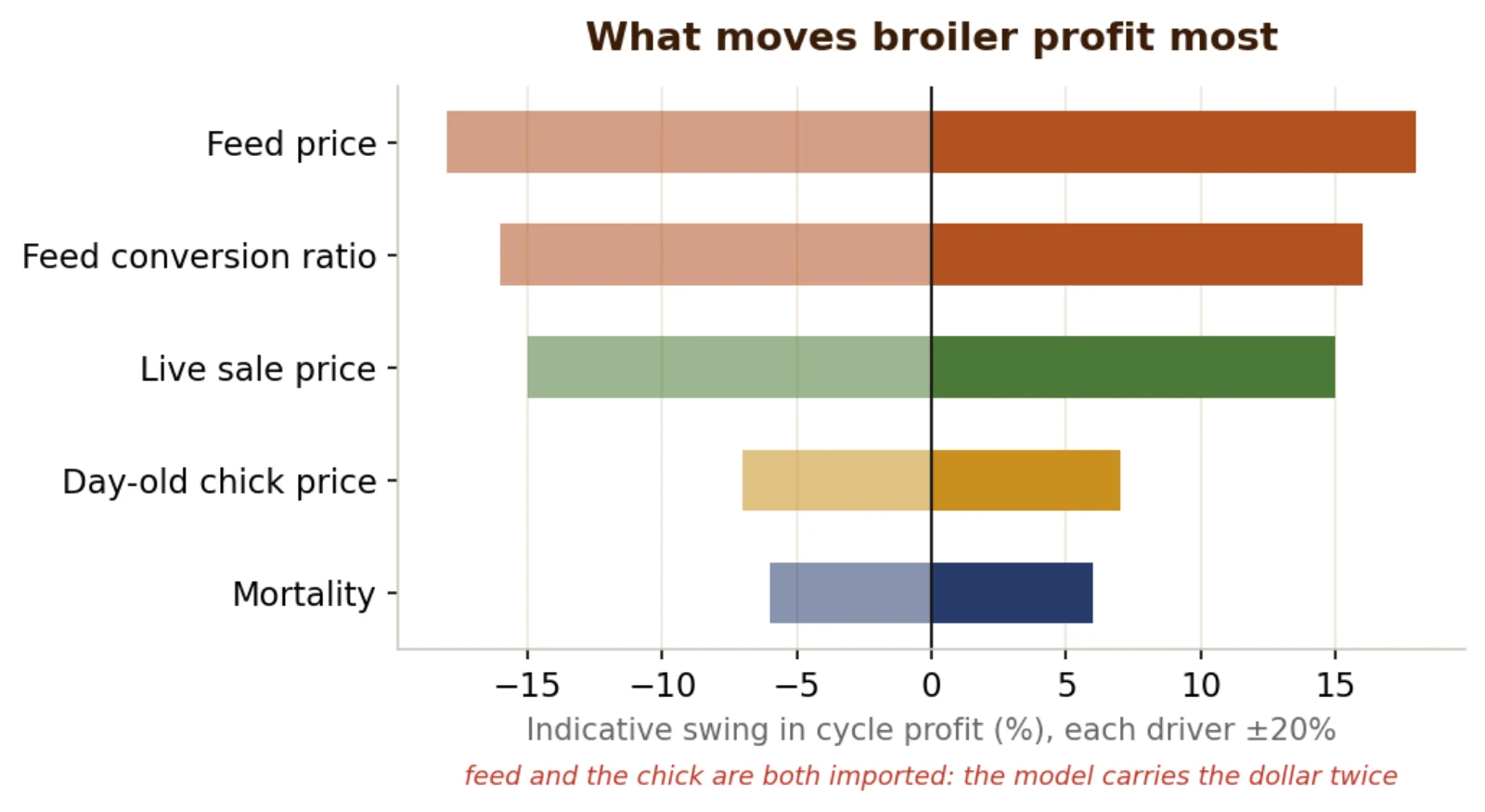
Notice what the top two drivers have in common. Feed and the chick are both imported and dollar-priced, so the model carries the exchange rate twice over. A cedi slide raises the feed bill and the chick bill together, and can flip a modest profit into a loss. The single biggest risk in the cost model is not on the farm, it is the exchange rate, and the only real hedge is cheaper local feed and locally hatched chicks.
A thin margin means small changes decide everything. The profit above can turn into a loss with a modest move in any of four drivers, and knowing which ones matter tells a farmer where to put attention.
In order of impact: the feed price and the feed conversion ratio, because feed is two-thirds of cost; the sale price, which the import ceiling of Pillar 2 caps; and mortality, because every dead bird is a full cost with no revenue.
Market signal, the model carries the dollar twice. Feed and the chick are both imported and dollar-priced. A cedi slide raises the feed bill and the chick bill together, so the single biggest risk in the cost model is not on the farm, it is the exchange rate.
🐔 Why Ghana costs more, and the three-cycle ceiling 🐔
Ghanaian broiler production is structurally expensive, and it helps to be honest about why. Studies put Ghanaian broiler production costs well above European farms, by some estimates 180 to 219 percent higher (Chibanda et al., 2024). Two things drive it: imported, dollar-priced feed and chicks, and small scale.
On top of that sits a time limit. Ghanaian farms manage only about three broiler cycles a year, against seven to eight in temperate Europe (Chibanda et al., 2024), partly because of heat, disease breaks and the festive-demand pattern of Pillar 2. Fewer cycles means the fixed costs of a shed are spread over less output, which raises the cost of every bird again.
The gap against European farms is not one problem but several, and breaking it down turns a discouraging headline into a list of separately-fixable levers.

| Cost driver | Ghana | Europe | Why it matters |
|---|---|---|---|
| Feed conversion ratio | about 2.0 to 2.4 | about 1.5 | Ghana buys more feed for each kilo of bird produced |
| Day-old chick | dearer, and imported | cheaper, and local | The chick is a bigger, dollar-priced cost in Ghana |
| Feed price | higher, import-priced grain | lower, local grain | Feed is the biggest cost, so a higher price magnifies the gap |
The gap against European farms is not one problem but several: separately-fixable levers, each of which better husbandry, local hatching or local milling can improve.
Source: Chibanda et al. (2022, 2024). Figures rounded.
Read as a to-do list, the gap is less daunting. Feed conversion and the chick, two of the biggest drivers, are the very things better husbandry and local hatching improve, and cheaper local feed follows from local milling. Ghana's cost disadvantage is structural but not fixed; it is the sum of specific, addressable levers, which is why the openings in this playbook, local feed, local hatching and efficiency services, are the same levers that close the gap.
🐔 The scale paradox: bigger is not always cheaper 🐔

It is tempting to assume the fix is simply to farm bigger, but the evidence complicates that. Most Ghanaian broiler farms are small, about 87 percent, with roughly 9 percent medium and 5 percent large, yet the large farms supply about half the local broiler meat (Chibanda et al., 2022).
Cost, though, does not fall in a straight line with size: in the typical-farm data a mid-sized operation was the cheapest producer per kilo, cheaper even than the largest farm (Chibanda et al., 2024). Scale helps up to a point, after which management matters more than sheer size. The goal is not to be the biggest, it is to be the best-run at a scale you can actually manage.
A well-run medium farm can beat a poorly-run large one, because past a certain size the savings on overhead are eaten by the extra cost and complexity of running a big flock badly. The goal is to be the best-run at a scale you can actually manage, which is encouraging for a careful entrant who cannot start large.
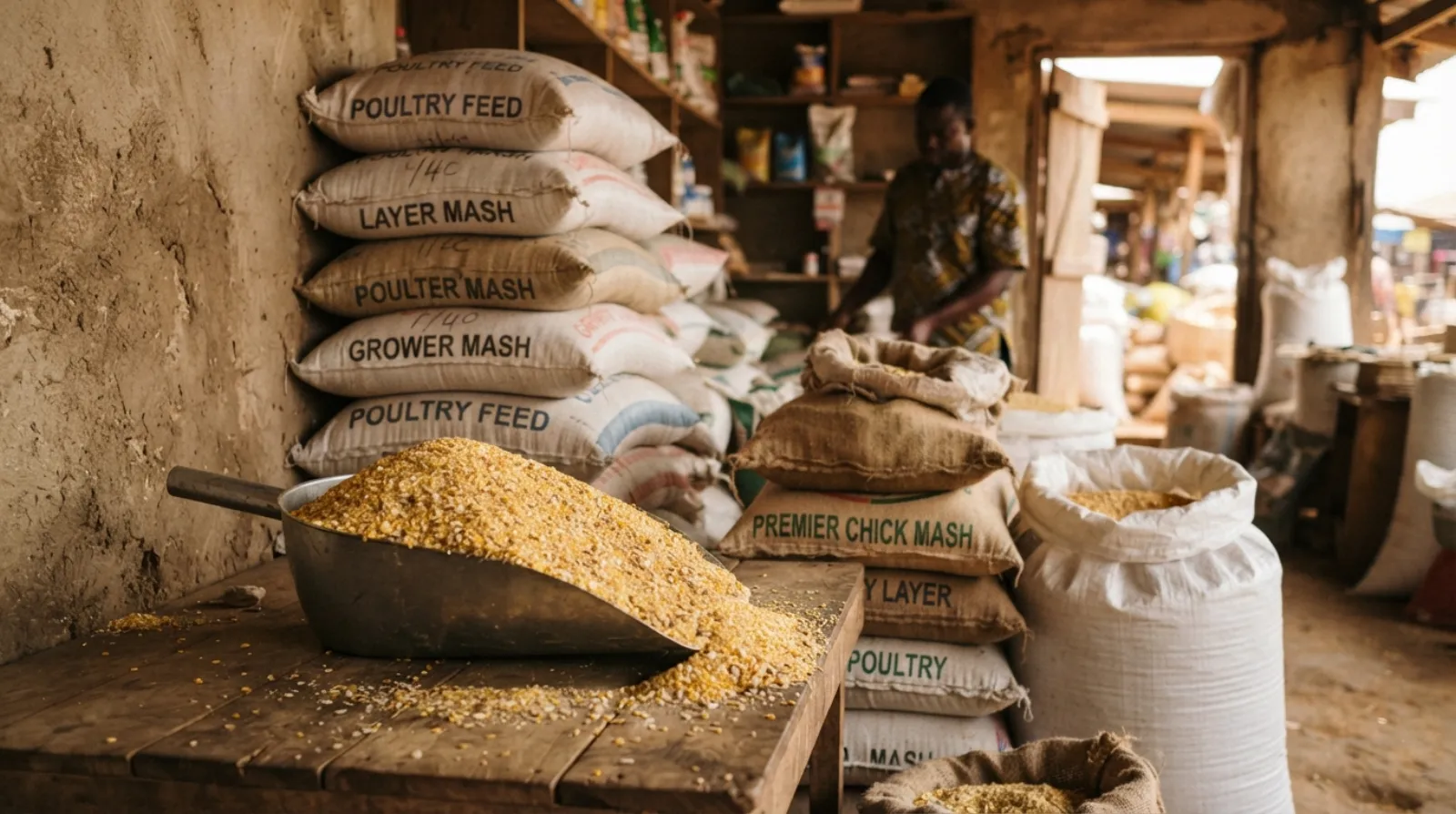
Local feed milling and ingredient supply. Because feed is two-thirds of cost and largely imported or import-priced, any cut in feed cost flows straight to the bottom line and shortens the dollar exposure.
Efficiency and record-keeping services. Helping farms measure and cut their feed conversion ratio and mortality, the two levers that move a thin margin most.
Aggregation for scale. Pooling smallholder birds to buy feed and chicks in bulk and sell in volume, attacking the small-scale cost penalty directly.
🐔 The risks that sit inside the cost and returns 🐔
Feed-cost and feed-quality shock
VERY HIGHFeed is about two-thirds of cost, so a jump in the maize, soya or feed price, or a batch of poor-quality feed that worsens conversion, wipes out a thin margin faster than any other single event.
Feed is 48 to 67 percent of Ghanaian broiler cost, maize jumped about 59 percent in the year to early 2025, and a 50 kilogram bag of broiler feed runs near GH¢590 (Anang et al., 2013; Chibanda et al., 2024; USDA FAS, 2025a; De Heus and Koudijs, 2026).
Every producer, worst for those buying feed cycle-to-cycle without storage or a bulk deal.
Buy feed forward or in bulk, test quality, and formulate with cheaper local ingredients where possible. The opening is local feed milling that cuts both the cost and the import exposure.
The working-capital squeeze
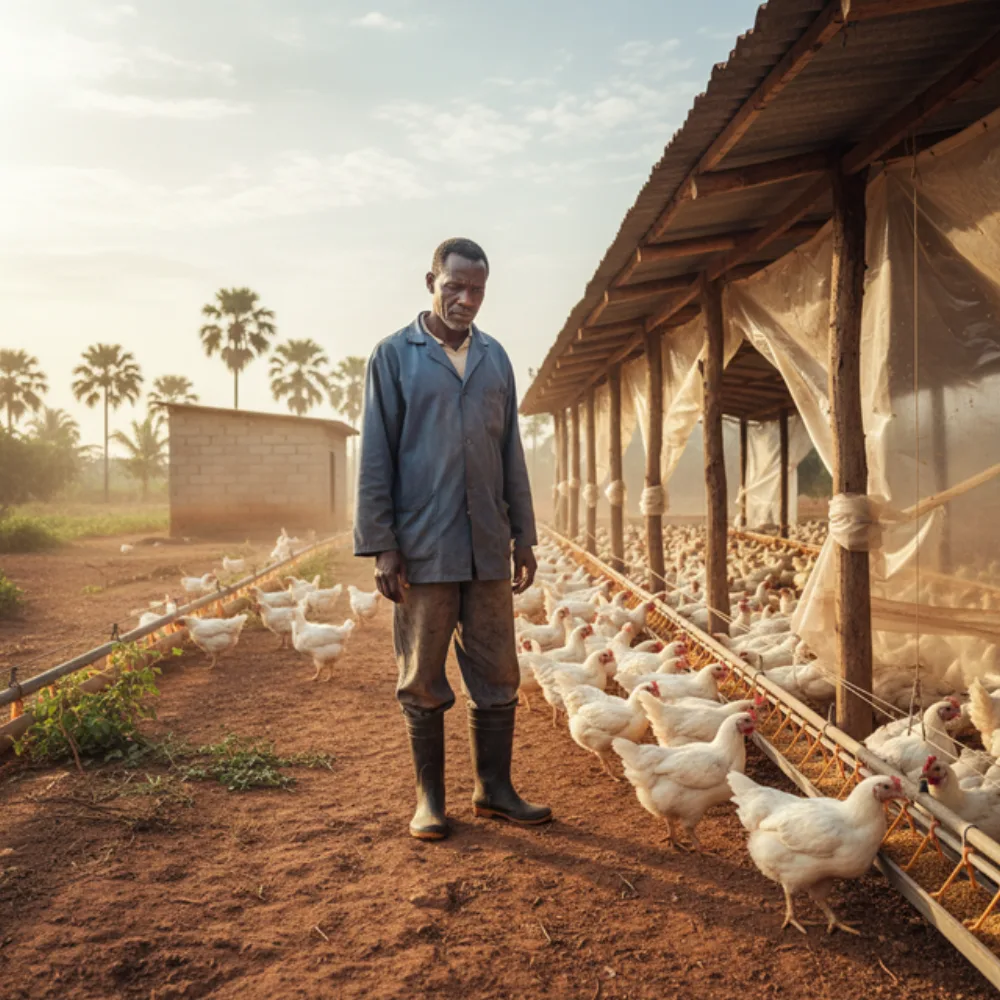
HIGHA broiler cycle ties up most of its cost in feed and chicks weeks before any revenue arrives, so a farm can be profitable on paper yet run out of cash mid-cycle and be forced to sell birds early and cheap.
Chicks and feed are paid up front and make up the bulk of the roughly GH¢93,000 committed to a 1,000-bird cycle before the first bird is sold (indicative model above; Anang et al., 2013).
Undercapitalised and first-time farmers without a cash buffer or affordable credit.
Size the flock to the cash on hand, secure a working-capital line before placing, and stagger placements. The opening is cycle-financing products and input-on-credit schemes tied to a confirmed buyer.
Thin margins in a volatile market
HIGHThe margin is slim and sits between a feed cost that can rise and a sale price capped by cheap imports, so normal volatility in either direction can erase the profit of a cycle.
The indicative return is modest and highly sensitive to feed price, the exchange rate, mortality and feed conversion, any of which can move enough to flip profit to loss (indicative model above; Chibanda et al., 2024).
All producers, but fatally for those with no buffer who treat one good cycle as the norm.
Compete on cost control and a secured premium channel, not on volume into the open market, and keep records to know the real margin. The opening is efficiency and aggregation services that widen a structurally thin margin.
Feed is the biggest single cost of a broiler, and feed, chicks and labour together are the great majority of it. Efficiency, led by feed conversion, is the first place to find profit.
On an indicative 1,000-bird cycle the margin is real but thin, and every figure needs replacing with field data before it is trusted. Treat the model as a frame, not a forecast.
The two biggest costs, feed and chicks, are both imported and dollar-priced, so the model carries exchange-rate risk twice. A cedi slide is the single biggest threat to the margin.
Ghanaian production costs run well above European farms because of imported inputs, small scale and only about three cycles a year. The disadvantage is structural, not a skill gap.
Because the problem is structural, the openings that pay attack the structure: local feed, local hatching, aggregation for scale, and selling into protected premium channels.