Ghana Agribusiness PlaybookBroiler Chicken
From day-old chick to dressed bird, the full broiler value chain in Ghana
Broiler Chicken · Pillar 06

Value Chain Analysis

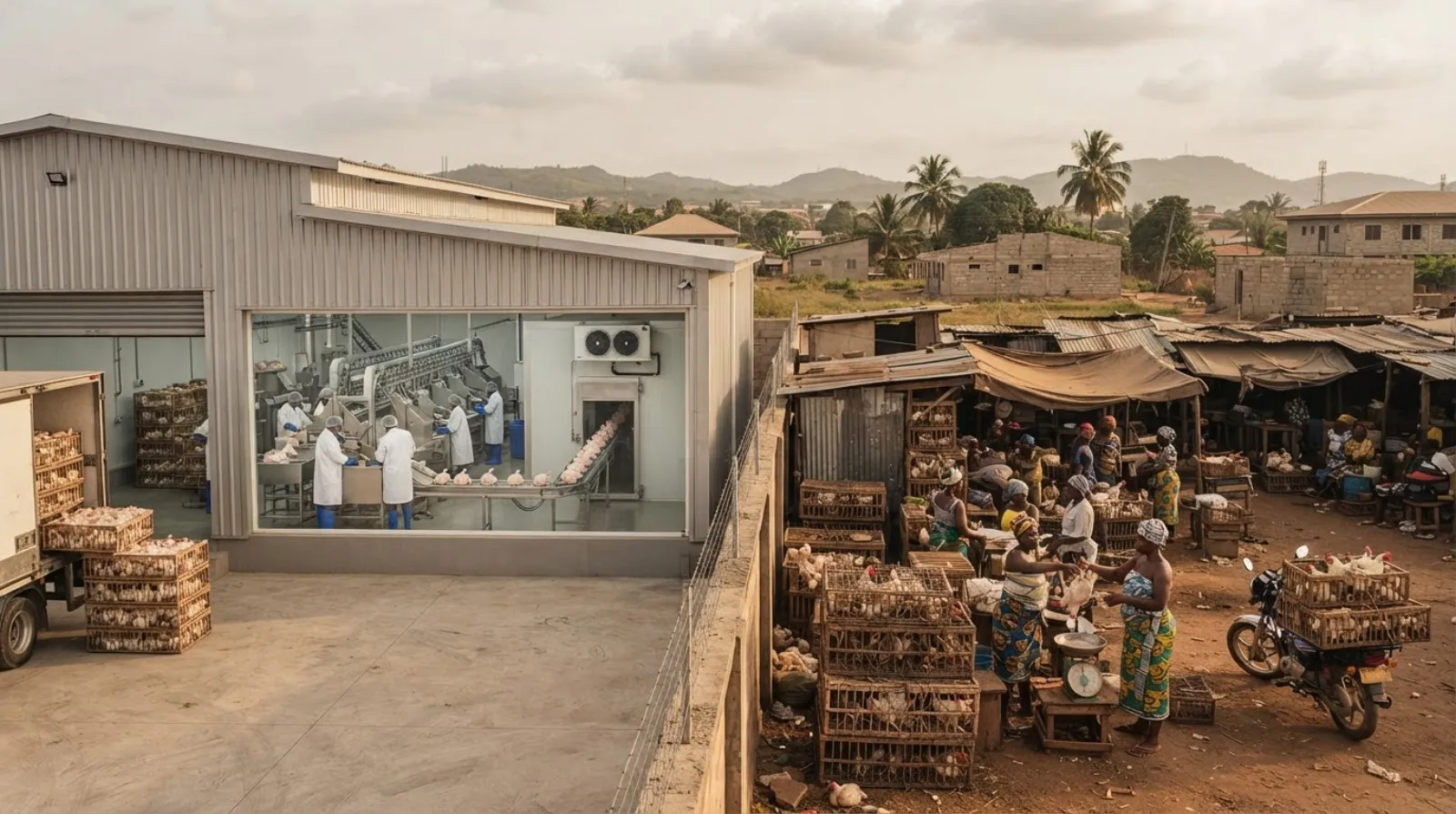
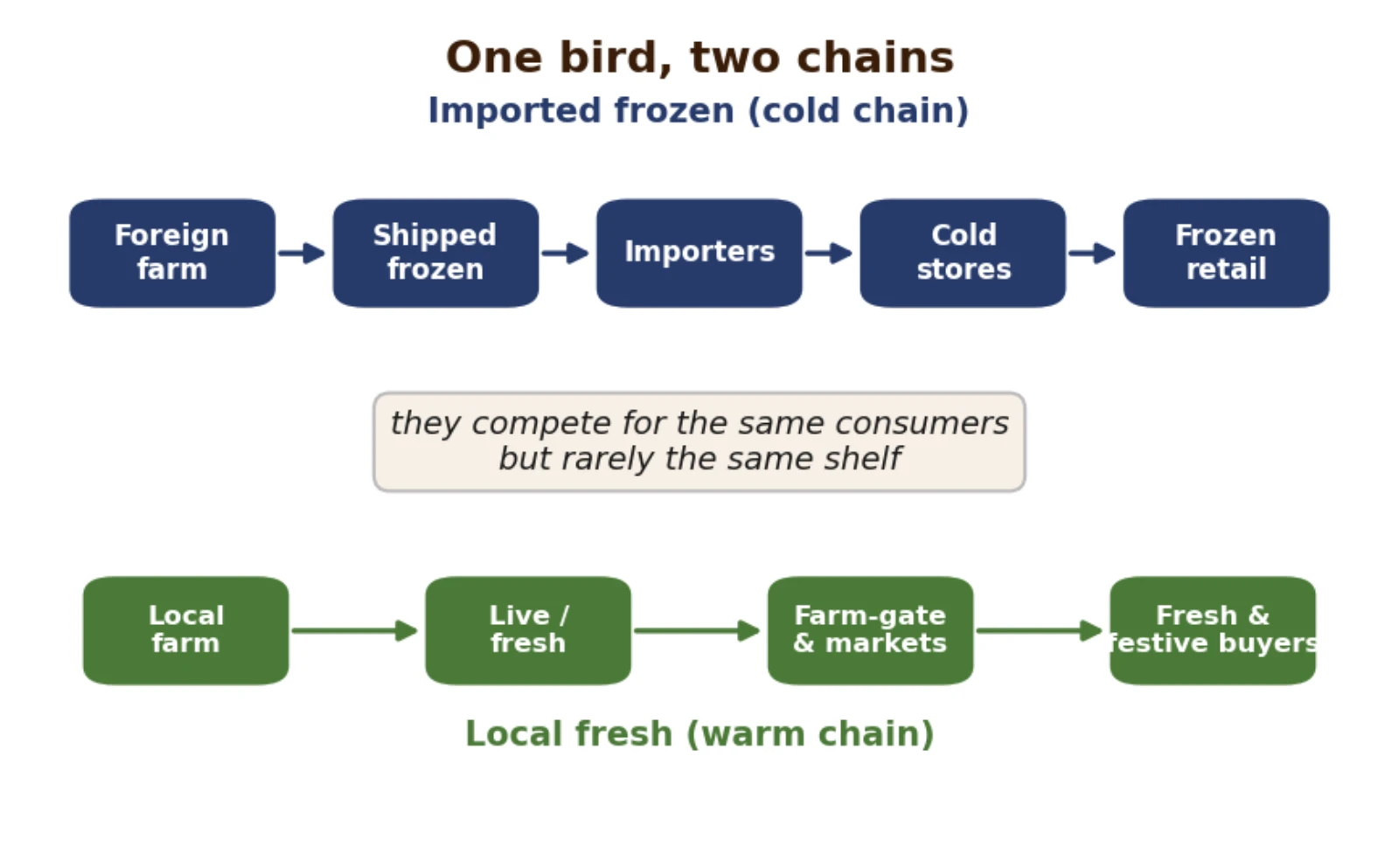
Two chains, not one. An imported frozen cold chain and a local fresh warm chain, rarely on the same shelf.
Value Chain Analysis · Pillar 06

This is the pillar that ties the whole business together, and it is detailed enough to stand on its own as the value chain analysis for broiler chicken in Ghana. It follows the bird from the imported chick to the plate, shows who along that chain earns what, and finds the one broken link, processing and cold storage, that decides whether local chicken ever competes. Read this pillar to understand not just how the chain works, but where a newcomer can profitably stand in it.

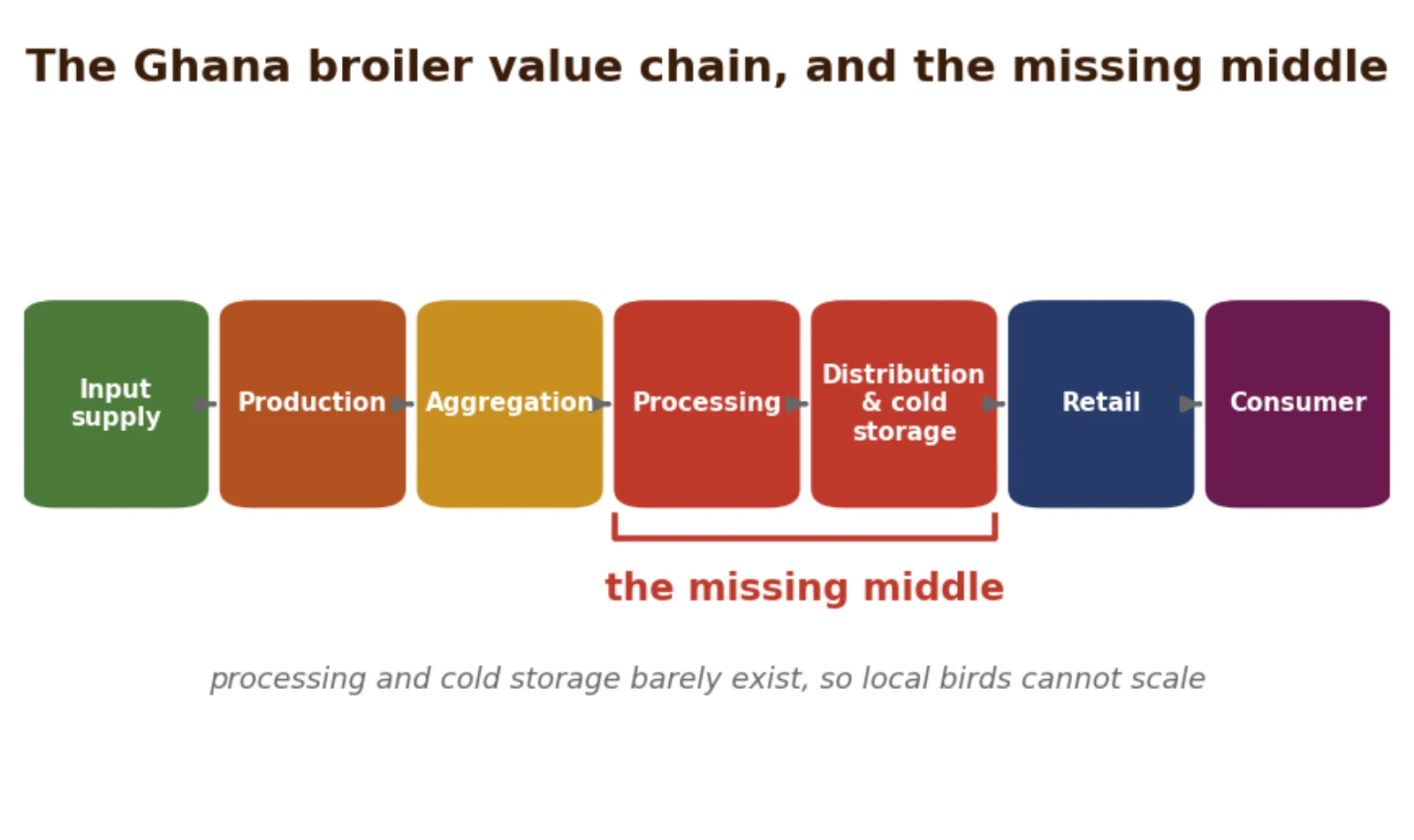
A broiler passes through the same set of hands from egg to table, and value is added, and captured, at each one. The stages are input supply (the imported parent stock, hatcheries and feed mills), production (the farms of Pillars 4 and 5), aggregation (the traders who gather birds), processing (slaughter and dressing), distribution and cold storage, retail, and finally the consumer.

The striking thing about Ghana's chain is not the stages themselves, which look like any country's, but where they are strong and where they break.

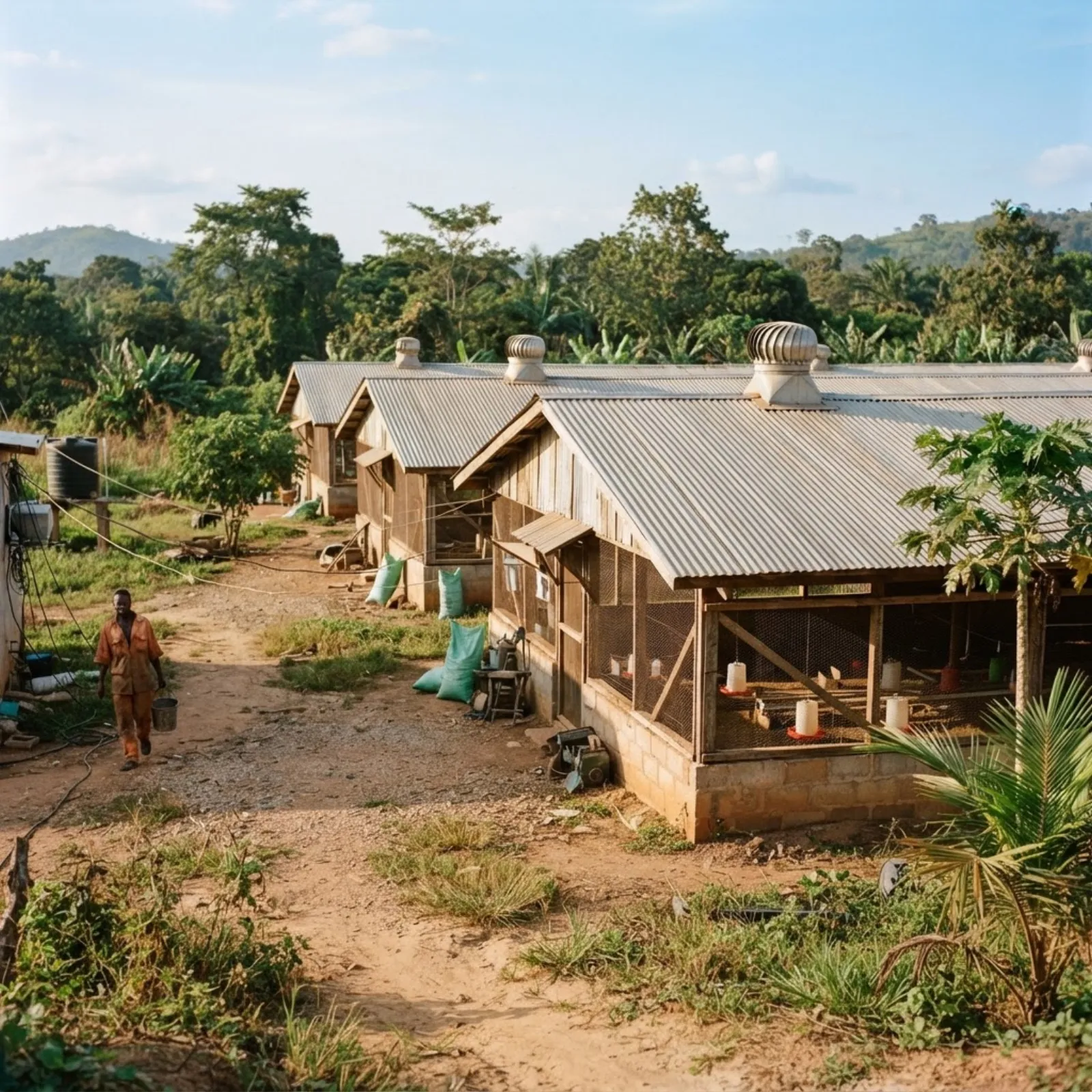
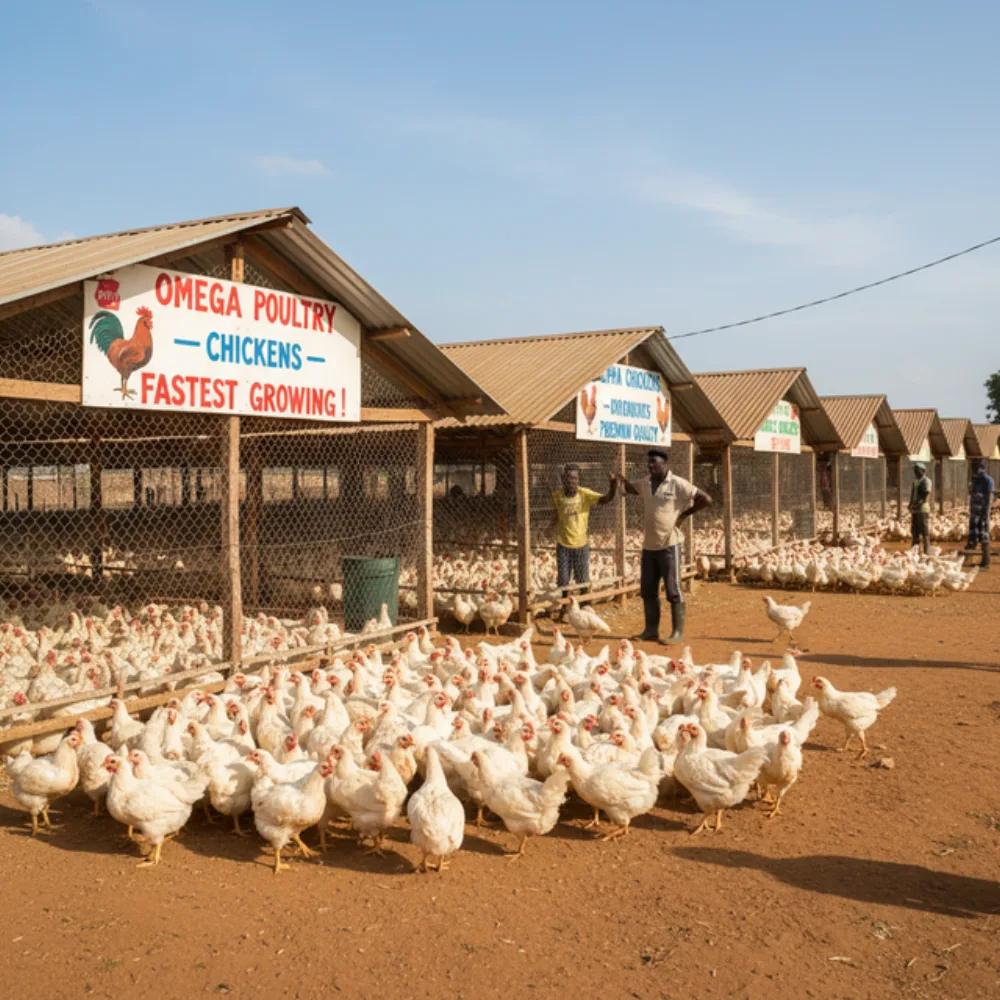
A commercial broiler house in Ghana with thousands of white broilers near market weight under warm shed lighting
Where the value is made, and lost
From chick to plate: the broiler passes through the same set of hands from egg to table, and value is added, and captured, at each one.
Two chains
not one: an imported frozen cold chain and a local fresh warm chain
~45%
of the chain's value is added by producers, about GH¢15.7 a bird
~42%
of birds leave live across the border, for lack of an organised home
The Ghana broiler value chain from imported chick to consumer, and where imports capture value
Figure 12 The Ghana broiler value chain from imported chick to consumer, and where imports capture value
What this shows

Follow the bird from the imported chick to the consumer and the pattern is clear. The value is created upstream at the farm, but the control, and the cold chain that reaches the modern shelf, sit downstream with a few well-capitalised players, and imported frozen chicken captures the value a local bird cannot.

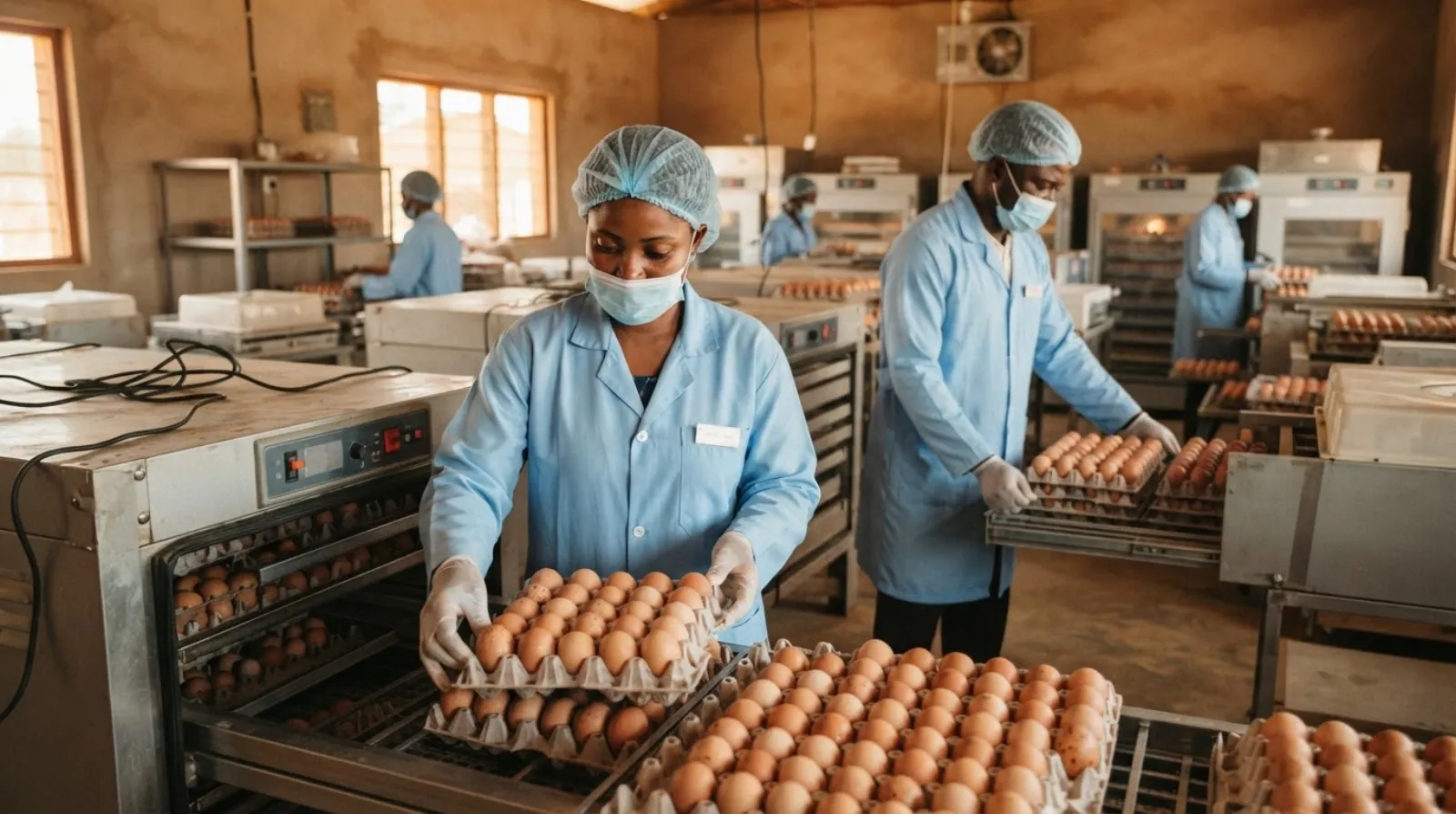
A Ghanaian poultry hatchery with trays of day-old broiler chicks under warm incubator light, workers in coats sorting chicks
The imported input base
The chain does not begin in Ghana. It begins with imported parent stock and day-old chicks.

🐔 Stage by stage: who operates each link 🐔

The value is not spread evenly

The chain rewards a close look, because the value, the power and the breakages are not spread evenly. Walk it link by link and the pattern is clear: the value is created upstream at the farm, but the control, and the cold chain that reaches the modern shelf, sit downstream with a few well-capitalised players. The table reads each link for an entrant, and the paragraphs that follow draw out the three links that decide the chain, the imported input base, the empty middle, and the concentrated distribution end.

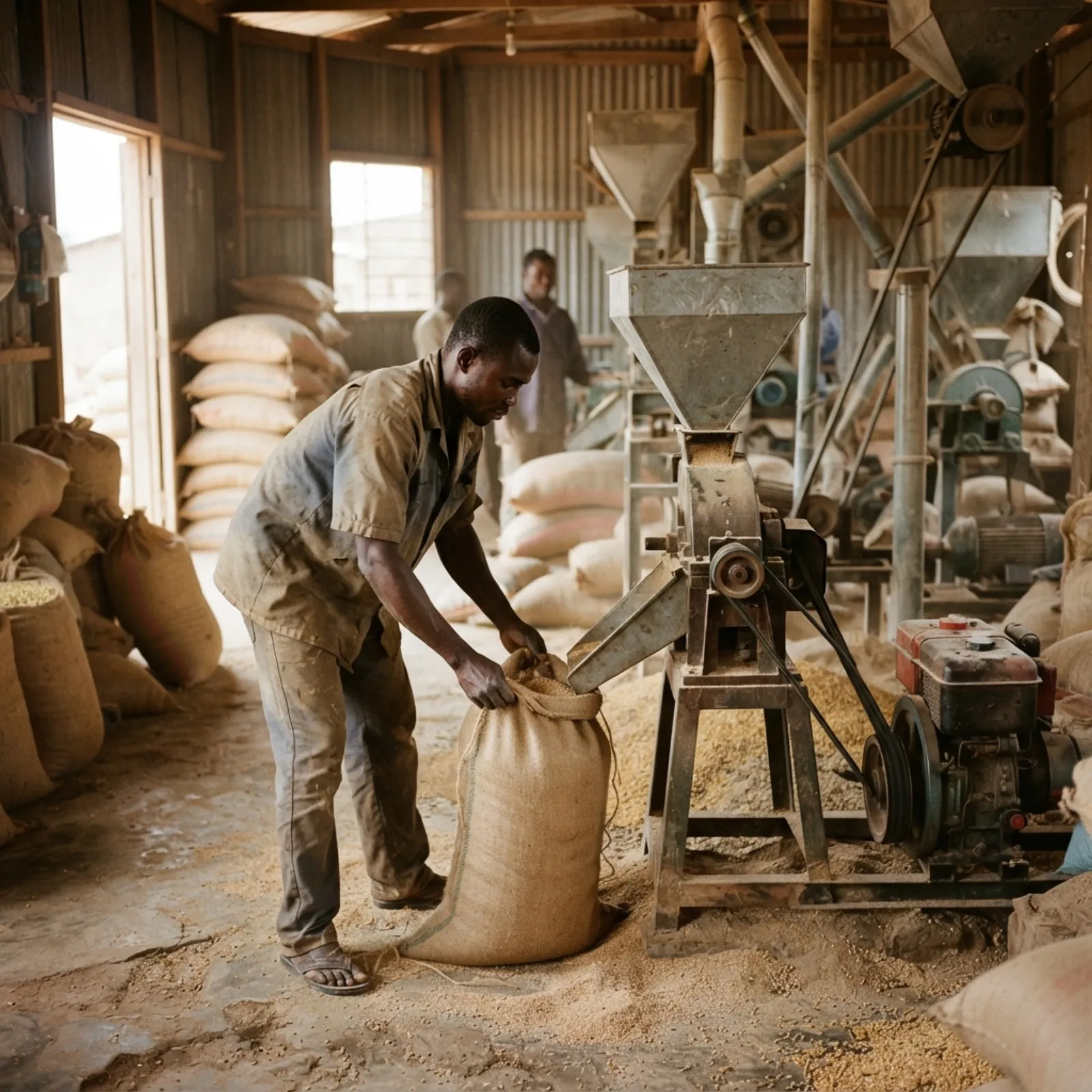
A Ghanaian poultry feed mill with sacks of maize and soya, augers and mixing silos, workers bagging finished broiler feed
Dollar-priced inputs
Feed built on maize and soya that track the world price, so each cycle starts with a foreign-exchange bill before a bird is fed.
The broiler value chain, read link by link, for the entrant
Table 12: The broiler value chain read link by link, for the entrant
LinkWho operates itWhat it capturesIts binding constraintThe opening inside it
Input supplyA few parent-stock and chick importers, about 15 hatcheries, and feed millsScarce, dollar-priced inputs with strong pricing powerMost chicks and much feed are imported and foreign-exchange exposedLocal hatching and feed milling that cut the import bill
ProductionAbout 29 large commercial farms and many smallholdersThe most value added, but it carries the disease and cost riskFragmented, thin-margin, and few cycles a yearEfficiency and aggregation, not another undifferentiated farm
AggregationInformal traders and middlemenThin, opaque margins; the chain's weakest connective tissueNo organised system, so about 42 percent of birds leave live across the borderOrganised aggregation and offtake tied to a confirmed buyer
ProcessingAlmost none independent; a few integrators such as Darko FarmsA high potential margin the country barely capturesThe binding bottleneck: no hygienic dressing or standard cuts at scaleCertified small-scale processing, the single biggest gap
Distribution and cold storageConcentrated frozen-import distributors and cold storesA modest share of value, but outsized power over priceThe cold chain serves imports, so local fresh is locked outCold-chain logistics that give local birds a route to the shelf
RetailCold stores and supermarkets for frozen; open markets for fresh and liveA retail margin on frozen, a premium on trusted freshBuyers switch to imports once local is dearerA branded local-fresh position the import cannot occupy
ConsumerHouseholds, food service, and festive and institutional buyersLarge and rising demand, price-led for the bulkFresh and trusted for the premium, cheapest for the restThe fresh, festive and institutional lanes local can win

Sources: Onumah et al. (2023); Apike et al. (2024); Aboah et al. (2025); and Pillars 1, 4 and 5.

The input base is imported. The chain does not begin in Ghana. It begins with parent stock and day-old chicks shipped in, and with feed built on maize and soya that track the world price, so almost all of the chick supply is foreign (Onumah et al., 2023; and Pillar 1). Input suppliers, though few, hold real pricing power, because they sell a scarce, dollar-priced good every farm must buy, and each cycle starts with a foreign-exchange bill before a bird is fed. The first structural fix in the chain is to make more of this input base at home.

The middle is empty. Between the farm and the shelf sits the link that should turn a live bird into a standard, chilled, sellable product, and in Ghana it barely exists. Aggregation is informal and independent processing is close to absent, so a farmer with mature birds often has nowhere to take them but the live market at the farm gate. The value that should be captured in dressing, portioning and cold storage simply leaks away. This empty middle is the chain's defining weakness and its largest opening.

The end is concentrated. Where the local chain is fragmented across many small farms, the imported chain's distribution end is tightly held by a few well-capitalised importers and cold-store operators (Apike et al., 2024). With the storage and reach the local chain lacks, they set the terms and hold their margins through control of cold storage and market access. The result is an hourglass: many small farms at one end, a mass market at the other, and a narrow, powerful, import-fed waist in between.

🐔 One bird, two chains 🐔

The two broiler chains in Ghana: the imported frozen cold chain against the local fresh warm chain
Figure 13 The two broiler chains in Ghana: the imported frozen cold chain against the local fresh warm chain
What this shows

Laying the two side by side shows why they rarely meet, and why the local chain cannot simply copy the imported one. They differ at every link, from where the bird starts to where it wins.

The single most important fact about the chain is that there are really two of them, running side by side and barely touching.

The imported frozen chain runs cold: birds raised abroad, shipped frozen, cleared through a concentrated group of importers, held in cold stores and sold as frozen cuts. The local fresh chain runs warm: birds raised on Ghanaian farms, sold live or freshly dressed, moved fast because there is little cold storage, and eaten near where they are grown.

These two chains compete for the same stomachs but almost never on the same shelf, and that is the key to the whole analysis.

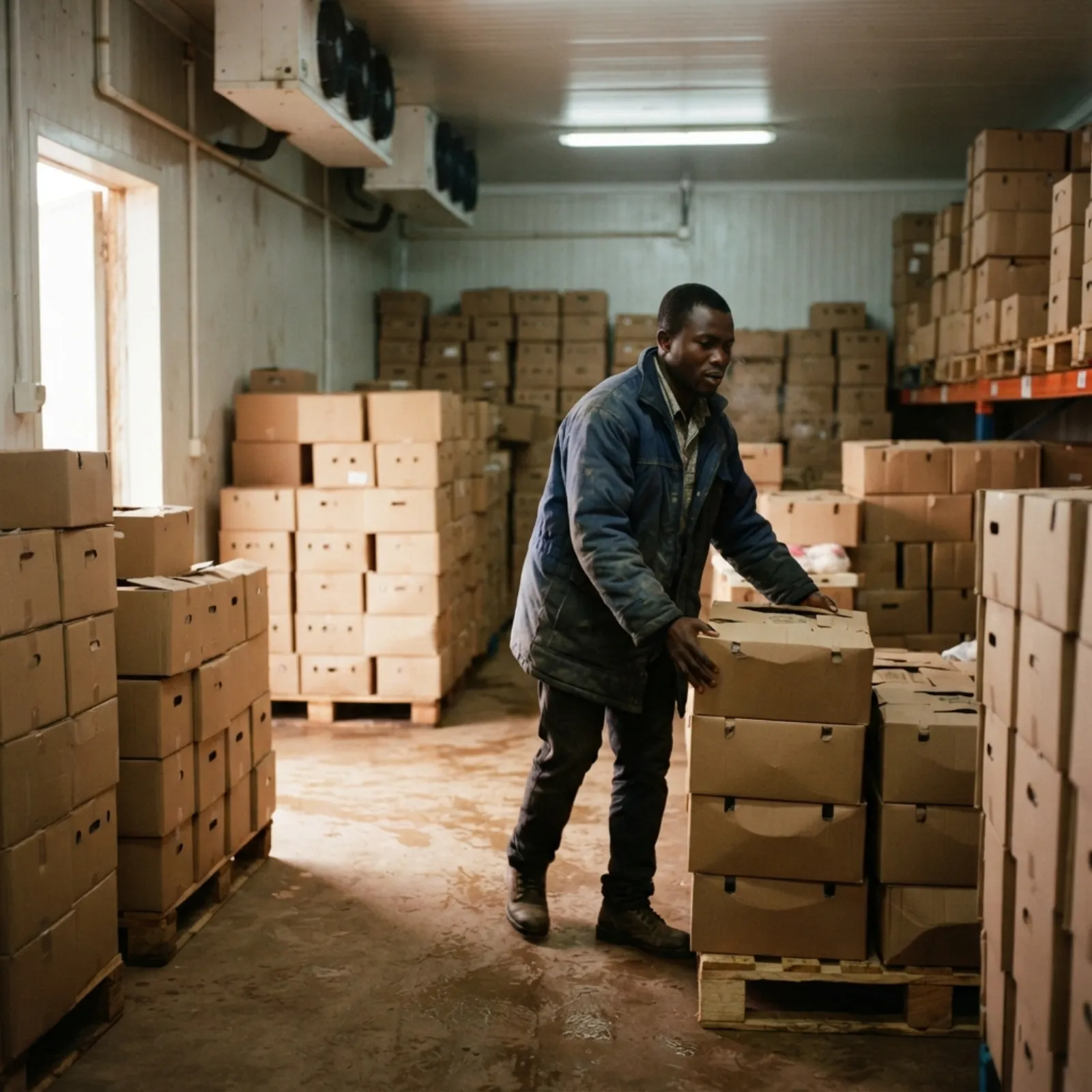
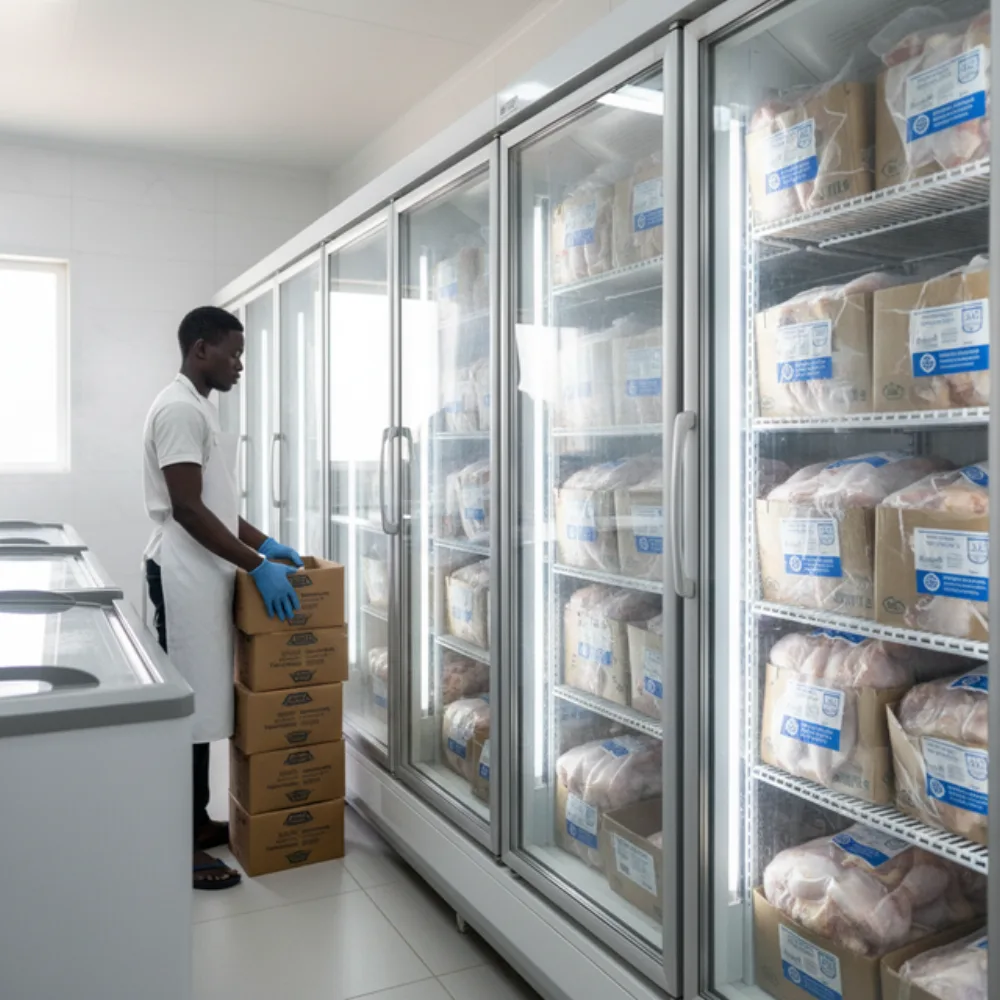
Stacked cartons of imported frozen chicken in a Ghanaian cold store, frost on the boxes, a worker in a padded jacket
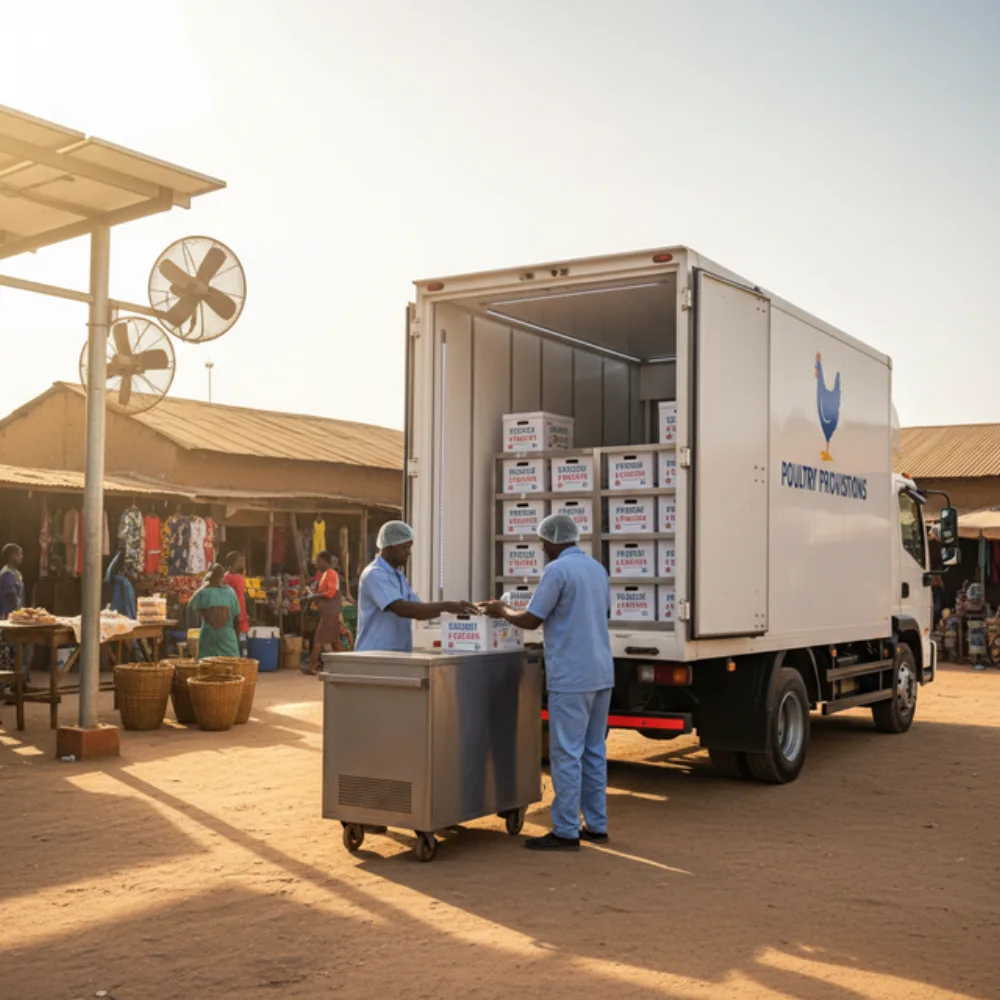
The imported cold chain
Birds raised abroad, shipped frozen, held in cold stores and sold as frozen cuts.
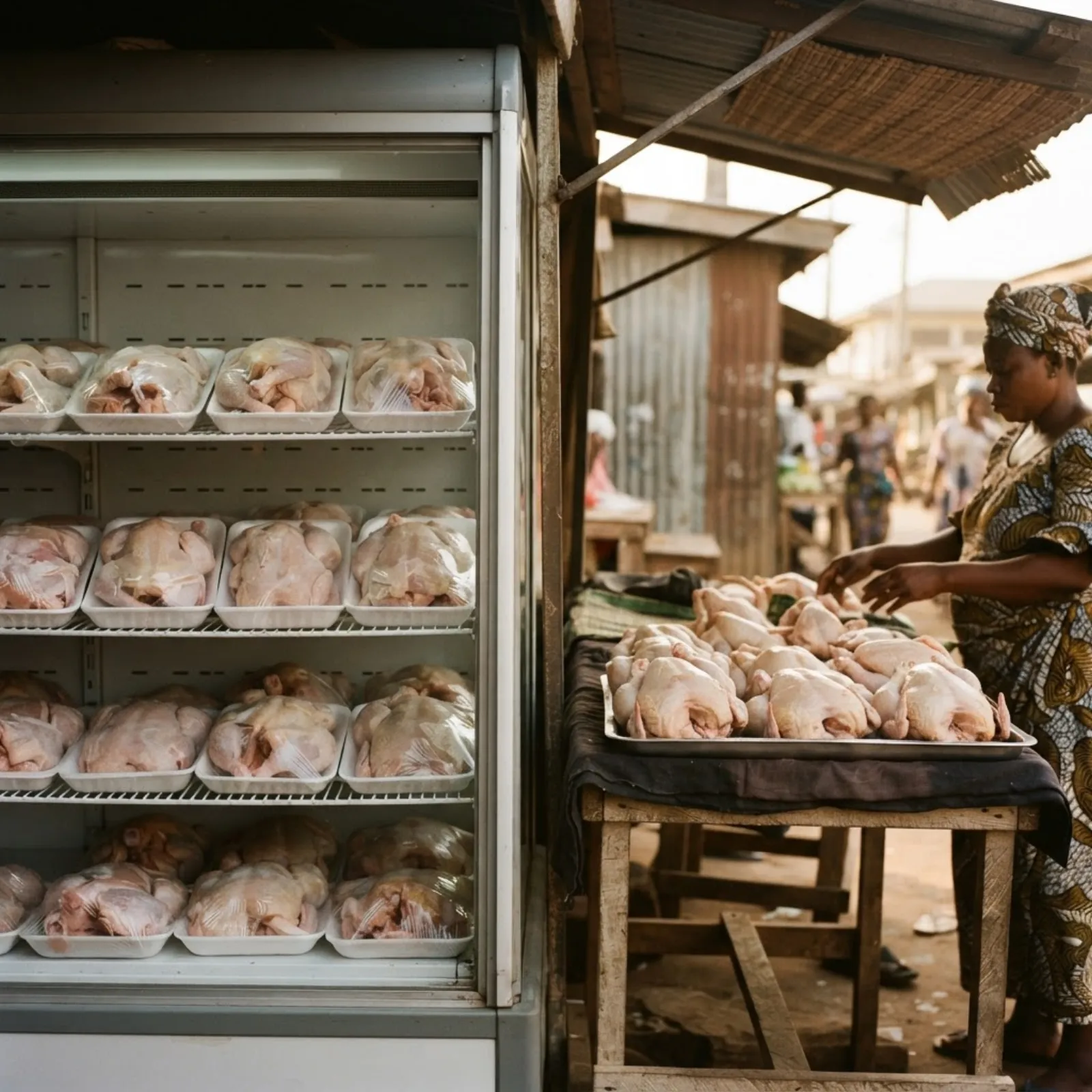
A Ghanaian open-market poultry stall selling freshly dressed local chicken, a vendor handing a bird to a customer
The local warm chain
Birds raised on Ghanaian farms, sold live or freshly dressed, moved fast because there is little cold storage.
The two broiler chains compared, link by link
Table 13: The two broiler chains compared, link by link
How they differImported frozen (cold chain)Local fresh (warm chain)
Where it startsForeign farms raising birds mainly for breast meatGhanaian farms, the production of Pillars 4 and 5
How it movesShipped frozen and held in cold stores; moved refrigeratedSold live or freshly dressed; moved fast because there is no cold chain
Who controls itA concentrated group of importers and cold-store distributorsFragmented producers and informal traders
Its cost edgeLeg quarters are a cheap by-product of the breast-meat tradeNone; it carries the full cost of feed, chick and time
Where it winsThe frozen shelf, supermarkets and price-led home cookingFresh, live, festive and, now, institutional buyers
Its weaknessDepends on trade and the exchange rate; far from freshnessNo processing or cold chain to reach the modern shelf

Sources: Onumah et al. (2023); Apike et al. (2024); Aboah et al. (2025).

The two chains explain why the market feels stuck. The imported chain wins the frozen commodity market on price, as Pillar 2 showed, while the local chain holds the fresh and live market on freshness and trust. Read plainly: local chicken is not losing a fair fight in its own arena, it is being kept out of the frozen arena by cost and out of the modern-retail arena by the lack of processing and cold chain. Fix the second, and the local chain can finally reach the shelves the import now owns.

🐔 Who earns what along the chain 🐔

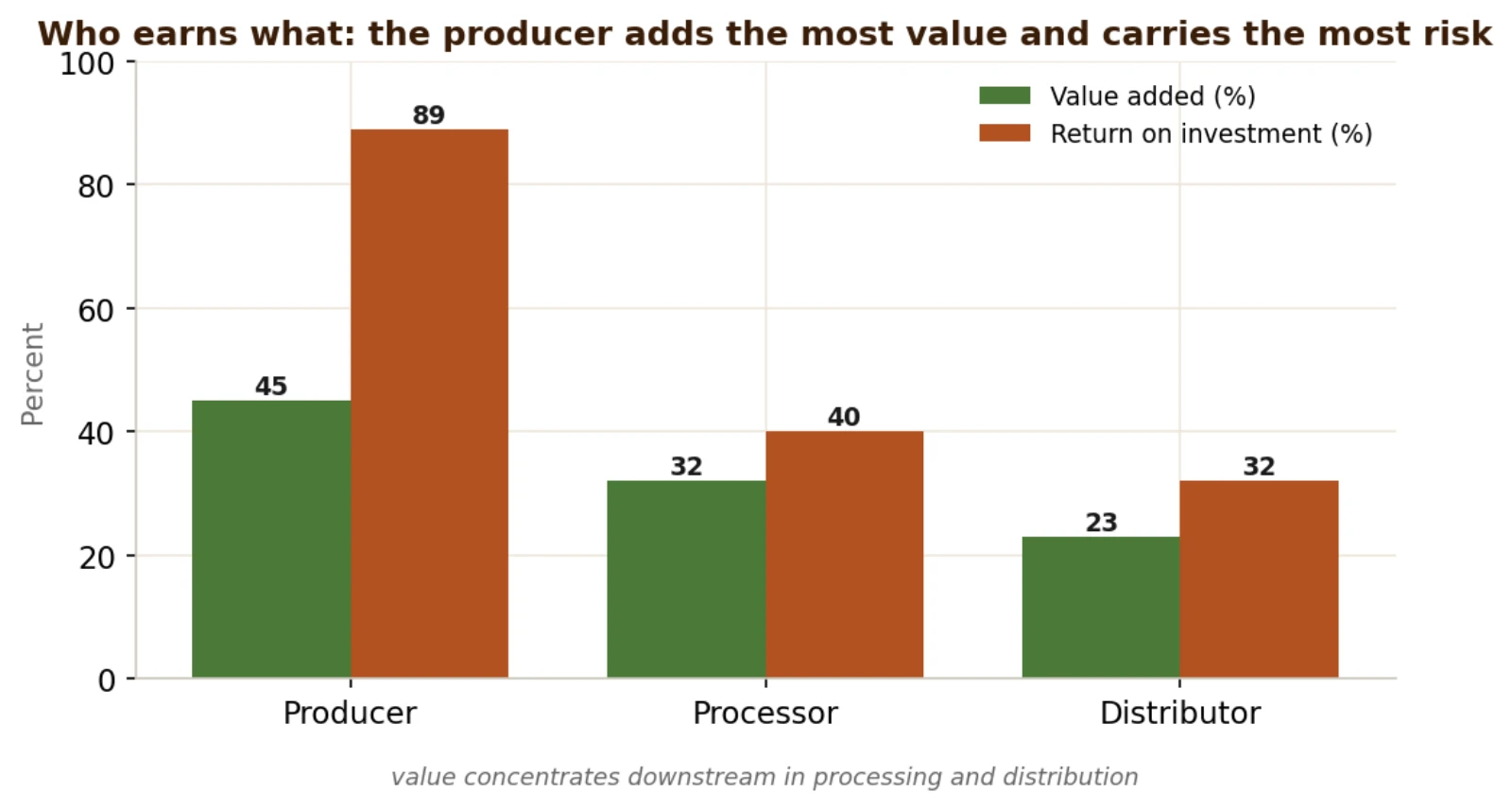
Follow the money along the local chain and a clear pattern appears. On the best Ghanaian evidence, producers add about 45 percent of the chain's value, about GH¢15.7 a bird, and earn about 89 percent return, against about 40 percent for processors and 32 percent for distributors (Onumah et al., 2023).

The producer, in other words, does the hardest, riskiest work, raising the bird through disease and feed-cost swings, and earns a strong return per bird, but sits below the processors and distributors who handle the bird for far less effort. Processors add about 32 percent of the chain's value and distributors about 23 percent, yet earn returns of about 40 and 32 percent by controlling the steps the producer cannot (Onumah et al., 2023). Those downstream actors, the study found, behave like informal cartels, using their control of slaughter and market access to hold their margins while the producer carries the risk.

Who earns what along the local broiler chain: value added and return by actor
Figure 14 Who earns what along the local broiler chain: value added and return by actor
What this shows

Producers add about 45 percent of the chain's value and earn about 89 percent return, yet the processors and distributors who handle the bird for far less effort hold the margin. The producer does the hardest, riskiest work but sits below the actors who control slaughter and market access.

The producer is what the study calls the chain's key governor, the actor everything depends on, yet the margin concentrates a step downstream, at processing and distribution, where a few players control access. Read plainly: raising birds is necessary but it is not where the easiest money sits. The strategic move for a newcomer is often not to become another producer competing on a thin margin, but to take a position at the concentrated, underserved processing and distribution step, where the leverage is.

Share of the chain's value added
~45%
added by producers, about GH¢15.7 a bird
~32%
added by processors
~23%
added by distributors
Return earned by actor
~89%
return for producers, who carry the disease and cost risk
~40%
return for processors, who control slaughter
~32%
return for distributors, who control market access

🐔 The missing middle: processing and cold chain 🐔

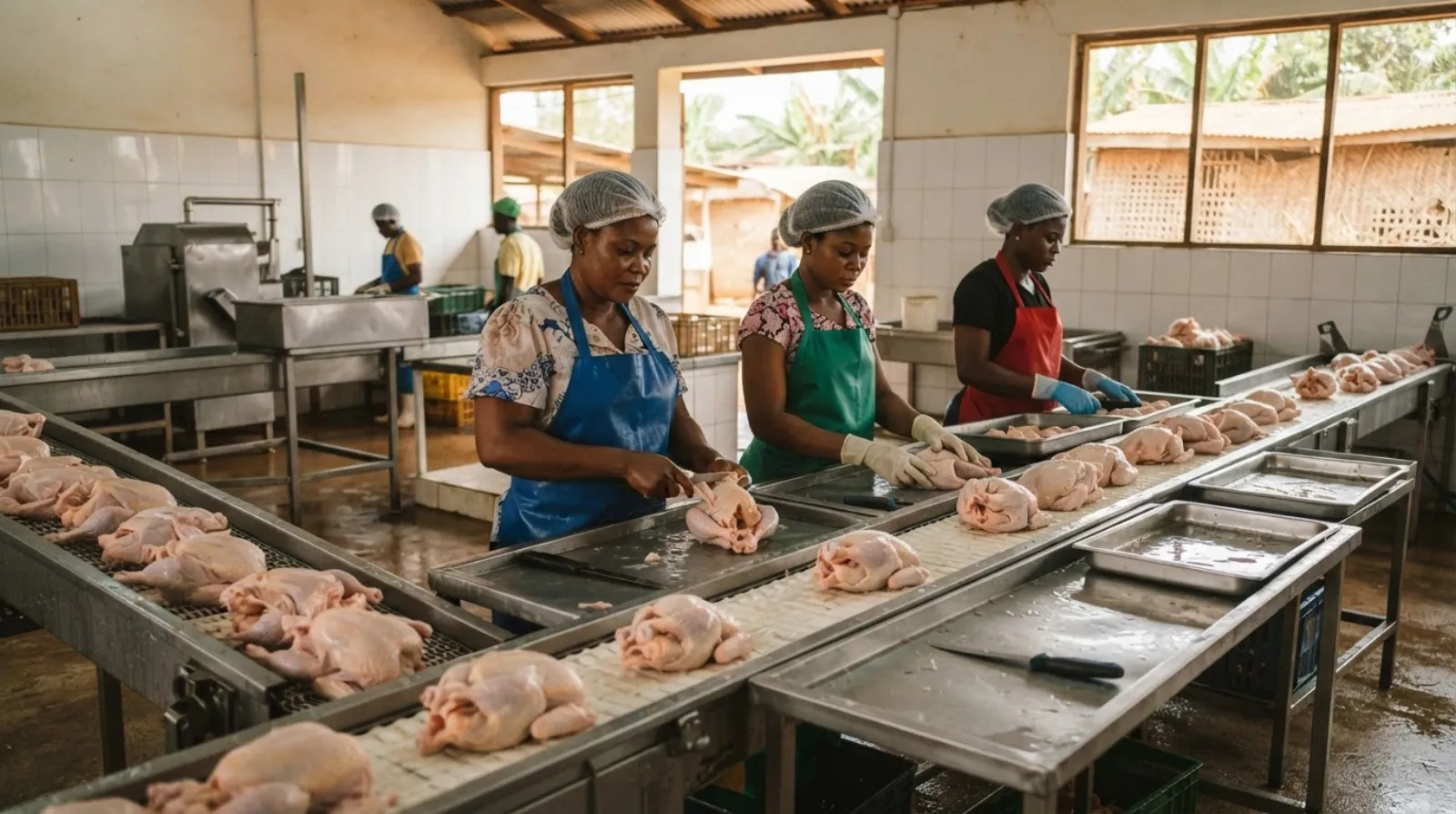
Inside a small hygienic Ghanaian broiler processing unit, stainless tables, workers in aprons and gloves dressing birds into standard cuts, a chiller behind
The single biggest gap
The missing middle being built: hygienic dressing, standard cuts and cold storage, the link Ghana barely has.
The broken link that decides everything

Here is the broken link that decides everything. Ghana can raise birds, but it struggles to slaughter, dress, chill and move them at scale, so a farmer with mature birds often has nowhere to take them but the live market at the farm gate. The country has very little independent processing and cold-storage capacity, and even the largest integrated processor is a rare exception: Darko Farms, revived under One District One Factory, has processing capacity of up to about 10,000 birds a day (Poultry News Africa, 2025). Because there is no cold chain, local birds cannot be stored, standardised into cuts, or placed on a supermarket shelf, which is exactly where the imported frozen chain wins by default (Aboah et al., 2025).

This is the single highest-value opening in the whole playbook. The bottleneck is not the farm, it is what happens after the farm: slaughter, dressing, chilling and distribution. Whoever builds affordable processing and cold chain does not just start a business, they unlock every producer upstream of them by giving the local bird a route to the modern shelf. Read plainly: the mature bird with no home is a problem for the farmer and an opportunity for the person who solves it.

🐔 The import chain and the success-to-the-successful trap 🐔

The imported chain does not just compete with the local one, it actively crowds it out, and the pattern is self-reinforcing. As imports grow, they fund more cold stores and distribution, which lowers their cost and widens their reach, which grows imports again. Researchers describe this as a success to the successful trap, where the importers prosper precisely as the local industry weakens (Aboah et al., 2025). Indeed, the frozen-import trade is concentrated (a Gini of about 0.55 to 0.70), and distributors switch away from local chicken once it is more than about 10 percent dearer (Apike et al., 2024), so a handful of well-capitalised importers set the terms, while local supply stays fragmented across many small farms with little bargaining power against them.

0.55 to 0.70
Gini of the frozen-import trade: concentrated among a few importers
~10%
dearer is all it takes for distributors to switch away from local chicken
10,000/day
birds even the largest integrated processor, Darko Farms, can dress

The trap is real but it is not destiny. It runs on one advantage: the import chain has processing and cold chain, and the local chain does not. Read plainly: the same missing middle that starves the local producer is what lets the import chain compound its lead. Break the processing and cold-chain bottleneck, and the self-reinforcing loop can be turned the other way, which is why every serious policy lever in Pillar 8 points at that link.

🐔 The four problems that hold the whole chain back 🐔

Stepping back from the individual links, a systems study of Ghana's poultry chain finds four problems that reinforce one another and keep the local chain weak (Aboah et al., 2025). Naming them matters, because each is a place where a reform, or a business, can intervene, and because no single one can be fixed on its own.

Table 14: The four systemic problems in Ghana's poultry value chain, and where each can be broken
The systemic problemWhat it does to the chainWhere it can be broken
Weak vaccine and research fundingDisease keeps circulating, raising loss and cost on every farmInvestment in animal health and diagnostics (see Pillar 3)
Low biosecurityRepeated outbreaks and reinfection undermine even well-run farmsAffordable biosecurity kits, training and certification
Limited access to creditFarms cannot fund the working capital a cycle ties up, so they stay smallCycle financing and input-on-credit tied to a confirmed buyer
Import competition and input dependenceCheap frozen imports cap the price, and imported chicks and feed raise cost, together starving the local chain of scaleBorder control and a higher tariff, paired with local processing, hatching and feed

Source: Aboah et al. (2025).

The four problems are linked: disease and weak biosecurity raise cost, thin credit keeps farms small, and cheap imports cap the price, so no single fix is enough on its own. Read plainly: the chain will not be reformed one farm at a time. The input, health, finance and processing gaps have to be closed together, which is exactly why the missing middle and local inputs, not more birds, are the leverage points.

🐔 Where a newcomer fits 🐔

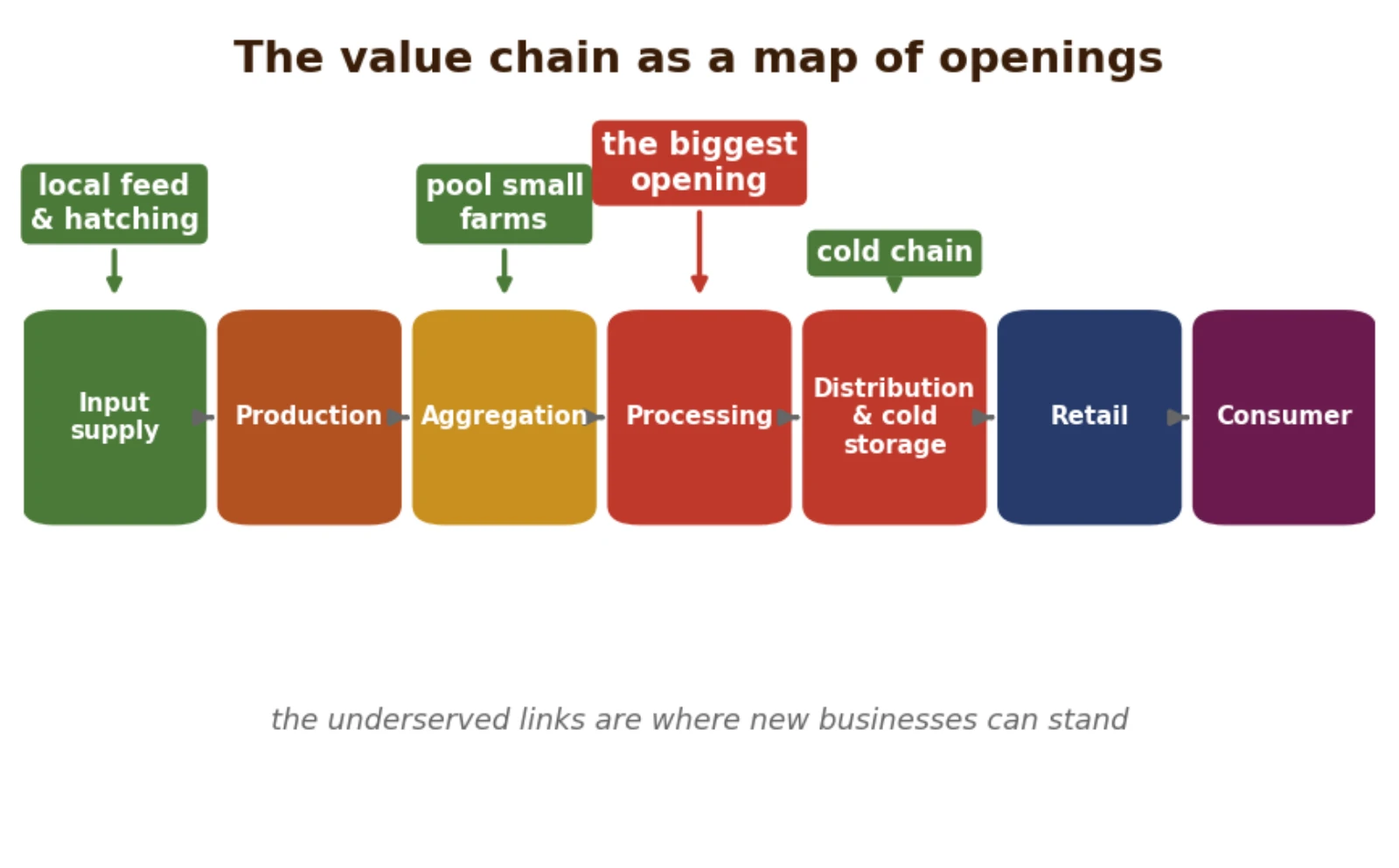
The broiler value chain as a map of openings, by capital needed and how underserved each node is
Figure 15 The broiler value chain as a map of openings, by capital needed and how underserved each node is
What this shows

The value chain read as a map of openings. The crowded, thin-margin, capital-heavy node is production itself. The underserved, higher-leverage nodes sit around it: local inputs, the missing middle of aggregation, processing and cold chain, and the branded fresh-retail end.

Enter where the need is greatest

The value chain read as a map of openings tells a first-time entrant where to stand. The crowded, thin-margin, capital-heavy node is production itself. The underserved, higher-leverage nodes are the ones around it: the input side (local hatching and feed of Pillar 1), the missing middle (aggregation, processing and cold chain), and the fresh-retail end (branded local chicken of Pillar 2). The lesson of the chain is to enter where the need is greatest and the competition thinnest, not simply to raise more birds.

🐔 The Opening: where to stand in the chain 🐔
01

Build the small-scale processing. Hygienic, certified dressing of local birds into standard cuts is the missing link, and it unlocks every producer who can then reach a modern buyer. It is the single biggest gap in the chain.

02

Own the cold chain and logistics. Even modest chilled storage and refrigerated transport lets local fresh chicken reach supermarkets, food service and institutions instead of only the farm-gate live market.

03

Aggregate and arrange offtake. Pooling smallholder birds to supply processors, schools and food service at volume, and buying inputs in bulk, attacks the small-scale penalty from both ends.

04

Make more inputs at home. The chain begins with imported chicks and feed, so local hatching and feed milling of Pillar 1 cut the import bill, while a branded local-fresh position of Pillar 2 wins the shelf the import cannot occupy.

🐔 The risks that sit inside the value chain 🐔

No home for the mature bird

VERY HIGH
What it is

With almost no independent processing capacity, a farmer with birds ready at market weight often has nowhere to sell them but the live farm-gate market, where the price is set by whoever turns up. Birds held waiting keep eating, so every day without a buyer eats the margin.

Evidence

Processing and cold storage are the binding bottleneck of the chain (Aboah et al., 2025), and even the largest integrated processor has capacity for only about 10,000 birds a day (Poultry News Africa, 2025), a fraction of what a self-sufficient sector would need.

Who it hits

Every producer without a confirmed buyer or nearby processor, worst for those far from the big markets.

How to manage it, and the opening

Line up a processor or offtake buyer before placing birds, and time production to a confirmed order. The opening is the processing and aggregation service itself, the single biggest gap in the chain.

The cold-chain gap

HIGH
What it is

Without chilled storage and transport, local fresh chicken cannot be standardised, stored or placed on a supermarket shelf, so it is locked out of the modern retail and institutional markets that the imported frozen chain serves by default.

Evidence

The imported chain wins the frozen and supermarket shelf precisely because it has cold chain and the local chain does not, a gap that lets imports compound their lead (Aboah et al., 2025; Apike et al., 2024).

Who it hits

Local producers trying to reach modern retail, food service or institutional buyers.

How to manage it, and the opening

Invest in even modest chilled storage and refrigerated transport, or partner with someone who has it. The opening is cold-chain logistics as a service to the whole local chain.

Undercapitalised entry at the wrong node

MEDIUM-HIGH
What it is

A newcomer who puts scarce capital into another thin-margin production unit, the most crowded node, competes on the chain's weakest economics, while the underserved processing, cold-chain and aggregation nodes go unbuilt.

Evidence

Producers add the most value but the margin concentrates downstream at the concentrated processing and distribution step, where a few actors control access (Onumah et al., 2023).

Who it hits

First-time entrants who assume 'poultry farming' means owning birds, and enter where competition is thickest.

How to manage it, and the opening

Study the chain before choosing a node, and enter where the need is greatest and competition thinnest, usually the missing middle, not production. The opening is precisely the node others are avoiding.

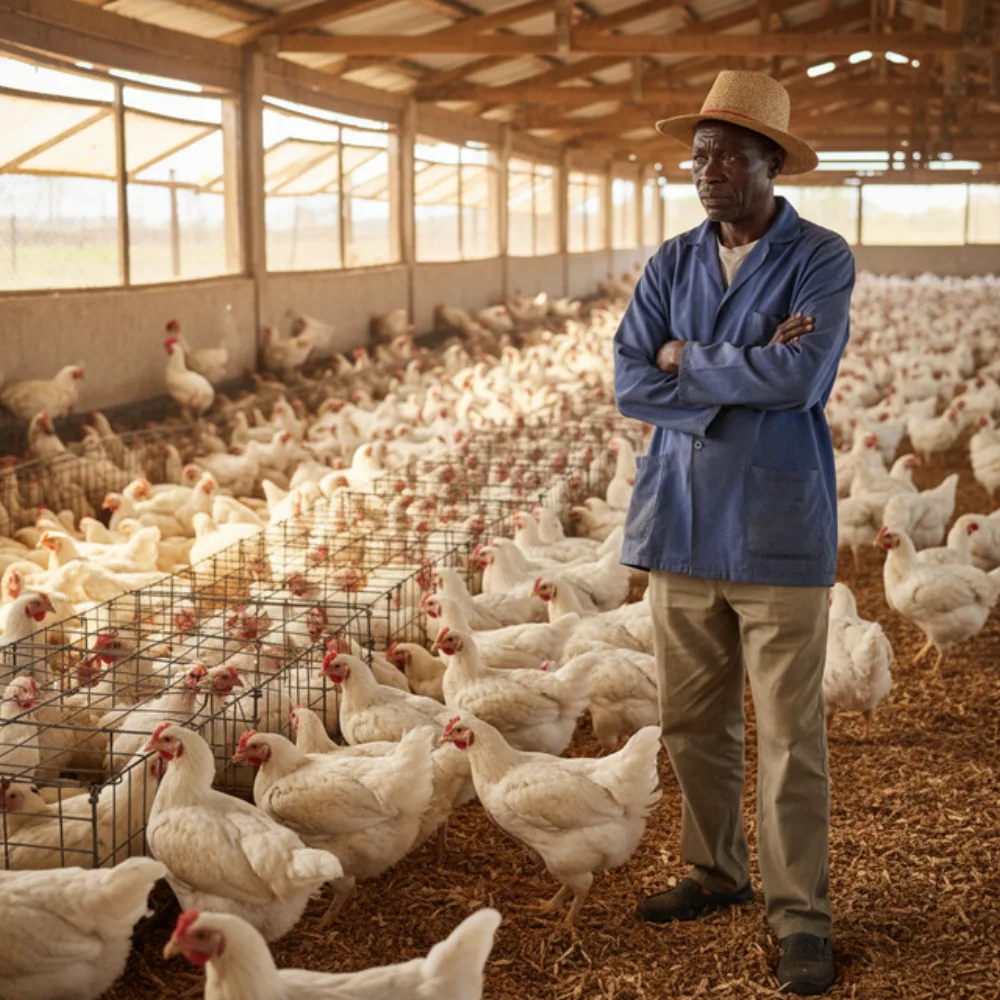
A Ghanaian broiler farmer beside mature birds at the farm gate with no processor to take them
No home for the mature bird
The mature bird with no place to be dressed and chilled is a loss for the farmer and an opening for whoever solves it.
Local fresh chicken locked out of a modern supermarket shelf for lack of cold chain
Locked out of the modern shelf
Without chilled storage and transport, local fresh chicken cannot reach the modern retail the frozen import serves by default.
A first-time entrant building yet another crowded broiler production unit instead of the underserved middle
Entry at the wrong node
Another production unit joins the most crowded node, while the underserved processing, cold-chain and aggregation nodes go unbuilt.
🐔 Key takeaways 🐔
01

Ghana has two broiler chains: an imported frozen cold chain and a local fresh warm chain. They compete for the same consumers but almost never on the same shelf.

02

Producers add the most value and carry the most risk, but the margin concentrates downstream at processing and distribution, where a few actors control access.

03

The missing middle, processing and cold chain, is the broken link that keeps local chicken off the modern shelf. It is the single highest-value opening in the playbook.

04

The import chain crowds out the local one in a self-reinforcing loop that runs on its cold-chain advantage. Breaking the processing bottleneck can turn that loop around.

05

For a newcomer, the smart move is usually not to raise more birds but to take a position in the underserved middle: processing, cold chain or aggregation.

Written for each reader

🐔 Practitioner intelligence 🐔

Hover any card to pause and lift it.

For students

If you are looking for a way into this business, do not assume it means owning birds. Walk the chain and find the missing link near you: often it is a farmer with mature birds and no hygienic place to have them dressed and chilled. Start by aggregating birds and arranging processing and delivery to a fresh buyer, learning the chain before you tie up capital. The trap is entering at the most crowded, thinnest-margin node, production, just because it is the most visible. What you gain is a view of where the real gaps are, and a service business that needs coordination more than capital.

For entrepreneurs

First move: build or secure small-scale processing and cold storage, because the missing middle is where the leverage and the least competition sit. Line up producers upstream and fresh, institutional or food-service buyers downstream before you invest, so the capacity is full from day one. The trap that kills first-timers is adding another production unit to a crowded node while the processing and cold-chain gap that would unlock the whole chain goes unbuilt. Solve the mature-bird problem for many farmers and you own the scarcest position in the chain.

For investors

Diligence asks: where in the chain does this venture sit, and is that node underserved or crowded. Production is capital-heavy and thin-margin; processing, cold chain and aggregation are scarce and hold pricing power. The thesis worth backing is the missing middle: certified processing and cold-chain logistics that give local birds a route to the modern shelf and break the import chain's compounding advantage. Underwrite the offtake and the throughput, and treat another undifferentiated broiler farm as the least attractive way into this sector.

For ecosystem actors

The lever is the missing middle: public and blended finance for certified small-scale processing, cold-chain infrastructure and aggregation hubs, the link the market has failed to build on its own. Measure success as processing and cold-storage capacity created and the share of local birds reaching modern retail and institutions, not as farms funded. The failure to avoid is financing yet more production while the processing and cold-chain bottleneck stays shut, which strands the extra birds and repeats the cycle that past programmes have run.

Download full PDF
UpcomingThis document isn't available yet.