Ghana Agribusiness PlaybookRice
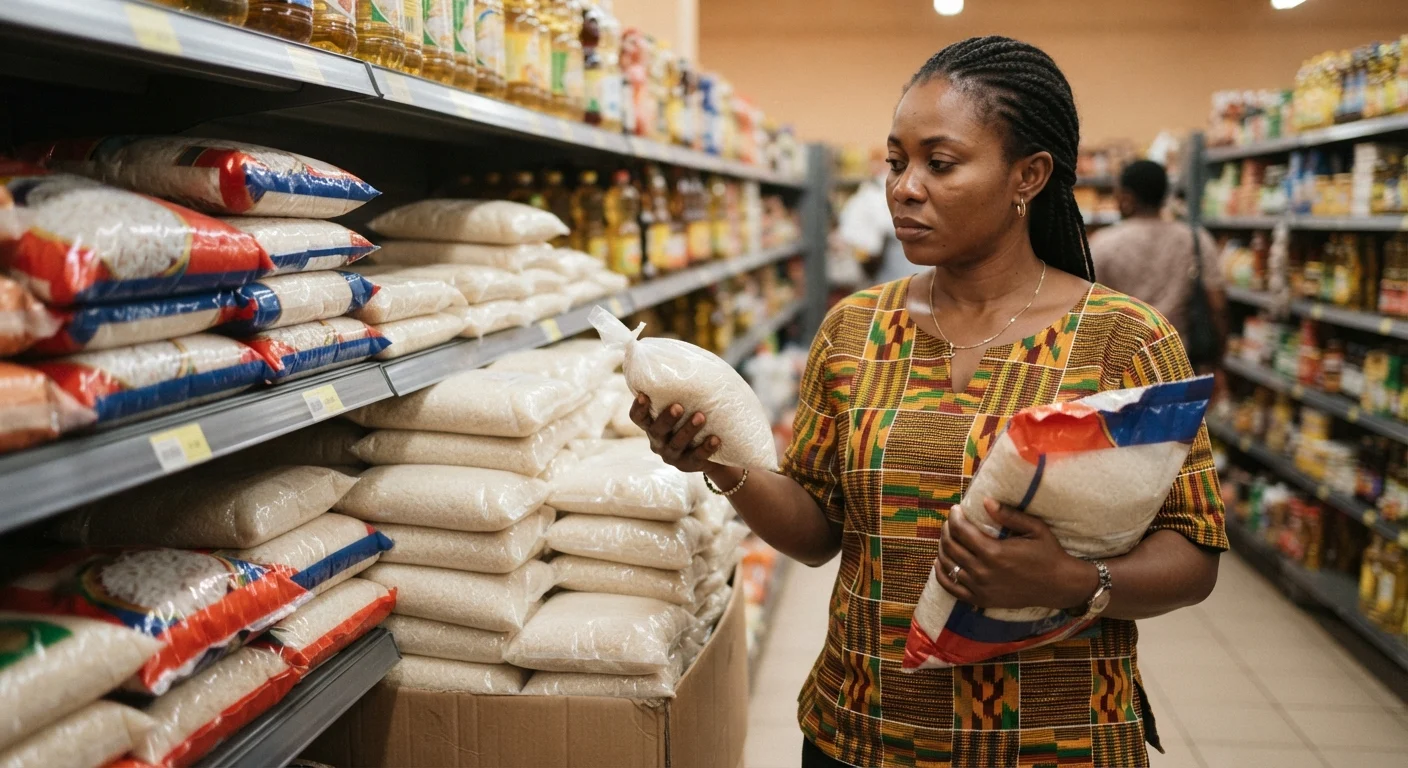
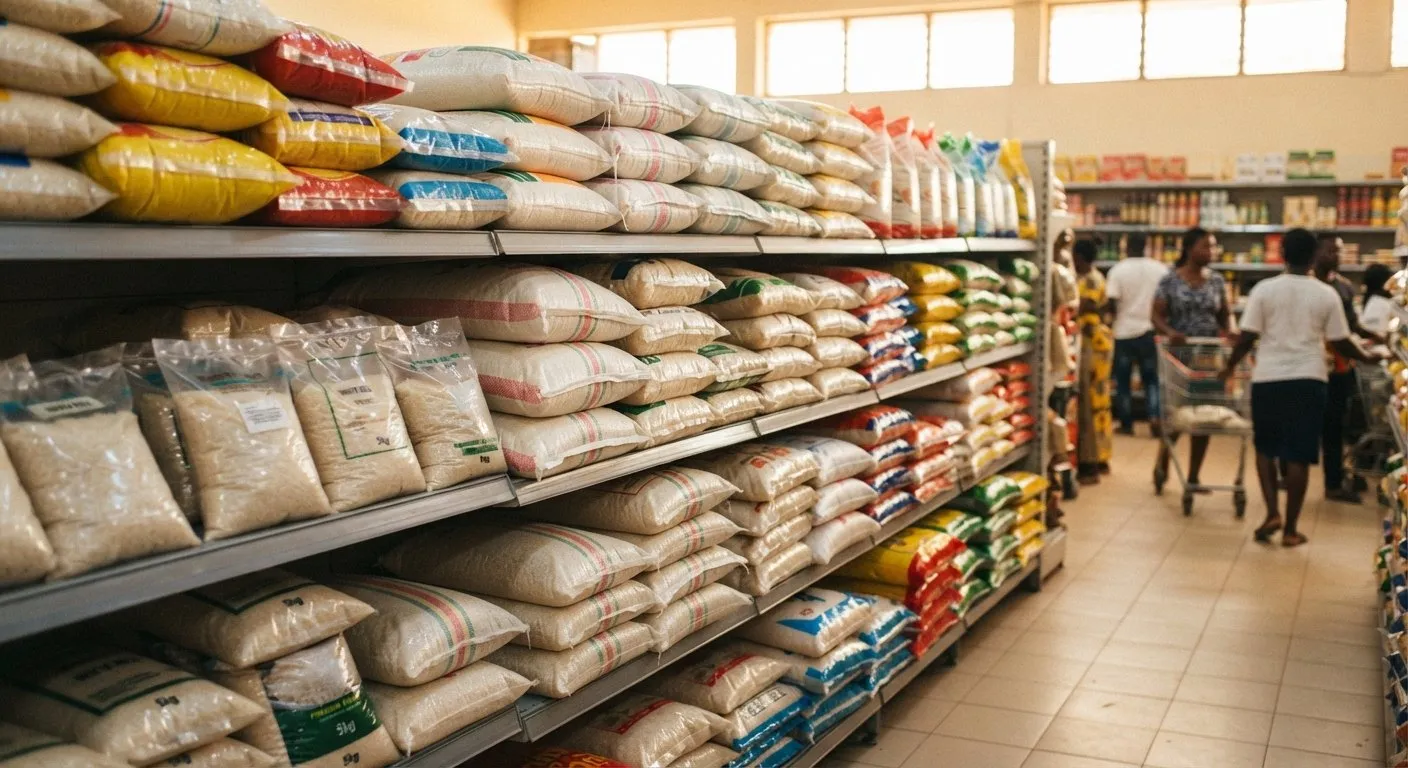
Branded local rice beside imported rice on a supermarket shelf
Rice · Pillar 02

Demand

The buyer is already here, and already paying someone else.
Demand · Pillar 02

Most crops in Ghana have to search for a buyer. Rice does not. The demand is enormous, it is growing, and it is already being paid, the trouble is that most of the money is going abroad. Ghanaians now eat about 1.9 million tonnes of milled rice a year, roughly 53 kilograms each, and that appetite has grown with every year of urban living and every busy household that wants a quick meal (United States Department of Agriculture, 2026). Yet only about half of that rice is grown in Ghana. About 1 million tonnes is imported each year, and in 2024 that cost the country about GH¢3.05 billion, some 7.8 percent of the whole food import bill (Ghana Statistical Service, 2025). This pillar answers the one question every rice business must answer first: who buys the rice, why do they buy imported over local, and what would it take to move that spending home.

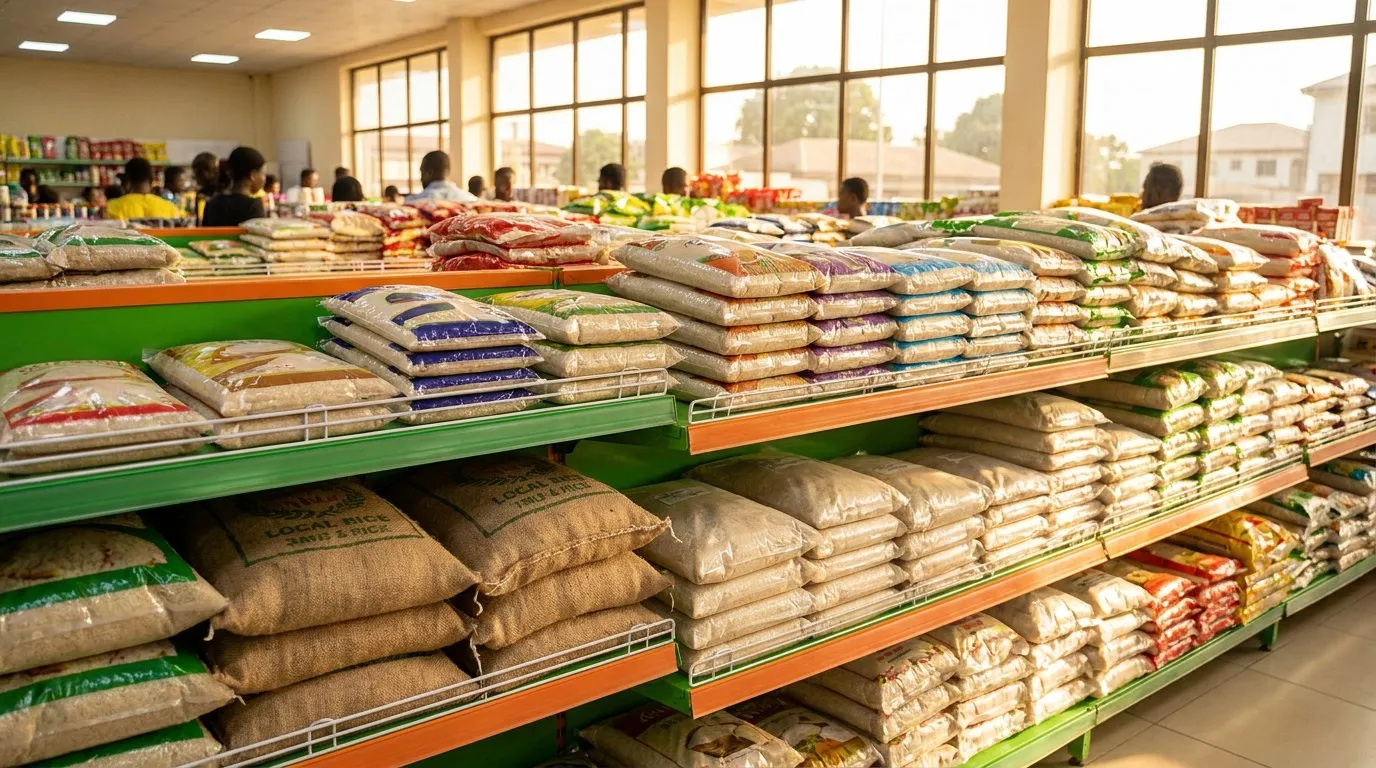
Local and imported rice side by side on a Ghanaian supermarket shelf
Already paying someone else
The buyer is already here: The buyer is already here and already paying, most of it just goes to imported rice on the same shelf.
1.9 Mt
milled rice eaten a year, about 53 kilograms each
~70%
of the rice on Ghanaian plates is imported
GH¢3.05 bn
import bill in 2024, some 7.8 percent of the food import bill

The pillar does not repeat how rice moves from farm to shop, which sits in the value-chain pillar, nor the milling economics, which sit in the cost pillar. Its job is to show where the demand is, why imported rice keeps winning it, and where the openings are for a local business to take it back.

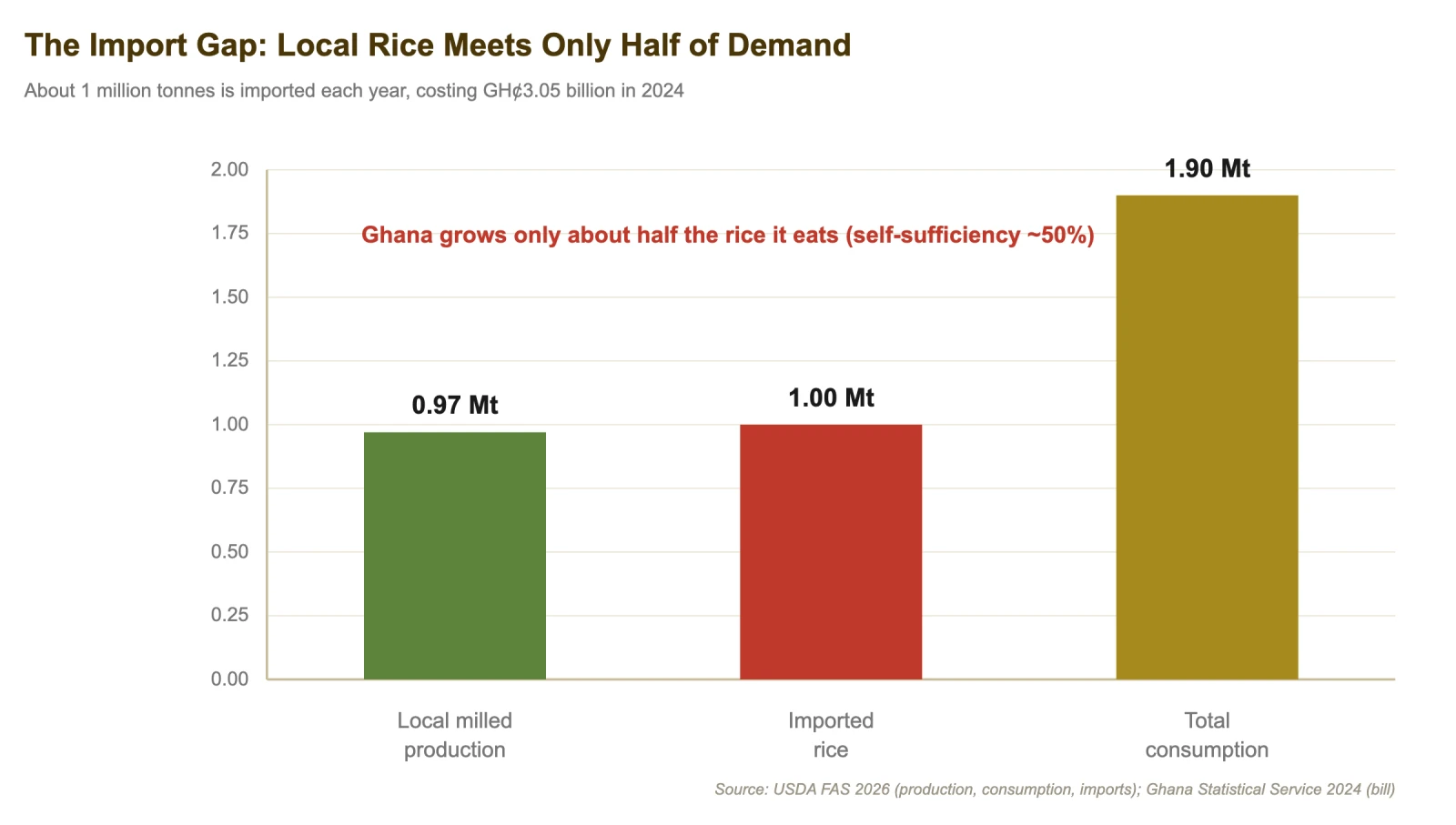
The import gap: local rice meets only half of demand
Figure 4 The import gap: local rice meets only half of demand
What this shows

Ghana grows only about half the rice it eats and imports the rest, a gap of about 1 million tonnes a year. That gap is not a problem to complain about; it is a market worth about GH¢3 billion a year that is sitting there waiting to be supplied locally.

Rice has quietly become Ghana's second staple after maize, and unlike many staples its demand is still climbing as towns grow and diets change. Per-person consumption has roughly tripled in a generation, and total consumption keeps rising with the population (United States Department of Agriculture, 2026). This is exactly the kind of demand a business wants: large, growing and non-negotiable, because people eat rice every week. The catch is that about 70 percent of the rice on Ghanaian plates is imported (United States Department of Agriculture, 2026). The buyer exists and spends the money reliably, but spends most of it on Vietnamese, Indian and Thai rice rather than on the Ghanaian crop.

~1 Mt
import gap a year, the rice Ghana eats but does not grow
GH¢3 bn
a year market sitting there waiting to be supplied locally

It is worth being clear about what that import money buys, because it is the whole opening. The imports are dominated by fragrant, perfumed long-grain rice, clean, even and neatly bagged. That is what the growing urban middle class has learned to want, and it is what Ghana's own aromatic varieties could supply if they were milled and packaged to the same standard. The demand is not for a foreign product; it is for a quality of product. Meet the quality, and the demand is already there.

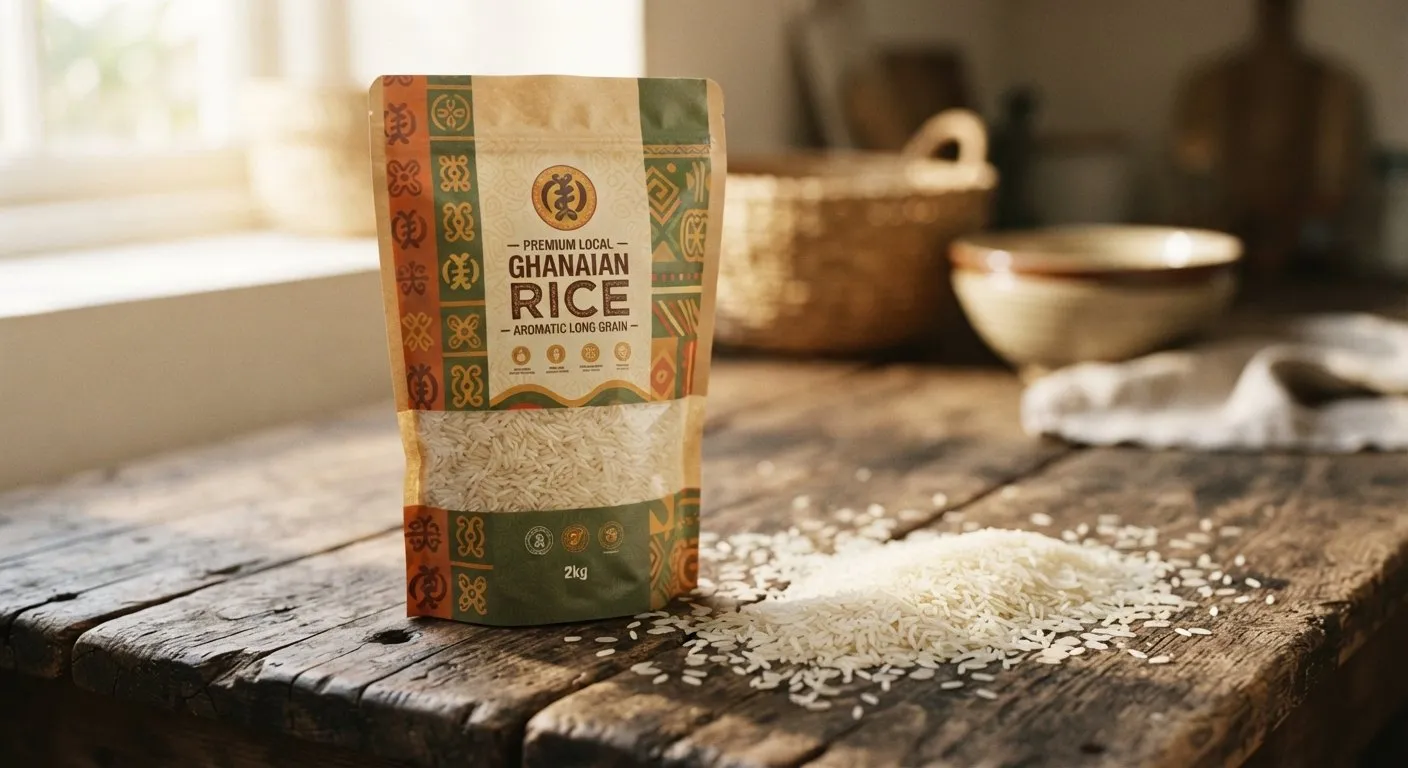
A branded pack of premium local Ghanaian rice with loose aromatic grains
Match the quality
Meet the quality, clean, graded, aromatic and branded, and the premium is already waiting to be collected.
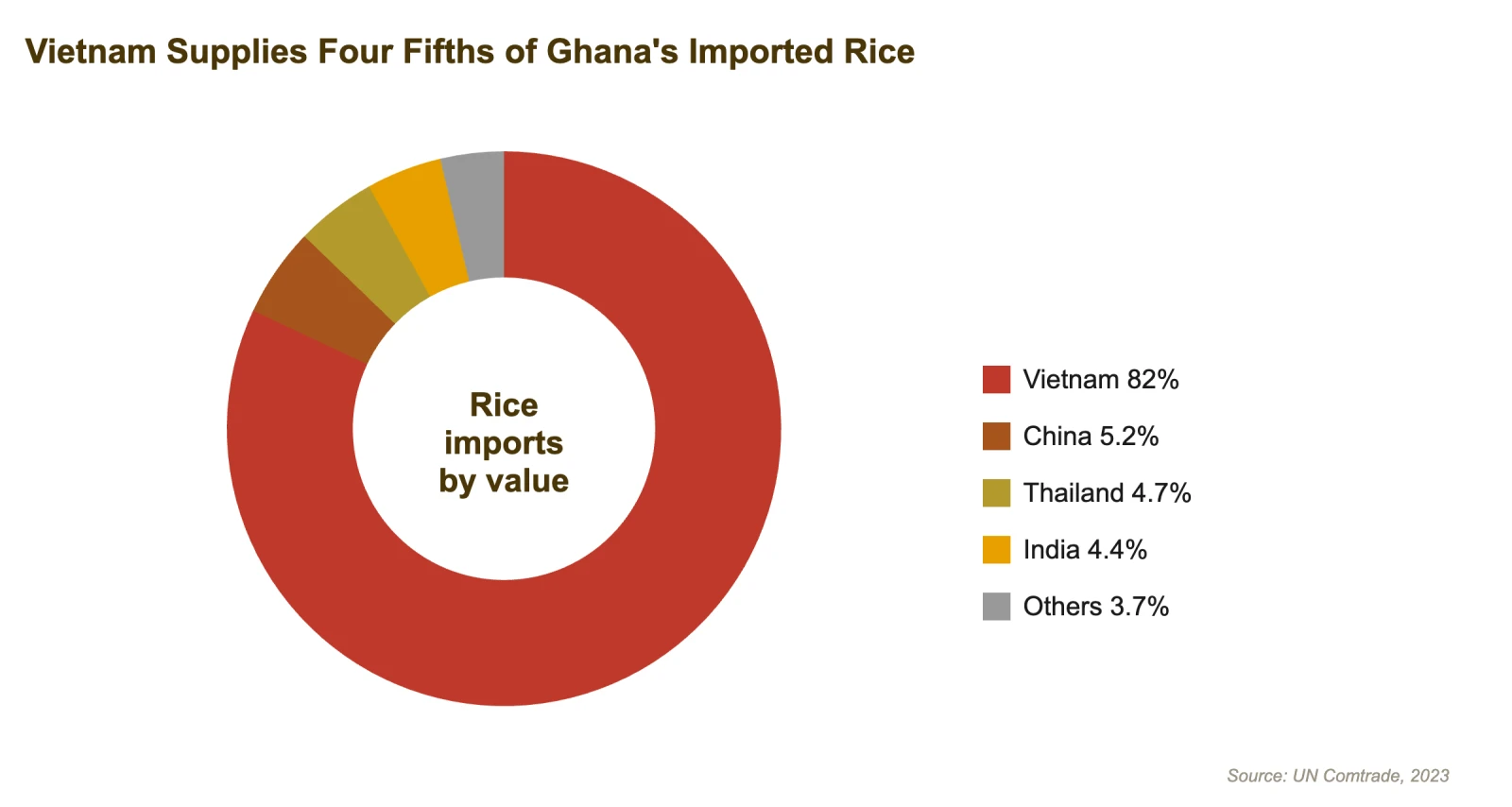
Vietnam supplies four fifths of Ghana's imported rice
Figure 5 Vietnam supplies four fifths of Ghana's imported rice
Where the imports come from

One country, Vietnam, sells Ghana about 82 percent of its imported rice by value. That concentration is a signal: this is a single, well-understood product, clean fragrant long grain, that a local supplier can study and match rather than a scattered market that is hard to enter.

82%
of Ghana's imported rice, by value, comes from Vietnam alone
Long grain
clean, fragrant, perfumed rice is the whole opening to match

🌾 Why imported rice wins, and it is not price 🌾

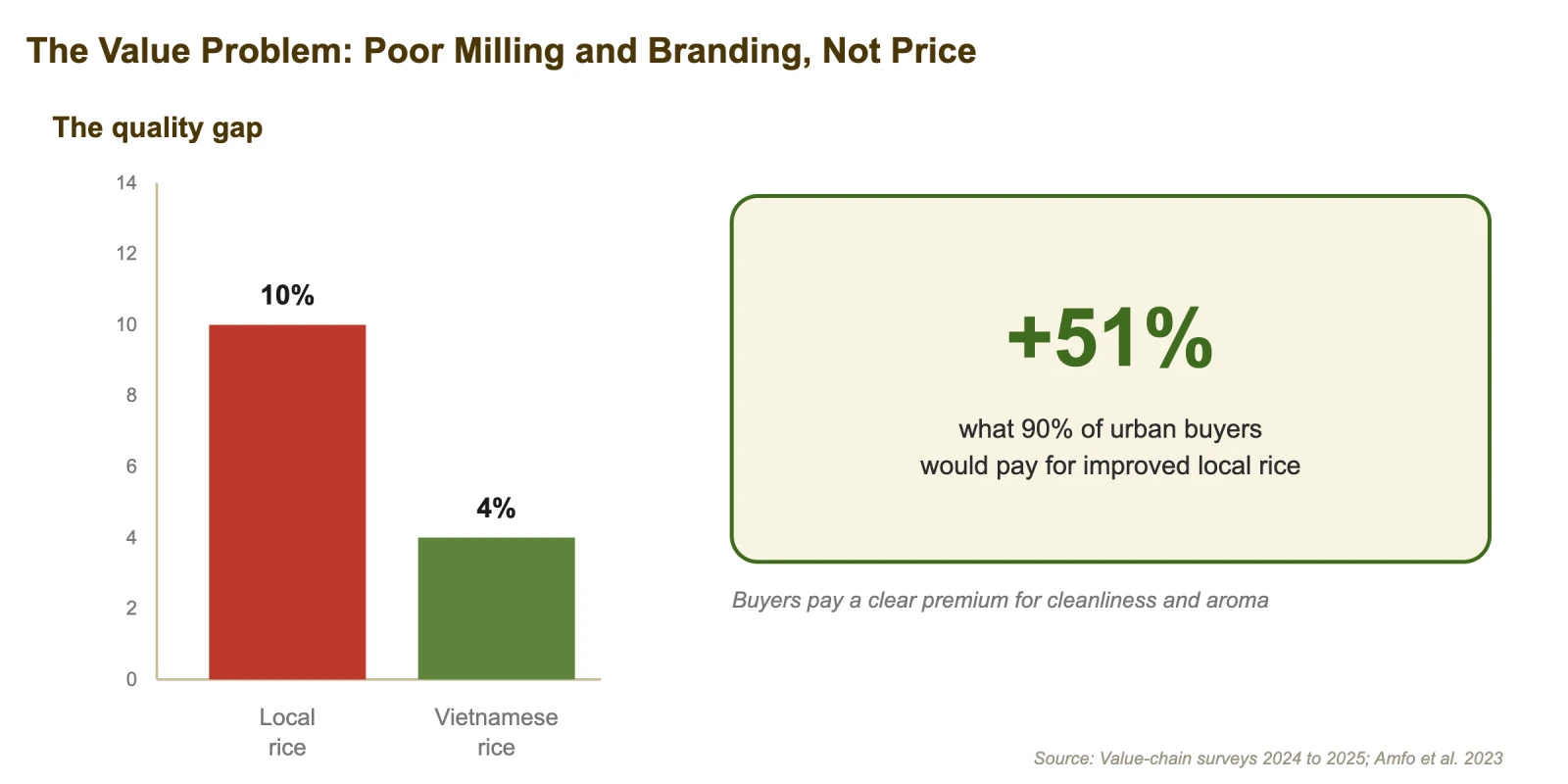
The value problem: poor milling and branding, not price
Figure 6 The value problem: poor milling and branding, not price
What this shows

Local rice carries far more broken grain than imported rice, yet about nine in ten urban buyers say they would pay around 51 percent more for local rice if its quality were fixed. The demand and the willingness to pay are already there; only the quality is missing. That is the single most important fact in the whole crop.

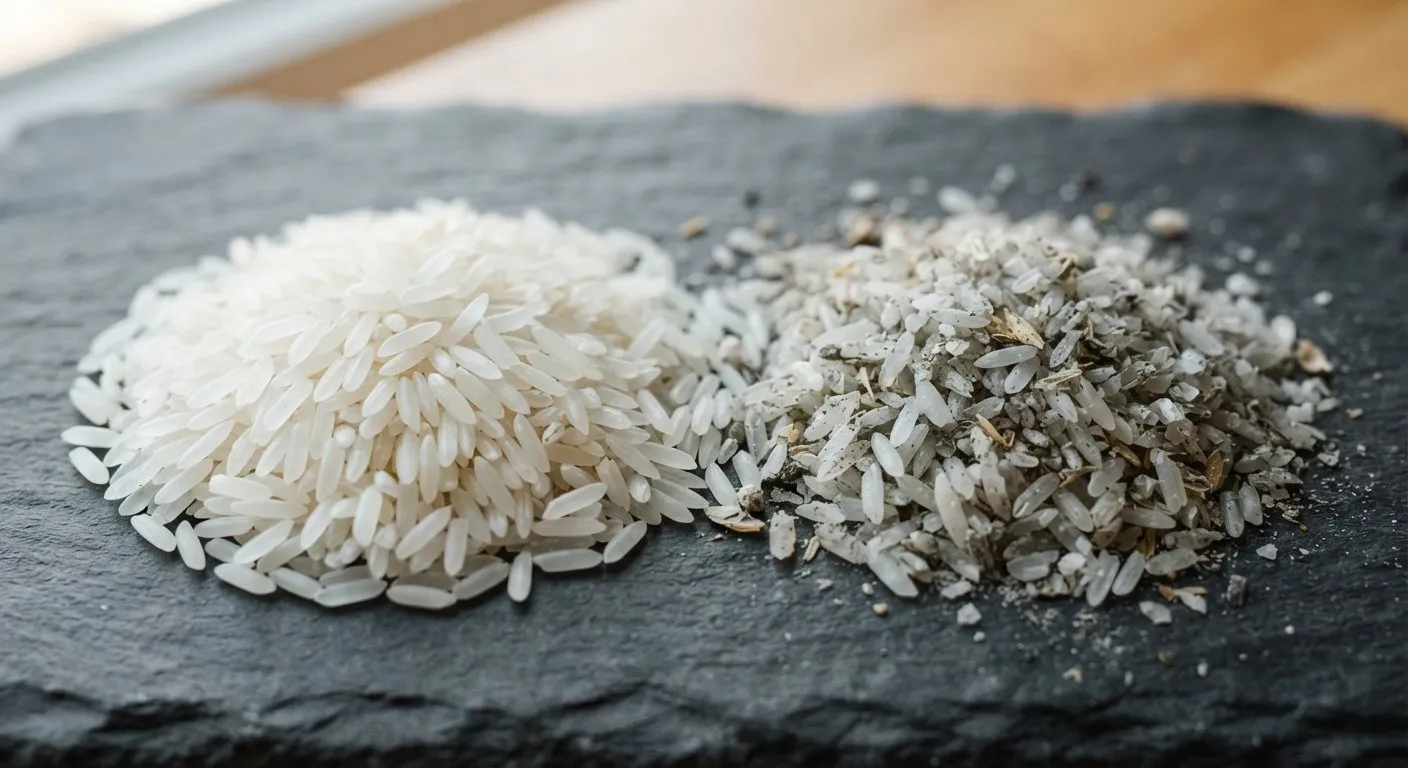
Clean white rice beside broken, discoloured rice, showing the quality gap
Quality, not price
The shopper reaches for clean, even grain; that gap is the whole opening.

The instinct is to assume imported rice wins because it is cheaper. It is not. The honest reason local rice loses is quality and presentation. Local rice reaches the shopper with more broken grains, more stones and chaff, uneven colour and, most tellingly, no brand and no clean bag to trust (International Food Policy Research Institute, 2023). Imported rice arrives clean, consistent and packaged, so the shopper reaches for it even at a premium. The clearest proof that this is about quality and not price comes from the shoppers themselves.

Around 90 percent of urban consumers say they would buy local rice, and pay about 51 percent more for it, if its cleanliness, aroma, grain appearance and packaging were improved (Amfo et al., 2023). Buyers already pay a clear premium for the very things local rice lacks, cleanliness, whiteness and aroma, which is why imported rice keeps the shelf (International Food Policy Research Institute, 2023). Read that plainly. The market is not asking Ghana to grow cheaper rice. It is offering to pay a premium for better local rice, and no one is fully collecting it. The gap between what the shopper will pay and what local rice delivers is the business.

+51%
more urban buyers say they would pay for better local rice
~90%
of urban consumers would buy local rice if the quality were fixed

🌾 The paradox of 2026: a record home crop that cannot be sold 🌾

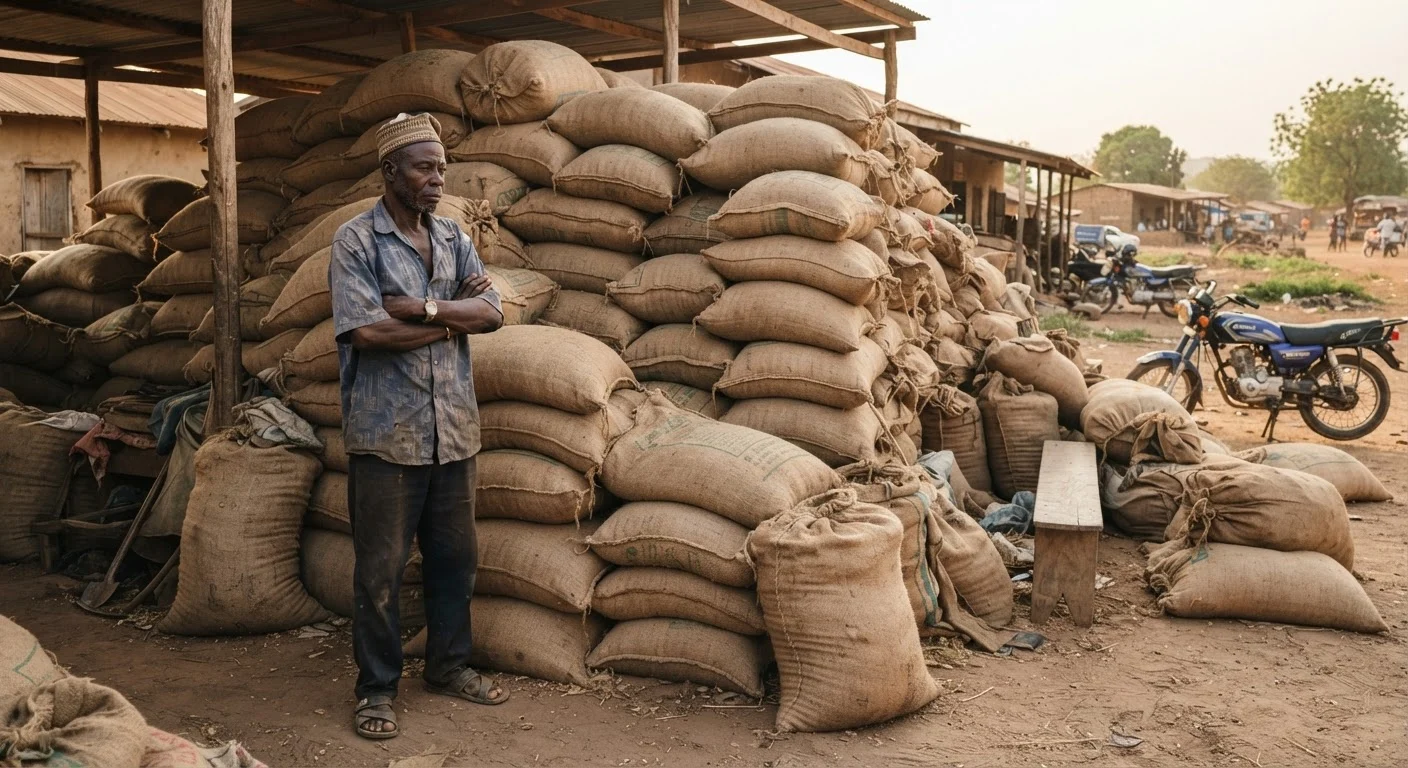
Nothing shows the real problem more sharply than what happened in 2025 and 2026. Even as imports poured in, Ghana's own farmers were left holding about 1 million tonnes of unsold paddy, worth around GH¢5 billion, and the Chamber of Agribusiness called it a national agricultural emergency while the Peasant Farmers Association asked for a temporary import ban (Chamber of Agribusiness, 2026; Peasant Farmers Association of Ghana, 2026). This is the paradox that defines the crop: Ghana imports half its rice and yet cannot sell the rice it grows. The reason is the same one running through this whole playbook. The unsold paddy is not the clean, branded, fragrant rice the market wants; it is un-milled or poorly milled grain with no buyer able to turn it into a product shoppers will choose. Growing more paddy without fixing milling, branding and market access does not help farmers; in 2026 it bankrupted some of them. The binding constraint is not the field. It is everything that happens after it.

Two price stories matter to a rice business. At the farm gate, the government has put a floor under paddy: through the buffer-stock company it set a guaranteed minimum price of GH¢625 for a 50 kilogram bag of paddy, about GH¢12.50 a kilogram, in September 2025, and told aggregators buying for the state not to pay below GH¢5 a kilogram (Ministry of Food & Agriculture and NAFCO, 2025). That floor de-risks growing paddy, but enforcement is weak, and in the glut some farmers sold well below it. At the shop, the price of rice swings with the exchange rate, because so much is imported: when the cedi strengthened through 2025, imported-rice bag prices fell sharply, squeezing local rice that could not match the presentation (News Ghana, 2025). A local brand that competes on quality, not on chasing the import price down, is insulated from that swing; one that competes only on being cheap is not.

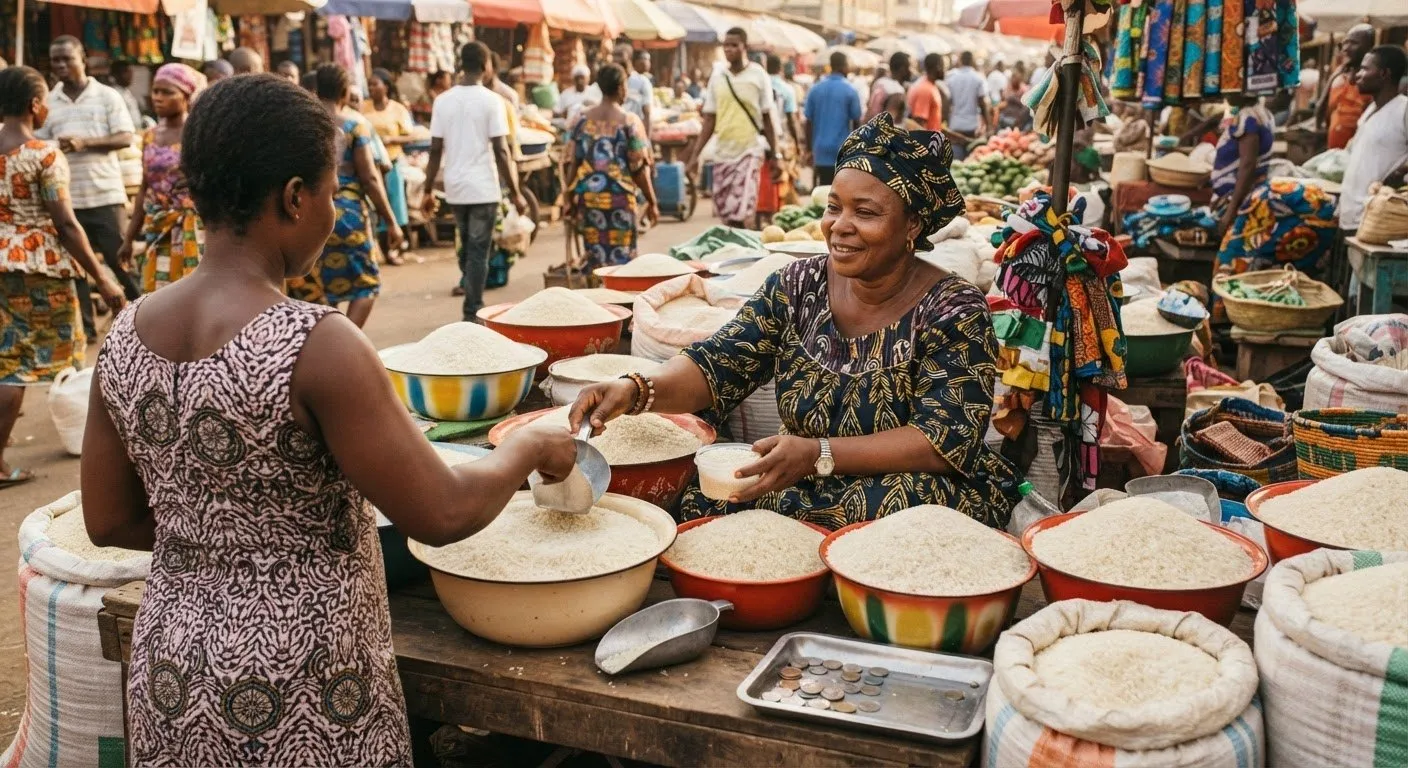
A Ghanaian woman trader selling rice at a busy market stall
The buyer eats weekly
Demand is large, weekly and non-negotiable; the question is only whose rice fills the bowl.
~1 Mt
of paddy left unsold in the 2026 glut, even as imports sold
GH¢5 bn
of unsold rice and grain, called a national agricultural emergency

For the first time, government policy is actively trying to move rice demand toward the local crop, which changes the calculation for any local business. Public schools and institutions have been directed to buy only Ghanaian rice, and after some kept buying imports, the President ordered that their rice be procured centrally through the buffer-stock company (Ministry of Finance, 2025; News Ghana, 2026). Government has also announced that rice import permits will be tied to buying from local farmers, though the instrument to enforce this had not yet been passed into law by mid-2026 (Citi Newsroom, 2026). Alongside these sits the Feed Ghana Programme and its target of rice self-sufficiency by 2028 (Ministry of Food & Agriculture, 2025). None of this guarantees a sale, but all of it points demand homeward, and a business that can supply clean, branded local rice at volume is exactly what these policies are trying to create a market for.

🌾 The Opening: demand, quality and the import gap 🌾
01

Supply the quality the shelf already pays for. The demand for clean, fragrant, packaged rice exists and is mostly met by imports. A local business that mills and brands to import standard steps straight into a market worth about GH¢3 billion a year, and into the roughly 51 percent premium buyers say they will pay for better local rice.

02

Serve the guaranteed institutional buyers. Schools and public institutions are now directed to buy local rice through the buffer-stock company. A miller or aggregator who can meet that specification and volume has a large, policy-backed off-taker that imports are being pushed out of.

03

Aggregate to smooth the seasons. Part of why local rice loses is that it is abundant just after harvest and scarce later, so wholesalers cannot rely on it. A business that stores and releases a steady, graded supply through the year turns that weakness into a selling point.

04

Brand for the premium, not the bottom. The FX-driven price war is unwinnable for a cheap unbranded sack. A named local brand that sells on cleanliness and aroma escapes the import price race and captures the whiteness and aroma premiums buyers already pay.

🌾 The risks that sit inside the demand decision 🌾

Competing on price against imports

HIGH
What it is

Imported rice prices swing with the cedi and can fall sharply when it strengthens. A local business that competes by being the cheapest sack on the shelf is always one currency move away from being undercut, and can never fund the quality that would actually win the buyer.

Evidence

When the cedi strengthened in 2025, imported-rice bag prices fell steeply, squeezing unbranded local rice (News Ghana, 2025).

Who it hits

Unbranded local millers and traders selling on price alone.

How to manage it, and the opening

Compete on quality and brand, not price: clean, graded, aromatic, packaged rice that collects the premium buyers will pay, so a cheaper import does not automatically win the sale.

Growing paddy with no buyer for it

VERY HIGH
What it is

Producing more paddy without a mill and a market to absorb it does not raise farmer incomes; it creates unsold stock. The 2026 glut left about 1 million tonnes of paddy unsold and some farmers unable to recover their costs.

Evidence

The Chamber of Agribusiness declared a national agricultural emergency over roughly GH¢5 billion of unsold rice and grain in 2026 (Chamber of Agribusiness, 2026).

Who it hits

Farmers who expand on the promise of self-sufficiency without a secured off-taker, and lenders financing them.

How to manage it, and the opening

Tie any expansion in paddy to a confirmed off-take, a mill, an aggregator or an institutional contract, before planting. The safe growth is in milling, branding and aggregation that pull paddy through, not in loose paddy.

🌾 Key takeaways 🌾
01

Rice demand is large and rising, about 1.9 million tonnes a year at 53 kilograms a person, but around 70 percent of it is met by imports that cost about GH¢3.05 billion in 2024.

02

Imported rice wins on quality and presentation, not price: it is cleaner, more consistent and branded, while local rice reaches the shopper broken, dirty and unbranded.

03

About 90 percent of urban buyers say they would pay around 51 percent more for local rice if its quality were fixed, and they already pay measurable premiums for whiteness and aroma. The premium is unclaimed.

04

The 2026 paddy glut, about 1 million tonnes unsold even as imports sold, proves the constraint is milling, branding and market access, not raw production.

05

Policy is pulling demand homeward through the schools directive, the planned import-permit rule and the 2028 self-sufficiency target, which is exactly the market a clean, branded local supply is meant to fill.

Written for each reader

🌾 Practitioner intelligence 🌾

Hover any card to pause and lift it.

For students

If you are entering rice, study the buyer before the field. The demand is already here and already paying a premium for clean, fragrant, packaged rice; it is just paying it to importers. Learn what the Accra or Kumasi shopper actually chooses and why, learn the difference between grade and brand, and you can work in a miller's or brand's sales and quality team, run aggregation that feeds a clean supply, or advise farmers on producing the even, clean paddy a brand needs. The gap to fill: nobody is fully collecting the roughly 51 percent premium buyers say they will pay for better local rice. The trap to avoid is thinking the answer is to grow more rice; in 2026 farmers who did that could not sell it. The value is in quality and market access, not volume.

For entrepreneurs

First move: pick one clear buyer and one quality standard, an urban brand shelf, a school-feeding contract, or a supermarket, and work backwards to the clean, graded, aromatic rice that buyer needs. Do not start by buying loose paddy hoping to sell it. Line up the off-take first, then the milling and branding to meet it. The trap: selling an unbranded sack on price, which locks you into an unwinnable war with imports whose price falls every time the cedi strengthens. The tailwind to use is the schools-buy-local directive and central procurement through the buffer-stock company, which is opening a large, policy-backed market to whoever can meet the specification.

For investors

Diligence asks: the thesis is that clean, branded local rice can capture demand and a premium that imports now hold, backed by a strong policy pull. Ask for the target buyer and signed or credible off-take, the quality specification and how it will be met, and the brand and packaging plan, not just the tonnage. Structure the money around the route to a paying buyer, milling, grading, packaging and working capital, released against off-take and quality milestones. The risk: policy intent is not yet law, the import-permit rule was not passed by mid-2026, and the market still rewards presentation over origin. Back businesses that win on quality even if every policy stalls, and treat the policy pull as upside, not the base case.

For ecosystem actors

The lever is quality and market access, not more production incentives alone. Encouraging farmers to grow more paddy without building the milling, grading, branding and aggregation to sell it created the 2026 glut. Fund and measure the demand side: the share of the local crop that is milled to standard and branded, the volume moving through guaranteed institutional buyers, and the passage of the import-permit rule into enforceable law. The measurable outcome is local rice taking a rising share of urban and institutional demand, and farmers selling a record crop rather than storing it. The failure to avoid is repeating the glut: a production push with no market to receive it.
Download full PDF
UpcomingThis document isn't available yet.