Ghana Agribusiness PlaybookRice
Who holds the power in Ghana's rice economy
Rice · Series intelligence

Strategic Outlook

How to venture into rice: the frameworks, the checklist and the mistakes.
Strategic Outlook & Executive Advisory · Pillar 07

This closing pillar pulls the analysis into a strategic view and a set of practical judgements for anyone deciding whether and how to enter Ghanaian rice. It uses four standard tools, a scan of the wider forces, the competitive structure, the strengths and threats, and the stakeholders, and then offers direct advice: a checklist for venturing in, and the mistakes that most often sink rice businesses. These are judgements, grounded in the evidence of the earlier pillars but sharpened into opinion.

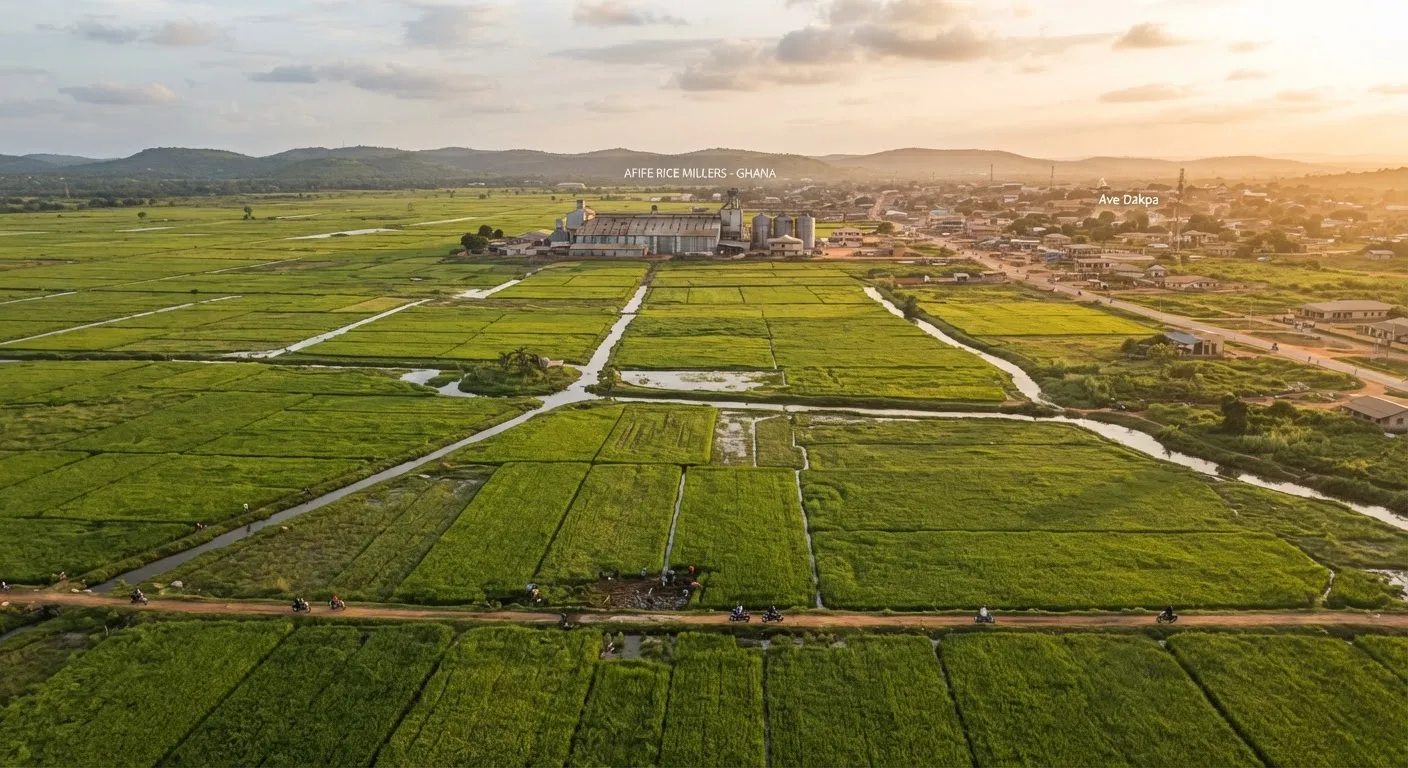
A wide aerial view of Ghana rice fields at golden hour stretching toward a mill and town
The moment is good
The prize is large: The prize is large and the moment is good: a large import bill, rising demand, aligned policy and available finance, all pointing to the same opening.
4 tools
PESTLE, five forces, SWOT and a stakeholder map, on one page
6 steps
the venture checklist before you commit a cedi
5 mistakes
that most often sink a rice business, the reverse of each step

🌾 The wider forces: a PESTLE scan 🌾

The instinct is to start a rice business with a field or a machine. The wiser first move is to scan the wider forces, because they decide whether the venture has a tailwind or a headwind before a single cedi is spent. A PESTLE scan reads the political, economic, social, technological, environmental and legal forces around Ghanaian rice, and on balance they favour a downstream, quality-led local business, with the economic and environmental forces the ones to plan against.

Table 7: PESTLE: the forces shaping Ghanaian rice
ForceWhat it means for a rice business
PoliticalStrong: self-sufficiency drive, buy-local directives, a proposed import quota and a grains export ban all push towards local rice, but policy can shift and some measures are not yet law
EconomicMixed: a large import bill and rising demand are the opportunity, but high lending rates, a volatile cedi and the 2026 paddy glut are real headwinds
SocialFavourable: rice demand is rising with urban living, buyers will pay for quality, and women dominate aggregation and processing, a base to build inclusive businesses on
TechnologicalImproving: rubber-roller milling, destoning and grading, improved GEM parboiling, aromatic and drought-tolerant varieties and warehouse receipts are all available now
EnvironmentalAdverse and rising: drought, Bagre-driven floods and unreliable rain threaten rain-fed rice, which makes irrigation and water control both a defence and a business
LegalEnabling but underused: Ghana Standards Authority grades, GIPC tax incentives and land and water arrangements shape returns, and quality standards are a lever few local millers meet

Source: Playbook synthesis of the evidence in Pillars 1 to 7, 2026.

🌾 The competitive structure: Porter's five forces 🌾

Where PESTLE reads the weather, Porter's five forces reads the board a business actually plays on: who it competes with, who can enter, who supplies it, who buys from it, and what can be substituted for its product. In Ghanaian rice the structure is unforgiving to the undifferentiated and generous to the integrated.

A Ghanaian entrepreneur analyst reviewing a rice business plan and market charts
Think like a strategist
Run a PESTLE and a five-forces scan on a real rice business, and you become the analyst that ventures and lenders need.
Table 8: Porter's five forces in Ghanaian rice
ForceStrengthWhat it means
RivalryHighImports dominate the shelf and local mills are many and fragmented; competition is on quality, where local rice is weak and imports strong
Threat of new entrantsMixedLow barriers to farming and small-scale aggregation, so those are crowded; high barriers to industrial milling and branding, so those are defensible
Supplier power (paddy)Low to farmers, but fragmentedSmallholders are price takers, but their fragmentation and seasonality make reliable supply hard, which is why integration and outgrowing pay
Buyer powerHighWholesalers set the price and capture margin; but the new institutional buyers, schools and public bodies, shift some power to millers who can meet their standard
SubstitutesHighImported rice is the main substitute for local rice, and maize and cassava substitute for rice in the diet; competing means matching imported quality

The structure rewards businesses that integrate, control quality and defend a branded position; it punishes undifferentiated farming and trading.

Source: Playbook synthesis, 2026.

🌾 Strengths, weaknesses, opportunities and threats 🌾

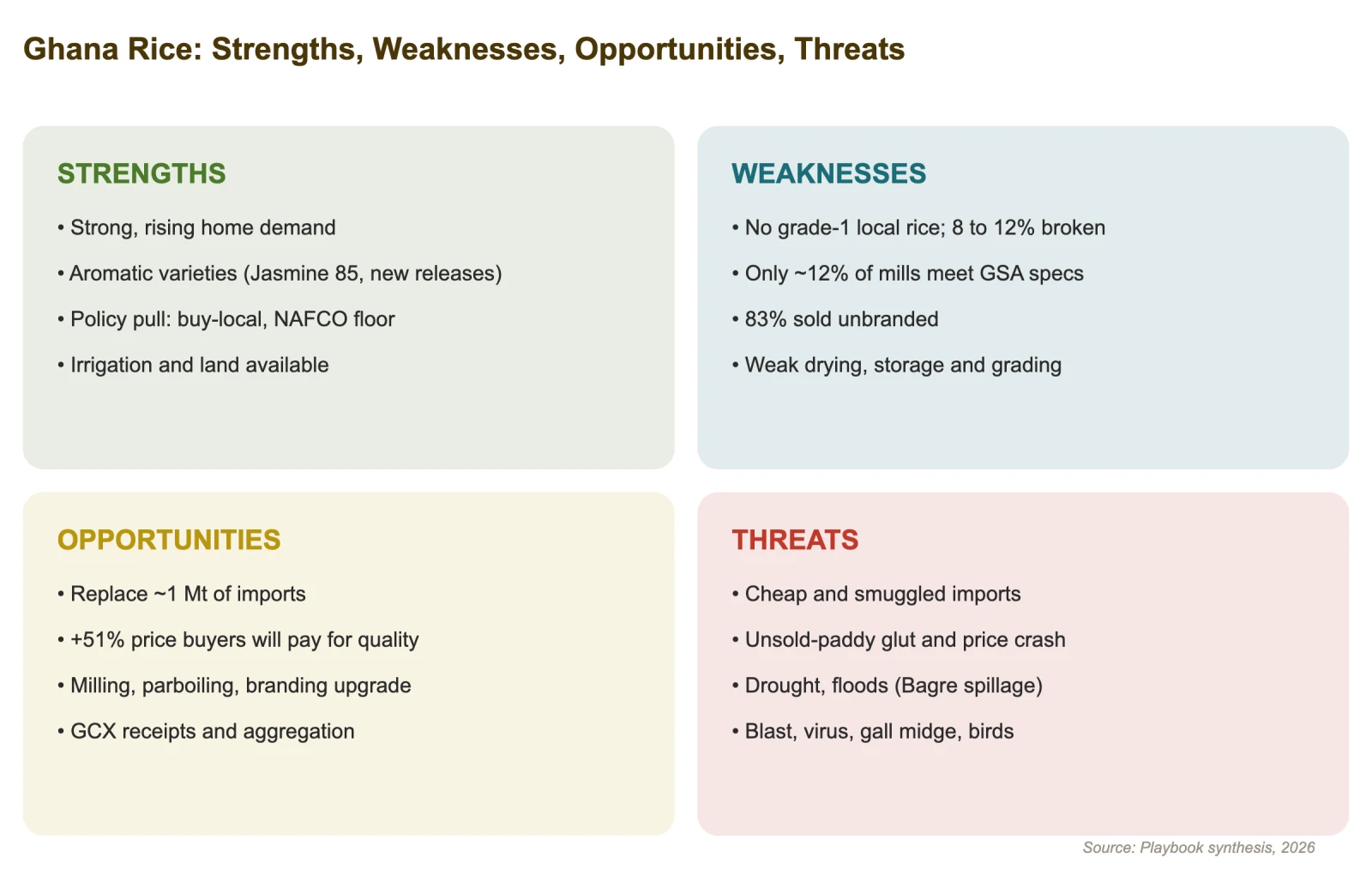
A strengths, weaknesses, opportunities and threats scan puts the whole crop on one page. It is worth reading not as a list but as a single judgement: the good news outweighs the bad, but only for a business that fixes quality and branding, the flaw that sits behind every weakness.

Ghana rice: strengths, weaknesses, opportunities and threats
Figure 18 Ghana rice: strengths, weaknesses, opportunities and threats
What this shows

The strengths and opportunities, strong demand, aromatic varieties, a policy pull and a large import gap, outweigh the weaknesses and threats if, and only if, a business fixes the quality and branding gap that sits at the centre of every weakness.

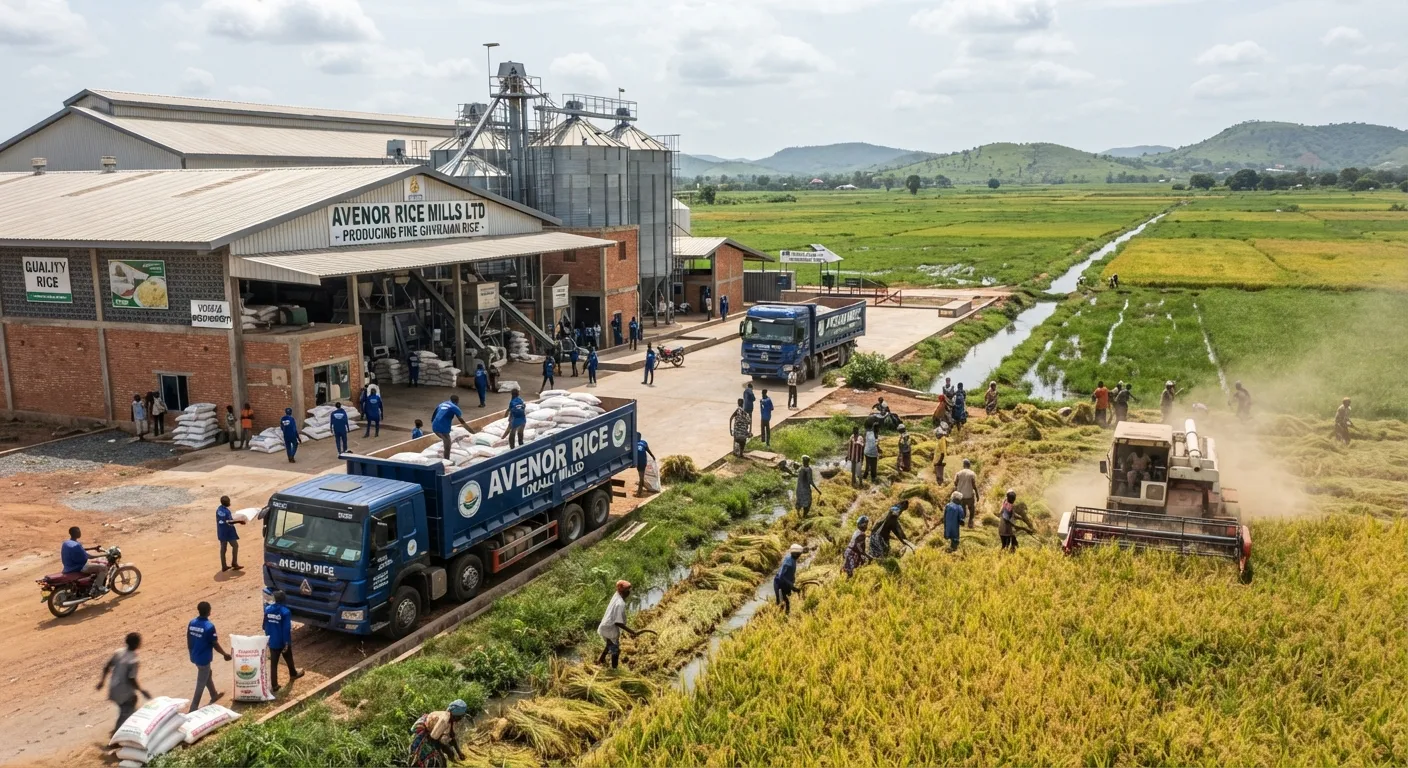
An integrated Ghana rice operation with a modern mill beside irrigated paddy fields
Fix the quality gap
Go downstream, build for quality, secure the buyer and the supply, and use the policy and finance rails.

🌾 Who holds the power: the stakeholder map 🌾

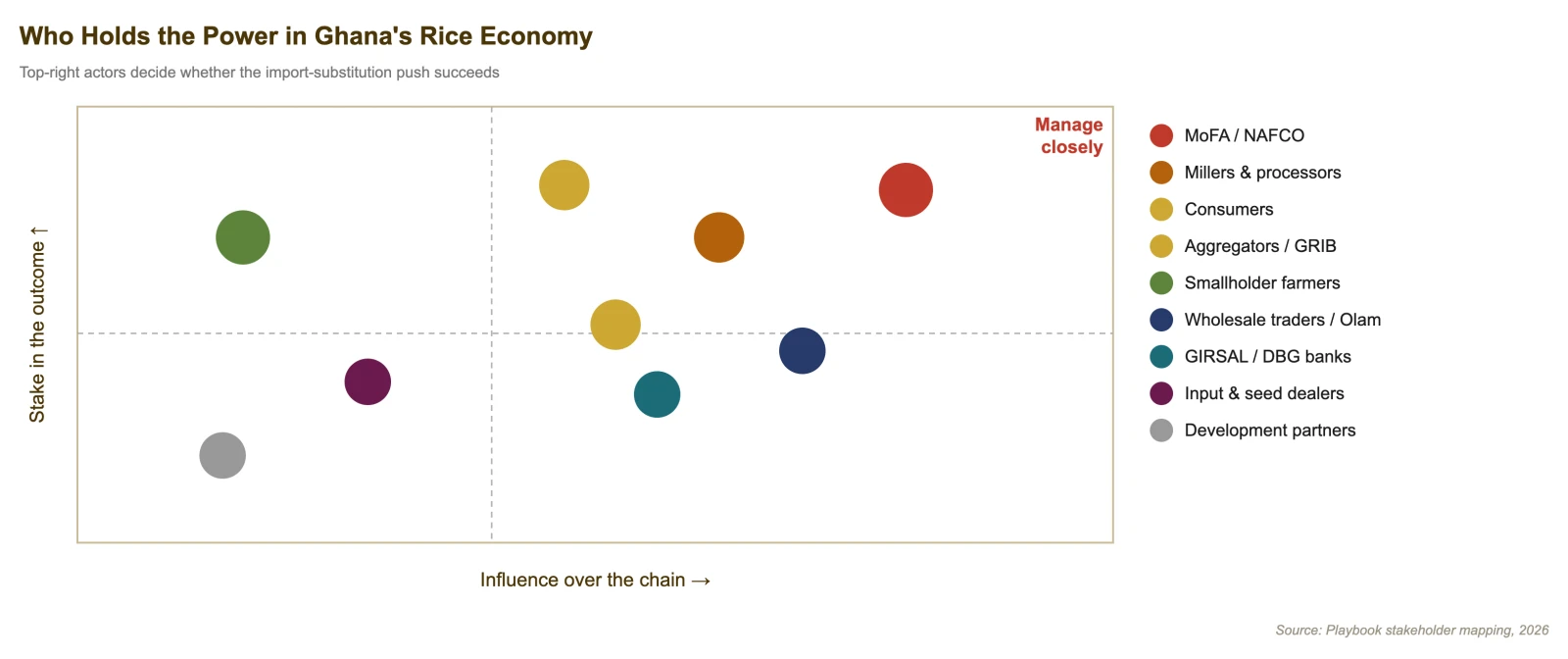
Strategy is not only about the market; it is about the people who hold power over it. The stakeholder map shows who a rice business must manage, and the top-right actors, government and the buffer-stock company, millers and processors, and consumers, hold the most power over whether the import-substitution push succeeds. A business must manage its relationships with these actors, not just with farmers.

Who holds the power in Ghana's rice economy
Figure 19 Who holds the power in Ghana's rice economy
A boardroom advisory meeting of Ghanaian rice business people discussing strategy
Manage the relationships
The actors who decide success sit downstream and in government; manage those relationships, not only your farmers.
What this shows

The actors in the top right, government and the buffer-stock company, millers and processors, and consumers, hold the most power over whether the import-substitution push succeeds. A business must manage its relationships with these actors, not just with farmers.

Table 9: Key stakeholders, their interest, and how a business should engage them
StakeholderWhat they wantHow to engage them
MoFA, NAFCO and governmentSelf-sufficiency, a stable food price, jobsAlign with the buy-local and price-floor programmes; supply the institutional market to standard
Millers and processorsSteady, clean paddy and a profitable marginPartner or become one; the mill is where value and power concentrate
Aggregators and GRIBVolume, turnover and organisationWork through the rice body and warehouse system for fair, financed aggregation
Banks, GIRSAL and DBGBankable, guaranteed, repayable lendingBring a quality-and-buyer plan that uses the guarantee; de-risk with off-take
Smallholder farmersA fair, steady price and reliable off-takeOffer outgrower terms, inputs and a guaranteed buy-back; fairness secures supply
ConsumersClean, fragrant, trustworthy riceWin them with quality and brand; they will pay a premium and are not loyal to imports
Wholesale tradersMargin and market controlCompete with a branded alternative and warehouse-backed steady supply, or partner selectively

Source: Playbook stakeholder analysis, 2026.

Executive advisory: how to venture into rice
🌾 The venture checklist: six steps before you commit 🌾
01

Choose your node. Decide where you will play, milling, parboiling, aggregation, branding or a service, and favour downstream over the farm gate, because that is where value is captured.

02

Secure the buyer first. Line up a named off-take, an institutional contract, a brand, a wholesaler, before you build capacity or plant a hectare. The 2026 glut punished everyone who did the reverse.

03

Secure the supply. Tie down clean paddy through outgrower relationships or a scheme, matched to the variety and quality your buyer needs.

04

Design for quality. Specify the milling, destoning, grading and parboiling that will meet the Ghana Standards Authority grade, because quality, not price, is how you win.

05

Use the rails. Build the GIRSAL guarantee, the Development Bank Ghana facility, the tax incentives and the warehouse-receipt system into the plan from the start.

06

Site for advantage. Base the business where the paddy, the quality and the tax break are, the northern belt for supply and incentives, Volta for higher-grade grain, the cities for the market.

Buyer first
line up a named off-take before you build capacity or plant a hectare
Downstream
favour milling, branding and services over the farm gate, where value is captured

🌾 Five mistakes that kill rice ventures 🌾

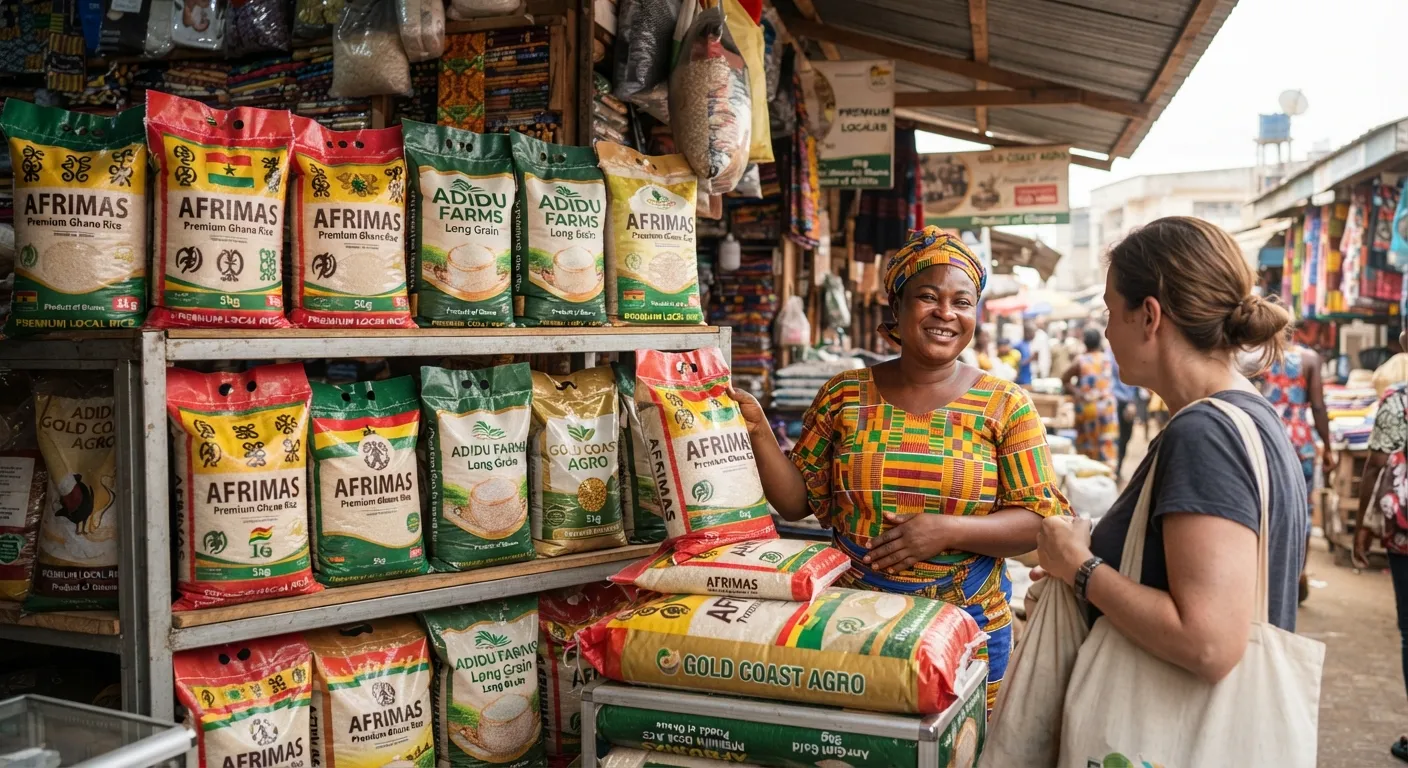
Branded bags of premium local Ghanaian rice stacked on a market shelf with a shopkeeper
Own quality, own the buyer
Wherever you enter, own quality and own the buyer relationship, because those are what last when the tailwinds fade.

Mistake 1

KILLS VENTURES

Growing paddy with no buyer or mill, then meeting the glut. Volume without a market destroys value.

Mistake 2

KILLS VENTURES

Competing on price against imports, and losing every time the cedi strengthens, instead of competing on quality.

Mistake 3

KILLS VENTURES

Skimping on milling and grading, so good paddy becomes low-grade rice that fails at the shelf.

Mistake 4

KILLS VENTURES

Building on a policy that is announced but not yet law, such as the import quota, as if it were guaranteed.

Mistake 5

KILLS VENTURES

Trusting dated or illustrative cost figures as current, and financing a business on numbers that inflation has overtaken.

🌾 Where to enter, by the capital you have 🌾

The last judgement is the most practical: where to enter depends on the capital you have. There is a defensible door at every level, from asset-light services to an integrated mill, and the deepest returns sit at the top, but so does the risk.

Table 10: Where to enter rice, by the capital you have
Capital levelEntry pointsWhat it takes
LowInput and seed dealing, aggregation, bird, weed and drying services, small-scale parboiling, agronomy adviceKnowledge, relationships and a small working float; the asset-light doors this playbook keeps pointing to
MediumUpgrading a mill with destoning and grading, a branded packing line, outgrower coordination, mechanisation servicesA guaranteed buyer, the GIRSAL guarantee, and equipment finance
HighAn integrated mill with irrigation, outgrowers and a brand, or scheme rehabilitationSerious capital, a strong management team and a secured market, but the deepest and most defensible returns

Source: Playbook synthesis, 2026.

🌾 The Opening: the strategic bottom line 🌾
01

The prize is large and the moment is good: a GH¢3 billion import bill, rising demand, aligned policy and available finance, all pointing to the same opening.

02

The winning strategy is consistent across every pillar: go downstream, build for quality, secure the buyer and the supply, and use the policy and finance rails.

03

The losing strategy is equally clear: grow undifferentiated paddy, compete on price, skimp on milling, and rely on unenacted policy.

04

Enter at the level your capital allows, but wherever you enter, own quality and own the buyer relationship, because those are what last when the tailwinds fade.

🌾 Key takeaways 🌾
01

The wider forces favour local rice: the political, social and technological signals are positive, and the economic and environmental headwinds are exactly what a downstream, irrigated, quality-focused business is built to withstand.

02

The competitive structure rewards integration, quality control and branding, and punishes undifferentiated farming and trading.

03

The stakeholders who decide success sit downstream and in government, so a business must manage those relationships, not only its farmers.

04

The venture checklist is buyer first, supply second, quality by design, rails used, and site for advantage; the fatal mistakes are the reverse of each.

05

Every strategic judgement and cost figure here should be weighed against your own situation and numbers before any real investment.

Written for each reader

🌾 Practitioner intelligence 🌾

Hover any card to pause and lift it.

For students

If you are entering rice, use these tools to think like a strategist, not just a farmer. Learn to run a PESTLE and a five-forces scan on a real rice business, and you become the analyst that ventures and lenders need. Start asset-light, at the low-capital doors, and learn the chain from inside before committing capital. The gap to fill: few new entrants think strategically about where to play and who holds the power, so they enter at the crowded farm gate and fail. Strategic clarity is itself a scarce, valuable skill. The trap to avoid is mistaking a business plan for a strategy; know your node, your buyer and your advantage.

For entrepreneurs

First move: run the venture checklist honestly against your own idea before you spend a cedi, and be ruthless about the five mistakes. Choose your node, secure your buyer and supply, and design for quality. Enter at the capital level you can actually fund, and grow into the next. The trap: falling in love with a plan that skips step two, the buyer. The tailwind is that the strategy this playbook recommends, downstream and quality-led, is exactly what the policy stack and the finance rails are built to support.

For investors

Diligence asks: use these frameworks as your screen. Does the business play a defensible node, integrate for supply and quality, and hold power with the stakeholders who matter. Score it against the venture checklist and the five mistakes before you look at the numbers, and then insist the numbers are field-priced. Structure the money behind businesses that pass the strategic screen, quality-led, integrated, buyer-secured, and use the guarantee and tax rails to improve the risk-adjusted return. The risk: backing a plan that is strong on production and weak on strategy. The strategic red flags in this pillar are the cheapest diligence you will do.

For ecosystem actors

The lever is helping entrepreneurs think and act strategically, and holding the enabling environment stable enough for them to plan. Fund business advisory, strategic training and market information for rice entrepreneurs, and measure the quality of ventures financed, not just their number. The measurable outcome is more rice businesses entering at defensible, downstream nodes with secured buyers and quality by design, and fewer failing at the crowded farm gate. The failure to avoid is funding a wave of undifferentiated production ventures into the same glut that has already shown what happens.
Download full PDF
UpcomingThis document isn't available yet.