If you are entering rice, learn to read the policy and market signals, because they tell you where the tailwinds are. Understand the self-sufficiency drive, the buy-local rules, the guarantee finance and the tax breaks, and you can advise businesses on positioning, work in an agribusiness that is riding the wave, or build a venture designed to use the rails. The gap to fill: many businesses miss the incentives and buyers that policy has opened because they do not know they exist. That knowledge is valuable. The trap to avoid is betting the whole business on a policy that is announced but not yet law, such as the import quota; treat policy as upside, not the foundation.
The earlier pillars showed where value leaks and where it can be captured. This one steps back to the whole business picture: how big the rice opportunity really is, why the moment is unusually good, and how the current wave of policy is pulling demand and finance towards exactly the kind of local business this playbook argues for. Rice is not just another crop to grow; it is the largest single import-substitution opportunity in Ghanaian food, and for once the state is pushing in the same direction as the market.

🌾 The prize: a billion-cedi market that is currently sent abroad 🌾

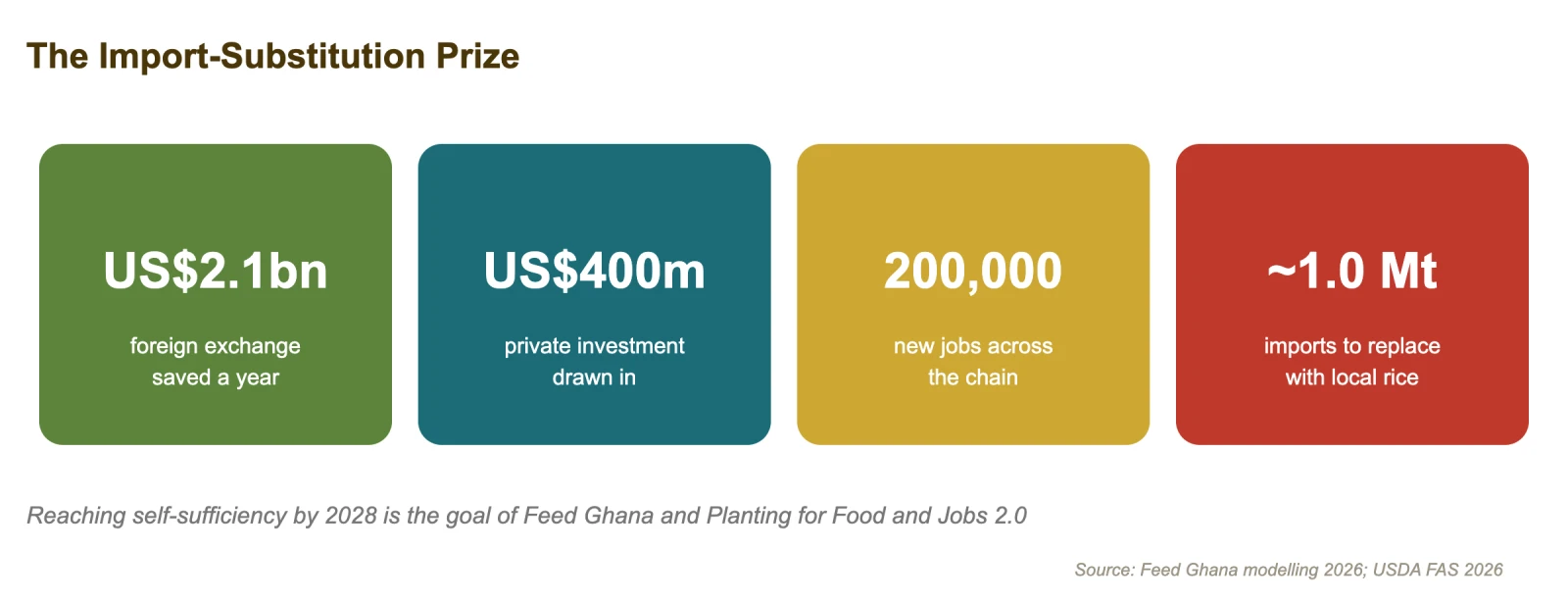
Replacing the roughly 1 million tonnes of rice Ghana imports each year is worth billions in saved foreign exchange, hundreds of millions in investment and hundreds of thousands of jobs. This is the size of the prize a competitive local rice industry is competing for.

The core business case for Ghanaian rice is simple and large. The country sends about GH¢3.05 billion abroad each year to buy rice it could grow and mill at home, and closing that gap is government's stated goal. Official modelling of full self-sufficiency puts the prize at around US$2.1 billion in saved foreign exchange, about US$400 million of new private investment and roughly 200,000 jobs across the chain (Feed Ghana modelling, 2026). Even a fraction of that, captured by clean, branded local rice taking shelf share from imports, is a substantial market. And the demand is not in doubt, it is rising every year, and about 90 percent of urban buyers say they would switch to local rice if its quality matched imports (Amfo et al., 2023). The prize is not to create demand; it is to meet demand that already exists and is currently met from abroad.
🌾 The pull: policy is, for once, aimed the right way 🌾
What makes the moment unusual is that policy, finance and market are aligned. For most of Ghana's history, rice policy was scattered and rice farmers were left to compete with cheap imports on their own. Since 2025 that has changed, and a stack of measures now pulls demand and capital towards local rice. A business that understands this stack can position itself to ride it rather than wait for it.

🌾 The policy and finance stack behind local rice, and the opening each creates
| Measure | What it does | The opening it creates |
|---|---|---|
| Feed Ghana Programme and Planting for Food and Jobs 2.0 | Targets rice self-sufficiency by 2028 with input, mechanisation and irrigation support | A funded push behind seed, irrigation, mechanisation and processing businesses |
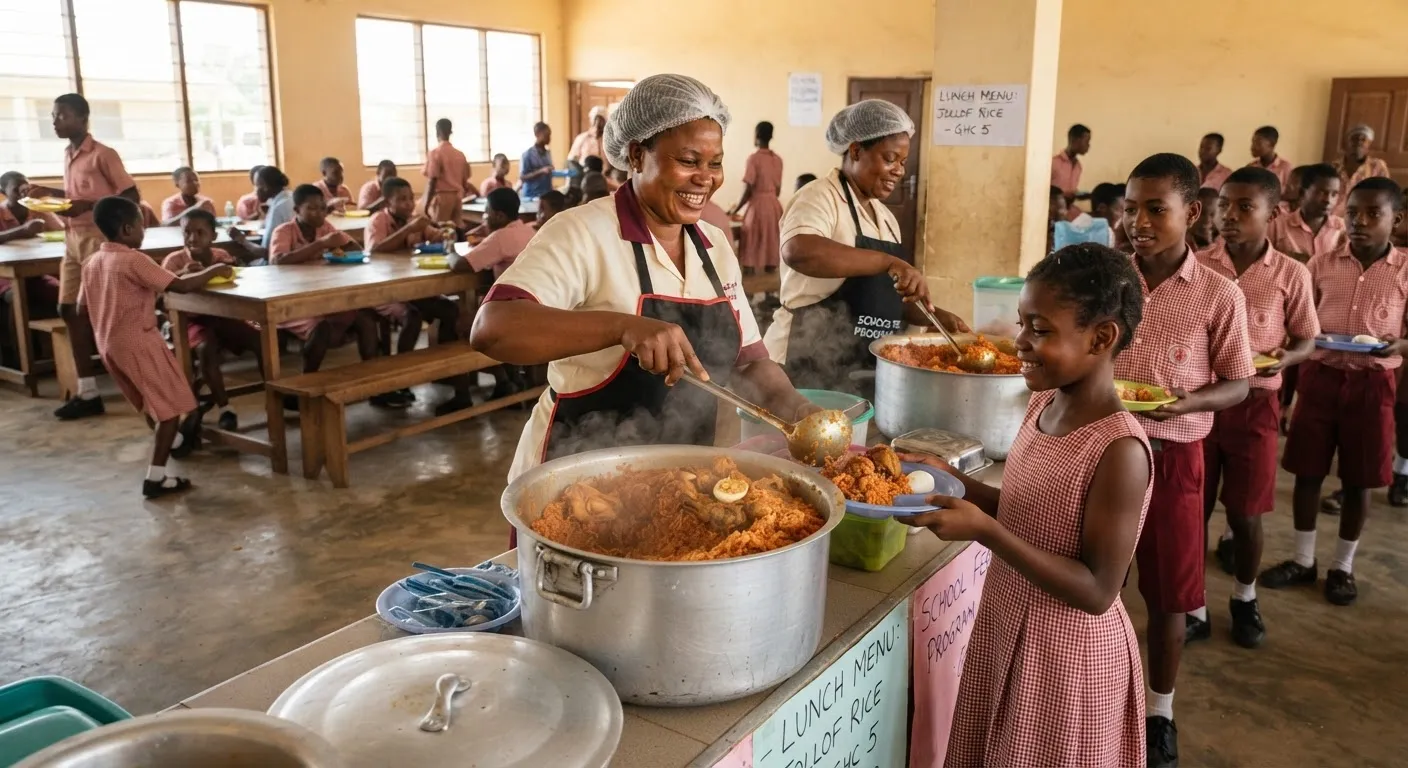
| Schools and public bodies buy local | Directs institutions to buy only Ghanaian rice, procured centrally through the buffer-stock company | A large, guaranteed institutional buyer for millers who can meet the specification |
| Rice import quota (announced, not yet law) | Would tie import permits to buying from local farmers | If passed, a direct shift of import demand towards local paddy and mills |
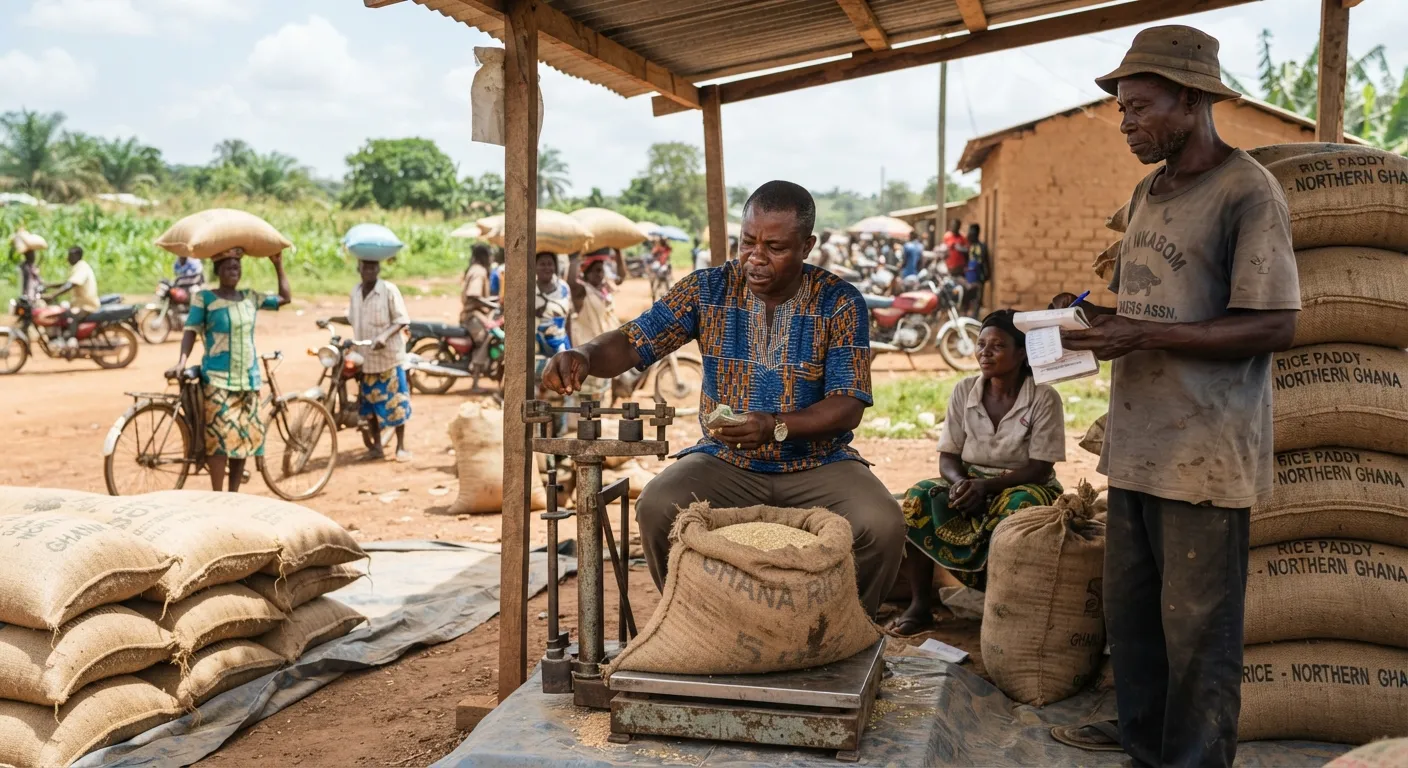
| NAFCO guaranteed price and purchases | A GH¢625 per 50 kg guaranteed paddy price, a GH¢5 per kg floor and buffer purchases | A price floor that de-risks paddy supply for an aggregator or mill |
| GIRSAL guarantee and Development Bank Ghana facility | Up to 70 percent loan guarantee and about GH¢500 million over five years for rice and three other chains | Access to capital for milling, parboiling and aggregation that pure farming cannot get |
| Agro-processing tax incentives (GIPC) | A 5 percent income-tax rate during the holiday and low rates after, lowest in the north | A materially better after-tax return for a mill sited near the paddy |
| Warehouse-receipt system and 1D1F mills | Storage-backed finance and district milling capacity | Rails for receipt-financed aggregation and for local milling ventures |
Several measures are recent and some, such as the import quota, are announced but not yet enacted; treat policy as a tailwind to verify, not a guarantee.
Sources: Ministry of Food and Agriculture (2025); Ministry of Finance (2025); NAFCO (2025); GIRSAL (2026); Development Bank Ghana (2025); Ghana Investment Promotion Centre (2025); Citi Newsroom (2026).


🌾 Reading the market signals 🌾

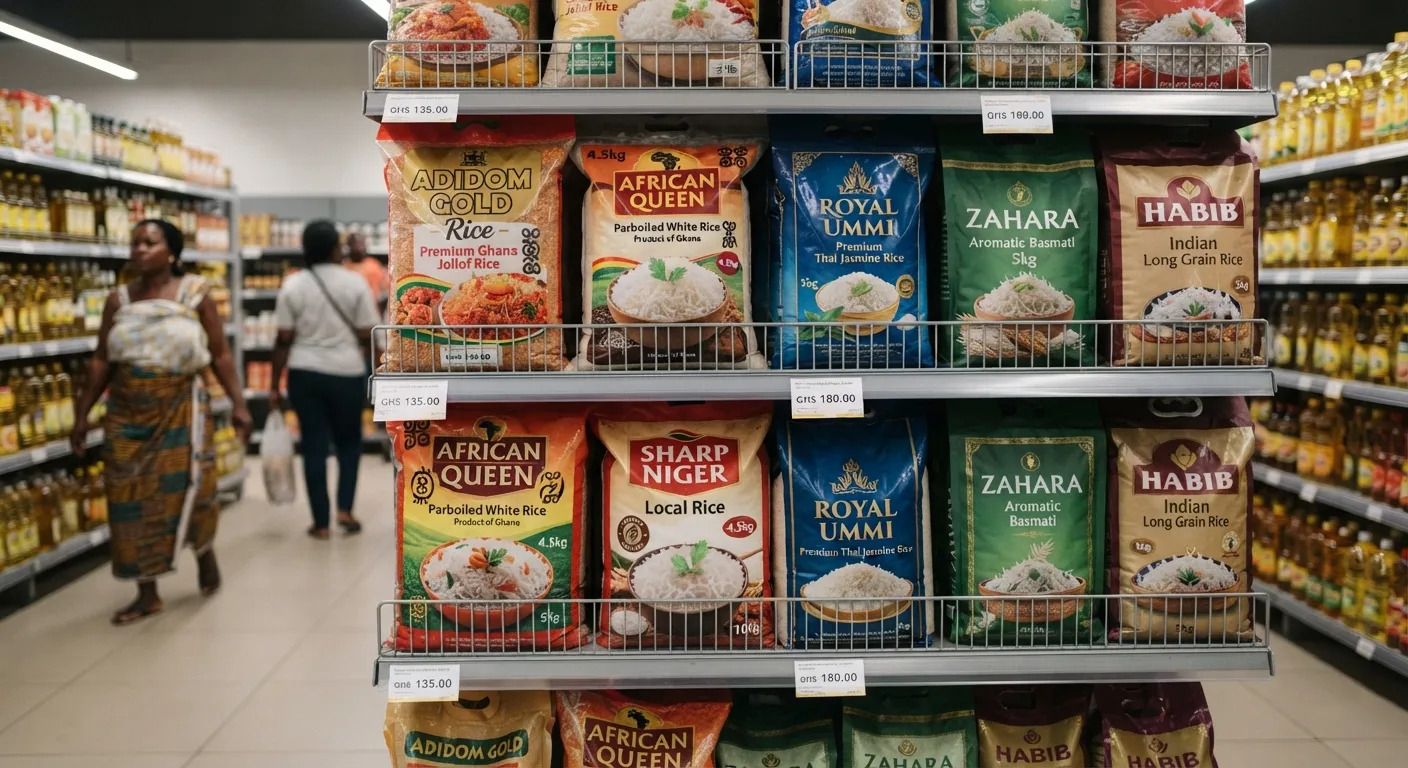
Three market signals should shape any rice business decision, and all three point the same way. First, the glut paradox: in 2026 Ghana held about 1 million tonnes of unsold local paddy even as it imported a similar amount, which proves the binding constraint is milling, quality and market access, not raw production. Second, imports keep winning on quality and presentation, not price, so the durable competitive advantage is a clean, branded local product, not a cheap one. Third, the exchange rate moves import prices sharply, so a local business that competes on quality is insulated from the currency swings that a cheap-sack competitor is not. Read together, these signals say the same thing the whole playbook says: build downstream, build for quality, and build for the buyer who already wants local rice but cannot yet find it good enough.
Position as an import-substituter, not a commodity grower. Frame the business, and the finance case, around taking shelf share from a GH¢3 billion import bill with a quality local product. That is the story policy and lenders are backing.
Line the business up with the policy stack. Site a mill in the north for the tax break, use the GIRSAL guarantee and Development Bank Ghana facility for capital, aim at the guaranteed institutional buyers, and use warehouse receipts against the glut. The rails exist; use them.
Build for quality as the moat. The lasting advantage is a clean, branded local rice that wins the roughly 51 percent premium buyers will pay, not a cheaper sack that loses every time the cedi strengthens.
Move while the alignment lasts. The current alignment of policy, finance and rising demand is unusual and may not persist. A business that establishes quality and buyer relationships now will hold them when the tailwind fades.
Rice is Ghana's largest single food import-substitution opportunity: about GH¢3.05 billion a year is sent abroad, and full self-sufficiency is modelled at around US$2.1 billion in saved foreign exchange and about 200,000 jobs.
For the first time, policy, finance and market are aligned behind local rice, through the self-sufficiency drive, buy-local directives, guaranteed prices, guarantee-backed finance and tax incentives.
The market signals all point downstream: the glut proves the constraint is milling and market access, imports win on quality not price, and quality insulates a business from currency swings.
The durable competitive advantage is a clean, branded local product that wins the premium buyers will pay, not a cheap unbranded sack.
The opening is to position as an import-substituter, line up with the policy and finance stack, and move while the alignment lasts.