Ghana Agribusiness PlaybookTilapia & Catfish
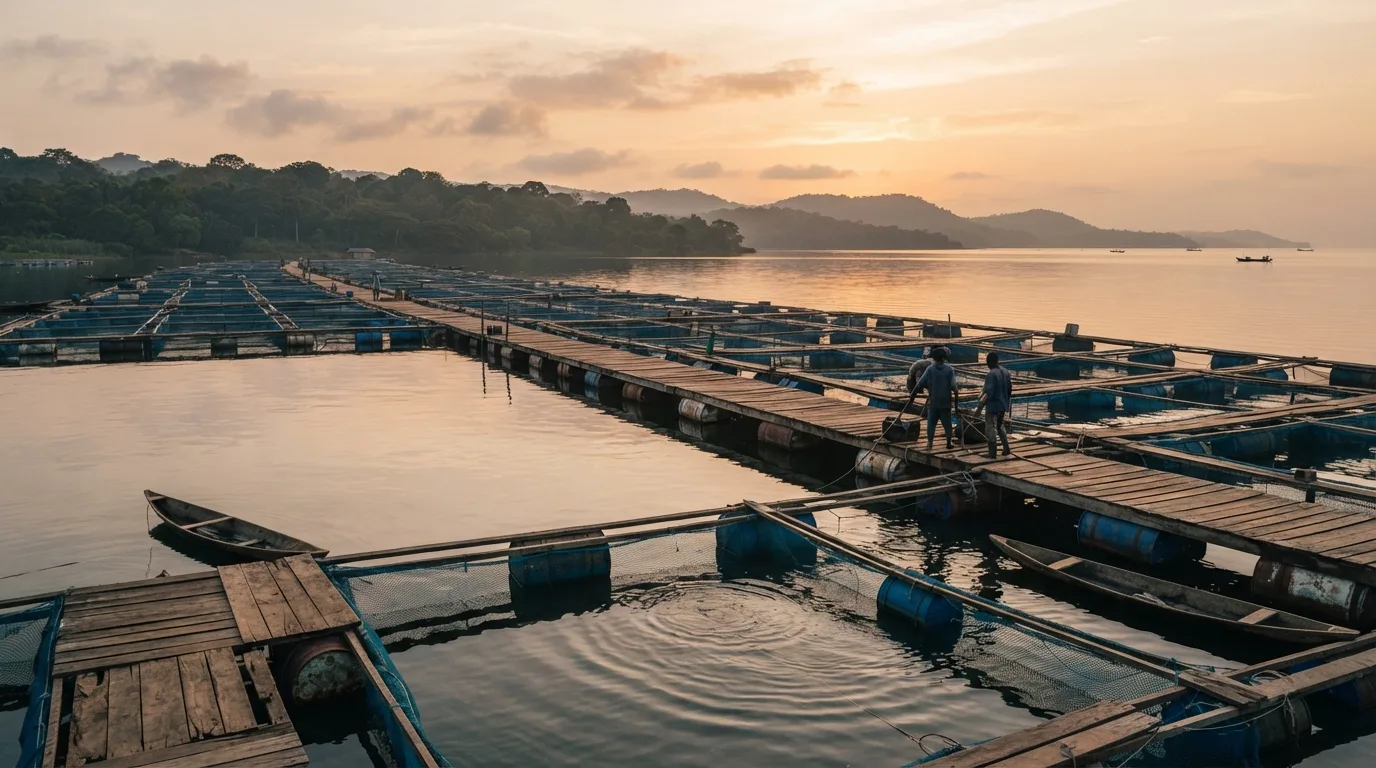
Floating tilapia cages stretching across Lake Volta at first light
Tilapia & Catfish · Pillar 04

Production System and Regime

Cages on Lake Volta, earthen ponds and catfish tanks. Water quality and stocking decide who harvests a full crop.
Production Systems · Pillar 04

How you grow the fish is not a farming preference; it is a capital-and-site decision made before the first fingerling goes in. Cages on Lake Volta give the highest volume but carry the highest disease and water-quality exposure and depend on lake access most entrants do not have. Ponds and tanks ask for less water and different money, and suit a different person. This pillar shows how to match the system to the site and the wallet, because choosing the wrong one is a common and expensive mistake.

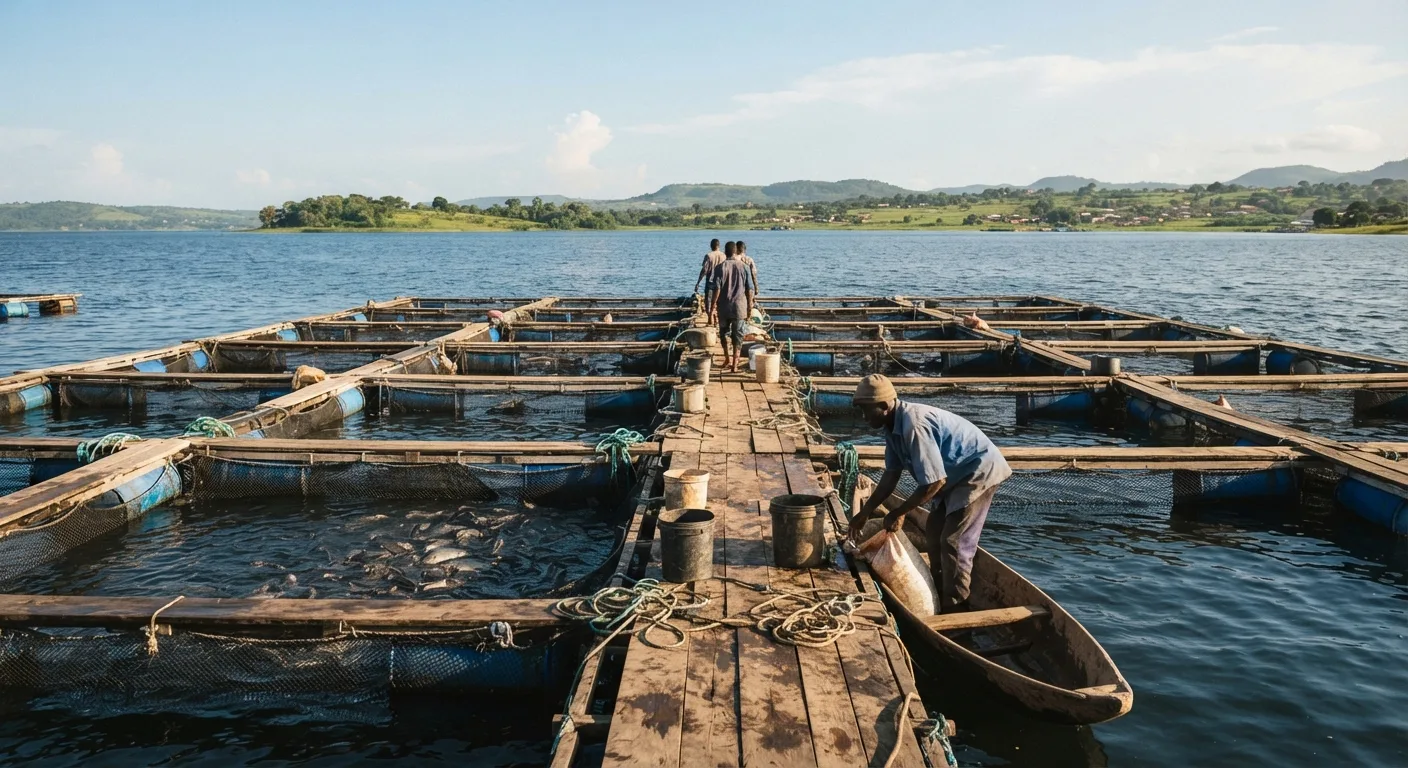
A cluster of square floating tilapia cages on the open blue water of Lake Volta, Ghana, a wooden walkway between the cage frames, a farmer in a small boat, bright morning light, distant green shoreline
Water, not hardware
Pick the system for your site and your money, not your taste.
~6 months
the cage cycle to a table fish of about 350 g
~90%
of Ghana's farmed fish comes from cages on Lake Volta (Banini et al., 2024)
5 to 20%
how low grow-out survival can fall when water and disease are not managed (Baah et al., 2026)

🐟 Three systems, one decision 🐟

There are really three ways to farm fish in Ghana, and they are not interchangeable. Cage culture suspends fish in netted enclosures in open water, almost all of it on Lake Volta; it is where the volume is, and about 90 percent of Ghana's farmed fish comes from floating cages on Lake Volta (Banini et al., 2024). Pond culture digs or builds an earthen basin and holds its own water; it needs land and a water source but not lake access, and it is the friendlier start for a smallholder inland. Tanks and recirculating systems (RAS) grow fish in built tanks that clean and reuse their water; they need the least water and the most capital and skill, and they sit near cities where the fish sells fresh. The mistake is to copy the cage model because it is the biggest, without owning the lake site, the capital or the disease tolerance it demands.

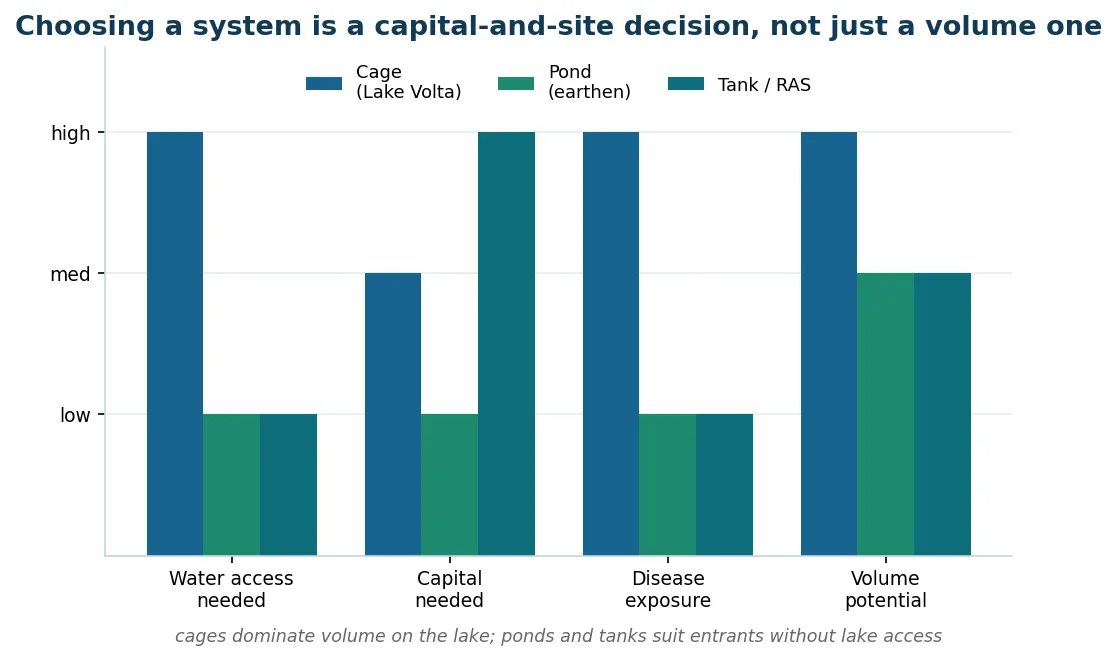
Cage, pond and tank systems compared on water need, capital, disease exposure and who each suits
Figure 10 Cage, pond and tank systems compared on water need, capital, disease exposure and who each suits

Cage culture on Lake Volta dominates by volume, but ponds and tanks demand less water access and suit a different entrant. The method is a capital and site decision.

Banini et al. (2024); WorldFish BMP; FAO (2015).

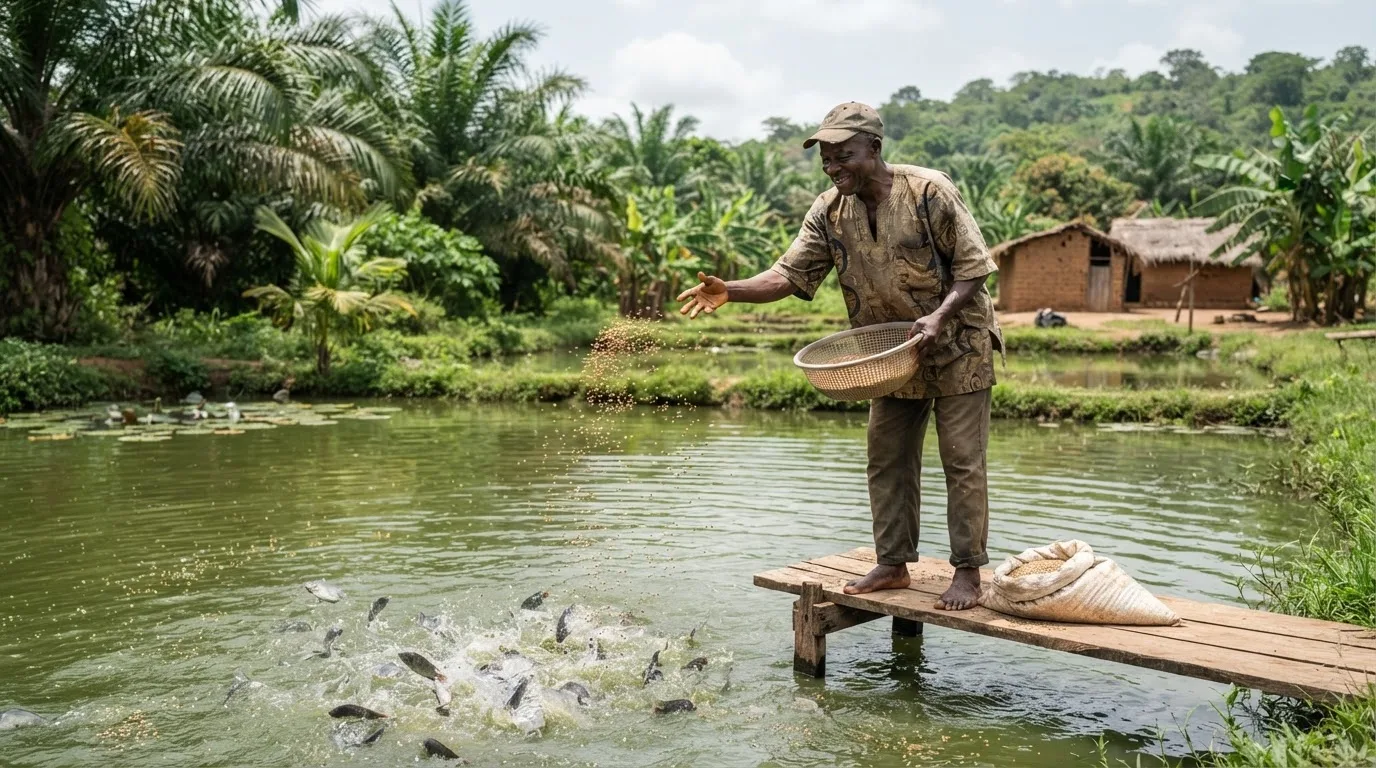
An earthen tilapia pond farm in Ghana, calm green water bordered by grass banks
Pond
An earthen pond on a Ghanaian smallholding: lower water access and capital than a lake cage, and a different entrant.
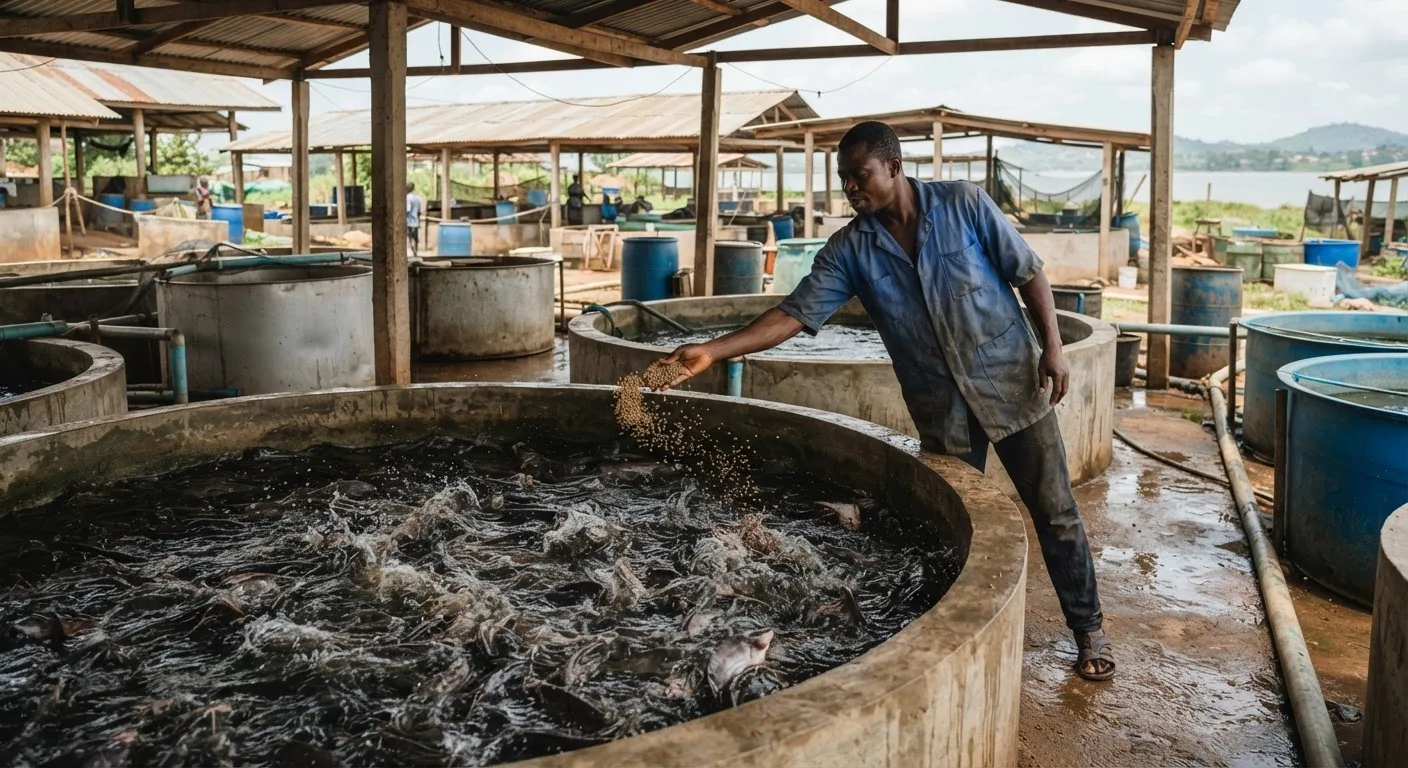
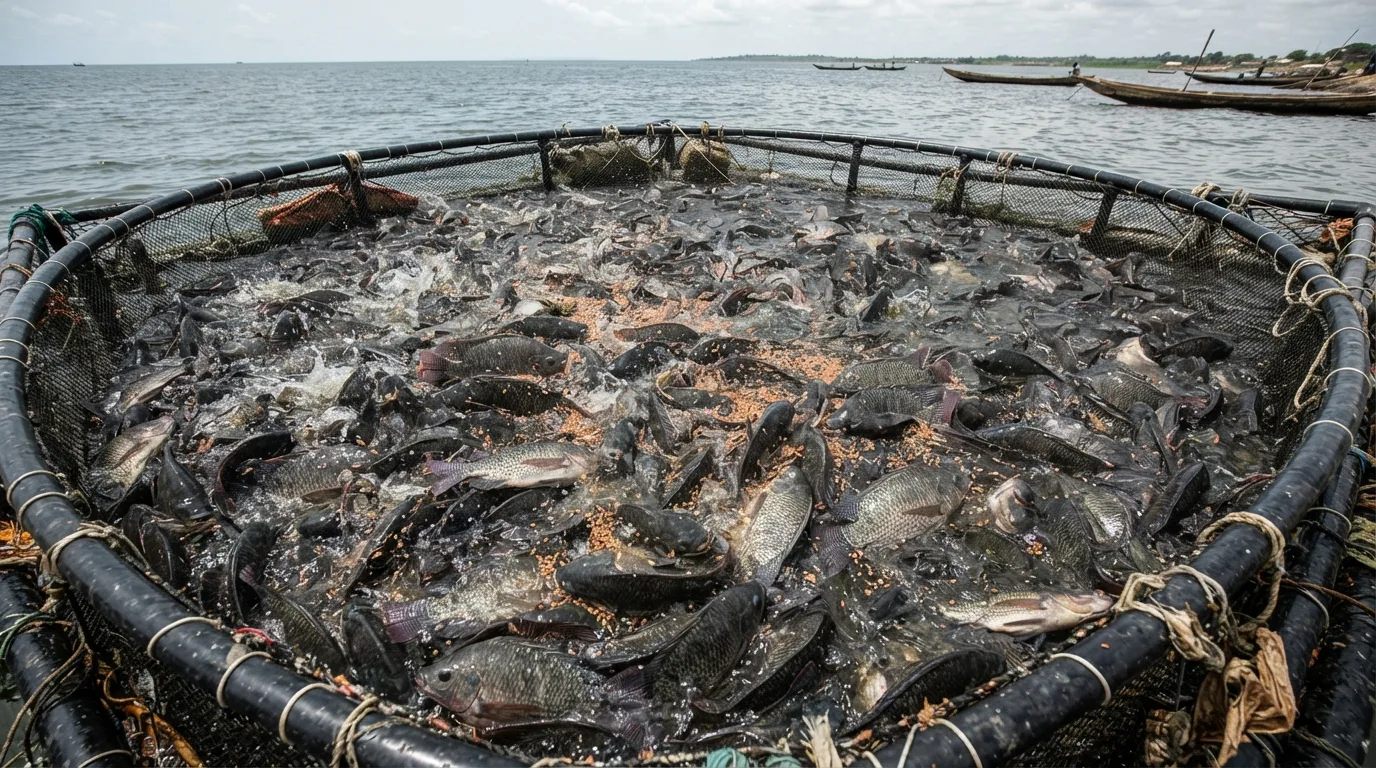
Round concrete and blue plastic catfish tanks in a covered Ghanaian yard, dense dark catfish churning the water surface, a worker scattering feed pellets by hand, natural daylight, documentary style
Tank / RAS
Tanks and RAS need the least water and the most capital and skill, near cities where the fish sells fresh.
Table 5: The three production systems read as a capital-and-site decision, not a farming style
SystemWater needIndicative capitalDisease exposureVolumeWho it suits
Cage (Lake Volta)open lake, flowing waterhigh (cages, feed, boat)highest: shared open water spreads disease fasthighest per unitsited, financed operators near the lake
Pond (earthen)land plus a modest water sourcelow to mediumlower: water can be managed and isolatedlow to mediuminland smallholders and first-timers
Tank / RASleast water, recirculatedhighest (pumps, filters, power)controllable but fails hard if the system stopsmedium, intensiveskilled, capitalised, near-city entrants

The three production systems read as a capital-and-site decision, not a farming style.

Sources: WorldFish best-management practice; FAO African Catfish Manual (2015); Banini et al. (2024); author synthesis.

🔍 What this means

Do not choose your system by which one produces the most fish. Choose it by two things you already know: whether you have secure access to lake water, and how much capital you can lose. Cage is the volume play but needs a lake site and absorbs the most disease risk. Pond is the low-capital, lower-risk way in for someone with land and water but no lake. Tank and RAS are for the well-funded, skilled entrant near a city who wants control and can survive a pump failure. Match the system to the site and the wallet first; everything else follows from that choice.

🐟 Why cages dominate, and what the concentration costs 🐟

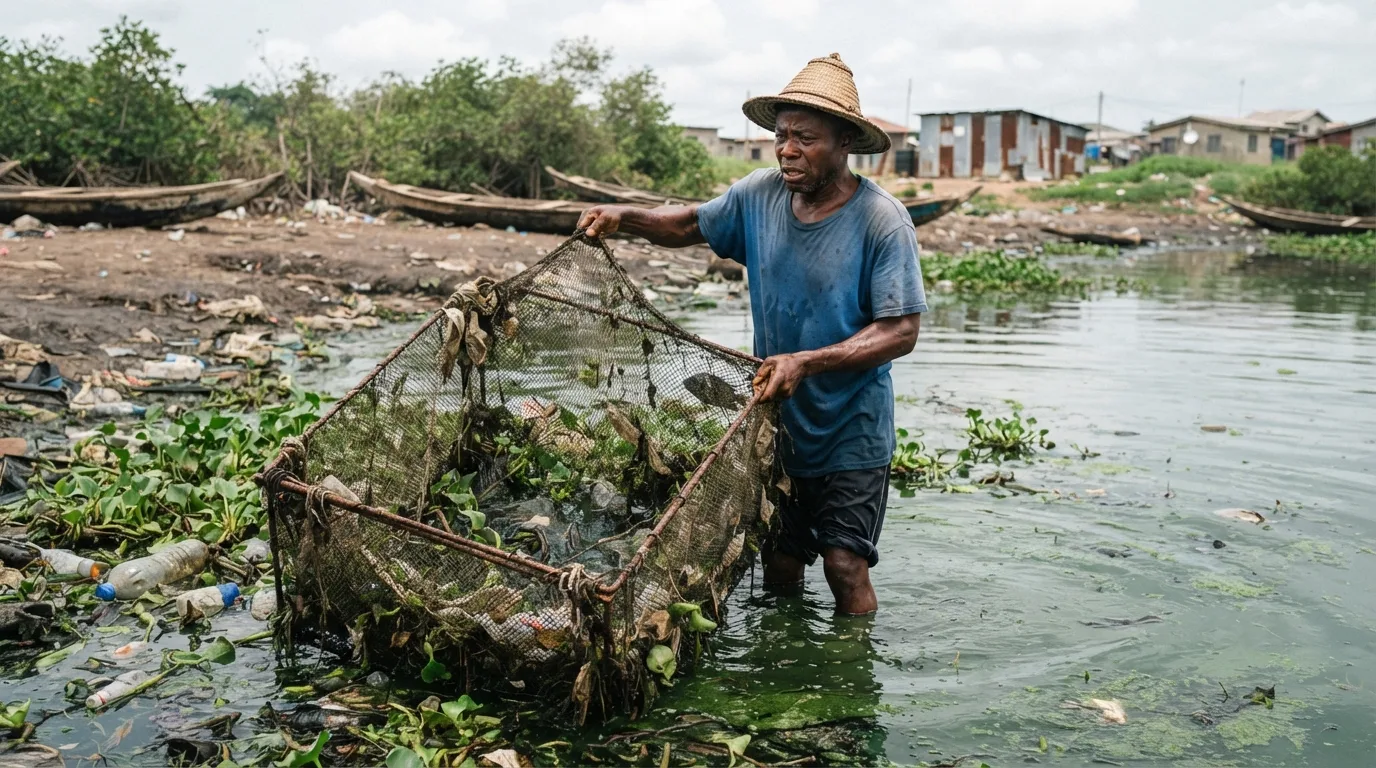
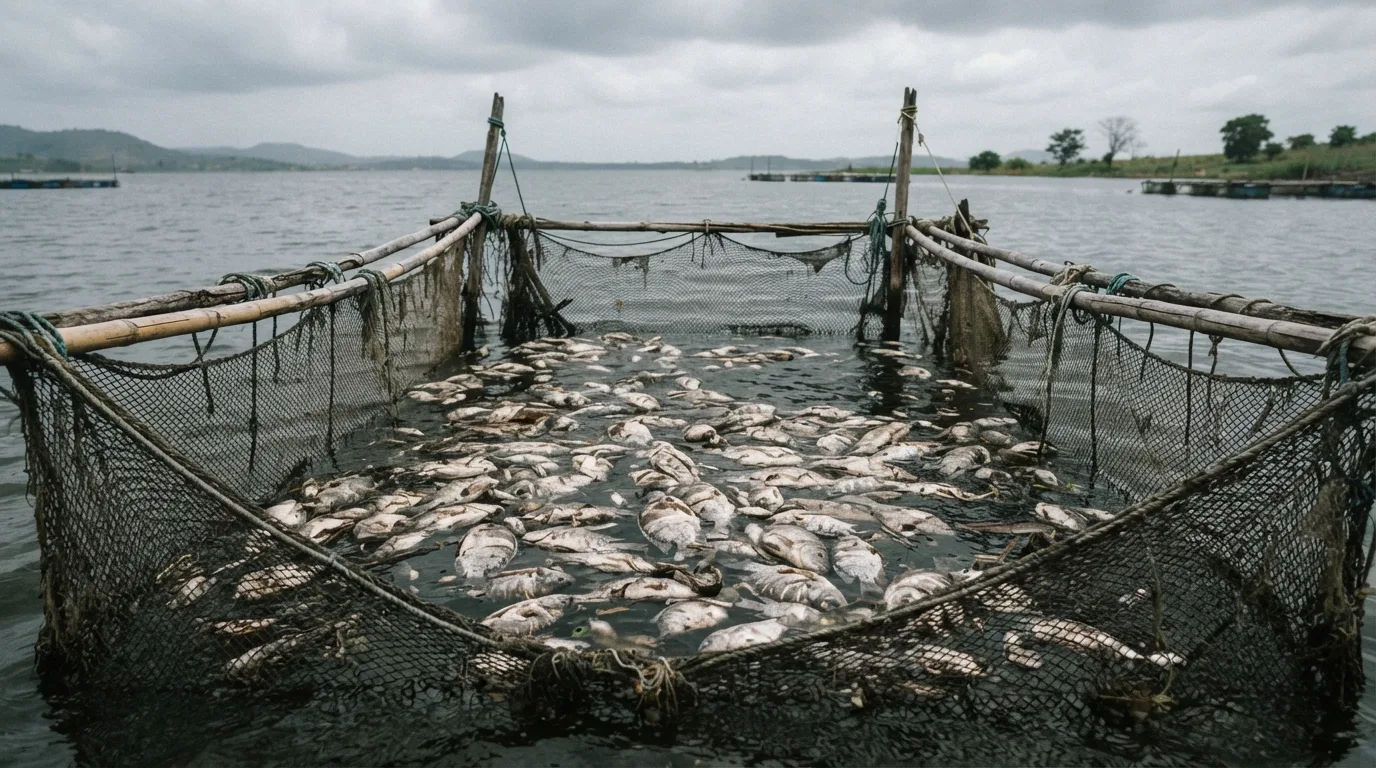
Cage culture is not just common, it is the sector. Ghana has about 10,102 cages and about 4,925 ponds, and cage culture on Lake Volta dominates output (Ghana National Aquaculture Development Plan, 2024), and cages produce the overwhelming share of the volume while ponds trail far behind. That concentration is easy to read as strength: one proven system, one lake, one crop. But the same concentration is the sector's biggest structural weakness. Almost every farmed fish in Ghana grows in the same open water, so a disease, a pollution event or a dam spillage does not hit one farm, it hits the whole industry at once. The 2018 virus crash and the roughly grow-out survival can fall to about 5 to 20 percent, mortalities can top 50 percent, and about 1,200 cages have been abandoned on Lake Volta (Baah et al., 2026) that some cages now report are the price of that concentration (the disease itself belongs to Pillar 3). Cage looks like the safe default because everyone does it; in risk terms it is the crowded trade.

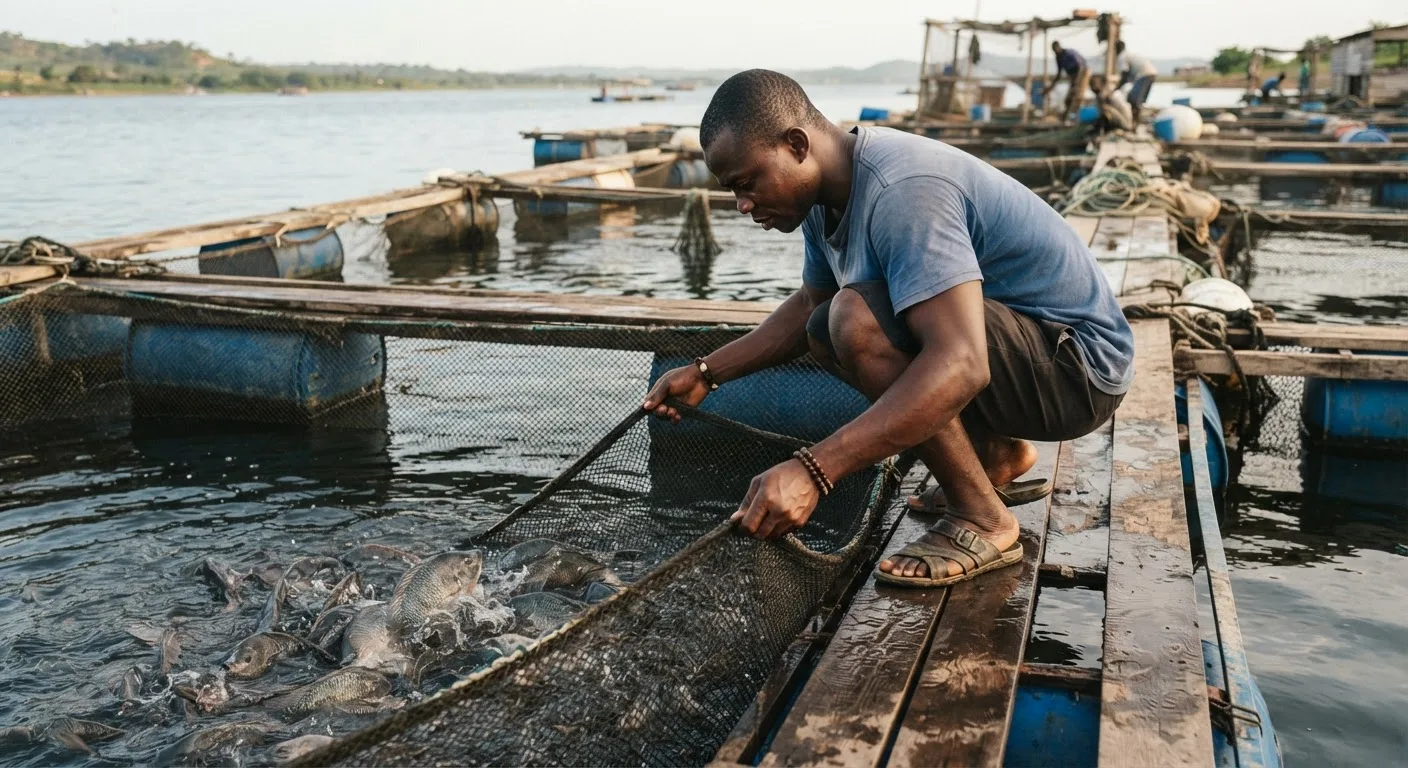
A Ghanaian fish farmer kneeling on a wooden cage walkway on Lake Volta, lifting the edge of a net cage to inspect tilapia, calm water reflecting the sky, documentary style, natural light
The crowded trade
Almost every farmed fish grows in the same open water, so one event hits the whole industry at once.
~80%
of the 121,809 tonnes farmed in 2024 is tilapia, mostly in lake cages (MoFAD, 2025)
1,200 cages
abandoned on Lake Volta where the water and disease stopped working (Baah et al., 2026)
📡 Market signal: the crowded lake is also the opening

The concentration on one lake is also where the opening is. Every regulator and investor now knows the sector is dangerously stacked on Lake Volta cages, so pond and tank capacity away from the lake, and better-sited cages within it, are exactly what the national plan wants to crowd in. An entrant who can grow fish profitably off the crowded lake is not just avoiding the shared-water risk; they are building the diversified capacity the sector is short of.

🐟 The grow-out regime is where survival and cost are decided 🐟

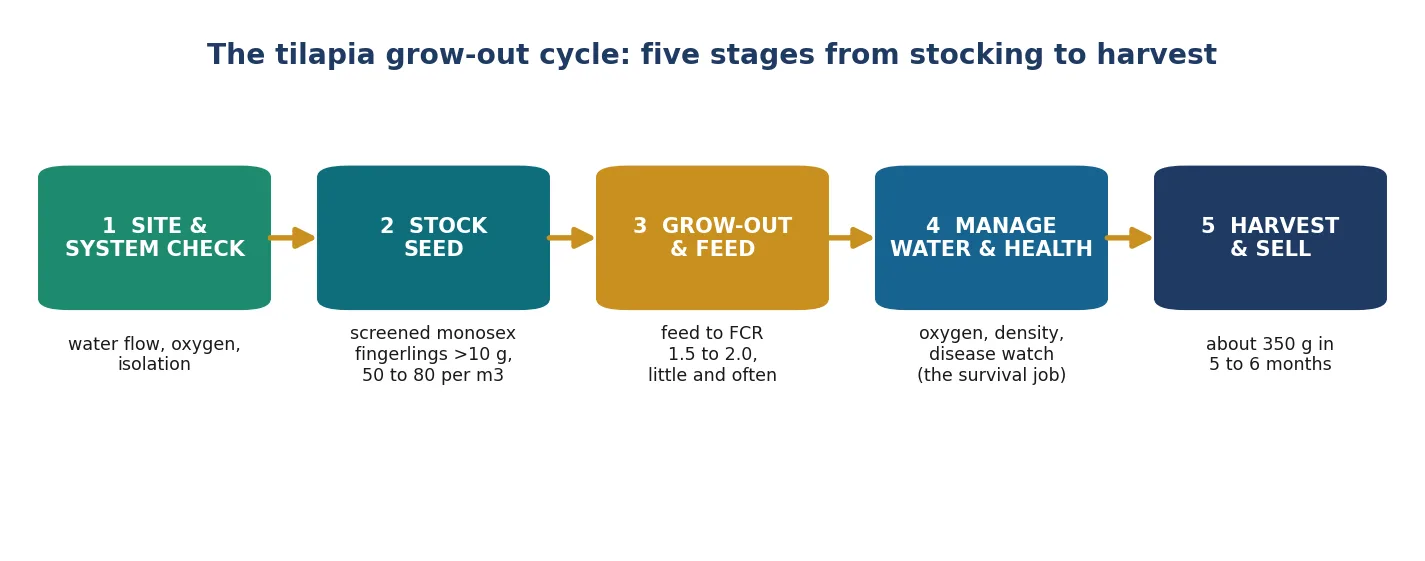
The tilapia grow-out cycle, stage by stage from stocking to harvest
Figure 11 The tilapia grow-out cycle, stage by stage from stocking to harvest

Survival and cost are set at stage two and defended every day at stage four, not fixed at harvest.

WorldFish best-management practice; author synthesis.

50 to 80
fish a cubic metre, the cage stocking range (WorldFish BMP)
1.5 to 2.0
cage tilapia feed conversion on 28 to 45 percent-protein pellets (WorldFish; FAO)

Whichever system you pick, the day-to-day regime is what turns a stocked cage or pond into a profit or a loss. Three levers do most of the work. First, stocking density: cages are stocked at about 50 to 80 fish a cubic metre, fingerlings above about 10 grams, and fish reach a table size of about 350 grams in five to six months (WorldFish best-management practice, n.d.). Crowd the cage to chase volume and you drop oxygen, raise stress and invite the disease that is already endemic. Second, feeding to a feed conversion ratio: cage tilapia runs a feed conversion of about 1.5 to 2.0 on floating pellets of about 28 to 45 percent protein by fish size (WorldFish; FAO feed management, n.d.). Because feed is by far the biggest cost (that is Pillar 5's story), every point of FCR wasted is money burned, so feeding little and often to a tight ratio is the core discipline. Third, water management: farmers themselves rank water pollution the single biggest risk factor at about 34.6 percent, ahead of pathogens at about 30.8 percent, so disease is partly a water-management problem (Baah et al., 2026). Get these three right and an ordinary site performs; get them wrong and the best fingerlings in Ghana will not save the batch.

🔍 What this means

Survival and cost are not set at harvest; they are set at stocking and defended every day after. The three levers, sensible density, tight feeding to a low FCR, and active water management, are cheaper than any input you can buy and matter more than the strain. An entrant who masters the regime on a small, well-run unit will beat a bigger, sloppier one every cycle, because in this business the operator, not the equipment, is the variable that moves the result.

🐟 Where to farm: the regional map is a shortlist, not a formality 🐟

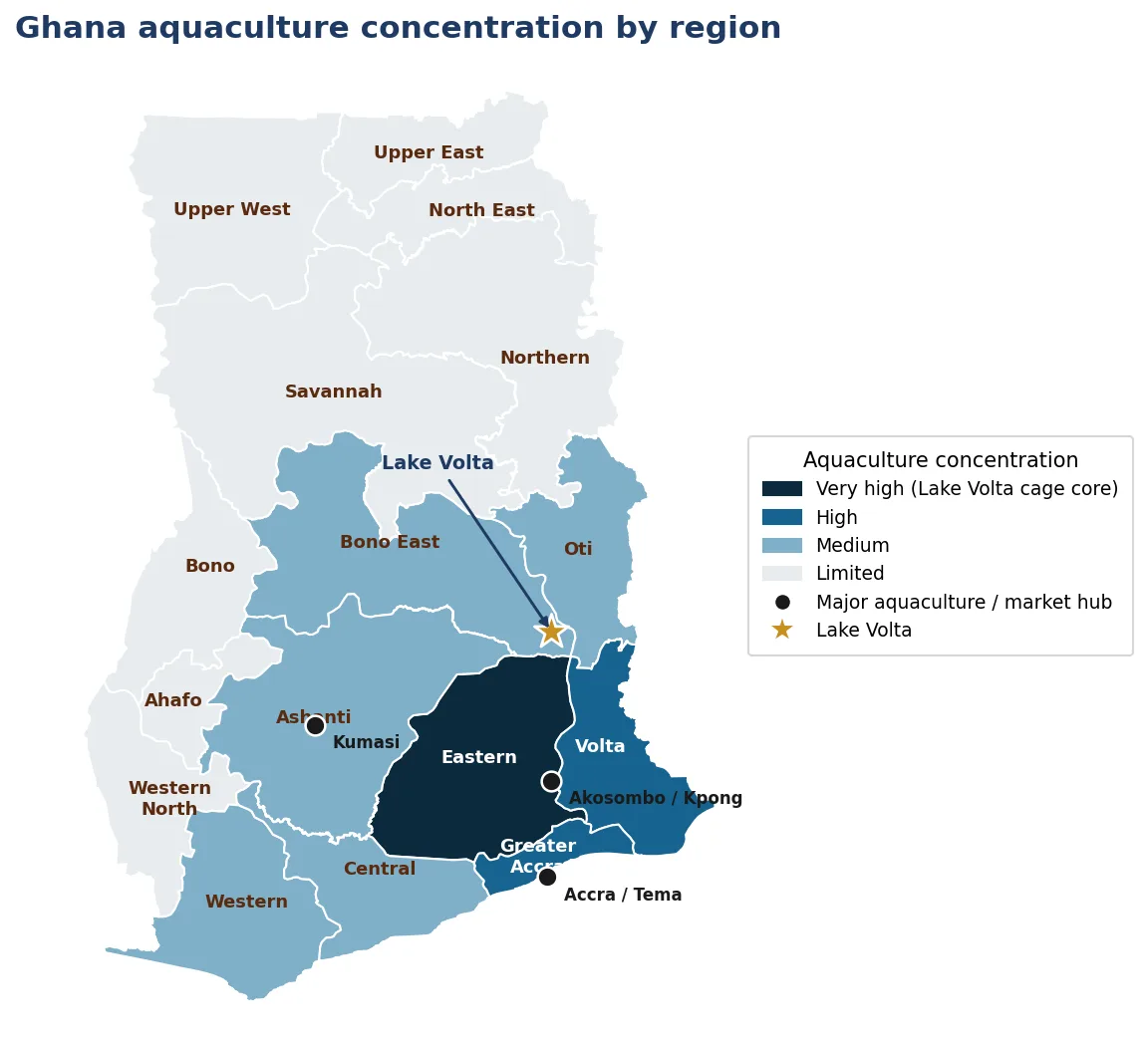
Siting is not a detail an entrant settles later; it is half the production decision. Ghana's farmed fish is heavily clustered: the Eastern Region, Greater Accra and the Volta basin together produce about 82 percent of Ghana's farmed fish (CGIAR, 2024). Those three areas dominate for good reasons: Lake Volta water for cages, and nearness to the Accra market for ponds and tanks that sell fresh. For a newcomer that map cuts two ways. Farming where the cluster already is means proven water, feed dealers, hatcheries and buyers on hand, but also the most crowding and the highest shared-disease risk. Farming outside it means thinner support and logistics, but cleaner water, less competition and a chance to serve a regional market that local fresh fish currently cannot reach.

Where the fish is farmed: the Eastern Region, Greater Accra and the Volta basin make about four-fifths of national output
Figure 12 Where the fish is farmed: the Eastern Region, Greater Accra and the Volta basin make about four-fifths of national output

Farmed fish clusters on and around Lake Volta, in the Eastern Region, Greater Accra and the Volta basin, which together make about four-fifths of national output. Water, not land, is the map.

CGIAR (2024); Ghana National Aquaculture Development Plan (2024).

🎯 Opportunity
01

Pond or tank grow-out near a secondary city, away from the crowded lake: cleaner water, lower disease risk, and a fresh-fish market that imports and distant cages struggle to serve.

02

A better-sited cage within the cluster, chosen for flow, depth and isolation rather than convenience, which is the difference between a cage that survives a hot, still week and one that does not.

03

Site-selection and set-up advice itself: many entrants pick water by what is available, not what is suitable, and a service that matches system to site prevents the most expensive early mistake in the pillar.

🐟 The stocking-density lesson: less can earn more 🐟

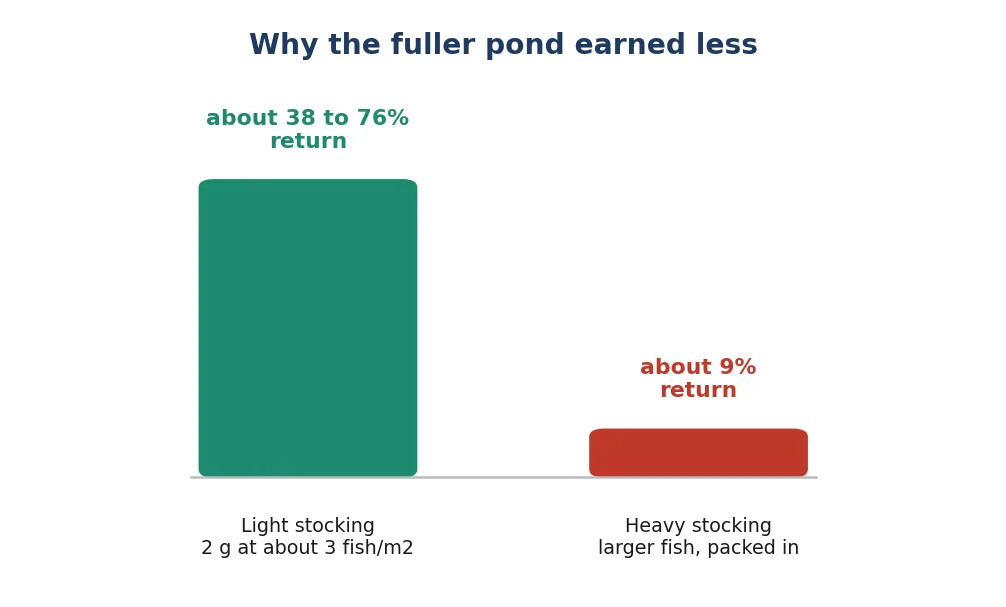
Why the fuller pond earned less: light against heavy stocking
Figure 13 Why the fuller pond earned less: light against heavy stocking

More fish in the water is not more money: crowding cut survival and raised the feed bill for a poorer harvest (Addo et al., 2024).

Addo et al. (2024).

One Ghanaian pond study makes the whole argument of this pillar concrete, and it surprises people. The most profitable way to stock a pond was not the fullest. the most profitable pond stocks small 2-gram fingerlings lightly, at about 3 fish a square metre, for a 38 to 76 percent return, while the poorest option, larger fingerlings stocked heavily, returns about 9 percent (Addo et al., 2024). The instinct to pack in more fish, to fill the water and chase volume, actually destroyed the return, because crowding slowed growth, raised mortality and pushed up the feed bill for a poorer harvest. The lesson generalises straight to cages: density is not a dial you turn to maximum. It is a balance between how many fish the water can carry healthily and how much each fish is worth at harvest, and the balance usually sits well below the crowded ceiling.

38 to 76%
return on a pond stocked lightly at about 3 fish a square metre (Addo et al., 2024)
~9%
return when the same pond is crowded to 6 fish a square metre (Addo et al., 2024)
🔍 What this means

Treat stocking density as a profit lever, not a volume dial. The evidence says a lightly stocked pond can return several times what a crowded one does, because slower, cleaner growth beats fast, stressed, high-mortality growth on the numbers that matter. For an entrant this is liberating: you do not need to fill every cubic metre to make money, and trying to often loses it. Stock for healthy growth and harvest weight, then let the maths, not the ego, decide the number.

🐟 The digital lever: managing the water from a phone 🐟

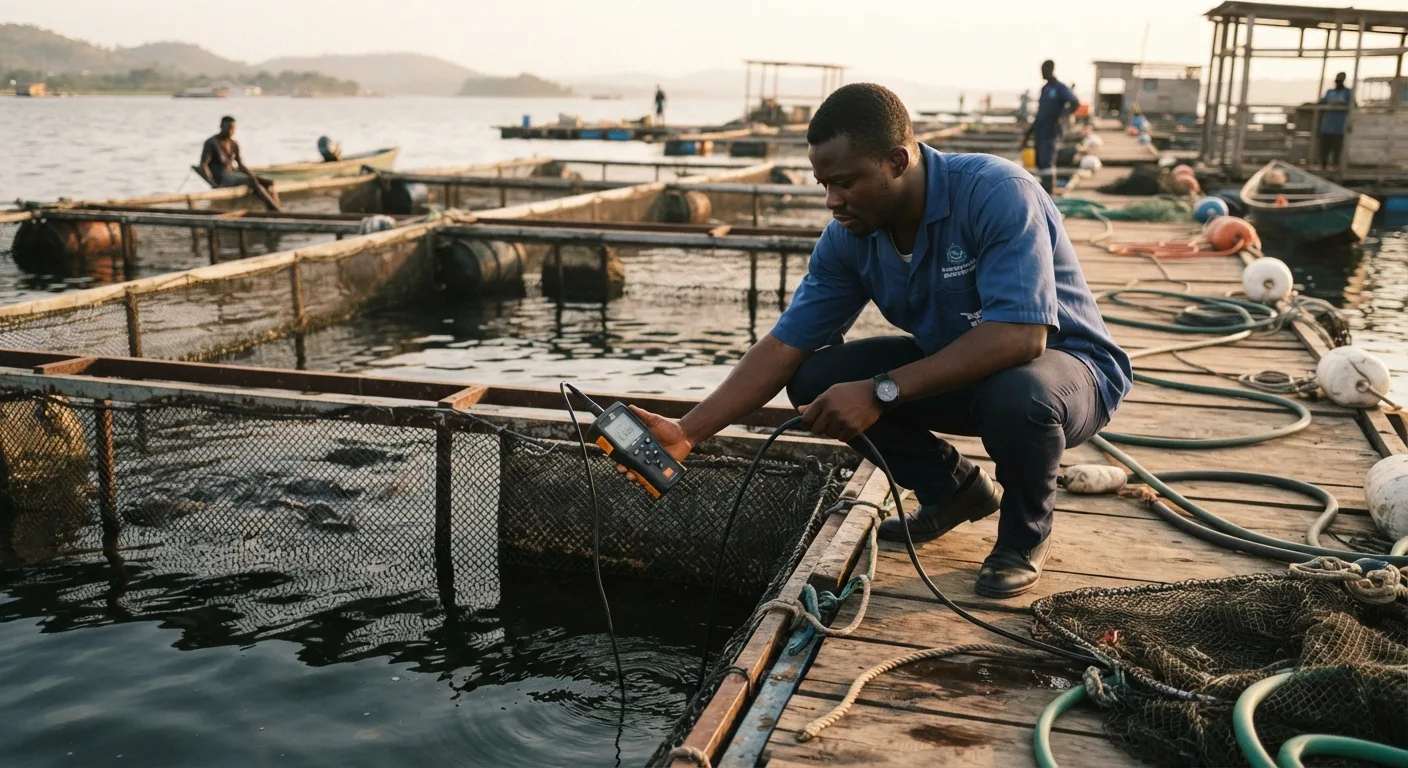
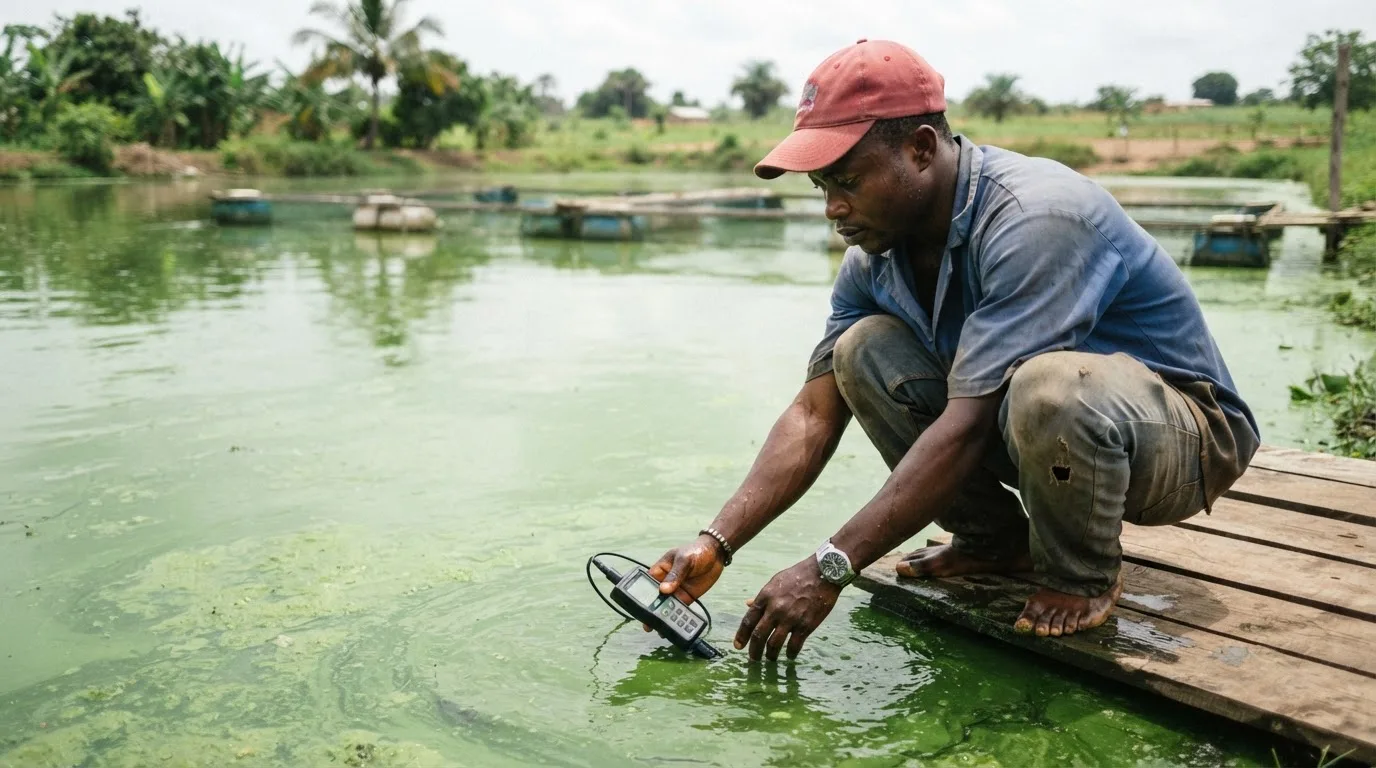
The single daily job this pillar keeps returning to, keeping the water right, is now the one an affordable digital tool can help with. AquaMet Technologies, a Ghanaian venture, already runs a solar water-quality probe with mobile alerts on more than 145 smallholder farms, reporting about 10 to 15 percent higher yields and up to a quarter less feed waste and mortality (Citi Newsroom; Africa Prize, 2025). Because poor water and low oxygen are the ranked number-one cause of loss, a solar-powered probe that texts an alert before an oxygen crash is not a gadget, it is survival insurance on the biggest controllable risk. solar sensors with text alerts, feeding-record apps and mobile-money input finance are feasible for smallholders now, while automatic feeders, camera disease detection and drone siting stay commercial-scale for the moment (author synthesis of live sources, 2026), so this is a production tool a smallholder can adopt today, not a future promise.

A technician on a Lake Volta cage walkway lowering a handheld dissolved-oxygen meter on a cable into the water beside a net cage, reading the display, early morning light on calm water, documentary style
Sensing beats guessing
A solar probe that texts before an oxygen crash is survival insurance on the biggest controllable risk.
145+ farms
run AquaMet's solar water-quality probe with mobile alerts (Citi Newsroom; Africa Prize, 2025)
10 to 15%
higher yields reported, with up to a quarter less feed waste and mortality (Africa Prize, 2025)
📡 Market signal: sensing beats guessing

The production edge over the next few years will not come from a new cage design, it will come from cheaper sensing and faster alerts on water and feeding. An entrant who builds or resells that monitoring, or simply runs it well on their own cages, protects the survival number that decides the whole cycle. The full technology map, feasible-now against commercial-only, is set out in Pillar 8.

🐟 The risks that sit inside the production-system choice 🐟

Overstocking the cage

Overstocking the cage

HIGH
What it is

Packing more fingerlings into a cage or pond to chase volume, on the belief that more fish means more money. Crowding drops dissolved oxygen, raises stress and disease, slows growth and pushes up the feed bill for a weaker, later harvest.

Evidence

The most profitable pond stocked only about 3 fish a square metre for a 38 to 76 percent return, while crowding to 6 fish collapsed it to about 9 percent (Addo et al., 2024); farmers themselves rank water quality the biggest risk factor at about 34.6 percent (Baah et al., 2026).

Who it hits

Volume-chasing entrants and anyone stocking to the cage's physical limit rather than its healthy carrying capacity.

How to manage it, and the opening

Stock within the recommended 50 to 80 fish a cubic metre, feed to a tight FCR, and monitor oxygen and mortality daily. The opening inside the risk is disciplined, lightly stocked production that quietly out-earns crowded neighbours, and advisory or monitoring services that help farmers find the right density.

Siting the farm in the wrong water

Siting the farm in the wrong water

HIGH
What it is

Choosing a site for convenience or availability rather than suitability: stagnant, shallow, polluted or poorly flowing water, or a crowded stretch of lake where disease already circulates. The system can be perfect and still fail if the water underneath it is wrong.

Evidence

About 90 percent of farmed fish grows in the same Lake Volta water, so shared-water disease and pollution hit the whole cluster at once, and grow-out survival has fallen to as low as 5 to 20 percent on some cages (Banini et al., 2024; Baah et al., 2026).

Who it hits

First-time entrants who take whatever water is nearest, and cage operators who crowd into the busiest, highest-risk part of the lake.

How to manage it, and the opening

Assess flow, depth, oxygen and isolation before committing, keep distance from other farms, and consider pond or tank sites off the crowded lake entirely. The opening is well-sited capacity away from the concentration, which is exactly the diversification the sector needs.

Buying the wrong system for your capital

Buying the wrong system for your capital

MEDIUM
What it is

Copying the cage or RAS model because it looks the most productive or the most modern, without the lake access, the working capital or the technical skill each demands. A tank system with no reliable power, or a cage with no lake site, is capital committed to the wrong shape of business.

Evidence

Cage, pond and tank differ sharply on water need, capital and skill, and RAS in particular fails hard if the pumps or power stop; cage depends entirely on secure lake access (FAO, 2015; author synthesis).

Who it hits

Ambitious entrants who scale the system to their aspiration rather than to their site and cash, especially those drawn to high-tech tanks without the power and skill to run them.

How to manage it, and the opening

Start with the system your site and capital actually support, prove the operating skill on a small unit, and scale into a bigger or more intensive system only once the cash flow and competence are real. The opening is matching entrants to the right system in the first place.

🐟 Key takeaways 🐟
01

Production method is a capital-and-site decision, not a farming taste. Cage, pond and tank differ on water need, capital, skill and disease exposure; pick the one your site and wallet support.

02

Cage culture is about 90 percent of output because it is the volume play, but that concentration on Lake Volta is the sector's single biggest structural risk, not its strength.

03

The grow-out regime, sensible density, tight feeding to an FCR of about 1.5 to 2.0, and active water management, decides survival and cost more than the strain or the equipment does.

04

Siting is half the decision. Three areas make about 82 percent of output; farming inside the cluster buys support but crowding, farming outside buys cleaner water but thinner logistics.

05

Less can earn more: a pond stocked at about 3 fish a square metre returned 38 to 76 percent against 9 percent when crowded to 6. Stock for healthy growth, not for a full tank.

Written for each reader

🐟 Practitioner intelligence 🐟

Hover any card to pause and lift it.

For students

If you want to learn production, do not start by dreaming of a cage farm on Lake Volta. Start on a small earthen pond or a couple of tanks inland, where the capital at risk is low and the water is yours to manage. Learn the three levers that actually decide the result: stocking density, feeding to a tight feed conversion ratio, and daily water management. Catfish in a pond is the most forgiving place to build these habits. The trap to avoid is copying the biggest, most impressive system before you can run a small one profitably, because the operator, not the equipment, is what moves the numbers.

For entrepreneurs

First move: decide your system from your site and your capital, in that order, before you buy anything. If you have secure lake access and the money to absorb disease risk, cage is the volume play; if you have land and water but no lake, a well-run pond is the lower-risk way in; if you are near a city with capital and skill, tanks can serve fresh at a premium. The expensive mistake is buying the wrong shape of business, a tank with no reliable power, or a cage on crowded, poorly flowing water. Stock within 50 to 80 fish a cubic metre, resist the urge to crowd, and prove the regime on one unit before you scale.

For investors

Diligence starts with the system-site fit, because it is where ventures quietly fail. Ask whether the water is secure and suitable, whether the site sits in the crowded, high-disease part of Lake Volta or safely off it, and whether the operator can run the grow-out regime rather than just build cages. A crowded cage on shared water is a concentrated disease position wearing a production costume. The thesis worth backing is well-sited, well-run capacity, especially pond and tank volume away from the lake, which is both lower-risk and the diversification the national plan is trying to fund. Underwrite the site and the operator before the tonnage target.

For ecosystem actors

The lever is diversified, well-sited production capacity, not more cages on the same crowded lake. Support pond and tank development away from Lake Volta, tie any siting approvals to flow, isolation and carrying capacity, and back extension that teaches the grow-out regime rather than just handing out fingerlings. Measure success as healthy production spread across suitable sites, not as cages counted. The failure to avoid is subsidising yet more crowding on the same stretch of water, which raises the shared disease risk the whole sector is already carrying.

Where this connects

The stocking density and grow-out regime set here decide the survival that Pillar 3 (disease and biosecurity) either protects or loses, especially on the crowded lake. The feeding and FCR discipline flows straight into the cost model in Pillar 5, where feed is the dominant expense, and the screened, monosex fingerlings this regime depends on are the seed choke point introduced in Pillar 1.

Download full PDF
UpcomingThis document isn't available yet.