Ghana Agribusiness PlaybookTilapia & Catfish
From cage and pond to smoked and fresh fish on a Ghanaian market table
Tilapia & Catfish · Pillar 06

Value Chain Analysis

The farmer takes the production risk but captures the least of the price. Value leaks upstream to imported feed and downstream to an unbuilt processing middle.
Value Chain Analysis · Pillar 06

A kilogram of tilapia roughly doubles in price from the farm gate to the retail slab, and quadruples to the supermarket shelf. Almost none of that markup reaches the farmer, who takes the production risk and captures the least of it. Value leaks two ways: upstream to imported feed, and downstream to the traders who move the fish and to a processing and cold-chain prize that nobody has claimed. That empty middle, no industrial processing, no organised cold chain, one fish in three lost after harvest, is the single biggest opening in the whole sector. This pillar walks the chain link by link and prices each one.

Before pulling the chain apart, see it whole. Ghana's tilapia chain is famously short and simple: seed and feed suppliers feed a set of farms, the farms sell to aggregators and traders, and the traders sell fresh whole fish to consumers. There is almost nothing in between. Two research teams, working a few years apart, reached the same one-line diagnosis, that the chain is short and shallow and adds little value along the way (Rurangwa et al., 2015; Ragasa et al., 2018).

That shortness is the story of this pillar. A short chain means the fish reaches the plate quickly and cheaply, but it also means the durable, high-value work, processing, portioning, freezing, branding, simply does not happen, so the money that work would earn is left on the table.

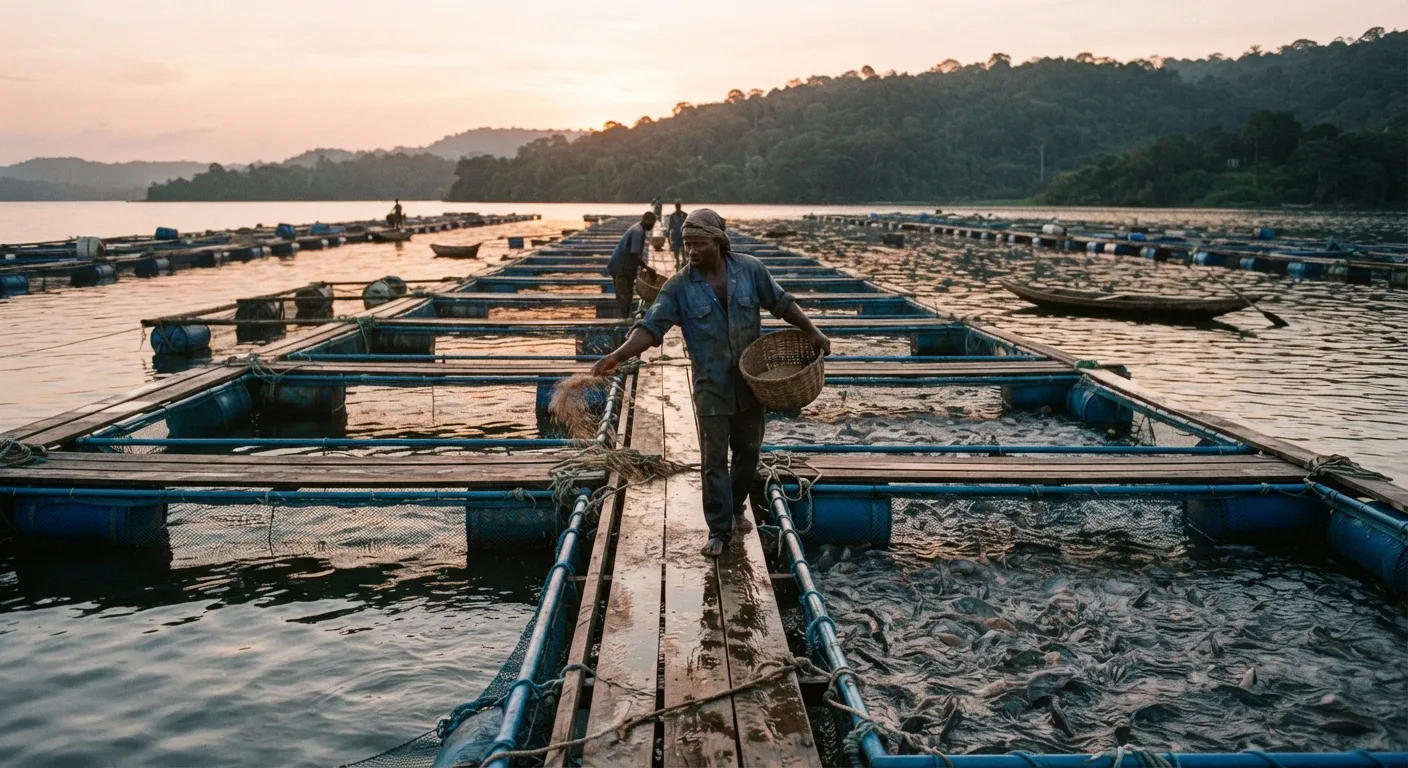
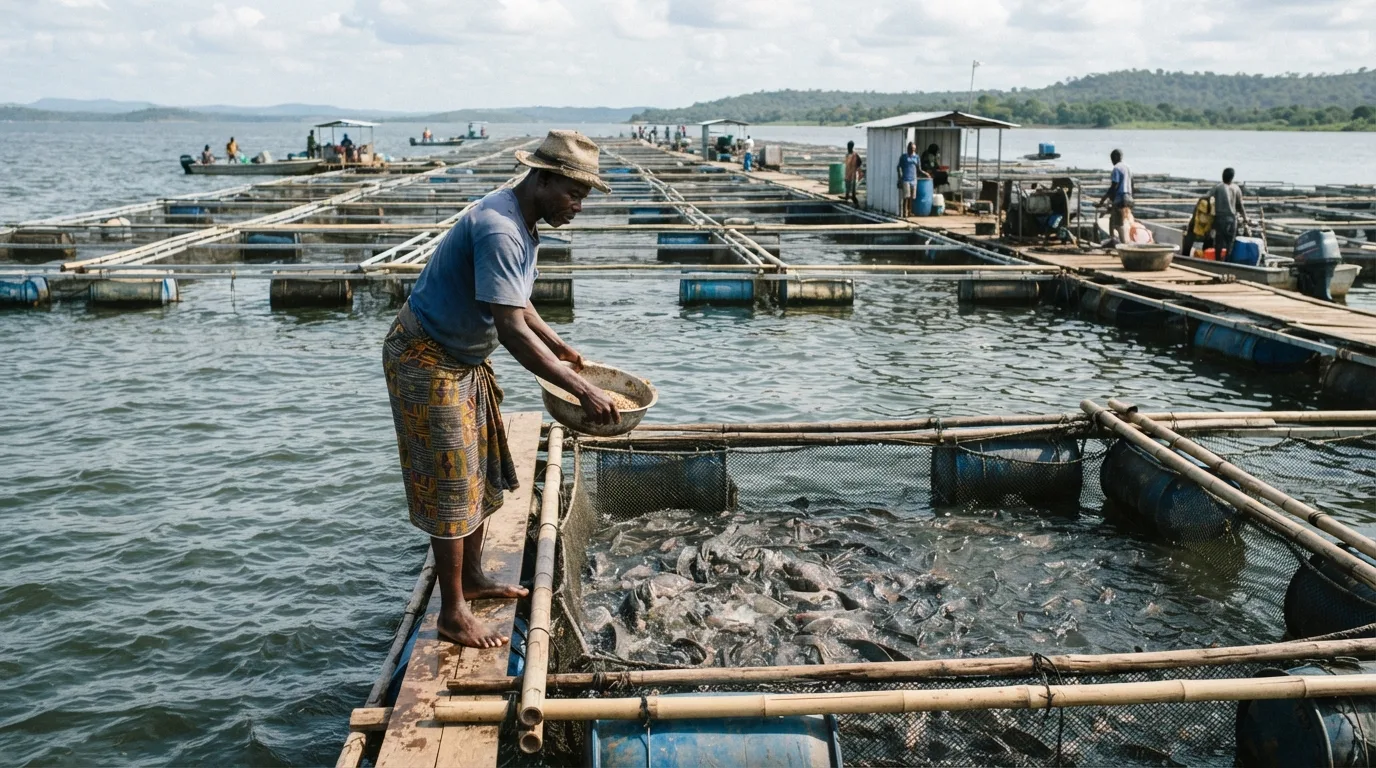
Rows of floating tilapia cages on Lake Volta at first light, wooden walkways and blue net frames on calm water, a farmer feeding fish by hand, documentary Ghana aquaculture scene, natural light
Where the value is made, and lost
Seed and feed to the plate: a short, shallow chain that reaches the plate cheaply but leaves the high-value work undone.
~2x
the farm gate is the retail price; up to 4x in a supermarket
60 to 80%
of farm cost is feed, the single biggest cost lever
20 to 40%
of production is lost after harvest, for want of a cold chain

🐟 The whole chain, in one view 🐟

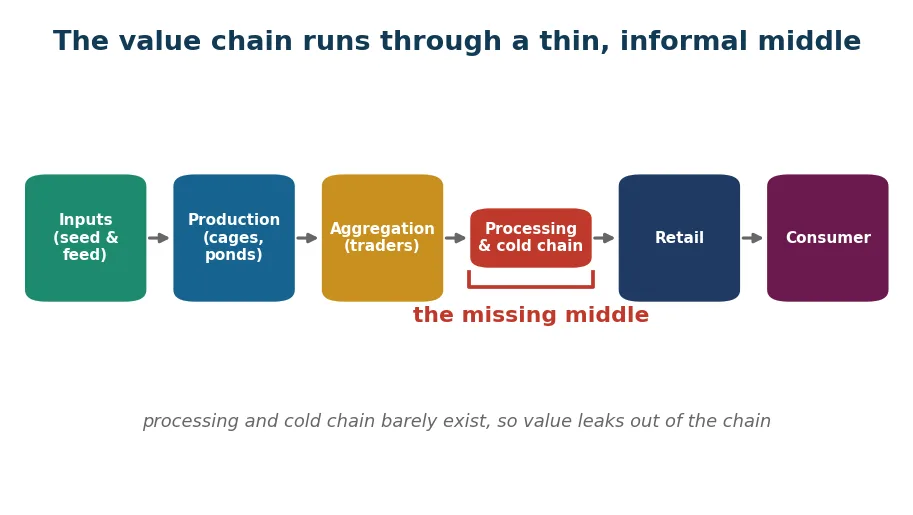
The tilapia value chain from seed and feed to the plate, with the thin, informal middle where value leaks
Figure 16 The value chain from seed and feed to the plate, with the thin, informal middle where value leaks. Sources: Rurangwa et al. (2015); Ragasa et al. (2018); Asiedu et al. (2016).
What this shows

The chain runs from seed and feed, through the farm, to a thin, informal middle of traders and smokers, and on to the plate. The gap in the middle is where the value leaks.

🔍 WHAT THIS MEANS

Read the chain as a set of margin pools, not a supply line. The two fattest pools sit at the ends: the input end, where feed captures most of the cost, and the downstream end, where processing and cold chain would capture most of the value if anyone built them. The farmer sits in the thin middle, taking the biological risk and the thinnest margin. Every opening in this pillar is about moving from that thin middle toward one of the fat ends.

🐟 Link by link: who operates each step 🐟

Link one, the input link: seed and feed set the whole chain

The chain begins before a single fish is stocked, and it is already where most of the money is decided. Feed is the giant. It is about 60 to 80 percent of the cost of raising fish, close to 77 percent on small-scale cages, the single biggest cost lever (Magna et al., 2023), and the market that supplies it is close to a monopoly: three feed producers supply the market, with Raanan holding about 70 percent share on about 24,000 tonnes of capacity (WUR; IFPRI, 2015 to 2016). Imported feed, from the likes of Coppens, Aller Aqua and Skretting, runs about 30 percent dearer than local, and the ingredient tariffs on the raw materials add another 20 to 30 percent to the cost (Ragasa et al., 2018). So the single largest cost in raising a Ghanaian fish is set by one dominant supplier and by an exchange rate the farmer cannot control. That is why it costs about US$1.51 to produce a kilogram of tilapia in Ghana, against about US$0.78 to 1.29 in Bangladesh, Egypt and China (Ragasa, in CGIAR, 2024), and it is why the feed link, not the farm, is where the sector's competitiveness is won or lost.

Seed is the second input, and it is scarce in a way that shapes the whole chain. Hatcheries supply about 79 million fingerlings a year against a shortage of roughly 50 million, and about 63 percent of farms buy seed from disease-positive farms (Asiedu et al.; Ayiku et al., 2016 to 2024). Tilapia fingerlings sell for about GH¢0.40 to 0.70 each and catfish from about GH¢0.50, with monosex males preferred (WorldFish; author synthesis, 2020 to 2026), a tiny share of farm cost, only about 6 to 7 percent, yet their quality decides survival and therefore whether the cage ever earns anything (Magna et al., 2023). Cheap, unscreened seed is the false economy that quietly sinks a batch. Pillar 1 covers the biology of the seed; here the point is commercial: the two inputs that decide the farmer's economics, feed and seed, are both supplied by a thin, concentrated set of players, and both are openings.

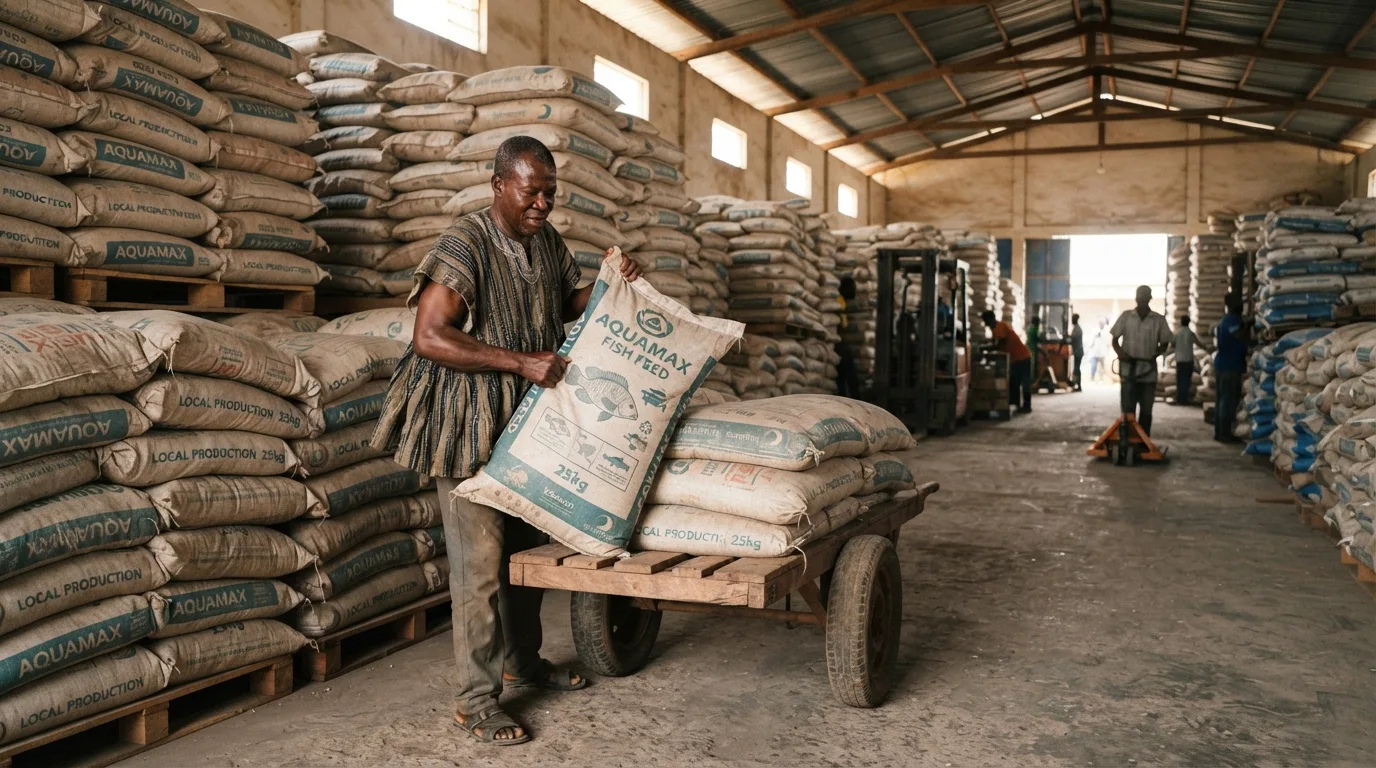
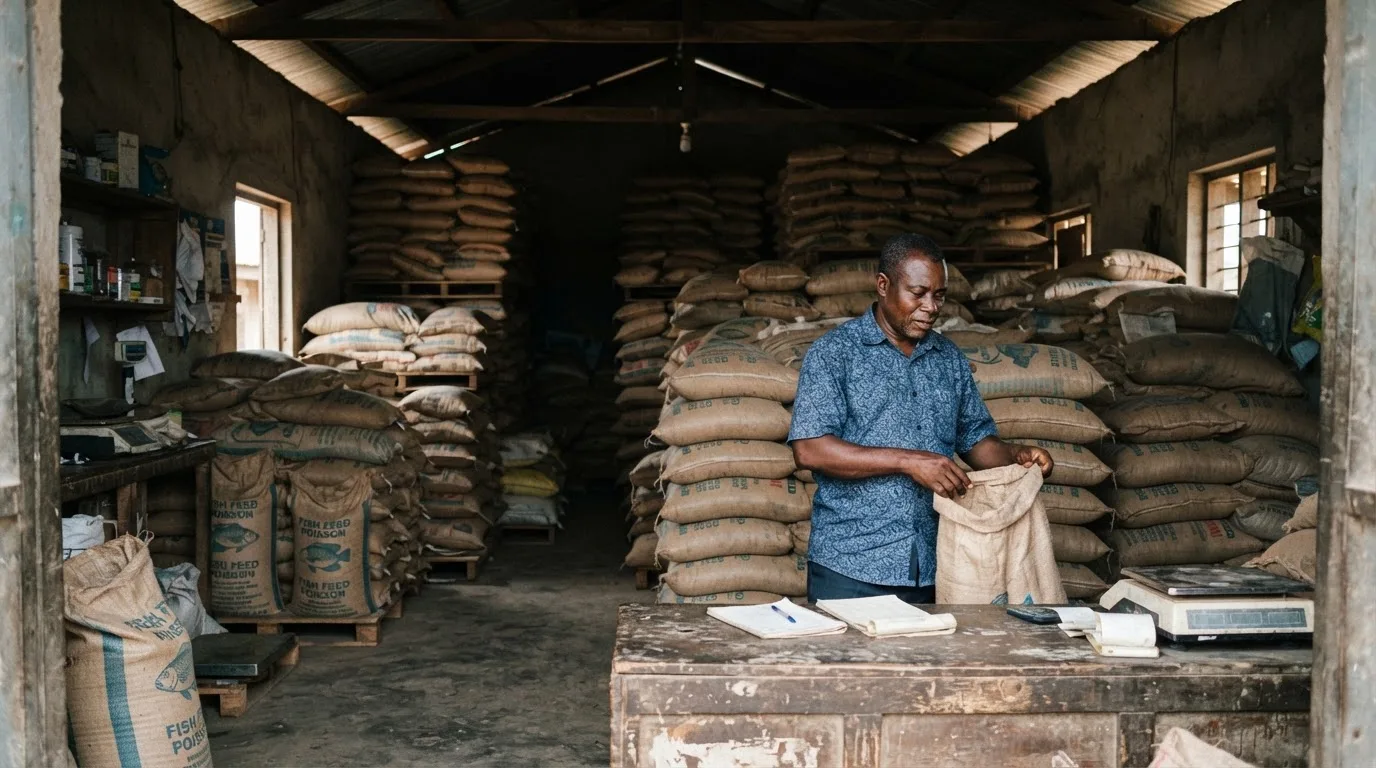
Stacked sacks of aquafeed in a Ghanaian feed store, the sector's biggest and most concentrated cost
Dollar-priced inputs
The sack, not the cage, is where the money goes: feed is the sector's biggest cost and its most concentrated market.
🎯 OPPORTUNITY

An independent feed mill is the highest-leverage entry in the entire chain. Because feed is 60 to 80 percent of every farmer's cost and one supplier holds about 70 percent of the market, cheaper, reliable local feed improves the economics of every farm at once. A mill of about 20,000 to 30,000 tonnes needs roughly US$4.2 million and can run at about a 60 percent gross margin (Rurangwa et al., 2015).

A certified hatchery sells into a standing shortage of tens of millions of fingerlings a year, at about GH¢0.40 to 0.70 a fish, while cutting the disease that unscreened seed spreads. Small on-farm feed production is a lighter version of the same idea: local producers already undersell Raanan by 10 to 35 percent (Ragasa et al., IFPRI).

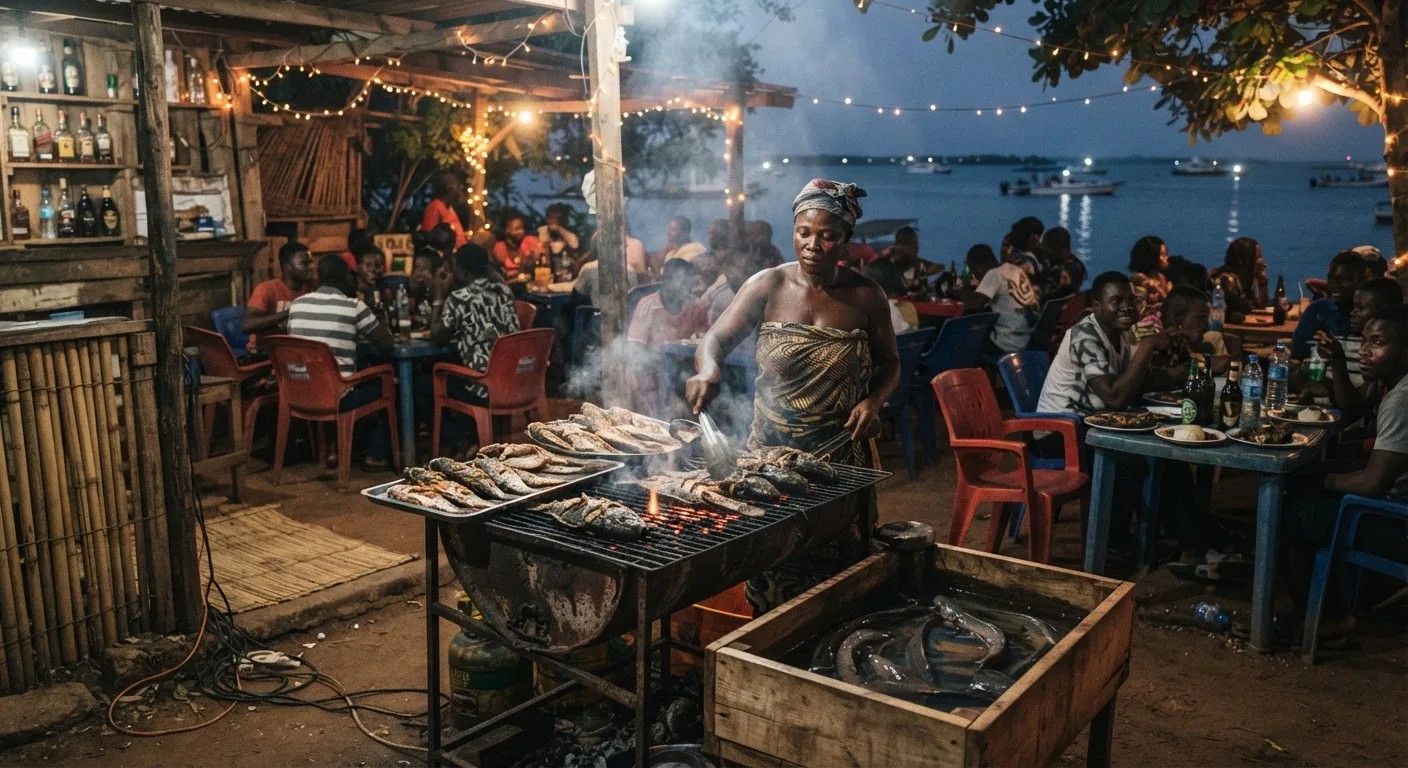
A busy Ghanaian point-and-kill bar at dusk, a vendor grilling fresh live African catfish over coals, customers seated at plastic tables, warm string lights, documentary night scene
The live-catfish trade
Catfish sold live into point-and-kill bars at about GH¢30 to 40 a kilogram sidesteps the cold-chain problem entirely.
Link two, production: two parallel chains, plus the live-catfish trade

Production is not one business but three overlapping ones, and confusing them is how entrants mis-plan. The tilapia side runs on two parallel chains. At the top sit two large integrated farms, about eight to fifteen medium ones and 100 to 300 smallholders make up the sector, alongside a separate live-catfish trade at about GH¢30 to 40 a kilogram (WUR; IFPRI, 2016). The two large farms are fully integrated: they own their hatcheries and their cold stores, they grade and gut before sale, and they reach the market through their own channels. Tropo Farms, the largest producer in West Africa, employs about 917 people and supplies through about 3,000 mostly women traders, and is scaling toward 30,000 tonnes on a US$10 million AgDevCo loan (AgDevCo, 2024), which shows what an integrated anchor looks like at scale. The smallholders are the opposite: they buy seed and feed from others, sell fresh whole fish at or near the farm gate, and depend on traders to move it. The same lake, the same fish, two completely different businesses.

Running alongside both is the live-catfish chain, which behaves nothing like tilapia. Catfish is sold live into the point-and-kill trade, bars and roadside spots where the customer picks a live fish and it is killed and grilled to order, at about GH¢30 to 40 a kilogram (live market search, 2026). Because it is sold live or smoked, it sidesteps the cold-chain problem that punishes fresh tilapia entirely, and it earns a hospitality premium. African catfish yields about 300 to 1,500 kilograms a cubic metre a year at a feed conversion of about 0.9 to 1.4, reaching about 1.1 to 1.6 kilograms in 30 to 50 weeks (FAO African Catfish Manual, 2015), so a dedicated live-catfish grow-out feeding urban bars is a distinct, defensible chain rather than a smaller copy of tilapia.

The three producer chains, read for where an entrant actually fits
Table 7: The three producer chains, read for where an entrant actually fits
The producer tierScale and structureHow it reaches the marketWhat it means for an entrant
Two large integrated farmsAbove about 5,000 tonnes each; own hatcheries and cold storesOwn grading, cold storage and trader networks (about 3,000 for Tropo)The anchor model; hard to out-compete head-on, better to supply or partner
Eight to fifteen medium farmsAbout 50 to 1,000 tonnes; buy in seed and feedSell to wholesalers and cold stores; lean on large farms for adviceThe realistic scale-up target once skills and offtake are proven
100 to 300 smallholdersAbout 1 to 50 tonnes; one to ten cagesSell fresh whole fish at or near the farm gate to tradersThe crowded, thin-margin, price-taker rung; enter here only with a cost or offtake edge
The live-catfish tradeSeparate, smaller, cash-basedSold live into point-and-kill bars and restaurants; also smokedA distinct premium chain that avoids frozen-import competition

Sources: Rurangwa et al. (2015); Ragasa et al. (2018); AgDevCo (2024); live market search (2026).

📡 MARKET SIGNAL: INTEGRATION IS WINNING

The integrated anchor is the direction of travel. Tropo already runs seed, feed, grow-out, cold storage and a 3,000-trader distribution network under one roof, and its 2024 loan is building the first modern processing plant on top of that. An entrant will rarely beat an integrated anchor at its own game, but supplying it (seed, feed, out-grown fish) or copying its model at smaller scale is a real position.

Link three, aggregation: the traders who move the fish

Between the farm and the plate sits a layer of aggregators and traders, and it is both the chain's workhorse and one of its sorest points. Aggregators pick fish up at the farm gate, and the degutting, descaling and icing is done by small traders and cold stores rather than by any organised processor (Ragasa et al., 2018). The scale is real: Tropo alone reaches the market through about 3,000 traders, most of them women (AgDevCo, 2024). This layer performs a genuine service, moving a perishable product from scattered cages to fragmented markets, but it does it informally, on ice and by road, and it captures a large slice of the farm-to-retail spread for doing so.

Farmers feel this as the cost of the middlemen. In the profitability survey, farmers named the high cost of middlemen, the distance from farm to market, and poor transport among their top constraints, and about 56 percent of farmers report difficulty accessing markets at all (Magna et al., 2023); about 54 percent of farmers struggle to access inputs and about 56 percent to access markets (Ragasa, in CGIAR, 2024). The trader is not a villain here; the farmer simply has no alternative route to the buyer, no cold chain of their own, and no shelf-stable product, so they accept the farm-gate price and let the trader take the spread. That absence of an alternative is itself the opening, and it reappears below as cold-chain aggregation.

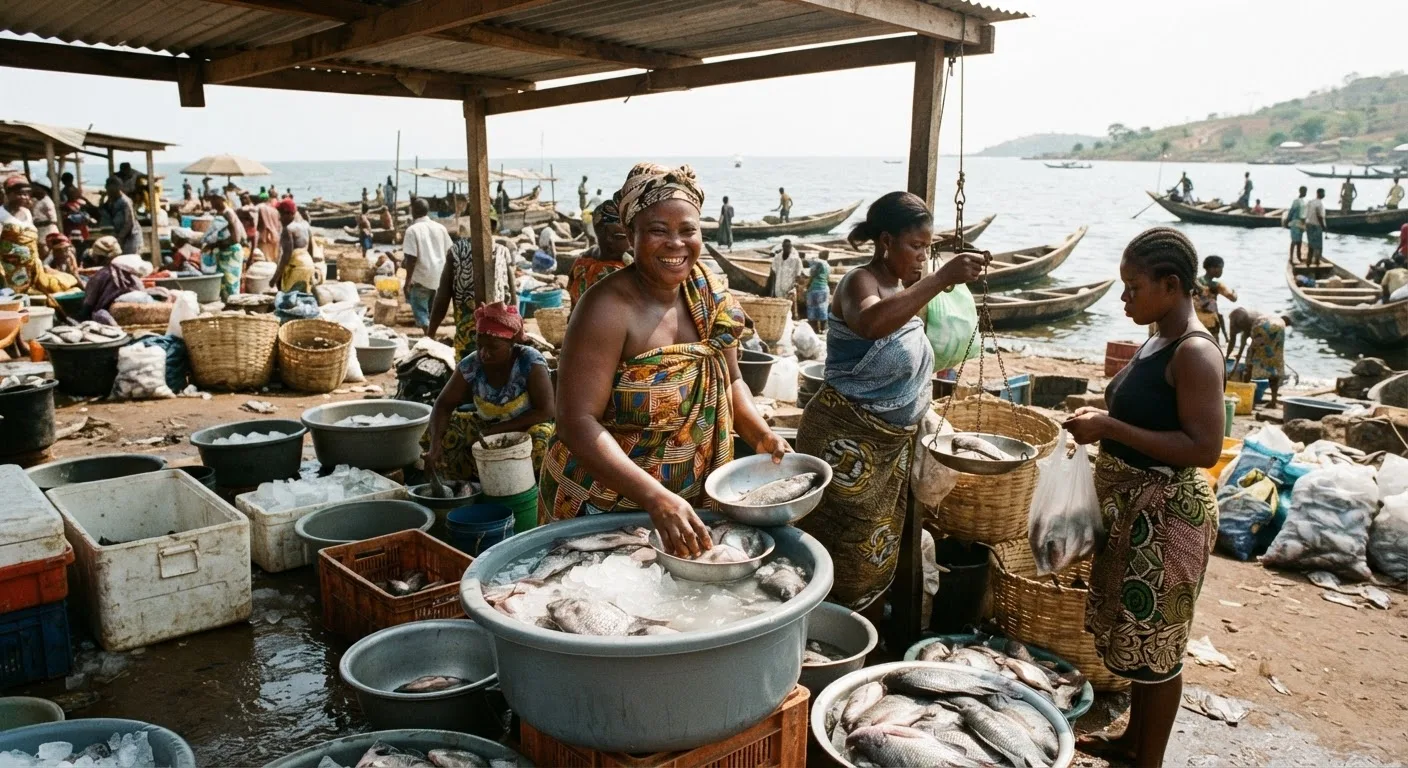
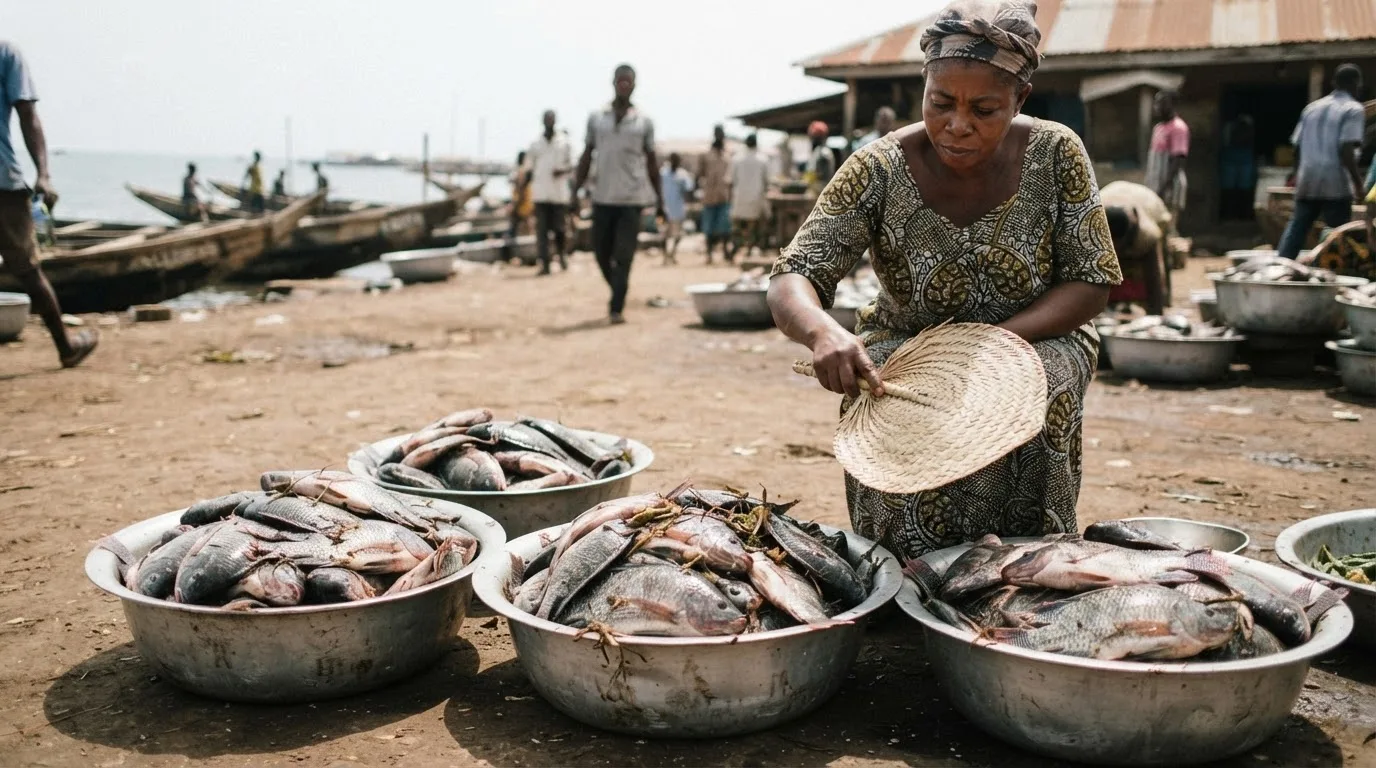
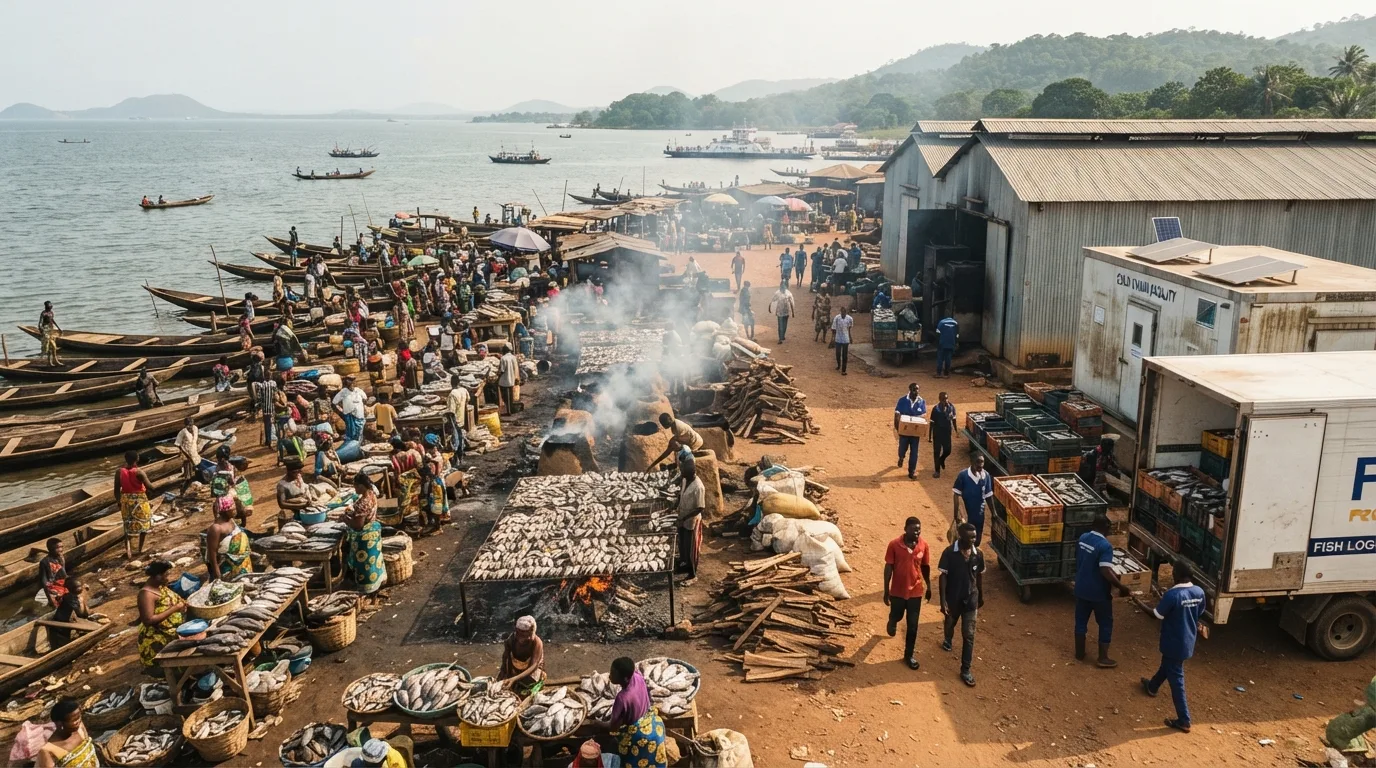
Ghanaian women fish traders at a busy lakeside market sorting fresh tilapia on ice into basins, weighing and bagging for buyers, bright daylight, documentary market scene
The chain's workhorse
Tropo alone reaches the market through about 3,000 traders, most of them women, moving a perishable fish on ice and by road.

🐟 The price ladder: how a kilogram doubles, then quadruples 🐟

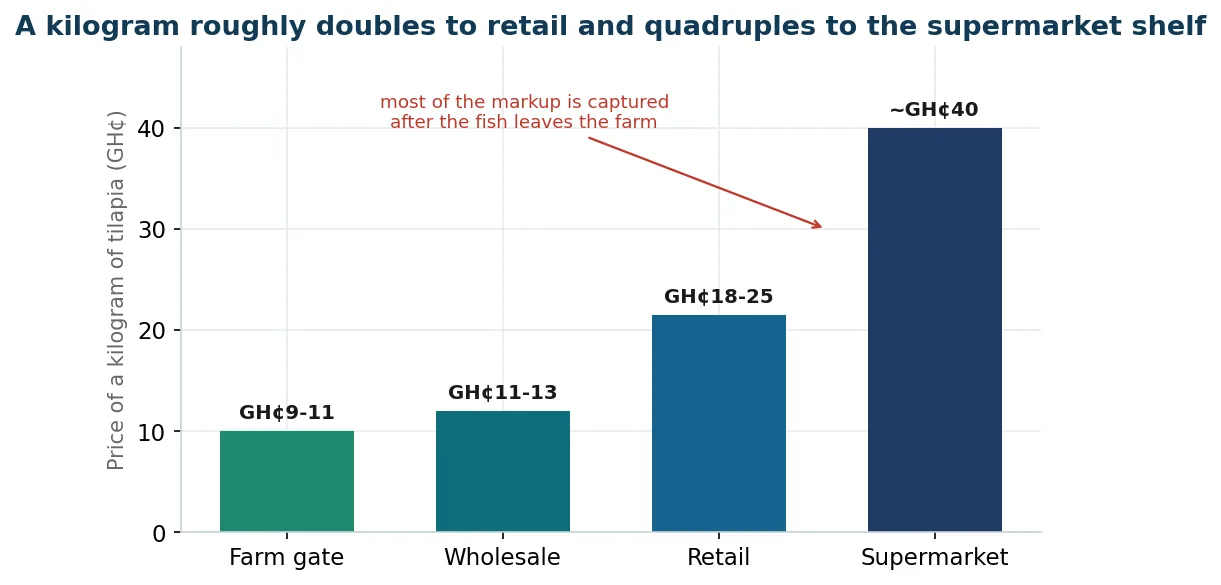
The tilapia price ladder from farm gate to wholesale to retail to supermarket, per kilogram
Figure 17 The tilapia price ladder: farm gate to wholesale to retail to supermarket, per kilogram. Sources: Ragasa et al. (2018), IFPRI Table 3.2; live market search (2026).

A kilogram of tilapia roughly doubles in price from the farm gate to the retail slab, and quadruples to the supermarket shelf. Most of that markup is captured after the fish leaves the farm.

Now put numbers on the markup. The clearest map of Ghana's fish prices tracks a kilogram of tilapia up every rung from the farm gate to the shelf: a kilogram of tilapia moves from about GH¢9 to 11 at the farm gate to about GH¢18 to 25 at retail and up to about GH¢40 in a supermarket, so retail is roughly double the farm gate, on 2016 survey prices (Ragasa et al., IFPRI, 2018).

Read that slowly. The fish leaves the farm at about GH¢9 to 11 and reaches the roadside trader or wet-market slab at about GH¢18 to 25, so retail is roughly double the farm gate. Put it in a supermarket and it is close to four times the farm gate. The 2016 figures are old, but the shape has held: by early 2026 fresh tilapia retails at about GH¢40 to 60 a kilogram while the farm gate has moved far less, so the spread has, if anything, widened.

The 2016 tilapia price ladder, rung by rung
Table 8: The 2016 tilapia price ladder, rung by rung, showing the roughly two-times farm-gate-to-retail jump
Rung on the ladderWho sells herePrice, GH¢ per kgWhat is added at this rung
Farm gate (Lake Volta)Smallholder and medium farmsabout 9 to 11The fish itself; nothing added
Medium and large sales outletsFarm depots and wholesale pointsabout 10 to 14Grading, gutting, first bulking
Wholesale markets and cold chainsWholesalers, cold storesabout 11 to 13Icing, storage, bulk breaking
Roadside and wet-market tradersMostly women retailersabout 18 to 25Transport, retail risk, small-lot selling
SupermarketsModern retailup to about 40Shelf, chill, packaging, convenience

Source: Ragasa et al. (2018), IFPRI Discussion Paper, Table 3.2 (regular and size-1 tilapia, 2016 prices).

🔍 WHAT THIS MEANS

The doubling from farm gate to retail is not a reward for adding value; it is the cost of moving a perishable fish through an informal chain. Between the farm and the shelf the fish is only iced, transported and re-sold in small lots. No one fillets it, freezes it, smokes it to export grade or brands it. So the whole GH¢8 to 15 a kilogram spread is captured by logistics and retail, not by transformation. Whoever industrialises that middle step captures a margin that today simply evaporates into handling.

A kilogram of tilapia, rung by rung
GH¢9 to 11
farm gate, where the farmer sells fresh whole fish
GH¢18 to 25
retail slab, roughly double the farm gate
up to GH¢40
supermarket shelf, close to four times the farm gate

🐟 Who earns what, and why the farmer earns least 🐟

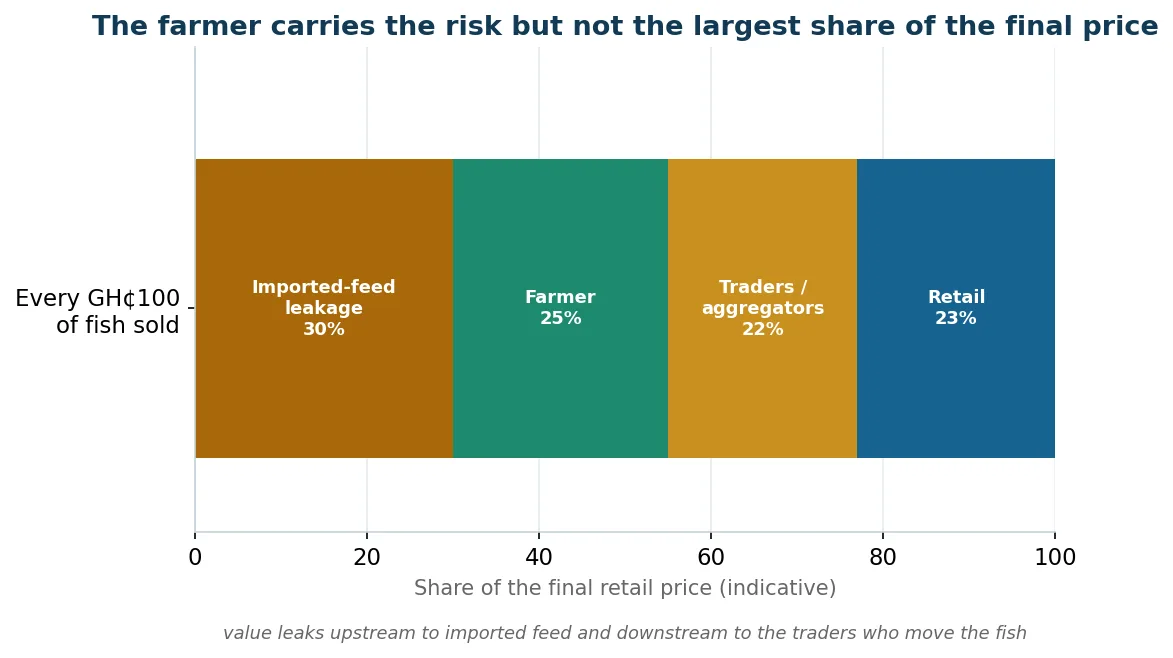
Follow the money and a hard pattern appears. The farmer carries the biology, the disease, the feed-price shock and the mortality risk, then sells a fresh whole fish at the bottom of the ladder and hands the rest of the value to others. Upstream, most of the input value has already leaked to feed, much of it imported, so of every cedi the farmer spends, 60 to 80 of every hundred pesewas leaves the country or the sector as feed cost (feed is about 60 to 80 percent of the cost of raising fish, close to 77 percent on small-scale cages, the single biggest cost lever (Magna et al., 2023)). Downstream, the roughly two-times farm-gate-to-retail markup is captured by traders and retailers who add ice and transport, not durable value. The farmer sits in the squeeze between the two.

This is not because farming is unprofitable. A well-run cage returns real money: a small-scale Lake Volta cage returns about GH¢127,261 a cycle on revenue of about GH¢395,231, a benefit-cost ratio of about 1.47 and a return on investment of about 47 percent (Magna et al., 2023), and well-run farms return about 36 percent a cycle, close to 72 percent a year, yet pooled schemes that promised 48 to 80 percent went insolvent (Adanu and Adanu, 2017). The point is subtler and more useful. The farmer's profit is real but thin and volatile, exposed to feed and disease, while the safer, fatter margins sit at the two ends of the chain that the farmer does not touch. An entrant who wants durable margin should think hard before adding yet another grow-out cage, and think instead about owning a piece of feed, seed, cold chain or processing, where the value actually concentrates.

Where the value goes along the tilapia chain: the farmer takes the risk but not the largest share of the final price
Figure 18 Where the value goes: the farmer takes the risk but not the largest share of the final price. Sources: Ragasa et al. (2018); Magna et al. (2023); Rurangwa et al. (2015).

The farmer takes the production risk but not the largest share of the final price. The value leaks upstream to imported feed and downstream to the traders who move and sell the fish.

A well-run cage still returns real money
~47%
return on investment on a small-scale Lake Volta cage
~1.47
benefit-cost ratio, about GH¢127,261 return a cycle
48 to 80%
promised by pooled schemes that then went insolvent
📡 MARKET SIGNAL: BACK THE NODE, NOT THE HYPE

Beware the pooled-scheme trap that this value distribution has already sprung once. Because grow-out looks profitable on paper, past investment vehicles promised backers 48 to 80 percent a year and went insolvent when feed, disease and price variance bit (Adanu and Adanu, 2017). The lesson for value-chain investing is the same: back the resilient nodes (feed, seed, cold chain, processing), not a leveraged bet on the riskiest link in the chain.

🐟 The missing middle: the biggest opening in the sector 🐟

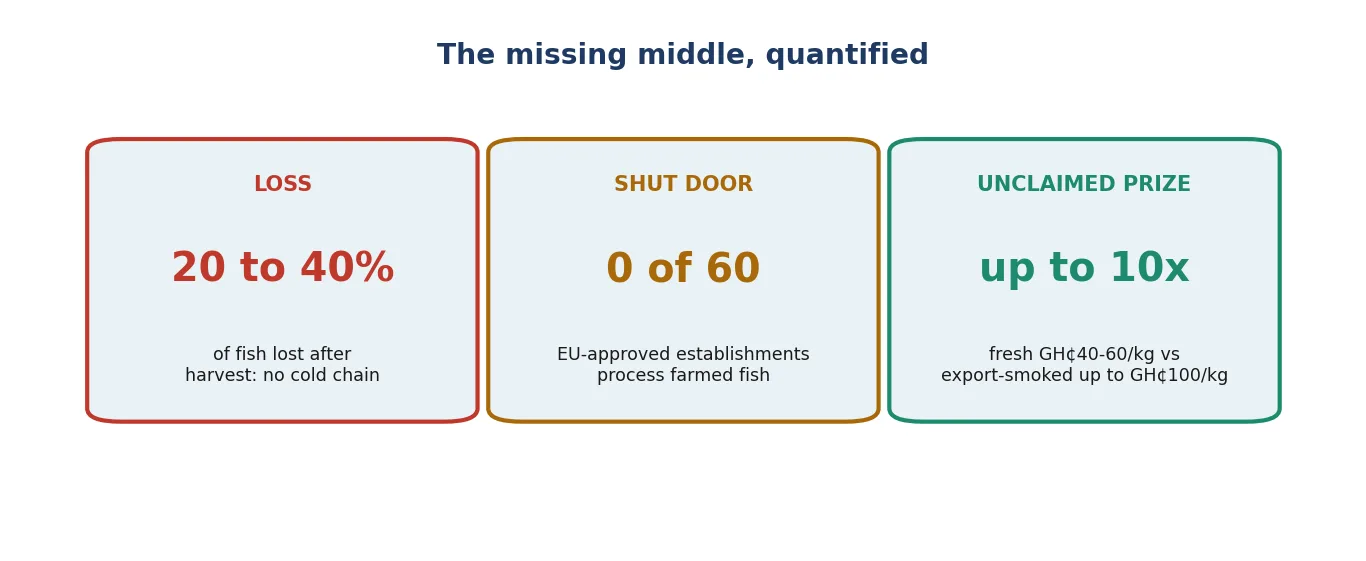
The missing middle quantified: post-harvest loss, the shut export door, and the unclaimed smoked-export premium
Figure 19 The missing middle, quantified: loss, the shut export door, the unclaimed premium. Sources: Author synthesis; live sources (2026).

One fish in three is lost, the export door is shut, and the highest-value product goes unmade. That empty middle is the biggest opening in the sector.

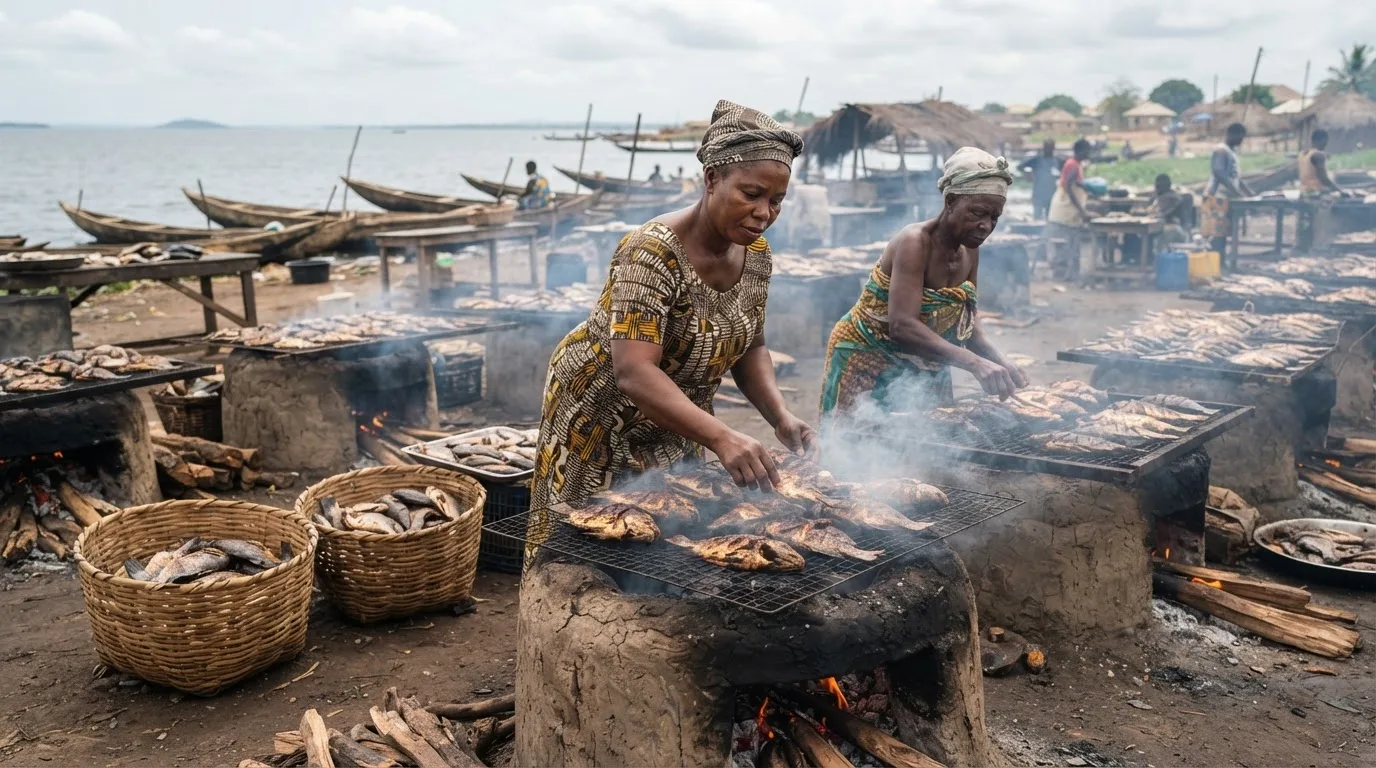
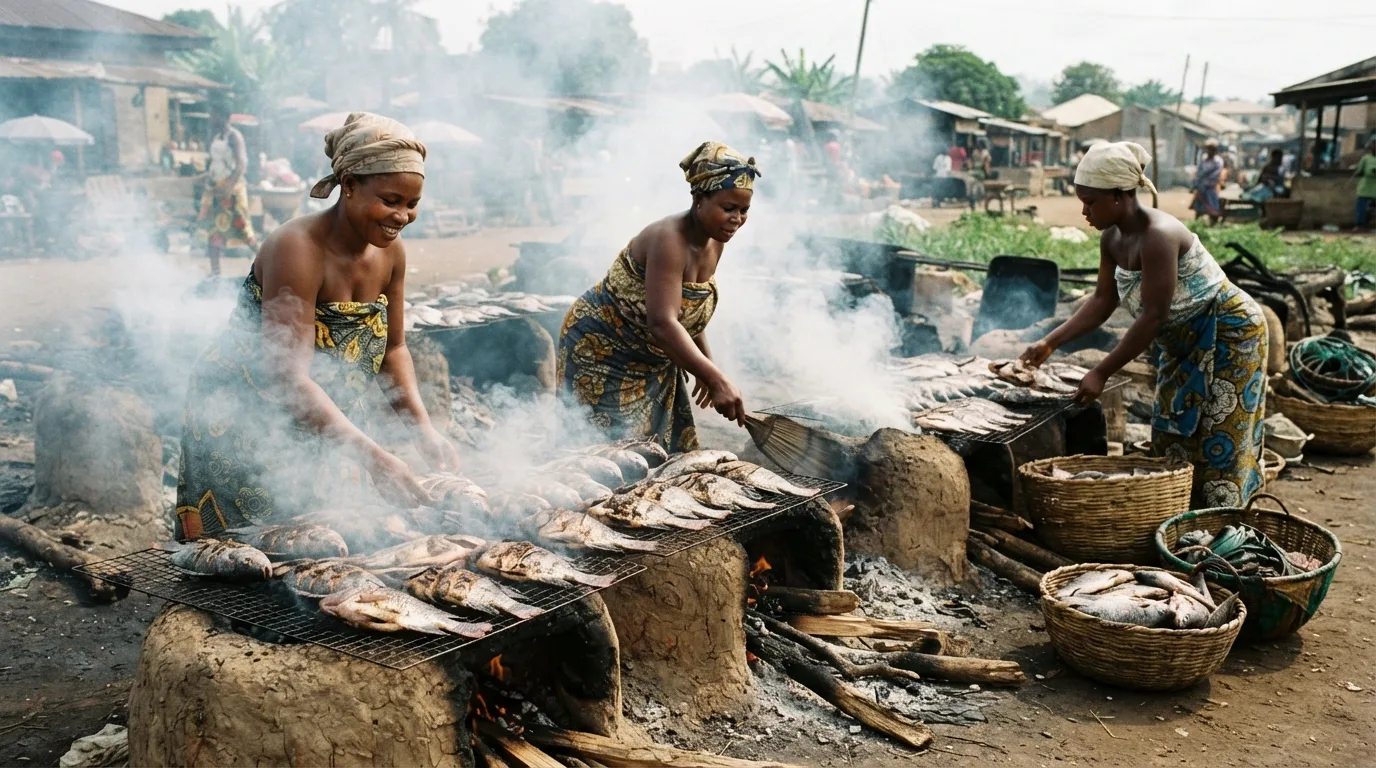
Traditional women-led fish smoking over wood fires, the only value addition most Ghanaian farmed fish gets today
The only value addition
Traditional women-led smoking: the only value addition most fish gets today.
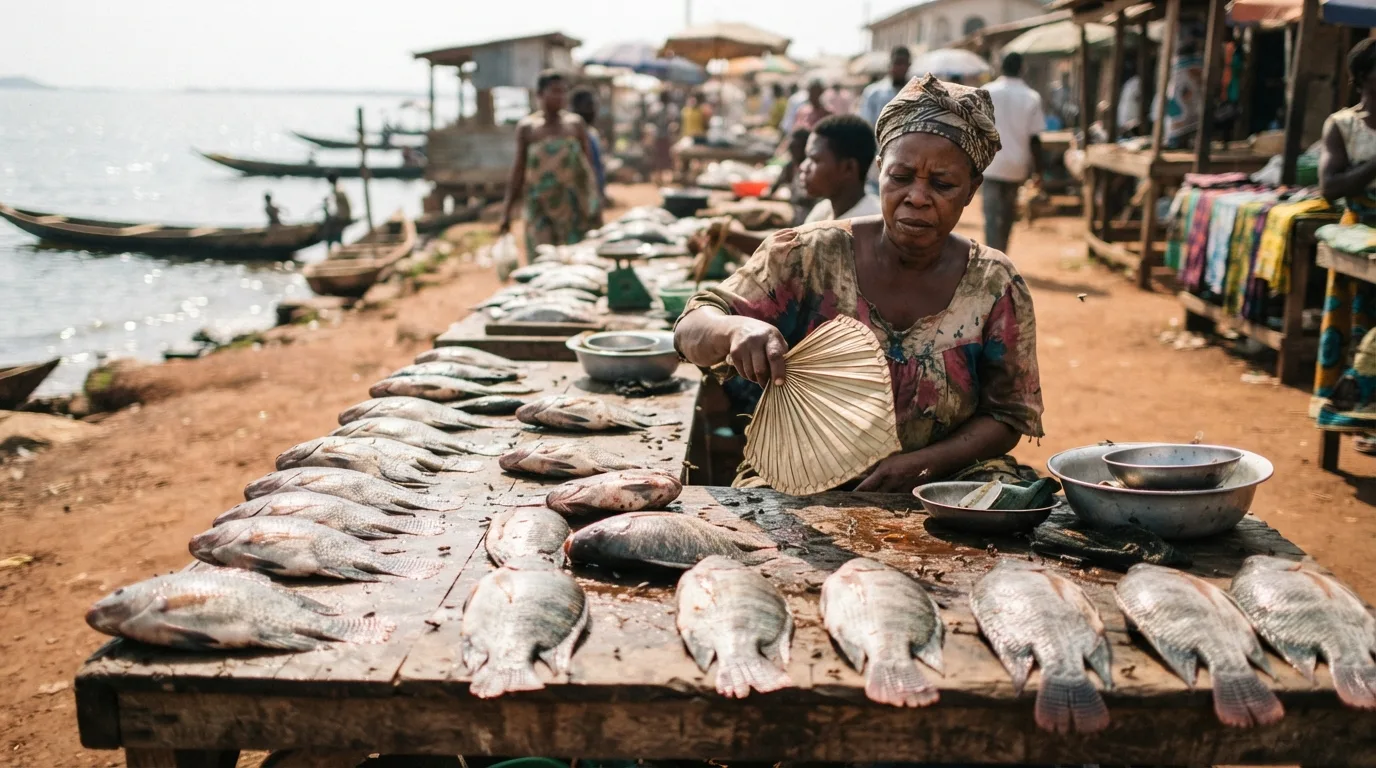
Fresh farmed fish laid out in the open sun with no ice, the cold-chain gap that costs a fifth of the catch
The cold-chain gap
Fresh fish in the open sun with no ice: the cold-chain gap that costs a fifth of the catch.
The three expensive consequences of the empty middle
20 to 40%
of production lost after harvest, a fifth to two-fifths wasted
US$183m
of frozen fish imported in 2023, the largest single import category
up to GH¢100/kg
for export-grade smoked fish, about ten times the fresh farm-gate price
A whole layer of the chain that barely exists

Everything so far points at one hole, and it is the centre of this pillar. Ghana produces about 121,809 tonnes of farmed fish in 2024, up from about 89,400 tonnes in 2022, with tilapia about 80 percent and catfish about 20 percent of the total (Ministry of Fisheries and Aquaculture Development, 2025), yet there is no industrial fish processing, traditional smokers run at half capacity, about 20 to 40 percent of fish is lost after harvest, and no aquaculture site sits among the 60 EU-approved establishments (Asiedu; author synthesis, 2015 to 2024). Sit with each half of that sentence. There is no industrial plant filleting, freezing, portioning or export-smoking farmed fish. The processing that does happen is traditional smoking, women-led, done at subsistence scale, and even the industrial smokers that exist run at half capacity. And no aquaculture site sits among the country's 60 EU-approved establishments, so the export door is effectively shut to farmed fish. This is the missing middle: a whole layer of the chain that, almost everywhere else in the world, captures the most value, and here barely exists.

The missing middle has three expensive consequences. First, loss: with no cold chain to hold a glut, about 20 to 40 percent of production is lost after harvest, a fifth to two-fifths of the fish simply wasted (Magna et al., 2023). Second, import vulnerability: because there is no shelf-stable, portioned local product, cheap frozen imports hold the low-income, no-fridge market that fresh local fish cannot reach, with about 222,153 tonnes of frozen fish worth about US$183 million in 2023, the largest single import category, none of it tilapia (UN COMTRADE, 2023). Third, leakage: the high-value prize is left unclaimed. Export-grade smoked fish can earn up to about GH¢100 a kilogram, close to ten times the fresh farm-gate price (live market search, 2026). A farmer stuck selling fresh whole fish at GH¢9 to 11 is standing next to a product worth up to ten times as much and cannot reach it.

🎯 OPPORTUNITY

The missing middle is the sector's open frontier, and it is now being validated. Tropo's 2024 loan is financing the first modern aquaculture processing plant in the country (AgDevCo, 2024), which is the clearest possible signal that processing and cold chain, not another grow-out cage, is where the smart money is going.

A processing and cold-chain business turns a GH¢40 to 60 a kilogram fresh commodity into shelf-stable, portioned, branded product: fillets, vacuum packs, export-grade smoked fish worth up to GH¢100 a kilogram. It cuts the 20 to 40 percent loss rate and lets a local brand hold the shelf-stable market that frozen imports own today.

Cold-chain aggregation is the lighter-capital cousin: branded refrigerated vans and cold stores that capture the two-times farm-gate-to-retail spread while cutting loss, exactly the model Tropo already runs.

🎯 OPPORTUNITY: THE DIGITAL MISSING MIDDLE

The missing middle is a digital opening, not only a bricks-and-cold-store one. A cold-chain aggregation platform that matches farmers to buyers, schedules refrigerated pick-up and tracks the fish from cage to shelf can capture the two-times spread and cut loss with software as much as with steel.

Traceability is the key that opens the export door. Because no farmed site sits among the 60 EU-approved establishments, digital batch traceability and cold-chain records are the low-capital groundwork a processor needs to reach the export-grade smoked and fillet markets. The feasible-now tools are set out in Pillar 8.

🐟 The chain priced, link by link 🐟

The whole analysis fits in one table. Each link, who operates it, the margin or price it carries, where it breaks, and the opening hiding inside the break. Read down the last column: every break-point in this chain is somebody's business.

Table 9: The tilapia and catfish value chain priced link by link, with the opening inside each break-point
LinkWho operates itMargin or priceWhere it breaksThe opening
Input, feedRaanan (about 70%) plus importers and small mills60 to 80% of farm cost; imports about 30% dearerNear-monopoly, high price, FX and tariff exposureA 20 to 30k-tonne mill: about US$4.2m, roughly 60% margin
Input, seedAbout 19-plus hatcheries; large farms self-supplyGH¢0.40 to 0.70 a fish; about 6 to 7% of costShortage of roughly 50m a year; much seed carries diseaseA certified hatchery selling into the gap
Production, cage2 large integrated, 8 to 15 medium, 100 to 300 smallCost about GH¢5.6 to 9.4 a kg; ROI about 47%Feed cost, disease, mortality, theft, thin creditOut-grower supply to an anchor; efficiency edge
Production, live catfishSeparate grow-out feeding urban barsAbout GH¢30 to 40 a kg liveFragmented supply into hospitality demandDedicated live-catfish grow-out and urban delivery
AggregationWholesalers, aggregators, about 3,000 mostly women tradersFarm gate 9 to 11 to wholesale 11 to 13High middlemen cost; distance; informal, on iceOrganised, branded cold-chain aggregation
ProcessingSubsistence women smokers; no industrial plantTraditional smoked low; export smoked up to GH¢100 a kgThe missing middle; smokers at 50% capacityFilleting, freezing, branded export-grade smoking
Cold chain and retailCold stores, roadside, wet markets, supermarketsRetail 18 to 25, up to about 40 in a supermarketThin cold chain; 20 to 40% post-harvest lossFrozen import-substitution; branded retail

Sources: Asiedu et al. (2016); Rurangwa et al. (2015); Ragasa et al. (2018); Magna et al. (2023); AgDevCo (2024); live market search (2026).

🐟 The value-capture openings, ranked 🐟

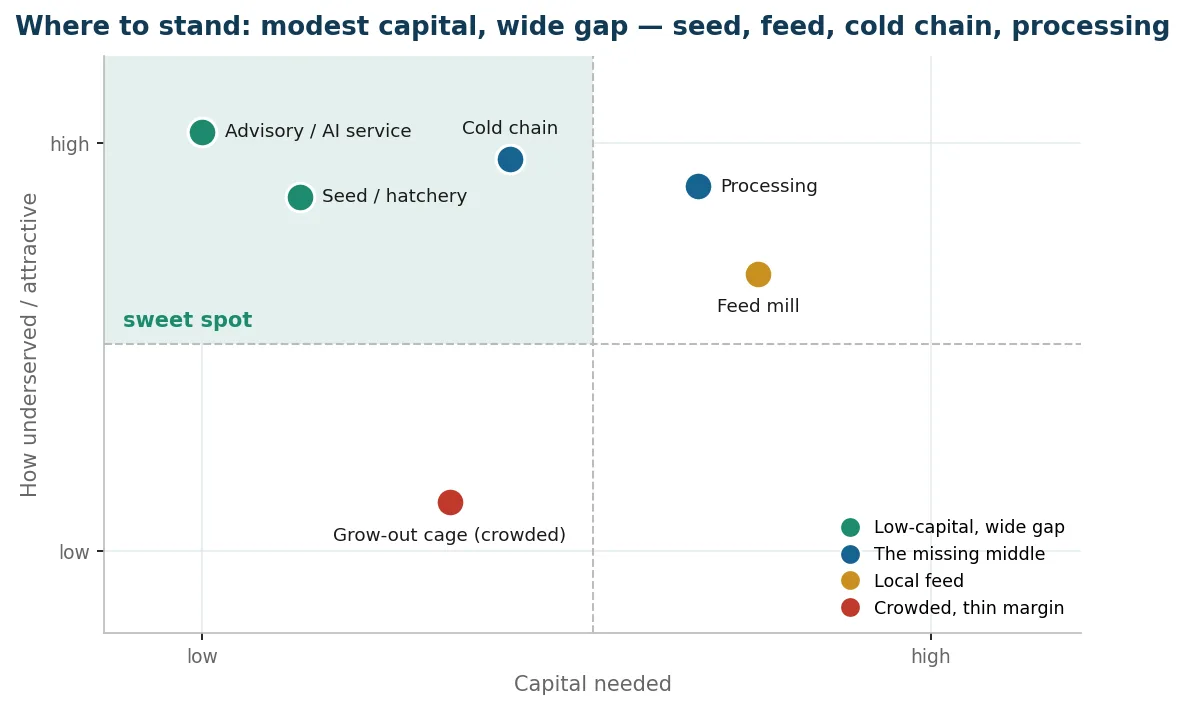
The value-capture openings mapped by capital needed against the size of the gap they fill
Figure 20 The value-capture openings mapped by capital needed against the size of the gap they fill. Sources: Author synthesis of Rurangwa et al. (2015); Ragasa et al. (2018); AgDevCo (2024).
What this shows

The best openings sit where capital needed is modest and the gap is wide: seed, feed, cold chain and processing. The crowded, thin-margin spot is another undercapitalised grow-out cage.

The best positions sit at the two fat ends

Pull the openings together and rank them by leverage and by how much capital they demand. The pattern is consistent: the best positions sit at the two fat ends of the chain, feed and seed upstream, processing and cold chain downstream, and the crowded, thin-margin spot is another undercapitalised grow-out cage in the middle.

🐟 The Opening: where to stand in the chain 🐟
01

An independent or premium feed mill. Highest leverage of all, because it improves every farm's economics at once: about US$4.2m for a 20 to 30k-tonne mill at roughly 60% gross margin.

02

A processing and cold-chain plant. The missing middle itself: fillets, vacuum packs and export-grade smoked fish worth up to GH¢100 a kilogram, cutting the 20 to 40% loss and holding the shelf-stable market from imports.

03

A certified improved-strain hatchery, selling into a tens-of-millions fingerling shortage while cutting the disease that unscreened seed spreads.

04

Cold-chain aggregation. Branded refrigerated distribution that captures the two-times farm-to-retail spread and cuts loss, at lighter capital than a full plant.

05

A dedicated live-catfish supply chain into point-and-kill bars, avoiding frozen-import competition entirely.

06

Import-substitution frozen or portioned tilapia, taking the shelf-stable segment that informal frozen imports hold today.

07

A contract-farming or out-grower model around a feed-and-processing anchor, locking in supply and stabilising smallholder margins, the Tropo network at smaller scale.

🐟 The risks that sit inside the value chain 🐟

No cold chain, heavy post-harvest loss

VERY HIGH
What it is

There is almost no organised cold chain for farmed fish, so a glut cannot be held and moved. Fish is iced and rushed to market or it is lost, which forces farmers to dump at low prices and wastes a large share of what they raise.

Evidence

About 20 to 40 percent of production is lost after harvest, and no shelf-stable local product exists to smooth supply (Magna et al., 2023; Asiedu et al., 2016).

Who it hits

Smallholders hardest, who have no storage of their own and must sell fresh whatever the day's price; also the wider sector, which loses a fifth to two-fifths of its output.

How to manage it, and the opening

Build or buy into cold storage and refrigerated distribution. The mirror-image opening is a cold-chain aggregation business: capture the farm-to-retail spread while cutting the loss that creates it.

No industrial processing outlet

HIGH
What it is

Because there is no industrial plant filleting, freezing or export-smoking farmed fish, the farmer is stuck selling fresh whole fish at the bottom of the price ladder and cannot reach the high-value forms that earn many times more.

Evidence

Aquaculture is excluded from all 60 EU-approved establishments, industrial smokers run at about 50 percent capacity, and export-grade smoked fish earns up to about GH¢100 a kilogram, close to ten times the fresh farm-gate price (Asiedu et al., 2016; live market search, 2026).

Who it hits

Every producer who wants durable margin rather than a fresh-commodity price; and the whole sector's export ambition.

How to manage it, and the opening

Do not add another grow-out cage; add the processing the chain lacks. Tropo's 2024 modern-processing investment shows the model is now bankable, and the first movers will define the category.

The single-feed-supplier squeeze

HIGH
What it is

Feed is the largest cost in the chain and one producer holds most of the market, so feed price and availability, not farming skill, often decide whether a farm survives. A price rise or supply gap upstream hits every farmer at once.

Evidence

Feed is about 60 to 80 percent of production cost, one supplier holds roughly 70 percent of output, imported feed is about 30 percent dearer, and ingredient tariffs add 20 to 30 percent (Rurangwa et al., 2015; Ragasa et al., 2018).

Who it hits

Every farmer, but hardest on smallholders with no buying power and no ability to hedge feed price.

How to manage it, and the opening

Lock feed supply and price where possible, buy through groups, and treat any move toward local feed as strategic. The opening is the feed mill itself: the squeeze on farmers is the business case for the entrant.

Undercapitalised entry at the wrong node

MEDIUM
What it is

The instinctive entry, a few grow-out cages, is the crowded, thin-margin, highest-risk node in the chain, and it is where undercapitalised newcomers cluster and fail. Value concentrates at feed, seed, cold chain and processing, not in one more small cage.

Evidence

The farmer captures the least of the roughly two-times farm-to-retail markup, carries the feed and disease risk, and past leveraged grow-out schemes promising 48 to 80 percent a year went insolvent (Adanu and Adanu, 2017; Ragasa et al., 2018).

Who it hits

First-time entrants and small investors who back a cage because it is the visible part of the business.

How to manage it, and the opening

Enter at a resilient node, or enter grow-out only with a real edge (secured feed, guaranteed offtake, a cost advantage). Underwrite the position, not the enthusiasm.

Fresh Ghanaian tilapia laid out in the open sun with no ice, the cold-chain gap that costs a fifth of the catch
The cold-chain gap
Fresh fish in the open sun with no ice: the cold-chain gap that costs a fifth of the catch.
A Ghanaian fish farmer with fresh whole tilapia and no industrial plant to fillet, freeze or export-smoke it
No processing outlet
With no industrial plant filleting, freezing or export-smoking, the farmer is stuck at the bottom of the price ladder.
Stacked sacks of aquafeed from a dominant supplier, the single-feed-supplier squeeze on Ghanaian fish farmers
The feed-supplier squeeze
Feed is the biggest cost and one supplier holds most of the market, so feed price often decides who survives.
An undercapitalised newcomer adding another crowded grow-out cage instead of a resilient node in the chain
Entry at the wrong node
Another grow-out cage joins the crowded, thin-margin node while feed, seed, cold chain and processing go unbuilt.
🐟 Key takeaways 🐟
01

The value is in the chain, not the fish. A kilogram roughly doubles from farm gate to retail and quadruples to the supermarket, and the farmer captures the least of it.

02

Value leaks two ways: upstream to feed, which is 60 to 80 percent of farm cost and largely imported, and downstream to traders who add only ice and transport for the two-times markup.

03

The missing middle, no industrial processing, no cold chain, 20 to 40 percent post-harvest loss, and aquaculture shut out of every EU-approved establishment, is the single biggest opening in the sector.

04

The high-value prize is real and unclaimed: export-grade smoked fish earns up to about GH¢100 a kilogram, close to ten times the fresh farm-gate price.

05

Enter at a fat node, feed, seed, cold chain or processing, not at the thin, crowded middle of another grow-out cage. Tropo's move into processing shows where the smart money is going.

Written for each reader

🐟 Practitioner intelligence 🐟

Hover any card to pause and lift it.

For students

Do not picture fish farming as owning cages. Picture the chain, and ask where the margin actually sits. Trace one kilogram of tilapia from a Volta cage to a supermarket shelf and write down who earns what at each rung; you will see the farmer earns least and takes the most risk. Then look at the two fat ends, feed upstream and processing downstream, and build your skills toward one of them. An internship or small job with an aggregator, a cold store, a smoker or a feed producer teaches you more about where money is made than a grow-out cage ever will.

For entrepreneurs

Resist the instinct to start with grow-out cages, which is the crowded, thin-margin, highest-risk node. Look instead at the openings this pillar prices: a feed mill, a hatchery, cold-chain aggregation, live-catfish supply, or a small processing and smoking operation. The trap that sinks newcomers is entering the visible part of the business, the cage, while the durable margin sits at feed, seed, cold chain and processing. If you do enter grow-out, do it only with a real edge, secured feed, guaranteed offtake, or a genuine cost advantage, and aim to integrate toward a fat node as you grow.

For investors

Underwrite the node, not the hype. The value distribution here is unforgiving: the farmer carries the risk and captures the least of the roughly two-times farm-to-retail markup, and leveraged grow-out schemes have already gone insolvent chasing returns the biology cannot deliver. Back the resilient links, feed, seed, cold chain and processing, where margin concentrates and where the missing middle is now being validated by Tropo's modern-processing investment. Diligence should ask where feed comes from, whether cold chain exists, and whether the venture owns a fat node or is just another cage exposed to feed and disease.

For ecosystem actors

The highest-leverage public move is to help build the missing middle: processing, cold chain and competitive feed. Every tonne of local processing captures value that leaks abroad today, and every cold store cuts the 20 to 40 percent post-harvest loss. Tie public support and the new Aquaculture Development Fund to processing, cold-chain and feed capacity rather than to yet more grow-out cages, and measure success as the share of farmed fish that is processed, cold-stored and sold as a durable local product. The failure to avoid is subsidising more production into a chain that cannot store, process or move it.
Where this connects. The feed and seed openings priced here are the input link whose biology Pillar 1 sets out, so read the two together. The thin farm margin that leaks up to feed and down to traders is the same margin Pillar 5 dissects in the cost-and-returns model, feed at three-quarters of cost is the value leak seen from the farm's side. And the missing-middle prize, processing, cold chain and the anchor investments that are starting to build it, is exactly what the financing, policy and investment wave in Pillar 7 is trying to crowd in.

Download full PDF
UpcomingThis document isn't available yet.